
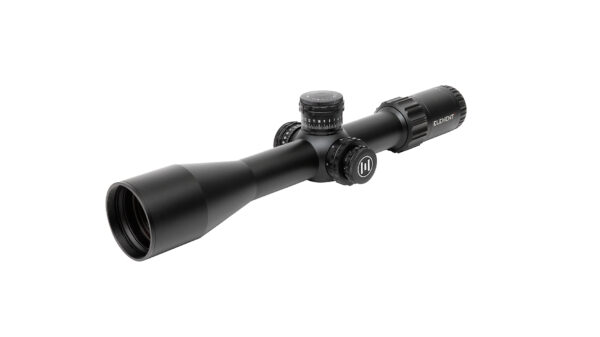
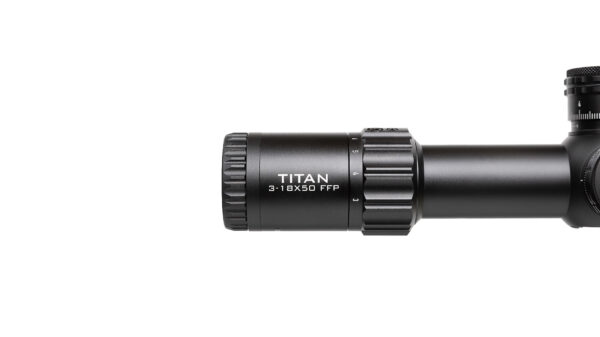
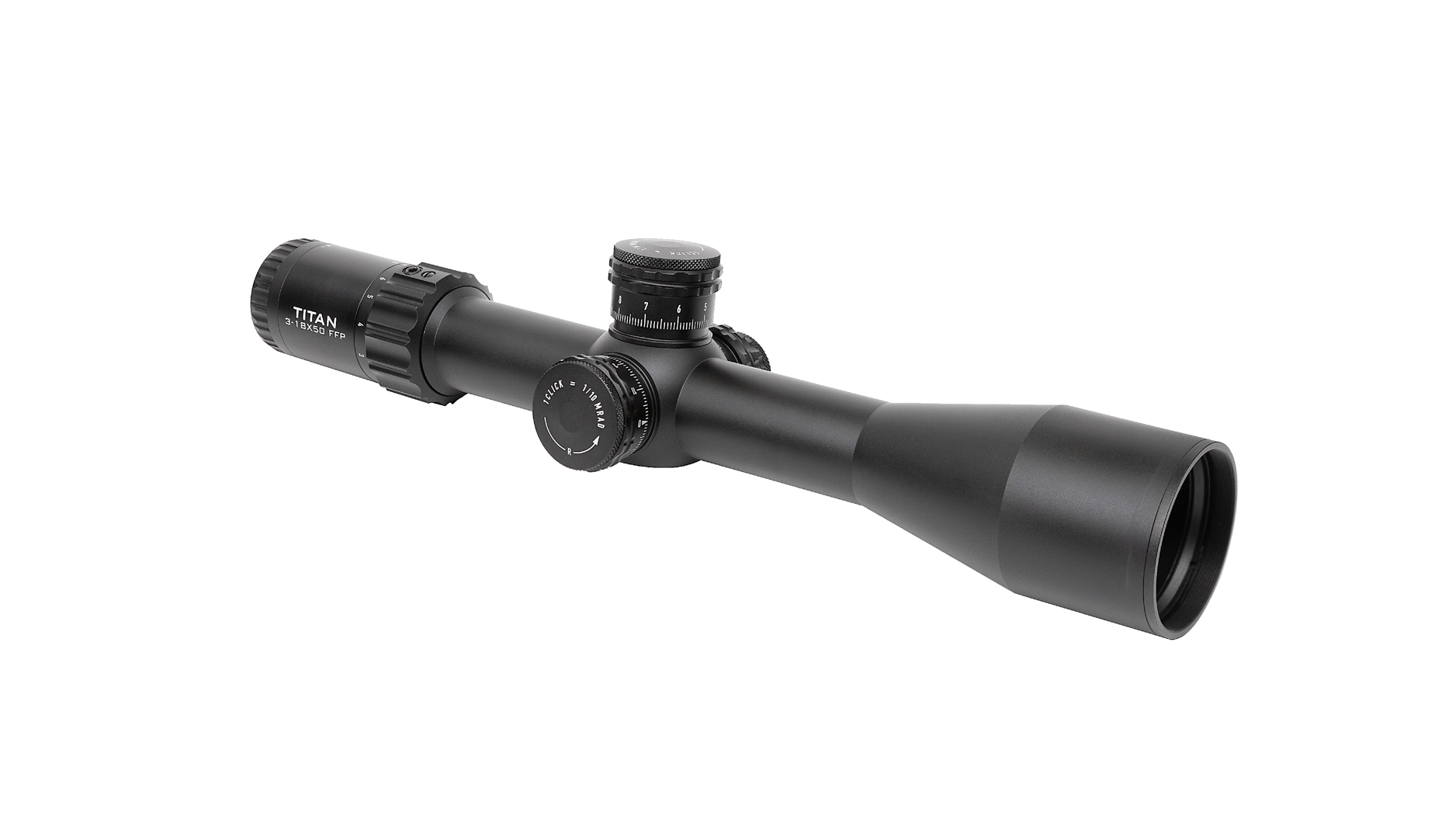
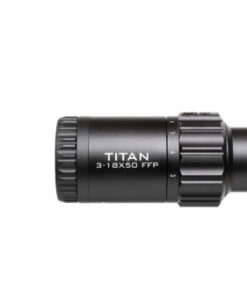
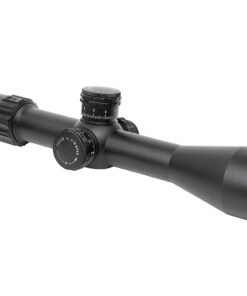
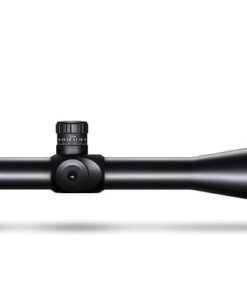
Element Optics Titan 3-18×50 FFP
$500.00
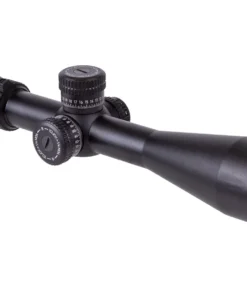
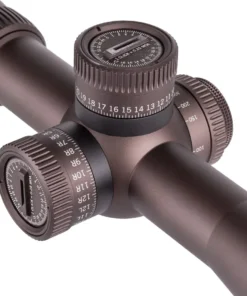
The TITAN puts your money where it matters, with precision-engineered internals and a turret system superior to other products in the same price class. To make things even better, we’ve gone one step ahead and given the Titan a 34mm tube and ED glass. The 3-18 Model features an impressive 150 MOA (43.6 MRAD) of internal Elevation Travel, making this a viable option for Extreme Long Range shooting, while the relatively compact form and broad magnification range makes it suitable for hunters and PRS shooters – a true multi-purpose riflescope.
As always, we’ve worked hard to introduce stringent quality control checks to give you peace of mind when taking that once-in-a-lifetime shot, and if something goes wrong, our Platinum Lifetime Warranty has you covered!
Features
-
- 34mm Main Body Tube
-
- Illuminated, First Focal Plane Reticle
-
- Aircraft Grade Aluminium
-
- Side Parallax: 10yds-Infinity
-
- HD Glass for reduced chromatic aberration and improved sharpness
-
- Tool-Free Resettable Turrets with 10 MRAD / 25 MOA per Revolution
-
- Upgraded Stainless Steel Turret Mechanism.
-
- Hard Mechanical Zero-Stop
-
- Removable Magnification Throw Lever
-
- Waterproof, Fogproof, Shockproof & Nitrogen Purged
-
- Sunshade, Lens Cloth & Rubber Lens Covers included
-
- 150 MOA (43.6 MRAD) Elevation Travel
- 34mm Main Body Tube
- Illuminated, First Focal Plane Reticle
- Aircraft Grade Aluminium
- Side Parallax: 10yds-Infinity
- ED Glass for reduced chromatic aberration and improved sharpness
- Tool-Free Resettable Turrets with 10 MRAD / 25 MOA per Revolution
- Upgraded Stainless Steel Turret Mechanism
- Hard Mechanical Zero-Stop
- Removable Magnification Throw Lever
- Waterproof, Fogproof, Shockproof & Nitrogen Purged
- Sunshade, Lens Cloth & Rubber Lens Covers included
- 150 MOA (43.6 MRAD) Elevation Travel
Element Optics Titan 3-18×50 FFP — 34mm Precision Riflescope with HD Glass, First Focal Plane Reticle, Zero Stop, and 150 MOA Elevation Travel
Element Optics Titan 3-18×50 FFP Optical Performance, FFP Reticle, HD Glass, Turret Precision, Parallax, and Zero Stop
The Element Optics Titan 3-18×50 FFP is a versatile precision riflescope built around a broad 3-18× magnification range, 50mm objective lens, 34mm main tube, illuminated first-focal-plane reticle, HD optical system, and unusually generous internal elevation adjustment. Element specifies 150 MOA / 43.6 MRAD of elevation travel, making this version notably different from the larger Titan 5-25×56.
The optic measures approximately 370mm / 14.57 inches, weighs about 976g / 34.4oz, and provides a constant 102mm / 4-inch eye relief. Field of view ranges from approximately 41 feet at 100 yards on 3× to 6.8 feet at 18×. Furthermore, its side parallax adjustment begins at approximately 10 yards / 10 metres and extends to infinity, making the scope suitable for controlled target shooting at both relatively close and longer distances.
The Titan can be configured with either 1/4 MOA clicks with 25 MOA per revolution or 0.1 MRAD clicks with 10 MRAD per revolution. Element also equips it with tool-free resettable turrets, an upgraded stainless-steel turret mechanism, a hard mechanical zero stop, and a removable magnification throw lever.
Sniper Hider
The term sniper hider does not describe any component or capability of the Titan. This model is an optical sighting system rather than a concealment device.
Optics Warehouse
Optics Warehouse is associated with the retail and comparison side of the optics market. When evaluating any scope, manufacturer specifications remain useful for confirming details such as tube diameter, click values, parallax, and focal-plane configuration.
Red Dot UK
A red dot UK search usually concerns reflex sights designed around minimal or no magnification. The Titan follows a very different design philosophy with variable 3-18× magnification and a detailed FFP reticle.
Picatinny
A Picatinny rail can provide a standardized mounting interface for compatible rings. Because the Titan uses a 34mm main tube, the rings must match that diameter.
Bipod for Rifle
A bipod for rifle can improve platform stability during lawful range shooting, although it does not change the optical performance of the scope.
IR Illuminator
An IR illuminator normally supports digital or image-intensified night-vision equipment. The Titan is a conventional optical riflescope and does not require infrared illumination for normal daylight operation.
Minotaur 10-50×60
The Minotaur 10-50×60 belongs to a different high-magnification optics platform. Its magnification range should not be confused with the Titan’s more versatile 3-18× configuration.
Picatinny Dimensions
Picatinny dimensions are defined by the MIL-STD-1913 specification. Correct rail and ring compatibility is important because poor alignment can place unnecessary stress on the scope tube.
Scope Mount
A scope mount connects the optic to the host platform. With the Titan’s relatively large 34mm body, suitable 34mm rings with sufficient objective clearance are required.
Zero Stop Scope
A zero stop scope provides a mechanical reference for the elevation turret. The Titan incorporates a hard mechanical zero-stop, allowing the turret to return to its configured reference without relying solely on visual turret markings.
Sniper Hider
The repeated sniper hider phrase remains unrelated to the Titan’s optical or mechanical system.
Optic Warehouse
An optic warehouse search typically concerns retailers and comparison sources rather than a scope feature.
What Is a Picatinny Rail
For what is a Picatinny rail, it is a standardized mounting rail containing regularly spaced transverse slots that accept compatible rings and accessories.
Parker Hale Scope Rings for Sale
Parker Hale scope rings for sale concerns separate mounting hardware. Any ring selected for this optic must correctly accommodate the Titan’s 34mm tube and the chosen mounting rail.
SWFA SS 10×42
The SWFA SS 10×42 is associated with a fixed-magnification optical platform, whereas the Titan provides variable power from 3× through 18×.
Delta Stryker
Delta Stryker scopes belong to another precision-optics family. Relevant comparison factors include glass quality, focal-plane design, turret feel, internal travel, weight, and close-focus capability.
PRS Spotting Scope Setups
PRS spotting scope setups are primarily observation systems used alongside a shooting platform. The Titan itself is a mounted optical sight rather than a dedicated spotting scope.
1913 Rail
A 1913 rail generally refers to the MIL-STD-1913 Picatinny mounting standard.
What Is Zero Stop on a Scope
For what is zero stop on a scope, the feature provides a defined mechanical stopping point for the elevation turret after zero has been established.
Element lists a hard mechanical zero stop as standard equipment on the Titan.
Difference Between Weaver and Picatinny Rail
The difference between Weaver and Picatinny rail mainly concerns standardized slot width and spacing.
Some mounting accessories can work with both, but compatibility should always be confirmed before installation.
Scope Illumination
Scope illumination makes selected portions of the reticle easier to see against darker backgrounds.
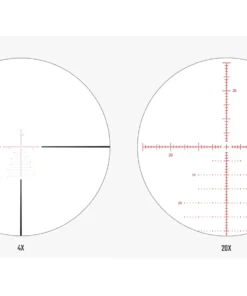
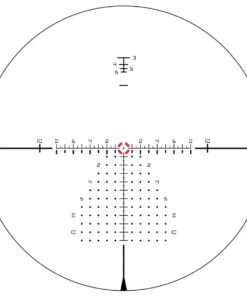
The Titan uses an illuminated first-focal-plane reticle, with APR-2D options available in both MOA and MRAD.
What Is Parallax in Optics
For what is parallax in optics, parallax is the apparent movement of the reticle relative to the target when the viewer’s eye changes position.
The Titan’s side-focus system can reduce this effect from approximately 10 yards to infinity.
Ballistic Solver
A ballistic solver uses projectile and environmental information to estimate trajectory. It is separate from the scope itself and should only be used within lawful, controlled sporting applications.
What Is Parallax in Optics
The repeated what is parallax in optics query becomes especially relevant as magnification increases because even small parallax errors become easier to observe.
Delta Optics
Delta Optics belongs to another optics manufacturer and is not part of the Titan system.
Element Optics
Element Optics manufactures the Titan and currently lists the 3-18×50 FFP with HD glass, a 34mm body, first-focal-plane illumination, 10-yard parallax, stainless-steel turret internals, tool-free turret reset, and 150 MOA of elevation travel.
Schmidt and Bender Scopes
Schmidt and Bender scopes belong to another premium optics category. Their specifications should be evaluated independently rather than assumed to match the Titan.
Best Rifle Bipod for Long Range Shooting
The best rifle bipod for long range shooting depends on the platform, surface, required adjustment range, stability, and intended lawful sporting activity.
Chrony Chronograph
A Chrony chronograph measures projectile velocity. Velocity data may be used for external ballistic calculations, but the chronograph is independent of the optical system.
Hikmicro Stellar SX60L Thermal Scope
The Hikmicro Stellar SX60L thermal scope uses electronic thermal imaging. By comparison, the Titan relies on conventional optical glass and visible ambient light.
Best Digital Night Vision Scope
The best digital night vision scope belongs to a separate technological category involving image sensors, electronic displays, and frequently infrared illumination.
March Riflescope Adjustments Argon Filled D42HV56WFML G2
The phrase march riflescope adjustments argon filled d42hv56wfml g2 relates to a different precision optic. Those specifications should not be applied to the Titan.
DNT Optics Review
A DNT optics review often concerns digital, thermal, or multispectral equipment, whereas the Titan is a conventional variable-power optic.
Falcon Optics
Falcon Optics is another optics manufacturer and should be compared according to the specifications of the individual model.
Best Night Vision Scope
The best night vision scope is generally evaluated by sensor resolution, infrared performance, display resolution, recording functions, and nighttime detection rather than conventional glass quality.
What Is Parallax in a Scope
For what is parallax in a scope, it occurs when the target image and reticle are not effectively aligned within the same apparent optical plane.
The Titan’s 10-yard-to-infinity side adjustment provides considerable flexibility for correcting it.
ZCO Optics
ZCO Optics refers to Zero Compromise Optic, another premium precision-scope manufacturer.
What Is Parallax in a Rifle Scope
For what is parallax in a rifle scope, reducing the apparent reticle shift can improve repeatability, particularly at higher magnification where alignment errors are more visible.
TNC225R Review
A TNC225R review concerns a separate digital imaging product rather than a conventional precision riflescope.
Tactical Rail
A tactical rail commonly refers to a standardized accessory or mounting interface such as Picatinny.
SWFA Scope Review
An SWFA scope review concerns competing optics and does not describe Titan specifications.
Scope Torque Wrench
A scope torque wrench can help keep ring and base fasteners within manufacturer-recommended limits.
Excessive ring pressure may damage a tube, while insufficient tightening can permit unwanted movement.
TPO Scopes
TPO scopes belong to another optics category or manufacturer depending on market context and should be researched independently.
Best Scope for Air Rifle
The best scope for air rifle depends on recoil characteristics, intended distance, magnification needs, total weight, and minimum parallax distance.
The Titan’s ability to focus from approximately 10 yards can be useful for precision air-rifle target setups where relatively close parallax adjustment is important.
What Is the MOA of a Scope
For what is the MOA of a scope, MOA means minute of angle and represents an angular unit used for reticle markings and turret corrections.
The MOA version of the Titan uses 1/4 MOA clicks and 25 MOA per turret revolution. The alternative MRAD version uses 0.1 MRAD clicks and 10 MRAD per revolution.
Optics Planet
Optics Planet is an optics retailer and information source rather than a feature of the Titan.
DNT Thermal Scope Review
A DNT thermal scope review concerns an electronic thermal imaging system and therefore evaluates a different set of performance characteristics.
Picatinny Dimensions
The repeated picatinny dimensions phrase remains relevant primarily when selecting compatible mounting hardware.
Vector Minotaur 10 50×60
The Vector Minotaur 10 50×60 provides a substantially higher magnification range and belongs to another optical platform.
Picatinny Scope Base
A Picatinny scope base can provide a standardized foundation for compatible 34mm rings.
Why the 3-18× Magnification Range Matters
The 3-18× zoom range gives the Titan an unusually broad operating envelope.
At 3×, the field of view is approximately 41 feet at 100 yards, providing substantially more surrounding visual information than many scopes that start at 5×.
At 18×, the field narrows to approximately 6.8 feet at 100 yards, allowing considerably finer target inspection.
Therefore, the optic can transition between relatively broad observation and detailed precision viewing without requiring an extremely high upper magnification.
Why the 34mm Main Tube Matters
The Titan uses a 34mm aircraft-grade aluminum body rather than the more common 30mm format.
The larger tube provides physical space for substantial internal adjustment.
That is particularly important here because the 3-18×50 provides an exceptional 150 MOA / 43.6 MRAD elevation range.
However, users must select genuine 34mm mounting rings rather than assuming 30mm hardware will fit.
Why 150 MOA of Elevation Is Significant
Element gives this model far more elevation travel than many conventional scopes.
The stated 150 MOA or 43.6 MRAD internal elevation range is one of the defining engineering characteristics of the 3-18×50 Titan.
The large adjustment envelope gives the internal erector system substantial movement while retaining a comparatively compact 370mm overall length.
How Good Is the HD Glass?
Element specifies HD glass designed to reduce chromatic aberration and improve sharpness.
Chromatic aberration can appear as colored fringing around high-contrast edges, particularly at stronger magnification.
Reducing this effect contributes to a cleaner image and makes fine target features easier to distinguish.
Actual perceived clarity will still vary with atmosphere, lighting, focus, eyesight, and magnification.
Why the 50mm Objective Matters
The 50mm objective represents a balance between light gathering, overall bulk, and mounting requirements.
Element lists an exit pupil of approximately 16.67mm at 3× and 2.78mm at 18×.
Consequently, maximum magnification naturally requires more precise eye positioning and generally benefits from stronger ambient light.
Why First Focal Plane Is Important
The reticle sits in the first focal plane, meaning its apparent size changes together with the magnified image.
As a result, the angular relationship between the reticle markings and the target remains consistent throughout the zoom range.
The 3-18×50 is offered with APR-2D MOA and APR-2D MRAD reticles. Element’s documentation describes these as more detailed designs containing multiple reference markings.
How the Turret System Supports Precision
The Titan incorporates tool-free resettable turrets with an upgraded stainless-steel internal mechanism.
The MOA version delivers 25 MOA per revolution, while the MRAD configuration provides 10 MRAD per revolution.
A mechanical zero stop provides a physical reference after adjustment.
Together, these features are intended to make repeated, controlled adjustment easier to manage.
Why Side Parallax Matters
The side-focus system operates from approximately 10 yards to infinity.
This unusually close minimum distance increases versatility for controlled range and precision air-rifle applications.
At higher magnification, correctly setting parallax becomes particularly important because small alignment differences are more visible.
Where the Titan Works Best
The Titan is well suited to lawful precision target shooting, competition-style range setups, and air-rifle target use where an FFP reticle, substantial elevation adjustment, and close parallax correction are useful.
Its approximately 976g weight makes it comparatively substantial, so it naturally favors platforms where adjustment capability and optical performance take priority over minimum weight.
When Higher Magnification Becomes Useful
The upper end of the magnification range becomes useful when fine target detail needs to be examined.
However, higher magnification narrows field of view and reduces exit pupil.
Therefore, lower or intermediate settings can provide a more comfortable image when broad situational awareness, rapid target location, or limited ambient light matters.
How Precise Is the Titan?
Precision-oriented characteristics include the FFP reticle, HD glass, 34mm tube, 0.1 MRAD or 1/4 MOA adjustment choices, stainless-steel turret mechanism, mechanical zero stop, and adjustable parallax.
Nevertheless, optical precision also depends on correct ring alignment, appropriate mounting torque, stable support, consistent eye position, and accurate parallax adjustment.
Important Information About the Titan
The Titan is nitrogen purged and is described by Element as waterproof, fogproof, and shockproof. A removable magnification throw lever, sunshade, lens cloth, and rubber lens covers are included.
The scope measures approximately 370mm and weighs approximately 976g, while 102mm of eye relief provides generous viewing distance.
For long-term reliability, the optical surfaces should remain protected, the adjustment mechanisms should never be forced beyond their normal range, and the 34mm tube should not be compressed through excessive mounting torque.
Overall, the Element Optics Titan 3-18×50 FFP combines a versatile zoom range, HD optical system, first-focal-plane reticle, substantial 150 MOA elevation capacity, 10-yard parallax adjustment, stainless-steel turret mechanism, mechanical zero stop, robust 34mm construction, and weather-resistant design into a highly capable precision-oriented optical platform.
Optical Clarity, Magnification Balance, Parallax Control, Turret Consistency, and Practical Reliability
Optical Clarity
A precision optic should provide a clear and usable image across its entire magnification range.
At lower power, the field of view is wider and the image generally feels brighter and easier to acquire.
As magnification increases, fine details become more visible, but small focusing errors and platform movement also become easier to notice.
For this reason, optical performance should be judged across several magnification settings rather than only at maximum power.
Why Image Contrast Matters
Good contrast helps separate fine details from the background.
Lens design and coating quality influence how well the optic handles reflections, glare, and changing light.
A high-resolution image is most useful when edges remain well defined and colors do not appear excessively washed out.
Clean optical surfaces also matter because fingerprints, dust, and moisture can reduce perceived contrast even when the internal glass is performing correctly.
Managing Chromatic Aberration
High magnification can make color fringing more noticeable around high-contrast edges.
A well-designed optical system should keep this effect controlled so that fine details remain easier to interpret.
However, chromatic aberration can also appear more obvious under harsh lighting.
The user should therefore evaluate clarity in different conditions rather than assuming one scene represents the optic’s complete performance.
Lower Magnification Use
The lower end of the zoom range provides a broader field of view and more forgiving eye placement.
This can make it easier to locate the target area quickly.
Lower magnification is also useful when lighting is limited because the effective exit pupil is larger.
For this reason, the lowest setting should not be treated merely as a transition point toward higher power.
It has practical value of its own.
Mid-Range Magnification
Intermediate magnification often provides the best balance between detail, field of view, image brightness, and eye-position tolerance.
In many situations, this is where the optic can feel most comfortable.
The user retains useful detail without making small movements appear unnecessarily large.
Mid-range settings are also useful when frequent changes in target distance make constant adjustment inconvenient.
Higher Magnification
The upper part of the magnification range allows finer observation of small details.
However, higher power narrows the field of view and makes eye placement more demanding.
The image may also appear less bright in poor light.
For this reason, maximum magnification should be selected when the extra visual detail is truly beneficial rather than used automatically.
Magnification Ring Feel
The zoom ring should move smoothly through its full range.
It should not feel excessively stiff, loose, or inconsistent.
If an accessory lever is fitted, it should remain secure and should not interfere with other controls.
A smooth magnification ring allows quick transitions between broader viewing and more detailed inspection.
Any sudden change in resistance should be investigated rather than ignored.
Parallax Adjustment
Correct parallax adjustment helps minimize apparent reticle movement when the eye shifts behind the scope.
The side-focus mechanism should be adjusted carefully until the target appears sharp and reticle movement is reduced.
The printed distance markings provide a useful reference, but the final visual result should take priority because eyesight and atmospheric conditions can affect the ideal setting.
Why Close-Focus Capability Matters
A short minimum parallax distance increases versatility.
It allows the optic to remain usable at relatively close target distances without sacrificing the ability to focus much farther away.
This is particularly valuable in controlled target environments where shooting distances may vary considerably.
The adjustment should move smoothly without feeling gritty or excessively loose.
Checking for Residual Parallax
A target can appear sharp even when some parallax error remains.
To check, the platform should remain still while the eye moves slightly behind the eyepiece.
If the reticle appears to shift relative to the target, further adjustment may be useful.
Consistent eye position remains important even after parallax has been minimized.
Reticle Scaling
A first-focal-plane reticle changes apparent size as magnification changes.
At low power, the markings may appear finer.
As magnification increases, the reticle becomes more prominent.
This behavior allows the angular relationship between the reticle and target to remain consistent throughout the zoom range.
The user should become familiar with how readable the reticle feels at several magnification settings.
Reticle Illumination
Illumination can make the reticle easier to see against dark or visually complex backgrounds.
Brightness should remain only as high as necessary.
Excessive illumination may make fine markings appear less precise and can increase eye fatigue.
During bright conditions, illumination may not be required at all.
The control should operate smoothly and the battery compartment should remain dry and clean.
Turret Click Quality
Elevation and windage adjustments should feel distinct and predictable.
Each click should register consistently without excessive play.
If the mechanism suddenly becomes vague or unusually stiff, the turret should not be forced.
Changes in feel can result from impact, contamination, or mechanical wear.
A consistent adjustment system makes long-term performance easier to monitor.
Mechanical Zero Reference
A mechanical stop provides a repeatable reference after elevation changes have been made.
The system should engage cleanly and should not require excessive force.
Users should follow the correct setup procedure before relying on it.
The stop should be treated as a reference mechanism rather than something to be repeatedly driven hard against its limit.
Tracking Consistency
Tracking describes whether internal adjustments respond predictably when the turrets are moved.
If apparent tracking changes occur, external mounting components should be checked before assuming an internal fault.
Loose rings, an unstable rail, or incorrect mounting torque can produce similar symptoms.
The complete optical and mounting system should therefore be evaluated together.
Return-to-Zero Behavior
After adjustments are reversed, the optic should return consistently to its intended reference.
If the point of impact changes unexpectedly, the ring screws, rail, mounting surfaces, turret position, parallax, and support setup should all be inspected.
Troubleshooting one variable at a time makes the cause easier to identify.
Main Tube Alignment
The tube should sit evenly inside the rings.
Misaligned rings can place unnecessary stress on the body and may interfere with internal movement.
The scope should not be twisted or forced into place.
Proper alignment protects both the external tube and internal adjustment system.
Deep compression marks should be treated as a warning that ring pressure may have been excessive.
Mounting Ring Position
The rings should support the tube without contacting the turret housing, objective bell, or magnification assembly.
They should also allow a natural eye position.
Incorrect spacing can place unnecessary pressure on the optic.
A correctly positioned scope should sit comfortably without needing the user to stretch forward or pull the head backward.
Fastener Torque
Mounting screws should be tightened evenly according to the hardware manufacturer’s recommendations.
Too much torque can damage threads or compress the tube.
Too little can allow movement.
A suitable torque tool provides more consistency than tightening by feel alone.
Fasteners should be checked periodically, especially after transport.
Eye Relief
Consistent eye relief improves both comfort and repeatability.
The user should see the complete image while maintaining a natural head position.
If the sight picture disappears easily with small head movements, the mounting position may need adjustment.
Proper eye relief becomes increasingly important at higher magnification.
Diopter Adjustment
The diopter is used to make the reticle appear sharp to the individual user.
It should be adjusted separately from target focus.
Once the reticle appears crisp, the setting usually needs little further change.
If the reticle becomes blurry, the diopter should be checked before altering the side-focus control.
Field of View
Field of view narrows progressively as magnification increases.
A wider view helps locate the target area and maintain more environmental awareness.
Starting at a lower setting and increasing magnification after the target is centered is often more efficient than trying to search at maximum power.
Exit Pupil
The effective exit pupil becomes smaller as magnification rises.
This makes eye position more critical and can reduce apparent brightness in poor light.
This behavior is normal and should not be mistaken for an optical defect.
Reducing magnification can improve comfort when light levels fall.
Glare Management
Bright light entering the objective can reduce perceived contrast.
A sunshade can help control stray light in some conditions.
The objective and eyepiece should remain free from fingerprints because oils can increase glare.
If the sunshade is installed, it should be protected carefully during transport.
Lens Protection
Optical surfaces should remain protected from scratches, dust, grit, and impact.
Loose particles should be removed before wiping.
A suitable lens blower, brush, or optical cloth is preferable to ordinary fabric.
Preventing damage is significantly easier than trying to correct scratched coatings later.
Moisture Protection
The optic should be dried after rain or heavy humidity.
Water should not remain trapped around turret bases, ring interfaces, or moving controls.
The scope should not be sealed inside a case while wet.
Allowing it to dry first helps reduce trapped moisture and possible corrosion around external hardware.
Transport Reliability
A padded case helps protect the optic from vibration, impact, and pressure.
The turrets, objective housing, and adjustment controls should have sufficient clearance inside the case.
After rough transport, mounting screws, turret positions, parallax adjustment, magnification control, and lens condition should be checked.
Long-Term Practical Reliability
Long-term reliability depends on clean lenses, stable mounting, correct torque, smooth controls, predictable turret behavior, consistent parallax adjustment, and sensible environmental protection.
The tube, rings, rail, objective, eyepiece, illumination system, zero mechanism, magnification control, and side focus should all be monitored over time.
Changes in clarity, focus, zero retention, adjustment feel, illumination, or tracking should not be ignored.
When the optic is mounted correctly, kept dry, protected during transport, and maintained carefully, it is more likely to preserve clear imaging, reliable adjustment, consistent reticle interpretation, and dependable precision over extended use.
Focus Precision, Reticle Interpretation, Adjustment Repeatability, Mounting Stability, and Long-Term Optical Care
Focus Precision
Precise focus becomes increasingly important as magnification rises.
At lower power, small focusing errors may be difficult to notice. At higher power, however, even slight softness becomes much more obvious.
The side-focus control should therefore be adjusted carefully until the target image appears sharp and comfortable to view.
The user should avoid rushing this process because a properly focused image reduces eye strain and helps reveal fine visual detail.
Why Magnification Changes the Viewing Experience
Magnification does more than make the target appear larger.
As power increases, field of view becomes narrower, eye position becomes more critical, and small platform movements appear more pronounced.
This means the highest setting is not always the most practical.
Moderate magnification can often provide a better balance between image stability, field of view, brightness, and detail.
Low-Power Practicality
The lower end of the magnification range is useful when a wider field of view is needed.
It also makes the optic easier to use in situations where the target area must be located quickly.
At lower power, the exit pupil is larger, making eye position more forgiving.
This can improve comfort during extended observation.
Mid-Range Balance
Intermediate magnification often provides the best combination of detail and usability.
The image remains sufficiently enlarged for careful inspection while retaining a reasonable field of view.
Movement also appears less exaggerated than it does at maximum power.
For many controlled target applications, this middle range can therefore feel especially natural and efficient.
High-Power Detail
Higher magnification is useful when fine details need to be examined more closely.
However, increased power also demands better support and more precise eye placement.
Lighting conditions become more important as well.
If the image begins to appear dim or unstable, reducing magnification can often improve the viewing experience.
Side-Focus Control
The side-focus mechanism should rotate smoothly through its normal range.
It should not feel gritty, loose, or unusually stiff.
The purpose of this control is not simply to sharpen the image but also to reduce parallax error.
The user should make small adjustments until both image clarity and reticle stability are improved.
Parallax Verification
Parallax should be checked after focusing, especially at higher magnification.
With the platform held still, the eye can be moved slightly behind the eyepiece.
If the reticle appears to move relative to the target, further side-focus adjustment may be necessary.
Consistent eye position remains important even after the system has been properly adjusted.
Reticle Scaling
A first-focal-plane reticle changes apparent size as magnification changes.
This allows its angular markings to maintain the same relationship to the target throughout the zoom range.
At lower power, the reticle may appear relatively fine.
At higher power, the markings become easier to see in greater detail.
The user should become familiar with how the reticle behaves at several magnification settings.
Reticle Visibility
Reticle visibility depends on background contrast, lighting, eyesight, and illumination setting.
The reticle should remain easy to identify without dominating the image.
If illumination is used, brightness should be kept only as high as necessary.
Excessive brightness can make fine markings appear thicker or less precise.
Illumination Management
The illumination system should be checked periodically for consistent operation.
If the reticle flickers, the battery and contacts should be inspected first.
The battery compartment should remain dry and clean.
During long-term storage, battery condition should be monitored so leakage does not damage the contacts.
Turret Adjustment Feel
Elevation and windage controls should provide consistent tactile feedback.
Each click should feel distinct.
If a turret suddenly becomes unusually stiff, loose, or vague, it should not be forced.
Mechanical changes can result from impact, contamination, or internal wear.
Consistent turret feel is one of the easiest ways to monitor mechanical condition over time.
Mechanical Stop Function
The mechanical stop provides a defined return reference.
It should engage cleanly and predictably.
The user should follow the correct setup procedure before relying on it.
The stop should not be repeatedly driven against with unnecessary force.
Treating it as a reference rather than a physical limit helps preserve long-term mechanical reliability.
Adjustment Repeatability
Repeatability describes whether the scope returns consistently after turret changes are reversed.
If performance appears inconsistent, external mounting components should be inspected first.
Loose rings, an unstable rail, improper torque, or platform movement can create symptoms that resemble internal tracking problems.
The complete system should therefore be evaluated methodically.
Mounting Ring Alignment
The rings should support the main tube evenly.
Misalignment can create uneven pressure and may affect the internal adjustment system.
The scope should sit naturally inside the rings without twisting or forcing.
If the upper ring halves do not close evenly, the mounting system should be inspected before tightening.
Ring Position
Ring placement should provide stable support while avoiding contact with the turret housing, objective bell, or magnification controls.
The scope should also remain positioned for comfortable eye relief.
Poor ring spacing can create unnecessary stress on the tube.
Correct positioning contributes to both comfort and long-term durability.
Fastener Consistency
Mounting screws should be tightened gradually and evenly.
One side should not be fully tightened while the opposite side remains loose.
A suitable torque tool can improve consistency.
Excessive force can damage threads or compress the tube, while insufficient tightening can allow movement.
Base and Rail Stability
The mounting base should remain secure and straight.
Loose hardware can cause alignment changes that may be incorrectly blamed on the optic.
The rail should also remain clean.
Dust, grit, or oil trapped between mounting surfaces can reduce stability.
Regular inspection helps maintain a dependable connection.
Eye Relief Consistency
The scope should be positioned so the complete image is visible while the user maintains a natural posture.
The head should not need to stretch forward or backward.
Consistent eye relief improves comfort and supports repeatable alignment.
This becomes especially important at higher magnification, where the viewing position is less forgiving.
Diopter Adjustment
The diopter is responsible for making the reticle appear sharp to the user.
It should be adjusted separately from target focus.
Once set correctly, the diopter generally requires little further change.
If the reticle appears blurred, the diopter should be checked before altering the side-focus control.
Field of View Awareness
Field of view becomes narrower as magnification rises.
A wider field helps the user locate the target area and maintain awareness of the surroundings.
For this reason, beginning at lower magnification and then increasing power can be more efficient than searching at maximum magnification.
Exit Pupil and Brightness
The exit pupil becomes smaller as power increases.
This can make the image appear dimmer and requires more precise eye positioning.
This is normal optical behavior.
Reducing magnification can improve apparent brightness when ambient light is limited.
Glare Control
Bright light entering the objective can reduce contrast.
A sunshade can help in situations where light approaches from the front or side.
The objective and eyepiece should also remain free from fingerprints because oils can increase reflections.
Any fitted sunshade should be protected from impact during transport.
Lens Cleaning
Loose dust should be removed before wiping any optical surface.
A suitable lens blower, brush, or microfiber cloth is preferable to ordinary clothing.
Harsh cleaning chemicals should be avoided.
The coatings are durable, but repeated aggressive cleaning can still cause damage over time.
Objective Protection
The objective housing should be protected from impact.
Its wider profile makes it vulnerable during transport if the scope is poorly packed.
Heavy objects should not rest against the front of the optic.
If the objective receives a significant impact, focus and image clarity should be checked before further use.
Eyepiece Protection
The eyepiece should remain clean and secure.
The scope should not be carried by the rear housing.
A protective case should provide adequate clearance so other equipment cannot strike the eyepiece.
Any looseness should be investigated rather than ignored.
Turret Protection
Exposed adjustment controls can be vulnerable to impact.
Heavy objects should not press directly against them inside a case.
Before use, the turret positions should be checked to confirm that accidental movement has not occurred.
Moisture Management
After rain or heavy humidity, the optic should be dried before storage.
Water should not remain trapped around rings, turret bases, or moving controls.
The scope should not be sealed immediately inside a closed case while wet.
Allowing it to dry first reduces the chance of trapped moisture.
Temperature Changes
Rapid movement between cold and warm environments can create condensation.
The scope should be allowed to acclimate gradually where possible.
Lenses covered with condensation should not be rubbed aggressively, especially if dust or grit is present.
Allowing moisture to evaporate naturally helps protect coatings.
Transport Checks
After rough or extended transport, the optic should be inspected.
Mounting screws, turret positions, side focus, magnification control, and lens condition should all be checked.
Transport vibration can reveal hardware that was beginning to loosen.
Storage Environment
The scope should be stored in a dry location away from excessive heat and direct sunlight.
Lens covers should be fitted when practical.
The case should not place pressure on the turrets, objective, or eyepiece.
Heavy equipment should not be stacked on top of the optic.
Long-Term Optical Reliability
Long-term reliability depends on secure mounting, clean lenses, correct fastener torque, smooth controls, stable parallax adjustment, and careful environmental protection.
The tube, rings, base, objective, eyepiece, turrets, illumination system, and magnification controls should all be monitored over time.
Changes in clarity, focus, adjustment feel, illumination, or zero retention should not be ignored.
When the optic is transported carefully, kept dry, cleaned correctly, mounted securely, and operated without forcing its controls, it is more likely to maintain clear imaging, predictable adjustments, stable reticle performance, and dependable precision over extended use.
Be the first to review “Element Optics Titan 3-18×50 FFP”
Related products
Reviews
There are no reviews yet.