
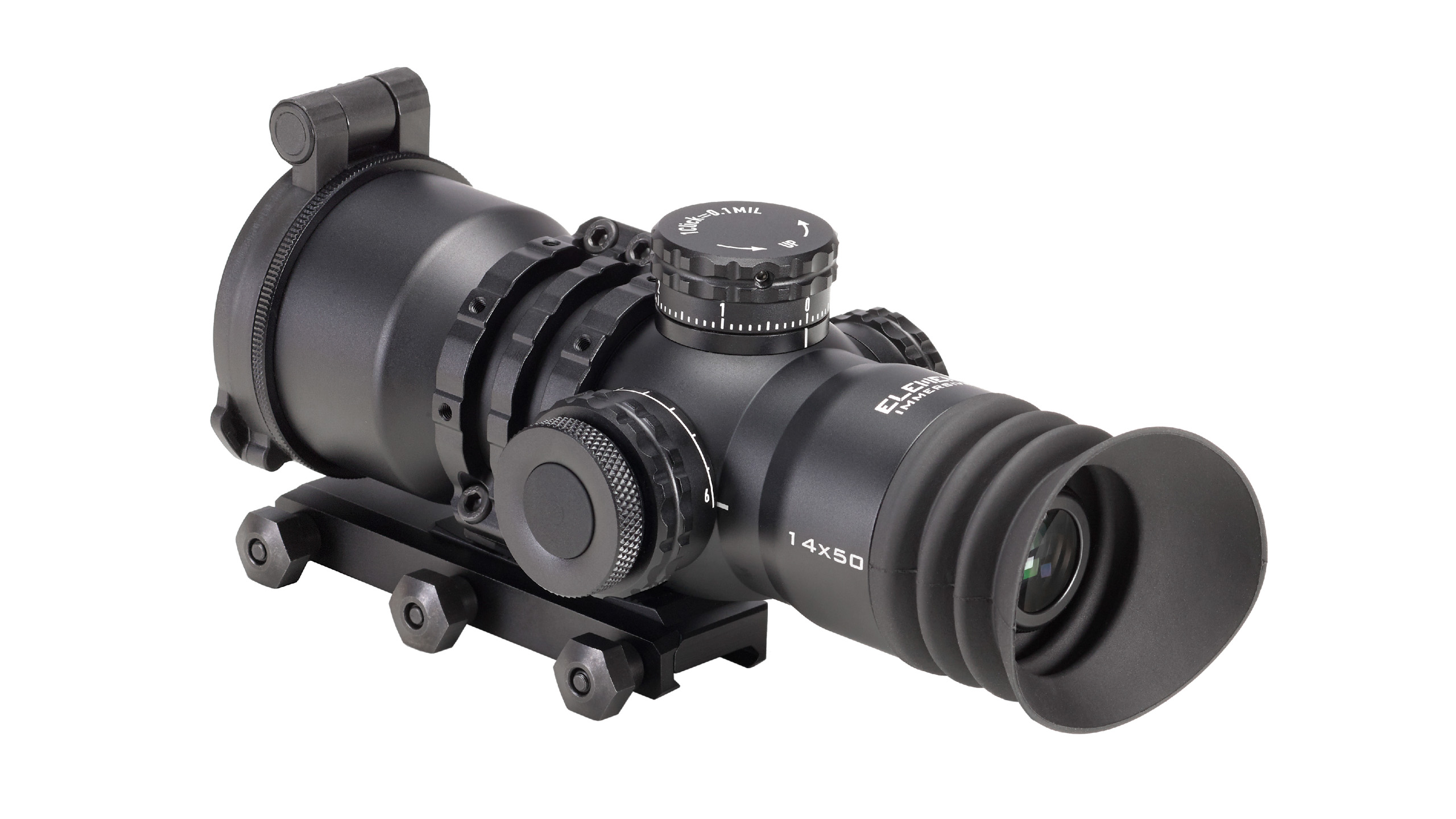
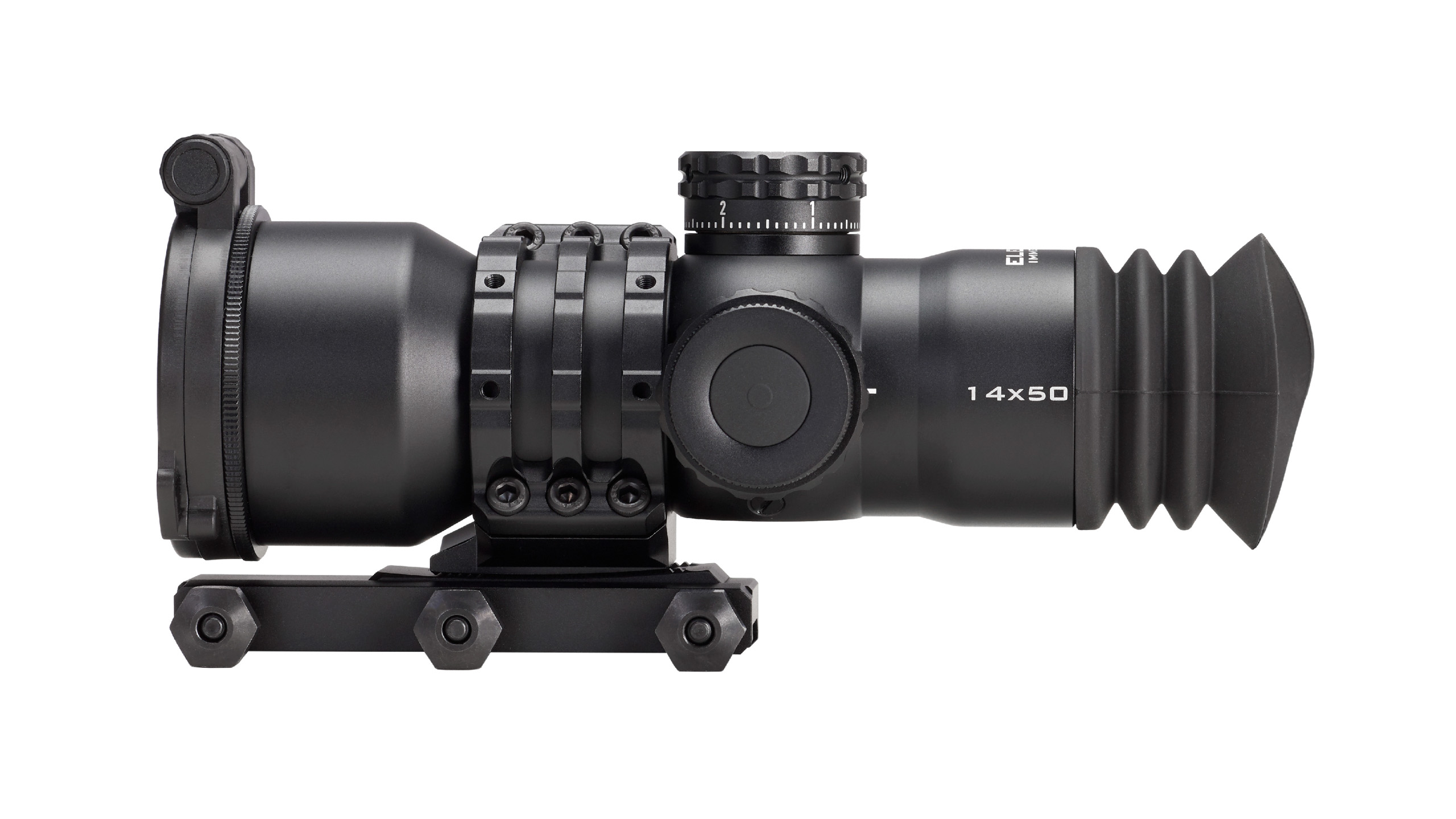
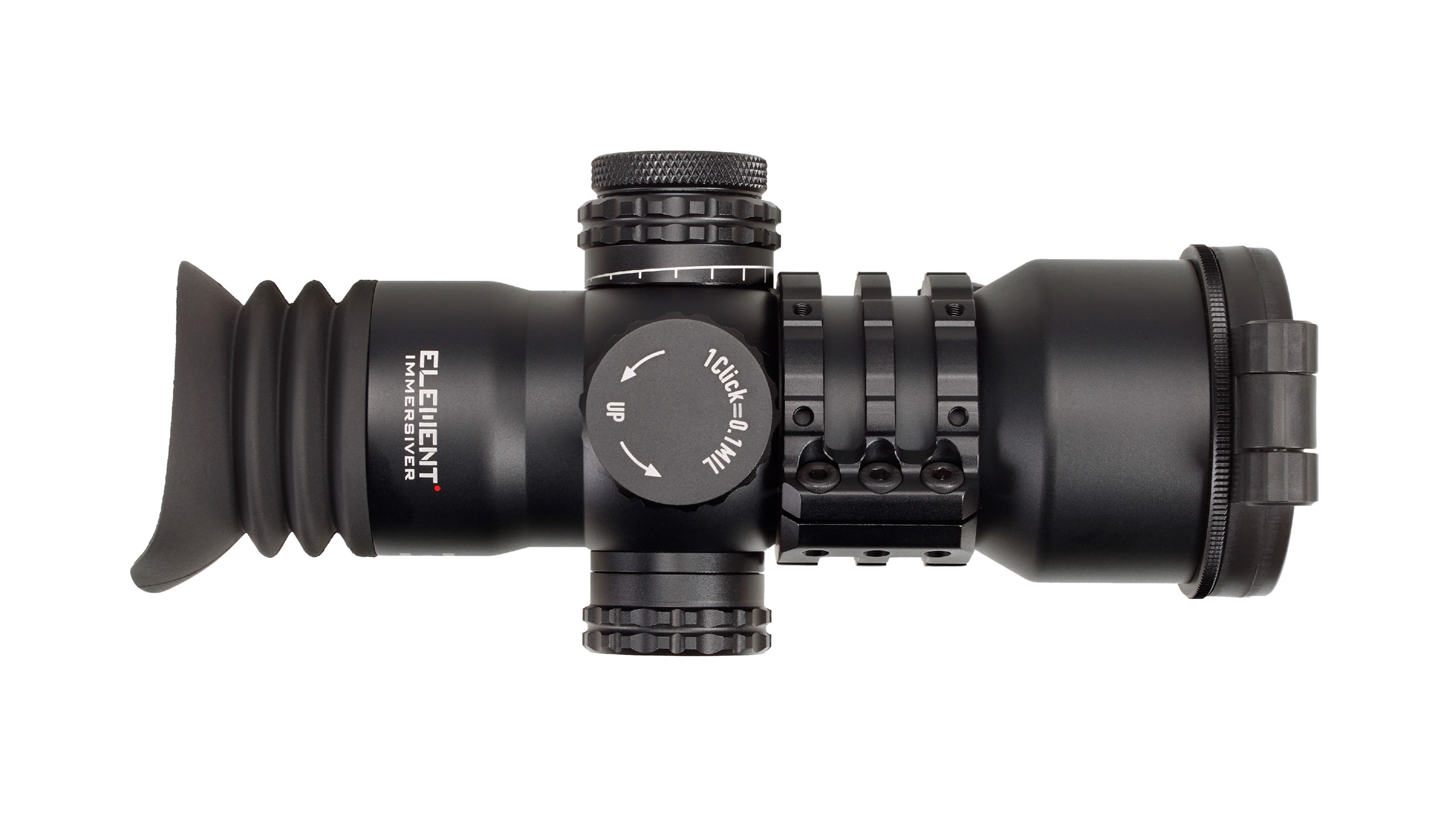
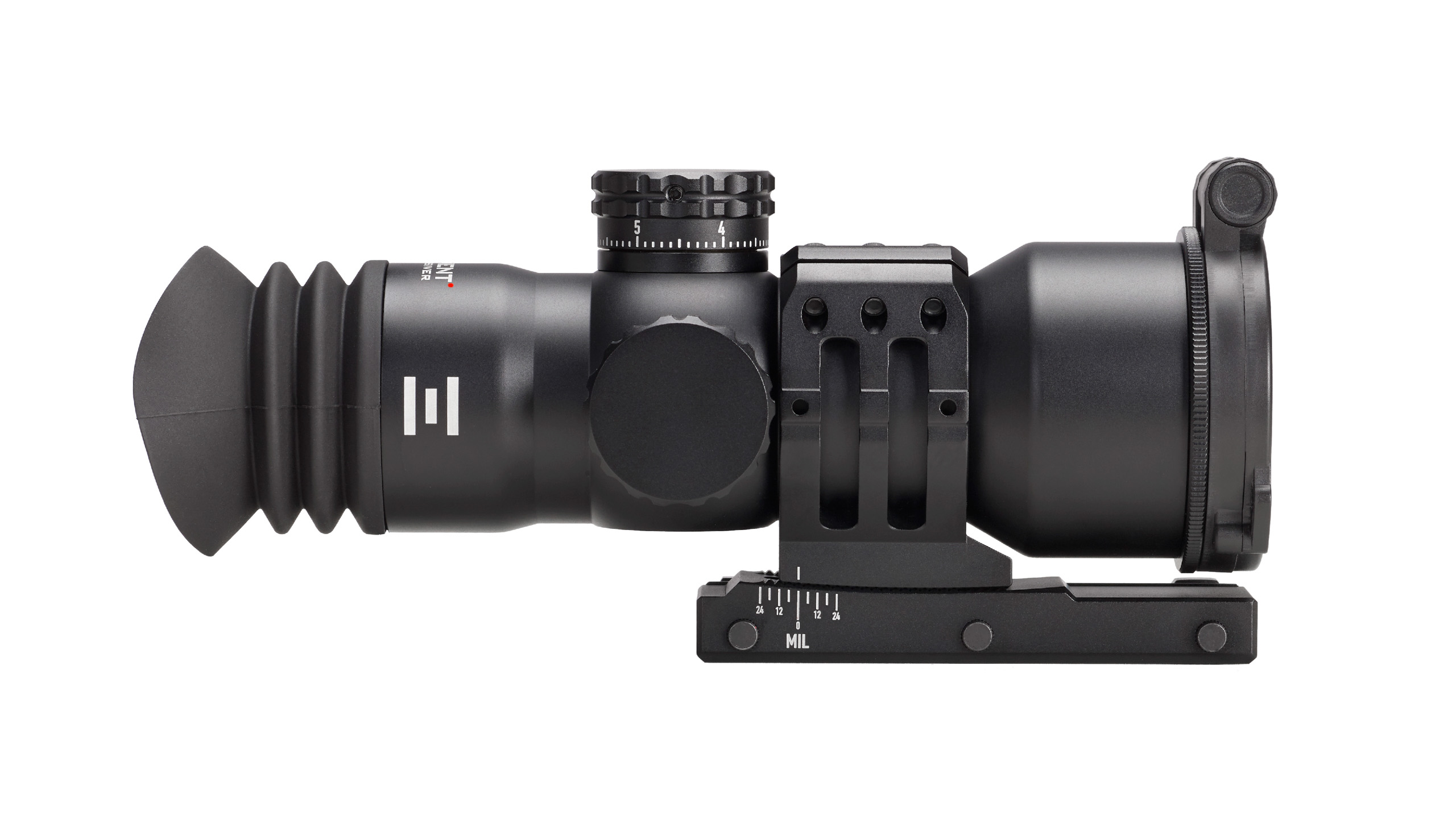
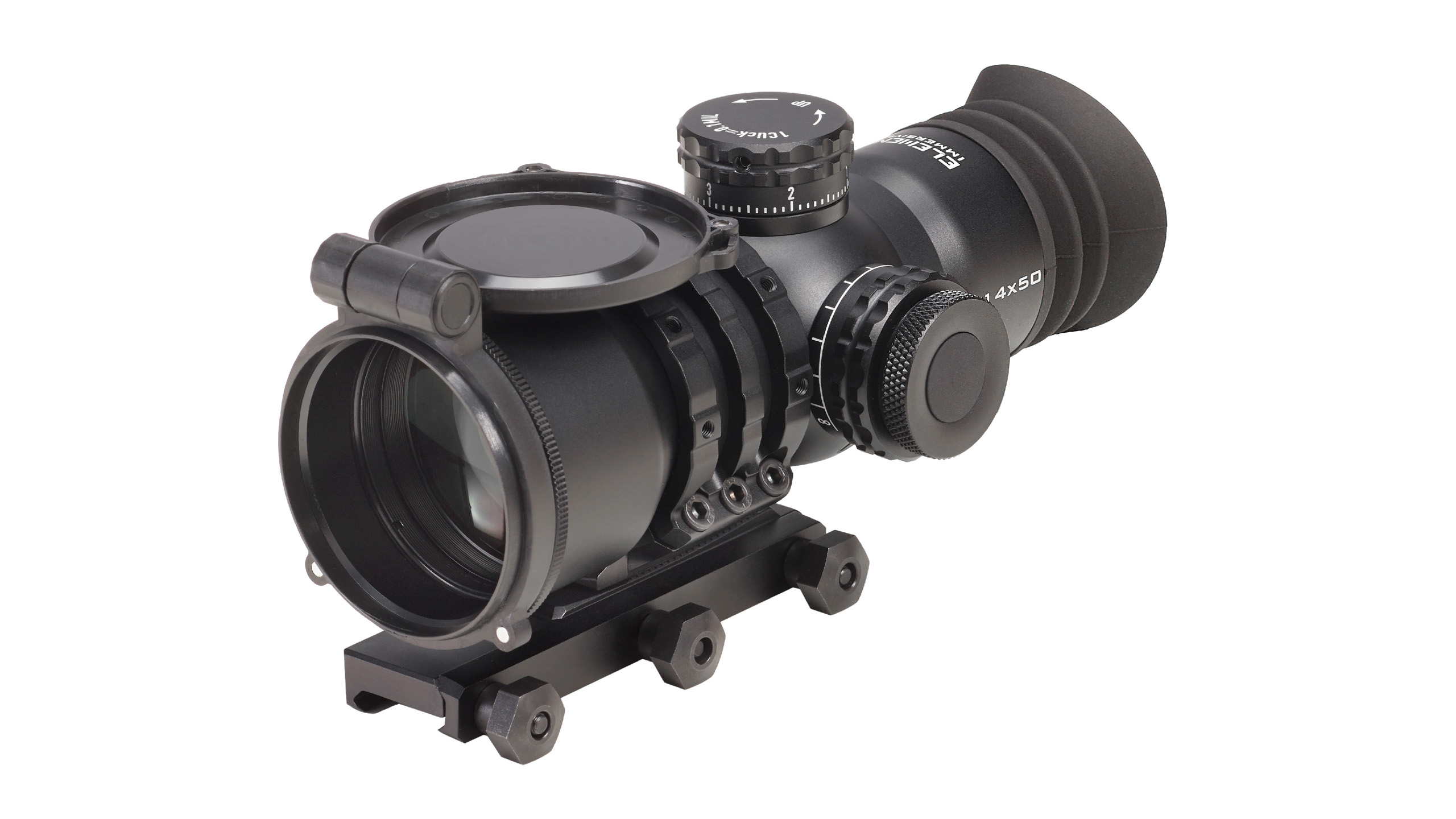
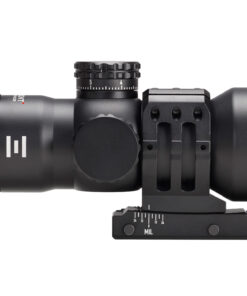
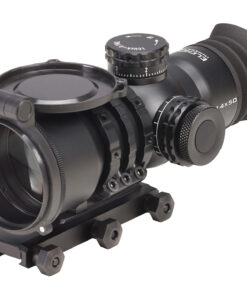
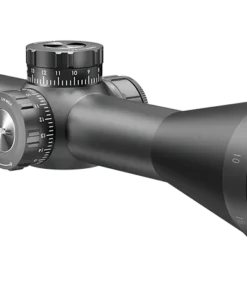
Element Optics Immersive Series 14×50
$350.00
Traditional riflescopes have their place in the optics world, but new technology is allowing us to push the envelope of what is possible. The Immersive Series brings you range of ultra-compact Prismatic Riflescopes with many unique properties, including market-leading field of view, drawing you in to your surroundings for a better perspective. Unlike conventional scopes, which present the image from the eyepiece as floating distantly in front of you, the image from an Immersive Series scope allows for vastly improved peripheral awareness, giving the impression that you are immersed in the scene – and with the optical clarity of ED Glass, there are no compromises.
The 10×40 and 14×50 models feature a short eye relief, allowing for an incredible field of view of up to 4x a traditional riflescope at the same magnification.
Features:
- Compact, Lightweight design
- Tilt-Adjustable Unimount with 3x Base Lengths Included
- Illuminated Reticle (Push-Button System)
- Side Parallax: 6yds-Infinity
- ED Glass for reduced chromatic aberration and improved sharpness
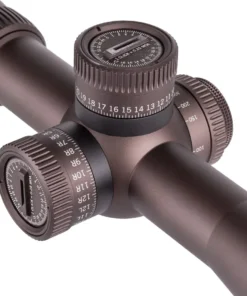
- Exposed Elevation turret, Capped Windage Turret (both resettable)
- Waterproof, Fogproof, Shockproof & Nitrogen Purged
- Magnetic Flip Cap & Rubber Eyecup Included
Specs:
| MAGNIFICATION | 14x |
| TUBE DIAMETER | |
| OBJECTIVE LENS DIAMETER | 50mm |
| EXIT PUPIL | |
| EYE RELIEF | 0.7” (18mm) |
| FIELD OF VIEW | @100yds: 28ft | @100m: 9.6m |
| CLICK VALUE | 1/4 MOA (15 MOA / REV) | 1/10 MRAD (6 MRAD / REV) |
| ELEVATION ADJUSTMENT RANGE | 83 MOA | 28 MRAD |
| WINDAGE ADJUSTMENT RANGE | 83 MOA | 28 MRAD |
| MINIMUM PARALLAX | 6 YDS | 6 METERS |
| LENGTH | 6.06” | 154mm |
| WEIGHT (W/MOUNT) | 19.5oz | 554g |
Element Optics Immersive Series 14×50 — Ultra-Compact Prismatic Scope with ED Glass, 6-Yard Parallax, Illuminated APR Reticle, and Wide Field of View
Element Optics Immersive Series 14×50 Optical Performance, Prismatic Design, ED Glass, Wide Field of View, Parallax, and Precision
The Element Optics Immersive Series 14×50 is an ultra-compact fixed-power prismatic optic designed around a very different viewing concept from a traditional long riflescope. Instead of relying on conventional long eye relief, it uses an extremely short 18mm eye relief and rubber eyecup to create a more immersive sight picture with unusually strong peripheral awareness. Element lists a field of view of approximately 28 feet at 100 yards / 9.6 metres at 100 metres, which is exceptionally wide for a fixed 14× optic.
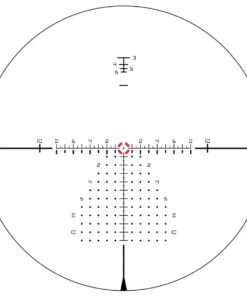
The optical system combines 14× fixed magnification, a 50mm objective, ED glass for reduced chromatic aberration and improved sharpness, side parallax adjustment from approximately 6 yards to infinity, and an illuminated push-button reticle system. Element offers the optic with APR-1C MRAD or APR-1C MOA reticles.
An important limitation must be understood before use: Element specifically states that the 14×50 short-eye-relief model is intended for zero-recoiling rifles, and its manual describes the 10×40 and 14×50 versions as being built for non-recoiling airguns and rimfires. Because the eyepiece sits extremely close to the eye, it should not be mounted on a recoiling platform contrary to manufacturer guidance.
Sniper Hider
The phrase sniper hider does not describe a function of this optic. The Immersive 14×50 is an optical sighting system focused on image quality, compactness, field of view, and precise adjustment.
Optics Warehouse
Optics Warehouse is associated with optics retail and comparison rather than a technical feature of the scope.
Red Dot UK
A red dot UK search usually concerns reflex sights with little or no magnification. The Immersive 14×50 instead provides fixed 14× magnification for detailed target observation.
Picatinny
A Picatinny mounting interface can be relevant because the scope is supplied with a dedicated adjustable mounting system rather than conventional tube rings.
Bipod for Rifle
A bipod for rifle can help stabilize a compatible non-recoiling shooting platform during lawful range use, although it does not alter the optic’s optical performance.
IR Illuminator
An IR illuminator is generally associated with digital or image-intensified night vision. This conventional optical system does not require infrared illumination for normal operation.
Minotaur 10-50×60
The Minotaur 10-50×60 belongs to a different high-magnification optics category. The Immersive design prioritizes compactness and unusually broad field of view rather than variable magnification.
Picatinny Dimensions
Picatinny dimensions refer to standardized MIL-STD-1913 mounting geometry. Correct compatibility between the supplied base and the host platform should always be confirmed.
Scope Mount
A scope mount is particularly important here because this optic uses a tilt-adjustable Unimount with three base lengths included. This system allows the compact scope body to be positioned correctly for the extremely short eye relief.
Zero Stop Scope
A zero stop scope uses a mechanical reference to return the elevation turret to a known zero. The Immersive 14×50 instead uses a resettable exposed elevation turret rather than being marketed around a dedicated hard zero-stop mechanism.
Sniper Hider
The repeated sniper hider term remains unrelated to the scope’s optical or mechanical design.
Optic Warehouse
An optic warehouse search normally concerns product availability or comparison rather than scope engineering.
What Is a Picatinny Rail
For what is a Picatinny rail, it is a standardized mounting rail containing regularly spaced transverse slots for compatible optical mounts and accessories.
Parker Hale Scope Rings for Sale
Parker Hale scope rings for sale concerns conventional ring systems. This optic does not use a normal cylindrical riflescope tube and instead comes with its own adjustable mounting architecture.
SWFA SS 10×42
The SWFA SS 10×42 belongs to another fixed-power scope category. Its conventional design differs significantly from the ultra-short prismatic construction used here.
Delta Stryker
Delta Stryker scopes belong to a separate precision-optics family and should be compared independently for glass quality, adjustment range, weight, and reticle system.
PRS Spotting Scope Setups
PRS spotting scope setups are generally external observation systems. The Immersive 14×50 is designed as a mounted optic rather than a dedicated spotting scope.
1913 Rail
A 1913 rail is another common name for the MIL-STD-1913 Picatinny interface.
What Is Zero Stop on a Scope
For what is zero stop on a scope, it is a mechanical feature that limits elevation travel at a preset reference. This model instead provides resettable exposed elevation adjustment.
Difference Between Weaver and Picatinny Rail
The difference between Weaver and Picatinny rail mainly concerns slot dimensions and standardized spacing. Compatibility should not automatically be assumed.
Scope Illumination
Scope illumination is built into the Immersive through a push-button illuminated reticle system. This helps the aiming references remain visible against darker or complicated backgrounds.
What Is Parallax in Optics
For what is parallax in optics, parallax occurs when the reticle appears to move relative to the target as the viewer’s eye position changes.
The 14×50 includes side parallax adjustment down to approximately 6 yards, which is unusually close for a fixed 14× optic.
Ballistic Solver
A ballistic solver calculates predicted trajectory using external data such as velocity, distance, projectile characteristics, and atmospheric conditions. It remains separate from the optic.
What Is Parallax in Optics
The repeated what is parallax in optics phrase is particularly relevant because fixed 14× magnification makes accurate parallax correction important for close and intermediate-distance precision.
Delta Optics
Delta Optics belongs to another manufacturer and is not part of the Immersive optical system.
Element Optics
Element Optics manufactures the Immersive Series and describes the 14×50 as an ultra-compact prismatic scope with ED glass, exceptionally wide field of view, illuminated APR reticle, and short-eye-relief configuration.
Schmidt and Bender Scopes
Schmidt and Bender scopes belong to another premium optical category and generally follow a more conventional riflescope architecture.
Best Rifle Bipod for Long Range Shooting
The best rifle bipod for long range shooting depends on platform geometry, surface, stability requirements, and lawful sporting use. It does not determine scope quality.
Chrony Chronograph
A Chrony chronograph measures projectile velocity and can provide information for external ballistic calculations.
Hikmicro Stellar SX60L Thermal Scope
The Hikmicro Stellar SX60L thermal scope uses thermal imaging technology, while the Immersive relies on conventional optical glass and visible light.
Best Digital Night Vision Scope
The best digital night vision scope belongs to a different technology category involving electronic sensors and displays.
March Riflescope Adjustments Argon Filled D42HV56WFML G2
The phrase march riflescope adjustments argon filled d42hv56wfml g2 concerns another premium optic and should not be used as specification data for this product.
DNT Optics Review
A DNT optics review generally covers digital or multispectral devices rather than a compact conventional prismatic scope.
Falcon Optics
Falcon Optics is another optics manufacturer and should be compared separately according to individual model specifications.
Best Night Vision Scope
The best night vision scope is evaluated according to sensor performance, infrared capability, display quality, and electronic image processing rather than conventional ED glass.
What Is Parallax in a Scope
For what is parallax in a scope, it is an apparent shift between the reticle and target caused by imperfect optical-plane alignment.
The 6-yard minimum side-focus distance makes the Immersive particularly flexible at relatively short ranges.
ZCO Optics
ZCO Optics belongs to another premium precision-scope manufacturer and uses a substantially different conventional riflescope design.
What Is Parallax in a Rifle Scope
For what is parallax in a rifle scope, correctly setting the side focus helps reduce apparent reticle movement and improves aiming consistency.
TNC225R Review
A TNC225R review concerns a different digital optical product rather than this prismatic system.
Tactical Rail
A tactical rail generally refers to an accessory mounting interface such as Picatinny.
SWFA Scope Review
An SWFA scope review concerns a competing scope product and should not be confused with Immersive specifications.
Scope Torque Wrench
A scope torque wrench can help mounting fasteners remain within the mount manufacturer’s recommended limits.
Because the optic uses a dedicated mounting system, excessive tightening should be avoided.
TPO Scopes
TPO scopes belong to another optics category or manufacturer depending on the specific model being researched.
Best Scope for Air Rifle
The best scope for air rifle depends on recoil type, distance, optical requirements, weight, and parallax.
The Immersive 14×50 is especially relevant to non-recoiling airgun platforms, which aligns directly with Element’s manufacturer guidance.
What Is the MOA of a Scope
For what is the MOA of a scope, MOA means minute of angle.
The MOA configuration of this optic uses 1/4 MOA clicks with 15 MOA per turret revolution, while the alternative MRAD version provides 0.1 MRAD clicks and 6 MRAD per revolution.
Optics Planet
Optics Planet is an optics retailer and information source rather than a feature of the product.
DNT Thermal Scope Review
A DNT thermal scope review relates to electronic thermal imaging and evaluates a very different class of optical technology.
Picatinny Dimensions
The repeated picatinny dimensions phrase remains relevant when confirming mount and rail compatibility.
Vector Minotaur 10 50×60
The Vector Minotaur 10 50×60 offers variable high magnification, whereas the Immersive uses fixed 14× power and a radically more compact prismatic layout.
Picatinny Scope Base
A Picatinny scope base can provide the mounting interface for the supplied Unimount where the host platform uses compatible rail geometry.
Why the Prismatic Design Matters
The Immersive 14×50 is substantially shorter than a traditional fixed-power scope.
It measures approximately 154mm / 6.06 inches while weighing about 554g / 19.5oz including the mount.
The compact prismatic architecture reduces overall length while maintaining fixed high magnification.
Why the Field of View Is Important
One of the strongest engineering advantages is the unusually wide field of view.
At 14×, Element specifies approximately 28 feet at 100 yards, and the manufacturer states that its short-eye-relief Immersive models can offer up to four times the field of view of some traditional scopes at comparable magnification.
This gives the user more surrounding visual information instead of producing the narrow tunnel-like view often associated with high magnification.
Why the 18mm Eye Relief Matters
The extremely short 18mm / 0.7-inch eye relief is fundamental to the Immersive viewing experience.
However, it is also why manufacturer platform guidance must be followed carefully.
This optic should not be placed on a recoiling platform that could drive the eyepiece toward the user’s eye.
How Good Is the ED Glass?
Element specifies ED glass to reduce chromatic aberration and improve sharpness.
This helps minimize colored fringing around high-contrast edges, which becomes particularly valuable at fixed 14× magnification.
Actual perceived detail will still depend on focus, atmospheric conditions, lighting, lens cleanliness, and individual eyesight.
Why the 50mm Objective Matters
The 50mm objective provides a comparatively large front optical aperture within a very compact body.
This supports useful light collection while allowing Element to maintain the short 154mm overall length.
The result is a high-magnification optic that occupies significantly less longitudinal space than a conventional long-tube scope.
How the APR Reticle Supports Precision
The 14×50 is available with APR-1C MOA and APR-1C MRAD reticles.
Element describes these reticles as providing a center dot, scaled vertical and horizontal references, numbered markings, and illuminated hold points without unnecessarily cluttering the image.
The selected reticle is paired with matching turret units, simplifying interpretation.
How Good Are the Turret Adjustments?
The MOA model uses 1/4 MOA clicks with 15 MOA per revolution, while the MRAD version uses 0.1 MRAD clicks with 6 MRAD per revolution.
Total elevation and windage adjustment are listed at approximately 83 MOA or 28 MRAD.
The elevation turret is exposed and resettable, while windage is capped and resettable.
Why Side Parallax Is Important
Side parallax adjustment begins at approximately 6 yards / 6 metres and extends to infinity.
This unusually close minimum distance makes the 14× optic practical for relatively close precision target work despite its high fixed magnification.
Why the Adjustable Mount Matters
The included tilt-adjustable Unimount is supplied with three base lengths.
This is particularly important because the 18mm eye relief requires precise longitudinal positioning.
The integrated mounting concept also avoids the need for traditional tube rings.
Where the Scope Works Best
The optic is best suited to lawful target shooting and precision use on compatible non-recoiling platforms, especially airguns where compactness, high fixed magnification, broad field of view, and very close parallax adjustment are advantageous.
When Fixed 14× Magnification Is Useful
Fixed 14× power works well when the user consistently needs detailed target observation and does not require a changing magnification range.
Removing the variable zoom mechanism also contributes to the compact optical design.
However, users who frequently need low-power viewing may prefer a variable system.
How Precise Is the Immersive 14×50?
Precision is supported by the fixed 14× image, ED glass, side parallax adjustment, matching MOA or MRAD reticle and turret systems, resettable adjustments, and the stable integrated mount.
Nevertheless, repeatable results still depend on correct mounting, parallax adjustment, consistent eye positioning, platform stability, and mechanical condition.
Important Information About the Immersive 14×50
The most important consideration is its short-eye-relief configuration and zero-recoil requirement.
Element explicitly marks the product for zero-recoiling rifles and identifies the 10×40 and 14×50 short-eye-relief variants as suitable for non-recoiling applications.
The optic is also nitrogen purged and described as waterproof, fogproof, and shockproof. A magnetic flip cap and rubber eyecup are included.
Overall, the Element Optics Immersive Series 14×50 combines an unusually compact prismatic body, fixed 14× magnification, ED glass, exceptionally wide field of view, six-yard parallax adjustment, illuminated APR reticle, resettable turrets, and a specialized adjustable mount into a distinctive precision optic for compatible non-recoiling platforms.
Optical Clarity, Fixed-Power Precision, Parallax Control, Eye Position, and Practical Reliability
Optical Clarity
A fixed-power precision optic should provide a clean, stable image without requiring the user to constantly manage a zoom system.
Because magnification remains constant, the viewing experience becomes more predictable from session to session.
Image quality still depends on lens design, coatings, focus, ambient light, atmospheric conditions, and correct eye position.
For the best results, the optical surfaces should remain clean and the focus should be adjusted carefully before precision work begins.
Why Fixed Magnification Can Be Useful
Fixed magnification removes one variable from the setup.
The user does not need to decide which power level should be selected for every observation.
This can make the optic feel more straightforward during repetitive target use.
In addition, the reticle remains visually consistent because the optical system is designed around one magnification level.
For users who regularly work at similar distances, this simplicity can be an advantage.
Image Stability
At relatively high fixed magnification, small movements become easier to see.
Movement from the platform, support equipment, breathing, or body position can make the image appear less stable.
For this reason, the optic performs best when the host platform is supported properly.
A stable setup allows the user to evaluate the true optical quality instead of seeing movement caused by poor support.
Wide Field of View
One of the practical strengths of this design is the broad field of view relative to the magnification level.
A wider viewing area makes it easier to maintain awareness of the surrounding target zone.
This can reduce the tunnel-like feeling sometimes associated with high magnification.
It also helps the user locate the intended point more quickly without needing to search across a very narrow image.
Short Eye Relief
The short eye-relief design is a major part of the immersive viewing experience.
The eye sits much closer to the eyepiece than it would with a conventional long riflescope.
This creates a wider apparent image, but it also means mounting position is extremely important.
The optic should only be used on compatible low- or non-recoiling platforms where the short viewing distance does not create a risk of the eyepiece moving toward the user’s face.
Why Eye Position Matters
Because the eye sits close to the rear lens, consistent head placement becomes important.
If the eye is positioned too far away, part of the image can be lost.
If the head is too close or off-center, viewing comfort may decrease.
The optic should be mounted so the user can establish a natural head position without stretching forward or forcing the neck.
A repeatable position improves both comfort and visual consistency.
Rubber Eyecup Use
The eyecup helps guide the eye toward the correct viewing position.
It can also reduce stray light entering from the side.
However, it should not be pressed aggressively against the face.
The rubber should remain clean and flexible.
If it becomes damaged or hardened over time, viewing comfort may be reduced.
Side-Focus Control
The side-focus mechanism is essential because fixed high magnification makes parallax error easier to notice.
The control should be adjusted until the target image appears sharp and apparent reticle movement is minimized.
The adjustment should rotate smoothly throughout its normal range.
It should not feel gritty, excessively loose, or unusually stiff.
Close-Distance Focus
A short minimum focusing distance increases versatility.
It allows the optic to remain useful for relatively close target work despite the high magnification.
This is particularly valuable on compatible air-powered platforms where target distances may be much shorter than those typically associated with high-power optical systems.
The focus control should still be adjusted carefully rather than relying only on printed distance markings.
Checking Parallax
After focusing the target, the user can check for residual parallax by keeping the platform still and moving the eye slightly behind the eyepiece.
If the reticle appears to shift relative to the target, additional adjustment may be required.
A sharp image alone does not always guarantee that parallax has been fully corrected.
Consistent eye position remains important after the adjustment is complete.
Reticle Visibility
The reticle should remain sharp and easy to interpret against a variety of backgrounds.
At fixed magnification, the markings maintain the same apparent size during use.
This can make reticle interpretation more consistent.
The user should become familiar with the center point, reference marks, and overall reticle structure before relying on them during precision target work.
Illumination Management
Reticle illumination can improve visibility when the background is dark or visually complex.
The brightness should remain only as high as necessary.
Excessive illumination can make fine markings appear thicker or less precise.
During bright daylight, illumination may not be required.
A moderate setting is generally better than using maximum brightness automatically.
Battery Condition
The illumination system depends on a reliable battery.
If brightness flickers or becomes inconsistent, the battery should be checked first.
The compartment should remain clean and dry.
For extended storage, battery condition should be monitored.
A leaking or corroded battery can damage the contacts and create unnecessary repair problems.
Elevation Adjustment
The elevation control should provide predictable, consistent movement.
Each click should feel distinct.
If the adjustment suddenly becomes vague or excessively stiff, it should not be forced.
Changes in turret feel can indicate contamination, impact, or mechanical wear.
Consistent adjustment is particularly important when the optic is used for repeatable range settings.
Windage Adjustment
Windage adjustment should operate with the same predictable feel.
The mechanism should remain clean and protected from impact.
If the capped design is used, the cap should be replaced carefully and should not be cross-threaded.
The cap provides useful protection from accidental movement and contamination.
Resettable Turrets
Resettable turrets allow the scale to be repositioned after a reference setting has been established.
This can make future adjustments easier to track.
The reset procedure should follow manufacturer guidance.
The turret should not be loosened, forced, or reassembled unnecessarily.
Careful handling helps maintain repeatable mechanical performance.
Mounting System Stability
The integrated mount plays a major role in performance.
Because the optic does not use a conventional long tube with separate rings, the supplied mounting system must remain securely attached.
All contact surfaces should be clean before installation.
Fasteners should be tightened evenly and only to appropriate values.
Excessive force can damage threads or mounting components.
Positioning the Mount
The mount should position the optic so the user can achieve correct eye relief naturally.
This is especially important because the viewing distance is very short.
Small longitudinal changes can significantly affect comfort.
The optic should be positioned only after the user has established a stable shooting posture.
Tilt Adjustment
If the mounting system provides angle adjustment, it should be configured carefully.
Any tilt mechanism must remain secure after setup.
Fasteners should be checked periodically for movement.
The mechanism should not be adjusted repeatedly without reason because unnecessary changes make it harder to maintain a consistent setup.
Rail Contact
The rail interface should remain clean and free from grit, oil buildup, or damage.
A dirty contact surface can reduce stability.
The mount should sit flat and should not rock when properly secured.
After transport or repeated use, the attachment should be checked to confirm that it has not shifted.
Fastener Care
Mounting screws should be tightened gradually and evenly.
One fastener should not be fully tightened while others remain loose.
A suitable torque tool can improve consistency.
Too much force can damage threads, while too little can allow unwanted movement.
The goal is stable attachment without unnecessary stress.
Lens Protection
The objective and eyepiece should be protected whenever the optic is not in use.
Dust, fingerprints, moisture, and grit can reduce optical clarity.
Loose particles should be removed before wiping.
A suitable lens cloth, blower, or soft brush should be used.
Ordinary clothing can trap grit and scratch optical coatings.
Objective Cleaning
The front lens should be cleaned only when necessary.
Loose contamination should be removed first.
If moisture or fingerprints remain, they can be wiped gently with an appropriate optical cloth.
Aggressive cleaning should be avoided.
Preserving the coatings helps maintain contrast and image quality over time.
Eyepiece Cleaning
The rear lens requires regular attention because it sits close to the face.
Skin oils and moisture can accumulate more quickly than on the objective.
The surface should remain clean, but excessive wiping is unnecessary.
A clean eyepiece helps maintain the immersive viewing effect.
Glare Reduction
Stray light can reduce contrast.
The eyecup helps limit side light, while clean lenses reduce unwanted reflections.
If glare becomes noticeable, the user should check lens cleanliness, viewing angle, and surrounding light sources before assuming that the optics are defective.
Moisture Protection
The optic should be dried after exposure to rain or heavy humidity.
Water should not remain trapped around adjustment controls or mounting surfaces.
The device should not be sealed immediately inside a case while wet.
Allowing it to dry first helps reduce trapped moisture and possible corrosion on external hardware.
Temperature Changes
Moving quickly from cold outdoor conditions into a warm environment can create condensation.
The optic should be allowed to acclimate gradually where possible.
The lenses should not be rubbed aggressively while condensation and dust are present.
Allowing moisture to evaporate naturally reduces the chance of scratching the optical surfaces.
Transport Protection
A padded case provides useful protection from impact, vibration, and pressure.
The optic should not be stored where heavy equipment can press against the objective, eyepiece, turrets, or mount.
After rough transport, all mounting fasteners and adjustment controls should be checked.
Storage Conditions
For long-term storage, the optic should remain clean, dry, and protected from excessive heat.
The battery should be monitored according to manufacturer guidance.
Lens covers should be fitted where practical.
The optic should not be stored beneath heavy objects that can damage the compact housing or mounting system.
Long-Term Practical Reliability
Long-term reliability depends on careful mounting, correct eye position, clean lenses, stable parallax adjustment, predictable turret behavior, protected electronics, and sensible environmental care.
The objective, eyepiece, illumination system, focus control, elevation adjustment, windage control, mount, and rail interface should all be checked periodically.
Changes in image clarity, focus behavior, reticle visibility, adjustment feel, or mounting stability should not be ignored.
When the optic is kept dry, protected from impact, cleaned correctly, mounted carefully, and used only on compatible low- or non-recoiling platforms, it is more likely to maintain dependable optical clarity, stable reticle performance, consistent adjustment, and reliable precision over extended use.
Focus Accuracy, Eye Alignment, Reticle Control, Mount Stability, and Long-Term Optical Care
Focus Accuracy
Accurate focusing is especially important with a high fixed-power optic because small errors become immediately visible.
The side-focus control should be adjusted until the target image appears sharp and the reticle remains stable against the target.
If the image looks soft, the user should check focus before assuming that the lens quality is responsible.
A properly focused image improves detail recognition and reduces unnecessary eye strain during longer viewing periods.
Why Fixed Magnification Changes the Experience
A fixed-power optic provides the same magnification every time it is used.
This creates a predictable viewing experience because the field of view, reticle appearance, and visual scale remain consistent.
There is no zoom ring to manage.
However, the user must be comfortable working at one magnification level.
For precision target use at known distances, this can simplify operation and reduce unnecessary adjustment.
Eye Alignment
Correct eye alignment is essential because the optic uses very short eye relief.
The user should position the head naturally so the complete sight picture appears without stretching or forcing the neck.
Small changes in eye position can affect how much of the image is visible.
A stable head position also improves repeatability.
The mount should therefore be positioned around the user rather than forcing the user to adapt to an uncomfortable setup.
Eye Relief Safety
Short eye relief requires particular attention to platform compatibility.
The optic should only be used on systems that meet the manufacturer’s recoil guidance.
The eyepiece sits close to the face, so unnecessary movement toward the user must be avoided.
Correct setup, stable positioning, and appropriate platform selection are therefore fundamental to safe operation.
Eyecup Position
The rubber eyecup helps guide the user toward the correct viewing distance.
It can also reduce stray light entering around the eye.
The eyecup should remain clean, flexible, and undamaged.
If it becomes deformed or hardened, viewing comfort may decrease.
It should never be compressed aggressively against the face.
Wide-View Awareness
A wide apparent field helps preserve more surrounding visual information.
This makes the viewing experience feel less restricted than many traditional high-magnification designs.
A broader image can also make target location easier because more of the surrounding area remains visible.
The user should become familiar with this field of view before relying on the optic for precision work.
Side-Focus Precision
The side-focus control should move smoothly and predictably.
Fine adjustment is important because the fixed magnification makes parallax easier to notice.
The user should make small changes until the target appears clear and apparent reticle movement is minimized.
Printed distance markings can provide guidance, but the final visual result should take priority.
Parallax Verification
After focusing, the user should check for remaining parallax.
With the platform held still, the eye can be moved slightly behind the eyepiece.
If the reticle appears to shift relative to the target, further focus adjustment may be required.
A sharp image alone does not always confirm correct parallax adjustment.
Consistent eye position remains important after the adjustment is complete.
Close-Distance Precision
Close-focus capability adds useful versatility to a high-magnification optic.
It allows clear observation at distances that would normally be difficult for many fixed-power systems.
This can be particularly useful in controlled target environments where relatively short distances are common.
The user should still confirm focus carefully rather than relying entirely on the distance scale.
Reticle Interpretation
The reticle should be understood before precision use begins.
Its central aiming area and supporting reference marks are designed to provide visual structure without overwhelming the sight picture.
Because magnification remains fixed, the scale relationship remains consistent during normal use.
This can make reticle interpretation straightforward once the user becomes familiar with the layout.
Reticle Visibility
Good reticle visibility depends on lighting, background contrast, eyesight, and illumination level.
The reticle should remain visible without becoming excessively bright.
In strong daylight, illumination may not be necessary.
Against darker backgrounds, moderate illumination can improve visibility.
The user should select the lowest brightness level that provides a clear aiming reference.
Illumination Control
The illumination controls should respond consistently.
If brightness flickers or becomes unstable, the battery and contacts should be checked first.
The battery compartment should remain dry and free from corrosion.
For long-term storage, battery condition should be monitored periodically.
This simple maintenance can prevent electrical problems later.
Elevation Adjustment Feel
The elevation adjustment should provide clear and repeatable clicks.
A consistent tactile feel helps the user recognize whether the mechanism is operating normally.
If the adjustment suddenly becomes stiff or vague, it should not be forced.
External contamination or impact should be considered before assuming that internal damage has occurred.
Windage Adjustment Feel
The windage system should operate with the same consistency.
If it is protected by a cap, the cap should be removed and replaced carefully.
Cross-threading should be avoided.
The adjustment itself should remain free from grit and moisture.
Any unexpected looseness should be investigated before precision use.
Turret Resetting
Resettable turrets make it easier to establish a simple visual reference after the optic has been adjusted.
The procedure should follow manufacturer instructions.
The mechanism should not be repeatedly loosened without need.
Once configured, the turret should remain secure.
A consistent reference helps simplify later checks.
Mount Stability
The mounting system is one of the most important components of the setup.
A stable optic cannot perform consistently if the mount moves.
The mount should sit flat against the rail and should not rock.
Fasteners should remain secure.
Movement between the mount and rail can cause alignment changes even when the optic itself is functioning normally.
Correct Mount Position
Because eye relief is extremely short, longitudinal mount position should be adjusted carefully.
A small change can significantly affect viewing comfort.
The mount should be set only after the user establishes a stable shooting position.
The complete sight picture should appear naturally without excessive head movement.
Tilt Mechanism Care
If the mount uses a tilt adjustment, the mechanism should remain secure after configuration.
Any angle adjustment should be made carefully.
Fasteners should be checked after setup.
The system should not be changed repeatedly without reason because unnecessary adjustments can complicate repeatability.
Rail Interface
The contact surfaces between the mount and rail should remain clean.
Dust, grit, or excessive oil can reduce stability.
The mount should sit evenly before fasteners are tightened.
If the optic is removed and reinstalled, the interface should be inspected each time.
A clean mounting surface supports better consistency.
Fastener Torque
Fasteners should be tightened according to manufacturer recommendations.
Too much torque can damage threads or distort mounting components.
Too little can allow unwanted movement.
A suitable torque tool can improve consistency.
Fasteners should also be tightened gradually rather than one screw being fully secured before the others.
Housing Inspection
The compact housing should remain free from cracks, dents, or unusual movement.
Although the optic is designed for demanding use, direct impact should still be avoided.
Any significant drop should be followed by a complete external inspection.
The focus control, turrets, lenses, illumination, and mount should all be checked.
Objective Lens Protection
The front lens should be protected from scratches and impact.
Dust should be removed before wiping.
A blower or soft brush can remove loose particles.
If additional cleaning is necessary, an appropriate optical cloth should be used gently.
Harsh materials should be avoided.
Eyepiece Lens Care
The rear lens may require more frequent cleaning because it sits close to the face.
Skin oils and moisture can accumulate quickly.
The surface should be cleaned carefully without excessive pressure.
A clean eyepiece helps preserve the immersive viewing experience and reduces distracting glare.
Glare Control
Stray light can reduce contrast and make the image more difficult to interpret.
The eyecup helps limit unwanted side light.
Clean optical surfaces also reduce reflections.
If glare appears unexpectedly, the user should first check viewing angle, lens cleanliness, and nearby light sources.
Moisture Management
After use in rain or heavy humidity, the optic should be dried thoroughly.
Water should not remain around adjustment controls or mounting interfaces.
The optic should not be sealed inside a case while still wet.
Allowing moisture to evaporate first helps protect external hardware and prevents trapped condensation.
Temperature Changes
Rapid movement between cold and warm environments can create condensation.
The optic should be allowed to acclimate gradually.
Wet lenses should not be rubbed aggressively while dust is present.
Allowing condensation to disappear naturally reduces the chance of scratching coatings.
Dust Protection
Fine dust can collect around moving controls and mounting surfaces.
Loose particles should be removed before wiping.
The optic should not be placed directly onto dirty or sandy surfaces when avoidable.
After dusty use, the focus control, turrets, mount, and lens edges should all be inspected.
Transport Protection
A padded case should protect the compact housing from impact and vibration.
Heavy equipment should not be allowed to press against the objective, eyepiece, or controls.
The mount should also be protected from sideways pressure.
After rough transport, fasteners and major adjustments should be checked.
Storage Conditions
For extended storage, the optic should remain clean, dry, and protected from excessive temperature changes.
Lens protection should be fitted when practical.
Battery condition should be monitored.
The case should provide enough clearance so constant pressure is not applied to the controls or mount.
Periodic Function Checks
A stored optic should be checked occasionally.
The focus control, elevation, windage, illumination, and mounting system can all be tested briefly.
This helps identify stiffness, battery deterioration, or mounting changes before the optic is needed again.
Long-Term Optical Reliability
Long-term reliability depends on correct mounting, stable eye position, clean lenses, smooth focus adjustment, predictable turret behavior, and careful environmental protection.
The housing, objective, eyepiece, reticle illumination, focus mechanism, elevation control, windage adjustment, mount, and rail interface should all be monitored.
Changes in clarity, adjustment feel, eye alignment, illumination, or mount stability should not be ignored.
When the optic is kept dry, protected from impact, mounted correctly, cleaned carefully, and used only on suitable compatible platforms, it is more likely to maintain clear imaging, consistent reticle performance, stable adjustment, and dependable precision over extended use.
Be the first to review “Element Optics Immersive Series 14×50”
Related products
Reviews
There are no reviews yet.