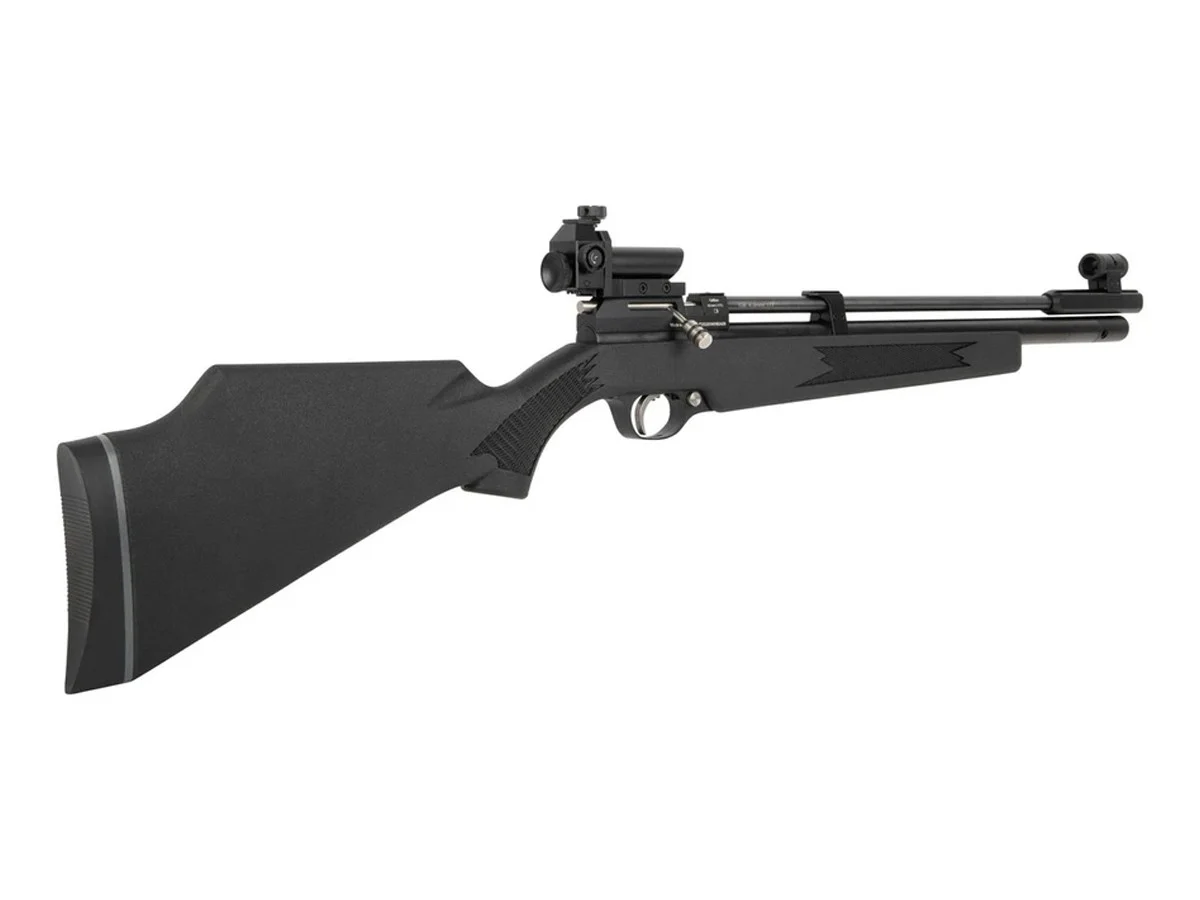
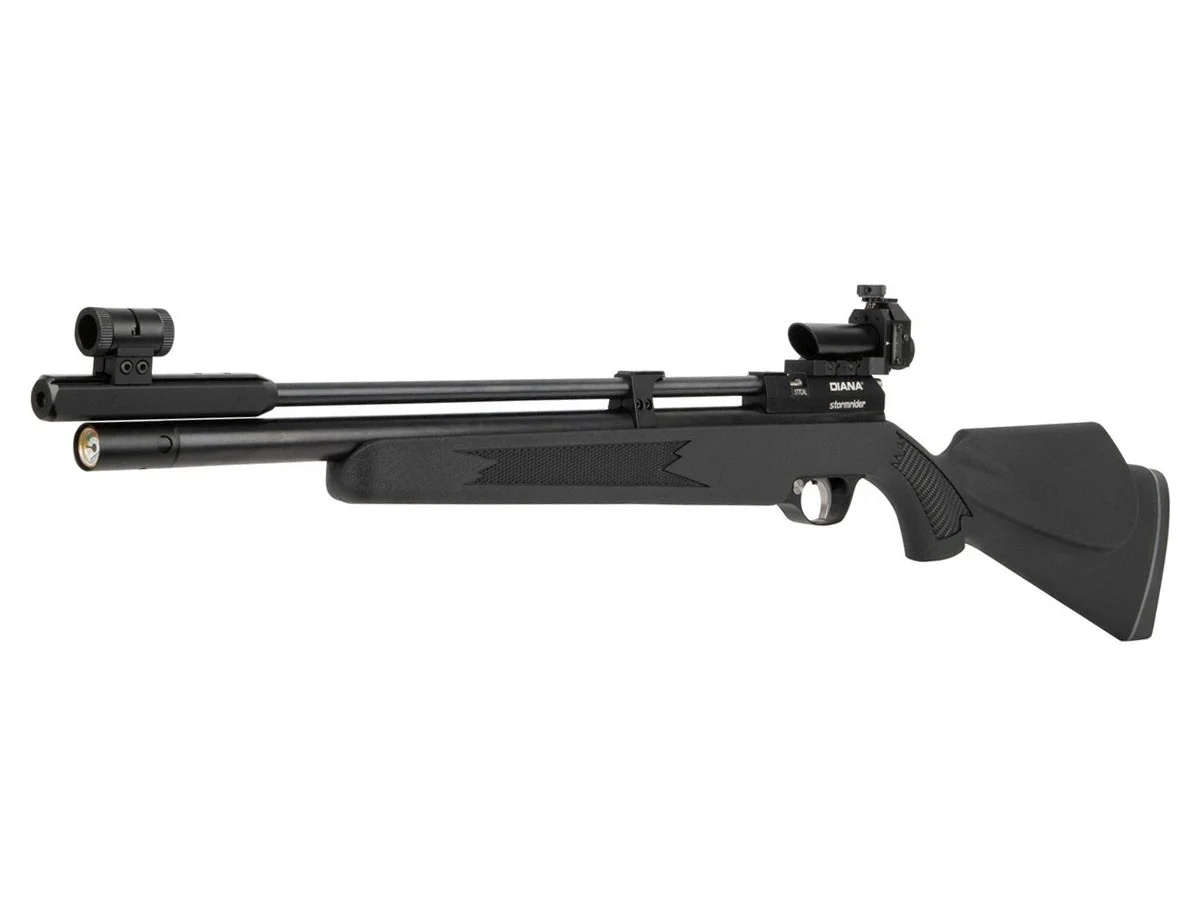
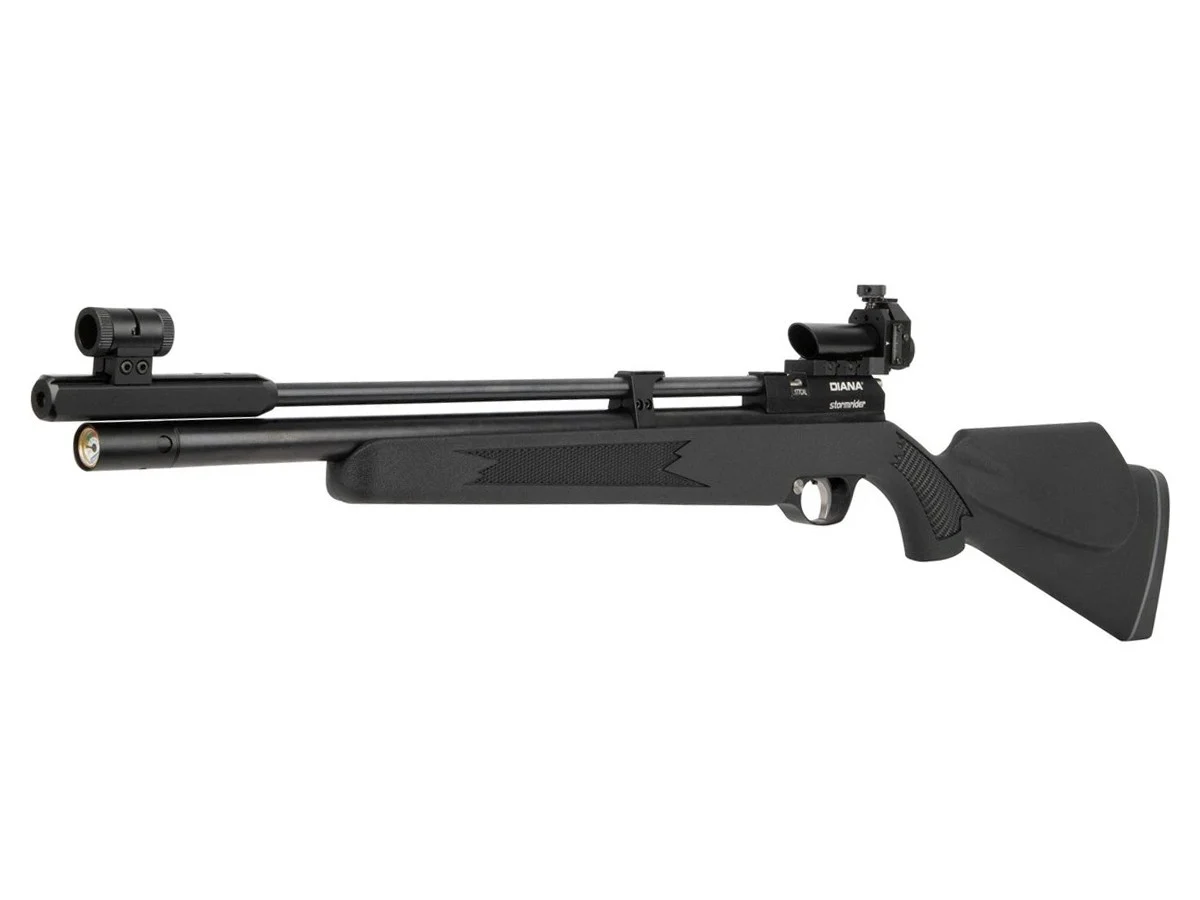
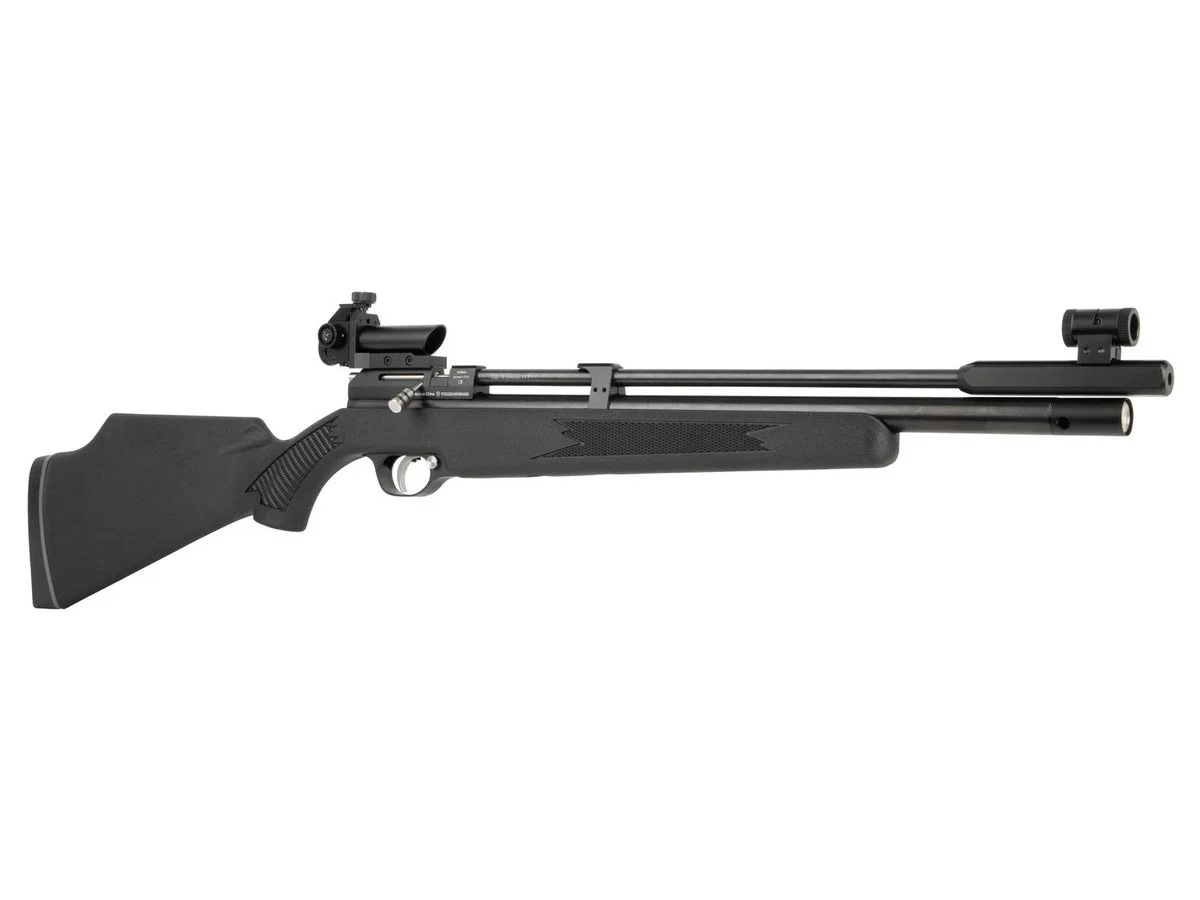
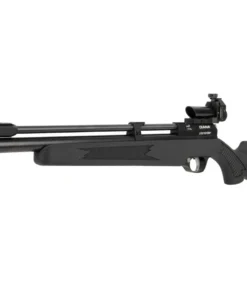
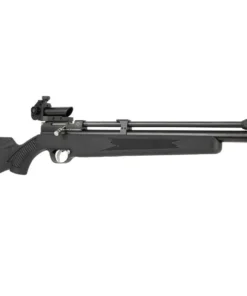
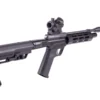
Diana Stormrider Sport PCP Air Rifle
$255.00
Description
The Diana Stormrider Sport is a PCP air rifle with features for accuracy for shooting targets, as well as the power needed for pest control and hunting small game such as squirrels and rabbits. It has improvements for consistency and shorter-range aiming compared to previous versions, while retaining many of the features that made it so successful.
Key Takeaways
- The regulator offers consistent velocities across an entire shot string for steady and repeatable performance with each shot.
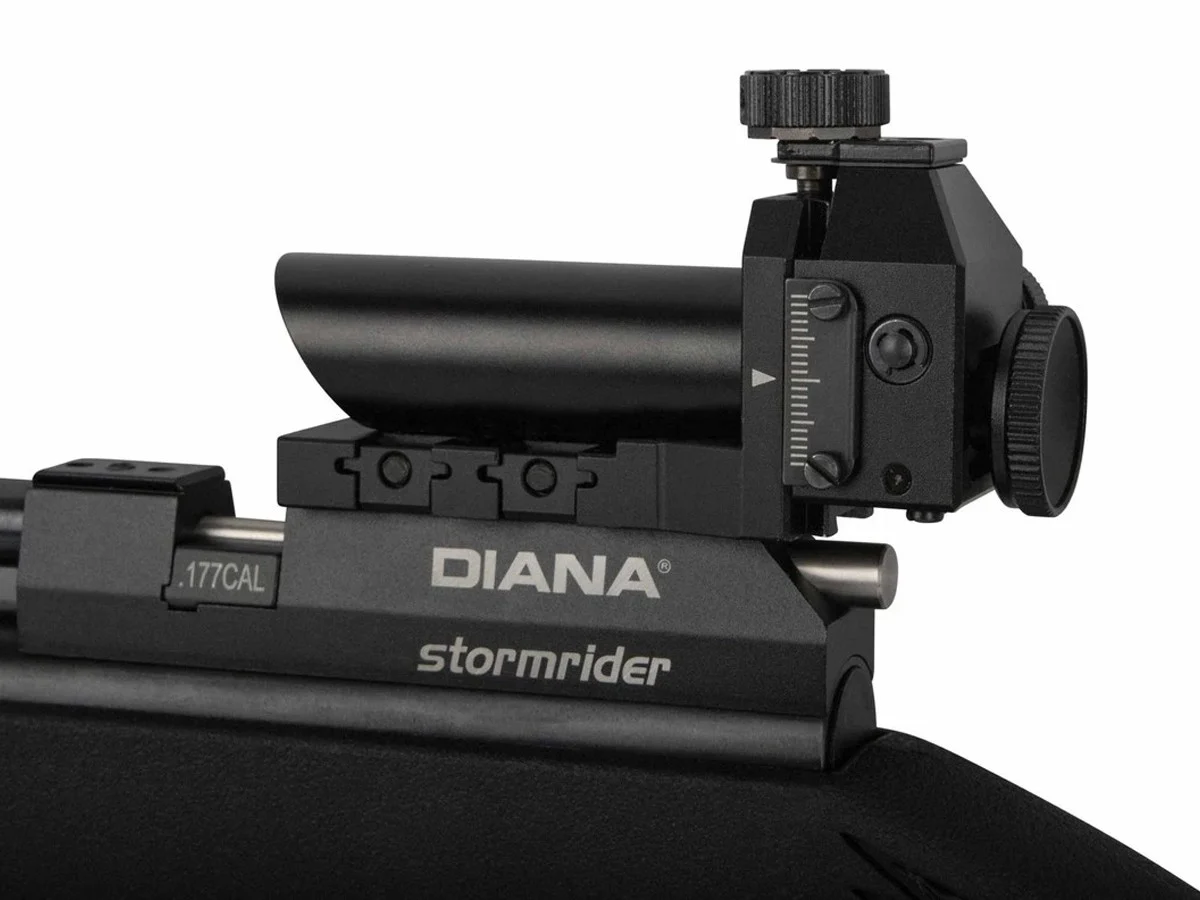
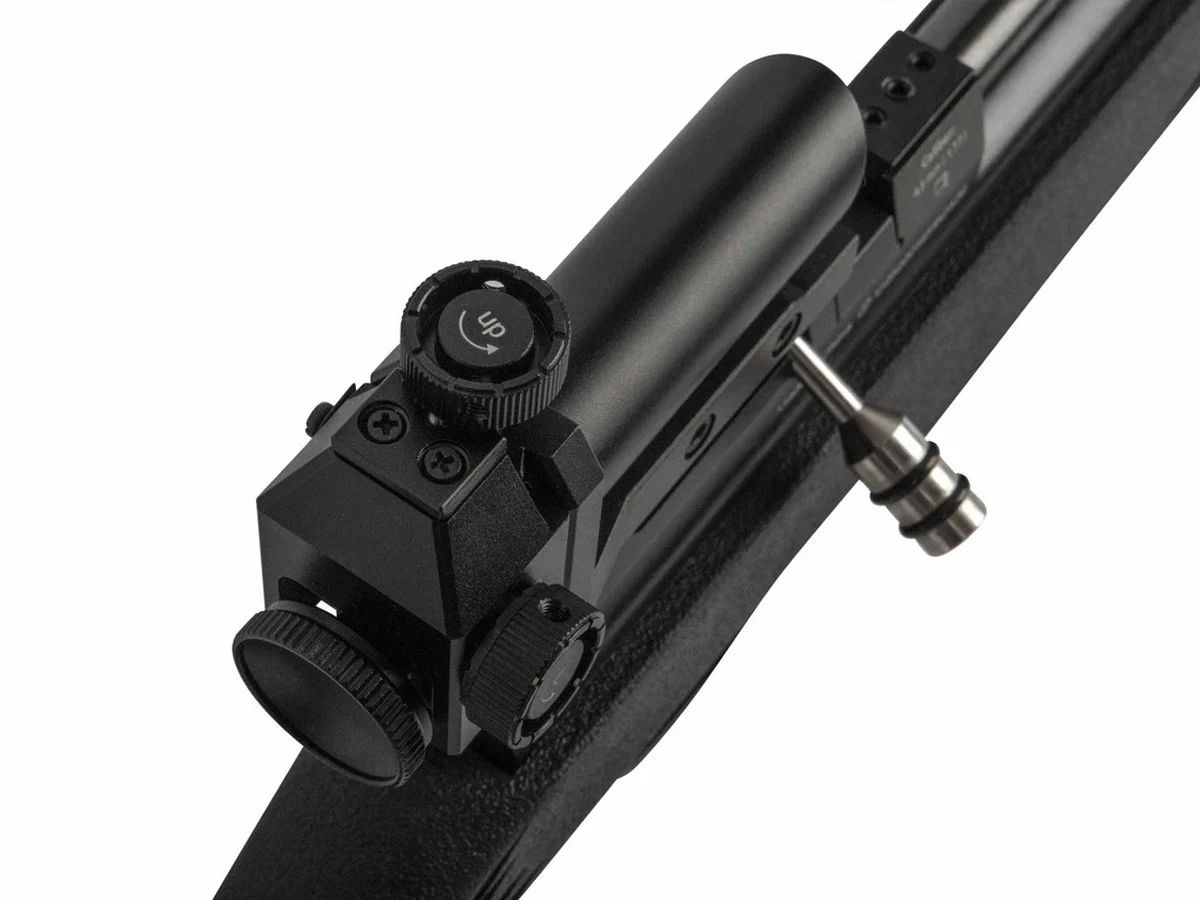
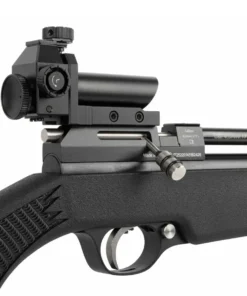
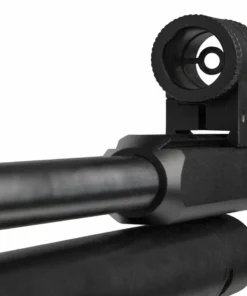
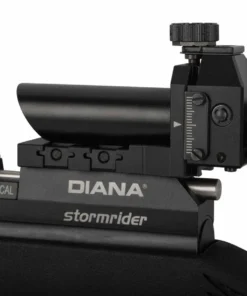
- This Sport version has a front globe sight that accepts inserts and a rear aperture sight that features click adjustments for windage and elevation.
- The two-stage DIT (Diana Improved Trigger) adjustable trigger allows shooters to customize the trigger break for a crisp and clean break that leads to accuracy.
- The barrel weight on the front of the barrel provides improved balance and handling for increased ease of use.
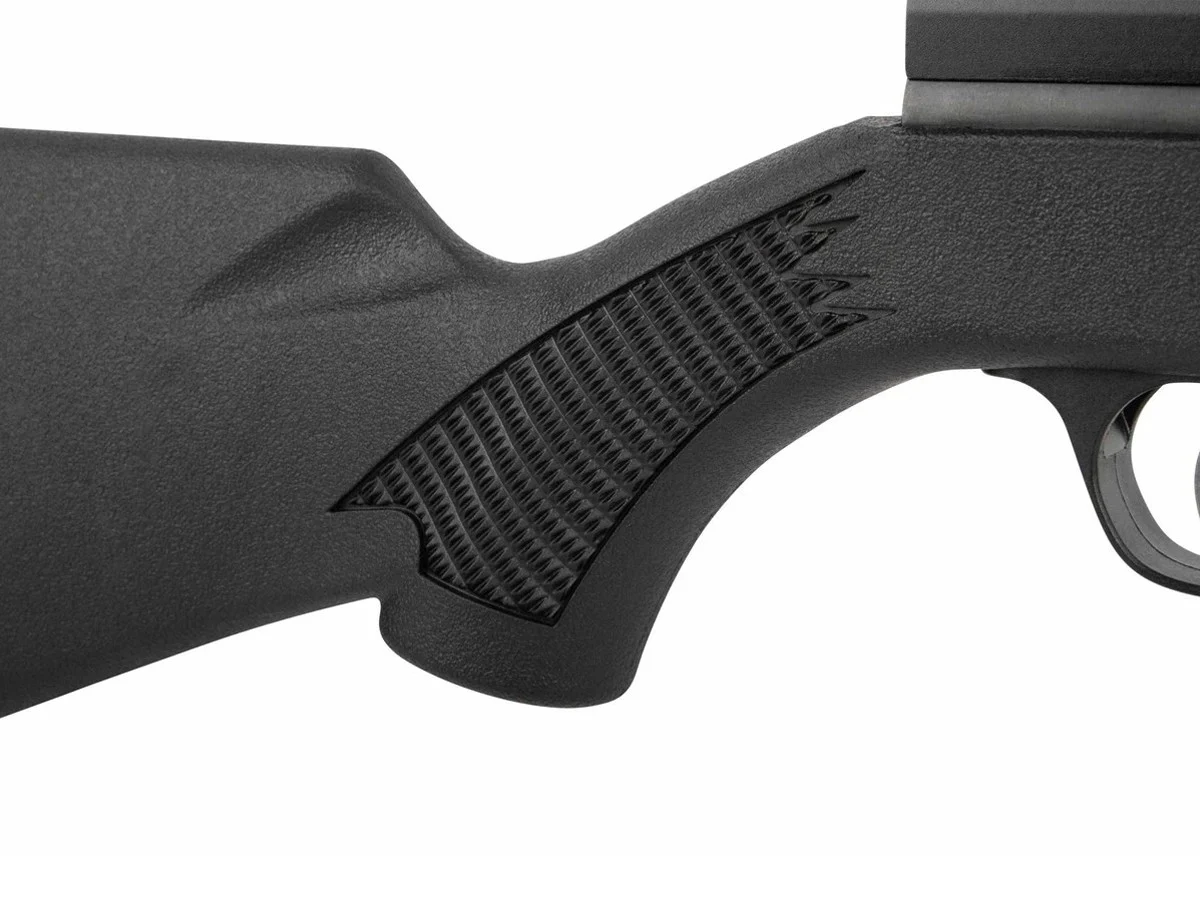
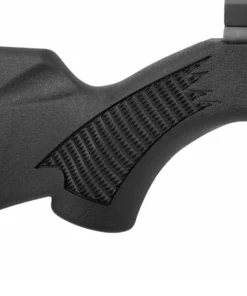
- The synthetic stock delivers comfortable control and durable operation, with a low overall weight, checkering on the grip and forearm, and a textured rubber buttpad.
Aperture Sights for Accuracy
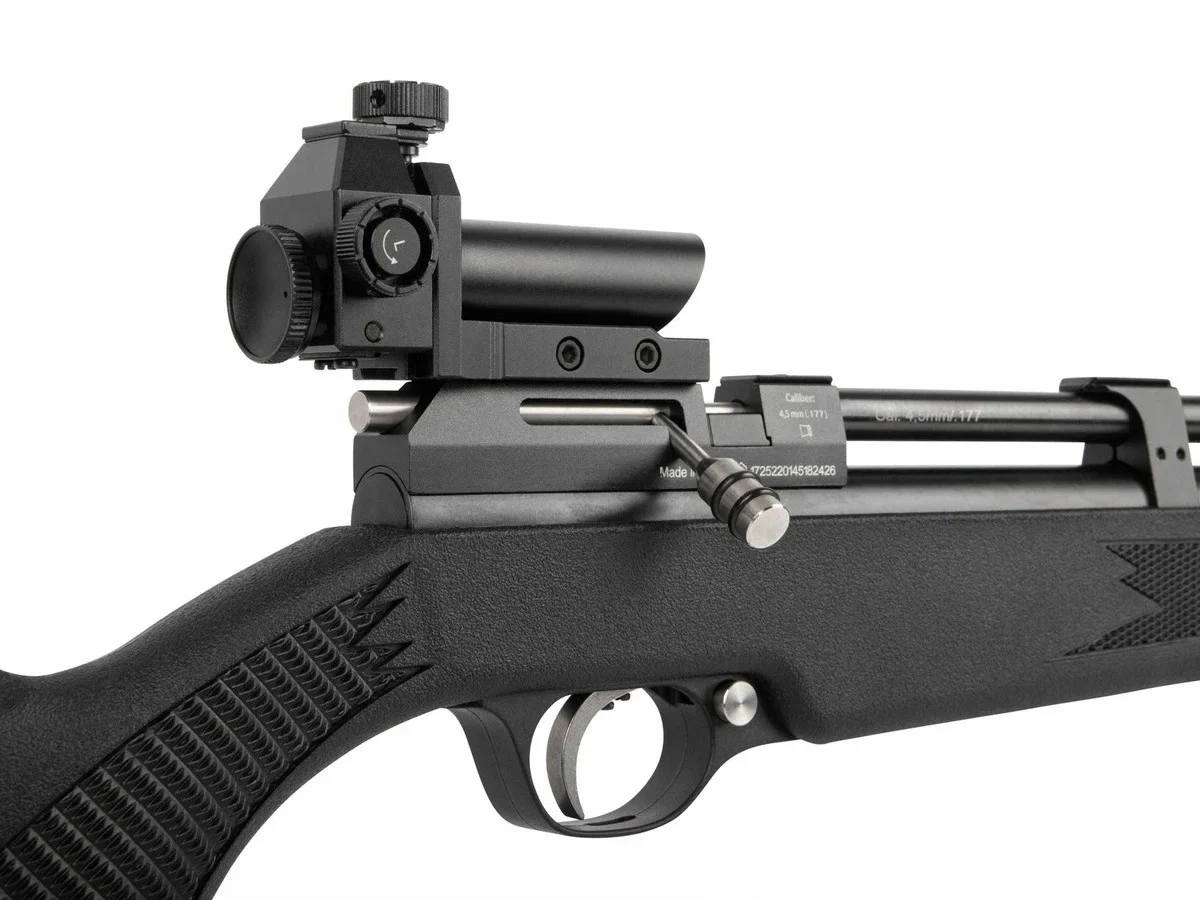
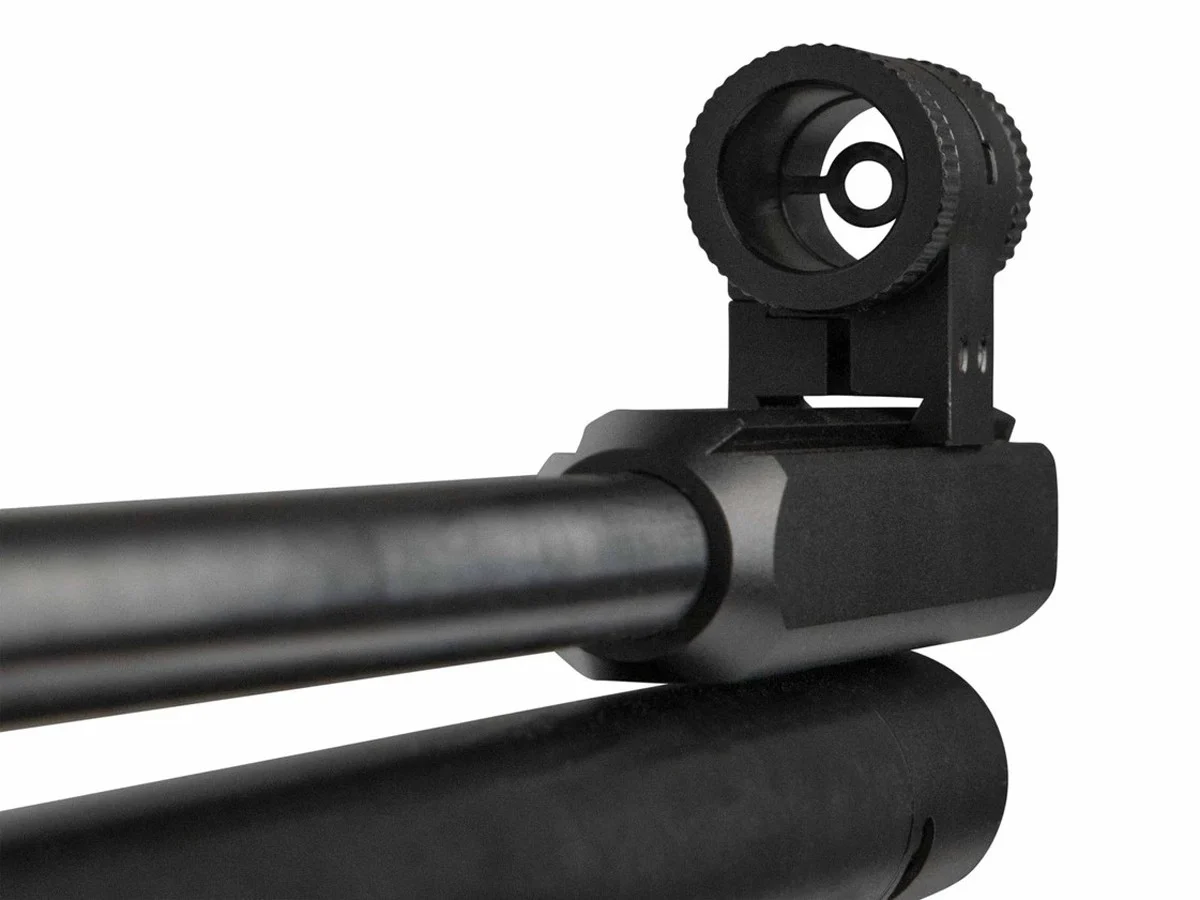
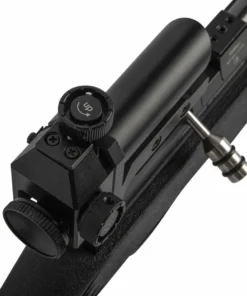
The Diana Stormrider Sport PCP Air Rifle has a front globe sight that accepts interchangeable inserts, as well as a rear diopter sight that has micrometer click adjustments for both elevation and windage. These sights combine to offer increased accuracy at shorter distances for target practice.
Integrated Regulator for Consistency
This air rifle has a regulator to provide steady performance with each shot because of the consistent velocity it offers. Shooters can be confident of the accuracy of a shot because the air rifle offers performance they can predict.
Synthetic Stock for Maneuverable Durability
The Diana Stormrider Sport PCP Air Rifle has an all-weather synthetic stock to provide dependable use in nearly any conditions, and the low weight makes it easy to carry and maneuver. The stock has a textured rubber buttpad for improved comfort and control, as well as checkering on the forearm and grip for a non-slip hold.
DIT (Diana Improved Trigger) for Accuracy and Adjustability
This PCP air rifle uses the DIT (Diana Improved Trigger) two-stage adjustable trigger, which can be adjusted for both sear engagement and travel. This gives the shooter the ability to customize the trigger break, which leads to a repeatable break for confident shots.
Features and Benefits
| Feature | Benefit |
|---|---|
| Front Globe Sight and Rear Diopter Sight | Provides accurate aiming for shorter-distance target practice, with the front sight accepting interchangeable inserts, and the rear sight featuring micrometer click adjustments for both windage and elevation. |
| Integrated Regulator | Delivers consistent performance from each shot, with stable velocity that leads to predictable accuracy. |
| Two-Stage Diana Improved Trigger (DIT) | Enables a customized break because of adjustments for travel and sear engagement, leading to a sharp and consistent break. |
| Barrel Weight | The weight at the end of the barrel results in superior handling and balance for improved stability. |
| Synthetic Stock | Offers a lightweight and durable experience for increased maneuverability, making it easy to carry. |
Diana Stormrider Sport PCP Air Rifle
- Available in .177 or .22 caliber
- .177 is also available at 5.5 FPE as an entry level 10m competition rifle
- Precharged pneumatic
- Repeater
- Regulated
- Synthetic stock
- Bolt action
- Barrel weight
- Magazine capacity: 9 rounds (.177), 7 rounds (.22)
- Magazine accommodates pellet lengths up to 8.6mm
- Integrated pressure gauge
- 100cc air cylinder
- Max. fill pressure: 2,900 PSI (200 BAR)
- Max. velocity: 600 FPS (.177, 5.5 FPE), 1050 FPS (.177), 950 FPS (.22)
- Max. energy: 20 FPE (.177), 26 FPE (.22)
- DIT (Diana Improved Trigger) two-stage adjustable trigger
- Checkering on forearm and grip
- Front globe sight accepts interchangeable inserts
- Rear diopter sight click-adjustable for windage and elevation
- 11mm dovetail optics rail
- Manual safety
- Textured rubber buttpad
- Barrel length: 19″
- Overall length: 35.43″
- Weight: 5.42 lbs.
- Includes single-shot tray and 1 magazine
Specifications
BrandCaliber.22 (5.5mm)Max Velocity950 fpsMuzzle Energy26 ft/lbsSuggested forSmall game hunting/target practicePowerplantPre-charged pneumaticLoudness3-MediumWeight5.42 lbsFunctionRepeaterCylinder Size100 ccActionBolt-actionFixed/adj. powerFixedScopeable11mm dovetailFront SightsPost globeRear SightsDiopter/micrometer adjustableSafetyManualTriggerTwo-stage adjustableBarrelRifledCapacity7 round(s)Body TypeRifleStockSyntheticButtplateRubberColorBlackOperating Pressure2900 PSI / 200 BARBarrel Length19 inGrip OrientationAmbidextrousOverall Length35.4 inRegulatedYesIs Safe To Dry FireYesMagazine Included1Upgrades26 FPE
Diana Stormrider Sport PCP Air Rifle – Precision Target Shooting, Regulated Power, Diopter Sight, Performance, Calibers & Complete Product Guide
Diana Stormrider Sport PCP Air Rifle – Comprehensive Product Description, Technical Specifications, Precision Engineering, Performance, and SEO Keywords
Diana Stormrider Sport PCP Air Rifle – Precision-Oriented Sporting Performance and Modern Pneumatic Engineering
The Diana Stormrider Sport PCP Air Rifle combines regulated pre-charged pneumatic technology, precision-oriented barrel construction, traditional bolt-action operation, and specialized target-shooting features in a lightweight sporting platform. Developed as an accessible introduction to PCP sport shooting, this modern configuration brings together an integrated air regulator, Diana Improved Trigger, adjustable diopter sight, front globe sight, and durable synthetic stock.
Unlike conventional spring-piston equipment, the Diana Stormrider Sport PCP Air Rifle uses compressed air stored inside a dedicated pressure reservoir. Consequently, the operating mechanism does not rely on a large spring and piston to compress air during each firing cycle. Instead, stored compressed air supplies the firing system through a regulated pneumatic arrangement.
Furthermore, the integrated regulator helps manage pressure delivery as the reservoir’s internal pressure changes. This engineering feature supports more consistent operating conditions and distinguishes the Sport configuration from earlier unregulated versions of the product family.
The Diana Stormrider Sport PCP Air Rifle is available in .177 and .22 caliber configurations. The .177 version incorporates a nine-round rotary magazine, while the .22 model accommodates seven pellets. Both configurations use a 100cc reservoir, 200 BAR maximum filling pressure, and a 19-inch rifled barrel.
However, the most distinctive feature is its specialized sighting arrangement.
The manufacturer includes an adjustable rear diopter sight and a front globe sight that accepts interchangeable inserts. This combination creates a recognizable target-oriented configuration that differs from the simpler open-sight arrangements available on some traditional sporting rifles.
Additionally, the Diana Stormrider Sport PCP Air Rifle incorporates an adjustable Diana Improved Trigger, commonly referred to as the DIT mechanism. This two-stage trigger system provides a refined mechanical interface associated with the manufacturer’s precision-oriented sporting equipment.
The synthetic stock offers another important distinction. Its ergonomic profile, checkered gripping surfaces, and textured rubber buttpad combine practical construction with contemporary styling.
Furthermore, the manufacturer incorporates a barrel weight as part of the Sport configuration. This feature contributes to the rifle’s physical balance and distinctive exterior appearance.
At approximately 5.4 pounds, the Diana Stormrider Sport PCP Air Rifle remains relatively lightweight compared with many larger pneumatic sporting platforms.
Its overall length of approximately 35.4 inches creates a compact configuration, while the 19-inch rifled barrel provides an important element of its precision-oriented design.
The Diana Stormrider Sport PCP Air Rifle also includes an 11mm dovetail optics rail, quick-fill connection, manual safety, and integrated pressure gauge.
For customers seeking a sporting pneumatic platform with recognizable target-shooting equipment, the combination of these features makes the rifle an interesting option.
Nevertheless, maximum published performance figures should not be confused with guaranteed accuracy. Actual results depend on the configuration, projectiles, mechanical condition, and testing environment.
The Diana Stormrider Sport PCP Air Rifle represents a specialized evolution of the established product family, bringing modern pressure regulation and target-oriented sighting equipment into an accessible package.
Diana Stormrider Sport PCP Air Rifle – Complete Technical Specifications and Features
The manufacturer’s 2026 catalog and current product information identify the following specifications.
Manufacturer and model specifications
-
Brand: Diana
-
Model: Stormrider Sport
-
Product number: 1900433 for the manufacturer-listed .177 configuration
-
Product category: Pre-charged pneumatic sporting rifle
-
Operating system: PCP compressed air
-
Action: Bolt-action repeater
-
Pressure regulation: Integrated regulator
-
Stock: Black synthetic with checkered gripping surfaces
-
Available calibers: .177 (4.5mm) and .22 (5.5mm)
-
Air reservoir: 100cc
-
Maximum filling pressure: 200 BAR / approximately 2,900 PSI
-
Barrel: Rifled
-
Barrel length: 480mm / approximately 19 inches
-
Overall length: 900mm / approximately 35.4 inches
-
Weight: Approximately 2.46kg / 5.4 pounds
-
Trigger: Two-stage adjustable Diana Improved Trigger
-
Rear sight: Adjustable diopter sight
-
Front sight: Globe sight with interchangeable insert compatibility
-
Optics mounting: 11mm dovetail rail
-
Barrel accessory: Integrated barrel weight
-
Safety: Manual
-
Pressure monitoring: Integrated gauge
-
Charging connection: Quick-fill port
-
Buttpad: Textured rubber
-
Grip orientation: Ambidextrous
-
Magazine system: Rotary magazine
-
Alternative feeding: Single-shot tray
Caliber-specific specifications
.177 Caliber Configuration
-
Nominal caliber: 4.5mm
-
Magazine capacity: 9 pellets
-
Maximum advertised velocity: 1,050 FPS / 320 m/s
-
Maximum advertised energy: 27 joules / approximately 20 FPE
-
Maximum fill pressure: 200 BAR
-
Reservoir capacity: 100cc
-
Barrel length: 19 inches
.22 Caliber Configuration
-
Nominal caliber: 5.5mm
-
Magazine capacity: 7 pellets
-
Maximum advertised velocity: 950 FPS / 290 m/s
-
Maximum advertised energy: 35 joules / approximately 26 FPE
-
Maximum fill pressure: 200 BAR
-
Reservoir capacity: 100cc
-
Barrel length: 19 inches
These figures come from the manufacturer’s 2026 specifications and are consistent with the current US retailer listing. Published performance varies with test pellets and country-specific restrictions.
1900433+2
Why Choose the Diana Stormrider Sport PCP Air Rifle?
The Diana Stormrider Sport PCP Air Rifle stands out through a combination of features specifically relevant to recreational target shooting and introductory precision-oriented sporting activities.
First, its integrated regulator distinguishes it from simpler unregulated designs. This system helps control downstream pressure, creating more consistent operating conditions.
Second, the specialized diopter sight and front globe sight provide a target-oriented optical arrangement without requiring the immediate purchase of a magnified scope.
Third, the adjustable two-stage trigger introduces mechanical refinement. Its design provides distinct stages of movement while retaining the manufacturer’s intended safety characteristics.
Furthermore, the compact synthetic stock offers practical resistance to certain environmental conditions that affect natural wood.
The checkered forearm and grip contribute tactile texture, while the rubber buttpad provides a comfortable contact surface.
Another advantage is the relatively manageable weight. At approximately 5.4 pounds, the equipment is lighter than many larger regulated pneumatic alternatives.
Additionally, the manufacturer includes both a rotary magazine and a single-shot tray, giving owners two supported feeding arrangements.
The barrel weight represents another distinctive feature. Its inclusion changes the rifle’s mass distribution and contributes to the external configuration.
However, buyers should understand that this is a specialized PCP system requiring approved high-pressure charging equipment.
The standard rifle package does not necessarily include a pump or compressor.
For enthusiasts interested in target-oriented features, regulated performance, and relatively lightweight construction, the Diana Stormrider Sport PCP Air Rifle provides a distinctive combination of technology and practicality.
How the Pre-Charged Pneumatic Power System Works
The Diana Stormrider Sport PCP Air Rifle operates using compressed air stored inside a dedicated high-pressure reservoir.
The system differs from conventional spring-powered equipment because the air is compressed before the firing cycle.
A mechanical valve controls the release of stored air through the firing mechanism.
Consequently, the operation has different vibration and recoil characteristics from a traditional spring-piston arrangement.
The integrated regulator further distinguishes the design.
During normal operation, reservoir pressure decreases as compressed air is consumed.
A regulator manages the pressure supplied to the downstream components, reducing certain variations associated with changing reservoir pressure.
However, pressure regulation does not guarantee identical performance under every condition.
Seal quality, projectile characteristics, temperature, and manufacturing tolerances remain important.
The Diana Stormrider Sport PCP Air Rifle therefore combines the convenience of a magazine-fed mechanism with the engineering requirements of a high-pressure pneumatic system.
Integrated Regulator – Consistent Air Delivery and Mechanical Reliability
One of the defining features of the Diana Stormrider Sport PCP Air Rifle is its integrated regulator.
A compressed-air reservoir contains gas at elevated pressure. As the stored supply decreases, reservoir pressure changes.
Without regulation, these changes may influence the conditions available to the firing mechanism.
The regulator manages downstream pressure to help establish more consistent operating conditions.
Consequently, it provides a useful foundation for repeatable pneumatic performance.
However, the system contains specialized components that require appropriate maintenance.
The regulator’s condition depends on seals, internal mechanisms, and correct manufacturer-supported operation.
Furthermore, unauthorized pressure adjustments may compromise reliability and safety.
The integrated regulator should therefore be regarded as an engineering advantage rather than an invitation to modify the equipment.
For technically knowledgeable buyers, this feature is particularly important because the platform combines pressure regulation with a compact reservoir.
100cc Reservoir and 200 BAR Maximum Filling Pressure
The Diana Stormrider Sport PCP Air Rifle incorporates a 100cc compressed-air reservoir.
Its relatively compact volume contributes to the rifle’s manageable physical dimensions.
However, reservoir capacity and operating pressure are different specifications.
Capacity describes internal storage space, while pressure defines the condition of the compressed gas.
The maximum permitted filling pressure is 200 BAR, equivalent to approximately 2,900 PSI.
Consequently, the rifle requires appropriately rated charging equipment.
A conventional household inflation device is not suitable for this application.
Furthermore, the reservoir must remain protected against impacts, excessive heat, corrosion, and unauthorized modifications.
The integrated pressure gauge provides information about reservoir pressure.
However, it does not replace the manufacturer’s approved filling procedures.
The Diana Stormrider Sport PCP Air Rifle should only be charged with the type of air specified by the manufacturer.
Specialized high-pressure equipment deserves appropriate care regardless of reservoir size.
Precision-Rifled Barrel and Barrel Weight
The rifle incorporates a 19-inch rifled barrel.
Rifling introduces rotational movement to compatible pellets, supporting their stability during flight.
However, barrel length alone does not establish accuracy.
Internal bore quality, mechanical consistency, projectile characteristics, and environmental conditions all matter.
Furthermore, the manufacturer incorporates a barrel weight within the Sport configuration.
The external weight influences the overall mass distribution and contributes to the rifle’s distinct appearance.
Nevertheless, the presence of a barrel weight should not be interpreted as a guarantee of superior precision.
Actual performance requires repeatable testing.
The relationship between the fixed rifled barrel, regulated air delivery, and target-oriented sighting arrangement makes this model technically interesting.
However, every component should be evaluated as part of the complete mechanical system.
Diopter Rear Sight – Precision-Oriented Target Sighting
The adjustable diopter sight is one of the most recognizable features of the Diana Stormrider Sport PCP Air Rifle.
Unlike a traditional open rear sight, a diopter uses a small aperture through which the shooter views the front sight.
This design is commonly associated with organized target-shooting equipment.
The manufacturer’s configuration provides adjustable windage and elevation.
Furthermore, the diopter arrangement works with the front globe sight.
However, sight quality depends on mechanical construction and condition.
A diopter does not guarantee exceptional results independently of the equipment and user.
The sighting system should be evaluated as part of the complete target-oriented design.
Front Globe Sight and Interchangeable Inserts
The front globe sight provides another distinctive feature.
Its construction accommodates interchangeable inserts, allowing the sight’s visual reference to be configured using manufacturer-compatible components.
This arrangement differs from a simple fixed front blade.
Furthermore, the enclosed globe design offers a recognizable sporting appearance.
However, insert compatibility must be verified.
Accessories intended for another sighting system may not fit.
The combination of a diopter rear sight and front globe sight is a defining feature of the Sport variant.
Diana Improved Trigger – Two-Stage Adjustable Mechanism
The Diana Stormrider Sport PCP Air Rifle incorporates the Diana Improved Trigger.
This mechanism provides two distinct phases of trigger movement.
Its adjustable construction offers manufacturer-defined options within the intended design.
However, trigger mechanisms are safety-critical components.
Unauthorized adjustment can compromise reliability.
Consequently, servicing should follow official manufacturer instructions.
The trigger’s quality contributes to the overall mechanical experience but does not independently guarantee precision.
Bolt-Action Repeater and Rotary Magazine
The Diana Stormrider Sport PCP Air Rifle uses a bolt-action mechanism.
The repeating system works with a caliber-specific rotary magazine.
The .177 version accommodates nine pellets, while the .22 version accommodates seven.
Furthermore, the manufacturer specifies that the magazine can accommodate pellets with lengths up to 8.6mm.
However, dimensional compatibility remains essential.
Projectiles and magazines should always meet the manufacturer’s requirements.
The system also includes a single-shot tray, providing an alternative feeding arrangement.
These features combine traditional mechanical operation with modern pneumatic technology.
Synthetic Stock and Sporting Ergonomics
The black synthetic stock gives the rifle its contemporary appearance.
Textured gripping surfaces appear along the forearm and grip.
Furthermore, the ergonomic arrangement accommodates different handling preferences.
The rubber buttpad provides another contact surface.
However, comfort depends on individual proportions.
A relatively lightweight stock may appeal to some users while others prefer different balance characteristics.
Synthetic materials also offer maintenance advantages under certain environmental conditions.
Nevertheless, impacts, chemical exposure, and excessive heat can still cause damage.
Proper care remains important.
.177 Caliber Performance and Technical Characteristics
The .177 version uses 4.5mm pellets and incorporates a nine-round magazine.
The manufacturer advertises maximum velocity reaching approximately 1,050 FPS and energy of approximately 20 foot-pounds.
However, these figures depend on testing conditions and legal market configuration.
The smaller nominal diameter contributes to different projectile characteristics from the larger caliber.
Nevertheless, caliber alone does not establish precision.
Actual results depend on ammunition consistency, barrel quality, and operating conditions.
.22 Caliber Performance and Technical Characteristics
The .22 version uses 5.5mm pellets and incorporates a seven-round magazine.
Its maximum published velocity reaches approximately 950 FPS, while energy is advertised at approximately 26 foot-pounds.
The larger projectile diameter creates different physical and ballistic characteristics.
However, it should not be described as universally more accurate.
The manufacturer’s approved ammunition specifications should guide compatibility.
Both caliber versions require appropriate facilities, safe handling, and legal compliance.
Diana Air Rifle Heritage and Traditional Sporting Engineering
The diana air rifle brand has an established history in pneumatic sporting equipment, with origins dating to 1890.
Customers researching air rifle diana, diana air rifles, and rws diana air rifle may encounter numerous classic and contemporary models.
The diana pellet gun category includes spring-powered designs, regulated pneumatic rifles, and compact sporting equipment.
However, models from the same manufacturer do not necessarily share the same internal technology.
For example, the Sport configuration combines an integrated regulator and specialized target sighting system, whereas traditional designs often rely on mechanical spring-piston technology.
The difference is especially important for buyers comparing pressure requirements, maintenance, physical dimensions, and shooting characteristics.
Diana 34, Diana 34 EMS, and Traditional Break-Barrel Comparisons
The diana 34 and diana 34 air rifle belong to the manufacturer’s established spring-powered product family.
The Diana 34 air rifle attracts interest from enthusiasts who appreciate traditional break-barrel construction.
Meanwhile, diana 34 ems and diana 34 ems fiber optic sights concern a modular model with different engineering characteristics.
The term diana r34 may appear in related searches, although buyers should verify the exact manufacturer designation.
A Diana break barrel air rifle uses a different operating principle from a regulated compressed-air system.
Similarly, Diana springer air rifle generally refers to spring-piston equipment.
Consequently, customers should not assume that these products use identical charging procedures or maintenance schedules.
The Diana Stormrider Sport PCP Air Rifle stands apart through its regulated air delivery, synthetic stock, and specialized target sights.
Diana 48, Diana 460 Magnum, and Fixed-Barrel Models
The diana 48 and diana mod 48 represent another traditional spring-powered product family.
The diana rws 460 magnum also incorporates a distinct mechanical arrangement.
These models differ from the Diana Stormrider Sport PCP Air Rifle in their power sources and operating systems.
A spring-piston mechanism generates compressed air through internal mechanical movement.
By comparison, a PCP system uses previously compressed air stored in a reservoir.
Consequently, their maintenance requirements and mechanical characteristics differ.
For buyers, the strongest comparison involves actual specifications rather than manufacturer reputation alone.
Diana 350 Magnum, Diana 250, and Traditional Sporting Rifles
The diana 350 magnum and diana 350 magnum air rifle are associated with powerful spring-piston equipment.
Meanwhile, the diana 250 air rifle, diana 250, and diana two fifty refer to another sporting family.
These models have different operating characteristics from a regulated pneumatic target rifle.
Furthermore, dimensions, weight, stock design, and trigger configurations vary.
Customers considering these alternatives should compare verified technical specifications and ownership requirements.
Diana Air Pistols, LP8, Chaser Accessories, and Other Models
The manufacturer’s product range extends beyond full-length sporting rifles.
Searches for diana air pistol and lp8 diana often concern compact spring-powered pistol models.
Likewise, diana chaser parts and diana chaser accessories refer to another product family with specific component requirements.
The diana r22 also identifies a separate sporting model.
These products may share a brand identity, but mechanical compatibility should never be assumed.
Replacement components should always match the exact manufacturer designation.
Diana Air Rifle .177 and .22 – Choosing Between Caliber Configurations
Searches for Diana air rifle .177 and Diana air rifle .22 reflect interest in the two common pellet diameters.
The Diana Stormrider Sport PCP Air Rifle offers both configurations according to its published manufacturer catalog.
However, the correct choice depends on the intended lawful activity and local regulations.
The phrase Diana air rifle accuracy should also be evaluated carefully.
Accuracy does not depend on caliber alone.
Manufacturing quality, projectile consistency, operating conditions, and testing procedures all influence measured results.
Meanwhile, the search phrase Diana air rifle hunting introduces additional legal and ethical considerations.
A product advertised for target shooting should not automatically be considered suitable for every hunting application.
Buy Diana Air Rifle – Important Purchasing Considerations
Customers searching for Buy Diana air rifle should evaluate more than the purchase price.
Important considerations include the exact model, caliber, pressure requirements, supplied accessories, warranty coverage, and after-sales service.
The Diana Stormrider Sport PCP Air Rifle includes specialized target-sighting equipment and an integrated regulator.
However, approved charging equipment may require a separate purchase.
The cost of compatible projectiles, protective eyewear, secure storage, and maintenance should also be considered.
A reliable retailer should clearly identify the exact configuration being supplied.
Umarex Airguns and Umarex Air Rifles – Alternative PCP Products
The wider umarex product portfolio contains various pneumatic systems.
Buyers searching for umarex usa, umarexusa, and the common misspelling umerex may discover products across multiple sporting categories.
The umarex notos represents a compact pneumatic platform, while the umarex zelos features a different stock configuration.
Meanwhile, umarex gauntlet and umarex gauntlet 2 represent alternative compressed-air designs.
The umarex hammer belongs to a significantly different performance category.
Other product searches include umarex fusion 2 and umarex komplete.
Although these products share a broader recreational market, their operating mechanisms and technical specifications differ.
Consequently, buyers researching umarex airguns, umarex air rifles, and general air guns should compare the actual features of each model.
The Diana Stormrider Sport PCP Air Rifle is particularly distinctive because of its diopter sight, front globe sight, and target-oriented design.
Umarex Glock BB Guns, Licensed Replicas, and Airsoft Equipment
The recreational replica market also attracts considerable interest.
Common searches include umarex glock, umarex glock 17, umarex glock 19, and umarex glock 17 gen 5.
Related terms include glock bb gun, glock 19 bb gun, bb gun glock, and metal bb gun.
Meanwhile, umarex airsoft, airsoft glock, and glock 19 airsoft concern another recreational category.
These products generally use different projectiles and operating mechanisms from a regulated pellet rifle.
Consequently, their magazine systems, ammunition, and power specifications cannot be treated as interchangeable.
A target-oriented pneumatic platform should be evaluated separately from licensed replica equipment.
Umarex T4E, TR50, HDR 50, and Specialized Launchers
The umarex t4e series represents another category of specialized sporting and training equipment.
Searches include umarex tr50, umarex hdr 50, and umarex t4e smith.
The question umarex p2p dr50 how many joules concerns a different product’s energy rating, which may vary by version and market.
Additional search terms such as umarex smith, umarex hk heckler, and umarex h may appear in broad manufacturer research.
However, these terms do not identify features of the Diana Stormrider Sport PCP Air Rifle.
Every product should be evaluated using its own technical documentation.
Airgun Pistols and Other Recreational Sporting Equipment
The broad air rifle market includes several operating technologies.
Likewise, airgun pistol, air pistol, airgun pistol and rifle, and air rifles and pistols describe different product categories.
Customers researching best airgun pistol, airgun pistol review, or air pistol for beginners may be comparing compact sporting equipment.
Other common searches include airgun pistol .177, air rifle .22, PCP airgun pistol, and airgun pistol accuracy.
The term air pistol for plinking generally refers to casual recreational target activities.
Meanwhile, best air rifle for hunting requires careful interpretation because legal suitability and humane standards differ by jurisdiction.
The Diana Stormrider Sport PCP Air Rifle is designed primarily around sporting target features rather than compact pistol characteristics.
Weihrauch, Crosman, Benjamin, and Other Sporting Pistol Comparisons
Buyers researching compact pneumatic equipment may encounter the Weihrauch HW44, Crosman 1377, and Benjamin Marauder Pistol.
Additional product searches include the AirForce TalonP, Gamo PT85, and Steyr LP10.
The Umarex Beretta M9, Sig Sauer P320, and Umarex Legends P08 are associated with other sporting or replica categories.
Their operating systems and projectile requirements can differ significantly.
The search phrase FX Maverick Pistol should be verified against an exact factory model rather than assumed to identify a standardized product.
Technical comparisons should prioritize authentic manufacturer specifications.
Karma Airguns and Compact Folding-Stock Alternatives
Searches involving karma airguns and .22 Karma SLS Compact Folding Stock lead to another segment of modern pneumatic equipment.
Compact or folding-stock designs introduce different physical dimensions and handling characteristics.
However, portability does not automatically establish superior accuracy.
The Diana Stormrider Sport PCP Air Rifle belongs to a different sporting category, emphasizing regulated power, a diopter sighting system, and traditional bolt-action operation.
Therefore, buyers should compare actual engineering features rather than relying exclusively on appearance.
Why the Diana Stormrider Sport PCP Air Rifle Is Suitable for Target-Oriented Sporting Activities
The Diana Stormrider Sport PCP Air Rifle is designed primarily for sporting target use.
Its diopter sight and front globe sight provide a recognizable arrangement associated with precision-oriented target equipment.
Furthermore, the adjustable trigger and relatively lightweight stock contribute to a practical sporting configuration.
However, suitability depends on the intended event, governing rules, and facility restrictions.
Not every formal shooting competition permits the same equipment characteristics.
Consequently, users should verify eligibility before participating.
The Diana Stormrider Sport PCP Air Rifle also requires a suitable high-pressure charging system, appropriate protective infrastructure, and responsible handling.
Final Section 1 Product Overview
The Diana Stormrider Sport PCP Air Rifle combines a 19-inch rifled barrel, integrated regulator, 100cc compressed-air reservoir, two-stage adjustable trigger, and specialized target-sighting equipment.
Its synthetic stock, rubber buttpad, and compact dimensions contribute to practical handling characteristics.
Furthermore, the rotary magazine and single-shot tray provide two manufacturer-supported feeding arrangements.
The diopter rear sight and front globe sight distinguish this model from simpler recreational configurations.
For enthusiasts seeking a regulated target-oriented pneumatic rifle, the Diana Stormrider Sport PCP Air Rifle offers a technically interesting combination of precision-focused features and manageable dimensions.
SECTION 2: Advanced Precision Engineering, Target-Shooting Technology, Pressure Regulation, Practical Performance, Maintenance, and Long-Term Ownership
Understanding the Engineering Philosophy Behind Modern Target Equipment
Modern precision-oriented pneumatic equipment brings together pressure-management technology, mechanical consistency, ergonomics, and specialized sighting arrangements. Each component performs a different function, but their collective operation determines the overall user experience.
The pressure reservoir supplies stored energy, while the firing valve controls its release. Meanwhile, the trigger mechanism provides the interface between the user and the mechanical assembly. The barrel influences projectile stabilization, and the stock establishes the physical relationship between the equipment and its operator.
Consequently, no individual component can guarantee exceptional performance.
A sophisticated sighting system may provide accurate visual references, but those references cannot compensate for every mechanical inconsistency. Similarly, a regulator may support controlled pressure delivery without eliminating projectile variation or environmental influences.
The value of modern engineering lies in how these features work together.
Manufacturing quality is equally important. Moving components must maintain appropriate dimensional tolerances, while pressure-bearing structures must operate within specified limits.
Furthermore, equipment intended for organized sporting activities should provide dependable operation and suitable ergonomic characteristics.
For buyers, understanding the complete mechanical design offers a more useful basis for evaluation than relying exclusively on maximum advertised velocity.
A technically balanced platform should combine reliable construction, documented safety requirements, accessible servicing, and practical compatibility with the intended sporting environment.
Why Integrated Pressure Regulation Is Important
Pressure regulation provides an important advantage in modern compressed-air systems.
A reservoir contains pressurized gas, and its internal pressure changes as that gas is consumed.
Without a regulator, the changing reservoir pressure may influence the conditions available to the firing mechanism.
A regulator manages downstream pressure, helping establish more consistent operating conditions within the intended pressure range.
However, this arrangement does not make the entire system immune to variation.
Temperature, sealing condition, manufacturing tolerances, and projectile characteristics still influence performance.
Furthermore, a regulator is itself a mechanical assembly.
Internal components may deteriorate over time, while contamination can affect reliable operation.
Consequently, the manufacturer should define appropriate servicing and inspection procedures.
Unauthorized adjustments can compromise safety and reliability.
The principal value of regulation lies in managing one important variable within a larger mechanical system.
Understanding Pressure Consistency and Repeatability
Repeatability is essential when evaluating precision-oriented equipment.
A single favorable result does not demonstrate that the same performance will occur repeatedly.
Consequently, technical assessments should examine consistent behavior across multiple operations.
Pressure delivery is one factor that influences this behavior.
However, other variables remain important.
The firing mechanism must maintain appropriate mechanical condition, while compatible projectiles must exhibit suitable manufacturing consistency.
Environmental conditions can also affect the measured results.
Furthermore, pressure-related behavior changes when the stored supply decreases below the system’s effective operating range.
For this reason, a regulator should be evaluated according to its intended design rather than treated as a universal guarantee.
A credible performance assessment should include the testing conditions and measurement methodology.
Why Reservoir Capacity Matters
Reservoir capacity describes the internal volume available for compressed-air storage.
However, capacity does not independently determine operating duration.
The efficiency of the firing mechanism, pressure range, and overall mechanical design influence how the stored air is consumed.
Consequently, two systems with similar reservoir volumes may provide different practical results.
A smaller reservoir can contribute to reduced weight and more compact external dimensions.
Nevertheless, it may require more frequent charging compared with a larger reservoir under otherwise comparable conditions.
Furthermore, additional capacity usually introduces physical trade-offs.
The reservoir’s material, dimensions, and mounting arrangement contribute to overall balance.
Buyers should therefore consider capacity alongside the complete design.
Understanding the Importance of Maximum Filling Pressure
Maximum filling pressure represents a critical manufacturer-defined limit.
The pressure vessel must remain within that limit to preserve its intended safety characteristics.
Exceeding the specified maximum may damage internal components or create dangerous conditions.
Consequently, only properly rated charging equipment should be considered.
Furthermore, the charging device’s maximum pressure rating does not override the pressure vessel’s own limit.
Connection compatibility also matters.
A fitting that appears physically suitable may still fail to meet the necessary engineering requirements.
The manufacturer’s approved procedures should remain the authoritative reference.
Pressure Gauges and Accurate Monitoring
A pressure gauge provides information about the condition of a compressed-air reservoir.
However, it is important to understand the distinction between pressure monitoring and pressure regulation.
A gauge measures pressure, while a regulator manages pressure supplied to another part of the mechanism.
Consequently, the two components serve different purposes.
Pressure gauges can also experience wear or damage.
Unusual readings should receive appropriate professional attention.
Furthermore, a gauge should not replace routine inspection of the reservoir, fittings, and charging equipment.
Correct pressure monitoring supports informed ownership but does not eliminate the responsibility to follow approved procedures.
Why High-Pressure Charging Equipment Requires Careful Selection
Compressed-air charging equipment must satisfy specific technical requirements.
Pressure capability, connector design, hose construction, filtration, and equipment condition are all relevant.
Consequently, ordinary household inflation devices are unsuitable for specialized high-pressure systems.
A compatible charging arrangement should meet the manufacturer’s specifications.
Furthermore, charging equipment requires appropriate maintenance.
Worn seals, damaged hoses, or defective pressure gauges may create hazards.
Owners should inspect the equipment according to official instructions and seek professional assistance when defects are suspected.
Improvised charging arrangements should be avoided.
Manual Pump Versus Electric Compressor
A manual pump provides a charging arrangement that does not require electrical power.
This can be practical for certain owners, particularly when the reservoir is relatively small.
However, manual charging requires physical effort.
The amount of effort depends on the pump’s design and the pressure conditions involved.
An electric compressor offers a powered alternative but introduces additional technical and maintenance requirements.
Furthermore, not every compressor is appropriate for every compressed-air reservoir.
The complete pressure rating and connection specifications must be verified.
The appropriate choice depends on physical capability, budget, available infrastructure, and manufacturer approval.
Precision Barrel Construction and Its Importance
A rifled barrel influences projectile stabilization.
Internal helical grooves impart rotational motion to compatible projectiles, helping maintain their aerodynamic orientation during flight.
However, rifling alone does not guarantee exceptional precision.
Bore quality, internal finish, projectile dimensions, and mechanical consistency remain important.
Furthermore, environmental conditions can influence actual results.
A longer barrel also changes physical dimensions and weight distribution.
Consequently, length should not be treated as a universal measure of accuracy.
Reliable testing provides a stronger basis for evaluating precision than promotional claims based on barrel length alone.
Why Projectile Quality Influences Performance
Compatible projectiles can vary in mass, shape, dimensions, and material consistency.
These differences may influence their interaction with the barrel and feeding system.
Consequently, accurate performance assessment requires attention to projectile characteristics.
However, compatibility should never be determined by nominal diameter alone.
The manufacturer’s approved specifications must guide selection.
Damaged or unsuitable projectiles may create mechanical problems.
Furthermore, performance tests should clearly identify the ammunition used.
Without this information, direct comparisons may be misleading.
Understanding Target-Oriented Diopter Sights
A diopter sight uses an aperture-based visual arrangement.
Unlike a conventional open rear sight, this design provides a small opening that forms part of the sight picture.
Such systems have a longstanding association with organized target disciplines.
However, the presence of an aperture sight does not guarantee precision.
Mechanical construction, adjustment consistency, and individual eyesight remain influential.
Furthermore, the complete sighting arrangement must maintain appropriate alignment and condition.
Damage or loose components may affect the quality of the visual reference.
The manufacturer’s documentation should guide inspection and maintenance.
Why a Front Globe Sight Is Significant
A front globe sight provides a specialized housing for the forward visual reference.
Certain designs accommodate interchangeable inserts.
This allows manufacturer-compatible visual elements to be used within the sight assembly.
However, compatibility must be confirmed.
Not every insert designed for another product will fit correctly.
Furthermore, the front globe should remain free from physical damage and contamination.
Its presence contributes to the target-oriented character of the equipment.
Nevertheless, actual performance depends on the complete system and the user’s visual requirements.
Mechanical Adjustment Quality in Target Sights
Adjustable sighting equipment incorporates moving mechanical elements.
These components must maintain consistent alignment and suitable mechanical integrity.
Manufacturing tolerances therefore influence reliability.
However, adjustment markings do not automatically prove that the mechanism performs with exceptional repeatability.
The quality of construction matters.
Furthermore, damage or excessive wear can affect the adjustment assembly.
A credible technical evaluation should consider mechanical condition and manufacturer documentation.
The Role of Barrel Weights in Sporting Equipment
An external barrel weight changes the distribution of mass along the equipment.
This influences the overall physical balance.
However, its effect depends on the complete configuration.
A weight that feels suitable to one user may not provide the same experience for another.
Furthermore, additional mass can affect portability.
The feature should therefore be evaluated as part of the manufacturer’s intended design rather than assumed to improve precision universally.
Unauthorized modifications should be avoided.
The Relationship Between Balance and Comfort
Balance describes the distribution of mass within the equipment.
Two products with similar overall weights can feel different because their components occupy different positions.
Consequently, total weight alone does not establish comfort.
Stock geometry, grip design, and physical proportions also contribute.
Furthermore, accessories can change the center of mass.
A suitable configuration should match the owner’s physical capabilities and intended sporting activities.
The importance of balance becomes clearer during extended use, when equipment that initially feels manageable may become tiring.
Two-Stage Trigger Engineering
A two-stage trigger provides distinct phases of mechanical movement.
The initial stage and subsequent release stage create a particular tactile experience.
However, quality depends on manufacturing precision, mechanical condition, and factory settings.
The number of stages alone does not determine accuracy.
Furthermore, trigger mechanisms are safety-critical components.
Unauthorized adjustments may compromise reliable operation.
The manufacturer’s approved configuration should therefore be preserved.
Professional servicing is appropriate when defects develop.
Why Trigger Consistency Matters
Consistency within the trigger mechanism contributes to a predictable mechanical experience.
However, this characteristic depends on suitable component tolerances and maintenance.
Internal wear, contamination, or unauthorized adjustments may alter the intended behavior.
Consequently, a trigger should receive appropriate inspection according to manufacturer guidance.
Its condition should also be considered alongside the complete firing mechanism.
A high-quality trigger cannot compensate for every variation in the barrel, projectile, or pressure system.
Bolt-Action Mechanical Construction
A bolt-action system provides a traditional mechanical interface.
Its internal components must maintain appropriate alignment during operation.
Consequently, manufacturing quality and component condition are important.
Wear may develop over time.
Furthermore, contamination or physical damage can affect moving surfaces.
Owners should inspect visible components and follow official maintenance instructions.
Internal repairs should involve qualified professionals where required.
The system’s reliability depends on engineering quality rather than its apparent simplicity.
Rotary Magazine Reliability
A rotary magazine accommodates multiple projectiles within a defined mechanical arrangement.
The internal chambers must match the intended caliber and projectile dimensions.
Consequently, magazines from different configurations are not necessarily interchangeable.
Manufacturing consistency also matters.
Damaged or contaminated components may create feeding problems.
Furthermore, replacement magazines should match the manufacturer’s approved specifications.
The convenience of a multi-shot arrangement does not eliminate the need for correct handling and maintenance.
Single-Shot Feeding and Mechanical Simplicity
A single-shot feeding component provides an alternative to the rotary magazine.
Its design accommodates one compatible projectile within the intended mechanism.
However, the component must match the specific product configuration.
Similar-looking accessories may have different dimensions.
Consequently, visual similarity is insufficient evidence of compatibility.
The availability of different feeding arrangements adds flexibility while preserving the same fundamental safety requirements.
Synthetic Stock Construction
Synthetic stocks provide an alternative to traditional wooden materials.
Their construction can offer practical resistance to certain environmental conditions.
However, synthetic materials are not immune to damage.
Impacts, excessive heat, ultraviolet exposure, and unsuitable chemicals may affect their condition.
Furthermore, durability depends on the quality of the material and manufacturing process.
Routine inspection and appropriate cleaning remain important.
A synthetic exterior can reduce some maintenance concerns without eliminating all ownership responsibilities.
Textured Gripping Surfaces and Ergonomic Fit
Textured surfaces influence how the equipment feels during handling.
They also contribute to exterior appearance.
However, ergonomic quality depends on more than surface texture.
Stock dimensions, grip shape, weight distribution, and individual body proportions all matter.
Consequently, a design that feels comfortable to one person may not suit another equally well.
Furthermore, textured surfaces require cleaning.
Dirt and moisture may accumulate within patterned areas.
Manufacturer-approved maintenance helps preserve the exterior condition.
Rubber Buttpad Construction
A rubber buttpad creates a contact surface at the rear of the stock.
Its texture and material characteristics can influence comfort.
However, its effectiveness depends on the complete stock geometry.
Rubber components can also deteriorate through age, excessive heat, or chemical exposure.
Consequently, periodic inspection is important.
A damaged component should receive appropriate attention.
The buttpad should be considered one part of the complete ergonomic arrangement rather than a universal guarantee of comfort.
Why Manageable Weight Is Important
A relatively lightweight platform can offer practical advantages.
Transportation, storage, and physical handling may become more convenient.
However, lower weight does not automatically guarantee superior accuracy.
Balance and mechanical consistency remain relevant.
Furthermore, accessories can increase the complete assembled weight.
Consequently, buyers should evaluate the equipment in its intended configuration.
Physical suitability depends on individual needs and preferences.
Compact Dimensions and Storage
Compact external dimensions can simplify certain storage arrangements.
However, even relatively small sporting equipment requires secure storage.
A lockable cabinet or appropriate protective case helps prevent unauthorized access.
Furthermore, ammunition and accessories should be protected.
Environmental conditions also matter.
Excessive humidity can affect metallic components, while heat may influence seals and synthetic materials.
The storage location should satisfy manufacturer recommendations.
The Importance of Manual Safety Systems
A manual safety provides a supplementary protective feature.
However, no mechanical safety should replace disciplined handling.
Components can fail or be operated incorrectly.
Consequently, appropriate muzzle direction and secure storage remain essential.
The equipment should always be handled according to official instructions.
Furthermore, local laws may impose additional storage and transportation requirements.
Safety depends on several complementary practices rather than one mechanism.
Optical Mounting Compatibility
An integrated mounting rail provides an interface for compatible optical equipment.
However, not every accessory uses identical dimensions.
Mounting hardware should match the manufacturer’s specifications.
Furthermore, additional optics introduce weight and clearance considerations.
The presence of a standardized rail does not mean every accessory is automatically suitable.
Buyers should verify mechanical compatibility before purchase.
Why Package Contents Should Be Confirmed
A product photograph may display accessories that are not included in the standard package.
Consequently, buyers should review the exact list of supplied components.
A rotary magazine, alternative feeding tray, and sighting equipment may be standard in one configuration while additional accessories are sold separately.
Furthermore, retailer bundles may differ from manufacturer packaging.
Clear product descriptions help prevent misunderstandings.
A reliable seller should identify the exact model, caliber, and included accessories.
Practical Use in Organized Target-Shooting Facilities
An authorized sporting facility provides a controlled environment for precision-oriented recreational activities.
However, not every facility permits the same equipment.
Restrictions may apply according to caliber, muzzle energy, sighting arrangements, and competition rules.
Consequently, participants should confirm eligibility before visiting.
Suitable protective infrastructure is essential.
A properly designed backstop helps prevent projectiles from traveling beyond the intended area.
Furthermore, participants should follow facility rules concerning protective equipment, supervision, and safe handling.
For newcomers, professional instruction can provide a valuable introduction to sporting procedures and equipment responsibilities.
The suitability of a particular facility should always take priority over assumptions based on product advertising.
Recreational Target Practice and Skill Development
Recreational target practice is one of the common lawful applications of precision-oriented pneumatic equipment.
Its appeal lies in the opportunity to participate in a structured sporting activity.
However, safe participation requires appropriate facilities and supervision.
Participants should also understand that formal competitions may establish specific equipment restrictions.
Consequently, a product designed with target-oriented features is not automatically eligible for every competition.
Different sporting organizations may impose limitations involving sighting equipment, weight, power, and other characteristics.
The relevant governing rules should be reviewed before participation.
Environmental Conditions and Outdoor Performance
Outdoor environments introduce variables that can influence both equipment condition and measured results.
Wind, temperature, humidity, and dust are important considerations.
Consequently, performance observed outdoors may differ from results obtained in controlled indoor conditions.
Furthermore, moisture can contribute to corrosion.
After exposure to challenging environmental conditions, appropriate inspection and cleaning are important.
However, maintenance should follow manufacturer guidance.
A durable synthetic exterior does not eliminate the need to protect internal metallic and pressure-bearing components.
Legal and Ethical Considerations
Ownership and use of powerful pneumatic equipment are subject to laws that vary between jurisdictions.
Some countries regulate products according to muzzle energy or caliber.
Others may impose requirements concerning age, storage, transportation, or permitted activities.
Consequently, prospective owners should verify local legal requirements before purchase.
Equipment designed for sporting targets should not automatically be considered appropriate for hunting.
Wildlife-related activities can involve additional licensing, species restrictions, and humane standards.
Responsible ownership requires compliance with all applicable regulations.
Routine Maintenance and Exterior Cleaning
Maintenance supports long-term reliability and helps preserve the condition of sporting equipment.
However, different components require different procedures.
Exterior surfaces may receive routine cleaning and inspection.
Meanwhile, internal pressure-bearing systems can require professional servicing.
Consequently, owners should distinguish between normal maintenance and specialized repair.
The manufacturer’s instructions should determine the approved procedures.
Unsuitable solvents, lubricants, or abrasive tools may damage components.
A maintenance record can also be useful for tracking inspections and professional work.
Pressure-System Maintenance and Seal Integrity
Seals maintain pressure boundaries within the pneumatic assembly.
Their condition affects the ability of the system to retain compressed air.
However, seals may deteriorate through mechanical wear, aging, or environmental exposure.
Consequently, unexpected leakage may indicate the need for inspection.
Replacement components must match manufacturer specifications.
Visually similar seals may have different material properties or dimensions.
Unauthorized internal repairs can create serious hazards.
Professional servicing is therefore important when pressure-related defects develop.
Preventing Corrosion and Material Deterioration
Moisture can contribute to the corrosion of metallic components.
Consequently, dry storage and appropriate protective maintenance are important.
However, cases can trap moisture when used improperly.
The storage environment should remain within manufacturer recommendations.
Furthermore, synthetic components may be affected by heat or chemical exposure.
Regular inspection helps identify visible deterioration.
Damaged parts should receive appropriate technical attention.
Professional Servicing and Genuine Replacement Components
Specialized mechanical systems may eventually require professional servicing.
Internal pressure components deserve particular care.
Consequently, repairs should involve appropriately qualified personnel.
Replacement components must match the exact model and production configuration.
Manufacturers may introduce design revisions that are not obvious from exterior photographs.
Therefore, genuine part identification is important.
Accessible technical support contributes to long-term ownership value.
Warranty Coverage and After-Sales Support
Warranty terms vary by manufacturer, retailer, product condition, and region.
Consequently, buyers should review the applicable documentation before purchase.
Proof of purchase may be necessary when requesting assistance.
Furthermore, unauthorized modifications can affect warranty eligibility.
Professional service availability should also influence purchasing decisions.
A product supported by reliable replacement-part distribution may offer greater long-term convenience.
Total Cost of Ownership
The initial purchase price represents only part of the financial commitment.
Additional expenses may include compatible charging equipment, projectiles, protective eyewear, secure storage, and professional servicing.
Furthermore, replacement magazines and optional accessories can increase costs.
Consequently, buyers should calculate the total ownership budget.
A lower initial price does not automatically establish better value.
Reliability, construction quality, maintenance requirements, and service support also matter.
Frequently Asked Questions About Performance, Precision, Technology, Maintenance, and Ownership
1. What makes this sporting platform different from traditional spring-powered equipment?
Its pre-charged operating system uses compressed air stored before operation rather than generating pressure through a spring-piston firing cycle.
Consequently, it has different mechanical characteristics and maintenance requirements.
Furthermore, the integrated pressure regulator provides an additional method of managing air delivery.
However, the system requires specialized charging equipment and responsible pressure-vessel care.
2. Why is an integrated regulator important?
A regulator manages the pressure supplied to the firing mechanism as reservoir pressure changes.
This can help reduce certain pressure-related variations.
However, regulation does not eliminate every influence on performance.
Mechanical condition, projectile consistency, and environmental factors remain important.
3. Does regulated pressure guarantee exceptional accuracy?
No.
Regulation contributes to controlled operating conditions, but accuracy depends on multiple factors.
Barrel quality, projectile compatibility, mechanical consistency, and testing conditions all influence results.
Consequently, exceptional precision should be demonstrated through repeatable testing rather than assumed.
4. Why is reservoir capacity important?
Reservoir capacity describes the volume available for compressed-air storage.
However, it does not independently determine the number of usable discharges.
Mechanical efficiency and operating pressure also contribute.
A relatively compact reservoir can reduce weight while introducing practical limitations on stored-air volume.
5. What does the maximum filling pressure mean?
The maximum filling pressure defines the upper safe operating limit established by the manufacturer.
Exceeding that limit can damage equipment and create serious hazards.
Only appropriately rated charging equipment should be used.
The manufacturer’s instructions must always remain the controlling reference.
6. Can a normal household compressor be used?
No.
Ordinary household inflation equipment generally cannot meet the technical requirements of specialized high-pressure pneumatic systems.
Suitable charging equipment must satisfy the manufacturer’s pressure, connection, and safety specifications.
7. Is a manual high-pressure pump suitable?
A manufacturer-approved manual pump may provide a practical charging option.
However, manual operation requires physical effort.
The pump must also have appropriate pressure ratings and compatible fittings.
Suitability depends on the pump design and the owner’s physical capabilities.
8. Does the package include a pump?
The standard rifle listing identifies the main equipment, magazine, single-shot tray, and target sighting system.
A pump is not listed as a standard included accessory.
Consequently, buyers should verify the retailer’s exact package contents before purchase.
9. Why is the barrel rifled?
Rifling introduces rotational motion to compatible projectiles.
This supports aerodynamic stability during flight.
However, precision also depends on projectile consistency and the mechanical condition of the complete system.
10. Does a longer barrel always improve accuracy?
No.
Barrel length influences construction and physical dimensions, but it does not independently guarantee precision.
Bore quality, projectile compatibility, and operating consistency also matter.
Reliable testing provides the strongest basis for performance comparisons.
11. What is the advantage of an aperture-style rear sight?
An aperture sight provides a specialized visual reference commonly associated with organized target disciplines.
However, its effectiveness depends on mechanical condition, optical compatibility, individual eyesight, and the complete sighting system.
Its presence does not automatically guarantee improved results.
12. Why does the front sight use interchangeable inserts?
Compatible inserts provide different manufacturer-supported visual reference arrangements.
However, the exact insert must match the sight housing.
Not every accessory intended for another sight system will be compatible.
13. Is a magnified scope necessary?
Not necessarily.
The standard configuration includes a target-oriented sighting system.
However, suitability depends on the user’s needs and the rules of the intended sporting activity.
If an additional optic is considered, mounting compatibility must be verified.
14. What is the purpose of the barrel weight?
The external weight contributes to the equipment’s overall mass distribution.
However, it does not independently guarantee accuracy.
Its practical value depends on the complete configuration and individual preferences.
15. Why is the trigger adjustable?
The adjustable trigger provides manufacturer-defined mechanical options.
However, unauthorized changes can compromise safety.
Any adjustments or servicing must follow official instructions.
16. What is the difference between single-shot and magazine-fed operation?
A single-shot arrangement accommodates one compatible projectile at a time.
A magazine contains multiple projectiles within a defined mechanical system.
However, the two arrangements require different components and should be used only as intended by the manufacturer.
17. Why do magazine capacities differ between calibers?
Projectile dimensions influence magazine construction.
Consequently, larger-diameter projectiles may require different internal chamber arrangements.
Replacement magazines must match the exact caliber and model.
18. Can magazines from other models be used?
Compatibility should not be assumed.
Similar-looking components may differ in mechanical dimensions.
Manufacturer-approved replacement parts provide the most reliable reference.
19. Is the stock appropriate for outdoor use?
Synthetic construction can provide practical resistance to some environmental conditions.
However, it remains susceptible to damage from impacts, excessive heat, and chemicals.
Appropriate maintenance is still necessary.
20. Does low weight mean better precision?
No.
Weight influences portability and handling.
However, accuracy depends on the complete mechanical system.
Balance and individual comfort are also relevant.
21. What is the purpose of a rubber buttpad?
A rubber buttpad provides a textured contact surface.
Its design can influence comfort and physical fit.
However, the overall experience depends on stock dimensions, balance, and individual preferences.
22. Is a mechanical safety sufficient to prevent accidents?
No.
A mechanical safety provides one layer of protection.
Responsible handling, secure storage, and compliance with manufacturer instructions remain essential.
23. Is this equipment suitable for beginners?
The manufacturer positions the design as an entry-level sporting platform.
However, beginners still require an understanding of compressed-air technology, safe handling, charging equipment, and maintenance.
Professional instruction is advisable.
24. Can it be used in official competitions?
Eligibility depends on the specific competition and its governing rules.
Different disciplines impose requirements concerning equipment type, power, dimensions, sights, and other characteristics.
Consequently, eligibility should be confirmed before participation.
25. Is it appropriate for backyard shooting?
Backyard suitability should never be assumed.
Local regulations, projectile hazards, property boundaries, and protective infrastructure must be considered.
An authorized facility is generally preferable.
26. Why is protective eyewear necessary?
Suitable eyewear helps reduce injury risks from projectiles, fragments, and unexpected incidents.
The protective equipment should meet the requirements of the activity and facility.
27. Can the equipment be used for hunting?
Only where hunting is lawful and the equipment meets the relevant requirements.
Species restrictions, licensing, seasons, and humane standards must be considered.
Its primary target-oriented design does not automatically establish hunting suitability.
28. Why is a suitable backstop important?
A backstop helps prevent projectiles from traveling beyond the intended area.
However, not every material provides adequate protection.
Approved facilities should use infrastructure appropriate to the equipment’s energy category.
29. How should the equipment be stored?
A secure, lockable storage arrangement helps prevent unauthorized access.
Furthermore, the storage environment should remain within manufacturer recommendations.
Ammunition and related accessories should also be secured appropriately.
30. Can excessive heat damage the pressure reservoir?
Yes.
High temperatures can influence compressed-gas pressure and material properties.
The reservoir should remain within the manufacturer’s specified environmental conditions.
31. What happens if unexpected air leakage develops?
Operation should stop.
A qualified service professional should inspect the equipment.
Improvised repairs to pressure-bearing components can create serious hazards.
32. Are replacement seals interchangeable?
No.
Seals differ in dimensions, materials, and pressure compatibility.
Manufacturer-approved replacement components should be used.
33. How often is professional maintenance necessary?
Service intervals depend on manufacturer guidance and equipment condition.
Unusual operation, visible damage, or suspected leakage may justify earlier inspection.
34. Can unauthorized modifications affect warranty coverage?
Yes.
Unauthorized modifications may affect warranty eligibility and introduce safety problems.
The manufacturer’s intended configuration should be preserved.
35. Why do performance specifications vary by region?
Different markets may impose legal power restrictions.
Manufacturers may also publish measurements obtained with different test projectiles.
Consequently, the exact regional configuration must be identified.
36. Are online accuracy reviews reliable?
They can provide useful observations when the testing methodology is transparent.
However, isolated results should not be treated as universal guarantees.
Repeatable testing provides stronger evidence.
37. Can this equipment be transported internationally?
International transportation may involve customs, import restrictions, and carrier requirements.
Pressure vessels can introduce additional rules.
The relevant requirements should be verified before travel.
38. What should buyers inspect after delivery?
The product should be checked for visible damage, correct configuration, included accessories, and documentation.
Suspected defects involving pressure-bearing components require particular caution.
39. What additional expenses should be considered?
Potential expenses include charging equipment, compatible projectiles, protective storage, eyewear, replacement components, and servicing.
The complete ownership budget should be considered before purchase.
40. What determines long-term value?
Long-term value depends on technical suitability, reliability, construction quality, maintenance requirements, and available service support.
The purchase price is only one factor.
Final Assessment: Precision, Regulated Performance, Sporting Usability, and Long-Term Reliability
This target-oriented pneumatic platform combines regulated pressure management, a precision-rifled barrel, specialized aperture sights, an adjustable trigger, and a lightweight synthetic stock.
Its principal technical advantages arise from the integration of these features rather than from maximum velocity alone.
Furthermore, the inclusion of a rotary magazine and single-shot tray provides useful manufacturer-supported flexibility.
The compact reservoir contributes to manageable overall dimensions, although it introduces particular charging and storage-capacity considerations.
However, precision should be assessed through repeatable evidence rather than unsupported marketing claims.
The complete system requires approved charging equipment, responsible maintenance, secure storage, and compliance with applicable regulations.
For enthusiasts interested in organized target activities and modern pneumatic technology, the design offers an appealing combination of mechanical simplicity, specialized sighting equipment, and regulated operation.
Ultimately, long-term value depends on the quality of the equipment, its suitability for the owner’s lawful activities, and the availability of dependable technical support.
Be the first to review “Diana Stormrider Sport PCP Air Rifle”
Related products
Diana Air Rifle
Diana Air Rifle
Diana Air Rifle
Diana Air Rifle
Diana Air Rifle
Diana Air Rifle
Reviews
There are no reviews yet.