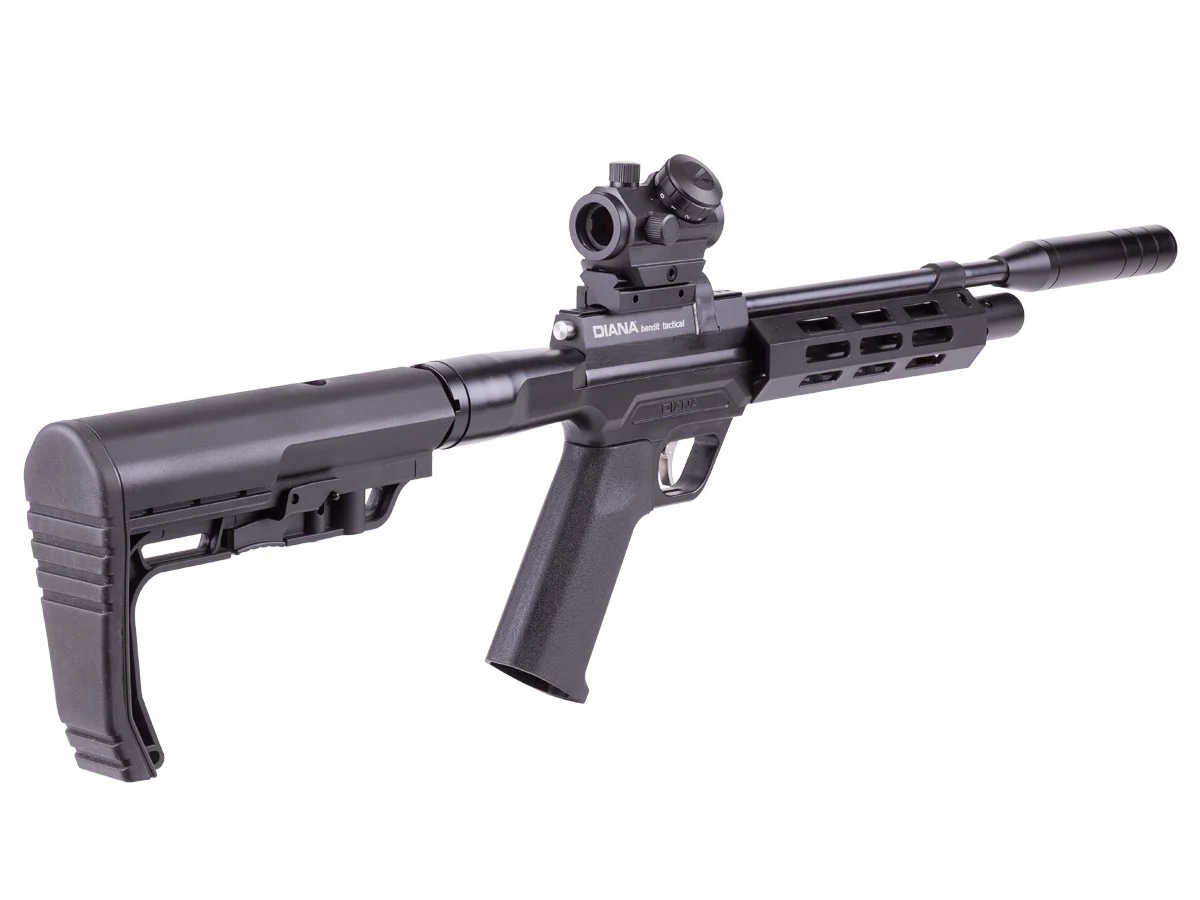
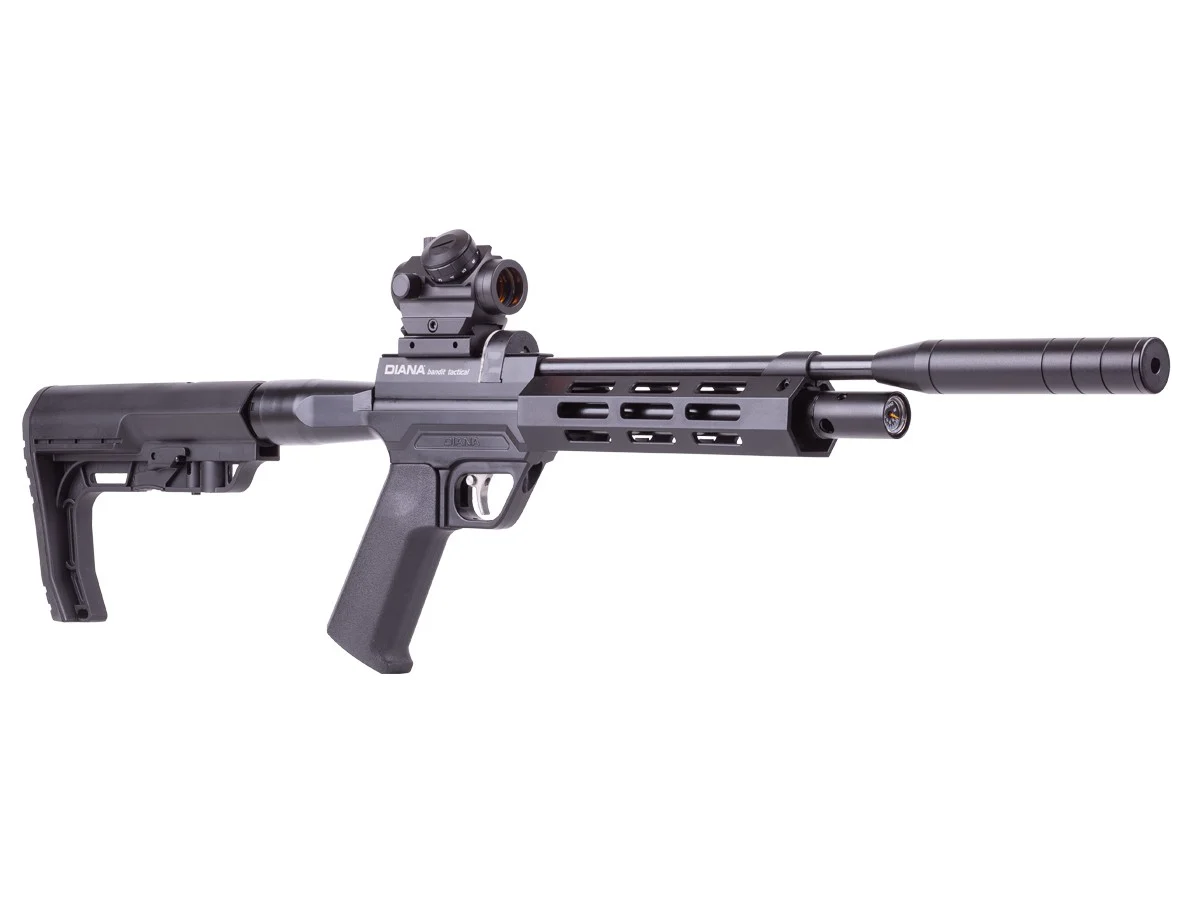
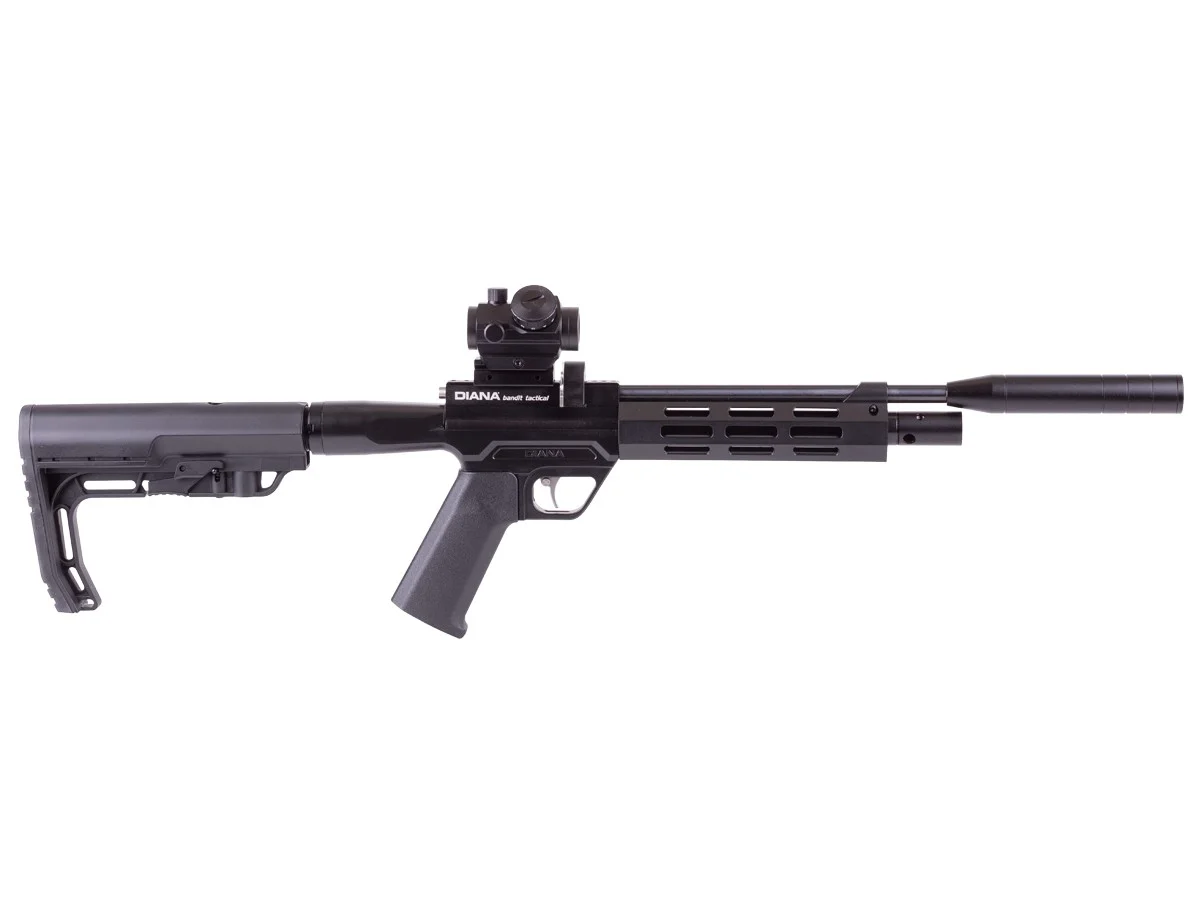
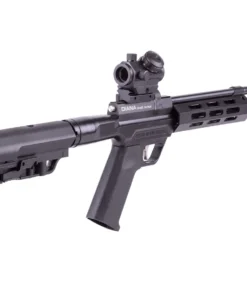
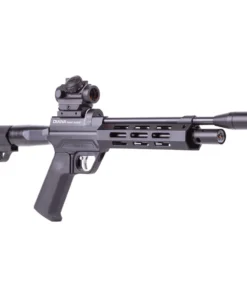
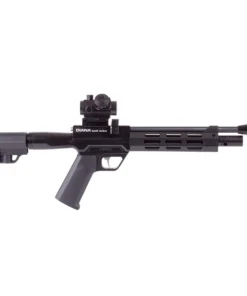
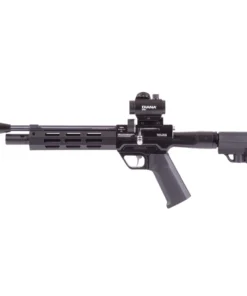
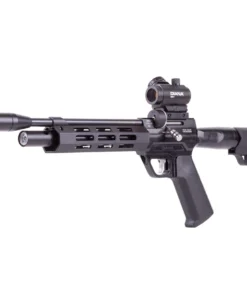
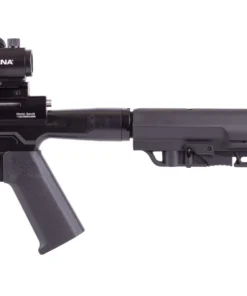
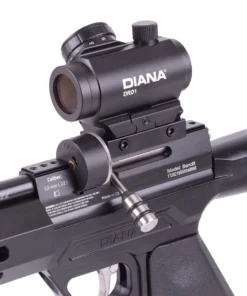
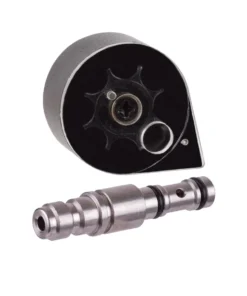
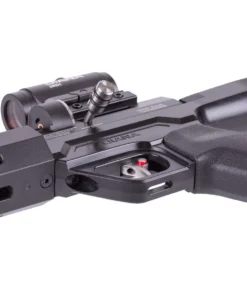
Diana Bandit Tactical PCP Air Carbine
$200.00
Description
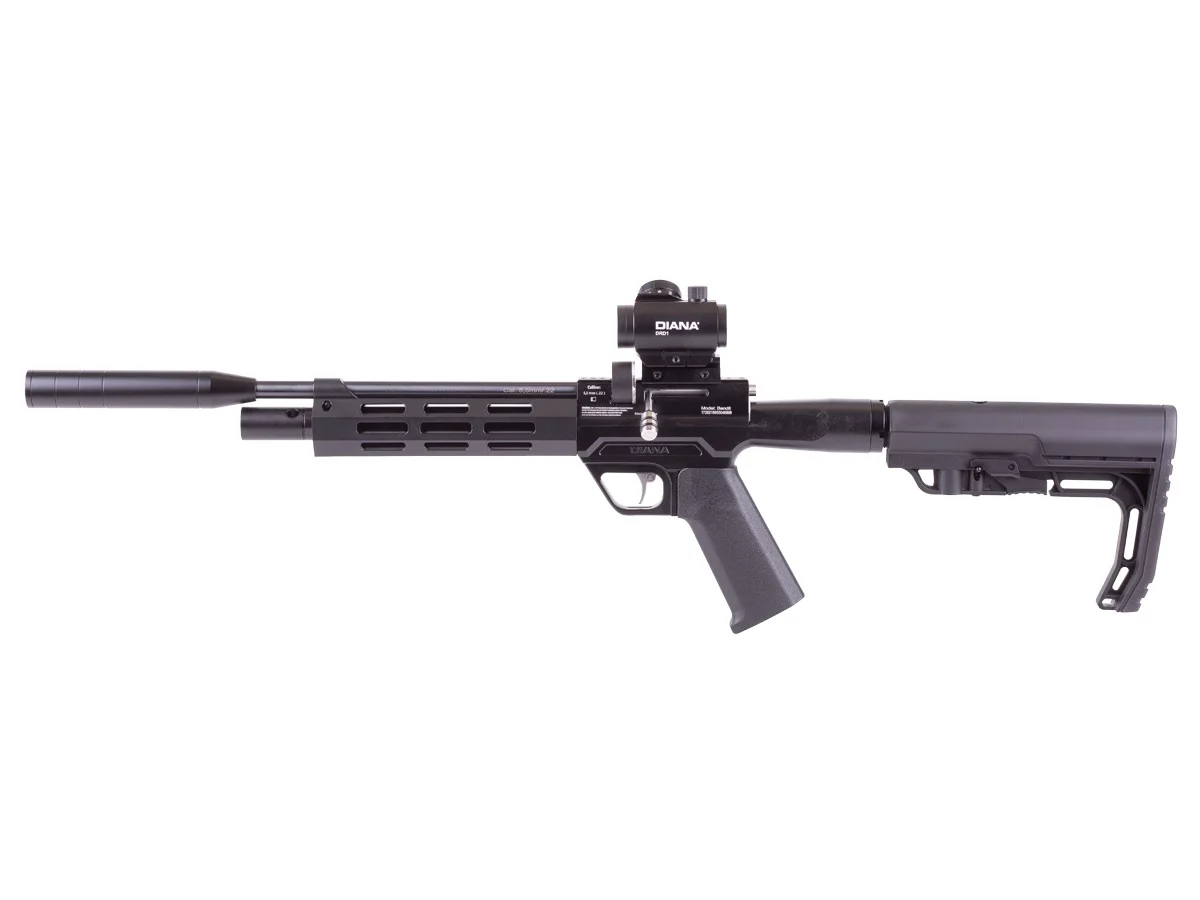
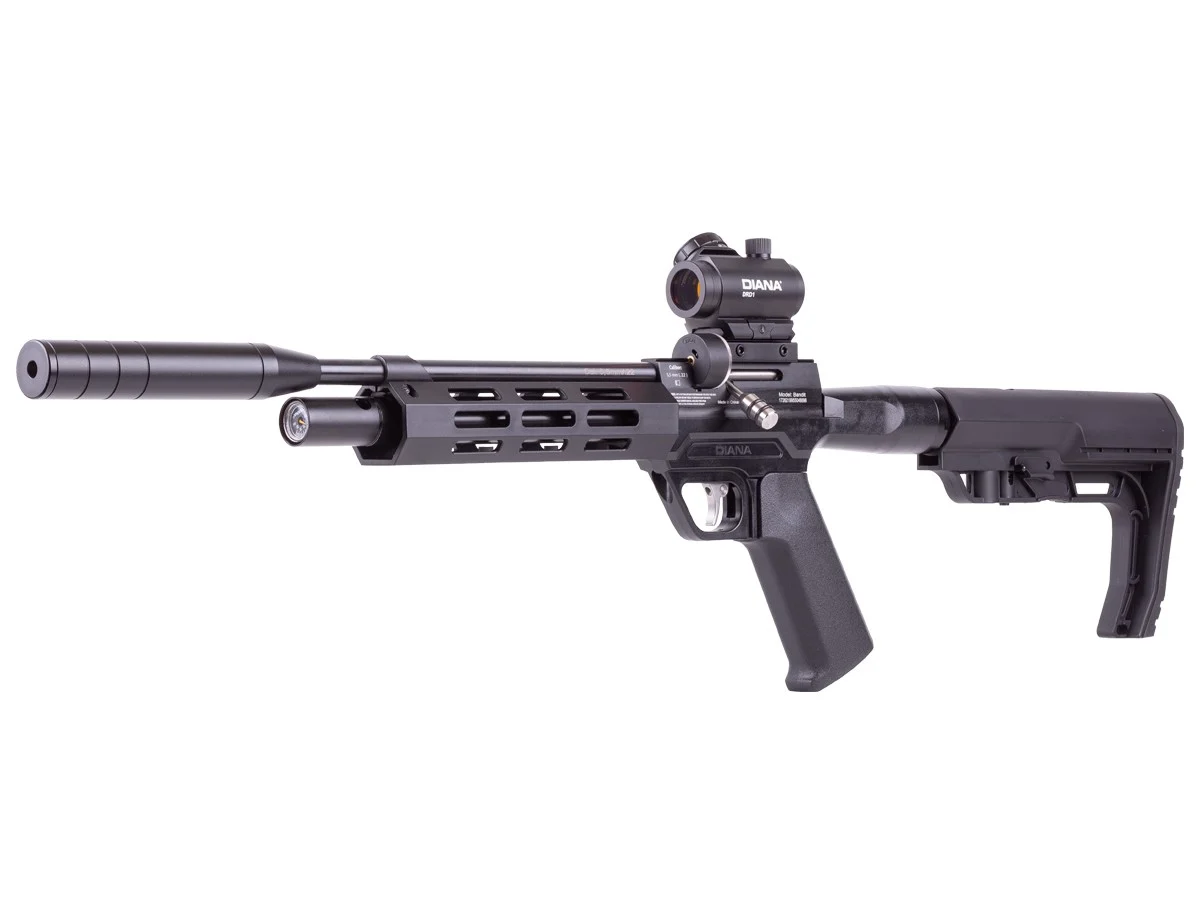
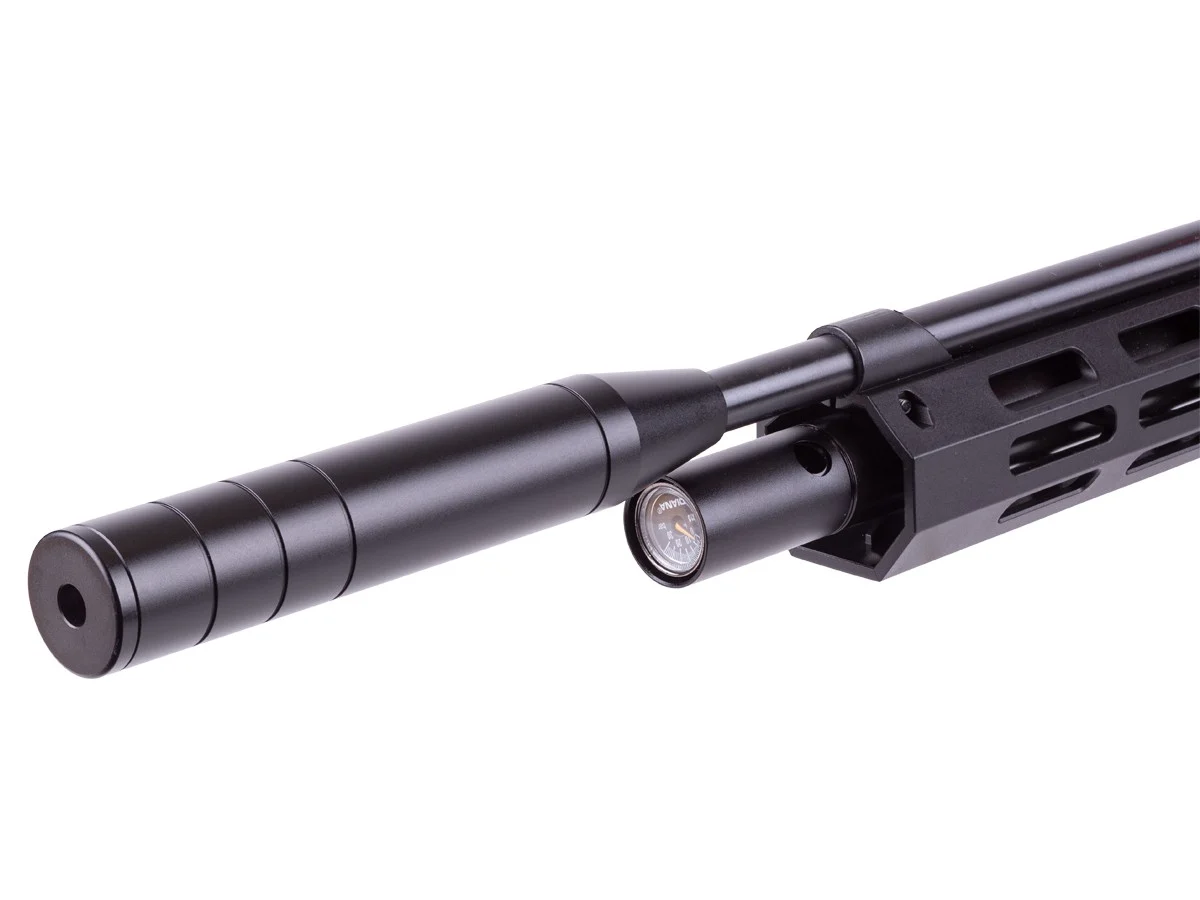
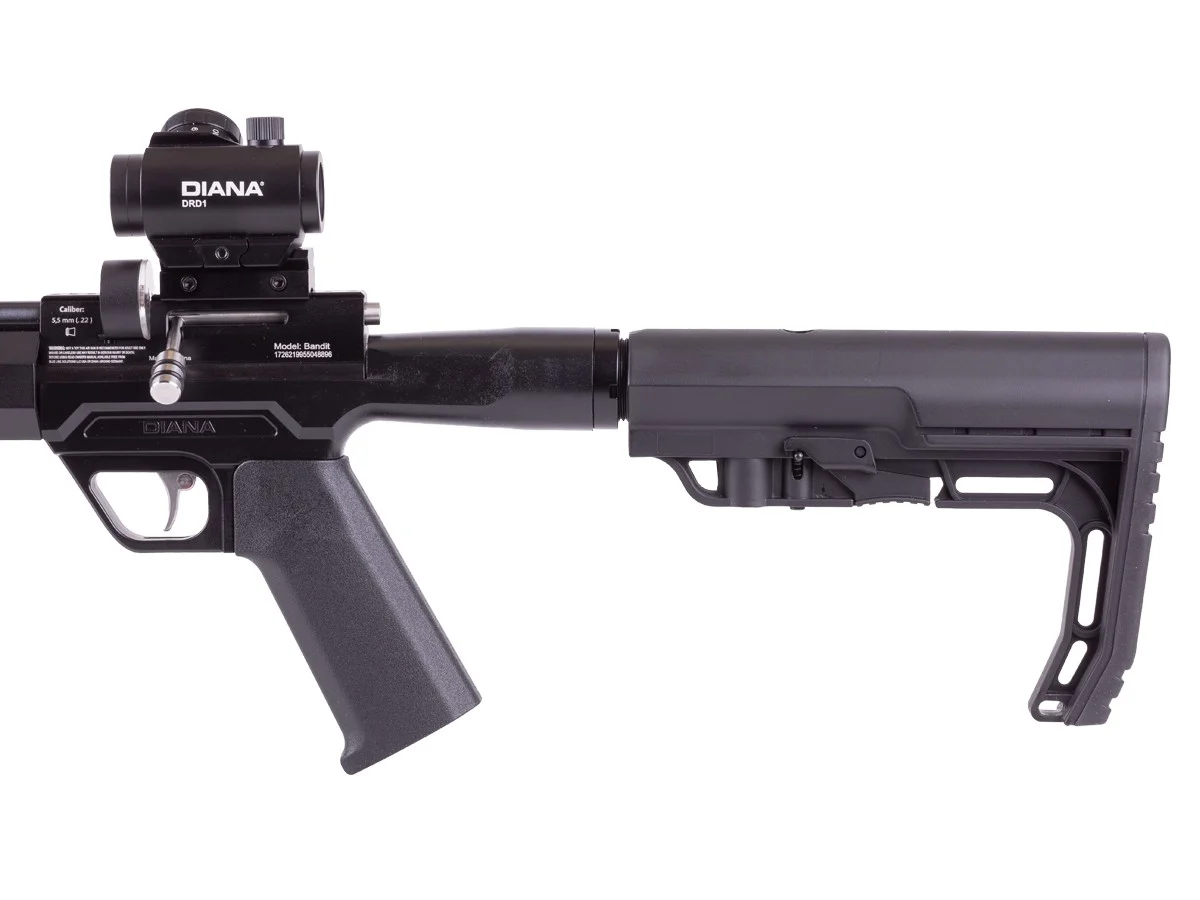
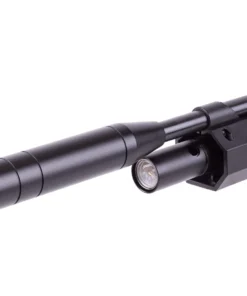
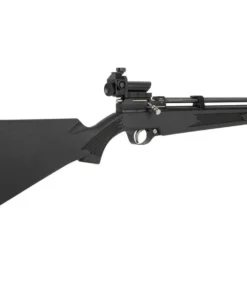
The Diana Bandit Tactical PCP Air Carbine comes in either .177 or .22 caliber. This compact airgun sits at only 28.7” and 31.25″ when fully extended with a 9.5” barrel and weighs 3.3lbs. It is internally regulated, comes with a red dot optic, and a sound suppressor to keep things quiet. This air carbine has a 40cc tank and a 2,900 PSI operating pressure to launch pellets up to 720 FPS in .22 (850FPS in .177).
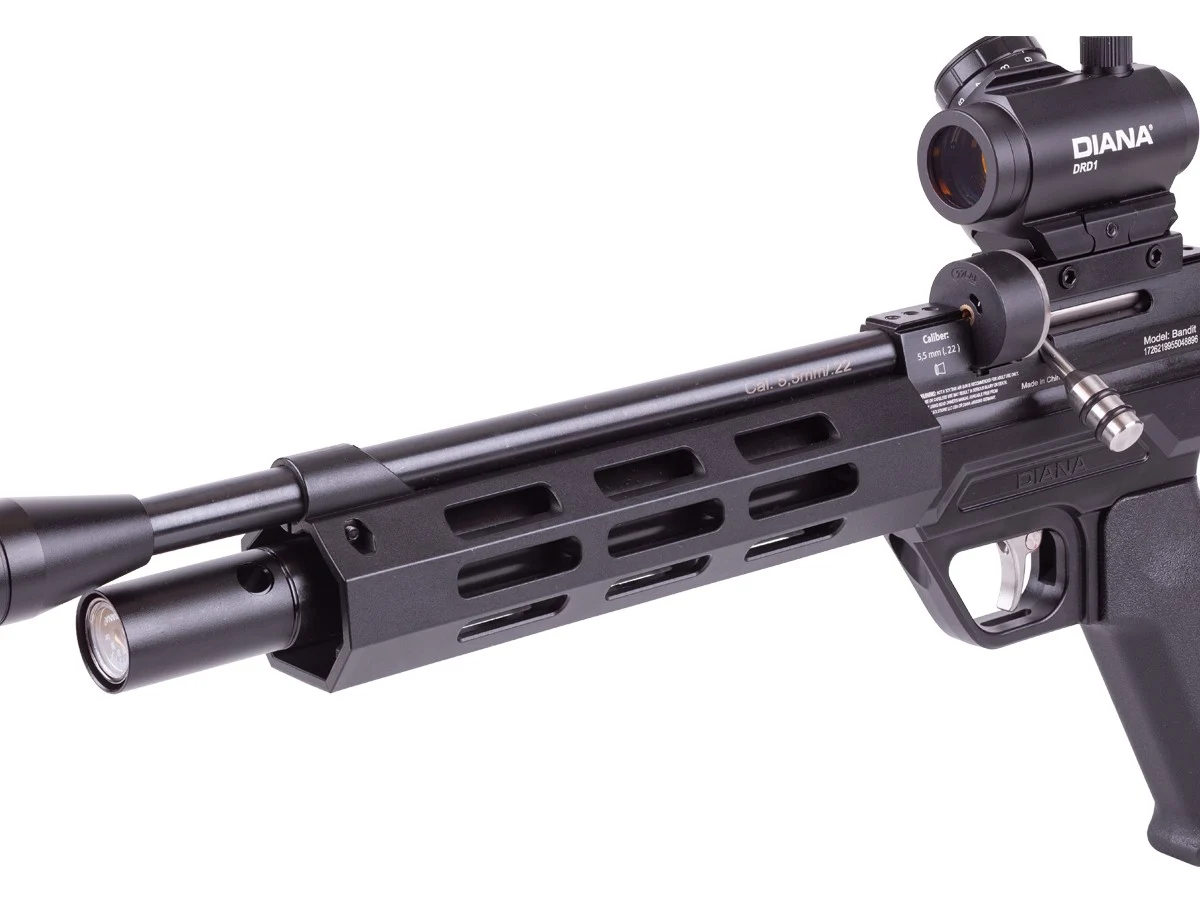
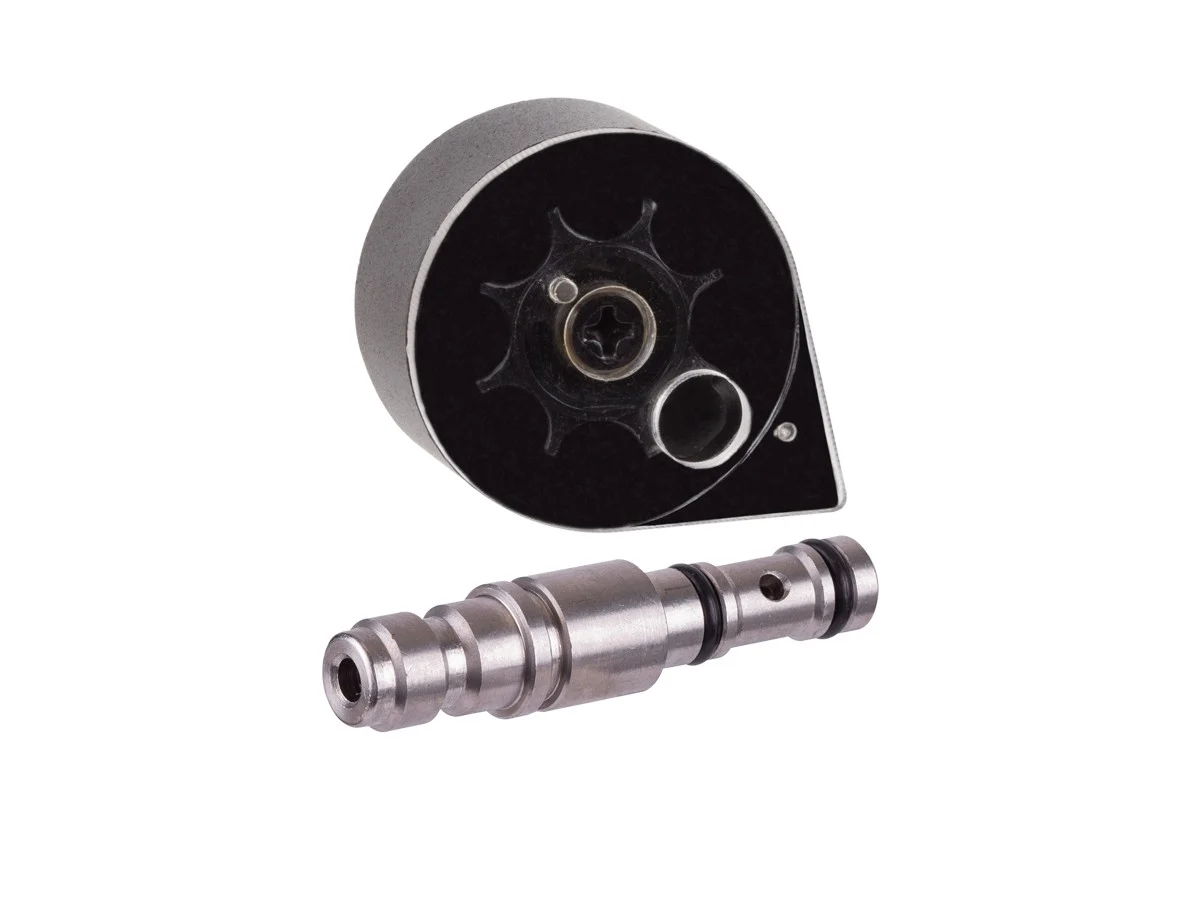
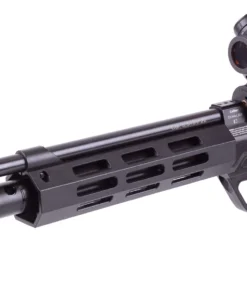
It can be fired in single shot or utilizing the magazine with a shot capacity of 7 or 9 rounds, depending on caliber. This bolt action air carbine has M-LOK slots for accessory mounting, along with a comfortable grip and stock for hours of shooting. It has the Diana Improved Trigger for optimized consistency between shots.
Diana Bandit Tactical PCP Air Carbine
- Available in .177 or .22 caliber
- Integrated regulator
- Bolt action
- Weight: 3.3lbs
- Length: 28.7″-31.25″
- Length of pull: 13.25″-15.75″
- Barrel: Rifled 9.5″
- Velocity: 850 FPS in .177 w/ 7gr pellet, 720 FPS in .22 w/ 13.4gr pellet
- Max energy: 11 FPE in .177, 15 FPE in .22
- Magazine capacity: 9rds in .177, and 7rds in .22
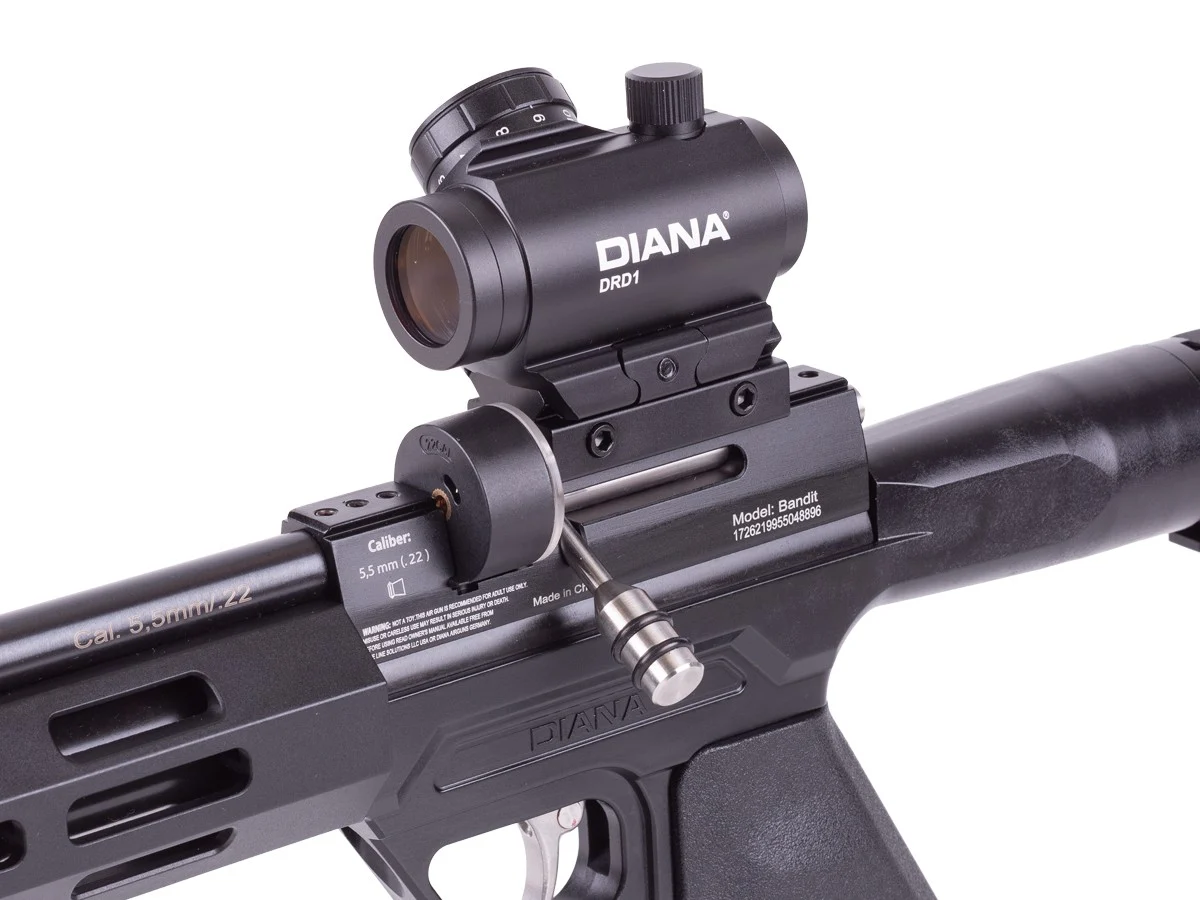
- 11mm dovetail rail
- 40cc tank with 2,900 PSI operating pressure
- M-LOK accessory slots
- AR-compatible grip
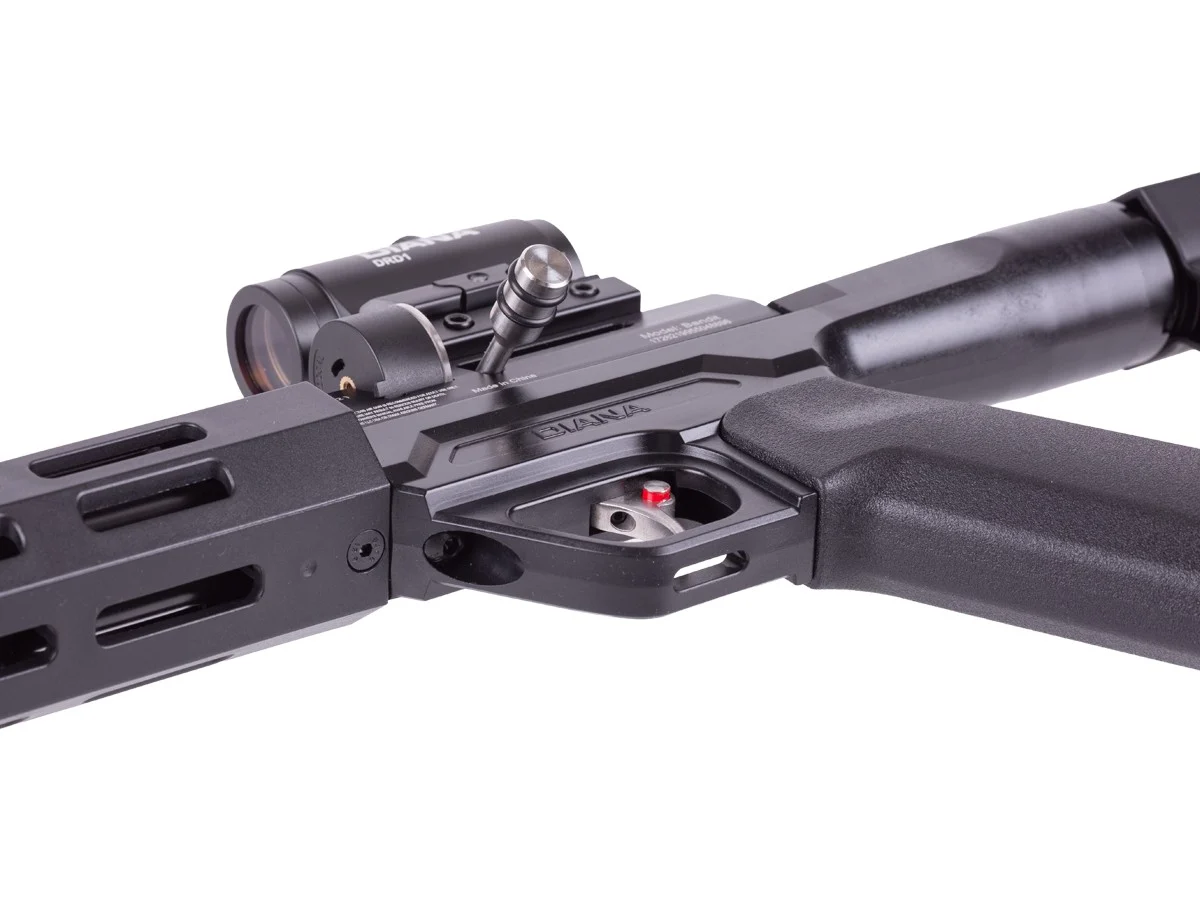
- DIT Diana Improved Trigger, two-stage adjustable
- Manual safety
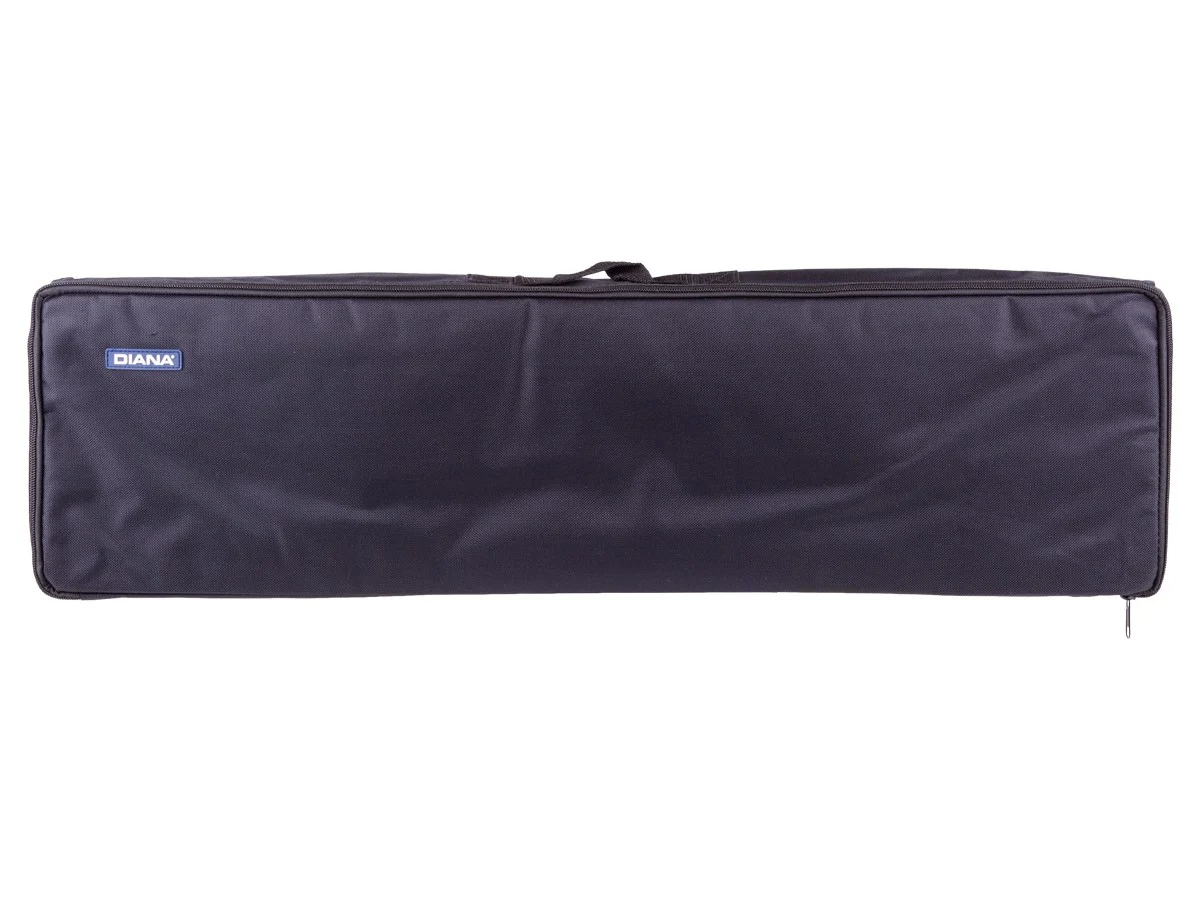
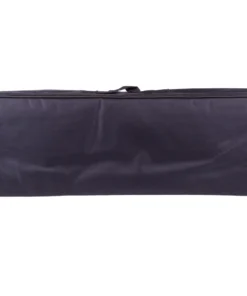
- Includes red dot optic, one magazine, and soft gun bag case
Specifications

Diana Bandit Tactical PCP Air Carbine – Complete Precision, Regulated Power, Performance, Specifications, Features & Product Guide
Diana Bandit Tactical PCP Air Carbine – Comprehensive Product Description, Technical Specifications, Precision Engineering, Performance, and SEO Keyword Integration
Diana Bandit Tactical PCP Air Carbine – Compact Design, Precision Engineering, and Modern Pneumatic Performance
The Diana Bandit Tactical PCP Air Carbine combines advanced pre-charged pneumatic technology, lightweight construction, and contemporary tactical styling in a versatile sporting platform. Designed for enthusiasts who appreciate compact equipment, mechanical consistency, and practical functionality, this distinctive model offers an internally regulated compressed-air system, a precision-rifled barrel, an adjustable two-stage trigger, and a detachable shoulder stock.
Unlike conventional spring-piston designs, the Diana Bandit Tactical PCP Air Carbine operates using compressed air stored inside a dedicated high-pressure reservoir. Consequently, its mechanical operating cycle differs from that of traditional break-barrel equipment, eliminating the characteristic movement of a large spring and piston during discharge.
Furthermore, the integrated pressure regulator helps manage air delivery to the operating mechanism, supporting consistent pressure conditions over the intended operating range. This feature makes the Diana Bandit Tactical PCP Air Carbine particularly interesting to enthusiasts who value regulated pneumatic engineering in a compact package.
Available in .177 and .22 caliber configurations, the Diana Bandit Tactical PCP Air Carbine accommodates different sporting preferences. The .177 version incorporates a nine-round rotary magazine, while the .22 version features a seven-round magazine. Both configurations share the same fundamental operating architecture and 9.5-inch rifled barrel.
Another distinctive advantage is the removable stock extension. This component allows the equipment to be configured with a shoulder stock or in its compact pistol-style arrangement, subject to applicable laws. Accordingly, the design provides flexibility that is not ordinarily associated with traditional full-length sporting rifles.
Additionally, the Diana Bandit Tactical PCP Air Carbine features an adjustable-length stock arrangement, an ergonomically shaped synthetic grip, and M-LOK accessory mounting slots. These components contribute to its modern exterior appearance and practical handling characteristics.
The manufacturer also includes a red dot optic, removable sound moderator, rotary magazine, and protective carrying bag with the standard Tactical package.
For buyers seeking modern pneumatic equipment without the size and weight of a conventional full-length rifle, the Diana Bandit Tactical PCP Air Carbine presents an interesting alternative.
However, the compact reservoir and specialized pressure system introduce specific charging, maintenance, and safety requirements.
The rifle’s strongest appeal lies in the combination of lightweight construction, regulated pneumatic technology, modular exterior features, and clearly defined accessories.
Diana Bandit Tactical PCP Air Carbine – Complete Technical Specifications
The following specifications describe the Tactical configuration rather than the original beechwood-grip pistol.
Manufacturer, Construction, and Operating Specifications
Brand: Diana
Model: Bandit Tactical
Manufacturer product number: 1910210
Product category: Compact pre-charged pneumatic air carbine
Available calibers: .177 (4.5mm) and .22 (5.5mm)
Powerplant: Pre-charged pneumatic
Pressure regulation: Integrated regulator
Action: Bolt-action repeater
Barrel: 9.5-inch / 240mm rifled barrel
Reservoir capacity: 40cc
Maximum filling pressure: 200 BAR / approximately 2,900 PSI
Magazine capacity: Nine rounds in .177 and seven rounds in .22
Trigger: Diana Improved Trigger, two-stage adjustable
Safety: Manual
Stock: Synthetic with removable extension
Stock adjustment: Adjustable-length configuration
Grip: Ambidextrous synthetic grip
Optics mounting: Machined 11mm dovetail rail
Accessory mounting: M-LOK slots
Muzzle device: Detachable moderator
Overall length: Approximately 28.7 inches in the manufacturer’s standard configuration
Extended length: Approximately 31.25 inches according to the US retailer
Weight: Approximately 3.3 pounds
Included optic: Red dot sight
Included storage: Soft carrying bag
Sighting system: Included optical sight
Caliber-Specific Velocity and Energy Specifications
The performance figures require careful interpretation because the manufacturer and US retailer publish different maximum velocity measurements.
For the .177 configuration, the manufacturer’s 2026 catalog lists approximately 427 FPS and 13 joules, while the US retailer advertises up to 850 FPS with a specified seven-grain pellet and approximately 11 foot-pounds.
For the .22 configuration, the manufacturer lists approximately 394 FPS and 16 joules, while the US retailer advertises up to 720 FPS with a 13.4-grain pellet and approximately 15 foot-pounds.
These figures reflect different published market configurations or test conditions and should not be treated as interchangeable guarantees. The exact version supplied, its legal power configuration, and the associated documentation must be checked before purchase.
1910210+2
Why Choose the Diana Bandit Tactical PCP Air Carbine?
The Diana Bandit Tactical PCP Air Carbine brings together several technical characteristics that distinguish it from conventional sporting equipment.
First, its compact dimensions provide a different ownership experience from traditional full-length designs. The overall configuration offers manageable storage proportions and relatively low weight.
Second, the internally regulated pneumatic system manages compressed-air delivery, helping create more consistent operating conditions.
Third, the removable stock extension introduces modularity. However, owners should verify that the intended configuration is lawful in their jurisdiction.
Furthermore, the two-stage adjustable trigger provides a refined mechanical interface associated with the manufacturer’s Diana Improved Trigger technology.
The included red dot sight is another practical benefit. Buyers do not necessarily need to purchase an optic separately to obtain the manufacturer’s standard Tactical configuration.
Additionally, the 11mm dovetail rail provides a familiar optical mounting interface, while the M-LOK slots accommodate certain compatible accessories.
The Diana Bandit Tactical PCP Air Carbine also incorporates a magazine-fed bolt-action arrangement. This distinguishes the design from single-shot break-barrel systems while preserving a relatively straightforward mechanical operating concept.
Nevertheless, a compact pneumatic platform requires realistic expectations.
The 40cc reservoir provides less compressed-air storage than many larger PCP rifles. Therefore, the exact number of consistent shots per fill depends on the operating configuration and testing conditions.
Overall, the Diana Bandit Tactical PCP Air Carbine appeals to owners who appreciate compact engineering, lightweight construction, and an integrated accessory package.
How the Pre-Charged Pneumatic System Works
The Diana Bandit Tactical PCP Air Carbine uses compressed air as its energy source.
Instead of employing a spring-piston assembly to compress air during each firing cycle, the equipment stores pressurized air inside a dedicated reservoir.
A valve mechanism controls the release of compressed air during operation.
Consequently, the mechanical behavior differs from traditional spring-powered designs.
The absence of a large moving spring-piston assembly removes one source of mechanical vibration associated with conventional spring-operated equipment.
However, the operating mechanism still contains moving parts and requires proper maintenance.
The internally regulated pressure system is particularly important because the reservoir pressure changes as compressed air is consumed.
By managing the pressure delivered downstream, the regulator helps establish more controlled operating conditions.
Nevertheless, regulation cannot eliminate every source of performance variation.
Temperature, projectile consistency, mechanical tolerances, and seal condition remain influential.
The Diana Bandit Tactical PCP Air Carbine therefore offers modern pneumatic technology without removing the responsibilities associated with high-pressure equipment.
Internal Regulator – Precision Pressure Management
The regulator is one of the defining features of the Diana Bandit Tactical PCP Air Carbine.
A compressed-air reservoir contains gas at elevated pressure, and that pressure decreases as the stored supply is consumed.
Without regulation, the changing pressure can directly influence the conditions available to the firing mechanism.
An integrated regulator manages downstream pressure within its designed operating range.
Consequently, the system provides a foundation for greater repeatability.
However, consistent pressure does not automatically guarantee perfect accuracy.
Barrel construction, compatible projectiles, mechanical condition, and environmental conditions remain important.
Additionally, a regulator contains specialized components that may require professional servicing.
Unauthorized adjustments should therefore be avoided.
For buyers evaluating engineering quality, the presence of regulation is a meaningful technical feature, particularly within such a compact design.
40cc Compressed-Air Reservoir and 200 BAR Operating Pressure
The Diana Bandit Tactical PCP Air Carbine incorporates a 40cc air reservoir.
This relatively compact capacity contributes to the equipment’s lightweight external configuration.
However, reservoir capacity and operating pressure represent different measurements.
Capacity describes internal storage volume, while pressure describes the condition of the compressed gas.
The maximum rated filling pressure is approximately 200 BAR.
Consequently, appropriate high-pressure charging equipment is essential.
Ordinary household inflation devices are not suitable for this application.
Furthermore, charging connections must meet the manufacturer’s specified requirements.
A high-pressure reservoir must remain protected against impacts, corrosion, excessive heat, and unauthorized modifications.
The compact size of the reservoir should not lead owners to underestimate the stored energy it contains.
Proper pressure-vessel care remains an important responsibility.
Precision-Rifled 9.5-Inch Barrel
The 9.5-inch rifled barrel is a central component of the Diana Bandit Tactical PCP Air Carbine.
Rifling introduces rotational movement to compatible pellets, supporting their stabilization during flight.
However, precision depends on more than barrel length.
The quality of the internal bore, projectile consistency, mechanical operation, and environmental conditions all influence results.
Furthermore, a compact barrel changes the overall physical design compared with longer sporting platforms.
The manufacturer combines the rifled barrel with a detachable moderator.
This component influences the exterior construction and may affect acoustic characteristics.
However, a moderated muzzle does not make the equipment completely silent.
Actual sound levels depend on operating conditions, environment, and testing methods.
The barrel’s engineering value should therefore be evaluated through verified construction details and repeatable performance testing.
Bolt-Action System and Magazine Capacity
The Diana Bandit Tactical PCP Air Carbine uses a bolt-action mechanism.
This system works with a caliber-specific rotary magazine.
The .177 configuration accommodates nine pellets, while the .22 configuration accommodates seven.
These differences reflect the physical dimensions of the projectiles.
However, magazine capacity should not be interpreted as a direct measurement of accuracy or reliability.
The quality of the internal mechanism, magazine condition, and correct projectile compatibility remain essential.
The manufacturer’s product information also identifies a single-shot operating option.
Consequently, the platform provides two manufacturer-supported feeding arrangements.
Replacement components should always match the exact model and caliber.
Diana Improved Trigger – Two-Stage Mechanical Control
The Diana Bandit Tactical PCP Air Carbine incorporates the Diana Improved Trigger system.
This two-stage arrangement provides distinct phases of mechanical movement.
Its construction contributes to the tactile operating experience.
However, the number of trigger stages does not automatically establish superior accuracy.
Mechanical consistency, manufacturing tolerances, and component condition remain important.
Furthermore, unauthorized trigger modifications can compromise safety.
Any required servicing should follow official manufacturer instructions.
The trigger system provides a recognizable premium feature within the compact pneumatic platform.
Removable Stock Extension and Adjustable Ergonomics
The removable stock extension is one of the most recognizable exterior features.
It allows different manufacturer-intended configurations, although legal restrictions may apply.
The adjustable stock arrangement also changes the overall length.
Consequently, the equipment provides greater dimensional flexibility than a permanently fixed stock.
Furthermore, the synthetic construction creates a modern appearance and avoids some wood-specific maintenance requirements.
The grip is designed for ambidextrous use.
However, comfort still depends on individual proportions and physical preferences.
The complete stock arrangement should therefore be considered in relation to weight, balance, and intended lawful activities.
Included Red Dot Optic and 11mm Dovetail Rail
The standard Tactical package includes a red dot sight.
This optic provides a distinct visual reference system from conventional open sights.
However, the presence of an included optic should not be confused with a guarantee of exceptional optical quality.
Battery requirements, durability, optical clarity, and mounting compatibility remain relevant.
The 11mm dovetail rail provides the designated mounting interface.
Replacement optics and mounts must be compatible with the manufacturer’s dimensions.
Furthermore, accessories should not obstruct operating controls or interfere with safe handling.
M-LOK Mounting System and Exterior Features
The Diana Bandit Tactical PCP Air Carbine incorporates M-LOK accessory slots.
This standardized interface is associated with compatible sporting accessories.
However, not every M-LOK product is suitable for every platform.
Dimensions, weight, and mechanical compatibility must be considered.
The compact stock, synthetic grip, and modern exterior contours contribute to the model’s distinctive appearance.
Nevertheless, accessory selection should prioritize verified compatibility and manufacturer guidance.
.177 Caliber – Performance and Product Characteristics
The .177 version uses 4.5mm pellets and incorporates a nine-round rotary magazine.
Its advertised maximum velocity depends on market configuration and testing conditions.
The smaller nominal projectile diameter differentiates it from the .22 version.
However, caliber alone does not determine precision.
Barrel condition, projectile manufacturing consistency, and the complete operating mechanism influence actual results.
Furthermore, regional energy restrictions may affect the supplied configuration.
Buyers should therefore verify the exact version before ordering.
.22 Caliber – Energy and Mechanical Differences
The .22 configuration uses 5.5mm pellets and incorporates a seven-round magazine.
It provides different published velocity and energy characteristics from the smaller-caliber version.
However, greater projectile diameter does not automatically establish better accuracy.
Mechanical consistency and compatible ammunition remain important.
Furthermore, the magazine and ammunition requirements differ.
Replacement components should therefore be selected specifically for the intended configuration.
The Diana Bandit Tactical PCP Air Carbine offers two caliber options with distinct ownership characteristics.
Diana Air Rifle Heritage and Traditional German Sporting Engineering
The diana air rifle name is associated with a long history of pneumatic sporting equipment. Founded in 1890, the manufacturer has developed traditional spring-powered products, modern compressed-air systems, and compact recreational platforms.
Customers researching air rifle diana, diana air rifles, and rws diana air rifle frequently encounter several different generations of sporting equipment.
The diana pellet gun category includes models with different actions, power sources, and stock configurations.
However, products from the same manufacturer should not be assumed to share interchangeable parts.
The Diana Bandit Tactical PCP Air Carbine represents the manufacturer’s modern compact pneumatic category, rather than its traditional spring-powered rifle family.
This distinction is important for buyers comparing mechanical operation, maintenance requirements, pressure systems, and accessory compatibility.
Diana 34 EMS, Diana 34, and Break-Barrel Comparisons
The diana 34 and diana 34 air rifle belong to the manufacturer’s established spring-powered family.
The Diana 34 air rifle is recognized among enthusiasts who appreciate traditional break-barrel construction.
Meanwhile, diana 34 ems introduces a modular sporting design with distinctive engineering features.
Searches for diana 34 ems fiber optic sights generally concern the sighting equipment associated with that product family.
The alternative search phrase diana r34 may also appear in product research.
A Diana break barrel air rifle differs from the Diana Bandit Tactical PCP Air Carbine because it uses a mechanical spring-piston system rather than a reservoir of previously compressed air.
Consequently, the two operating principles involve different mechanical cycles and charging requirements.
The phrase Diana springer air rifle also refers to traditional spring-powered equipment.
For buyers, understanding these differences is more important than comparing maximum velocity figures alone.
Diana 48, Diana 460 Magnum, and High-Powered Spring Rifles
The diana 48 and diana mod 48 represent another established family of sporting rifles.
Likewise, the diana rws 460 magnum uses a different mechanical arrangement from a compact PCP carbine.
The diana 350 magnum and diana 350 magnum air rifle belong to the manufacturer’s powerful spring-piston category.
These products may offer different overall dimensions, weight, handling characteristics, and maintenance requirements.
However, they should not be considered interchangeable alternatives simply because they share a manufacturer.
The Diana Bandit Tactical PCP Air Carbine stands apart through its compact dimensions, regulated pneumatic system, and removable stock extension.
Diana 250, Diana Two Fifty, and Other Sporting Models
The diana 250 air rifle, diana 250, and diana two fifty are frequently researched by customers considering traditional sporting equipment.
The diana r22 represents another model designation within the wider market.
These products occupy different equipment categories and may have substantially different technical specifications.
Consequently, replacement components and operating procedures should always be identified using the exact model.
Customers searching for Buy Diana air rifle should consider not only price but also product configuration, caliber, legal suitability, and service availability.
Diana Air Pistols, LP8, and Chaser Accessories
The manufacturer’s catalog also includes compact pistol-style products.
Searches for diana air pistol and lp8 diana often concern different recreational or target-oriented equipment.
Similarly, diana chaser parts and diana chaser accessories refer to components intended for another product family.
These terms are relevant for comparison, but they should not be treated as evidence of direct mechanical compatibility.
Furthermore, a compact pneumatic platform can have different pressure-system requirements from a spring-powered pistol.
Buyers should therefore consult the manufacturer’s specific documentation before purchasing replacement components.
Diana Air Rifle .177 and .22 – Caliber Comparison
Searches for Diana air rifle .177, Diana air rifle .22, and air rifle .22 reflect interest in different pellet diameters.
However, nominal caliber does not independently establish precision.
The complete design, projectile compatibility, and operating condition remain important.
Similarly, Diana air rifle accuracy should be evaluated through reliable testing rather than manufacturer reputation alone.
The phrase Diana air rifle hunting concerns another important consideration: legal suitability.
Applicable laws may restrict the use of certain pneumatic products for wildlife-related activities.
Consequently, the local legal framework and humane standards must guide any such application.
Umarex Airguns and Umarex Air Rifles – Alternative Pneumatic Platforms
The broader umarex portfolio contains numerous sporting and recreational pneumatic products.
Searches for umarex usa, umarexusa, and the common misspelling umerex may lead customers to different equipment categories.
The umarex notos is associated with a compact pre-charged pneumatic platform.
Meanwhile, the umarex zelos uses a different design with distinctive external dimensions.
The umarex gauntlet and umarex gauntlet 2 represent other pneumatic platforms.
Furthermore, the umarex hammer belongs to a higher-energy category, while umarex fusion 2 and umarex komplete use different operating arrangements.
Buyers comparing umarex airguns, umarex air rifles, and general air guns should consider the power source, reservoir capacity, weight, maintenance requirements, and intended activities.
The Diana Bandit Tactical PCP Air Carbine differs through its compact dimensions, removable shoulder-stock extension, and included optic.
Umarex Glock BB Guns and Licensed Replica Products
The replica pistol market attracts considerable interest from recreational enthusiasts.
Popular search terms include umarex glock, umarex glock 17, umarex glock 19, and umarex glock 17 gen 5.
Other searches include glock bb gun, glock 19 bb gun, bb gun glock, and metal bb gun.
These products generally differ from a regulated pneumatic pellet carbine in projectile type, power source, and mechanical design.
The umarex airsoft, airsoft glock, and glock 19 airsoft categories are also distinct.
Airsoft projectiles, metallic BBs, and pellets are not interchangeable.
Therefore, every product must be evaluated according to its own ammunition and safety requirements.
Umarex T4E, TR50, HDR 50, and Specialized Products
The umarex t4e product range includes specialized recreational and training equipment.
Related searches include umarex tr50, umarex hdr 50, and umarex t4e smith.
The question umarex p2p dr50 how many joules concerns the muzzle-energy specifications of another product, which may vary by version and region.
Other searches include umarex smith, umarex hk heckler, and umarex h.
These terms do not establish technical features or component compatibility with the main product.
Consequently, buyers should rely on exact product identification rather than broad brand-related searches.
Airgun Pistols and Compact Sporting Equipment
The broader air rifle and airgun pistol markets contain products with different operating mechanisms.
Customers searching for airgun pistol and rifle, air pistol, or air rifles and pistols may be comparing compact and full-length platforms.
Other common terms include best airgun pistol, airgun pistol review, and air pistol for beginners.
Searches involving airgun pistol .177, PCP airgun pistol, and airgun pistol accuracy often concern compact pneumatic equipment.
Meanwhile, air pistol for plinking generally refers to recreational target use.
The phrase best air rifle for hunting requires careful interpretation because legal and humane suitability depends on the jurisdiction and intended activity.
A compact pneumatic carbine should therefore be evaluated according to its verified specifications rather than universal rankings.
Weihrauch, Crosman, Benjamin, and Other Compact Models
Several alternative sporting products attract interest from buyers researching compact equipment.
Examples include the Weihrauch HW44, Crosman 1377, and Benjamin Marauder Pistol.
Additional comparisons include the AirForce TalonP, Gamo PT85, and Steyr LP10.
The Umarex Beretta M9, Sig Sauer P320, and Umarex Legends P08 belong to other sporting or replica product categories.
These designs may use different projectiles and power sources.
The search term FX Maverick Pistol should be verified against an exact manufacturer configuration rather than assumed to identify a universally available factory model.
Consequently, technical comparisons should distinguish verified product specifications from ambiguous search terminology.
Karma Airguns and Compact Folding-Stock Designs
Searches involving karma airguns and .22 Karma SLS Compact Folding Stock lead toward another category of compact pneumatic equipment.
A folding-stock arrangement changes external dimensions and may influence portability.
However, stock design does not independently determine accuracy.
Mechanical quality, barrel construction, pressure regulation, and projectile compatibility remain important.
The Diana Bandit Tactical PCP Air Carbine should therefore be evaluated on the basis of its own verified specifications.
When and Where the Diana Bandit Tactical PCP Air Carbine Is Appropriate
The Diana Bandit Tactical PCP Air Carbine is marketed for recreational target practice, plinking, and certain sporting applications.
However, not every location is suitable for powerful projectile equipment.
Appropriate backstops, protective equipment, and legal authorization remain essential.
Furthermore, local laws may classify different configurations according to their dimensions, energy, or stock arrangement.
Consequently, owners must verify the legal status of the intended configuration.
Controlled sporting facilities provide a more appropriate environment than improvised residential locations.
The compact size may offer convenient transportation and storage, but it does not reduce the need for responsible handling.
Why the Diana Bandit Tactical PCP Air Carbine Is Worth Considering
The Diana Bandit Tactical PCP Air Carbine combines a regulated pneumatic powerplant, compact rifled barrel, detachable stock extension, adjustable trigger, rotary magazine, and included red dot sight.
Furthermore, its relatively low weight distinguishes it from many full-length pneumatic alternatives.
The 40cc reservoir offers a compact pressure-storage arrangement, although its capacity introduces practical limitations compared with larger systems.
The removable moderator and modern accessory interfaces provide further equipment features.
However, the rifle requires appropriate high-pressure charging equipment and careful maintenance.
For owners who appreciate compact construction and sophisticated pneumatic technology, the Diana Bandit Tactical PCP Air Carbine presents a distinctive combination of technical features and practical considerations.
SECTION 2: Advanced Pneumatic Engineering, Precision Evaluation, Compact Design, Practical Usability, Maintenance, Reliability, and Comprehensive Ownership Guide
Understanding the Engineering Principles Behind Compact Pneumatic Technology
Compact compressed-air sporting equipment presents a distinctive engineering challenge. Manufacturers must balance pressure storage, mechanical efficiency, structural integrity, weight, and ergonomic requirements within relatively limited dimensions. Consequently, successful designs depend on careful integration rather than simply reducing the size of a conventional full-length platform.
The central operating principle involves storing compressed air within a pressure-rated reservoir. During normal operation, the firing mechanism releases a controlled quantity of this stored air. The resulting mechanical cycle differs from conventional spring-powered arrangements because the energy source has already been pressurized.
However, compressed-air technology requires precise coordination between several internal components. The reservoir must retain pressure, the valve must function reliably, and the trigger assembly must interact correctly with the operating mechanism.
Furthermore, compact dimensions create additional design considerations. A relatively small reservoir offers limited internal storage volume, while the shorter overall structure changes the distribution of mass.
Manufacturing tolerances remain important. Valves, seals, moving components, and structural interfaces must maintain appropriate relationships throughout their intended service life.
A sophisticated compact system therefore represents more than a miniature version of larger equipment.
Its design requires an appropriate balance between size, mechanical function, safety, and practical ownership.
For prospective buyers, understanding these relationships helps establish realistic expectations concerning performance, maintenance, and long-term reliability.
Why an Integrated Regulator Is an Important Feature
Pressure regulation serves an important role in modern compressed-air technology.
The reservoir contains air at elevated pressure. As the stored supply decreases, the pressure inside the reservoir changes.
An integrated regulator manages the pressure supplied to the downstream operating mechanism.
Consequently, the design can reduce certain variations associated with changing reservoir pressure.
However, regulated pressure should not be confused with guaranteed identical performance.
Mechanical tolerances, temperature, projectile characteristics, and component condition still influence results.
Furthermore, regulators contain specialized internal components. Seals, springs, valve surfaces, and supporting structures must function within their intended tolerances.
Over time, wear or contamination may affect their operation.
For this reason, manufacturer-supported inspection and maintenance remain essential.
An integrated regulator represents meaningful engineering sophistication, but its advantages should be evaluated as part of the complete mechanical system.
How Pressure Changes During Normal Operation
Compressed air behaves according to established physical principles.
When the reservoir contains a full permitted charge, it holds a particular quantity of compressed gas. As the mechanism consumes that air, the amount remaining decreases.
Consequently, reservoir pressure gradually changes.
The relationship between stored pressure and operating characteristics depends on the equipment’s internal design.
A regulated arrangement attempts to maintain controlled downstream conditions over an appropriate pressure range.
However, regulation cannot compensate indefinitely for declining reservoir pressure.
The system must remain within the manufacturer’s documented operating limits.
Furthermore, temperature changes can influence pressure readings independently of ordinary air consumption.
Therefore, a responsible owner should distinguish expected pressure variation from unusual leakage or mechanical problems.
Unexpected pressure loss requires appropriate inspection.
The Importance of a Compact Reservoir
A compact pressure reservoir contributes to reduced external dimensions and manageable weight.
However, the smaller internal volume also limits the amount of compressed air available for operation.
Consequently, practical performance involves a compromise between compactness and storage capacity.
A larger reservoir may offer more stored-air volume, but it usually introduces additional dimensions or mass.
A smaller reservoir can support a lightweight platform, although charging frequency may be greater.
Furthermore, the internal mechanical efficiency affects how much useful operation can be obtained from the stored supply.
For this reason, capacity alone cannot establish a reliable shot-count figure.
The manufacturer’s testing methodology and the particular operating configuration must also be considered.
The value of a compact reservoir lies in the complete design balance rather than maximum storage volume.
Understanding Maximum Filling Pressure
The maximum filling pressure represents a critical safety specification.
It identifies the upper pressure limit established by the manufacturer for the reservoir.
Exceeding this limit can damage pressure-bearing components and create dangerous conditions.
Consequently, only approved charging equipment should be used.
The pressure rating of the charging device must also be distinguished from the reservoir’s permissible maximum.
A compressor or manual pump capable of generating greater pressure does not authorize exceeding the equipment’s stated limit.
Furthermore, connectors and hoses must meet the relevant technical requirements.
An apparently compatible connection does not automatically establish safe suitability.
Pressure-vessel safety must remain central to ownership.
Why Pressure-Vessel Materials Matter
Pressure-bearing components require materials capable of withstanding substantial internal forces.
Manufacturers may select steel, aluminum, or composite materials according to the intended application.
Each material presents different engineering characteristics.
Weight, strength, manufacturing complexity, and environmental behavior all influence suitability.
However, material choice alone does not establish durability.
The quality of manufacturing and inspection remains equally important.
Furthermore, pressure vessels can suffer damage from impacts, corrosion, excessive heat, or improper handling.
Consequently, owners should inspect visible surfaces and follow manufacturer guidance.
Any suspected structural defect requires professional assessment.
The reservoir should never receive unauthorized modifications.
Charging Equipment and Practical Ownership
Compressed-air equipment requires a suitable charging source.
Depending on manufacturer approval, this may involve a specialized hand pump, an appropriate compressor, or another compatible compressed-air supply.
However, not every charging device is suitable.
Pressure rating, connection design, filtration, and mechanical condition are important.
Furthermore, high-pressure charging equipment requires its own maintenance.
Hoses, seals, gauges, and fittings may deteriorate over time.
Consequently, buyers should consider the condition and service requirements of the complete charging arrangement.
A suitable system must comply with the manufacturer’s instructions.
Improvised charging connections should be avoided.
Manual Charging and Its Practical Advantages
A hand-operated pump provides independence from electrical power.
This can be useful for owners who do not have convenient access to a powered charging system.
Furthermore, a manual pump may involve a lower initial investment than a specialized electric compressor.
However, manual charging requires physical effort.
The amount of effort depends on the pump design, reservoir capacity, and pressure conditions involved.
Consequently, manual charging may be less practical for some users.
The pump must also receive appropriate inspection and maintenance.
Physical simplicity does not eliminate the hazards associated with high-pressure systems.
Owners should select equipment according to manufacturer compatibility rather than price alone.
Electric Compressors and Specialized Charging Systems
Electric charging systems offer a different ownership experience.
A powered compressor uses a motor-driven assembly to generate compressed air.
However, these systems introduce electrical, mechanical, and maintenance requirements.
Cooling arrangements, filtration, pressure monitoring, and approved operating procedures may be necessary.
Furthermore, not every compressor marketed for recreational equipment is appropriate for specialized high-pressure reservoirs.
The complete technical specifications must be reviewed.
A compatible system should have suitable pressure ratings, approved connections, and manufacturer-supported safety features.
The choice between manual and powered charging depends on budget, physical capability, available infrastructure, and expected frequency of use.
Compact Barrel Design and Precision Engineering
A relatively short barrel creates a different mechanical arrangement from a traditional full-length design.
Its physical dimensions contribute to compactness and overall weight distribution.
However, barrel length alone does not establish accuracy.
Bore quality, internal rifling, projectile consistency, and mechanical operation remain important.
A well-manufactured shorter barrel can provide suitable performance within its intended design parameters.
Nevertheless, claims of guaranteed precision require repeatable testing.
Furthermore, barrel condition affects long-term reliability.
Improper cleaning or mechanical damage can influence the internal surface.
Consequently, maintenance should follow the manufacturer’s instructions.
The Importance of Rifling
Rifling introduces rotational movement to compatible projectiles.
This rotation contributes to aerodynamic stability during flight.
However, stabilization depends on the interaction between the barrel and projectile.
Differences in diameter, geometry, material, and manufacturing consistency can influence results.
Consequently, nominal caliber alone does not establish compatibility with every projectile.
Manufacturer recommendations should provide the primary reference.
Furthermore, bore damage or accumulated contamination can affect mechanical interaction.
Appropriate maintenance helps preserve the intended condition.
Reliable precision remains a property of the complete system rather than the rifling alone.
Why Projectile Consistency Matters
Projectiles manufactured to the same nominal specification can still exhibit variation.
Differences in mass, shape, and dimensions may influence their behavior.
Consequently, projectile consistency forms part of any credible precision assessment.
However, these differences should not be used to justify experimenting with unsuitable ammunition.
Compatibility must remain within manufacturer specifications.
Damaged projectiles should also be avoided.
For buyers evaluating performance claims, the characteristics of the test ammunition should be clearly identified.
Results obtained with one projectile type should not automatically be treated as universal.
Understanding Velocity Measurements
Velocity describes the speed of a projectile.
However, maximum velocity is only one performance measurement.
Advertised figures may reflect particular test conditions, projectiles, or regional configurations.
Consequently, a maximum figure does not establish the average result under every circumstance.
Furthermore, velocity alone does not guarantee precision.
Mechanical consistency, projectile stability, and environmental conditions also matter.
A more meaningful evaluation considers repeated measurements obtained under documented conditions.
When comparing specifications, buyers should ensure that the sources describe equivalent configurations.
Understanding Muzzle Energy
Muzzle energy represents the kinetic energy carried by a projectile when it exits the barrel.
It depends on both mass and velocity.
Consequently, different projectiles can produce different energy measurements.
The maximum published velocity and maximum energy may come from separate tests.
Therefore, they should not automatically be combined.
Energy also has important safety and legal implications.
Powerful projectiles can remain dangerous beyond the immediate shooting area.
Appropriate backstops, protective equipment, and compliance with regulations are essential.
The Relationship Between Velocity and Precision
Velocity and precision describe different characteristics.
A system can achieve relatively high velocity without necessarily producing exceptionally consistent results.
Likewise, equipment with lower maximum velocity may demonstrate useful precision under controlled conditions.
Mechanical quality, projectile compatibility, and environmental factors influence accuracy.
Consequently, maximum speed should not dominate purchasing decisions.
A credible evaluation should examine repeatability and documented testing methodology.
Unsupported claims of perfect accuracy should be avoided.
Why Independent Testing Is Valuable
Independent testing can provide useful information beyond manufacturer advertising.
However, testing quality varies significantly.
A reliable evaluation should identify the equipment configuration, measurement conditions, and procedures used.
Furthermore, repeated results offer stronger evidence than isolated favorable outcomes.
Environmental conditions should also be acknowledged.
Wind, temperature, and other variables may influence outdoor measurements.
For buyers, transparent testing provides a more useful basis for comparing mechanical performance.
Reviews that omit their methodology should be interpreted cautiously.
Bolt-Action Engineering and Reliability
A bolt-action mechanism relies on moving components that must maintain appropriate mechanical alignment.
Its operation depends on material quality, manufacturing tolerances, and maintenance.
Consequently, a visually simple mechanism may still require precise engineering.
Wear and contamination can affect moving surfaces.
Furthermore, damaged components may interfere with normal operation.
Owners should inspect the equipment for unusual resistance or visible defects.
Internal servicing should follow manufacturer instructions.
Unauthorized alterations can compromise safety and reliability.
Rotary Magazine Construction
A rotary magazine incorporates multiple projectile chambers and a mechanical indexing arrangement.
The internal dimensions must correspond to the intended caliber.
Consequently, magazines designed for different configurations should not be assumed interchangeable.
Manufacturing quality influences reliable operation.
Furthermore, physical damage or contamination can affect the feeding mechanism.
Appropriate cleaning and inspection help preserve condition.
Replacement magazines should match the manufacturer’s approved specifications.
The Role of a Single-Shot Arrangement
A manufacturer-supported single-shot component provides an alternative to the rotary magazine.
This arrangement accommodates individual compatible projectiles.
However, it does not alter the equipment’s fundamental pressure or safety requirements.
The component must also match the exact configuration.
Visually similar accessories may have different dimensions.
Consequently, compatibility should be verified before replacement purchases.
Two-Stage Trigger Technology
A two-stage trigger provides distinct phases of mechanical movement.
The initial movement and subsequent release stage create a recognizable tactile experience.
However, trigger quality depends on more than stage count.
Manufacturing precision, mechanical condition, and approved settings remain important.
Furthermore, trigger mechanisms are safety-critical components.
Unauthorized modifications may compromise reliable operation.
Professional servicing should be considered when defects arise.
Why Manual Safety Matters
A manual safety provides an additional protective feature.
However, no mechanical safety should be treated as a guarantee against accidental discharge.
The equipment must be handled according to manufacturer instructions.
Furthermore, secure storage prevents unauthorized access.
Safe muzzle direction and appropriate awareness remain essential.
Mechanical safety devices supplement responsible behavior rather than replacing it.
Removable Stock Design and Modularity
A removable stock changes the external configuration of the platform.
This modular arrangement may offer different storage and handling characteristics.
However, legal classification can change according to configuration and jurisdiction.
Consequently, owners should verify local requirements before changing the equipment’s arrangement.
The stock must also remain compatible with the manufacturer’s intended design.
Unauthorized structural modifications should be avoided.
The practical advantage of modularity lies in manufacturer-supported flexibility rather than unrestricted customization.
Adjustable Length and Ergonomic Considerations
An adjustable stock changes the external dimensions of the equipment.
This can help accommodate differences in body proportions.
However, physical comfort remains subjective.
Arm length, shoulder geometry, grip dimensions, and personal preferences all influence fit.
Furthermore, adjustment mechanisms must remain mechanically secure.
Damaged or loose components may create handling problems.
A suitable stock design should balance comfort, structural integrity, and safe access to the operating controls.
Lightweight Construction and Portability
Low overall weight is an important characteristic of compact sporting equipment.
It can make transportation and storage more convenient.
However, lower weight is not automatically advantageous in every situation.
Balance and component placement also influence handling.
Furthermore, accessories increase the complete assembled mass.
Consequently, buyers should consider the final configuration rather than the base weight alone.
Physical suitability depends on individual needs and intended activities.
Synthetic Materials and Environmental Durability
Synthetic exterior components provide an alternative to natural wood.
They can offer practical resistance to certain environmental conditions.
However, polymer materials remain vulnerable to physical damage, excessive heat, and chemical exposure.
Furthermore, durability depends on material formulation and manufacturing quality.
A well-designed synthetic component should maintain appropriate structural integrity under normal conditions.
Nevertheless, visible damage should receive attention.
Manufacturer-approved cleaning procedures help preserve the exterior finish.
Textured Grips and Comfort
Textured gripping surfaces influence tactile characteristics.
They also contribute to the equipment’s appearance.
However, the quality of the texture depends on the manufacturing process.
Damaged surfaces may become uncomfortable.
Furthermore, dirt and moisture can collect within patterned areas.
Appropriate cleaning helps preserve condition.
Ergonomic quality should be evaluated through the complete design rather than one surface feature.
Compact Dimensions and Storage Practicality
Compact equipment may fit more conveniently into certain storage arrangements.
However, the external dimensions must be considered alongside accessories and protective cases.
Optical equipment, mounting hardware, and other components can increase the space required.
Furthermore, secure storage remains essential regardless of size.
A compact product should not be left accessible simply because it occupies less space.
A lockable cabinet or suitable protective storage arrangement helps prevent unauthorized access.
Red Dot Optical Technology
A red dot optic provides an illuminated visual reference.
Its design differs from traditional open sights and magnified optical systems.
However, quality depends on the specific optic.
Lens clarity, electronic reliability, battery requirements, and adjustment consistency matter.
Furthermore, an included optic may provide convenience without matching the capabilities of every separately purchased alternative.
Buyers should evaluate the documented specifications.
The manufacturer’s instructions should guide maintenance and battery replacement.
Optical Mounting Compatibility
An optical mounting rail provides a designated mechanical interface.
However, not all accessories use identical dimensions.
The compatibility of mounting hardware should therefore be verified.
Furthermore, accessory weight can affect the overall balance.
The mounting interface must also remain in suitable condition.
Loose or damaged components require appropriate attention.
A standardized rail supports compatibility with certain products but does not guarantee universal suitability.
Accessory Mounting Interfaces
Modern sporting equipment may incorporate standardized attachment slots.
These interfaces create designated locations for compatible equipment.
However, accessory selection should not rely exclusively on visual similarity.
Dimensions, materials, and manufacturer approval remain important.
Furthermore, accessories can alter the complete weight and physical balance.
The presence of mounting slots provides flexibility without eliminating the need for careful compatibility assessment.
Muzzle Moderators and Acoustic Characteristics
A muzzle moderator can influence the sound characteristics of pneumatic sporting equipment.
However, it does not eliminate all noise.
Mechanical movement, compressed-air discharge, and environmental conditions may contribute to audible sound.
Consequently, claims of silent operation should be avoided.
Furthermore, laws concerning muzzle accessories differ between jurisdictions.
Compatibility must also be confirmed.
A threaded or detachable assembly does not establish that every aftermarket component is suitable.
Why Sound Measurements Vary
Acoustic measurements depend on equipment, environment, and methodology.
For example, indoor spaces can reflect sound differently from open outdoor environments.
Microphone placement and measurement procedures also influence reported values.
Consequently, decibel figures from different tests may not be directly comparable.
A credible acoustic evaluation should describe the conditions under which measurements were obtained.
Furthermore, reduced sound does not establish residential suitability.
Projectile hazards and legal restrictions remain central considerations.
Practical Use in Controlled Sporting Facilities
An authorized sporting facility provides an appropriate environment for evaluating projectile-based equipment.
However, different facilities impose different restrictions.
Some may limit participation according to caliber, muzzle energy, equipment configuration, or other factors.
Consequently, owners should confirm eligibility before visiting.
Suitable backstops are essential.
Not every material can safely contain projectiles from every type of equipment.
Furthermore, protective eyewear and adherence to facility rules are important.
For inexperienced users, professional instruction provides valuable guidance concerning safe handling and equipment responsibilities.
Recreational Target Shooting and Plinking
Recreational target shooting can provide an enjoyable sporting activity when conducted in a suitable environment.
However, equipment capabilities must match the facility’s requirements.
A compact pneumatic platform may offer convenient physical dimensions, but those dimensions do not reduce projectile hazards.
Consequently, all relevant safety precautions remain necessary.
Furthermore, the owner should understand the legal status of the equipment and permitted activities.
Appropriate supervision and professionally designed protective infrastructure help support responsible participation.
Outdoor Sporting Considerations
Outdoor environments introduce additional factors.
Wind, moisture, temperature, and dust can influence equipment condition and measured results.
Consequently, outdoor use requires attention to environmental protection.
After exposure to challenging conditions, the exterior should receive appropriate inspection.
However, cleaning and maintenance must follow manufacturer instructions.
Furthermore, local laws may restrict recreational projectile activities in public spaces or residential surroundings.
A location should never be assumed suitable without verifying the applicable requirements.
Responsible Hunting and Pest-Control Regulations
Some compact pneumatic equipment is marketed for small-game hunting and pest control.
However, legality varies by jurisdiction.
Relevant rules may specify permitted species, seasons, equipment energy, licensing, and authorized locations.
Consequently, prospective users should consult local wildlife authorities.
Humane standards are also essential.
Published energy figures alone do not establish suitability for every animal or circumstance.
Responsible activities require appropriate training, legal compliance, and consideration of environmental consequences.
Routine Exterior Maintenance
Routine maintenance helps preserve the equipment’s appearance and mechanical condition.
However, maintenance requirements vary by component.
Exterior surfaces may require cleaning and inspection, while internal pressure components can require professional servicing.
Consequently, owners should distinguish ordinary maintenance from technical repair.
Manufacturer-approved cleaning products should be used.
Aggressive solvents or inappropriate lubricants may damage seals, finishes, or moving components.
A maintenance record can help document inspections and professional servicing.
Pressure Seals and Long-Term Reliability
Seals maintain pressure boundaries within the pneumatic assembly.
Their condition influences how effectively the system retains compressed air.
However, seals can deteriorate through age, contamination, mechanical wear, or environmental exposure.
Consequently, unexpected leakage may indicate the need for inspection.
Replacement parts must meet manufacturer specifications.
Visually similar seals may differ in dimensions or material properties.
Unauthorized internal repairs can create hazards.
Professional servicing provides a safer approach when pressure-related defects occur.
Preventing Corrosion and Environmental Damage
Moisture can contribute to corrosion of metallic components.
Consequently, dry storage and appropriate protective maintenance are important.
However, protective cases can also trap moisture if used improperly.
The storage environment should remain within manufacturer recommendations.
Furthermore, excessive heat can affect seals and pressure-bearing components.
The equipment should be inspected periodically for visible damage.
Any unusual deterioration should receive appropriate attention.
Why Professional Servicing Matters
Specialized pneumatic equipment contains components that require technical knowledge.
Pressure-bearing assemblies deserve particular care.
Consequently, internal repairs should not be improvised.
Qualified service personnel can assess mechanical defects and identify compatible replacement components.
Furthermore, manufacturer-supported servicing helps preserve the intended configuration.
Unauthorized alterations may affect safety, reliability, and warranty coverage.
Accessible technical support contributes significantly to long-term ownership value.
Warranty Coverage and Customer Support
Warranty terms depend on the manufacturer, retailer, product condition, and region.
Consequently, buyers should review the applicable documentation before purchase.
Proof of purchase may be required when requesting service.
Furthermore, international purchases may involve additional support limitations.
A reputable retailer should provide clear information about warranty eligibility and available technical assistance.
Replacement-part availability is another important consideration.
For complex equipment, dependable after-sales support can make a substantial difference to ownership satisfaction.
Total Cost of Ownership
The purchase price represents only the initial financial commitment.
Additional expenses may include charging equipment, compatible projectiles, protective storage, maintenance, and professional servicing.
Furthermore, optical accessories and replacement components can increase total costs.
Consequently, buyers should prepare a realistic ownership budget.
A comparatively inexpensive main product may become more costly when essential accessories are considered.
The best value depends on suitability, construction quality, reliability, and long-term support.
Frequently Asked Questions About Precision, Engineering, Maintenance, and Ownership
1. What makes a regulated pneumatic system different from a conventional spring-powered design?
A regulated pneumatic system uses stored compressed air and an internal pressure-management mechanism.
A spring-powered system generates compressed air during its mechanical firing cycle.
Consequently, their recoil characteristics, maintenance requirements, and ownership costs differ.
Neither operating principle is universally superior for every application.
2. Why is the integrated regulator important?
The regulator manages downstream pressure as reservoir conditions change.
This arrangement can reduce certain pressure-related variations.
However, it cannot guarantee identical results under every condition.
Mechanical quality and projectile consistency remain important.
3. Is a compact reservoir a disadvantage?
Not necessarily.
A smaller reservoir can contribute to lightweight construction and reduced external dimensions.
However, it provides less stored-air volume than a larger reservoir at the same pressure.
The suitability depends on the owner’s priorities and operating requirements.
4. Does the equipment require electricity?
The main pneumatic mechanism does not require an electrical power source.
However, the included electronic optic may require a battery.
Charging arrangements also vary according to the equipment selected.
5. Can a standard household compressor supply the required pressure?
No.
Ordinary household inflation equipment generally does not meet the requirements of specialized high-pressure pneumatic systems.
Only compatible, properly rated charging equipment should be used.
6. Why is the maximum fill pressure important?
The maximum fill pressure establishes a critical safety limit.
Exceeding it may damage pressure-bearing components and create serious hazards.
Manufacturer specifications must always be followed.
7. Does regulation guarantee outstanding accuracy?
No.
Regulation contributes to controlled pressure delivery.
However, precision also depends on barrel construction, projectile quality, mechanical consistency, and environmental conditions.
8. Why is the barrel rifled?
Rifling introduces rotational movement to compatible projectiles.
This contributes to stability during flight.
Nevertheless, rifling alone does not guarantee exceptional precision.
9. Does a shorter barrel automatically reduce accuracy?
No.
Barrel length is one engineering characteristic among several.
Manufacturing quality, projectile compatibility, and mechanical consistency are also important.
A shorter barrel should be evaluated according to documented results.
10. Is a higher velocity always preferable?
Not necessarily.
Velocity measures speed, whereas precision concerns repeatability.
A high maximum velocity does not automatically establish superior accuracy or reliability.
11. Why do different calibers have different magazine capacities?
Projectile dimensions influence the internal geometry of the magazine.
Consequently, capacity varies between configurations.
Replacement magazines should match the manufacturer’s specifications.
12. Can magazines from other products be used?
Compatibility should never be assumed.
Similar-looking components may have different dimensions or mechanical characteristics.
Manufacturer-approved replacement parts are preferable.
13. What is the purpose of a two-stage trigger?
A two-stage trigger provides distinct phases of mechanical movement.
This creates a particular tactile experience.
However, the number of stages does not independently determine accuracy.
14. Can trigger adjustments affect safety?
Yes.
Trigger mechanisms are safety-critical components.
Unauthorized changes may compromise reliable operation.
Servicing should follow manufacturer instructions.
15. Why is a removable stock useful?
A removable stock provides manufacturer-intended configuration flexibility.
However, the legal classification of different configurations may vary by jurisdiction.
Owners should verify applicable regulations before making changes.
16. Is the adjustable stock comfortable for everyone?
No single stock design suits every person equally.
Physical proportions, weight distribution, and individual preferences influence comfort.
The adjustable arrangement provides flexibility but does not guarantee universal suitability.
17. Does lightweight construction mean better accuracy?
No.
Weight influences handling and portability.
However, accuracy depends on the complete mechanical system.
A lightweight product is not automatically more precise than a heavier alternative.
18. Is the synthetic exterior durable?
Synthetic materials can provide useful resistance to certain environmental conditions.
However, impacts, heat, and chemicals may still cause damage.
Appropriate maintenance remains necessary.
19. Does the included optic require maintenance?
Yes.
Electronic optical equipment may require battery replacement, cleaning, and inspection.
The manufacturer’s instructions should guide care.
20. Can another optic be installed?
A compatible optic may be suitable for the designated mounting interface.
However, dimensions and mechanical requirements must be checked.
Not every mounting system is interchangeable.
21. Is the equipment completely silent?
No.
A moderator can influence acoustic characteristics, but it does not eliminate every sound.
Actual noise levels vary according to operating conditions and surroundings.
22. Can the equipment be used in residential areas?
Residential suitability should not be assumed.
Projectile hazards, local regulations, and protective infrastructure must be considered.
An authorized sporting facility is generally preferable.
23. Are protective glasses necessary?
Appropriate eye protection is an important part of safe sporting activity.
Projectiles, fragments, and unexpected incidents can create injury risks.
24. Why are suitable backstops essential?
Backstops help prevent projectiles from traveling beyond the intended area.
However, not every material provides adequate protection.
Facilities should use infrastructure appropriate to the equipment’s energy category.
25. Can this equipment be used for hunting?
Only where the activity is lawful and the equipment meets the relevant requirements.
Species restrictions, seasons, licensing, and humane standards must be observed.
26. How should the equipment be stored?
A secure, lockable storage arrangement helps prevent unauthorized access.
Environmental conditions should also meet manufacturer recommendations.
27. Can excessive heat affect the reservoir?
Yes.
Temperature influences compressed-gas pressure and may affect certain materials.
The reservoir should remain within the manufacturer’s approved conditions.
28. What should happen if a pressure leak develops?
Operation should stop.
A qualified professional should inspect the suspected defect.
Improvised repairs can create serious hazards.
29. Are replacement seals interchangeable?
No.
Seals differ in dimensions, material composition, and pressure compatibility.
Only appropriate manufacturer-approved replacements should be used.
30. How often is professional servicing required?
Service requirements depend on the manufacturer’s recommendations and equipment condition.
Unexpected mechanical behavior may justify earlier inspection.
31. Can unauthorized modifications affect warranty coverage?
Yes.
Modifications may affect warranty eligibility and introduce safety risks.
The manufacturer’s intended configuration should be preserved.
32. Can the equipment be transported internationally?
International transportation may involve import restrictions, carrier rules, and customs requirements.
Additional limitations can apply to pressure vessels.
Requirements should be verified before travel.
33. What should buyers inspect after delivery?
The package should be checked for visible damage, missing components, and incorrect configuration.
Any suspected pressure-related defect requires particular caution.
34. Why is the manufacturer’s manual important?
The manual provides official operating, maintenance, and safety guidance.
It should remain available throughout ownership.
35. Do online reviews guarantee accuracy?
No.
Reviews may offer useful observations, but results depend on testing conditions.
Repeatable measurements provide stronger evidence than isolated experiences.
36. Is an included optic always equivalent to a premium aftermarket optic?
No.
Optical quality depends on construction, clarity, electronic reliability, and adjustment consistency.
An included optic provides convenience but should be evaluated on its own specifications.
37. Does the package include every accessory needed for ownership?
Not necessarily.
A compatible charging system, protective equipment, projectiles, and secure storage may require separate purchases.
38. Why is after-sales support important?
Specialized equipment may require replacement components or professional servicing.
Accessible manufacturer support contributes to long-term reliability and ownership satisfaction.
39. What determines value for money?
Value depends on construction quality, features, reliability, maintenance costs, warranty coverage, and suitability.
The initial purchase price is only one factor.
40. What should buyers prioritize before purchasing?
Important considerations include legal eligibility, verified specifications, safety requirements, maintenance, compatible accessories, and service availability.
A responsible decision should reflect the complete ownership experience.
Final Product Assessment: Compact Engineering, Precision Potential, and Responsible Ownership
This compact regulated pneumatic platform combines lightweight construction, a precision-rifled barrel, a two-stage trigger, rotary magazine operation, and a modular synthetic stock.
Its engineering appeal lies in the relationship between these components rather than any single advertised performance figure.
Furthermore, the included electronic optic and protective carrying bag provide practical package value.
However, the compact reservoir introduces limitations that should be considered alongside its weight and external dimensions.
The pressure-management system requires approved charging equipment, correct maintenance, and responsible handling.
Likewise, the adjustable exterior features and accessory interfaces must remain within manufacturer-supported configurations.
Precision should be evaluated through reliable testing rather than unsupported claims of universal accuracy.
Long-term ownership also requires attention to legal compliance, secure storage, and professional servicing when necessary.
For experienced enthusiasts who appreciate compact sporting equipment and modern pneumatic engineering, this design presents an interesting combination of mechanical refinement, practical portability, and integrated accessories.
Ultimately, the strongest purchasing decision is based on verified specifications, realistic expectations, appropriate safety arrangements, and dependable after-sales support.
Be the first to review “Diana Bandit Tactical PCP Air Carbine”
Related products
Diana Air Rifle
Diana Air Rifle
Diana Air Rifle
Diana Air Rifle
Diana Air Rifle
Diana Air Rifle
Reviews
There are no reviews yet.