



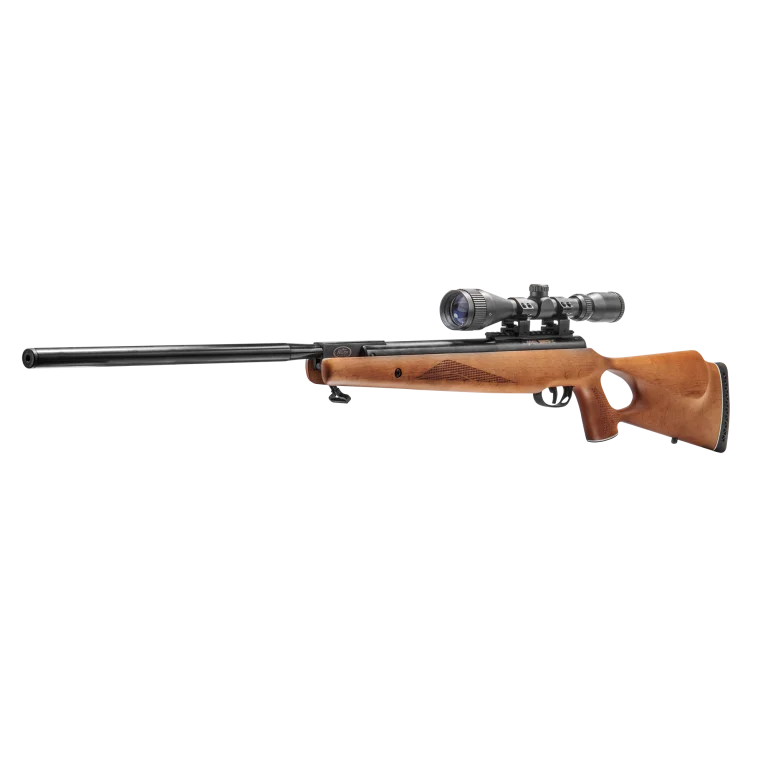


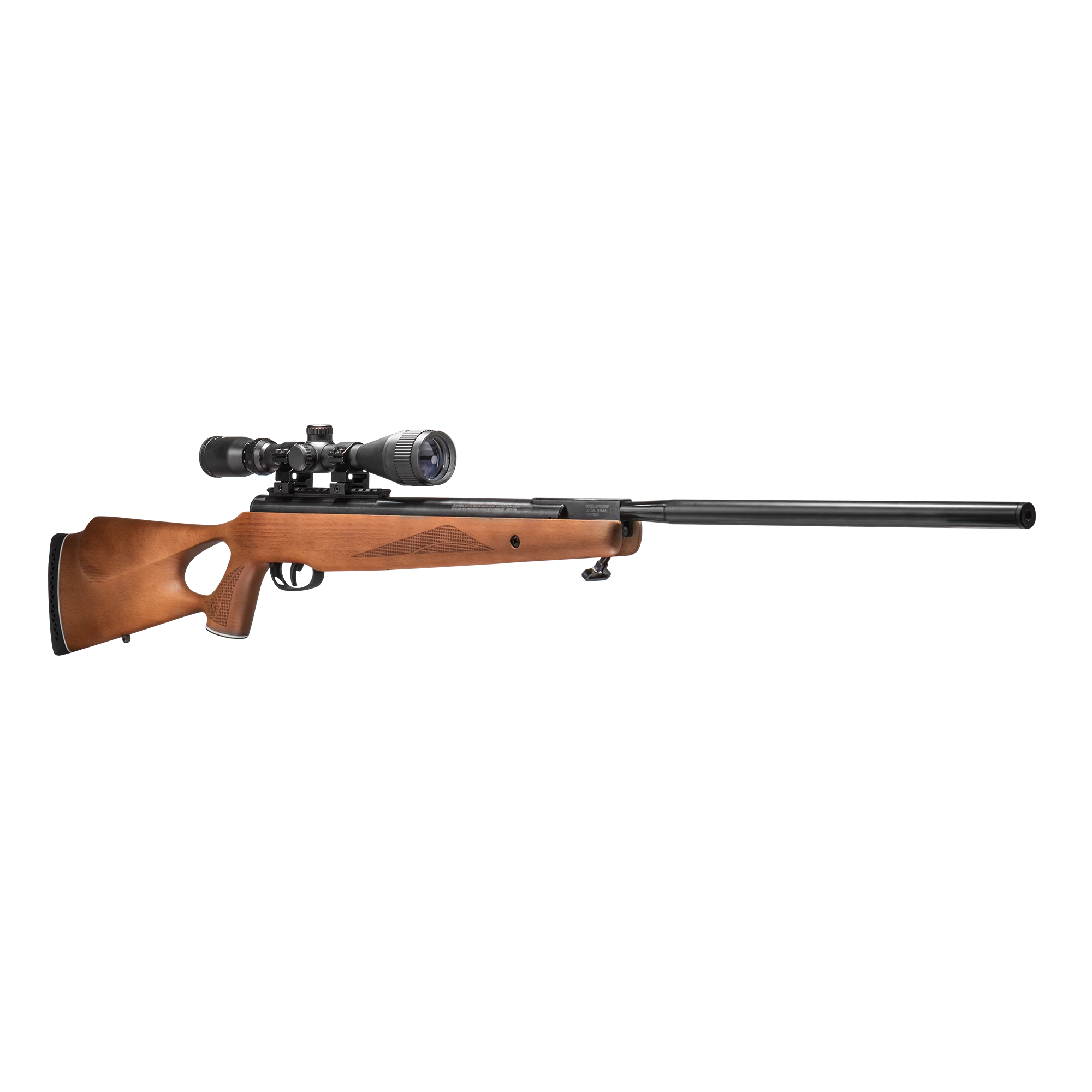









Benjamin Trail XL Magnum
$200.00
The Benjamin Trail XL boasts a checkered, hardwood stock that looks and feels superb. With its staggering velocities of up to 1500 fps (.177), 1100 fps (.22), and 900 fps (.25), the Benjamin Trail NP XL will have no problem handling small game. Our nitro piston-powered break barrels are 70% quieter compared to spring-powered air guns. With less noise, less recoil, and a smooth, simple cocking motion that allows for rapid follow-up shots, this air rifle is ready to impress on your next hunting adventure.
All Benjamin Trail NP Break Barrels include a 3-9×40 mm CenterPoint precision scope with an adjustable objective and range estimating reticle. The Benjamin Trail XL also comes with a rifled barrel, sling mounts (installed), a ventilated rubber recoil pad, and a Picatinny mounting rail system for your accessories.
Features:
- Nitro piston-powered, break barrel air rifle
- Crisp two-stage trigger is adjustable
- Rifled steel barrel
- 1500 fps air rifle (.177-caliber)
- 1100 fps air rifle (.22-caliber)
- 900 fps air rifle (.25-caliber)
- 3-9x40mm Adjustable Objective CenterPoint scope and a Picatinny rail system
- Premium hardwood stock
This handsome air rifle is a worthy addition to our legacy, and yours. Our air guns are famously customizable and modifiable, so browse our top-quality air gun accessories to make it your own. While you’re at it, you can never own too much air gun ammo, and we make it easy to stock up. The Benjamin Trail XL 1500 is an heirloom-quality air rifle that’s hand-assembled to last a lifetime and stay in the family for generations. Own a true original, make it yours, and enjoy the rugged craftsmanship you can only get from a Benjamin.
Additional information
| Caliber: | .177, .22, .25 |
|---|---|
| Powerplant: | Nitro Piston |
| Lead Pellet Velocity: | Up to 1500 fps with .177 caliber Up to 1100 fps with .22 caliber Up to 900 fps with .25 caliber |
| Alloy Pellet Velocity: | Up to 1500 fps |
| Action: | Break Barrel |
| Length: | 49.00 in |
| Product Weight: | 8.50 lbs |
| Barrel Material: | Steel |
| Barrel Type: | Rifled |
| Front Sight: | None |
| Rear Sight: | N/A |
| Material: | Wood |
| Magazine: | N/A |
| Mounting Rail: | Picatinny |
| Trigger: | Two Stage |
| Stock Style: | Thumbhole |
| Stock Material: | Wood |
| Safety: | Lever |
Benjamin Trail XL Magnum — Nitro Piston Power, Precision, and Break-Barrel Engineering
Benjamin Trail XL Magnum Engineering, Precision, and Platform Overview
The Benjamin Trail XL Magnum is a Nitro Piston-powered break-barrel air rifle built around a rifled steel barrel, adjustable two-stage trigger, hardwood thumbhole stock, Picatinny optic rail, sling mounts, and a 3-9×40 mm adjustable-objective scope. Benjamin currently lists .177, .22, and .25 caliber versions with advertised alloy-pellet velocities of up to 1,500 fps, 1,100 fps, and 900 fps respectively. The current 2026 catalog also lists a five-year warranty and states that Trail XL break barrels are quieter and produce less recoil than traditional spring-powered designs.
Benjamin Bulldog Magnum Series Bullpup
The Benjamin Bulldog Magnum Series Bullpup belongs to a completely different PCP category. It uses stored compressed air and bullpup architecture rather than the break-barrel Nitro Piston system used here.
Benjamin Air Rifle
A benjamin air rifle may use several different powerplants. This model uses a nitrogen-filled gas piston that is compressed during the cocking cycle.
Air Rifle and Air Pistol
The phrase air rifle and air pistol includes platforms with different dimensions, powerplants, projectile types, and handling characteristics.
Benjamin Bulldog
The benjamin bulldog represents a large-bore pneumatic platform and should not be mechanically confused with this gas-piston rifle.
Benjamin Air Rifles
Modern benjamin air rifles include PCP, Nitro Piston, break-barrel, and specialized pneumatic designs.
Benjamin Break
A benjamin break barrel rifle uses the barrel itself as part of the cocking mechanism. On this model, cocking compresses the internal gas piston before the barrel is returned to its locked firing position.
Benjamin Airbow Airgun
A benjamin airbow airgun launches arrows using compressed air rather than pellets through a conventional break-barrel action.
Benjamin Marauder PCP
The benjamin marauder pcp family relies on a pre-filled air reservoir, whereas this platform generates each shot through its gas-piston mechanism.
Air Bows Pellet Rifle
The term air bows pellet rifle combines different projectile systems. Airbows launch arrows, while this platform is designed around pellets.
Benjamin Bulldog 457 20 Joules
Searches for benjamin bulldog 457 20 joules can refer to large-bore or regionally restricted configurations and do not describe this model.
CO2 Pellet Guns
Unlike co2 pellet guns, this rifle does not require disposable CO₂ cartridges or an external high-pressure reservoir.
Benjamin Armada
The benjamin armada uses PCP power and a modular rifle chassis, making its operating principle substantially different.
Benjamin Prowler
The benjamin prowler is another Nitro Piston break-barrel platform, although its dimensions, velocity ratings, stock, and optic package differ.
Benjamin Marauder Air Rifle Bulldog 357
The phrase benjamin marauder air rifle bulldog 357 combines separate PCP families and should not be confused with Nitro Piston engineering.
Benjamin Marauder
The benjamin marauder represents a multi-shot PCP system rather than a manually cocked single-shot break barrel.
Cal .177 Pellets
cal .177 pellets are compatible with the .177 version. Benjamin advertises that model at up to 1,500 fps with alloy ammunition.
Brake Barrel BB Gun
A brake barrel bb gun may resemble this platform mechanically, although this rifle uses a rifled barrel intended for appropriately sized pellets.
Benjamin Pellet Gun
A benjamin pellet gun may use PCP, gas-piston, or other technology, making exact model identification important.
Benjamin Bow
The benjamin bow category belongs to arrow-launching pneumatic equipment rather than pellet-based break-barrel systems.
Benjamin Pellet
A benjamin pellet or another compatible projectile affects practical accuracy through weight, diameter, head profile, skirt condition, and manufacturing uniformity.
Benjamin Air Rifle Repair
Professional benjamin air rifle repair may be appropriate if the gas piston, trigger, barrel pivot, breech seal, safety, or locking mechanism develops a fault.
Benjamin Air Rifle 22 Break Barrel
A benjamin air rifle 22 break barrel closely describes the .22 version, which Benjamin currently rates at up to 1,100 fps with alloy pellets.
Benjamin Air Bow
A benjamin air bow launches arrows and therefore has different ammunition and operating requirements.
Benjamin Marauder .25
The benjamin marauder .25 uses PCP operation, while the .25 version here uses a gas piston and break-barrel action.
Benjamin Bulldog 457
The benjamin bulldog 457 belongs to a substantially larger-bore pneumatic category.
Benjamin Marauder Pistol
The benjamin marauder pistol is a compact PCP platform rather than a full-length break-barrel rifle.
Benjamin Air Pistol
A benjamin air pistol typically offers shorter dimensions and different balance than a full-sized rifle.
Pellet Rifle 1500 FPS
The phrase pellet rifle 1500 fps directly relates to the advertised maximum velocity of the .177 version, although Benjamin specifies that this figure is achieved with alloy pellets. Projectile weight and type can change actual velocity substantially.
Air Guns for Hunting
air guns for hunting are subject to local laws, permitted species, caliber restrictions, and energy requirements. Safe target identification and an adequate backstop remain essential.
177 Pellet Gun
A 177 pellet gun uses smaller-diameter projectiles than .22 or .25 configurations and therefore produces different velocity, trajectory, and energy characteristics.
Benjamin Airbow M600
The benjamin airbow m600 belongs to an arrow-launching pneumatic category rather than a break-barrel pellet platform.
Benjamin Pioneer Airbow
The benjamin pioneer airbow likewise uses compressed air to launch arrows.
Benjamin Marauder PCP Air Rifle
A benjamin marauder pcp air rifle uses a reservoir-fed pneumatic system rather than the self-contained gas piston used here.
Benjamin Pellet Gun 22 Cal
A benjamin pellet gun 22 cal description applies broadly to the .22 version, although its defining feature is its Nitro Piston break-barrel powerplant.
Benjamin Vaporizer
The benjamin vaporizer is another Nitro Piston-powered break-barrel family, but its stock, sound-management technology, and overall specifications differ.
Arrow Gun for Deer Hunting
An arrow gun for deer hunting belongs to a specialized category governed by jurisdiction-specific hunting rules and should not be confused with a conventional pellet rifle.
Benjamin 22 Air Rifle
A benjamin 22 air rifle can use several powerplants. This .22 configuration uses a nitrogen-filled gas piston and rifled steel barrel.
PCP Benjamin Marauder
The phrase pcp benjamin marauder describes a pre-charged pneumatic platform, whereas this rifle requires no external PCP filling equipment.
Pneumatic Gun BB Gun Rifle
A pneumatic gun bb gun rifle may describe several technologies. Ammunition type, bore design, and powerplant should always be matched to the exact model.
Benjamibenjamin Nitro Piston 22 Air Rifle for Hunting
The search phrase benjamibenjamin nitro piston 22 air rifle for hunting closely relates to the .22 configuration because Nitro Piston technology defines its operating system.
Why Nitro Piston Engineering, Accuracy, and Break-In Matter
The Trail XL Magnum’s key engineering characteristics include a rifled steel barrel, adjustable two-stage trigger, hardwood stock, Picatinny rail, and 3-9×40 adjustable-objective optic. Benjamin states that Nitro Piston break barrels provide smoother cocking, reduced recoil, and approximately 70% less noise than traditional spring-powered airguns.
Precision should nevertheless be evaluated after the rifle has settled mechanically. Benjamin’s owner’s manual notes that the Trail NPXL may require a break-in period of up to approximately 100 shots, during which accuracy and sound can initially be less consistent. Projectile type and weight also influence actual velocity. Therefore, barrel lockup, ammunition consistency, optic stability, trigger technique, and repeatable hold remain important factors in real-world accuracy.
Gas-Piston Operation, Accuracy Factors, Barrel Lockup, Recoil Behavior, and Practical Reliability
How the Gas-Piston System Operates
The rifle uses a gas-piston powerplant rather than a traditional coiled mainspring. During cocking, the barrel is moved downward and the internal gas ram is compressed. Once the barrel is returned to its locked position and the trigger is released, the gas piston drives the internal mechanism forward and compresses air behind the projectile.
This design can produce a smoother firing cycle than many conventional spring-powered systems because there is no metal mainspring oscillating after the shot. However, the rifle still generates noticeable movement when the piston travels forward. Therefore, consistent shooting technique remains important.
The powerplant is self-contained and does not require a separate high-pressure filling system or disposable gas cartridges. Even so, the internal mechanism contains stored mechanical energy and should not be dismantled casually.
Why Barrel Lockup Matters
A break-barrel rifle depends heavily on consistent barrel alignment.
Every time the barrel is opened for cocking and loading, it must return to precisely the same position before the next shot. If the locking mechanism becomes loose or inconsistent, the relationship between the barrel and the sighting system can change.
This can result in a shifting point of impact even when the ammunition and optic remain unchanged.
The locking surfaces should therefore remain clean, while the barrel pivot should operate smoothly without excessive side-to-side movement.
Any noticeable looseness, unusual resistance, or failure to close securely should be treated as a reason for inspection.
Understanding Recoil and Firing Behavior
The firing cycle of a gas-piston platform differs from that of a conventional firearm.
Movement begins inside the rifle when the piston accelerates forward. As a result, the platform may react before the projectile has completely left the barrel.
This makes a consistent hold especially important.
Holding the stock too tightly can affect how the rifle moves during the shot, while dramatically changing grip pressure from one shot to another may cause inconsistent grouping.
A controlled and repeatable position generally produces more useful accuracy results than excessive muscular tension.
Follow-through also matters. The shooter should avoid immediately moving the rifle after the trigger is released.
Accuracy and Projectile Consistency
Projectile quality can influence practical accuracy considerably.
Small differences in weight, diameter, head shape, and skirt condition can change how individual projectiles engage the rifling.
Damaged ammunition may produce even greater variation. Dents, bent skirts, or contamination can interfere with both barrel fit and flight stability.
For controlled testing, the same projectile type should be used throughout the session.
Changing ammunition constantly makes it difficult to determine whether grouping differences are caused by the rifle or the projectile.
Consistent ammunition, a stable shooting position, and repeatable barrel lockup create a better foundation for evaluating precision.
Trigger Control and Shot Release
Trigger behavior directly affects practical accuracy.
Pressure should be applied smoothly and progressively while maintaining sight alignment.
An abrupt trigger movement can pull the rifle away from the intended point of aim immediately before the shot.
Consistent finger placement also helps reduce variation.
Any trigger adjustments should remain within the manufacturer’s recommended settings.
If the trigger becomes unusually rough, heavy, light, or unpredictable, the rifle should be inspected before further use.
The trigger and safety mechanism should always operate predictably.
Optic Stability and Mounting Security
Gas-piston rifles can place repeated mechanical stress on optic mounts.
For this reason, the scope and mounting hardware should remain securely installed.
Mounting screws should be inspected periodically, particularly after transportation or extended use.
However, excessive tightening should be avoided because it can damage threads, rings, or the optic tube.
If the point of impact begins moving unexpectedly, the mounting system should be checked before assuming that the barrel or internal powerplant is responsible.
Stable eye placement is also important because changing head position can alter the sight picture.
Breech Seal Performance
The breech seal helps contain compressed air where the barrel meets the main action.
If this seal becomes worn, damaged, or contaminated, some of the compressed air may escape during the shot.
This can reduce efficiency and create inconsistent performance.
The seal should be inspected periodically for visible wear, flattening, or damage.
A sudden decline in velocity or grouping consistency can sometimes be related to sealing problems.
Only suitable maintenance products should be used because incorrect lubricants may damage sealing materials or attract debris.
Barrel Cleaning and Muzzle Protection
The barrel should be cleaned carefully and only when necessary.
Frequent aggressive cleaning can cause unnecessary wear, especially when unsuitable rods or abrasive materials are used.
The muzzle crown deserves particular protection because it influences how the projectile leaves the barrel.
Damage in this area can affect grouping even if the remainder of the bore is in good condition.
If accuracy declines, other factors should be checked first, including ammunition condition, optic stability, barrel lockup, trigger technique, and shooting position.
Environmental Influence on Performance
Wind can have a noticeable effect on projectile flight.
The influence generally increases with distance because the projectile remains exposed to the moving air for a longer period.
Temperature may also affect lubricants, seals, and the behavior of the internal gas system.
Humidity presents another concern because moisture can contribute to corrosion.
After use in damp conditions, external surfaces should be dried before storage.
A clean and dry environment helps protect both internal and external components over time.
Storage and Long-Term Reliability
Long-term reliability depends on routine inspection and careful storage.
The rifle should be unloaded and secured whenever it is not in use.
A suitable case can help protect the barrel, stock, and optic during transport, but the rifle should be dry before being enclosed for an extended period.
Barrel lockup, trigger behavior, breech seals, optic mounts, stock screws, and external surfaces should all be checked periodically.
Small warning signs should not be ignored.
Changes in cocking resistance, unusual sounds, shifting accuracy, loose hardware, or reduced performance may indicate that maintenance is required.
When the rifle is used within its design limits, stored correctly, maintained conservatively, and operated with consistent ammunition and technique, it is more likely to preserve predictable accuracy, dependable mechanical operation, and long-term durability.
Power Delivery, Precision Control, Cocking Behavior, Optic Stability, and Long-Term Mechanical Performance
Power Delivery Through the Gas-Piston System
The internal powerplant uses a sealed gas ram instead of a traditional coiled spring. During the cocking cycle, the barrel is moved downward, compressing the internal piston system and storing mechanical energy for the next shot. Once the barrel returns to its locked position, that stored energy is ready to drive the piston forward.
When the trigger is released, the piston rapidly compresses air behind the projectile. This compressed air then pushes the projectile through the rifled barrel. Because a gas ram replaces the conventional mainspring, the firing cycle can feel smoother and produce less spring vibration.
However, the internal piston still moves rapidly. Therefore, consistent handling remains important for repeatable accuracy.
Why Smooth Cocking Matters
The cocking process should feel controlled and predictable.
A smooth cocking stroke helps reduce unnecessary stress on the barrel pivot and locking surfaces. The barrel should move through its normal range without grinding, excessive looseness, or sudden resistance.
Any major change in cocking effort may indicate that inspection is required.
The barrel should also be returned firmly to its closed position after loading. Proper lockup is essential because the barrel must align consistently with the main action before every shot.
Forcing the mechanism or applying unnecessary sideways pressure should be avoided.
Barrel Lockup and Mechanical Precision
Break-barrel accuracy depends heavily on consistent barrel positioning.
Because the barrel moves during every loading cycle, it must return to the same mechanical alignment before each shot. Even a small amount of looseness at the pivot or locking mechanism can influence the relationship between the bore and the optic.
The locking surfaces should remain clean and free from debris.
Side-to-side barrel movement should not be ignored. If noticeable looseness develops, the rifle should be inspected before continued use.
Stable lockup creates a more reliable foundation for accuracy.
Understanding Firing-Cycle Movement
A gas-piston rifle produces a unique firing sensation because internal movement begins before the projectile exits the barrel.
The piston accelerates forward rapidly, generating movement through the stock and action. Therefore, the way the shooter supports the rifle can influence practical accuracy.
An extremely tight grip may change how the platform reacts. Conversely, inconsistent support pressure from one shot to another can produce different points of impact.
A controlled, repeatable hold is generally more effective.
Consistent shoulder contact, support-hand placement, and follow-through can help maintain similar conditions for every shot.
Projectile Quality and Barrel Compatibility
Projectile consistency is essential when evaluating precision.
Variations in weight, diameter, head shape, and skirt condition can influence how the projectile engages the rifling.
A damaged skirt may allow compressed air to escape unevenly, while a deformed head can affect alignment inside the barrel.
For meaningful testing, ammunition should be inspected before loading.
Using one consistent projectile design throughout a shooting session makes it easier to evaluate mechanical performance.
Ammunition should also be protected from moisture, dirt, and physical damage during storage.
Practical Accuracy and Repeatability
Practical accuracy should be evaluated through repeated groups rather than one isolated result.
A single tight group can occur because of favorable conditions, while several consistent groups provide a clearer indication of overall performance.
Testing should therefore use the same shooting distance, support position, optic settings, and ammunition whenever possible.
Environmental conditions should also remain reasonably consistent.
Changing several variables at the same time makes it difficult to determine which factor caused an improvement or decline.
Repeatability provides a more useful measure of performance than maximum velocity alone.
Trigger Control and Stability
Trigger technique can significantly influence grouping.
Pressure should be applied gradually while the sight picture remains stable.
A sudden trigger movement may pull the rifle away from the intended point of aim during the final stage before the shot.
Finger placement should remain consistent from one shot to another.
If the trigger begins to feel unusually heavy, rough, or unpredictable, the rifle should be inspected.
Adjustments should remain within manufacturer-approved limits because excessive modification can affect safe operation.
Optic Mounting and Zero Retention
The firing cycle can place repeated stress on scope mounts and fasteners.
Therefore, the optic should be installed securely using hardware suitable for the platform.
Mounting screws should be inspected periodically, especially after prolonged shooting or transportation.
However, overtightening should be avoided because excessive force can damage threads, rings, or the optic tube.
If the point of impact changes unexpectedly, the optic system should be checked before assuming the barrel or powerplant has developed a problem.
Stable mounting is essential for consistent zero retention.
Breech Seal Efficiency
The breech seal helps contain the compressed air generated during the firing cycle.
If the seal becomes damaged, flattened, or contaminated, air may escape before it can efficiently propel the projectile.
This can reduce consistency and overall performance.
The seal should therefore remain clean and should be inspected periodically.
A sudden change in firing behavior may sometimes be related to seal condition rather than a problem with the internal gas system.
Only suitable maintenance products should be applied where recommended.
Temperature and Environmental Effects
Environmental conditions can influence both the rifle and projectile.
Wind can move the projectile sideways, especially as distance increases.
Temperature may affect sealing materials, lubrication, and internal mechanical behavior.
Extreme heat should be avoided during storage, while very cold conditions may change the flexibility of some components.
Humidity can contribute to corrosion if moisture remains on metal surfaces.
After exposure to damp conditions, the rifle should be dried thoroughly before storage.
Cleaning and Routine Maintenance
Routine maintenance should remain conservative.
The barrel should only be cleaned when necessary and with suitable equipment.
Aggressive cleaning can damage the rifling or muzzle crown.
External metal surfaces should be wiped clean after use to remove dirt, moisture, and fingerprints.
Fasteners, barrel lockup, optic mounts, and the stock should also be inspected periodically.
Small maintenance problems are generally easier to correct before they develop into larger mechanical faults.
Long-Term Reliability
Long-term reliability depends on proper storage, careful handling, and routine inspection.
The rifle should be unloaded and secured whenever it is not being used.
A protective case can reduce damage during transportation, although equipment should be dry before long-term enclosed storage.
Changes in cocking effort, trigger feel, barrel movement, firing sound, or accuracy can provide useful warning signs that maintenance may be required.
When the platform is kept clean, operated within its design limits, protected from moisture, and used with consistent ammunition, it is more likely to maintain dependable operation and stable precision throughout extended use.
Build Quality, Shooting Comfort, Maintenance, Storage, and Long-Term Reliability
Construction Quality and Mechanical Strength
A powerful break-barrel platform depends on the strength and alignment of several major components. The barrel assembly, breech, locking mechanism, stock, trigger group, gas-piston system, optic rail, and external fasteners all contribute to overall reliability. When these parts remain properly fitted, the rifle is more likely to preserve consistent mechanical behavior over time.
Durability does not eliminate the need for inspection. Repeated cocking, firing, transportation, and environmental exposure can gradually affect fasteners, seals, pivot points, and mounting surfaces. Therefore, the rifle should be checked periodically for unusual movement, looseness, or changes in resistance.
A solidly constructed platform should feel firm when the barrel is locked into position. Any noticeable side-to-side movement or unexpected change in alignment should be investigated before extended use continues.
Why Shooting Comfort Matters
Comfort directly affects practical consistency because an uncomfortable shooting position creates unnecessary muscular tension. If the shooter must constantly adjust grip pressure, shoulder position, or head alignment, repeatable accuracy becomes more difficult.
Stock shape, length, balance, and optic placement all influence how naturally the rifle can be supported. A stable cheek position helps maintain the same relationship between the eye and the optic, while consistent shoulder contact helps reduce variation between shots.
Comfort is therefore more than a convenience feature. It can support repeatable body positioning and reduce fatigue during longer sessions.
Weight Distribution and Handling Balance
Weight distribution has a major influence on how the rifle feels in practical use.
A front-heavy setup may feel stable from a supported position, but it can also create fatigue in the support arm. A rear-heavy configuration may feel easier to lift but could require more effort to keep the sight picture steady.
Optics and mounting hardware can shift the center of gravity considerably. Therefore, scope selection should consider overall weight and balance as well as magnification.
A balanced setup generally requires less muscular effort and can help the shooter maintain more consistent alignment over time.
Barrel Lockup and Repeatable Alignment
Break-barrel accuracy depends heavily on the barrel returning to the same position after every cocking cycle.
The locking mechanism should engage firmly and consistently. If the barrel closes differently from one shot to another, the relationship between the bore and the optic may change.
The breech area should remain clean because dirt or debris can interfere with proper closure.
Any unusual looseness, roughness, or difficulty locking the barrel into place should be treated as a reason for inspection.
Consistent lockup is one of the most important foundations of repeatable accuracy.
Breech Seal Condition and Air Retention
The breech seal helps prevent compressed air from escaping where the barrel meets the action.
If this seal becomes worn, flattened, damaged, or contaminated, performance may become less consistent.
A sudden change in firing behavior can sometimes be linked to a poor seal rather than the gas-piston system itself.
The seal should remain clean and should be inspected periodically for visible damage.
Only suitable maintenance products should be used because incorrect lubricants can damage sealing materials or attract dirt.
Trigger Condition and Mechanical Control
The trigger should operate smoothly and predictably.
A consistent release helps reduce unnecessary movement during the final stage of aiming.
If the trigger begins to feel unusually rough, heavy, light, or inconsistent, the rifle should be inspected before continued use.
Any adjustment should remain within manufacturer-approved limits.
Excessive modification can affect reliability and may create unsafe operating conditions.
The safety mechanism should also be checked periodically to confirm that it functions normally.
Optic Stability and Mounting Security
The firing cycle of a gas-piston rifle can place repeated stress on scope mounts and fasteners.
For that reason, the optic should be mounted using hardware appropriate for the platform.
Mounting screws should remain secure, but overtightening should be avoided because excessive force can damage threads, rings, or the optic tube.
If the point of impact shifts unexpectedly, checking the scope and mounts should be one of the first troubleshooting steps.
A stable sighting system is essential for meaningful accuracy evaluation.
Barrel Cleaning and Muzzle Protection
The barrel should be treated as a precision component.
Cleaning should be performed only when necessary and with suitable tools.
Aggressive cleaning can damage the rifling or muzzle crown, especially if hard rods or abrasive products are used incorrectly.
The crown is particularly important because it affects the final release of the projectile.
If accuracy begins to decline, other possible causes should be checked before assuming the barrel needs cleaning. Ammunition, optic stability, barrel lockup, trigger control, and shooting technique can all influence grouping.
Stock and Fastener Maintenance
The stock supports the action and provides the primary interface between the shooter and the rifle.
Action screws and other fasteners should remain properly tightened.
Loose hardware can affect handling and consistency, while excessive tightening can damage threads or stock material.
The stock should also be inspected for cracks, looseness, or damage around mounting points.
A stable stock helps preserve the relationship between the action, optic, and shooter.
Environmental Protection
Moisture, dust, heat, and cold can all affect long-term condition.
Humidity can contribute to corrosion if metal surfaces remain damp.
Dust and debris may also collect around the breech, trigger area, pivot points, and mounting hardware.
After use in wet or dirty conditions, the rifle should be wiped clean before storage.
Extreme heat should be avoided because prolonged exposure may affect seals, finishes, and lubricants.
Very cold conditions can also change the behavior of some materials.
Secure Storage and Transport
The rifle should be unloaded and secured whenever it is not in use.
A protective case can help prevent impact damage during transportation, particularly around the barrel, optic, and stock.
However, the rifle should be dry before being enclosed for an extended period.
Moisture trapped inside a case can promote corrosion.
Direct sunlight and prolonged exposure to extreme temperature should also be avoided.
Local rules covering transport and secure storage should always be followed.
Preventive Maintenance and Long-Term Reliability
Preventive maintenance is generally more effective than waiting for a major mechanical problem to develop.
Barrel lockup, breech-seal condition, trigger behavior, optic mounts, stock fasteners, and external surfaces should all be inspected periodically.
Small warning signs should not be ignored. Changes in cocking resistance, firing sound, point of impact, barrel movement, or trigger feel can indicate that servicing is required.
Long-term reliability depends on careful handling, proper storage, consistent ammunition, stable optics, clean mechanical surfaces, and regular inspection.
When these factors are managed properly, the rifle is more likely to maintain dependable operation, predictable accuracy, and sound mechanical condition over an extended service life.
Be the first to review “Benjamin Trail XL Magnum”
Related products


Benjamin

Benjamin

Benjamin

Reviews
There are no reviews yet.