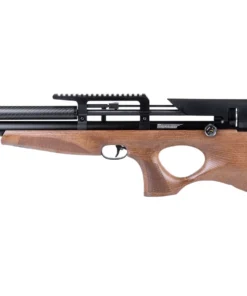
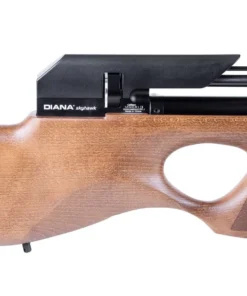
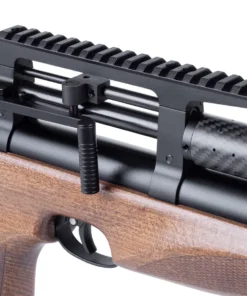
Diana Skyhawk Gen2 PCP Air Rifle
$600.00
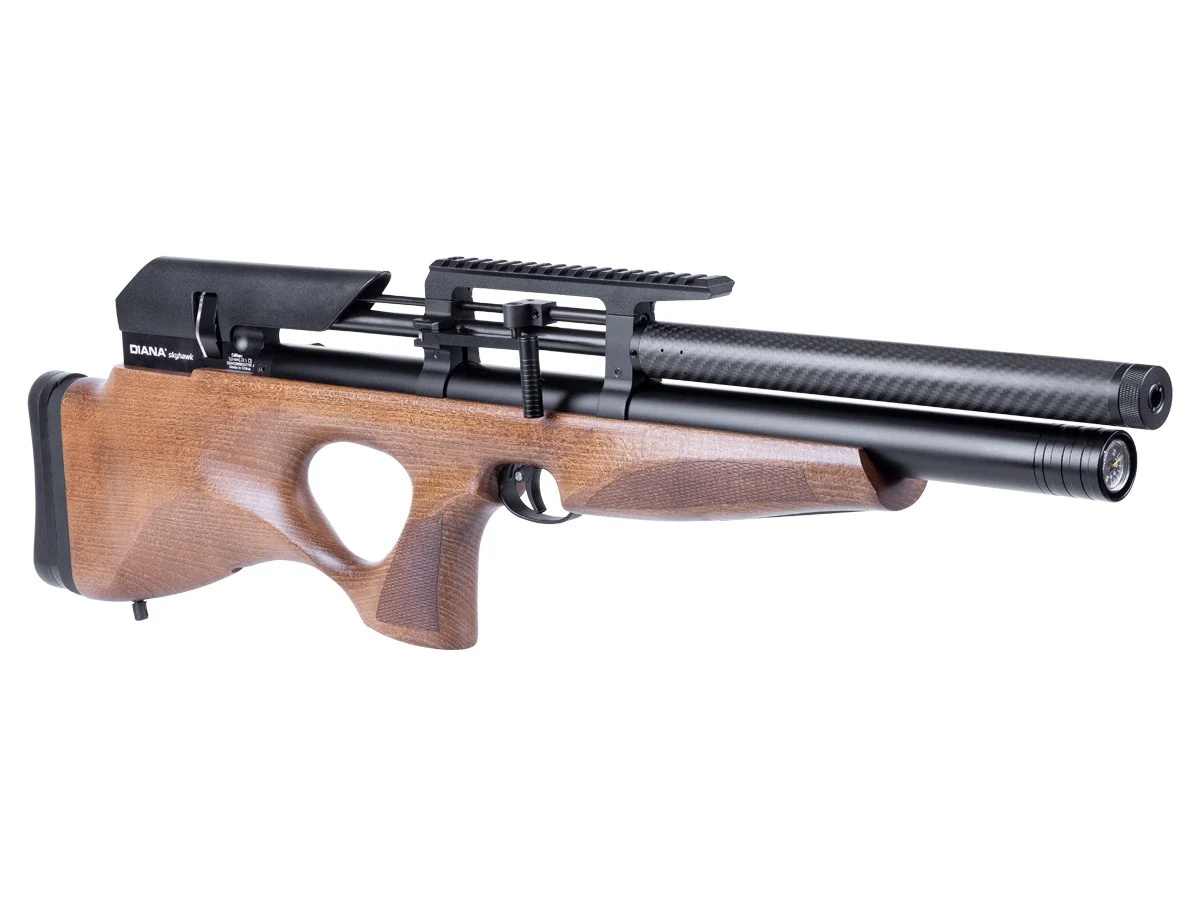
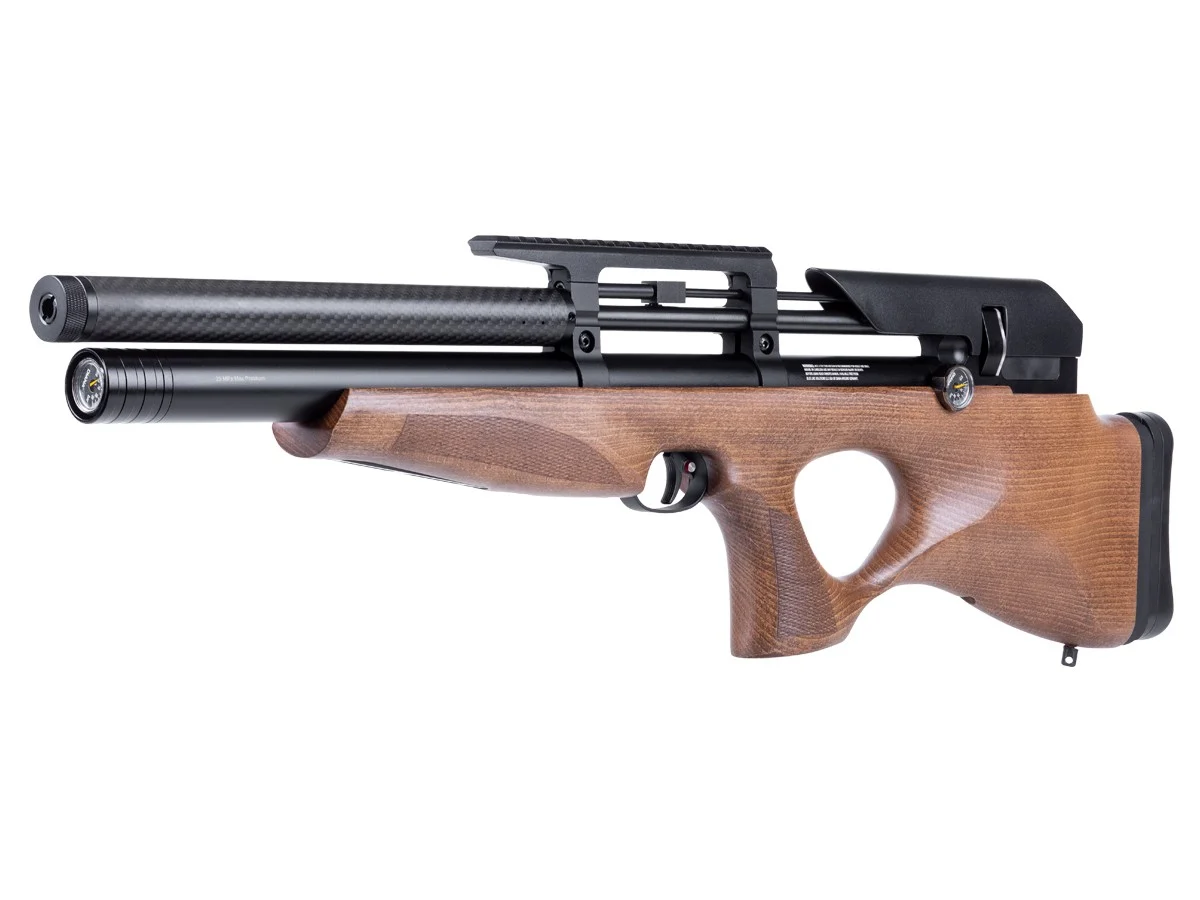
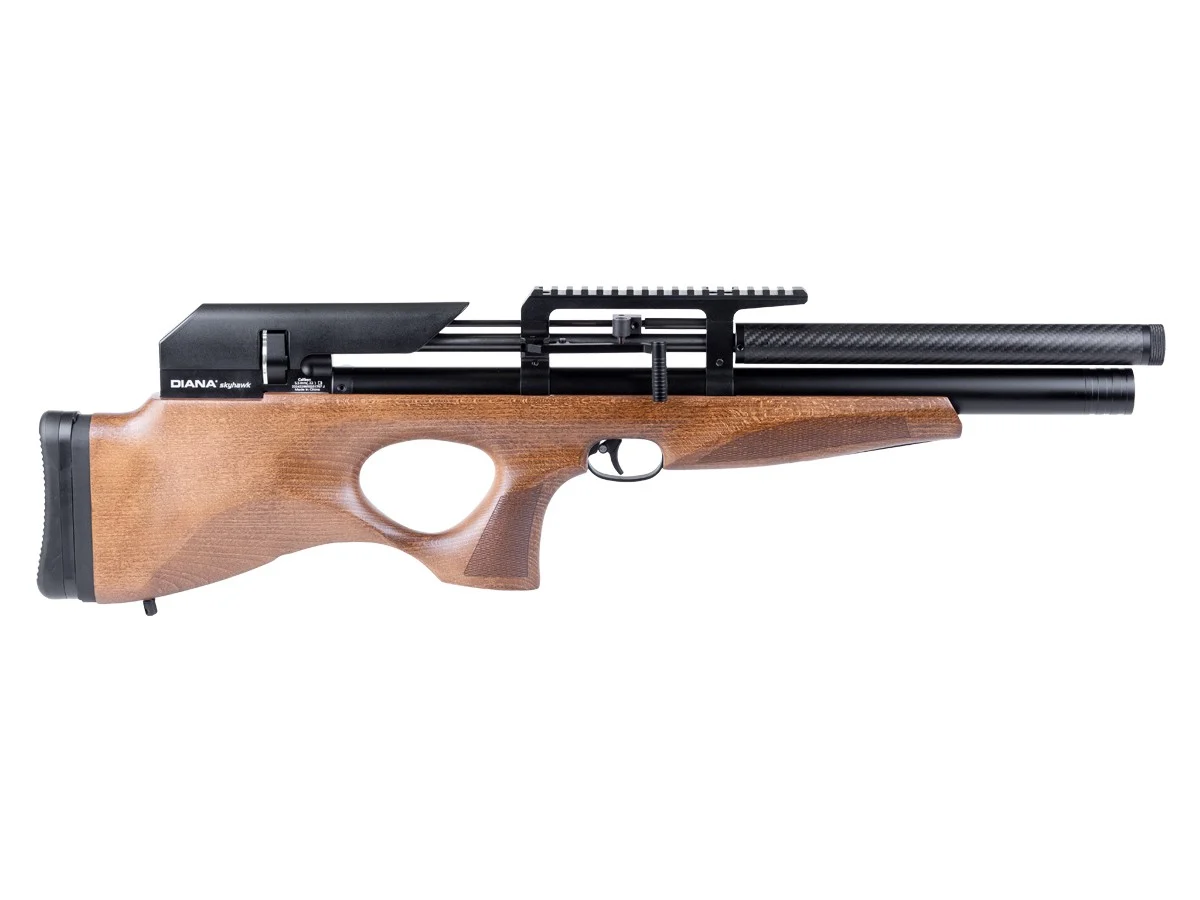
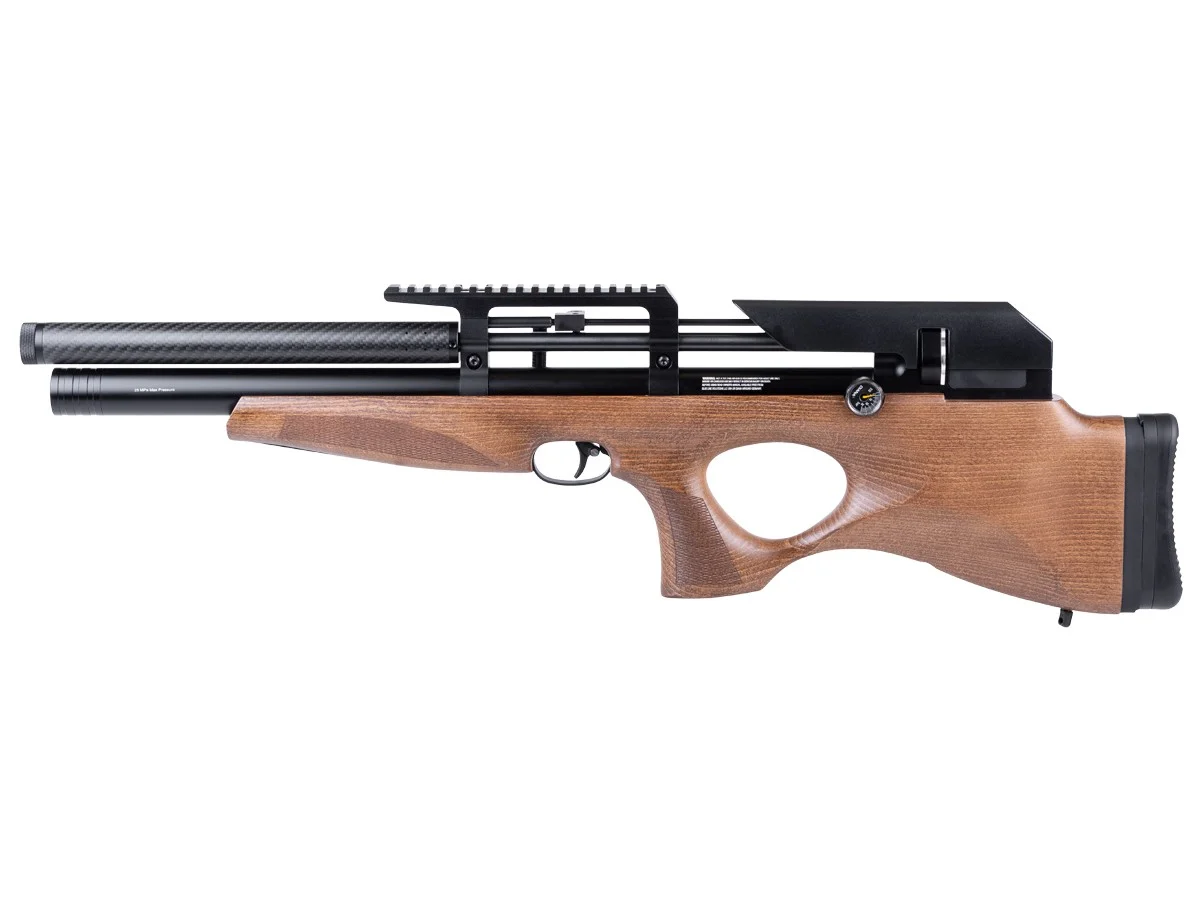
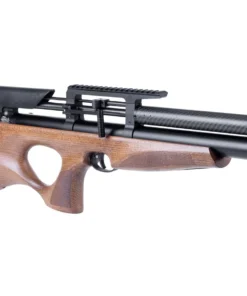
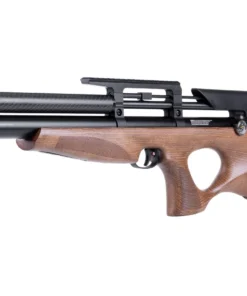
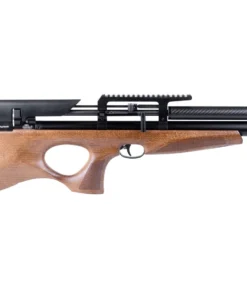
The Diana Skyhawk Gen2 PCP Air Rifle is a compact and lightweight bullpup air gun with a wood thumbhole stock and improvements compared to the previous version. It reaches velocities up to 985 FPS in .177 and 950 FPS in .22, with power up to 19 FPE in .177 and 32 FPE in .22 to provide the performance needed for plinking, pest control, and small-game hunting.
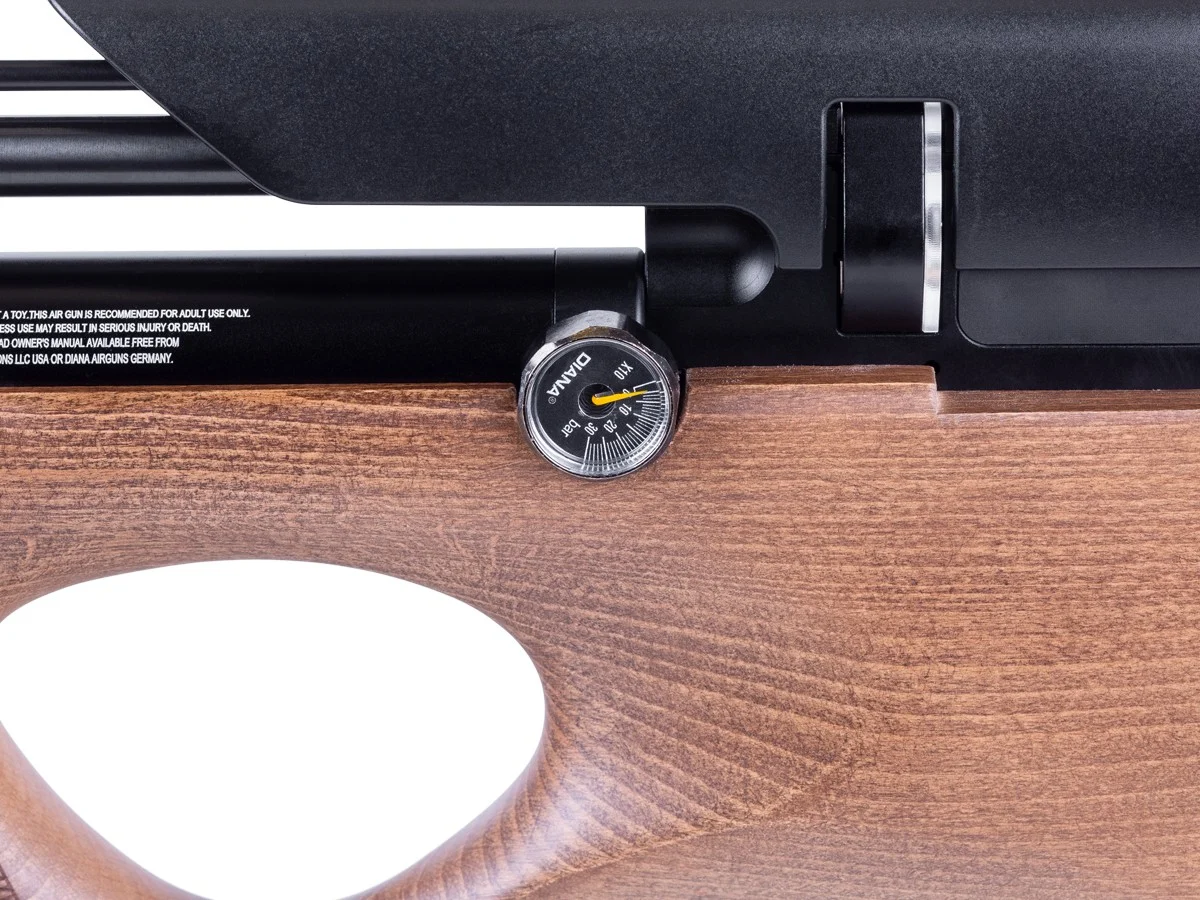
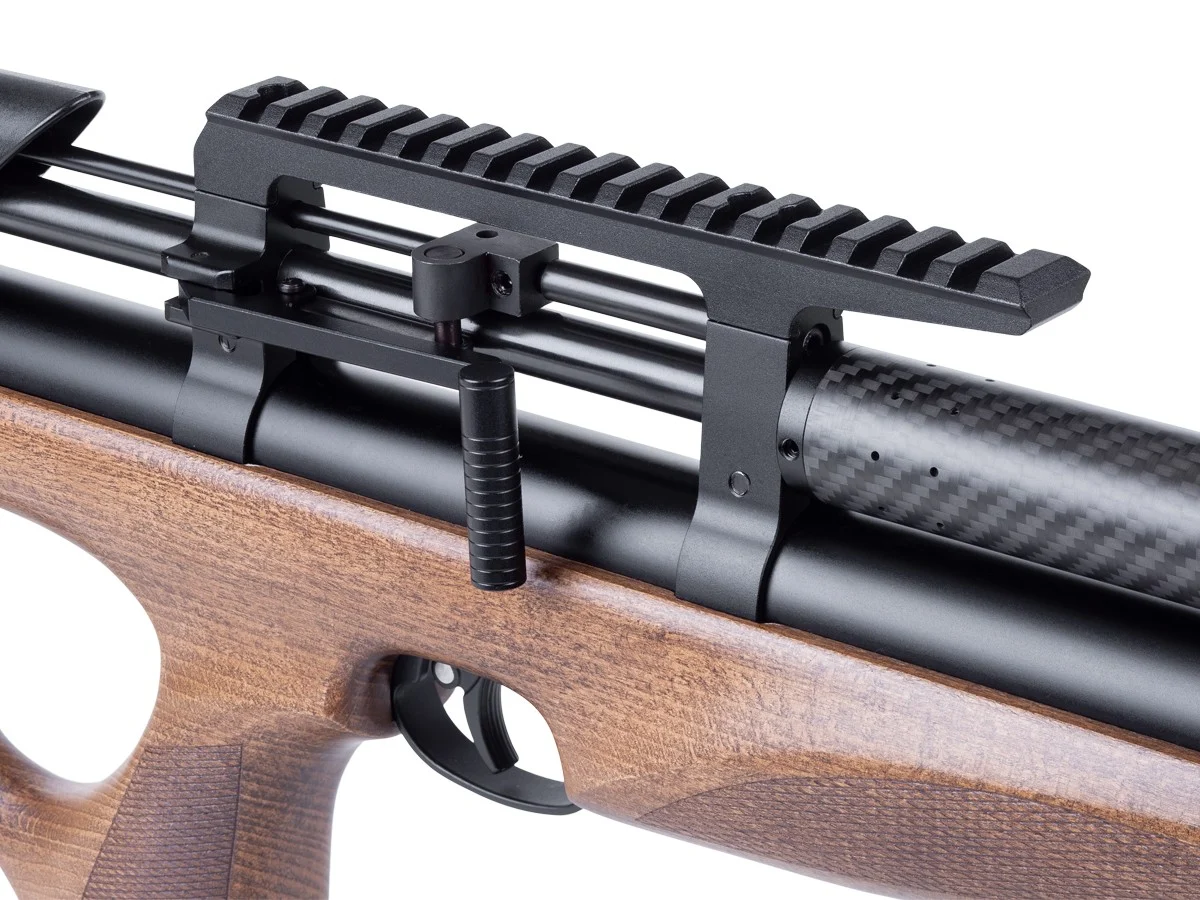
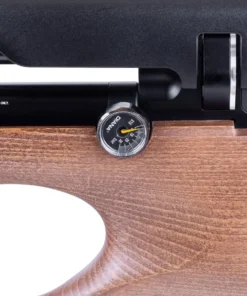
The smooth sidelever action has been upgraded for ease of use by moving it to the middle of the stock, near the trigger, compared to back by the buttstock in the older model. This air rifle is still fully regulated to provide consistent and accurate shots, and the separate regulator pressure gauge and fill pressure gauge mean the expected performance of each shot and when a refill is needed are both simple to monitor.
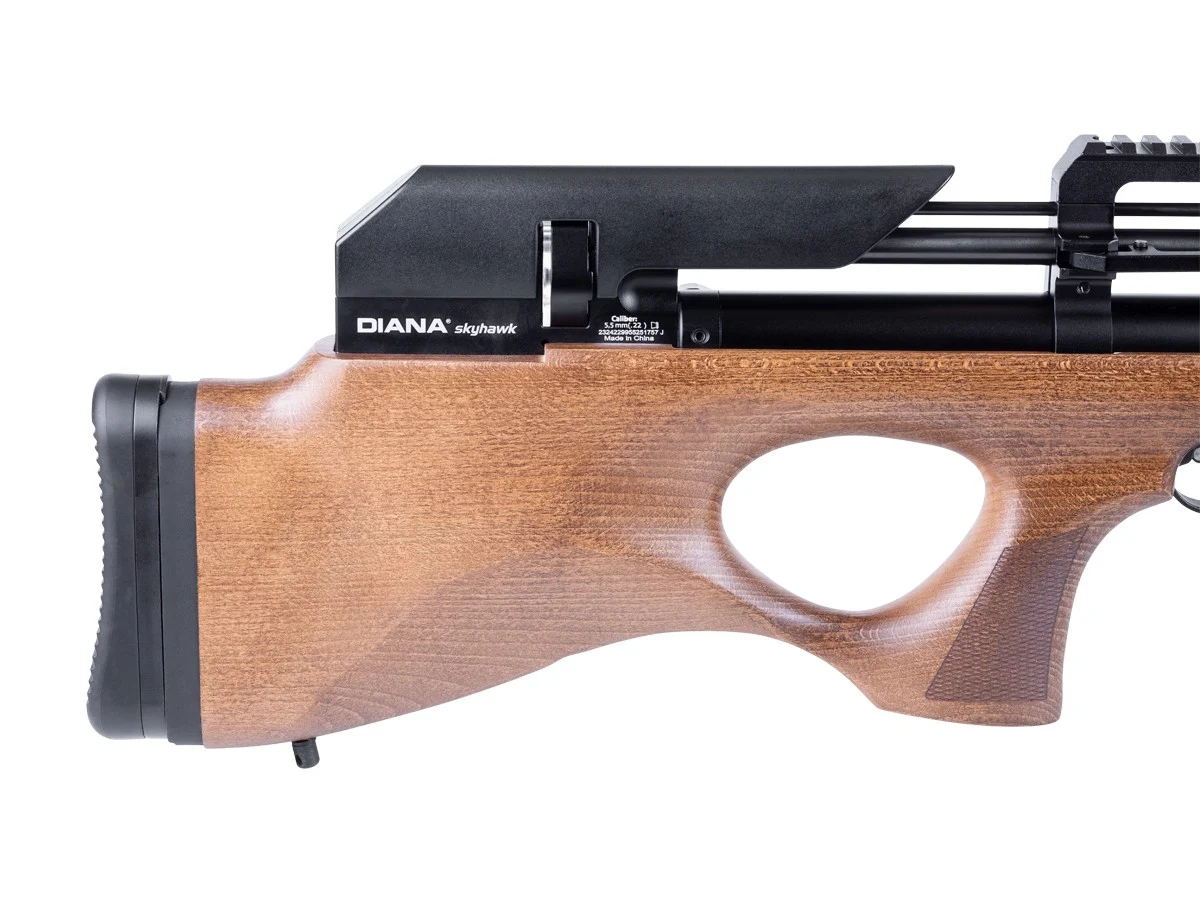
For accurate sighting, the Diana Skyhawk Gen2 has a Picatinny optics rail that accommodates a scope or other optics, and the stock has checkering on both the forearm and the grip to ensure a slip-free hold even in the presence of moisture. A sling swivel stud is included to facilitate the addition of a sling for convenient carrying, the package includes two magazines, and the rubber buttpad is adjustable for height.
Diana Skyhawk Gen2 PCP Air Rifle
- Precharged pneumatic
- Repeater
- Wood thumbhole bullpup stock
- Sidelever action
- Sidelever now mounted mid-stock vs. rear-stock
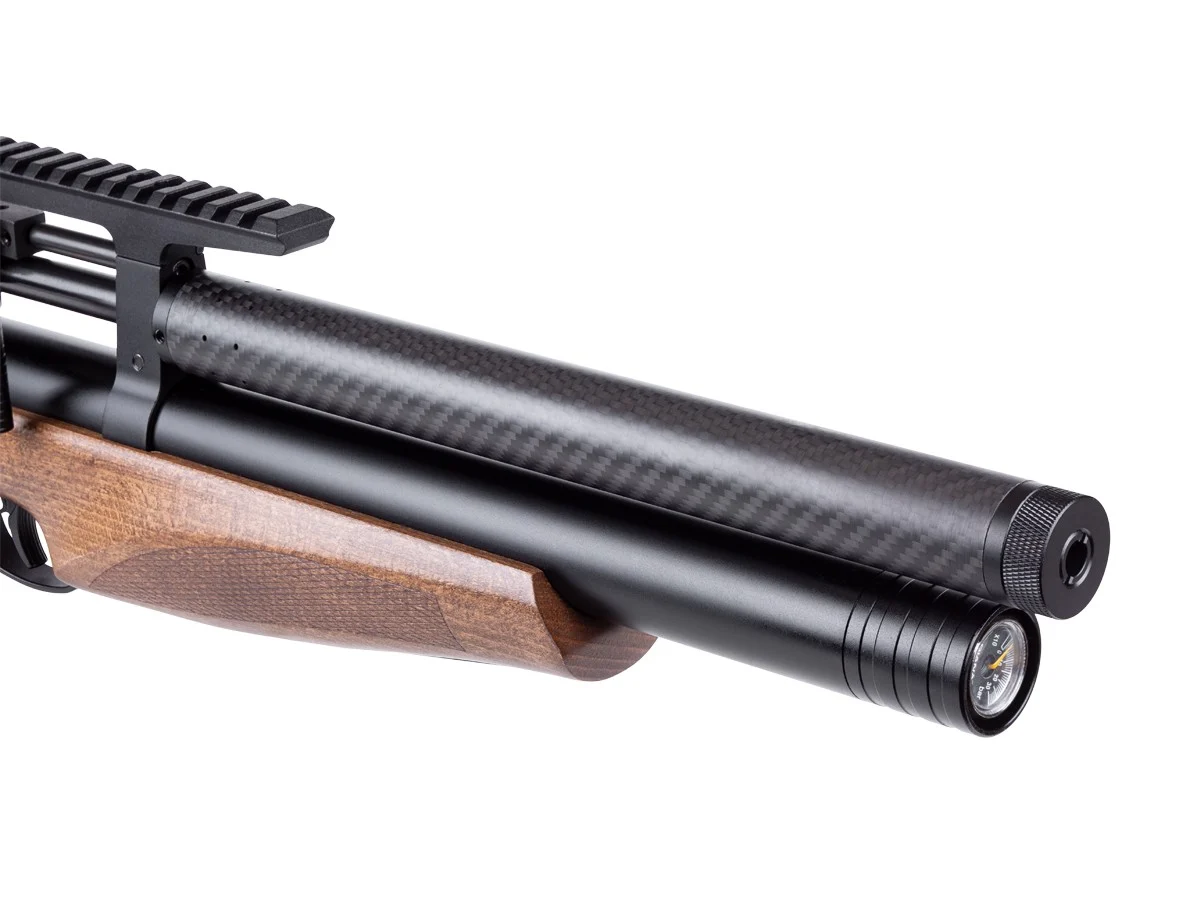
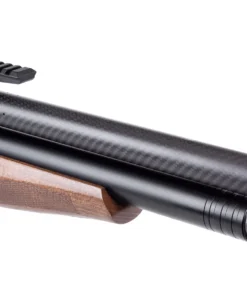
- Shrouded barrel with carbon fiber sleeve
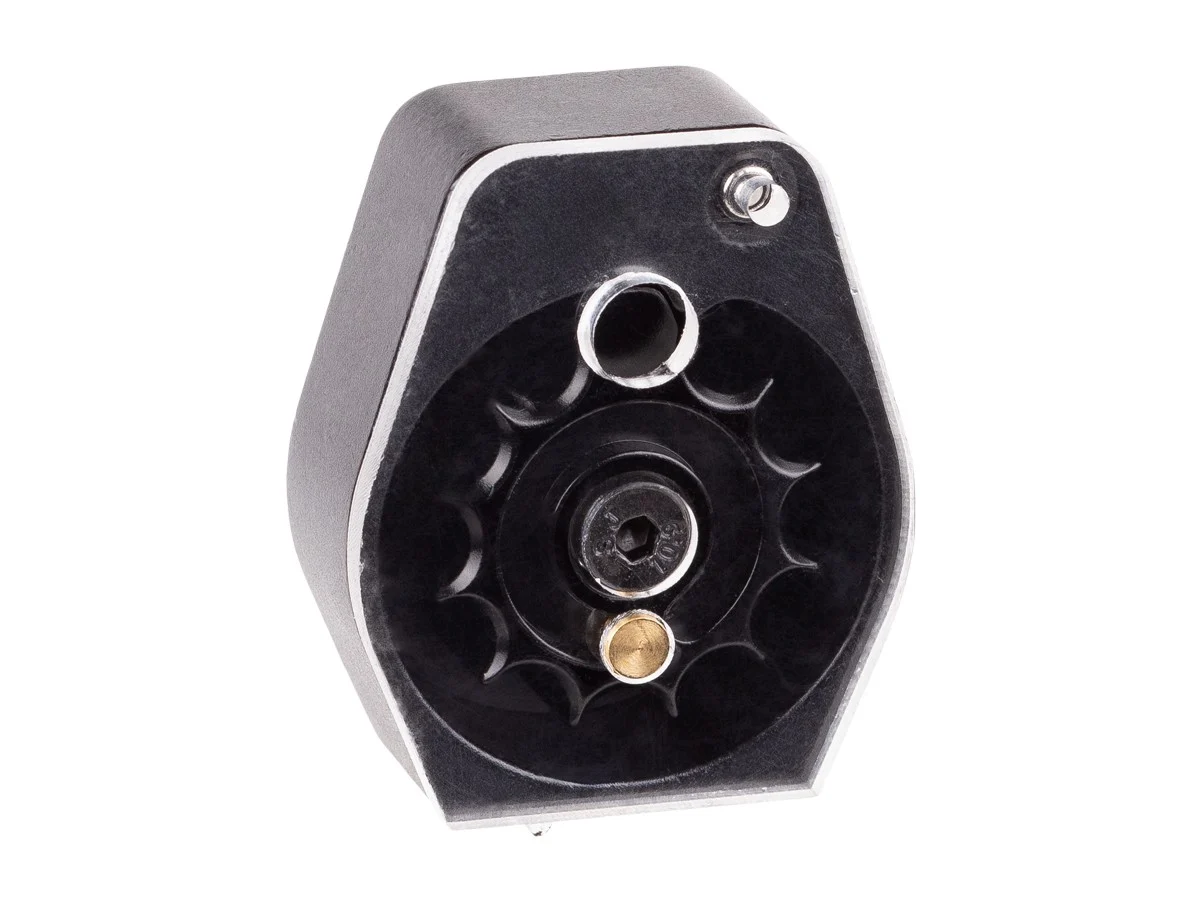
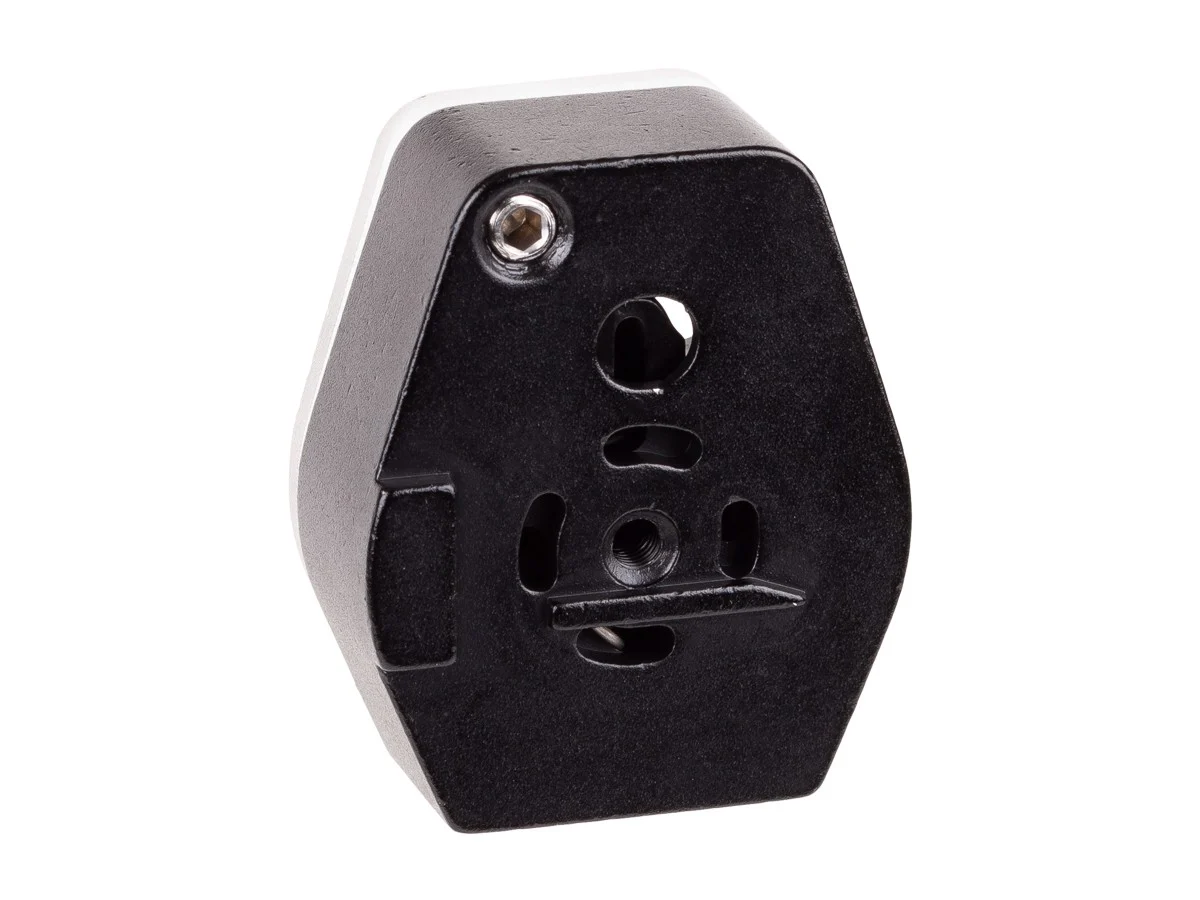
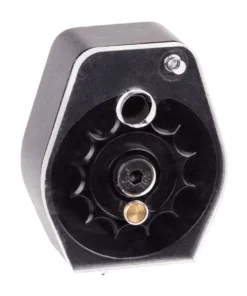
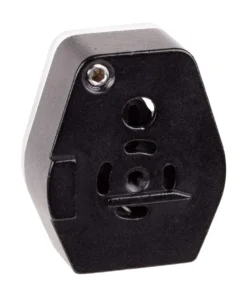
- Magazine capacity: 11 rounds (.177), 9 rounds (.22)
- Dual integrated pressure gauges (fill pressure, regulator pressure)
- 265cc air cylinder
- Max. fill pressure: 3,625 PSI (250 BAR)
- Max. velocity: 985 FPS (.177), 950 FPS (.22)
- Max. energy: 19 FPE (.177), 32 FPE (.22)
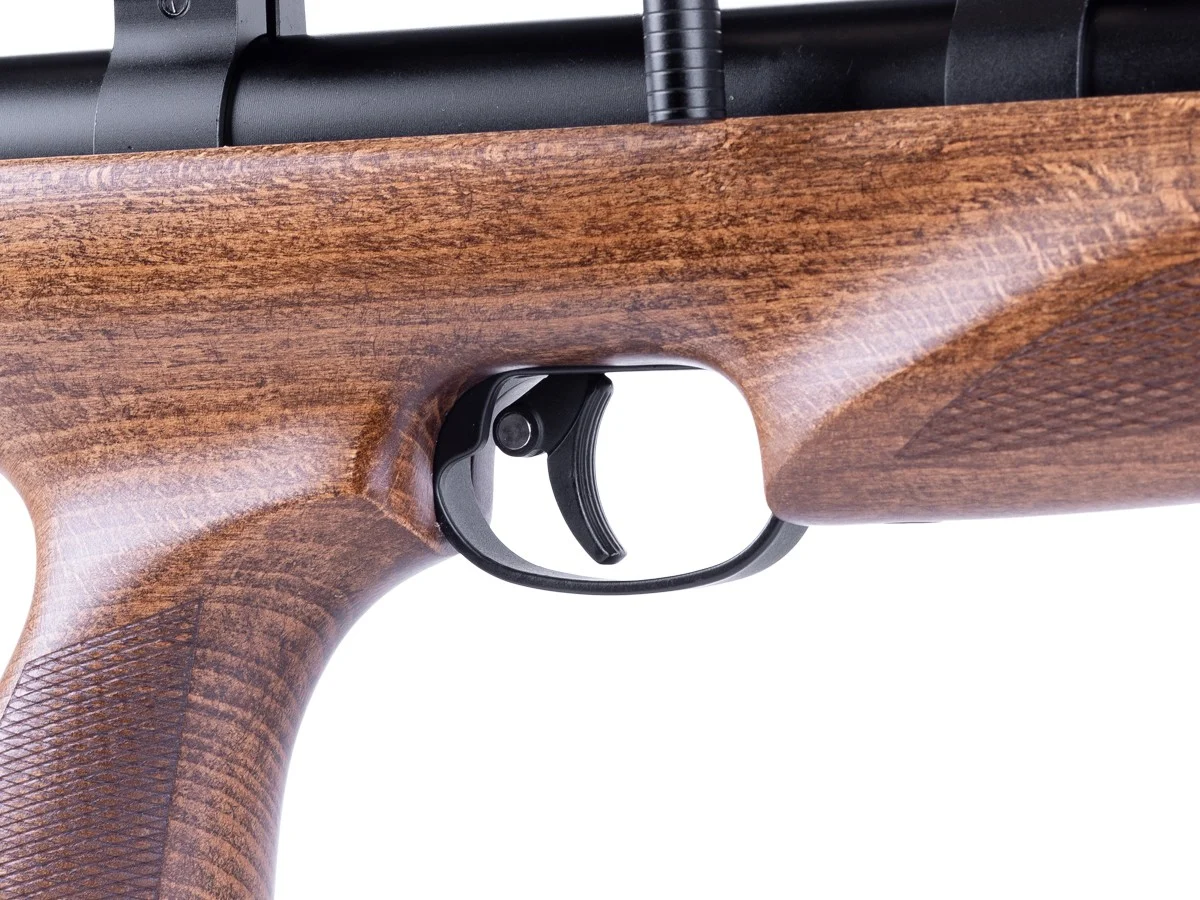
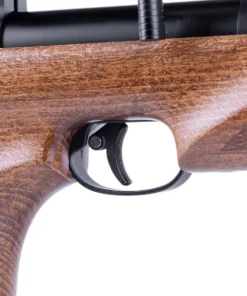
- DIT (Diana Improved Trigger) two-stage adjustable trigger
- Checkering on forearm and grip
- Picatinny optics rail
- Manual safety
- Height-adjustable rubber buttpad
- Sling swivel stud
- Barrel length: 17.7″
- Overall length: 29″
- Weight: 6.7 lbs.
- Includes soft case, fill probe, and two magazines
Specifications
BrandCaliber.22 (5.5mm)Max Velocity950 fpsMuzzle Energy32 ft/lbsSuggested forSmall game hunting/plinkingPowerplantPre-charged pneumaticLoudness3-MediumNoise Level87.88 dB Weight6.7 lbsFunctionRepeaterCylinder Size265 ccActionSideleverShroudedYesScopeable11mm dovetailFront SightsnoneRear SightsnoneSafetyManualBarrelRifledBarrel Length17.7″Overall Length29.0″Capacity9 round(s)Body TypeBullpupStockHardwoodButtplateRubberOperating Pressure3625 PSI / 250 BARRegulatedYesIs Safe To Dry FireYesCase IncludedSoft CaseMagazine Included2
Diana Skyhawk Gen2 PCP Air Rifle – Complete Precision, Power, Regulated Performance, Bullpup Engineering, Features, Calibers & Product Guide
Diana Skyhawk Gen2 PCP Air Rifle – Comprehensive Product Description, Technical Specifications, Precision Engineering, Performance, and SEO Keyword Integration
Diana Skyhawk Gen2 PCP Air Rifle – Advanced Bullpup Engineering and Precision-Oriented Performance
The Diana Skyhawk Gen2 PCP Air Rifle brings together contemporary pre-charged pneumatic technology, traditional hardwood craftsmanship, regulated air delivery, and compact bullpup engineering in a distinctive sporting platform. Developed for enthusiasts who appreciate mechanical refinement, consistent performance, and practical ergonomics, this second-generation model combines an improved side-lever action, precision-rifled barrel, carbon-fiber shroud, and adjustable two-stage trigger.
Unlike conventional spring-piston sporting rifles, the Diana Skyhawk Gen2 PCP Air Rifle operates using compressed air stored within a dedicated reservoir. Consequently, its firing mechanism does not depend on a large compression spring moving through a cylinder during each firing cycle. Instead, stored compressed air supplies the operating system through an integrated regulator.
Furthermore, the compact bullpup arrangement allows the Diana Skyhawk Gen2 PCP Air Rifle to retain a useful rifled barrel length within relatively short overall dimensions.
Measuring approximately 29 inches from end to end, the rifle combines a 17.7-inch barrel with a distinctive wooden thumbhole stock. This arrangement offers a different balance and handling experience from conventional full-length sporting rifles.
Another important improvement is the redesigned side-lever mechanism. Compared with the earlier generation, the operating handle is positioned closer to the middle of the stock and the trigger area. This reflects the manufacturer’s effort to improve accessibility while preserving the established mechanical concept.
The Diana Skyhawk Gen2 PCP Air Rifle also incorporates a 265cc compressed-air reservoir rated to a maximum of approximately 250 BAR, equivalent to 3,620 PSI.
Additionally, two integrated pressure gauges provide separate information about the main reservoir and the regulated pressure system.
The precision-rifled barrel features a carbon-fiber sleeve associated with the moderated barrel assembly. Consequently, the exterior combines modern composite styling with traditional wood furniture.
The hardwood stock includes checkered gripping surfaces, an integrated cheek rest, and a height-adjustable rubber buttpad. Together, these details create a recognizable sporting configuration.
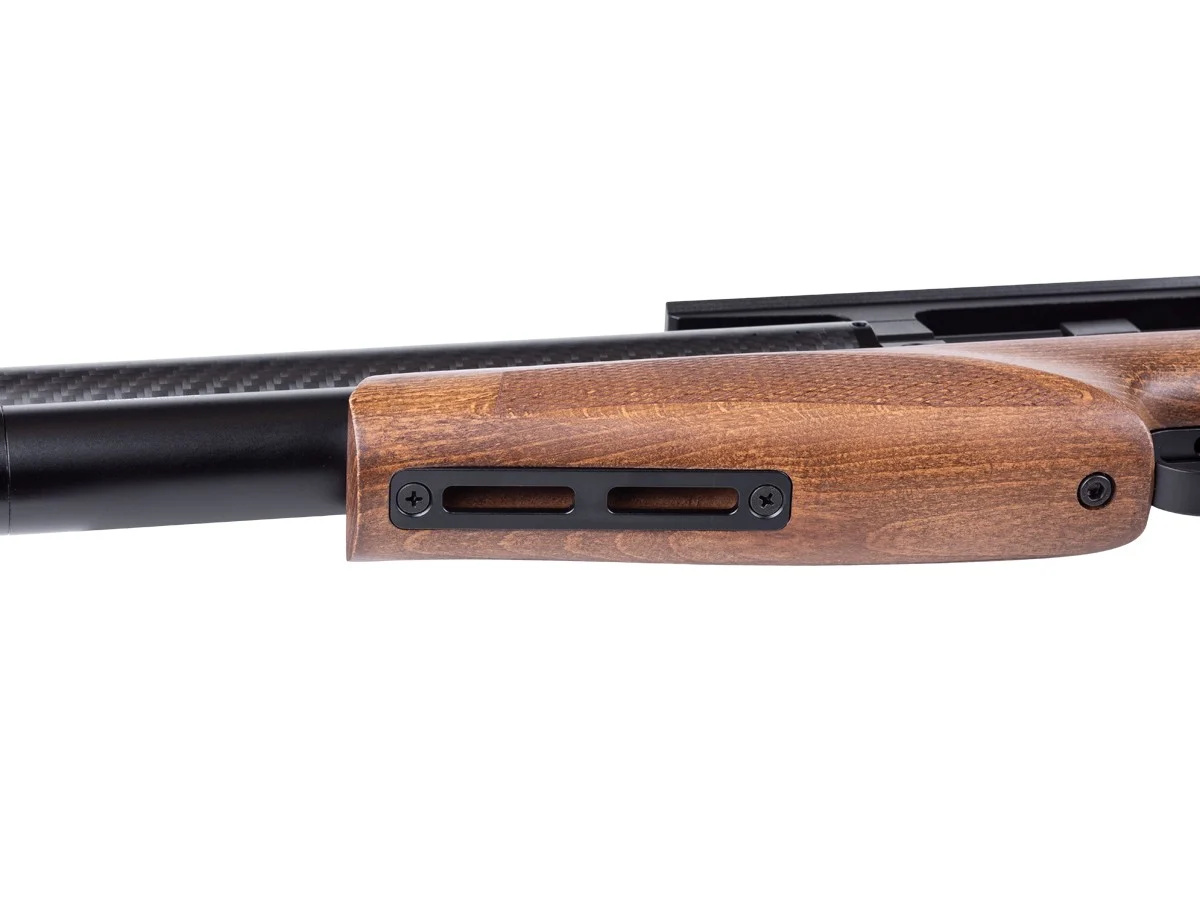
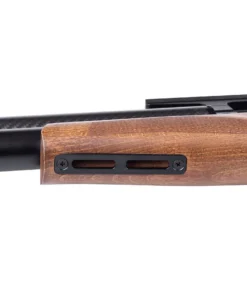
Furthermore, the Diana Skyhawk Gen2 PCP Air Rifle incorporates a Picatinny optics rail, an M-LOK accessory interface on the forearm, and a rear sling attachment stud.
Available in .177, .22, and .25 caliber configurations in the manufacturer’s catalog, the rifle provides different published velocity, energy, and magazine-capacity specifications.
However, regional retail availability varies. Some US retailers list only the .177 and .22 configurations.
For buyers seeking a modern regulated pneumatic platform without the extended dimensions of a traditional full-length stock, the Diana Skyhawk Gen2 PCP Air Rifle offers an interesting combination of engineering, ergonomics, and recognizable manufacturing heritage.
Its appeal lies not simply in maximum power, but in the integration of the regulated operating system, compact mechanical layout, adjustable stock features, and included accessories.
Diana Skyhawk Gen2 PCP Air Rifle – Complete Technical Specifications
The specifications below follow the manufacturer’s 2026 catalog and current retailer information for the second-generation design.
Manufacturer and model
-
Brand: Diana
-
Model: Skyhawk Gen2, also catalogued as the current Skyhawk
-
Manufacturer product family: Skyhawk
-
Product category: Pre-charged pneumatic sporting rifle
-
Power source: Compressed air
-
Configuration: Bullpup
-
Action: Side-lever repeater
-
Pressure system: Internally regulated
-
Stock material: Checkered hardwood
-
Stock design: Thumbhole, with integrated cheek rest
-
Available catalog calibers: .177, .22, and .25
-
Air reservoir capacity: 265cc
-
Maximum fill pressure: 250 BAR / approximately 3,620 PSI
-
Barrel: Rifled steel
-
Barrel length: 450mm / approximately 17.7 inches
-
Overall length: 737mm / approximately 29 inches
-
Weight: Approximately 3.03kg / 6.7 pounds
-
Trigger: Diana Improved Trigger, two-stage adjustable
-
Safety: Manual
-
Pressure monitoring: Two integrated gauges
-
Barrel exterior: Carbon-fiber shroud
-
Optical mounting: 22mm Picatinny rail
-
Accessory interface: M-LOK forearm rail
-
Buttpad: Height-adjustable rubber
-
Sling attachment: Rear stud
-
Magazine system: Rotary, caliber-specific
-
Open sights: Not included in the standard US retail configuration
-
Muzzle interface: Manufacturer-listed 1/2-inch UNF threading
-
Standard listed accessories: Two magazines, filling probe, and soft carrying case
Caliber-specific specifications
| Specification | .177 caliber | .22 caliber | .25 caliber |
|---|---|---|---|
| Projectile diameter | 4.5mm | 5.5mm | 6.35mm |
| Magazine capacity | 11 | 9 | 8 |
| Maximum catalog velocity | 985 FPS | 950 FPS | 850 FPS |
| Maximum catalog energy | 26 J / 19 FPE | 44 J / 32 FPE | 52 J / 38 FPE |
| Reservoir volume | 265cc | 265cc | 265cc |
| Maximum filling pressure | 250 BAR | 250 BAR | 250 BAR |
| Action | Side-lever | Side-lever | Side-lever |
| Regulated | Yes | Yes | Yes |
The manufacturer’s current product page lists different maximum energy figures for certain calibers than its 2026 catalog. Therefore, this description uses the catalog values consistently, rather than combining the highest figures from separate publications. Maximum velocity and energy may also represent different projectile tests.
Diana+2
Why Choose the Diana Skyhawk Gen2 PCP Air Rifle?
The Diana Skyhawk Gen2 PCP Air Rifle offers a combination of compact construction and advanced mechanical features.
First, the bullpup layout creates a shorter overall profile than many conventional sporting rifles with comparable barrel lengths.
Second, the internally regulated pressure system provides an important foundation for repeatable pneumatic operation.
Third, the redesigned side-lever position reflects a practical improvement over the earlier generation.
Furthermore, the wooden thumbhole stock combines natural materials with an unconventional modern profile.
The height-adjustable buttpad introduces an additional ergonomic feature, while the integrated cheek rest contributes to the physical stock arrangement.
Another important advantage is the dual-gauge pressure-monitoring system. Instead of relying on one indicator, the equipment provides separate information about reservoir and regulator pressure.
Additionally, the manufacturer includes two rotary magazines and a soft carrying case in the advertised standard package.
The 265cc reservoir provides substantial air-storage volume relative to the rifle’s compact dimensions.
However, buyers should consider the need for suitable high-pressure charging equipment.
The standard package does not necessarily include a manual pump or electric compressor.
Consequently, the total ownership cost should account for an appropriate charging arrangement, protective storage, compatible ammunition, and future maintenance.
For experienced enthusiasts, the Diana Skyhawk Gen2 PCP Air Rifle offers a technically sophisticated package that balances compactness with practical engineering features.
How the Pre-Charged Pneumatic System Works
The Diana Skyhawk Gen2 PCP Air Rifle uses previously compressed air as its source of operating energy.
A high-pressure reservoir stores the air, while an internal valve mechanism controls its release during operation.
Unlike a spring-piston system, the air is not primarily compressed by the movement of a large piston during each firing cycle.
Consequently, the two powerplant types demonstrate different mechanical characteristics.
The Diana Skyhawk Gen2 PCP Air Rifle also incorporates an internal regulator.
As the reservoir’s stored air decreases, the internal pressure changes.
The regulator manages the pressure supplied to the downstream operating system within its intended range.
This arrangement can help reduce certain variations associated with changing reservoir pressure.
However, the regulator cannot eliminate every source of inconsistency.
Temperature, projectile variation, mechanical tolerances, and component condition remain important.
Therefore, the complete pneumatic architecture should be considered rather than assuming that regulated pressure guarantees identical results.
Integrated Regulator – Advanced Pressure Management
The regulator is one of the defining engineering components of the Diana Skyhawk Gen2 PCP Air Rifle.
Its purpose is to manage the pressure delivered from the reservoir to the firing mechanism.
This helps establish more predictable operating conditions during the appropriate pressure range.
However, a regulator is a mechanical assembly containing precision components.
Seals, valves, and internal surfaces must function correctly.
Furthermore, environmental conditions can influence performance.
The regulator should therefore receive appropriate professional attention when servicing becomes necessary.
Unauthorized adjustment may compromise reliability or create safety hazards.
A regulated platform offers meaningful technical advantages, but owners should preserve the manufacturer’s approved operating configuration.
265cc Compressed-Air Reservoir and 250 BAR Maximum Pressure
The Diana Skyhawk Gen2 PCP Air Rifle incorporates a 265cc compressed-air reservoir.
This provides the storage volume required by the operating system.
The maximum rated filling pressure is approximately 250 BAR.
Consequently, specialized high-pressure charging equipment is essential.
Ordinary household compressors or inflation pumps are not appropriate for this application.
Furthermore, the reservoir must remain protected against impacts, corrosion, excessive temperatures, and unauthorized modification.
The manufacturer specifies compressed breathing air as the approved gas.
Oxygen, carbon dioxide, and other substitute gases must not be introduced into the system.
The maximum pressure rating should never be exceeded.
For prospective owners, the reservoir represents an important balance between storage capacity, physical weight, and practical charging requirements.
Dual Pressure Gauges – Better Visibility Into the Pneumatic System
The Diana Skyhawk Gen2 PCP Air Rifle incorporates two pressure gauges.
One monitors the main air reservoir.
The other provides information about the regulated pressure system.
These gauges perform different monitoring functions.
Consequently, their readings should not be interpreted as equivalent measurements.
Furthermore, a pressure gauge is not a substitute for appropriate maintenance.
A damaged or inaccurate gauge can create misleading information.
Owners should follow manufacturer instructions and obtain professional assistance when unexpected readings occur.
The dual-gauge arrangement represents a useful technical feature, particularly for owners who appreciate transparent information about the operating system.
Compact Bullpup Architecture – Why the Design Matters
The bullpup configuration places important mechanical components farther toward the rear than in many conventional rifle designs.
Consequently, a relatively long barrel can fit within shorter overall dimensions.
This arrangement changes the relationship between length, weight distribution, and stock geometry.
However, compact construction does not automatically guarantee greater accuracy or comfort.
Individual physical proportions influence the handling experience.
Furthermore, bullpup arrangements involve different relationships between the action, trigger, and stock.
Manufacturing quality is therefore important.
The Diana Skyhawk Gen2 PCP Air Rifle combines this mechanical layout with a natural wooden thumbhole stock, creating a distinctive design that differs from both traditional sporting rifles and polymer-bodied alternatives.
Improved Side-Lever Position – A Key Second-Generation Difference
One of the most recognizable improvements is the revised side-lever position.
Earlier designs positioned the operating mechanism farther toward the rear.
The second-generation arrangement moves the lever closer to the center of the rifle.
This change alters the physical location of an important operating control.
However, the improvement should be understood in terms of the manufacturer’s intended ergonomic design.
It does not automatically guarantee increased precision.
Mechanical alignment, manufacturing tolerances, and component condition still determine reliability.
For buyers comparing generations, the relocated side lever is one of the clearest identifiers of the updated model.
Precision-Rifled Barrel and Carbon-Fiber Shroud
The Diana Skyhawk Gen2 PCP Air Rifle incorporates a 17.7-inch rifled barrel.
Rifling introduces rotational movement to compatible pellets, supporting stabilization during flight.
The barrel also features a carbon-fiber exterior shroud associated with the sound-management assembly.
This contributes to the rifle’s modern appearance.
However, a carbon-fiber shroud should not be confused with a guarantee of superior accuracy.
Barrel precision depends on internal bore quality, projectile compatibility, mechanical consistency, and environmental conditions.
Likewise, the moderated assembly does not mean that the equipment is completely silent.
Actual acoustic characteristics vary according to test conditions and surroundings.
Diana Improved Trigger – Two-Stage Adjustable Construction
The Diana Skyhawk Gen2 PCP Air Rifle uses the Diana Improved Trigger system.
This two-stage mechanism provides distinct phases of trigger movement.
Its adjustable construction introduces an additional element of mechanical refinement.
However, quality depends on manufacturing consistency and component condition.
Furthermore, unauthorized adjustments may compromise safety.
The trigger should therefore remain within manufacturer-approved specifications.
For buyers interested in precision-oriented sporting equipment, the presence of a two-stage trigger is a relevant feature, although it cannot independently guarantee accuracy.
Wooden Thumbhole Stock – Classic Craftsmanship Meets Modern Design
The wooden thumbhole stock gives the Diana Skyhawk Gen2 PCP Air Rifle its distinctive appearance.
Natural wood grain provides visual characteristics that vary between individual stocks.
Meanwhile, the thumbhole shape creates an unconventional profile compared with traditional straight-grip sporting designs.
The manufacturer incorporates checkering along the forearm and grip.
These textured surfaces contribute to the overall tactile characteristics.
Furthermore, an integrated cheek rest provides a dedicated contact area.
The height-adjustable rubber buttpad introduces additional flexibility.
However, natural wood requires appropriate care.
Excessive moisture, impacts, heat, and unsuitable cleaning products can damage the finish.
Proper maintenance helps preserve the stock’s appearance and structural condition.
Picatinny Optics Rail and M-LOK Accessory Interface
The Diana Skyhawk Gen2 PCP Air Rifle includes a 22mm Picatinny optics rail.
This provides an interface for compatible optical equipment.
The forearm also incorporates an M-LOK accessory mounting interface.
Furthermore, the stock includes a rear sling-swivel stud.
These features offer a range of manufacturer-supported equipment interfaces.
However, not every accessory is automatically compatible.
Mounting dimensions, weight, mechanical construction, and legal requirements must be considered.
A scope is not identified as a standard component of the US retailer package.
Consequently, prospective buyers should verify the exact supplied accessories.
Height-Adjustable Buttpad and Integrated Cheek Rest
The height-adjustable buttpad contributes to the stock’s ergonomic arrangement.
It allows the rear contact surface to accommodate certain differences in body proportions.
However, an adjustable component cannot guarantee ideal fit for every user.
The integrated cheek rest also influences the physical relationship between the stock and the user’s face.
Comfort depends on individual preferences and overall stock geometry.
Furthermore, adjustment hardware must remain in suitable condition.
Loose or damaged components should receive attention.
.177 Caliber – Published Performance and Product Characteristics
The .177 configuration uses 4.5mm pellets.
Its magazine accommodates 11 rounds.
The manufacturer’s catalog lists a maximum velocity of approximately 985 FPS and muzzle energy of approximately 19 foot-pounds.
These figures represent published testing conditions.
However, actual results depend on compatible projectiles and the mechanical condition of the equipment.
The smaller nominal diameter differentiates this configuration from the larger options.
Precision should still be established through repeatable testing.
.22 Caliber – Performance and Engineering Differences
The .22 configuration uses 5.5mm pellets and incorporates a nine-round magazine.
The manufacturer’s 2026 catalog lists a maximum velocity of approximately 950 FPS and muzzle energy of approximately 32 foot-pounds.
However, the current manufacturer product page may report different energy specifications.
Therefore, buyers should identify the exact regional configuration.
The larger projectile diameter introduces different physical characteristics.
Nevertheless, caliber alone cannot establish superior accuracy.
.25 Caliber – Higher-Energy Configuration
The .25 configuration uses approximately 6.35mm pellets.
The magazine accommodates eight rounds.
According to the manufacturer’s 2026 catalog, maximum published velocity reaches approximately 850 FPS, while muzzle energy is approximately 38 foot-pounds.
However, availability varies between markets.
Not every retailer offers all three caliber options.
The more powerful configuration also introduces important legal and safety considerations.
Consequently, buyers should verify local regulations and the suitability of their chosen sporting facility.
What Is Included With the Diana Skyhawk Gen2 PCP Air Rifle?
The advertised standard package includes:
-
The rifle in the selected caliber.
-
Two caliber-specific rotary magazines.
-
A compatible filling probe.
-
A soft carrying case.
-
Manufacturer documentation.
However, an optical scope and high-pressure charging equipment should not be assumed included.
Retailers may also offer additional accessory packages with different contents.
Consequently, customers should check the precise product listing before purchasing.
The included carrying case provides a practical protective accessory, but secure long-term storage should still meet applicable requirements.
Diana Air Rifle Heritage and the Wider Sporting Product Range
The diana air rifle name has a longstanding association with pneumatic sporting equipment. Since its origins in 1890, the manufacturer has developed spring-powered rifles, modern compressed-air designs, and compact recreational products.
Customers researching air rifle diana, diana air rifles, and rws diana air rifle frequently encounter a mixture of historic models and contemporary sporting technology.
The diana pellet gun market includes several different operating systems.
Consequently, two products carrying the same manufacturer name should not be assumed to share identical mechanisms.
For example, traditional spring-piston equipment generates compressed air during the firing cycle. By contrast, the Diana Skyhawk Gen2 PCP Air Rifle stores compressed air beforehand.
This distinction affects maintenance, handling, charging requirements, and mechanical behavior.
Furthermore, the manufacturer’s heritage should be considered alongside verified specifications.
A recognizable brand name does not eliminate the need for appropriate product evaluation.
Diana 34, Diana 34 EMS, and Traditional Spring-Piston Comparisons
The diana 34 and diana 34 air rifle are associated with traditional break-barrel sporting products.
The Diana 34 air rifle remains a recognizable name among enthusiasts researching established mechanical designs.
Meanwhile, the diana 34 ems family introduces modular engineering features.
Searches for diana 34 ems fiber optic sights concern the optical and sighting components associated with that separate product family.
The phrase diana r34 also appears in some product searches, although the exact designation should be verified before ordering parts.
A Diana break barrel air rifle differs fundamentally from a regulated bullpup platform because its operating system stores energy within a spring rather than a high-pressure air reservoir.
Likewise, Diana springer air rifle generally identifies equipment operating through spring-piston technology.
The Diana Skyhawk Gen2 PCP Air Rifle represents a different engineering approach.
Consequently, buyers should consider the power source, overall dimensions, servicing requirements, and stock construction when comparing these models.
Diana 48, Diana 460 Magnum, and Fixed-Barrel Spring Rifles
The diana 48 and diana mod 48 belong to a traditional fixed-barrel spring-powered family.
Similarly, the diana rws 460 magnum represents another established sporting design.
These products differ from the Diana Skyhawk Gen2 PCP Air Rifle in the way they generate operating pressure.
Furthermore, traditional spring mechanisms produce different recoil and vibration characteristics.
A PCP platform uses stored compressed air, while a spring-powered rifle relies on an internal mechanical spring and piston.
Consequently, the ownership requirements are different.
A buyer who already possesses suitable high-pressure charging equipment may evaluate the two systems differently from someone purchasing their first pneumatic rifle.
The most meaningful comparison involves verified product specifications rather than maximum velocity alone.
Diana 350 Magnum, Diana 250, and Other Models
The diana 350 magnum and diana 350 magnum air rifle are associated with powerful traditional spring-powered equipment.
Meanwhile, the diana 250 air rifle, diana 250, and diana two fifty refer to another product family with different mechanical characteristics.
These models may attract buyers interested in classic sporting construction.
However, their operating systems, stock arrangements, and overall dimensions differ from a compact regulated bullpup.
The diana r22 also represents a separate product designation that should be researched independently.
Consequently, technical comparisons must use the exact manufacturer configuration.
Components from one model should not be assumed compatible with another merely because they share a brand.
Diana Air Pistols, LP8, and Chaser Components
The manufacturer also offers compact recreational products.
Searches for diana air pistol and lp8 diana commonly concern different sporting pistol models.
Likewise, diana chaser parts and diana chaser accessories relate to components intended for another platform.
These categories are relevant to buyers exploring the wider product range, but their parts should not be treated as interchangeable with those of the main rifle.
Furthermore, compact pistols may use entirely different operating mechanisms.
Therefore, model-specific documentation remains essential when considering replacement parts or compatible accessories.
Diana Air Rifle .177 and .22 – Understanding Caliber Differences
Searches for Diana air rifle .177 and Diana air rifle .22 reflect the popularity of two common pellet diameters.
The Diana Skyhawk Gen2 PCP Air Rifle is documented in both configurations.
However, the manufacturer also lists a larger caliber in its current catalog.
The selection should be based on verified specifications and lawful intended use.
The phrase Diana air rifle accuracy requires careful interpretation because caliber alone does not determine precision.
Barrel quality, projectile consistency, operating conditions, and environmental influences remain important.
Likewise, customers researching Diana air rifle hunting should understand that legal suitability varies by jurisdiction.
A product’s advertised energy cannot establish permission for every wildlife-related activity.
Buy Diana Air Rifle – Important Buyer Considerations
Customers searching for Buy Diana air rifle should evaluate the complete ownership requirements before placing an order.
The Diana Skyhawk Gen2 PCP Air Rifle offers a regulated operating system, compact wooden stock, dual pressure gauges, and improved side-lever arrangement.
However, the equipment requires a suitable high-pressure charging source.
Furthermore, ownership costs may include compatible ammunition, protective storage, optical equipment, and professional maintenance.
Buyers should confirm the exact caliber, included accessories, retailer warranty, and regional specifications.
The product’s compact size may be attractive, but physical comfort should still be evaluated individually.
The most appropriate purchase is one that matches the owner’s lawful sporting activities and maintenance capabilities.
Umarex Airguns and Umarex Air Rifles – Alternative Pneumatic Platforms
The broader umarex catalog includes numerous pneumatic sporting products.
Searches for umarex usa, umarexusa, or the misspelling umerex can lead customers toward different models.
The umarex notos is associated with a compact PCP design.
Meanwhile, the umarex zelos offers another bullpup-style pneumatic arrangement.
The umarex gauntlet and umarex gauntlet 2 represent alternative regulated platforms with different physical dimensions.
The umarex hammer belongs to a larger-caliber energy category.
Other models include umarex fusion 2 and umarex komplete, each associated with different operating characteristics.
Consequently, customers researching umarex airguns, umarex air rifles, and general air guns should compare actual technical specifications.
The Diana Skyhawk Gen2 PCP Air Rifle distinguishes itself through its wooden bullpup configuration, improved mid-stock side lever, and integrated pressure-monitoring system.
Umarex Glock BB Guns, Airsoft Pistols, and Licensed Replicas
The replica pistol category generates substantial online interest.
Customers often search for umarex glock, umarex glock 17, umarex glock 19, and umarex glock 17 gen 5.
Other common phrases include glock bb gun, glock 19 bb gun, bb gun glock, and metal bb gun.
Meanwhile, umarex airsoft, airsoft glock, and glock 19 airsoft concern a different recreational product category.
These products may use plastic projectiles, metallic BBs, or other ammunition types depending on the exact model.
Consequently, their technical specifications cannot be transferred to a regulated pellet rifle.
A product’s brand identity does not establish ammunition interchangeability.
Umarex T4E, TR50, HDR 50, and Specialized Launchers
The umarex t4e product family includes equipment developed around different recreational and training applications.
Common searches include umarex tr50, umarex hdr 50, and umarex t4e smith.
The question umarex p2p dr50 how many joules concerns the energy specification of a separate model.
The precise answer depends on its version and regional configuration.
Additional searches include umarex smith, umarex hk heckler, and umarex h.
These phrases should not be interpreted as features or accessories of the Diana Skyhawk Gen2 PCP Air Rifle.
The correct manufacturer documentation must guide any comparison.
Airgun Pistols and Alternative Recreational Equipment
The broad air rifle market includes numerous spring-powered and compressed-air platforms.
Similarly, airgun pistol, air pistol, airgun pistol and rifle, and air rifles and pistols describe distinct categories.
Customers researching best airgun pistol, airgun pistol review, or air pistol for beginners may be considering compact recreational equipment.
Other relevant searches include airgun pistol .177, air rifle .22, PCP airgun pistol, airgun pistol accuracy, and air pistol for plinking.
These categories differ from a full-length regulated bullpup in mechanical configuration and intended use.
Meanwhile, the phrase best air rifle for hunting requires additional legal and ethical consideration.
No single product should be described as universally suitable for every wildlife-related activity.
Weihrauch, Crosman, Benjamin, and Other Sporting Pistols
Buyers comparing compact sporting products may encounter the Weihrauch HW44, Crosman 1377, and Benjamin Marauder Pistol.
Other commonly researched models include the AirForce TalonP, Gamo PT85, and Steyr LP10.
The Umarex Beretta M9, Sig Sauer P320, and Umarex Legends P08 are associated with other sporting or replica pistol families.
However, these products vary in power source, projectile type, and technical configuration.
The phrase FX Maverick Pistol should also be verified against an exact manufacturer model rather than assumed to identify a standard factory product.
For technically informed comparisons, genuine model identification remains important.
Karma Airguns and Compact Folding-Stock Alternatives
Searches involving karma airguns and .22 Karma SLS Compact Folding Stock concern another category of modern pneumatic equipment.
A folding-stock design changes the external dimensions and may affect portability.
However, the stock arrangement does not independently determine precision.
A reliable comparison must consider pressure regulation, mechanical quality, barrel construction, and manufacturer support.
The Diana Skyhawk Gen2 PCP Air Rifle offers a different compact approach through its integrated wooden bullpup stock.
When and Where the Diana Skyhawk Gen2 PCP Air Rifle Is Appropriate
The Diana Skyhawk Gen2 PCP Air Rifle is marketed for recreational target shooting and, where lawful, certain hunting or pest-control applications.
However, the permitted activities vary by jurisdiction.
Local laws may regulate energy, caliber, licensing, hunting seasons, and approved locations.
Consequently, owners should verify the relevant requirements before use.
For controlled target shooting, facilities should provide suitable backstops and protective infrastructure.
The compact dimensions may simplify transportation, but the equipment still requires secure storage and careful handling.
The regulated pneumatic system also requires an approved compressed-air source.
How Good Is the Diana Skyhawk Gen2 PCP Air Rifle?
The Diana Skyhawk Gen2 PCP Air Rifle offers several appealing engineering characteristics.
Its regulated pressure system supports controlled air delivery.
The redesigned side-lever position improves the physical arrangement of the operating controls compared with the earlier generation.
Furthermore, the hardwood thumbhole stock offers a distinctive balance of traditional appearance and modern compact design.
The carbon-fiber barrel shroud, dual pressure gauges, adjustable buttpad, and standardized accessory interfaces contribute to the overall technical package.
However, product quality should not be judged from features alone.
Actual accuracy, long-term reliability, and owner satisfaction depend on manufacturing consistency, maintenance, and appropriate use.
The platform represents an interesting option for experienced enthusiasts seeking a compact regulated pneumatic rifle.
Final Section 1 Product Assessment
The Diana Skyhawk Gen2 PCP Air Rifle combines contemporary compressed-air technology with a distinctive wooden bullpup configuration.
Its principal features include a regulated 265cc reservoir, 250 BAR maximum filling pressure, improved side-lever action, precision-rifled barrel, carbon-fiber shroud, dual pressure gauges, and adjustable two-stage trigger.
Furthermore, the manufacturer supplies two rotary magazines and a soft carrying case with the standard package.
The short overall length creates practical storage and transportation advantages compared with many traditional full-length configurations.
However, the product requires approved charging equipment, appropriate maintenance, and responsible handling.
For buyers who appreciate advanced pneumatic engineering and compact sporting design, the Diana Skyhawk Gen2 PCP Air Rifle offers a recognizable combination of functionality, modern styling, and manufacturer-supported technology.
SECTION 2: Advanced Engineering, Pressure Regulation, Precision Evaluation, Practical Ownership, Maintenance, Long-Term Reliability, and Comprehensive Product FAQs
Understanding the Engineering Philosophy Behind Modern Compressed-Air Sporting Equipment
Modern compressed-air sporting equipment integrates several mechanical systems within a carefully designed structure. The pressure reservoir, regulator, firing valve, barrel, trigger assembly, magazine, and exterior furniture must function together reliably. Consequently, the performance of the complete platform depends on the interaction between these components rather than any single advertised specification.
One important engineering consideration is the relationship between stored energy and mechanical control.
The reservoir stores compressed gas, while the internal mechanisms manage how that stored energy is released during normal operation.
Unlike conventional spring-powered arrangements, the system does not rely on a large spring-piston movement to generate compressed air during each firing cycle.
This changes the mechanical behavior of the equipment.
However, it also creates specific servicing requirements.
Pressure seals, valves, gauges, and charging connections must remain in appropriate condition.
Furthermore, the structure must accommodate a reservoir capable of safely containing substantial internal pressure.
Manufacturing tolerances are therefore important.
Even relatively small dimensional differences can influence how individual mechanical components interact.
A technically successful design balances pressure-management performance, physical dimensions, material selection, and long-term reliability.
For buyers, understanding this complete relationship provides a more meaningful basis for assessing engineering quality than focusing exclusively on maximum velocity.
Why a Regulated Pressure System Matters
A regulator manages the pressure delivered from the reservoir to the downstream operating mechanism.
This function becomes important because reservoir pressure changes as compressed air is consumed.
Without regulation, those changes can influence the conditions available to the firing mechanism.
A regulator helps establish a more controlled pressure environment over its intended operating range.
Consequently, it may reduce certain sources of variation.
However, regulation does not guarantee identical results under every condition.
Temperature, projectile characteristics, mechanical wear, and component tolerances can still affect measured performance.
Furthermore, regulators contain specialized internal parts.
Seals, springs, valves, and pressure-bearing surfaces must function within their intended design limits.
Unauthorized adjustments can compromise reliability and safety.
Therefore, the manufacturer’s documented operating parameters should remain the controlling reference.
A regulator represents an important engineering advantage, but its effectiveness depends on the condition of the complete system.
How Pressure Changes as Compressed Air Is Consumed
A compressed-air reservoir contains gas at elevated pressure.
During normal operation, the quantity of stored gas decreases.
Consequently, the reservoir pressure changes.
The relationship between pressure and available energy depends on the system’s design and environmental conditions.
A regulated arrangement manages the pressure supplied downstream while the reservoir remains within its effective operating range.
However, no regulator can maintain the same downstream pressure indefinitely as the reservoir becomes depleted.
The system must remain within the manufacturer’s approved conditions.
Furthermore, temperature affects compressed-gas pressure.
A change in environmental temperature can therefore influence gauge readings independently of ordinary air consumption.
Unexpected pressure changes should receive appropriate attention.
Owners should not assume that every irregular reading is caused by temperature alone.
The Importance of Reservoir Capacity
Reservoir capacity describes the internal volume available for compressed-air storage.
However, capacity alone does not establish usable operating duration.
The efficiency of the firing mechanism, pressure regulation, and other characteristics influence how the stored supply is consumed.
Consequently, two products with similar reservoir volumes may demonstrate different practical results.
A larger reservoir generally requires additional physical space.
Its material and dimensions may also influence weight.
Therefore, manufacturers must balance storage capacity against compactness and ergonomic requirements.
The most suitable reservoir depends on the complete product design.
Buyers should avoid interpreting capacity as a universal guarantee of a particular number of consistent discharges.
Why Maximum Filling Pressure Is a Critical Safety Limit
The maximum filling pressure represents the upper operating limit established by the manufacturer.
It is not an optional recommendation.
Exceeding this limit can create serious hazards.
Pressure-bearing components may experience damage if subjected to conditions outside their specifications.
Consequently, only approved charging equipment should be used.
Furthermore, the pressure rating of a charging device does not override the rating of the reservoir.
A compressor capable of producing greater pressure does not justify exceeding the equipment’s maximum.
Compatible connectors, hoses, and gauges are also important.
Improvised arrangements should be avoided.
Responsible ownership requires strict attention to the manufacturer’s pressure limits.
Understanding Dual Pressure Monitoring
A system with separate pressure gauges provides information about two different parts of the pneumatic arrangement.
The reservoir gauge indicates stored-air pressure.
The downstream gauge provides information about the pressure-management system.
Consequently, the readings serve different purposes.
However, pressure gauges are mechanical instruments that can become damaged or inaccurate.
The condition of each gauge is therefore important.
Unexpected readings may indicate a problem requiring professional inspection.
Furthermore, a gauge does not replace the manufacturer’s maintenance instructions.
The complete system must remain within its intended operating limits.
Pressure-Vessel Construction and Material Quality
Pressure vessels require suitable materials and manufacturing processes.
The structure must withstand substantial internal forces under approved operating conditions.
Manufacturers select materials according to strength, weight, corrosion characteristics, and manufacturing requirements.
However, no material is immune to damage.
Impacts, corrosion, excessive heat, and unauthorized modifications may compromise structural integrity.
Consequently, pressure-bearing components require appropriate protection.
Visible deterioration should receive professional attention.
Owners should also verify whether the manufacturer requires periodic inspections or testing.
The reservoir should never be treated as an ordinary storage container.
Why Correct Charging Equipment Matters
A high-pressure charging arrangement must satisfy the requirements of the equipment it serves.
Pressure capability, connection type, filtration, and mechanical condition are all important.
Consequently, ordinary household inflation devices are unsuitable for specialized compressed-air reservoirs.
The complete charging arrangement should be evaluated.
A connector that appears physically compatible may still fail to meet the necessary specifications.
Furthermore, hoses and fittings can deteriorate over time.
Damaged components should not remain in service.
Approved equipment and manufacturer-supported procedures reduce unnecessary risk.
Manual Pumps and Their Practical Advantages
A manual high-pressure pump provides a charging option without requiring electricity.
This may appeal to owners who value equipment independence.
However, manual pumping requires physical effort.
The amount of effort depends on the pump’s design, reservoir characteristics, and pressure conditions.
Furthermore, pumps require maintenance.
Seals, hoses, gauges, and filtration components must remain in suitable condition.
A manual device should meet all manufacturer specifications.
Its lower initial cost does not justify using incompatible equipment.
Electric Compressors and Long-Term Ownership
An electric compressor provides a powered charging arrangement.
However, these systems introduce additional financial and technical considerations.
Electricity requirements, cooling systems, filtration, and maintenance may all influence suitability.
Furthermore, not every compressor advertised for recreational use meets specialized pressure requirements.
The manufacturer’s specifications should therefore guide equipment selection.
Owners should evaluate both initial cost and ongoing servicing needs.
A powered compressor may offer convenience, but it must remain compatible with the pressure system.
Compact Mechanical Layout and Physical Balance
A compact layout changes the distribution of the equipment’s components.
Moving substantial mechanical assemblies toward the rear can reduce overall length.
However, this arrangement also influences balance.
The center of mass may differ from that of a conventional full-length design.
Consequently, two products with similar weights can feel noticeably different.
Individual physical proportions also influence comfort.
Furthermore, additional accessories can alter the balance.
A compact design should therefore be evaluated as a complete ergonomic arrangement rather than through length alone.
Why Barrel Construction Matters for Precision
The barrel provides a controlled internal passage for compatible projectiles.
Its manufacturing quality influences how consistently the projectile interacts with the bore.
Rifling introduces rotational motion, contributing to projectile stability.
However, barrel quality depends on more than rifling.
Internal finish, dimensional consistency, material properties, and mechanical alignment also matter.
Furthermore, projectile construction can influence results.
A precision-oriented barrel should therefore be evaluated through repeatable testing.
Unsupported promises of guaranteed accuracy should be avoided.
Understanding Projectile Stabilization
Projectile stability involves the interaction between projectile geometry, rotational motion, and aerodynamic forces.
A suitable rifled barrel provides rotational movement.
However, stability depends on the characteristics of the projectile.
Differences in dimensions, mass, and construction may influence its behavior.
Furthermore, atmospheric conditions contribute to measured performance.
Consequently, no particular barrel should be described as universally compatible with every projectile of the same nominal diameter.
Manufacturer-approved ammunition remains essential.
The Importance of Projectile Manufacturing Consistency
Projectiles can differ slightly even when they share the same nominal specification.
Manufacturing variations may involve weight, geometry, or material distribution.
Consequently, the consistency of the projectile supply can influence measured results.
However, these differences should not encourage experimentation with unsuitable projectiles.
Correct compatibility must remain the priority.
Performance evaluations should clearly identify the projectiles used.
Without that information, comparisons can be misleading.
How Barrel Length Influences the Overall Design
Barrel length affects the physical configuration of sporting equipment.
It can influence overall dimensions, balance, and certain performance characteristics.
However, longer barrels do not automatically provide superior accuracy.
Manufacturing quality and the complete mechanical system remain important.
A compact exterior may still accommodate a substantial barrel when the mechanical layout permits it.
Consequently, overall length and barrel length should be evaluated separately.
Carbon-Fiber Exterior Components and Material Properties
Carbon-fiber composites offer distinctive engineering characteristics.
Their suitability depends on the material formulation, construction method, and intended function.
An exterior barrel sleeve may contribute to appearance and structural packaging.
However, it should not be confused with a complete carbon-fiber barrel.
Furthermore, composite surfaces can still experience damage.
Impacts, heat, and unsuitable cleaning products may affect their condition.
Appropriate inspection remains important.
Understanding Moderated Barrel Assemblies
A moderated barrel assembly can influence sound characteristics.
However, it does not eliminate every source of noise.
Mechanical movement, compressed-air discharge, and environmental conditions may contribute to audible sound.
Consequently, descriptions such as silent or completely quiet should be avoided.
Furthermore, acoustic measurements depend on the testing method and surroundings.
A moderated assembly does not establish that the equipment is appropriate for residential use.
Legal restrictions may also apply to certain muzzle accessories.
Mechanical Reliability of a Side-Lever Action
A side-lever mechanism contains moving components that require suitable alignment.
Manufacturing precision influences how these parts interact.
However, every mechanical system can experience wear.
Repeated operation, contamination, or damage may affect component condition.
Consequently, routine external inspection is useful.
Internal servicing should follow manufacturer recommendations.
Unauthorized alterations may create safety and reliability problems.
Why Operating-Control Placement Matters
The position of a mechanical control influences the relationship between the user and the equipment.
A change in control location may improve accessibility for some individuals.
However, the effect depends on body proportions and personal preferences.
Furthermore, moving a control can introduce different mechanical linkage requirements.
The underlying components must remain properly aligned.
A revised layout should therefore be evaluated for both ergonomics and long-term reliability.
Rotary Magazine Construction and Reliability
A rotary magazine contains multiple chambers designed for compatible projectiles.
The chamber dimensions depend on the intended caliber.
Consequently, magazines from different configurations may not be interchangeable.
Mechanical indexing and component condition also influence reliability.
Damaged or contaminated magazines can create operating problems.
Furthermore, replacement components should match the manufacturer’s specifications.
The presence of two magazines provides convenience without eliminating the need for proper handling.
The Importance of a Two-Stage Trigger
A two-stage trigger provides distinct phases of mechanical movement.
This creates a particular tactile experience.
However, mechanical quality depends on manufacturing tolerances, condition, and approved settings.
The number of stages does not independently determine accuracy.
Furthermore, unauthorized trigger modifications can compromise safety.
All servicing should remain within manufacturer guidance.
Manual Safety and Responsible Handling
A mechanical safety provides an additional protective feature.
However, no safety device should replace responsible behavior.
Mechanical components can fail or be operated incorrectly.
Consequently, proper handling and secure storage remain essential.
The equipment should be treated according to the manufacturer’s instructions at all times.
Wooden Stock Construction and Traditional Craftsmanship
Natural wood provides a distinctive sporting appearance.
Its grain and color may vary between individual examples.
However, wood responds to environmental conditions.
Humidity, temperature, and physical impacts can influence its condition.
Consequently, proper storage and maintenance are important.
A suitable finish provides protection but does not eliminate all risks.
Owners should use manufacturer-approved cleaning products.
Checkering and Tactile Surface Design
Checkering introduces patterned texture into the stock’s gripping surfaces.
This contributes to its appearance and tactile characteristics.
However, damaged or poorly maintained texturing can affect comfort.
Furthermore, dirt and moisture may accumulate within patterned areas.
Appropriate cleaning helps preserve the finish.
Aggressive abrasives should be avoided unless expressly approved.
Integrated Cheek Support and Ergonomic Fit
A cheek rest provides a designated contact area within the stock.
Its shape influences the physical relationship between the equipment and the user.
However, comfort depends on individual proportions.
Facial structure, shoulder geometry, and personal preferences vary.
Consequently, no single arrangement suits every person equally.
A well-designed stock should accommodate practical handling while preserving structural integrity.
Height-Adjustable Buttpad Construction
An adjustable buttpad provides a means of changing the rear contact geometry.
This may help accommodate differences in individual body proportions.
However, adjustability does not guarantee perfect comfort.
The complete stock design remains important.
Furthermore, adjustment components require appropriate inspection.
Loose or damaged hardware can affect reliability.
Weight Distribution and Portability
Overall weight is important for transportation and storage.
However, weight distribution also influences handling.
Two products with identical weights may feel different because their mass is positioned differently.
Furthermore, added accessories increase the assembled weight.
Consequently, buyers should evaluate the intended final configuration.
Comfort depends on physical suitability, balance, and intended activities.
Optical Mounting and Accessory Compatibility
A standardized optics rail provides an interface for compatible sighting equipment.
However, not every optic or mount is automatically suitable.
Dimensions, construction quality, and mechanical clearance matter.
Furthermore, accessories can influence weight and balance.
The manufacturer’s specifications should guide compatibility.
The inclusion of a rail does not necessarily mean that an optic is supplied.
M-LOK and Other Attachment Interfaces
Modern attachment systems provide designated locations for compatible accessories.
However, mechanical suitability must still be verified.
Different accessories may require specific mounting hardware.
Furthermore, additional components can influence the complete equipment’s physical characteristics.
Standardized interfaces offer flexibility, but they do not eliminate the need for responsible accessory selection.
Why an Included Carrying Case Adds Value
A protective carrying case helps reduce exposure to impacts and surface damage during transportation.
However, it does not necessarily provide adequate security for long-term storage.
A lockable storage system may still be required.
Furthermore, the case should fit the complete equipment configuration.
Additional optics or accessories may alter the required dimensions.
The included case therefore represents a useful convenience rather than a replacement for secure storage.
Practical Use at Authorized Sporting Facilities
An authorized sporting facility provides an appropriate environment for recreational projectile activities.
However, different facilities impose different restrictions.
Some may limit equipment according to muzzle energy, caliber, projectile type, or mechanical configuration.
Consequently, owners should confirm eligibility before visiting.
Appropriate backstops are essential.
Not every material can safely contain every projectile.
Furthermore, eye protection and adherence to established facility rules are important.
For inexperienced users, professional instruction can provide useful guidance.
Outdoor Conditions and Environmental Effects
Outdoor environments introduce several variables that can influence equipment condition and measured performance.
Wind, temperature, humidity, and dust are important considerations.
Consequently, results obtained outdoors may differ from those measured in controlled indoor conditions.
Furthermore, rain and moisture can affect wooden and metallic components.
After exposure to challenging conditions, appropriate inspection and cleaning are important.
However, maintenance must follow manufacturer instructions.
A durable exterior does not eliminate the need for environmental protection.
Hunting, Pest Control, and Legal Suitability
Some pneumatic sporting products are marketed for hunting or pest-control applications.
However, legality varies by jurisdiction.
Relevant restrictions may address species, seasons, licensing, permitted locations, and equipment specifications.
Consequently, owners should consult local wildlife authorities.
Humane standards are also essential.
A published muzzle-energy figure does not establish suitability for every animal or circumstance.
Responsible participation requires legal compliance and appropriate training.
Routine Exterior Maintenance
Routine maintenance helps preserve mechanical condition and appearance.
However, different components require different procedures.
Exterior surfaces may receive appropriate cleaning and inspection.
Internal pressure-system components can require specialized servicing.
Consequently, owners should distinguish between routine care and technical repair.
Unsuitable solvents or lubricants may damage seals, finishes, and other components.
Manufacturer-approved maintenance products provide the appropriate starting point.
Pressure-System Reliability and Seal Condition
Seals maintain important pressure boundaries within compressed-air systems.
Their condition influences pressure retention.
However, seals may deteriorate because of age, contamination, mechanical wear, or environmental exposure.
Consequently, unusual leakage may indicate a problem requiring professional attention.
Replacement components should meet manufacturer specifications.
Visually similar seals may not have equivalent material properties or dimensions.
Unauthorized internal repairs should be avoided.
Preventing Corrosion and Material Deterioration
Moisture can contribute to corrosion on metallic surfaces.
Consequently, dry storage and appropriate maintenance are important.
However, protective cases may trap moisture if used improperly.
Wooden components also require environmental care.
Furthermore, excessive heat can affect certain seals and composite materials.
Regular inspection helps identify visible deterioration.
Damaged components should receive professional assessment when necessary.
Why Professional Servicing Is Important
Specialized compressed-air systems contain pressure-bearing components and precision mechanical assemblies.
Consequently, internal repairs may require professional expertise.
Unauthorized modifications can compromise safety and reliability.
Furthermore, incorrect replacement components may create compatibility problems.
Qualified technicians can identify appropriate parts and servicing procedures.
Manufacturer-supported maintenance helps preserve the intended configuration.
Replacement Components and Product Revisions
Manufacturers may introduce changes between generations or production batches.
These revisions can involve internal dimensions, mechanical interfaces, or exterior components.
Consequently, a replacement part from an older product may not be compatible with a newer version.
Accurate model identification is important.
Furthermore, genuine replacement components provide a clearer reference for compatibility.
Owners should verify specifications before purchasing parts.
Warranty Coverage and After-Sales Support
Warranty terms vary according to manufacturer, retailer, location, and product condition.
Consequently, customers should review the applicable documentation before purchase.
Proof of purchase may be necessary for assistance.
Furthermore, unauthorized modifications may affect eligibility.
Accessible service support contributes to long-term ownership satisfaction.
Replacement-part availability should also be considered.
Secure Storage and Transportation
Secure storage helps prevent unauthorized access.
A lockable cabinet or appropriate storage system provides important protection.
Furthermore, ammunition and accessories should be secured.
Environmental conditions also matter.
Excessive humidity can damage metallic and wooden components.
Transportation requirements vary by jurisdiction.
A protective carrying case can reduce physical damage but does not replace legal compliance.
Understanding the Complete Cost of Ownership
The initial purchase price represents only part of the total financial commitment.
Additional expenses may include charging equipment, suitable projectiles, protective eyewear, secure storage, optional optics, and professional servicing.
Furthermore, replacement components may eventually be necessary.
Consequently, buyers should prepare a realistic ownership budget.
A product offering substantial technical features may still involve meaningful ongoing costs.
Long-term value depends on reliability, maintenance, suitability, and available support.
Frequently Asked Questions About Engineering, Precision, Safety, and Ownership
1. What makes the compact configuration different from a conventional full-length design?
The mechanical arrangement places substantial components farther toward the rear, allowing shorter overall dimensions.
However, compactness does not automatically establish superior accuracy.
Balance, weight, and individual physical fit remain important.
2. Why is an internal regulator useful?
A regulator helps manage the pressure delivered to the firing mechanism.
Consequently, it can reduce certain pressure-related variations.
However, mechanical condition and projectile characteristics still influence results.
3. Does regulated pressure guarantee identical performance?
No.
Regulation manages one important variable, but it cannot eliminate every influence.
Temperature, seal condition, manufacturing tolerances, and projectile consistency remain relevant.
4. Why is reservoir capacity important?
Reservoir capacity describes available storage volume.
However, it does not independently establish operating duration.
Mechanical efficiency and pressure-management characteristics also matter.
5. Is a larger reservoir always preferable?
Not necessarily.
Greater capacity may provide additional stored-air volume, but it can also increase dimensions and weight.
The best balance depends on the complete design and ownership requirements.
6. What is the importance of maximum filling pressure?
Maximum filling pressure represents a critical safety limit.
Exceeding it can create serious hazards.
Only approved equipment and procedures should be used.
7. Why are separate pressure gauges useful?
They provide information about different parts of the pneumatic system.
However, gauges do not replace professional inspection or approved maintenance.
Unexpected readings require attention.
8. Can ordinary household compressors be used?
No.
Specialized high-pressure equipment requires suitable charging hardware.
Ordinary household inflation systems generally cannot meet those requirements.
9. Is a manual pump suitable for charging?
A manufacturer-approved manual pump may provide a practical option.
However, it requires physical effort and must meet all pressure and connection requirements.
10. Does the standard package include a compressor?
The verified standard retailer package includes the main equipment, magazines, filling probe, and carrying case.
A compressor is not listed among those standard accessories.
11. Why is the barrel rifled?
Rifling introduces rotational movement to compatible projectiles.
This contributes to stability during flight.
However, actual precision depends on several other factors.
12. Does a carbon-fiber shroud improve accuracy automatically?
No.
The exterior sleeve contributes to the design, but it does not independently guarantee precision.
Bore quality, projectile compatibility, and operating consistency remain important.
13. Is the equipment completely silent?
No.
A moderated assembly may influence sound characteristics but does not eliminate every noise source.
The surrounding environment also affects perceived sound.
14. Why does barrel length matter?
Barrel length influences physical dimensions and certain operating characteristics.
However, greater length does not automatically mean greater accuracy.
The complete mechanical system must be considered.
15. What is the advantage of a side-lever action?
A side-lever mechanism provides a particular mechanical operating arrangement.
However, reliability depends on manufacturing quality and component condition.
16. Why was the control position redesigned?
A revised location changes the physical accessibility of the mechanism.
Its ergonomic value depends on individual proportions and preferences.
The improvement should not be confused with guaranteed accuracy.
17. What is a two-stage trigger?
A two-stage trigger provides distinct phases of mechanical movement.
This creates a particular tactile experience.
However, quality depends on the complete mechanism rather than stage count alone.
18. Can trigger adjustments affect safety?
Yes.
Trigger mechanisms are safety-critical components.
Unauthorized changes can compromise reliable operation.
Official instructions should guide any servicing.
19. Why do magazines have different capacities?
Projectile dimensions influence the internal design.
Consequently, magazine capacity varies by caliber.
Replacement components must match the intended configuration.
20. Can magazines from an older generation be used?
Compatibility should not be assumed.
Manufacturers may change components between generations.
The correct replacement part should be verified using official documentation.
21. Is the wooden stock durable?
Natural wood can provide long service when appropriately manufactured and maintained.
However, excessive humidity, impacts, and unsuitable chemicals may affect its condition.
22. What is the purpose of the integrated cheek rest?
The cheek rest provides a designated contact area.
Its suitability depends on individual physical proportions and preferences.
It does not guarantee ideal fit for everyone.
23. Why is the buttpad adjustable?
The adjustable component changes the rear contact geometry.
However, physical comfort still depends on the complete stock arrangement.
24. Does lower overall length mean better portability?
Compactness can improve storage convenience.
However, weight, balance, accessories, and legal transport requirements also matter.
25. Can a scope be fitted?
Compatible optical equipment may be used with the designated mounting interface.
However, mounting dimensions and suitability must be verified.
26. Is an optical scope included?
The standard verified retail listing does not identify a scope as an included accessory.
Customers should confirm the current package contents.
27. What is the purpose of the accessory slots?
They provide interfaces for compatible equipment.
However, mechanical suitability must be checked.
Not every accessory is automatically compatible.
28. Is the included carrying case suitable for permanent storage?
A carrying case can provide physical protection.
However, secure long-term storage may require a lockable cabinet or another approved arrangement.
29. Can the equipment be used at any shooting range?
No.
Facilities establish their own restrictions.
Owners should verify acceptance before visiting.
30. Why are suitable backstops important?
Backstops help prevent projectiles from traveling beyond the intended area.
However, not every material offers adequate protection.
Facilities should provide appropriate infrastructure.
31. Is protective eyewear important?
Yes.
Appropriate eyewear helps reduce the risk of injury during authorized sporting activities.
32. Can the equipment be used in residential areas?
Residential suitability should never be assumed.
Local regulations, projectile hazards, and protective arrangements must be considered.
Authorized sporting facilities are generally preferable.
33. Can it be used for hunting?
Only where the activity is lawful and the equipment meets applicable requirements.
Wildlife regulations and humane standards must be observed.
34. How should the equipment be stored?
A secure, lockable arrangement helps prevent unauthorized access.
Environmental conditions should also meet manufacturer recommendations.
35. Can excessive heat affect the pressure vessel?
Yes.
Heat can influence compressed-gas pressure and material properties.
The equipment must remain within the manufacturer’s specified environmental limits.
36. What should an owner do if a leak develops?
Operation should stop.
A qualified professional should inspect the equipment.
Improvised internal repairs may create serious hazards.
37. Are replacement seals interchangeable?
No.
Seals differ in dimensions, material properties, and intended pressure applications.
Manufacturer-approved parts should be used.
38. How frequently should the equipment receive maintenance?
Maintenance intervals depend on manufacturer instructions and equipment condition.
Unexpected mechanical behavior may justify earlier inspection.
39. Can unauthorized modifications affect warranty coverage?
Yes.
Unauthorized changes may compromise safety and affect warranty eligibility.
The manufacturer’s intended configuration should be preserved.
40. Why is the manufacturer’s manual important?
The manual provides operating, maintenance, and safety instructions specific to the equipment.
It should remain accessible throughout ownership.
41. Why do published performance figures differ?
Different test projectiles, regional configurations, and testing methods may produce different results.
The exact version and source documentation should be identified.
42. Can online reviews establish guaranteed accuracy?
No.
Reviews can provide useful observations, but results depend on testing conditions.
Repeatable evidence is more informative than isolated claims.
43. What is the importance of genuine replacement parts?
Genuine parts offer a manufacturer-supported reference for compatibility.
Visually similar components may not have identical dimensions or material characteristics.
44. Can the equipment be transported internationally?
International transportation may involve import restrictions, customs requirements, and carrier policies.
Pressure vessels can introduce additional regulations.
Requirements must be verified before travel.
45. What should buyers inspect when receiving a shipment?
The package should be checked for visible damage, correct caliber, included accessories, and documentation.
Suspected pressure-related damage requires particular caution.
46. Is the included case waterproof?
A soft carrying case should not be assumed waterproof unless the manufacturer explicitly states that property.
Protection depends on the case’s actual construction and materials.
47. What additional ownership costs should buyers consider?
Potential expenses include charging equipment, compatible projectiles, protective eyewear, secure storage, replacement components, and servicing.
48. Is the most powerful version always the best choice?
Not necessarily.
Greater energy may introduce additional legal and safety requirements.
Suitability depends on the intended lawful activity and complete product characteristics.
49. Why does professional service availability matter?
Specialized pressure systems may require technical assistance.
Accessible qualified support can help maintain reliability and resolve defects appropriately.
50. What determines long-term value?
Long-term value depends on construction quality, reliability, maintenance requirements, warranty coverage, and suitability.
The initial purchase price is only one factor.
Final Product Assessment: Precision Engineering, Compact Design, and Responsible Ownership
This modern regulated pneumatic sporting platform combines a compact mechanical layout with a precision-rifled barrel, internally managed pressure system, refined operating controls, and traditional wooden furniture.
Its principal engineering features work together to create a distinctive alternative to conventional full-length designs.
Furthermore, separate pressure gauges provide useful information about the internal pneumatic arrangement.
The improved operating-control position, height-adjustable buttpad, and standardized accessory interfaces contribute additional practical features.
However, these characteristics do not independently guarantee exceptional accuracy.
Measured precision depends on barrel quality, projectile compatibility, mechanical condition, environmental factors, and reliable testing.
Long-term ownership also requires appropriate charging equipment, correct maintenance, secure storage, and access to qualified servicing.
The pressure reservoir must remain within its manufacturer’s specified limits, while any accessories should satisfy the applicable mechanical and legal requirements.
For enthusiasts interested in compact regulated pneumatic engineering and traditional sporting materials, the design offers an interesting combination of modern technology and recognizable craftsmanship.
Ultimately, a responsible purchasing decision should reflect verified technical specifications, realistic ownership costs, safe handling requirements, and suitability for the owner’s intended lawful activities.
Be the first to review “Diana Skyhawk Gen2 PCP Air Rifle”
Related products
Diana Air Rifle
Diana Air Rifle
Diana Air Rifle
Diana Air Rifle
Diana Air Rifle
Diana Air Rifle
Reviews
There are no reviews yet.