
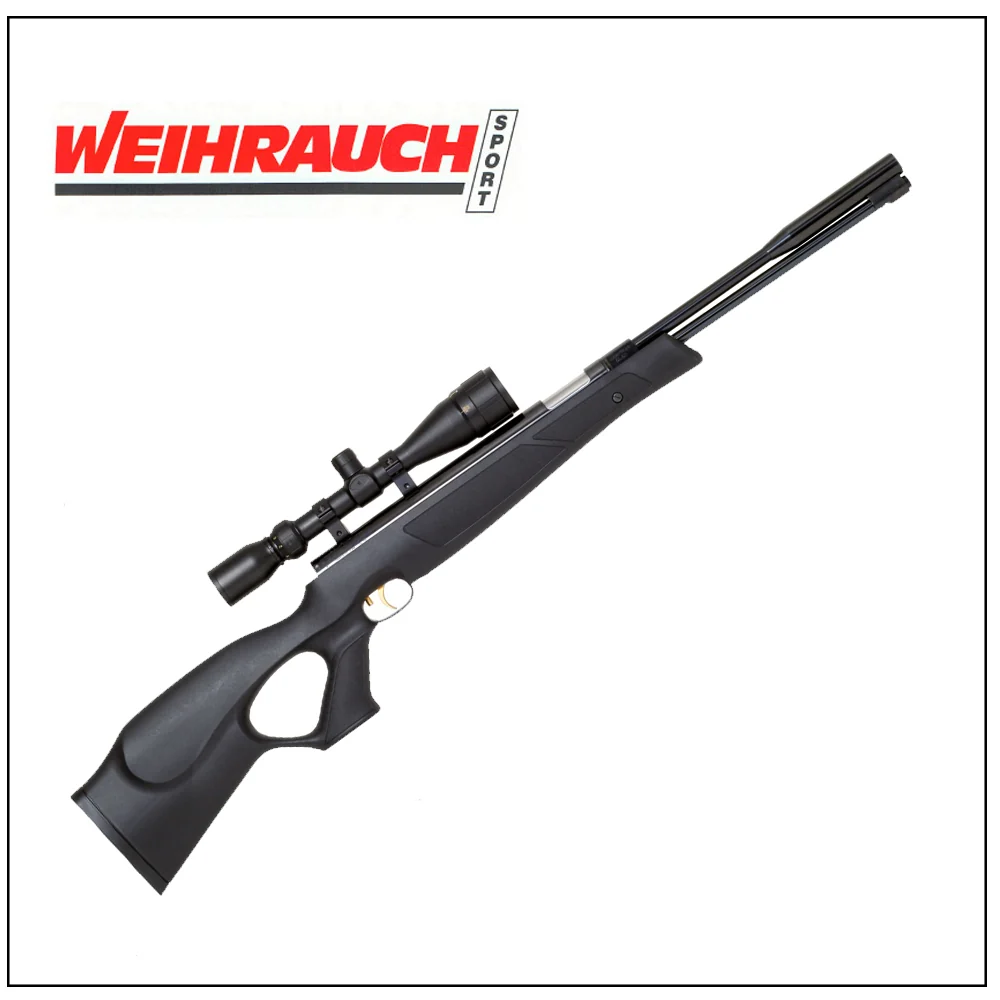
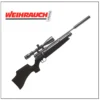
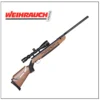
Weihrauch HW97KT Synthetic Blackline – Precision Fixed-Barrel Underlever Air Rifle with Synthetic Thumbhole Stock and Rekord Trigger
Design, Synthetic Thumbhole Stock, Engineering, Precision, Handling, and Practical Performance
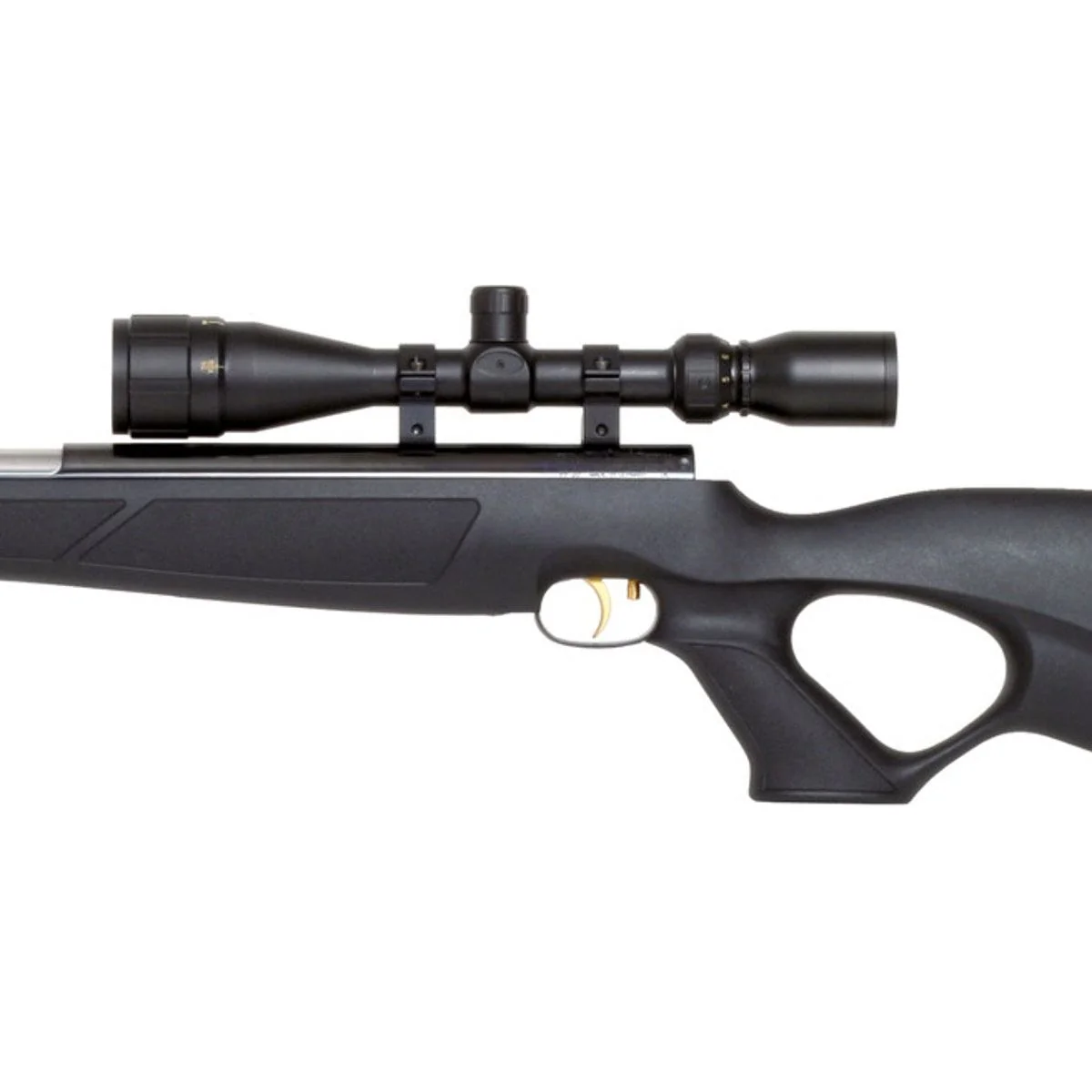
The Weihrauch HW97KT Synthetic Blackline is a precision-oriented spring-piston rifle built around a fixed-barrel underlever action and a durable synthetic thumbhole stock.
The current factory Black Line configuration weighs approximately 4.20 kg, measures about 1,015 mm overall, uses a 300 mm barrel, and operates as a single-shot spring-piston platform. Moreover, Weihrauch equips it with the respected two-stage Rekord match trigger and designs the stock specifically for scope use.
The rifle is particularly well suited to shooters who value deliberate target practice, stable barrel alignment, substantial handling, and a mechanically self-contained platform.
Weihrauch HW90
The Weihrauch HW90 belongs to a separate gas-ram family and should not be confused with this conventional spring-piston underlever design.
weihrauch
weihrauch is widely associated with German sporting airguns known for durable construction, refined trigger systems, and precision-oriented engineering.
weihrauch
A second search for weihrauch may include spring rifles, underlever systems, gas-ram platforms, PCP rifles, and air pistols.
hw 30
The hw 30 is a significantly lighter break-barrel rifle designed around easier handling.
weihrauch hw45
The weihrauch hw45 is a spring-powered air pistol rather than a full-size shoulder-fired rifle.
weihrauch hw100
The weihrauch hw100 is a PCP rifle using stored compressed air rather than a spring-piston powerplant.
weihrauch hw 95
The weihrauch hw 95 belongs to the manufacturer’s break-barrel family.
weihrauch hw44
The weihrauch hw44 is a compact pneumatic pistol and has a completely different operating system.
german air rifle
As a german air rifle, this model reflects the manufacturer’s emphasis on substantial construction, mechanical consistency, and precision-oriented trigger control.
air rifles
Among modern air rifles, fixed-barrel underlever platforms remain attractive to shooters who value stable alignment and deliberate operation.
weihrauch hw95 hw100 airgun air pistols
The phrase weihrauch hw95 hw100 airgun air pistols covers several different product categories, including spring rifles, PCP rifles, and handguns.
hw100 airgun
A hw100 airgun uses pneumatic operation and repeating capability rather than a spring-powered single-shot system.
air pistols
air pistols prioritize compactness and handgun-style handling, whereas a full-size rifle provides greater shoulder support.
rifles de aire
The phrase rifles de aire broadly refers to air-powered rifles using spring, gas-ram, or compressed-air systems.
hw50
The hw50 is a lighter traditional break-barrel rifle with different balance and dimensions.
what are air pistols
For buyers asking what are air pistols, they are compact air-powered platforms designed around pistol ergonomics rather than shoulder-fired handling.
weihrauch hw50
The weihrauch hw50 offers a lighter spring-powered platform intended for a different handling experience.
sk x rifles
The phrase sk x rifles does not represent an official factory designation for this model.
air shot gun
An air shot gun belongs to a separate equipment category and should not be confused with a rifled pellet platform.
air rifle makes
Among established air rifle makes, Weihrauch is particularly well known for spring-powered and precision pneumatic sporting platforms.
weihrauch hw97k
The weihrauch hw97k is the core fixed-barrel underlever platform from which several stock and finish configurations are offered.
compressed air rifles
compressed air rifles normally refer to PCP systems using stored high-pressure air, whereas this rifle uses mechanical spring energy.
hw97
The hw97 family is strongly associated with fixed-barrel stability and scope-oriented precision.
weihrauch hw50s
The weihrauch hw50s uses a conventional break-barrel layout and is considerably lighter.
weihrauch englisch
The phrase weihrauch englisch often reflects searches for English-language product information from the German manufacturer.
hw50 s
The hw50 s remains a separate lighter spring-powered model.
hw35 air rifle
The hw35 air rifle is a traditional break-barrel platform with its own long-established design.
hw 97k
The hw 97k uses fixed-barrel underlever engineering and is designed specifically around scope shooting.
weihrauch hw80
The weihrauch hw80 is a robust break-barrel model with a different action and handling profile.
weihrauch hw30
The weihrauch hw30 provides a much lighter and more compact shooting platform.
hw35e for sale
The phrase hw35e for sale reflects purchase intent for another classic spring-powered rifle.
hw97k
The hw97k remains one of the manufacturer’s dedicated fixed-barrel precision platforms.
accurate air rifles
When buyers compare accurate air rifles, barrel stability, ammunition compatibility, trigger quality, optic setup, and shooting technique all matter.
hw35
The hw35 belongs to the traditional break-barrel product family.
weihrauch revolvers
weihrauch revolvers belong to a separate handgun category and are unrelated to this underlever rifle.
hw 50
The hw 50 provides a lighter spring-powered alternative.
hw 100 bullpup
The phrase hw 100 bullpup refers to a compact pneumatic layout rather than a traditional spring-piston underlever design.
hw75
The hw75 is a precision-focused air pistol and should be evaluated separately.
hw95
The hw95 uses conventional break-barrel cocking rather than a fixed-barrel underlever.
weirauch
The term weirauch is a common misspelling of the Weihrauch brand name.
weihrauch hw30s
The weihrauch hw30s emphasizes low weight and straightforward recreational handling.
hw50s
The hw50s is another lighter spring-powered model.
Weihrauch HW90 air rifle
The Weihrauch HW90 air rifle uses a gas-ram system rather than a conventional spring.
HW90 gas ram air rifle
An HW90 gas ram air rifle stores energy using compressed gas instead of a coiled mainspring.
Weihrauch gas ram rifle
A Weihrauch gas ram rifle generally refers to the manufacturer’s gas-ram platform and should not be confused with this underlever design.
Weihrauch pellet gun
The phrase Weihrauch pellet gun can broadly describe many rifles and pistols within the manufacturer’s sporting range.
Weihrauch air rifles
Weihrauch air rifles include break-barrel, underlever, gas-ram, and PCP platforms.
Weihrauch HW50 S
The Weihrauch HW50 S is a lighter traditional break-barrel alternative.
HW95 S
The HW95 S is another spring-piston break-barrel model with a more conventional sporter layout.
HW80 K
The HW80 K is a shorter version of a larger break-barrel platform.
HW97 KT
The HW97 KT is a closely related thumbhole-stock variant. Current factory material describes the KT separately from the synthetic Black Line, with an adjustable buttplate and a different stock configuration.
Synthetic Thumbhole Stock
The synthetic thumbhole stock is the defining feature of the Black Line configuration.
Its material is resistant to many of the cosmetic concerns associated with traditional wood, while the thumbhole layout provides a distinctive grip position and modern appearance.
The stock is also ambidextrous, allowing both right- and left-handed shooters to use the platform comfortably.
Fixed-Barrel Underlever Engineering
The fixed barrel remains stationary while a separate lever beneath the barrel compresses the spring.
As a result, the relationship between the bore and mounted optic remains mechanically consistent throughout the cocking process.
This design is one of the main reasons the platform is associated with precision-oriented shooting.
Scope-Focused Design
The rifle is supplied without conventional open sights.
Instead, the stock uses a high comb and geometry intended specifically for optic use.
Consequently, the shooter can establish a more natural head position once the scope is mounted correctly.
Rekord Match Trigger
The two-stage Rekord match trigger is one of the rifle’s most important precision features.
Its first stage allows controlled preparation, while the second stage provides a clearly defined release.
A predictable trigger helps reduce unnecessary movement immediately before the shot.
Single-Shot Loading
The rifle uses single-shot loading.
Each pellet is inserted individually, creating a slower and more deliberate shooting rhythm.
This encourages the shooter to concentrate on breathing, sight alignment, grip, and follow-through.
Smooth Cocking Operation
Weihrauch describes the platform as well balanced with an easy and smooth cocking cycle.
A controlled cocking stroke can make longer target sessions more comfortable while maintaining the rifle’s traditional mechanical feel.
300 mm Barrel
The current Black Line configuration uses a 300 mm barrel.
This compact barrel length forms part of the short, substantial design while preserving the fixed-barrel architecture.
Why Choose This Rifle?
The strongest reasons include fixed-barrel stability, synthetic-stock durability, excellent trigger quality, scope-oriented ergonomics, mechanical independence, and proven spring-piston engineering.
It is particularly attractive to shooters who want a durable stock without giving up the substantial feel and precision potential of a full-size underlever platform.
How Good Is the Precision?
The platform has strong practical accuracy potential when paired with suitable ammunition and correct technique.
Its fixed barrel, secure scope mounting, predictable trigger, and substantial mass all contribute to a stable foundation.
However, spring-powered rifles remain sensitive to hold consistency and follow-through.
Where Is It Best Used?
The rifle is well suited to lawful recreational target shooting, controlled range practice, field-target training, and silhouette-style sporting use.
Weihrauch specifically positions the HW97 family around field-target and silhouette shooting.
When Does It Make Sense?
This platform makes sense for shooters who want traditional spring-powered independence but prefer a modern synthetic stock and scope-focused layout.
It is also a strong choice when fixed-barrel stability is preferred over a break-barrel system.
How Good Is the Handling?
At approximately 4.20 kg before an optic is fitted, the rifle has a substantial and planted feel.
That weight can reduce small aiming movements, although unsupported shooting may become tiring during longer sessions.
Precision and Consistency
Strong practical consistency depends on a secure optic, suitable ammunition, repeatable grip pressure, stable shoulder contact, and disciplined follow-through.
Because a spring-piston system produces a distinctive firing cycle, the shooter should allow the rifle to recoil naturally rather than gripping it excessively tightly.
Important Technical Information
Current factory specifications for the synthetic Black Line configuration list approximately 4.20 kg weight, 1,015 mm overall length, 300 mm barrel, fixed-barrel underlever operation, spring-piston power, single-shot loading, two-stage Rekord match trigger, synthetic ambidextrous thumbhole stock, scope-focused design, and no conventional sights.
Factory caliber listings include .177, .20, .22, and .25, with listed maximum velocities varying by caliber and legal market configuration.
Important Model Naming Information
The factory currently distinguishes between the KT and BLACK LINE versions.
The KT is a separate thumbhole-stock model, while the BLACK LINE uses a synthetic thumbhole stock and slightly different listed dimensions and weight.
Therefore, a retailer using the combined description “KT Synthetic Blackline” should ideally confirm the exact stock and factory model marking before publishing specifications.
Engineering Design, Spring-Piston Operation, Scope Setup, Handling, and Precision Performance
Engineering Design
The rifle uses a fixed-barrel underlever configuration designed to support mechanical consistency and deliberate shooting.
A separate cocking lever beneath the barrel compresses the spring while the barrel remains stationary. Because the barrel does not pivot during the loading cycle, the relationship between the bore and mounted optic remains stable.
This design creates a solid foundation for repeatable target performance.
Underlever Operation
The underlever provides the mechanical force required to cock the spring-piston system.
Its movement is independent of the barrel, which helps preserve fixed alignment.
A smooth and controlled cocking stroke makes the shooting cycle predictable and comfortable during longer practice sessions.
Spring-Piston Power System
The rifle uses a mechanical spring and piston to generate compressed air for each shot.
When the action is cocked, energy is stored inside the spring.
After the trigger is released, the piston moves forward and compresses air behind the pellet, creating the pressure required for propulsion.
Fixed-Barrel Stability
The fixed barrel is one of the main reasons this type of design is valued for precision-oriented shooting.
Because the barrel remains in the same position throughout the cocking process, there is no repeated barrel lock-up cycle.
This reduces one potential source of mechanical variation.
Single-Shot Loading
Each pellet is loaded individually before firing.
Although this process is slower than using a magazine, it encourages the shooter to prepare each shot carefully.
This can improve concentration and help reinforce consistent shooting habits.
Loading Consistency
Pellets should be inserted carefully and without unnecessary force.
Damaged or deformed ammunition can affect accuracy.
Keeping the loading area clean also supports smooth and reliable operation.
Scope-Focused Layout
The rifle is designed primarily around optic use.
Its stock geometry supports a higher head position, allowing the shooter to align naturally with a mounted scope.
A comfortable visual position can improve both accuracy and endurance.
Scope Positioning
The optic should be mounted so that the shooter can obtain a clear sight picture without stretching the neck or moving the head excessively.
Correct eye relief helps make the shooting position more repeatable.
The scope should feel naturally aligned once the rifle is shouldered.
Scope Mount Stability
Spring-powered recoil creates forces in more than one direction.
For that reason, the mounting system should remain secure and suitable for this type of firing cycle.
Any movement in the optic or mounts can shift point of impact.
Synthetic Stock Durability
The synthetic stock offers practical resistance to moisture and minor cosmetic wear.
This can make it easier to maintain in changing environmental conditions.
Its thumbhole layout also provides a distinct grip position that supports controlled handling.
Thumbhole Ergonomics
The thumbhole design allows the firing hand to settle into a more defined position.
This can help the shooter maintain repeatable grip pressure and wrist angle.
A consistent grip supports better control throughout the firing cycle.
Shoulder Position
The butt should settle naturally against the shoulder.
A consistent contact point helps the rifle react similarly from shot to shot.
Changing shoulder pressure can influence how the rifle moves during recoil.
Fore-End Support
The support hand should remain in a similar position beneath the stock.
Moving the hand forward or backward changes the balance of the rifle.
A stable support point helps reduce unnecessary variation.
Weight Distribution
The rifle has a substantial feel that can help reduce small aiming movements.
Its weight contributes to stability, especially during supported shooting.
However, good posture remains important during longer unsupported sessions.
Trigger Characteristics
The two-stage trigger is designed to provide a predictable release.
The first stage allows the shooter to prepare the shot while maintaining aim.
The second stage provides a more defined release point.
Trigger Control Technique
Trigger pressure should be applied gradually.
A sudden pull can disturb the rifle before the shot is released.
Smooth control helps preserve the sight picture and supports repeatable performance.
Recoil Behavior
The firing cycle produces the distinctive movement associated with spring-powered rifles.
The piston accelerates forward and then stops rapidly as pressure builds.
This creates a characteristic two-direction recoil pattern.
Hold Sensitivity
Changes in grip and support pressure can influence practical accuracy.
A relaxed and repeatable hold generally produces better results than excessive tension.
The objective is to let the rifle react naturally and consistently.
Supported Shooting
A stable rest can be useful when checking optic settings or testing ammunition.
However, the rifle should not be clamped rigidly.
Allowing natural movement often provides more realistic results with spring-powered systems.
Unsupported Shooting
Unsupported shooting requires more physical control.
The shooter must manage balance, breathing, shoulder contact, and support-hand placement carefully.
The rifle’s substantial weight can help provide stability once the correct stance is established.
Ammunition Selection
Different pellets can produce noticeably different results.
Weight, shape, head size, and manufacturing consistency all influence grouping.
Testing several suitable options under similar conditions helps identify the most reliable choice.
Group Evaluation
Shot groups provide useful feedback about the complete setup.
Tight groups suggest that ammunition, optic setup, hold, and trigger technique are working together effectively.
Irregular groups may indicate that one or more variables need attention.
Breathing Control
Breathing affects both body movement and sight stability.
Many shooters find that a natural pause provides the best moment for trigger release.
Relaxed breathing is usually more effective than excessive tension.
Follow-Through
The shooter should remain in position after the trigger releases.
This allows the firing cycle to complete naturally.
Moving too early can reduce consistency.
Environmental Conditions
Outdoor performance can be affected by wind, temperature, humidity, and changing light.
These factors should be considered when comparing groups between sessions.
Stable conditions provide the most useful baseline.
Wind Awareness
Lightweight pellets can be influenced by crosswinds.
Even moderate wind may move the point of impact.
Observing direction and strength helps explain group movement.
Temperature Influence
Temperature can slightly affect lubricants, seals, and spring behavior.
Very hot or cold conditions may change how the rifle feels.
Comparisons are most meaningful when testing is carried out under similar conditions.
Mechanical Consistency
The spring, piston, trigger, barrel, stock, cocking linkage, and scope mounts all contribute to overall performance.
Routine inspection helps ensure that these components continue to behave predictably.
Consistency is the central objective.
Maintenance Simplicity
Routine care should focus on external cleaning, stock protection, mount inspection, hardware checks, and secure storage.
Complex internal work should be handled by a qualified technician.
Unnecessary disassembly should be avoided.
Long-Term Ownership
A well-maintained spring-powered rifle can remain dependable for many years.
Its self-contained operating system reduces reliance on external equipment.
Careful handling and regular inspection help preserve both mechanical and cosmetic condition.
Overall Section Summary
The rifle combines fixed-barrel stability, underlever operation, spring-piston power, single-shot loading, synthetic thumbhole ergonomics, and scope-focused handling.
Its design rewards careful hold, correct optic setup, suitable ammunition, disciplined breathing, and consistent follow-through.
For shooters who value deliberate precision and durable mechanical construction, it provides a stable and satisfying platform for long-term recreational use.
Practical Shooting Experience, Accuracy Development, Scope Use, and Real-World Performance
Practical Shooting Experience
The rifle delivers a deliberate and controlled shooting experience that rewards consistency.
Its fixed-barrel layout, substantial weight, scope-focused stock, and spring-powered action encourage the shooter to prepare each shot carefully rather than rush through a sequence.
That slower rhythm can improve concentration and make each practice session feel more purposeful.
Accuracy Development
Practical accuracy depends on several factors working together.
Ammunition quality, optic setup, hold consistency, trigger control, body position, and follow-through all influence the final result.
The rifle provides a strong mechanical foundation, but the shooter still plays an important role in producing repeatable groups.
Scope Use
The stock geometry supports comfortable optic use.
A properly positioned scope should allow the shooter to obtain a clear sight picture without excessive head movement.
Correct eye relief and a stable cheek position help reduce fatigue during longer sessions.
Sight Picture Consistency
A repeatable sight picture is essential for good performance.
The shooter should see the same relationship between the reticle and target before every shot.
Small changes in head position can affect alignment, so a natural and consistent cheek position is important.
Supported Shooting
A stable rest can be useful when testing ammunition or checking scope settings.
However, the rifle should still be allowed to move naturally during the firing cycle.
An overly rigid support can change the way the spring-powered action reacts.
Unsupported Shooting
When shooting without a rest, balance becomes more important.
The shooter must manage the rifle’s weight, breathing, shoulder contact, and support-hand position carefully.
Good posture helps reduce fatigue and improve consistency.
Hold Consistency
Spring-powered rifles often respond noticeably to changes in grip pressure.
A relaxed and repeatable hold generally produces better results than excessive tension.
The goal is to allow the rifle to react in the same way from shot to shot.
Thumbhole Grip Control
The thumbhole stock provides a defined position for the firing hand.
This can help the shooter maintain a more repeatable wrist angle and grip pressure.
A consistent grip supports better trigger control and overall stability.
Fore-End Support
The support hand should remain in a similar position beneath the stock.
Moving the hand forward or backward changes the balance of the rifle and can influence recoil behavior.
A stable support point helps reduce unnecessary variation.
Shoulder Placement
The butt should contact the shoulder in the same general position each time.
Too much or too little pressure can change the way the rifle moves during the firing cycle.
Natural, moderate contact usually provides the best results.
Head Position
A stable head position supports consistent scope alignment.
The shooter should avoid lifting or twisting the head unnecessarily.
A natural cheek contact point makes it easier to reproduce the same sight picture.
Trigger Technique
Trigger pressure should be applied smoothly and progressively.
A sudden pull can disturb the aim before the shot is released.
Good trigger technique allows the shooter to maintain alignment through the final stage of the shot.
Breathing Control
Breathing affects both body movement and sight stability.
Many shooters find that a natural pause provides the best moment for releasing the shot.
Relaxed breathing generally produces better results than excessive tension.
Follow-Through
Follow-through is especially important with spring-powered actions.
The shooter should remain in position after the trigger releases and allow the internal firing cycle to complete naturally.
Moving too early can introduce inconsistency.
Single-Shot Rhythm
The single-shot format creates a naturally controlled pace.
After each shot, the shooter must reload and rebuild the shooting position.
This pause can improve concentration and encourage a more disciplined approach.
Ammunition Testing
Different pellets can produce very different results in the same barrel.
Weight, shape, head size, and manufacturing consistency all influence practical accuracy.
Testing several suitable options under similar conditions helps identify the most reliable choice.
Group Analysis
Shot groups provide useful feedback about the complete setup.
Tight and repeatable groups suggest that the rifle, ammunition, optic, and shooter are working together effectively.
Irregular groups may indicate that one or more variables require attention.
Scope Adjustment
Scope adjustments should be made gradually.
The shooter should fire controlled groups before changing the settings.
Large changes can make it difficult to understand how each adjustment affects point of impact.
Range Practice
Regular range practice helps the shooter become familiar with the rifle’s balance, trigger feel, recoil behavior, and preferred hold.
As these details become more predictable, the shooting process becomes easier to repeat.
Familiarity can improve both confidence and practical consistency.
Skill Development
The rifle can help develop strong fundamentals.
It encourages deliberate trigger control, careful follow-through, consistent body position, and precise sight alignment.
These skills can transfer to many other precision-oriented shooting platforms.
Outdoor Shooting
Outdoor conditions introduce additional variables.
Wind, temperature, humidity, and changing light can influence results.
Understanding these factors helps the shooter interpret group movement more accurately.
Wind Influence
Pellets can be affected by crosswinds.
Even moderate wind may shift the point of impact.
Observing direction and strength helps explain why groups may move between shots.
Temperature Influence
Temperature can slightly affect lubricants, seals, and spring behavior.
Very hot or cold conditions may change how the rifle feels.
Comparisons are most meaningful when testing is carried out under similar conditions.
Recoil Management
The recoil cycle should be allowed to occur naturally.
Trying to restrain the rifle aggressively can make performance less consistent.
A relaxed and repeatable technique usually produces better results.
Long Shooting Sessions
Longer sessions can become tiring because of the rifle’s substantial weight.
Good posture and regular breaks help preserve technique.
Fatigue can cause grip pressure, shoulder contact, and head position to change without the shooter noticing.
Recreational Use
For recreational target shooting, the platform offers a satisfying combination of mechanical involvement and precision.
The manual cocking and loading process creates a more deliberate experience than magazine-fed systems.
This can make each session feel more focused.
Transport Considerations
The rifle should be carried in a protective case.
This helps protect the stock, barrel, scope, and underlever mechanism from impacts.
Careful transport also helps preserve cosmetic condition.
Storage Between Sessions
The rifle should be stored in a dry, secure, and stable environment.
Moisture, extreme heat, and accidental contact should be avoided.
Good storage habits support long-term reliability.
Routine Inspection
Before and after shooting, the owner should check for loose fasteners, optic movement, unusual sounds, or changes in cocking effort.
Small issues are easier to address when discovered early.
Routine inspection helps maintain confidence in the rifle.
Confidence Through Familiarity
Repeated use allows the shooter to understand how the rifle reacts.
Knowing the preferred hold, trigger feel, balance, and optic position makes operation more predictable.
This familiarity often improves practical accuracy.
Practical Ownership Experience
The rifle offers a balanced combination of fixed-barrel stability, durable stock construction, scope-focused ergonomics, and precision-oriented handling.
It rewards careful technique and regular practice.
For shooters who enjoy deliberate target work, this can create a satisfying ownership experience.
Overall Practical Value
Practical value comes from mechanical independence, durable construction, and strong accuracy potential.
The rifle does not require external charging equipment during normal use.
This keeps the ownership system relatively straightforward.
Final Performance Summary
In real-world use, the rifle provides stable handling, fixed-barrel consistency, refined trigger control, and strong precision potential.
Its spring-powered firing cycle requires disciplined technique, but that challenge can make the shooting experience more rewarding.
With suitable ammunition, secure optics, careful maintenance, and regular practice, it can provide dependable recreational performance across many future shooting sessions.
Maintenance, Storage, Protection, and Long-Term Reliability
Importance of Regular Maintenance
Routine maintenance helps preserve reliable operation, consistent performance, safe handling, and long-term value.
A spring-powered underlever rifle contains a mainspring, piston, seals, trigger components, cocking linkage, barrel assembly, stock hardware, and optic mounts that all benefit from periodic inspection.
Good maintenance does not require constant disassembly. Instead, sensible cleaning, proper storage, and careful handling usually provide the best long-term results.
Pre-Use Inspection
Before each shooting session, the rifle should be checked for visible damage or unusual mechanical changes.
The owner should inspect the stock, barrel, underlever, loading area, trigger, safety, scope mounts, and major fasteners.
Any unexpected looseness, stiffness, or unusual sound should be investigated before normal use continues.
Post-Use Inspection
After shooting, another brief inspection can help identify new marks, loosened hardware, or changes in mechanical feel.
Dust, fingerprints, moisture, and small particles should be removed before storage.
This simple routine makes long-term condition easier to monitor.
Exterior Cleaning
External surfaces should be wiped with a clean, soft cloth.
Harsh chemicals and abrasive materials should be avoided unless they are specifically suitable for the finish.
Gentle cleaning helps preserve both the metalwork and synthetic furniture.
Synthetic Stock Care
The synthetic stock is relatively resistant to moisture and minor cosmetic wear.
Even so, dirt and residue should still be removed regularly.
A clean surface makes it easier to identify scratches, cracks, or hardware movement.
Thumbhole Area Inspection
The thumbhole section should be checked periodically for visible damage or looseness around nearby hardware.
Because this area is handled frequently, dirt and oils from the hands can collect there.
Routine cleaning helps maintain a secure and comfortable grip.
Barrel Care
The barrel should be cleaned only when necessary.
Excessive cleaning can create more wear than benefit, especially when unsuitable rods or abrasive materials are used.
A careful and minimal approach is generally preferable.
Muzzle Protection
The muzzle should be protected from accidental impact.
Damage around the crown can affect consistency.
A padded case helps reduce the risk of contact during transport and storage.
Underlever Care
The cocking lever should move smoothly through its normal range.
Any grinding sensation, sudden stiffness, or unusual resistance should be investigated.
Forcing the mechanism can place unnecessary stress on internal components.
Cocking Linkage Inspection
The cocking linkage relies on several moving components working together correctly.
These areas should remain clean and secure.
Excessive looseness or abnormal movement may indicate that professional inspection is needed.
Loading Area Inspection
The loading area should remain clean and free from pellet fragments, dust, or debris.
Anything that interferes with smooth loading should be removed carefully.
The mechanism should never be forced when resistance feels abnormal.
Trigger Protection
The trigger mechanism should remain clean and dry.
Unnecessary internal adjustment should be avoided unless carried out by someone with suitable experience.
A predictable trigger depends on correct condition and proper setup.
Safety Mechanism
The safety should be checked periodically for normal operation.
However, it should never be treated as the only safety measure.
Correct muzzle direction and responsible handling remain essential.
Fastener Inspection
Stock screws, scope-mount screws, and other hardware should be checked regularly.
Spring-powered recoil can gradually loosen fasteners over time.
Even slight movement may affect handling or point of impact.
Avoiding Over-Tightening
Fasteners should be secure without excessive force.
Over-tightening can damage threads or place unnecessary stress on the stock and action.
Controlled tightening helps preserve the rifle.
Scope Mount Inspection
The scope mounting system should be inspected frequently.
Spring-powered recoil creates forces in more than one direction and can loosen unsuitable mounting systems.
Any movement can affect consistency.
Scope Protection
The optic should be protected from moisture, impacts, and rough handling.
Lens covers can help protect the glass during transport and storage.
The mounting position should also be checked after extended use.
Spring and Piston Care
The internal spring and piston should not be dismantled casually.
These components can store significant mechanical energy and require correct tools and experience for safe servicing.
Complex internal work should be left to a qualified technician.
Seal Condition
Internal seals help maintain compression and consistent firing behavior.
Changes in sound, cocking feel, or performance may indicate wear.
Persistent changes should be investigated rather than ignored.
Correct Lubrication
Only suitable lubricants should be used where recommended.
Incorrect oils or greases may damage seals or affect normal operation.
Excessive lubrication can also create residue and inconsistent performance.
Avoiding Excess Lubrication
More lubricant does not necessarily improve reliability.
Heavy application can attract dirt and create unwanted buildup.
A minimal and appropriate approach is usually best.
Moisture Management
Moisture is one of the main long-term threats to metal components.
After use in damp conditions, the rifle should be dried before storage.
Areas around screws, joints, mounts, and the cocking mechanism should not be overlooked.
Corrosion Prevention
Regular wiping and dry storage help reduce the risk of corrosion.
Any early signs of rust should be addressed carefully before they spread.
Protective products should be compatible with the original finish.
Temperature Management
The rifle should not be stored in locations exposed to extreme heat or rapid temperature changes.
Vehicles, damp sheds, and humid storage areas are poor long-term choices.
A stable indoor environment is preferable.
Transportation Protection
A padded case is recommended during transport.
It helps protect the barrel, stock, optic, muzzle, and underlever from impacts.
The rifle should also be secured so that it cannot move excessively inside the case.
Safe Storage
The rifle should be stored securely and in accordance with local regulations.
Unauthorized access should be prevented.
A dry and stable environment helps preserve both mechanical reliability and cosmetic condition.
Storage Position
The rifle should be supported so that it cannot fall.
Heavy objects should not rest against the stock, barrel, scope, or cocking lever.
A stable storage position reduces unnecessary stress.
Monitoring Performance Changes
Changes in accuracy, trigger feel, cocking effort, recoil behavior, or sound can provide early warning of a developing issue.
Owners who understand the rifle’s normal behavior are more likely to notice these changes quickly.
Professional Servicing
Complex work involving the spring, piston, trigger unit, compression chamber, or cocking linkage should be handled by a qualified technician.
Professional servicing helps preserve safe operation and long-term reliability.
Avoiding Unauthorized Modifications
Unapproved internal changes can affect consistency, reliability, and legal compliance.
The rifle is best maintained within its intended design parameters.
Responsible ownership focuses on dependable operation rather than unnecessary modification.
Developing a Maintenance Routine
A simple maintenance routine can be highly effective.
Inspect before use, wipe the rifle afterward, check the scope and fasteners, monitor the cocking system, protect the stock, and store the rifle correctly.
These habits require little time but provide meaningful long-term benefits.
Long-Term Reliability
A well-maintained spring-powered rifle can provide dependable service for many years.
Mechanical simplicity, strong construction, careful storage, and proper handling all contribute to durability.
The owner’s maintenance habits have a direct effect on long-term condition.
Final Maintenance Summary
Long-term reliability depends on careful inspection, sensible cleaning, protected transport, proper storage, and respect for the rifle’s mechanical system.
Protecting the synthetic stock, barrel, optic, underlever, trigger, spring, piston, seals, and hardware helps preserve consistent performance.
With responsible care and qualified servicing when necessary, the rifle can remain accurate, reliable, and enjoyable across many future shooting sessions.
Be the first to review “Weihrauch HW97KT Synthetic Blackline”
Related products
WEIHRAUCH
WEIHRAUCH
WEIHRAUCH
WEIHRAUCH
WEIHRAUCH
WEIHRAUCH
Reviews
There are no reviews yet.