
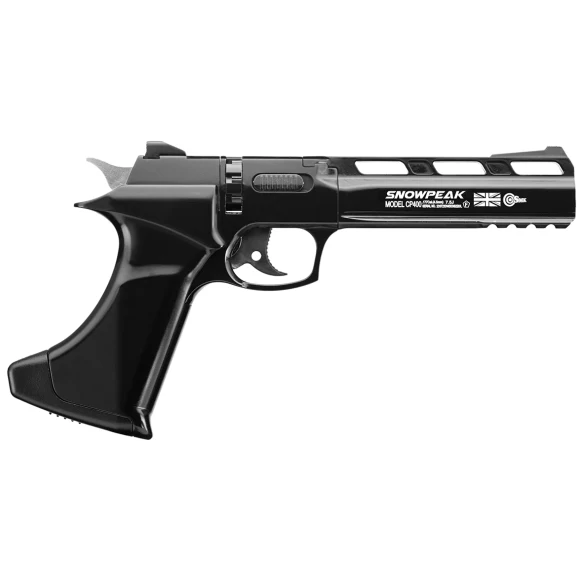
Snowpeak CP400 CO2 Air Pistol
$150.00
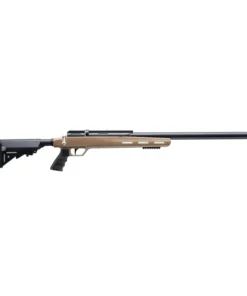
Snowpeak CP400 Air Pistol is relatively unique in its position in the CO2 airgun world being a multi-shot pistol in a tactical style.
| Action | Multi Shot |
|---|---|
| Calibre | .177 (4.5mm) |
| Type | CO2 powered |
| Weight | 680g |
| Length (total) | 5.7″ |
Snowpeak CP400 CO2 Air Pistol – Compact 8-Shot CO2 Performance, Lightweight Handling and Practical .177 Accuracy
The Snowpeak CP400 CO2 Air Pistol is a lightweight recreational pistol designed around simple CO2 operation, compact dimensions and practical multi-shot use. Snowpeak officially lists the CP400 in 4.5mm calibre with an 8-shot magazine, 12g CO2 power source, manual safety and a 168mm barrel. The manufacturer specifies a velocity of approximately 400fps, an overall size of about 250 × 32 × 150mm and a weight of only 0.6kg.
Unlike a PCP Pistol that requires a high-pressure pump, compressor or charging bottle, the CP400 uses replaceable CO2 cartridges. Consequently, it provides a straightforward introduction to recreational pellet shooting for users who value compact handling and uncomplicated operation.
4.5mm Calibre and Recreational Accuracy
The CP400 is chambered in 4.5mm/.177 and is designed for lead pellets rather than steel BBs. The rifled 168mm barrel helps stabilize the projectile, while the compact layout keeps the pistol manageable during informal target sessions. Snowpeak specifies approximately 400fps, while some distributor listings show slightly lower real-world figures depending on ammunition and testing conditions.
This makes the pistol better suited to controlled recreational target use than to applications where maximum power is the main priority.
12g CO2 Power System
The pistol is powered by a standard 12g CO2 cartridge.
This is one of the main differences between the CP400 and a what is a pcp airgun search result. A PCP system stores high-pressure compressed air in a reservoir, while the CP400 relies on a disposable CO2 capsule.
For buyers who do not want to manage pumps, filling probes or high-pressure charging equipment, the CO2 system can be more convenient.
8-Shot Rotary Magazine
The CP400 uses an 8-shot rotary magazine.
This allows several pellets to be loaded before the shooting session begins, reducing interruptions between shots.
Retail descriptions also identify the pistol as using a double-action-only mechanism, meaning the trigger operates the firing sequence without a separate manual hammer-cocking stage.
For recreational target shooting, this creates a simple and repeatable operating rhythm.
Manual Safety
A manual safety is fitted as standard.
The safety provides an additional control when the pistol is being handled or prepared for use.
As with any air pistol, it should still be treated responsibly, stored securely and used only in an appropriate and lawful environment.
Lightweight 0.6kg Construction
Snowpeak lists the CP400 at approximately 0.6kg.
That light weight makes the pistol easy to handle and transport.
The manufacturer also specifies a black resin stock/grip, giving the pistol a practical synthetic exterior that requires little cosmetic maintenance.
This lightweight configuration is particularly suitable for casual target sessions where heavy match-style construction is unnecessary.
Fixed Front Sight and Practical Aiming
The CP400 uses a fixed front sight, while distributor information commonly describes the rear sight as adjustable.
This gives the shooter a simple sighting system for basic recreational accuracy.
Because the pistol is intended as a sport CO2 model rather than a dedicated match pistol, its design emphasizes simplicity and ease of use.
Snowpeak PP750L and PCP Pistol Comparison
Searches for Snowpeak PP750L PCP Air Pistol, Snowpeak PP750L, Snowpeak Air Pistol, PCP Pistol, Airgun Pistol, High power PCP air pistol, Snowpeak PP750L PCP Air Pistol for sale, snowpeak pp750, pp750, and snow peak pp750 refer to different pneumatic pistol platforms.
The PP750 family uses pre-charged pneumatic operation rather than the CP400’s 12g CO2 system.
Therefore, air capacity, pressure systems, velocities and operating characteristics should not be mixed between these models.
Snowpeak PP20 Comparison
Searches for snow peak pp20 and snowpeak pp20 refer to Snowpeak’s regulated match-oriented target pistol.
That model emphasizes match shooting, trigger adjustment and precision grip ergonomics, whereas the CP400 is designed as a lighter recreational CO2 pistol.
The two serve different users and different shooting styles.
Snowpeak P35 and P35X Comparison
Buyers may also encounter snowpeak p35, p35, snowpeak p35x, p35x, p35x pcp, pcp p 35, and snowpeak p35 vs p35x.
These are larger PCP rifle platforms and are fundamentally different from the compact CO2 architecture used here.
Their air bottles, magazine systems, regulators and overall dimensions should not be applied to the CP400.
Other Snowpeak Rifle and Equipment Searches
Broader searches may include snowpeak airguns, snowpeak sports, snowpeak ap900, snowpeak max, snowpeak max 1 price, pr900 gen 3, snowpeak m25, m25 rifle, m25 weapon, ap900b pcp air rifle, snowpeak m60, snowpeak m60b, m50 rifle, pcp pellet rifle, snowpeaks, snow peak equipment, hp300, pellet 9mm, how much did the m60 weigh, t rex 6000, snowfall gun, snow peak customer service, and snow peak brand origin.
These terms span PCP rifles, spring-powered products, accessories and unrelated research.
For example, the M25 is a full-size high-pressure PCP rifle with a large air tube, bolt action and multiple calibre options, making it completely different from this compact CO2 pistol.
Accessories and Supporting Equipment
Searches for air gun accessories, air gun pc, air gun suppressor, and airgun moderator often appear during broader airgun research.
However, compatibility should always be confirmed for the specific pistol before accessories are fitted.
Because the CP400 is compact and light, unnecessary accessories may alter balance and handling.
Related Pistol Search Terms
The phrase pistolet pcp arcea-snowpeak onix sport may appear in broader pneumatic pistol searches.
However, it refers to a different product context and should not be confused with the CP400.
Likewise, the CP400 should not be described using specifications from larger PCP pistols or rifles simply because the products share a manufacturer or similar search audience.
Daystate Comparison Searches
High-end pneumatic research may also include Daystate Delta Wolf Performance, daystate blackwolf, delta wolf, huntsman daystate, day state, daystate delta wolf, daystate alpha wolf, daystate, alpha red wolf, daystate wolverine sapphire, day wolf, and what is a delta wolf.
Terms such as puddy bottle cover and black snood can also appear during wider accessory searches.
These belong to a completely different premium PCP ecosystem with advanced rifle platforms and should not be confused with the mechanically simple CO2 operation of the CP400.
Why Choose the Snowpeak CP400 CO2 Air Pistol?
The strongest reason to choose the CP400 is its simplicity.
The 12g CO2 power source eliminates the need for a high-pressure filling system.
The 8-shot rotary magazine reduces loading interruptions.
The 4.5mm rifled barrel supports useful recreational accuracy.
The manual safety adds a practical handling feature.
The lightweight synthetic construction makes the pistol easy to carry and manage.
Its compact dimensions make storage and transport straightforward.
For shooters who want a simple, lightweight and affordable recreational pellet pistol for controlled target practice, the Snowpeak CP400 offers a practical combination of easy CO2 operation, multi-shot convenience and compact handling.
Section 2 – Practical Accuracy, CO2 Efficiency, Handling and Everyday Performance
Designed for Simple Recreational Shooting
The strongest appeal of this pistol comes from its straightforward operating system.
Rather than requiring a high-pressure charging setup, the pistol relies on a compact CO2 power source and a simple multi-shot magazine. This makes preparation easy and allows the shooter to focus more on basic handling, sight alignment, trigger control, and target practice.
For recreational users, simplicity can be a major advantage.
The pistol does not require complicated air management.
The magazine is easy to understand.
The sights are uncomplicated.
The overall weight is light enough for comfortable use.
Together, these qualities create a practical platform for casual target shooting and skill development.
Why Consistency Still Matters
Even a recreational pistol benefits from a consistent shooting routine.
Accuracy depends on more than the mechanical design.
The projectile must suit the barrel.
The CO2 cartridge must provide stable pressure.
The sights must remain secure.
The shooter must repeat grip pressure, wrist position, stance, and trigger movement.
When these elements remain consistent, group size becomes easier to control.
Establishing a Baseline
A baseline should be created before significant changes are made.
One suitable projectile should be selected.
A fresh CO2 cartridge should be installed.
The sights should remain unchanged.
Several groups should be fired from the same distance.
The same grip and stance should be used.
This gives the shooter a reference.
If performance changes later, the new results can be compared with the baseline.
Change One Variable at a Time
Changing several things at once makes testing difficult.
If the shooter changes ammunition, sight settings, grip pressure, and cartridge condition during the same session, it becomes difficult to identify what caused the result.
A better method is simple.
Change one factor.
Test again.
Compare the result.
Then decide whether another change is needed.
This approach makes troubleshooting more useful.
Projectile Selection
Ammunition choice can influence accuracy significantly.
Weight matters.
Diameter matters.
Shape matters.
Manufacturing consistency matters.
Two pellets with similar published specifications can still behave differently in the same barrel.
For this reason, several suitable options should be tested.
The best choice is the one that produces repeated accuracy rather than one unusually good group.
Repeating Ammunition Tests
One tight group is not enough to establish a preferred projectile.
Chance can produce an excellent result.
Several groups should be fired.
The same distance and shooting position should be maintained.
If one pellet consistently produces smaller groups, confidence in that choice increases.
Inspecting Ammunition
Damaged pellets can create misleading results.
Dents, deformed skirts, contamination, or inconsistent shape may influence flight.
For careful target shooting, pellets should be inspected before loading.
Damaged pieces should be removed.
This reduces unnecessary variation.
Understanding CO2 Operation
CO2 behaves differently from compressed air.
The gas is stored under pressure inside a cartridge.
When a shot is fired, a small amount of gas expands and propels the pellet.
As the cartridge is used, pressure gradually changes.
Temperature also has a strong influence.
For this reason, CO2-powered pistols should be evaluated differently from high-pressure pneumatic systems.
Temperature and CO2 Pressure
Temperature is one of the most important factors affecting CO2 performance.
Warmer conditions generally increase cartridge pressure.
Cooler conditions reduce it.
A pistol that performs consistently at one temperature may behave differently in colder conditions.
This does not necessarily indicate a mechanical fault.
The gas itself responds to temperature.
Why Temperature Matters for Accuracy
If pressure changes, velocity can also change.
Velocity variation may produce changes in point of impact.
At short recreational distances, the effect may be modest.
However, it can still become visible during careful group testing.
For meaningful comparison, the pistol should be tested under similar temperature conditions.
Allowing the Cartridge to Recover
Rapid shooting can cool the CO2 cartridge.
As the cartridge becomes colder, pressure can temporarily decrease.
This can reduce velocity.
A slower shooting rhythm allows the cartridge to recover more effectively between shots.
For accuracy testing, deliberate shooting is often more useful than firing very quickly.
Why Rapid Shooting Can Reduce Consistency
Every shot causes some gas to expand.
Expansion cools the cartridge.
If shots are fired in quick succession, cooling can accumulate.
The result may be a temporary decrease in pressure.
This can create greater velocity variation.
Therefore, a controlled pace is generally better when evaluating precision.
Useful Shot Count
The useful number of shots from a cartridge depends on several factors.
Temperature matters.
Projectile weight matters.
Firing pace matters.
The condition of the seals matters.
The absolute maximum shot count is less important than the number of shots that remain consistent.
The shooter should learn when velocity or point of impact begins to change.
Recognizing a Weakening Cartridge
As a CO2 cartridge becomes depleted, performance may begin to change.
The report may become softer.
The point of impact may drop.
The action may feel less consistent.
Velocity can also decrease.
When these signs appear, continuing to shoot may produce less reliable accuracy.
Replacing CO2 Cartridges Sensibly
The cartridge should be replaced when performance becomes inconsistent.
There is little value in forcing every possible shot from a nearly depleted cartridge if accuracy is the goal.
A fresh cartridge provides a more stable starting point for serious testing.
Cartridge Installation
CO2 cartridges should be installed according to the manufacturer’s instructions.
The seal area should remain clean.
Excessive force should be avoided.
The cartridge should seat properly.
If gas begins to escape immediately after installation, the setup should be checked before further use.
Seal Care
The CO2 system depends on seals.
Damaged or dry seals can cause leakage.
The user should inspect the cartridge area periodically.
If the pistol loses gas unexpectedly, the seal system may require attention.
Only suitable maintenance products should be used where appropriate.
Magazine Convenience
The rotary magazine makes recreational shooting more convenient.
Several pellets can be loaded before the shooting sequence begins.
This reduces interruption.
The shooter can focus more on stance, grip, sight alignment, and trigger control.
Magazine Loading
Pellets should be loaded carefully.
They should sit properly inside the magazine.
Damaged pellets should not be forced into place.
The magazine should rotate smoothly.
Keeping it clean helps maintain reliable feeding.
Magazine Reliability
A dirty or damaged magazine can create feeding problems.
The shooter should inspect it periodically.
Dust and debris should be removed.
If the magazine does not rotate smoothly, forcing it is not recommended.
The cause should be identified first.
Grip Ergonomics
The grip provides the main connection between the shooter and pistol.
The hand should settle naturally.
The fingers should wrap around the grip without excessive squeezing.
The wrist should remain comfortable.
The trigger finger should move independently.
A consistent grip can improve repeatability significantly.
Grip Pressure
Grip pressure should remain similar from shot to shot.
Too much tension can create shaking.
Too little pressure can reduce stability.
The goal is a firm but relaxed hold.
The same pressure should be repeated each time.
Wrist Stability
The wrist should remain stable throughout the firing cycle.
Changing wrist angle can change sight alignment.
A natural wrist position is easier to repeat.
The shooter should avoid forcing the wrist into an uncomfortable angle.
Trigger Control
Trigger technique is one of the most important factors in practical accuracy.
Pressure should be applied smoothly.
A sudden pull can move the muzzle.
The finger should move mainly rearward.
The pistol should remain stable until the shot is complete.
Trigger Finger Placement
Too much finger on the trigger can pull the pistol sideways.
Too little contact can reduce control.
The ideal position varies from shooter to shooter.
Consistency is more important than copying someone else’s technique.
Trigger Feel
A recreational pistol may not have the same trigger character as a dedicated competition model.
For this reason, the shooter should become familiar with the trigger’s travel and release point.
Once the trigger feel becomes predictable, accuracy can improve.
Stance
The stance should be balanced and comfortable.
The shooter should avoid excessive muscular tension.
The shoulders should remain relaxed.
The body should face the target in a way that feels natural.
A stable stance is easier to repeat.
Foot Position
Foot placement should remain consistent.
Small changes can affect body alignment.
Once a comfortable stance is found, the shooter should use it repeatedly.
This helps the pistol settle naturally toward the same point of aim.
One-Handed Shooting
One-handed shooting can be useful for improving technical control.
The wrist must remain stable.
Grip pressure becomes more important.
Trigger movement becomes easier to observe.
However, it can also be more demanding physically.
Two-Handed Shooting
A two-handed grip usually provides greater stability.
The supporting hand should assist without twisting the pistol.
Pressure should remain balanced.
The shooter should avoid squeezing so hard that the muzzle begins to move.
Sight Alignment
Sight alignment is essential.
The front and rear sights must remain correctly positioned relative to each other.
A small sight-alignment error can produce a noticeable shift on the target.
The shooter should pay close attention to this relationship.
Front-Sight Focus
The front sight should receive strong visual attention.
The target does not need to appear perfectly sharp.
Maintaining a clear front-sight reference makes alignment errors easier to detect.
Sight Picture
Sight picture describes how the aligned sights are positioned on the target.
The same reference should be used for each shot.
If the shooter changes the visual relationship between the sights and target, the group can shift.
Natural Movement
The pistol will move slightly.
Trying to eliminate all movement can create tension.
A better approach is to accept a small natural movement area.
The trigger should then be operated smoothly while the sights remain controlled.
Breathing Control
Breathing naturally moves the upper body.
Many shooters complete the shot during the comfortable pause after exhaling.
The pause should not be forced.
If the shot is not ready, breathing should resume.
Long breath holds can reduce control.
Follow-Through
Follow-through remains important even with a low-powered recreational pistol.
The shooter should keep the sights aligned after the trigger releases.
The wrist should remain stable.
The pistol should not be lowered immediately.
This helps reveal whether the shot was executed correctly.
Calling the Shot
Calling the shot means predicting where the pellet likely landed based on what the shooter observed during release.
If the sights moved left at the moment of the shot, the shooter may expect the impact to move left as well.
Developing this awareness helps separate shooter error from equipment problems.
Short-Range Target Shooting
The pistol is best suited to controlled short-range target use.
At these distances, the shooter can concentrate on basic fundamentals.
Grip consistency becomes obvious.
Trigger mistakes are easier to identify.
Sight alignment can be practiced repeatedly.
Indoor Use
Indoor shooting can provide stable conditions where lawful and appropriately set up.
Wind is removed.
Temperature may be easier to control.
Lighting can remain consistent.
These conditions make accuracy testing easier.
Outdoor Use
Outdoor shooting introduces additional variables.
Wind can affect pellets.
Temperature can affect CO2 pressure.
Lighting may change during the session.
These factors should be considered when comparing results.
Wind Effects
At short distances, wind may have only a modest effect.
However, lightweight pellets can still be moved by strong or inconsistent air movement.
If outdoor conditions are unstable, target results should be interpreted carefully.
Lighting Effects
Lighting can change how the sights appear.
Bright light may create glare.
Low light can make sight edges less clear.
Consistent lighting is useful during serious accuracy testing.
Mechanical Accuracy Versus Shooter Accuracy
The pistol may be capable of tighter groups than the shooter can initially produce.
This is normal.
A stable rest can help separate mechanical performance from shooter movement.
If groups become much smaller from a support, technique may be the main limiting factor.
Bench Testing
A bench can help evaluate the pistol.
The hands or pistol should be supported consistently.
The support should reduce movement without forcing the pistol into position.
Several groups should be compared.
Why a Stable Support Helps
A stable support removes some human movement.
This makes it easier to evaluate ammunition and sight settings.
Once the mechanical baseline is understood, the shooter can return to normal unsupported shooting.
Zeroing and Sight Adjustment
Sight changes should be made only after a consistent group is established.
Adjusting after every shot can create confusion.
Several shots reveal the average point of impact.
Once the pattern is clear, the sights can be adjusted.
Confirming Sight Settings
After any sight adjustment, another group should be fired.
This confirms whether the correction worked.
Once the sights are set properly, unnecessary adjustment should be avoided.
Keeping Records
A simple shooting log can be useful.
The shooter can record pellet type, cartridge condition, temperature, group size, distance, and sight settings.
This makes changes easier to understand.
It also helps identify which setup works best.
Accuracy Troubleshooting
Accuracy problems should be investigated systematically.
Check the sights.
Check the ammunition.
Check the CO2 cartridge.
Review temperature.
Review grip pressure.
Review trigger control.
Review stance.
Only after these factors have been considered should more complicated causes be investigated.
Tight Groups That Shift
If groups remain small but move to another part of the target, the pistol may still be mechanically accurate.
Possible causes include sight movement, temperature change, cartridge pressure, grip position, or lighting.
A shifted group is different from a larger group.
Groups That Become Larger
If groups become much larger, ammunition, grip consistency, trigger technique, sight alignment, or declining cartridge pressure may be responsible.
Returning to the known baseline can help identify the problem.
Barrel Cleaning
The barrel should be cleaned based on performance rather than a rigid schedule.
If accuracy remains stable, frequent cleaning may be unnecessary.
If group size deteriorates unexpectedly, barrel condition can be investigated.
Suitable materials should be used.
Aggressive methods should be avoided.
Conditioning After Cleaning
A freshly cleaned barrel may behave differently.
The first few shots may not match normal point of impact.
The shooter should allow performance to stabilize before making conclusions.
Synthetic Grip Care
The synthetic grip is easy to maintain.
Dust and dirt can usually be removed with a soft cloth.
Harsh chemicals should be avoided.
The grip should remain clean and dry.
Exterior Care
Metal components should be kept clean and dry.
Fingerprints and moisture should be wiped away after use.
Suitable protective products can be applied where appropriate.
Excess lubricant should not be allowed to migrate into unwanted areas.
CO2 Seal Monitoring
If the pistol begins losing gas rapidly, seals should be considered.
The cartridge area should be inspected.
Repeated leakage should not be ignored.
The correct replacement parts should be used if servicing becomes necessary.
Avoiding Unnecessary Disassembly
A pistol that performs correctly does not need constant internal work.
Repeated disassembly can create new problems.
Routine cleaning, cartridge-area inspection, and proper storage are usually sufficient.
Internal servicing should be performed only when necessary.
Professional Servicing
Valve work, seal replacement, and other internal maintenance require appropriate knowledge and tools.
If the owner is not qualified, professional servicing is the better option.
Correct servicing supports reliability and safety.
Transport
The pistol should be transported unloaded.
A suitable case can protect the sights, grip, barrel, and exterior.
Hard impacts should be avoided.
Applicable transport requirements should always be followed.
Storage
The pistol should be stored in a dry and secure location.
Unauthorized persons should not have access.
Humidity should be controlled where possible.
A CO2 cartridge should not be left installed indefinitely if the manufacturer recommends removal.
Long-Term Reliability
Reliability comes from simple maintenance.
The magazine should remain clean.
The barrel should be cleaned only when needed.
The sights should remain secure.
The seals should be monitored.
The pistol should be stored correctly.
These habits help preserve performance.
Why the CO2 System Is Convenient
CO2 operation removes the need for a large high-pressure charging system.
A cartridge can be installed when needed.
The pistol is then ready for recreational shooting.
For many casual users, this convenience is one of the strongest advantages of the design.
Why the Rotary Magazine Matters
The multi-shot magazine reduces interruptions.
Several pellets can be prepared before shooting begins.
The shooter can focus on stance, grip, sights, and trigger control.
For informal target sessions, this makes the experience more convenient.
Why Low Weight Matters
A lightweight pistol is easy to handle.
It can be comfortable during longer sessions.
It is also simple to transport and store.
For newer shooters, low weight can make learning basic technique easier.
Why Simple Controls Matter
A recreational pistol benefits from straightforward controls.
The user can spend less time managing complex systems and more time focusing on safe handling and basic shooting fundamentals.
Simplicity can improve confidence.
Why Moderate Performance Can Be an Advantage
Maximum velocity is not necessary for every shooting application.
A moderate-output recreational pistol can be easier to control.
It can also be better suited to short-range target use.
For many users, practical accuracy and convenience matter more than maximum power.
Who Will Appreciate This Configuration
This platform is particularly suitable for shooters who value simple CO2 operation, lightweight handling, multi-shot convenience, and recreational target practice.
It appeals to users who do not want to manage high-pressure charging equipment.
It also suits shooters who want a compact pistol for basic accuracy practice.
Final Practical Assessment
The strongest quality of this pistol is simplicity.
The CO2 power system is easy to understand.
The multi-shot magazine reduces interruptions.
The lightweight construction makes handling comfortable.
The rifled barrel supports practical short-range accuracy.
The manual safety adds a useful handling feature.
The compact dimensions make transport and storage straightforward.
Together, these features create a convenient recreational target platform.
However, good results still depend on proper technique.
Suitable ammunition should be selected through repeated testing.
A baseline should be established.
Grip pressure should remain consistent.
The sights should be checked before mechanical problems are assumed.
Temperature should be considered.
Cartridge pressure should be monitored indirectly through performance.
Maintenance should remain sensible.
When these habits are combined with stable shooting technique, the pistol can provide predictable recreational accuracy, straightforward operation, and enjoyable long-term use.
For shooters who want a compact, lightweight CO2 pistol with simple controls, multi-shot convenience, and practical target performance, this configuration offers an effective balance of ease of use, consistency, and everyday usability.
Section 3 – Advanced Accuracy, CO2 Consistency, Reliability and Long-Term Ownership
Precision Comes From Repeatable Technique
A lightweight recreational pistol can produce surprisingly consistent results when the shooter focuses on repeatable technique.
The most important principle is consistency.
The same grip should be used.
The same stance should be used.
The same sight picture should be used.
The same trigger pressure should be applied.
The same type of pellet should be used during testing.
The CO2 system should also be allowed to operate under similar temperature conditions.
When these factors remain stable, the pistol becomes easier to understand.
Changes in performance also become easier to identify.
Establishing a Reliable Baseline
A baseline should be created before major changes are made.
One suitable pellet should be selected.
A fresh cartridge should be installed.
The sights should remain unchanged.
Several groups should be fired from the same distance.
The shooter should use the same grip and stance.
The results can then be recorded.
This gives the shooter a dependable reference.
If performance changes later, the difference can be compared against this baseline.
Mechanical Accuracy Versus Practical Accuracy
Mechanical accuracy describes what the pistol can achieve when shooter movement is minimized.
A stable support and consistent ammunition help reveal this.
Practical accuracy describes what can be achieved when the pistol is held normally.
The two are not always identical.
A pistol may produce much tighter groups from a rest than from an unsupported position.
That does not automatically mean the pistol is difficult to shoot.
It simply shows how much human movement influences the result.
Reading Group Patterns
Group shape can provide useful information.
Vertical spread may suggest one type of inconsistency.
Horizontal spread may suggest another.
Scattered groups can result from several causes at once.
However, one target should not be treated as final proof.
Several groups should be compared.
Repeated patterns are far more useful than isolated results.
Vertical Dispersion
Vertical movement can be influenced by changes in CO2 pressure.
As the cartridge cools or becomes depleted, velocity may decrease.
This can move the point of impact lower.
Vertical spread can also come from changing sight picture, breathing, or wrist angle.
Several possible causes should therefore be considered.
Horizontal Dispersion
Horizontal spread is often connected with grip pressure, trigger movement, or sight alignment.
If the trigger finger pulls sideways, the muzzle can move.
Uneven pressure from the fingers can create the same effect.
Body alignment can also influence horizontal consistency.
The shooter should therefore review technique before assuming a mechanical issue.
Sight Alignment
Sight alignment remains one of the most important parts of accurate pistol shooting.
The front and rear sights must remain correctly aligned.
Even a small error can create a noticeable shift on the target.
The shooter should concentrate on the relationship between the sights rather than trying to stare directly at the target.
Front-Sight Focus
The front sight deserves strong visual attention.
When the front sight is clearly observed, alignment errors become easier to detect.
The target may appear slightly less sharp.
That is normal.
The important point is that the sight relationship remains consistent.
Sight Picture
Sight picture describes how the aligned sights are positioned relative to the target.
The same reference should be used for every shot.
If the shooter changes the aiming relationship, group location can also change.
Consistency matters more than chasing the center after every individual shot.
Natural Movement
The pistol will move slightly while being held.
Trying to eliminate all movement can create excessive tension.
That tension can make the movement worse.
A better approach is to accept a small natural movement area and operate the trigger smoothly while the sights remain controlled.
Trigger Control
Trigger control is critical.
Pressure should be applied gradually.
A sudden pull can disturb the sight picture.
The finger should move mainly rearward.
The rest of the hand should remain as stable as possible.
Trigger Finger Independence
The trigger finger should operate independently from the gripping fingers.
If the entire hand tightens during the trigger press, the muzzle may move.
This is one of the most common sources of horizontal error.
Developing independent trigger movement can improve consistency significantly.
Grip Consistency
The grip should feel the same from shot to shot.
Too much pressure can create shaking.
Too little pressure can reduce control.
The shooter should aim for a firm but relaxed grip.
The same finger pressure should be repeated every time.
Wrist Stability
The wrist should remain stable through the firing cycle.
Changing wrist angle changes the relationship between the sights and bore.
A natural wrist position is easier to repeat.
The shooter should avoid forcing the hand into an uncomfortable angle.
One-Handed Technique
One-handed shooting can help develop technical control.
Grip pressure becomes more obvious.
Wrist stability becomes more important.
Trigger movement becomes easier to evaluate.
However, the shooter should avoid excessive arm tension.
Two-Handed Technique
A two-handed grip can provide additional support.
The supporting hand should assist without twisting the pistol.
Pressure should remain balanced.
The goal is stability rather than maximum squeezing force.
Stance Consistency
A stable stance provides the foundation for accurate shooting.
Foot position should be comfortable.
Body weight should remain balanced.
The shoulders should stay relaxed.
The upper body should not be forced into an unnatural position.
Natural Point of Aim
Natural point of aim refers to where the pistol tends to settle when the body is relaxed.
If the shooter must constantly force the pistol toward the target, foot position may need adjustment.
A natural alignment reduces muscular effort.
Reduced effort generally improves repeatability.
Breathing Control
Breathing naturally moves the upper body.
Many shooters complete the shot during the comfortable pause after exhaling.
The pause should not be forced.
If the shot is not ready, breathing should resume.
Long breath holds often reduce control.
Timing the Shot
The shooter should avoid holding the pistol on target for too long.
As the arm becomes tired, movement increases.
Visual focus may also decrease.
If the shot does not develop naturally, the pistol should be lowered and the sequence restarted.
Follow-Through
The shooting sequence continues after the trigger releases.
The sights should remain observed.
The wrist should stay stable.
The pistol should not be lowered immediately.
Good follow-through helps reveal whether the shot was executed correctly.
Calling the Shot
Calling the shot means predicting where the pellet likely landed based on what the shooter observed.
If the sight picture moved left during the trigger release, the shooter may expect a left-side impact.
This skill helps separate technique problems from mechanical problems.
Understanding CO2 Pressure Behavior
CO2 pressure changes with temperature.
This is one of the most important characteristics of the system.
A warmer cartridge generally produces higher pressure.
A colder cartridge produces lower pressure.
For this reason, the pistol may behave differently between hot and cool conditions.
Cooling During Rapid Shooting
Every shot causes gas expansion.
Gas expansion cools the cartridge.
If shots are fired quickly, this cooling can accumulate.
Temporary pressure reduction may follow.
The result can be lower velocity and a change in point of impact.
Why Shot Pace Matters
A controlled shot pace can improve consistency.
Allowing a short period between shots gives the cartridge time to recover.
This is especially useful during accuracy testing.
Rapid firing may be enjoyable, but it can make performance less predictable.
Cartridge Depletion
As the cartridge becomes empty, pressure and useful output eventually decline.
The report may become softer.
The point of impact may drop.
Groups may begin to open.
These are signs that the cartridge may be near the end of its useful range.
Useful Shot Count
The useful number of shots is more important than the absolute maximum.
A cartridge may technically continue firing after accuracy has begun to decline.
For serious target work, the shooter should replace the cartridge once performance becomes inconsistent.
Temperature and Storage
CO2 cartridges should not be exposed to excessive heat.
High temperature can increase internal pressure.
Storage should therefore follow the manufacturer’s guidance.
The pistol itself should also be kept away from extreme heat.
Cartridge Installation
The cartridge should be installed carefully.
The sealing area should remain clean.
Excessive force should be avoided.
Once installed, the system should be checked for obvious gas loss.
Detecting CO2 Leakage
A leak may produce an audible hiss.
The cartridge may also empty unusually quickly.
If leakage occurs, the pistol should be inspected before further use.
Repeated gas loss may indicate a worn seal.
Seal Care
Seals are normal wear components.
Their lifespan depends on use, cleanliness, temperature, and storage habits.
Only suitable replacement parts should be used.
Improvised seals can create further problems.
Magazine Reliability
The rotary magazine should operate smoothly.
Pellets should sit correctly.
Damaged ammunition should not be forced into place.
Dust and debris should be removed.
Reliable magazine function helps maintain a consistent shooting rhythm.
Feeding Problems
If feeding becomes irregular, the shooter should stop and inspect the magazine.
Possible causes include damaged pellets, debris, or misalignment.
Forcing the mechanism can make the problem worse.
Projectile Consistency
Pellets should be visually inspected during serious testing.
Damaged skirts or contamination can influence flight.
A consistent pellet is generally more valuable than one selected purely because of high advertised velocity.
Repeated Ammunition Testing
Several groups should be fired with each candidate pellet.
One excellent group is not enough.
Repeated performance provides better evidence.
The same distance, cartridge condition, stance, and sight settings should be maintained when possible.
Chronograph Testing
A chronograph can provide useful information.
Several shots should be measured.
Average velocity provides a reference.
Variation between shots can also be observed.
The data should be interpreted as a pattern.
Extreme Spread
Extreme spread is the difference between the fastest and slowest measured shots.
A smaller spread generally suggests more consistent velocity.
This can help reduce vertical movement.
However, good velocity consistency does not automatically guarantee small groups.
Standard Deviation
Standard deviation shows how closely velocity readings cluster around the average.
Lower values can be useful when evaluating consistency.
However, small numerical improvements should not be overvalued if actual target performance does not improve.
Why CO2 Testing Requires Patience
A CO2 pistol should not be evaluated in exactly the same way as a high-pressure pneumatic system.
Temperature and firing pace matter more.
This means the shooter should use a controlled testing routine.
Shots should be spaced reasonably.
Temperature should remain as stable as possible.
Cartridge condition should be noted.
Indoor Testing
Indoor shooting offers controlled conditions.
Wind is removed.
Temperature may be easier to maintain.
Lighting can remain more stable.
This can make accuracy testing more meaningful.
Outdoor Testing
Outdoor conditions introduce more variables.
Temperature can change.
Wind can move lightweight pellets.
Lighting may shift during the session.
These factors should be considered when comparing groups.
Wind Effects
At short distances, wind may have only a modest effect.
However, light pellets can still be moved by strong or inconsistent air movement.
If outdoor conditions become unstable, accuracy testing may become less useful.
Lighting Effects
Lighting can influence how the sights appear.
Bright light may create glare.
Low light can make sight edges less distinct.
Changing light can also affect perceived sight alignment.
Consistent lighting is useful during serious testing.
Bench Testing
A stable support can help evaluate mechanical accuracy.
The pistol or hands should be supported consistently.
The support should reduce movement without forcing the pistol into position.
Several groups should be compared.
Why a Stable Rest Helps
A rest removes some human movement.
This makes it easier to evaluate ammunition, sights, and cartridge consistency.
Once the mechanical baseline is understood, the shooter can return to unsupported practice.
Sight Security
The sights should remain secure.
If the point of impact changes unexpectedly, sight movement should be considered.
Adjustment screws should not be changed casually.
A known sight setting should be protected unless there is a clear reason to alter it.
Sight Adjustments
Sight changes should be made only after a consistent group has been established.
Adjusting after every individual shot can create confusion.
Several shots reveal the average point of impact.
Once the pattern is clear, a correction can be made.
Confirming Sight Changes
After adjusting the sights, another group should be fired.
This confirms whether the correction worked.
Once the desired setting is achieved, unnecessary adjustment should be avoided.
Keeping Detailed Records
A shooting log can save time.
The shooter can record pellet type, cartridge condition, temperature, group size, target distance, and sight settings.
This creates a useful performance history.
Patterns become easier to recognize.
Accuracy Troubleshooting
Accuracy problems should be investigated systematically.
Check the sights.
Check ammunition.
Review cartridge condition.
Review temperature.
Review grip.
Review trigger control.
Review stance.
Only after these factors have been checked should more complex mechanical causes be considered.
Tight Groups That Shift
If groups remain tight but move to another area of the target, the pistol may still be mechanically accurate.
Possible causes include sight movement, temperature change, cartridge pressure, grip position, or lighting.
A shifted group is different from a larger group.
Groups That Become Larger
If group size increases significantly, ammunition, declining cartridge pressure, grip inconsistency, trigger movement, fatigue, or visual focus may be responsible.
Returning to the known baseline can help isolate the cause.
Barrel Cleaning
Cleaning should be based on performance.
If the pistol continues to group well, frequent cleaning may not be necessary.
If accuracy declines unexpectedly, barrel condition can be investigated.
Suitable cleaning materials should be used.
Aggressive methods should be avoided.
Conditioning After Cleaning
The first shots after cleaning may behave differently.
The barrel may require a short conditioning period.
The shooter should allow performance to stabilize before drawing conclusions.
Synthetic Grip Care
The synthetic grip requires little maintenance.
Dust and dirt can usually be removed with a soft cloth.
Harsh chemicals should be avoided.
The grip should remain clean and dry.
Exterior Metal Care
Metal surfaces should be kept clean and dry.
Fingerprints and moisture should be wiped away after use.
Suitable protective products can be used where appropriate.
Excess lubricant should not be allowed to migrate into unwanted areas.
Long-Term Cartridge Habits
A cartridge should not be left installed indefinitely unless the manufacturer permits it.
Long-term pressure on seals can affect service life in some systems.
Following the manufacturer’s storage guidance is the safest approach.
Avoiding Unnecessary Disassembly
A pistol that performs correctly does not need constant internal work.
Repeated disassembly can introduce new problems.
Routine cleaning, seal monitoring, magazine care, and proper storage are usually sufficient.
Internal servicing should be performed only when necessary.
Professional Servicing
Valve work, seal replacement, and other internal maintenance require suitable knowledge and tools.
If the owner is not qualified, professional servicing is the better option.
Correct servicing supports reliability and safety.
Transport
The pistol should be transported unloaded.
A suitable case should protect the sights, grip, barrel, and exterior.
Hard impacts should be avoided.
Applicable transport requirements should always be followed.
Storage
The pistol should be stored in a dry and secure location.
Unauthorized persons should not have access.
Humidity should be controlled where possible.
The pistol should be stored according to the manufacturer’s guidance regarding installed cartridges
Be the first to review “Snowpeak CP400 CO2 Air Pistol”
Related products
Snowpeak Airguns
Snowpeak Airguns
Snowpeak Airguns
Snowpeak Airguns
Snowpeak Airguns
Snowpeak Airguns
Snowpeak Airguns
Snowpeak Airguns
Reviews
There are no reviews yet.