
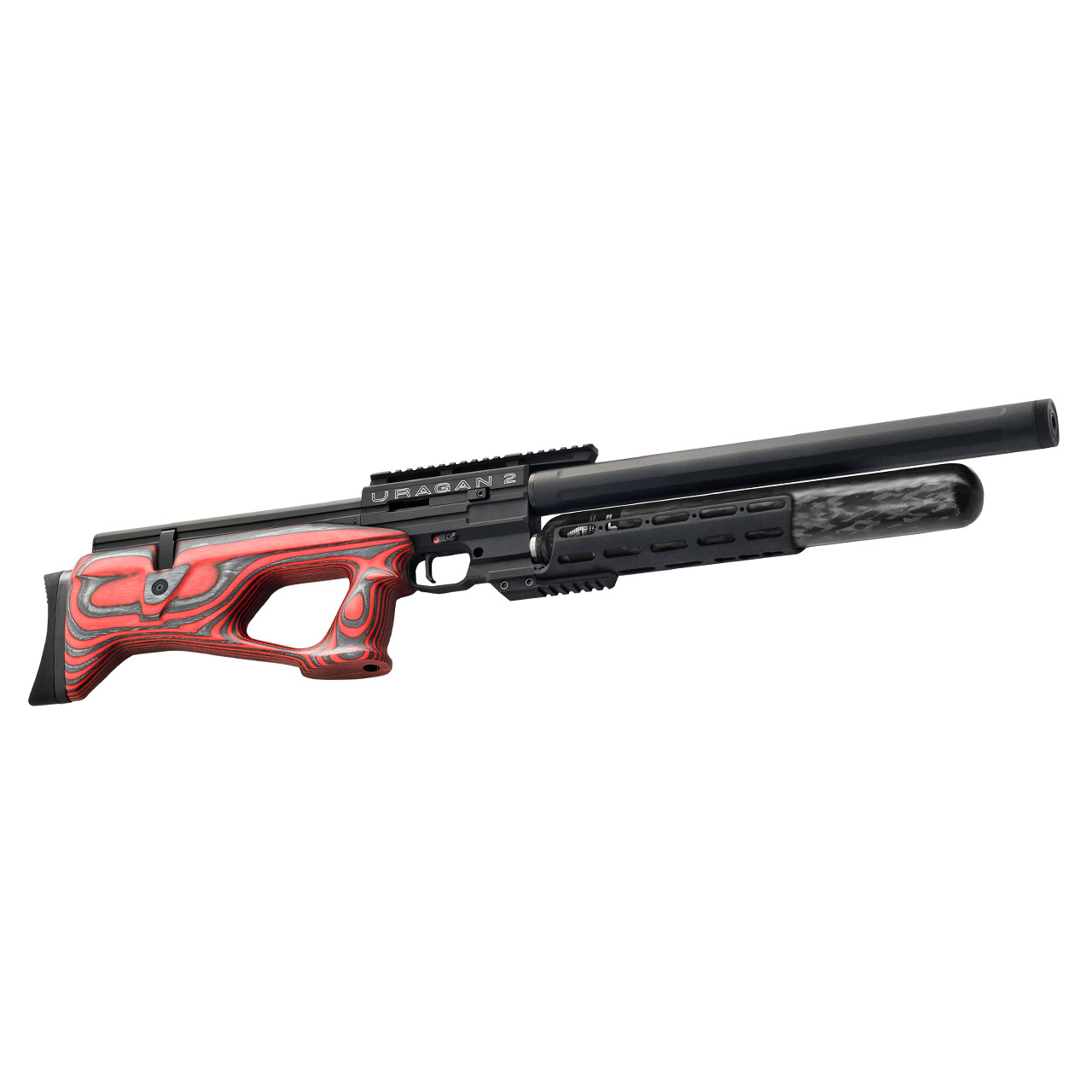
AGT Uragan 2 Red Laminate 600
$1,999.00
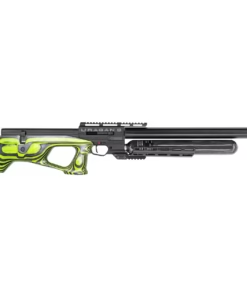
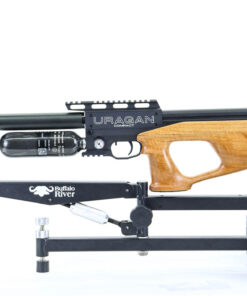
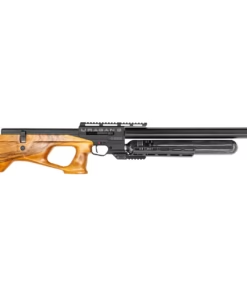
Developed from the original Uragan (meaning hurricane), the AGT Uragan 2 Red Laminate 600 takes many of the features of the Vulcan 3 and mixes them to create an air rifle with excellent rear-biased balance and operation.
The CZ-made barrel now features a new sound moderator and offers stunning accuracy. A crisp, adjustable trigger and fully ambidextrous biathlon-style side lever cocking system make hitting the target easy for any shooter. The gun is fitted with a 20MOA sloped Picatinny rail to aid scope mounting for distance shooting, and a further accessory rail is offered underneath for accessories mounting.
AGT Uragan 2 Red Laminate 600 Features
- Cold hammer forged barrel
- Biathlon side lever is easily changed for right and left hand configuration, no special tools required
- Pressure gauge
- Pressure regulator
- Adjustable buttpad
- Weaver rail for bipod
- Handguard with KeyMod
- Safety catch
- 20 MOA sloped top weaver rail for optical sight
- Ability to mount extra sound moderator (silencer)
AGT Uragan 2 Red Laminate Specifications
| Type | PCP |
| Scope Rail | Picatinny |
| Power Output | 10.8 – 11.8 ft lbs |
| Shots Per Fill Approx
.177 |
230 |
| Magazine Capacity
.177 |
15 |
| Overall Length | 895mm |
| Barrel Length | 600mm |
| Number of Magazines | 2 |
| Cylinder Capacity | 530cc |
| Max Fill Pressure | 300 Bar |
| Weight | 3.5kg |
| Warranty | 3 Years |
| Rifle Comes With | Fill Probe |
AGT Uragan 2 Red Laminate 600 – Regulated Czech PCP Bullpup with 600 mm Barrel and Premium Laminate Stock
The AGT Uragan 2 Red Laminate 600 combines a substantial 600 mm barrel with a compact bullpup architecture, large high-pressure air reservoir, regulated pneumatic action, and distinctive red laminated furniture. Current specifications list a 530 cc carbon-fibre air tank, 300 bar maximum filling pressure, approximately 900 mm overall length, around 3.5 kg total weight, a reversible biathlon-style loading lever, two-stage adjustable trigger, manual safety, pressure gauge, lower accessory rail, and a 20 MOA Weaver/Picatinny top rail for compatible optics.
The second-generation design also introduced a revised shroud, updated aluminium forward cradle, improved trigger system, improved safety arrangement, and better accessory integration compared with the original platform.
AGT Uragan Air Rifle
The AGT Uragan air rifle family uses regulated pre-charged pneumatic operation together with a rear-action bullpup layout.
This arrangement allows a substantial barrel to be retained while overall length remains shorter than a comparable conventional rifle.
AGT Uragan
The AGT Uragan platform is associated with Czech engineering, high-capacity compressed-air storage, magazine feeding, and reversible side-lever operation.
The second generation refined several of those features while retaining the general design philosophy.
Uragan Air Rifle
A Uragan air rifle stores compressed air before firing rather than relying on a large spring piston.
Consequently, the firing cycle contains less heavy reciprocating movement than many traditional spring-powered systems.
AGT Uragan 3
The AGT Uragan 3 is the later generation and should not be confused with this second-generation configuration.
The third generation incorporates further changes to the receiver, regulator, valve, plenum, and firing mechanism.
AGT Uragan Compact
The AGT Uragan Compact is shorter than this 600 mm model and typically uses a reduced barrel length and smaller reservoir.
Therefore, Compact specifications should not be applied directly to the 600 version.
AGT Uragan Air Rifle for Sale
The phrase AGT Uragan air rifle for sale can return several generations, stock finishes, barrel lengths, calibers, and regional power configurations.
Exact model identification is therefore essential when comparing technical data.
Best AGT Uragan Review
A useful Best AGT Uragan review should examine regulator consistency, barrel quality, trigger behavior, reservoir capacity, loading-lever smoothness, magazine indexing, stock ergonomics, optics mounting, and service history.
AGT Uragan Price
The AGT Uragan price varies according to stock material, caliber, market, taxation, power configuration, and dealer.
One current European listing shows the red laminate 600 at approximately €1,436, while another UK retailer lists it around £1,790, illustrating the effect of regional pricing.
Buy AGT Uragan Air Rifle
Searches for Buy AGT Uragan air rifle should be considered alongside applicable licensing, transfer, age, transportation, storage, and power restrictions.
AGT Uragan Hunting
The phrase AGT Uragan hunting relates to lawful field applications where suitable pneumatic equipment is permitted.
Actual suitability depends on caliber, legal energy output, local wildlife regulations, land access, and humane-use requirements.
AGT Uragan .22
The AGT Uragan .22 uses 5.5 mm ammunition.
Current second-generation 600 mm listings commonly identify a 12-round magazine and approximately 170 regulated shots per fill in factory-market .22 configurations.
AGT Uragan .25
The AGT Uragan .25 uses 6.35 mm ammunition.
Availability varies by market, and shot count and energy specification should be confirmed for the exact rifle.
AGT Uragan High Power
An AGT Uragan high power configuration cannot be identified from external appearance alone.
For example, one UK version is listed around 10.8–11.8 ft-lb, while other international configurations are offered at substantially different energies.
AGT Uragan PCP Air Rifle
The AGT Uragan PCP air rifle stores compressed air inside a large carbon-fibre reservoir and meters that air through a regulated firing system.
AGT Uragan Accuracy
AGT Uragan accuracy depends on barrel condition, regulator stability, ammunition compatibility, optic installation, trigger control, pressure consistency, and shooter technique.
The 600 mm barrel provides a substantial platform for repeatable target performance.
AGT Uragan vs FX Impact
The phrase AGT Uragan vs FX Impact compares two premium pneumatic platforms with different design philosophies.
The second-generation URAGAN emphasizes straightforward regulated architecture and a large reservoir, whereas the competing system is known for extensive external adjustment.
AGT Uragan Review 2026
An AGT Uragan review 2026 should distinguish the second-generation model from the later third-generation platform.
The 600 mm second-generation configuration remains notable for its large 530 cc reservoir, 300-bar rating, improved shroud, reversible lever, updated safety, and red laminate furniture.
AGT Uragan PCP
The AGT Uragan PCP concept combines compressed-air storage, regulator-controlled pressure, magazine feeding, and side-lever cycling.
Air Venturi Alpha
Air Venturi Alpha belongs to a separate manufacturer and should not be confused with the Czech system described here.
Air Venturi Alpha PCP Rifle
An Air Venturi Alpha PCP Rifle uses its own barrel, regulator, reservoir, trigger, magazine, and chassis arrangement.
Air Venturi Alpha Air Rifle
The phrase Air Venturi Alpha Air Rifle represents another pneumatic product family rather than a feature of this model.
Air Venturi Alpha Hunting Rifle
An Air Venturi Alpha Hunting Rifle should be assessed separately according to its caliber, legal power configuration, and local regulations.
Air Venturi Alpha Tactical PCP
The Air Venturi Alpha Tactical PCP follows a different chassis philosophy from the laminate bullpup format.
Air Venturi Alpha Regulated PCP
An Air Venturi Alpha Regulated PCP demonstrates the wider use of pressure regulators in modern pneumatic platforms.
Air Venturi Alpha Multi Shot Rifle
An Air Venturi Alpha Multi Shot Rifle belongs to the magazine-fed pneumatic category, although magazine design and capacity differ.
Air Venturi Alpha Precision Air Rifle
An Air Venturi Alpha Precision Air Rifle comparison should focus on regulator consistency, barrel quality, trigger characteristics, ergonomics, and ammunition compatibility.
Air Venturi
Air Venturi is a separate manufacturer and distributor of pneumatic equipment.
Air Venturi Avenger
The Air Venturi Avenger belongs to another regulated platform and occupies a different price and adjustment category.
Airventuri
The spelling airventuri generally refers to the same Air Venturi brand.
Air Venturi Avenger
The air venturi avenger uses a different chassis, reservoir system, regulator architecture, and adjustment philosophy.
Air Venturi Avenge
The phrase air venturi avenge is commonly a shortened or misspelled reference to the Avenger line.
Air Venturi Compressor
An air venturi compressor belongs to the filling-equipment category rather than the rifle itself.
Venturi Air
The phrase venturi air often appears alongside pneumatic rifles, tanks, compressors, and accessories.
Air Venturi Air Compressor
An air venturi air compressor or another suitable high-pressure unit should supply clean, dry compressed air within the limits of the equipment being filled.
Air Rifle and Air Pistol
The phrase air rifle and air pistol covers several propulsion systems, including spring, CO₂, gas-ram, multi-pump, and pre-charged pneumatic designs.
Air Venturi RovAir 4500 Portable Compressor
The air venturi rovair 4500 portable compressor represents one example of portable high-pressure filling equipment.
Air Ventur Avenge
The phrase air ventur avenge is another common search variation associated with the Avenger family.
Air Venturi MicroStrike
The air venturi microstrike belongs to a separate product family.
Dragon Claw
The dragon claw is associated with large-bore pneumatic equipment rather than this smaller-caliber bullpup platform.
Air Venturi RovAir
The air venturi rovair name generally relates to portable compressed-air filling equipment.
Air Venturi Tank
An air venturi tank can function as an external high-pressure air source when correctly rated and maintained.
Air Venturi Air Tank
An air venturi air tank should remain within its certification, inspection, and working-pressure limits.
Air Venturi OmniStorm
The air venturi omnistorm belongs to another pneumatic product family.
Air Venturi PCP Compressor
An air venturi pcp compressor is a dedicated high-pressure filling system rather than a rifle component.
Air Venturi Avenger 25
The air venturi avenger 25 is another .25-caliber pneumatic platform with different adjustment and reservoir characteristics.
Seneca Dragon Claw
The seneca dragon claw belongs to the large-bore pneumatic category.
Ventur Air Compressor
A ventur air compressor search generally relates to high-pressure filling equipment.
Seneca Air Rifles
Seneca air rifles cover several independent pneumatic designs and should be evaluated according to their own specifications.
Air Bolt Gun
An air bolt gun describes specialized pneumatic equipment configured for different projectile types.
50 Caliber Dragon
The phrase 50 caliber dragon normally refers to large-bore equipment rather than the platform described here.
Claw Air Gun
A claw air gun search similarly points toward a different large-bore product family.
Air Venturi
The repeated air venturi search phrase remains associated with a separate pneumatic-equipment brand.
Avenger Price
An avenger price comparison concerns another platform and should account for differences in materials, adjustment, regulator design, and construction.
Air Rifle Compressor
An air rifle compressor used with a 300-bar reservoir must be correctly rated and capable of delivering clean, dry compressed air.
PCP Airguns
PCP airguns use stored compressed air before firing, allowing manufacturers to incorporate regulators, magazines, large reservoirs, and comparatively low-recoil operating cycles.
PCP Air Rifles
Among modern pcp air rifles, this 600 mm red laminate model combines a long barrel, large 530 cc carbon reservoir, 300-bar pressure rating, regulated action, reversible controls, and premium natural-feel laminate furniture.
Why the Red Laminate 600 Configuration Matters
The defining feature of this configuration is the combination of a full 600 mm barrel and a large reservoir with striking red laminated furniture.
The stock gives the rifle a traditional shaped feel while the internal system remains thoroughly modern.
600 mm Barrel
The barrel length is 600 mm, while overall length remains approximately 895–900 mm because of the bullpup architecture.
530 cc Carbon Reservoir
A 530 cc carbon-fibre reservoir provides substantial air capacity and is rated to a maximum of 300 bar.
Regulated Air Delivery
The regulator controls the working pressure supplied to the firing valve while reservoir pressure remains within the useful range.
This supports more predictable velocity and shot-to-shot behavior.
Improved Sound Shroud
The second generation uses an enlarged and redesigned shroud intended to reduce report compared with the earlier system.
Red Laminate Thumbhole Stock
The laminated thumbhole stock combines a distinctive layered red finish with a rigid external structure.
Because laminate is built from bonded layers, it is generally dimensionally stable while retaining the tactile character of wood-based furniture.
Adjustable Butt Pad
Current listings identify a vertically adjustable butt pad, allowing shoulder contact to be refined for individual fit.
Reversible Biathlon-Style Side Lever
The loading lever can be moved for right- or left-side operation.
This supports more flexible ergonomics and allows the shooter to configure the action according to preference.
Improved Two-Stage Trigger
The second generation includes an improved adjustable two-stage trigger system.
Predictable trigger behavior is important for consistent target performance.
20 MOA Optics Rail
The top Weaver/Picatinny mounting rail incorporates approximately 20 MOA of inclination, providing additional elevation adjustment for compatible optics.
Lower Accessory Mounting
A lower rail integrated around the reservoir cradle provides a mounting interface for compatible accessories.
This second-generation arrangement improves practical accessory integration compared with the earlier platform.
Magazine Capacity and Shot Count
Current .177 versions are commonly listed with 15-round magazines and approximately 220–230 shots per fill, while .22 versions commonly use 12-round magazines and are listed around 170 shots per fill in regulated factory specifications.
Actual shot count varies with power level, ammunition, temperature, regulator setting, and individual rifle condition.
Precision and Repeatability
Practical precision comes from multiple systems working together.
The barrel, regulator, trigger, ammunition, optic installation, reservoir pressure, stock stability, and shooter technique all influence grouping.
No single specification guarantees a particular result.
Important Filling Information
The reservoir should never be charged beyond 300 bar.
Only clean, dry compressed air should be used.
Hoses, fittings, cylinders, and compressors must be correctly rated for the required pressure.
Legal and Ownership Considerations
Power levels vary significantly by market.
Possession, licensing, transfer, storage, transportation, caliber, age restrictions, muzzle-energy limits, and lawful field use should therefore be checked according to local regulations.
Overall Engineering Character
The AGT Uragan 2 Red Laminate 600 combines a 600 mm barrel, 530 cc carbon-fibre reservoir, 300-bar filling capability, pressure regulation, reversible loading controls, improved trigger and safety systems, 20 MOA optics mounting, accessory integration, and distinctive laminated furniture.
Its defining engineering characteristic is the balance between substantial pneumatic capacity and barrel length on one hand, and relatively compact bullpup dimensions on the other.
Pressure Stability, Balance, Trigger Control, Sight Setup, and Practical Shooting Performance
Developing Consistent Performance
Repeatable results depend on controlling the same variables during every shooting session.
Ammunition condition, reservoir pressure, optic alignment, trigger movement, shoulder contact, support-hand placement, and environmental conditions can all influence point of impact.
For meaningful testing, only one major variable should be changed at a time.
Several groups should then be compared before deciding whether a particular adjustment has improved or reduced performance.
Understanding Regulated Pressure
A regulated pneumatic system separates the high pressure stored inside the reservoir from the lower working pressure delivered to the firing valve.
This helps maintain more consistent output while sufficient reservoir pressure remains available.
However, regulation does not eliminate pressure variation completely.
As pressure approaches the lower operating threshold, shot behavior may begin to change.
Starting From a Similar Pressure
Accuracy testing becomes more reliable when each session begins from a similar pressure level.
Starting one group immediately after filling and another near the lower end of the useful range can make the results difficult to compare.
A consistent starting point helps isolate ammunition, technique, and optic changes from pressure-related variation.
Monitoring Air Consumption
The pressure gauge should be checked throughout longer sessions.
Recording pressure before and after several groups helps establish normal air consumption.
Over time, this creates a useful reference.
If the rifle suddenly begins consuming more air under similar conditions, the pneumatic system may deserve inspection.
Large Reservoir Behavior
A larger reservoir can provide a longer useful operating period between fills.
However, reservoir size alone does not determine consistency.
Regulator behavior, power configuration, ammunition, temperature, and valve efficiency all influence practical shot count.
The shooter should learn the normal pressure pattern of the individual rifle rather than relying entirely on advertised figures.
Controlled Filling
High-pressure filling should be performed gradually.
The filling source should be correctly rated and capable of delivering clean, dry compressed air.
Connections should be inspected before pressure is introduced.
Fast filling can generate additional heat and may make the initial pressure reading less stable.
Temperature Effects
Compressed air changes pressure as temperature changes.
A reservoir filled in a cool environment may show a different reading after warming.
Likewise, pressure may decrease as the rifle cools.
For useful comparisons, pressure readings should always be considered together with environmental temperature.
Balance With a Longer Barrel
A longer barrel and substantial reservoir can create a different balance from shorter configurations.
Although the rear-action layout keeps overall length manageable, the front of the rifle can still feel more substantial.
The shooter should find a support-hand position that allows the rifle to settle naturally without unnecessary muscular tension.
Supporting-Hand Placement
The supporting hand should rest where the rifle feels balanced rather than simply at the geometric center.
Holding too far forward can increase fatigue.
Holding too close to the body may reduce control of the front end.
Once a comfortable position is found, it should be repeated consistently.
Shoulder Contact
The rear pad should contact approximately the same area of the shoulder during every shot.
Excessive pressure is unnecessary.
A secure but relaxed mount generally produces better repeatability.
Changing shoulder pressure can alter how the rifle settles and may contribute to changes in group shape.
Cheek Position
The head should return naturally to the same location behind the optic.
Changing cheek position can affect eye alignment.
The shooter should avoid forcing the head downward.
A relaxed position that provides a complete sight picture immediately is usually easier to repeat.
Optic Height
Ring height influences comfort and alignment.
A scope mounted too low may force the shooter to press the cheek excessively into the stock.
A scope mounted too high can reduce cheek support.
The best height allows natural eye alignment while maintaining adequate clearance.
Eye Relief
Eye relief should be adjusted while the shooter is in the normal firing position.
The full image should appear without stretching forward or backward.
Once the correct location is found, the mounting hardware should be secured according to the optic manufacturer’s specifications.
Trigger-Hand Position
The firing hand should remain secure but relaxed.
Excessive grip pressure can pull the rifle sideways.
The trigger finger should move independently from the rest of the hand.
Consistent finger placement helps pressure travel directly to the rear.
First-Stage Control
A two-stage trigger allows the first portion of movement to be taken up before the final release.
The first stage should be approached smoothly.
The shooter should maintain a stable sight picture while pressure increases gradually.
Rushing through this movement can make the final release less predictable.
Final Trigger Release
The final release should remain smooth and controlled.
A sudden jerk can disturb alignment immediately before discharge.
The shooter should increase pressure steadily rather than trying to anticipate the exact moment of release.
This helps reduce unnecessary movement.
Follow-Through
The shooting position should remain stable briefly after firing.
The head should stay behind the optic.
Shoulder contact should remain unchanged.
The trigger hand should stay relaxed.
Good follow-through helps identify movement and supports repeatable technique.
Loading-Lever Operation
The loading lever should be cycled through its complete movement smoothly.
Excessive force is unnecessary.
If resistance suddenly increases, the shooter should stop and inspect the magazine, breech, or ammunition.
Forcing the action can damage components or deform a projectile.
Magazine Condition
The magazine should rotate smoothly and index correctly.
Each chamber should align properly.
Projectiles should be loaded carefully to avoid damage.
If one chamber repeatedly causes resistance, the magazine should be inspected for wear, contamination, or alignment problems.
Ammunition Inspection
Damaged projectiles can reduce consistency.
Bent skirts, crushed heads, dirt, or obvious deformation should be removed from serious testing.
A quick visual inspection is generally sufficient.
Perfect sorting is unnecessary, but clearly damaged ammunition should not be included in meaningful group evaluation.
Comparing Ammunition
Different barrels can respond differently to projectile weight, shape, and dimensions.
Several suitable options can therefore be compared under controlled conditions.
Pressure, distance, support, optic settings, and weather should remain as similar as possible.
Repeated results provide stronger information than one unusually good group.
Supported Testing
A stable rest can help reduce shooter movement.
The rifle should contact the support at consistent points.
It should not be clamped rigidly.
Supported testing is particularly useful when comparing ammunition or confirming sight settings.
Evaluating Vertical Spread
Repeated vertical spreading can sometimes be associated with pressure variation, inconsistent breathing, changing support, or ammunition differences.
One group does not provide enough evidence.
Several groups should be compared before mechanical adjustments are made.
Evaluating Lateral Spread
Side-to-side spreading can result from wind, trigger movement, changing shoulder pressure, or inconsistent body position.
If the same pattern appears repeatedly under calm conditions, technique and setup should be reviewed.
Zero Confirmation
Sight adjustments should be based on the center of a complete group rather than individual impacts.
Constantly changing settings after every shot can create confusion.
A better method is to fire a controlled group, make a small correction, and then confirm the new setting with another group.
Managing Rifle Cant
Tilting the rifle differently from one shot to another can influence point of impact.
The shooter should develop a repeatable level position.
If a level indicator is installed, it can be used as a quick confirmation rather than becoming the main focus before each shot.
Breathing Control
Natural breathing moves the upper body.
The shooter should avoid holding the breath for excessive periods.
A short pause after normal breathing can provide a stable moment.
If alignment is not satisfactory, restarting the breathing cycle is generally better than forcing the shot.
Standing Practice
Standing introduces more natural movement.
The objective is not to eliminate all movement but to control it.
Short practice sessions are usually more productive than long unsupported sessions that create fatigue.
Seated and Kneeling Positions
Seated and kneeling positions provide additional stability while still requiring practical body control.
Shoulder placement, head position, support-hand location, and trigger movement should remain consistent.
These positions also help reveal how the longer configuration balances away from a bench.
Environmental Conditions
Wind, temperature, and lighting can all influence observed performance.
A change in impact should not automatically lead to mechanical adjustment.
External conditions should be considered first.
Simple notes can make later comparisons more useful.
Recognizing Fatigue
Fatigue affects grip pressure, breathing, concentration, and sight alignment.
Groups may widen even though the equipment itself has not changed.
Short breaks can restore consistency.
If performance declines late in a session, fatigue should be considered before modifying the setup.
Maintaining Performance Records
A basic shooting log can include starting pressure, ending pressure, ammunition type, distance, group size, sight settings, and environmental conditions.
Over time, these records help reveal patterns and gradual changes in mechanical behavior.
Overall Practical Performance
Strong practical performance comes from combining stable pressure behavior, correct sight setup, consistent body position, careful ammunition selection, smooth trigger control, and regular mechanical observation.
When those variables remain controlled, the rifle becomes easier to evaluate and more predictable during lawful recreational and precision target shooting.
Repeatability across several groups remains a more meaningful measure of performance than one exceptional result.
Real-World Handling, Shooting Rhythm, Sight Stability, Environmental Awareness, and Long-Term Performance Refinement
Real-World Handling
A long-barrel bullpup configuration can feel compact in overall length while still carrying noticeable mass through the front and center of the rifle.
The reservoir, barrel assembly, optic, mounts, moderator, and accessories all contribute to final balance.
For that reason, handling should be evaluated with the complete setup assembled rather than judging the rifle from the stock and action alone.
A balanced setup feels easier to control and places less unnecessary strain on the shoulders.
Finding the Natural Balance Point
The supporting hand should rest where the rifle settles naturally.
Holding too far forward may increase fatigue during longer sessions.
Holding too close to the body may reduce control over the front end.
The ideal position is the point where the rifle remains stable while the shoulders stay relaxed.
Once that position is found, it should be repeated consistently during accuracy testing.
Shoulder Placement
The rear pad should contact approximately the same area of the shoulder every time the rifle is raised.
Excessive rearward pressure is unnecessary.
A secure but relaxed contact point usually provides better repeatability than forcing the rifle aggressively into the body.
Changing shoulder pressure can alter how the rifle settles and may affect group consistency.
Cheek Position
The head should return naturally to the same position behind the optic.
A changing cheek position can alter eye alignment and sight picture.
The shooter should avoid pressing the head downward excessively.
A comfortable position that provides a complete image immediately is easier to repeat and reduces neck strain during longer sessions.
Eye Alignment
The full sight picture should appear quickly after the rifle is shouldered.
Repeated forward, backward, or sideways head movement introduces another variable.
If the eye does not align naturally, optic height or fore-and-aft position may need to be reconsidered.
Comfort and repeatability should remain the priority.
Magnification Selection
High magnification can make small movements appear much larger.
This can be useful for precise aiming, but it can also make natural body movement more distracting.
The shooter should use enough magnification to see the target clearly without making the sight picture unnecessarily difficult to control.
Moderate magnification can often provide a more relaxed shooting rhythm.
Parallax Awareness
Parallax can affect apparent point of aim when the eye moves behind the optic.
If the scope includes adjustable parallax, it should be set for the approximate target distance.
Consistent cheek position also helps reduce the effect of changing eye placement.
Building a Consistent Shooting Rhythm
A smooth shooting rhythm can improve repeatability.
Each shot should follow the same general sequence: loading, settling into position, checking alignment, controlling breathing, applying trigger pressure, firing, and maintaining follow-through.
Rushing through these steps can create unnecessary variation.
A calm routine also makes unusual mechanical behavior easier to notice.
Loading Between Shots
The loading lever should be operated through a complete and smooth movement.
Excessive speed or force is unnecessary.
If resistance suddenly increases, the shooter should stop and inspect the loading area.
Damaged ammunition, debris, or magazine misalignment may be responsible.
Forcing the action can turn a minor problem into mechanical damage.
Magazine Observation
The magazine should continue to rotate smoothly throughout the session.
Any noticeable change in resistance deserves attention.
Dust, damaged projectiles, or wear can interfere with feeding.
Keeping magazines clean and protected from grit helps maintain reliable operation.
Monitoring Projectile Seating
Loading resistance should feel reasonably consistent.
If one projectile requires much more force than the others, it may be damaged or dimensionally different.
Questionable ammunition should not be forced into the breech.
Inconsistent seating can affect both reliability and practical precision.
Watching Pressure Trends
Reservoir pressure should be observed periodically rather than only at the end of a session.
The shooter should learn how quickly pressure normally decreases.
A sudden change in air consumption may indicate a developing seal issue or another mechanical condition.
Predictable pressure behavior provides a useful maintenance reference.
Temperature Effects
Compressed air responds to temperature changes.
A reservoir filled in cooler conditions may show a different reading after warming.
Likewise, pressure can decrease as the system cools.
Pressure readings should therefore be interpreted together with environmental temperature.
Allowing Pressure to Stabilize
Filling can generate heat inside the reservoir.
Allowing the system to settle briefly before serious group testing can make pressure comparisons more meaningful.
This is particularly useful when performance is being recorded across several sessions.
Ammunition Storage
Projectiles should remain clean, dry, and protected from impact.
A damaged container can deform them.
Loose ammunition stored with hard tools or accessories may also become damaged.
Proper storage helps preserve consistency before loading begins.
Comparing Different Ammunition Types
Different projectile designs can produce noticeably different results.
Only one major variable should be changed at a time.
Changing weight, shape, and dimensions simultaneously makes it difficult to identify what caused an improvement or decline.
Simple notes can make testing more efficient.
Avoiding Constant Sight Adjustment
Once the optic is mounted securely and zeroed, unnecessary adjustments should be avoided.
Repeated changes make it harder to determine whether variation comes from ammunition, weather, technique, or equipment.
Zero should be confirmed through complete groups rather than single impacts.
Checking Mount Security
Scope mounts should be inspected periodically.
Even small movement can create unexplained changes in point of impact.
Fasteners should be tightened according to the mount manufacturer’s instructions.
Excessive tightening can damage threads or mounting surfaces.
Bench Shooting
On a bench, the rifle should contact the support at consistent points.
Changing the resting location can alter balance and shooter input.
The rifle should rest naturally rather than being clamped tightly.
Supported shooting is particularly useful when evaluating ammunition and mechanical consistency.
Seated Position
A seated position provides additional stability without relying completely on a bench.
The shooter should use natural body support where possible.
The rifle should settle into the shoulder instead of being held entirely through muscular effort.
This also provides a useful way to judge how the longer barrel and larger reservoir affect balance.
Standing Position
Standing introduces more natural movement.
The objective is not to eliminate every movement but to control it.
A smooth trigger release during a stable portion of the natural aiming pattern is generally more practical than trying to hold perfectly motionless.
Kneeling Position
Kneeling offers an intermediate level of stability.
The supporting arm and body should work together naturally.
The rifle should rest into the position rather than being forced there.
This reduces fatigue and improves repeatability.
Breathing Rhythm
Breathing should remain natural.
A short pause after a normal breath can provide a stable moment.
Holding the breath for too long creates tension.
If the sight picture is not satisfactory, restarting the breathing cycle is usually better than forcing the shot.
Follow-Through Awareness
After firing, the head should remain behind the optic briefly.
Shoulder contact should remain unchanged.
The shooter should continue observing the sight picture.
This helps reveal whether movement occurred during trigger release and reinforces a more consistent rhythm.
Recognizing Fatigue
Fatigue can develop gradually during longer sessions.
Grip pressure may increase, shoulders may tighten, and trigger movement may become less controlled.
Groups can widen even though the rifle itself has not changed.
Taking a short break is often more useful than making immediate equipment adjustments.
Wind Awareness
Wind can influence lightweight projectiles noticeably.
Safe environmental indicators such as flags or vegetation can provide useful information.
A shift in point of impact during windy conditions does not automatically indicate a mechanical or sighting problem.
Calm-weather results provide a better reference.
Lighting Conditions
Bright sunlight, heavy shade, glare, and low-light conditions can change how clearly the target and reticle appear.
Visual conditions can influence aiming confidence.
They should therefore be considered before changing sight settings after one unusual group.
Post-Session Inspection
After use, the shooter should inspect the magazine, loading area, optic mounts, pressure gauge, reservoir exterior, stock, and muzzle area.
Any unusual movement, damage, or change in feel should be identified early.
A brief inspection can prevent minor issues from becoming larger problems.
Maintaining a Shooting Log
A useful record can include starting pressure, ending pressure, ammunition type, distance, group size, weather conditions, and sight settings.
Over time, these notes create a clearer picture of normal performance.
They can also reveal gradual mechanical changes.
Developing Long-Term Familiarity
Regular use allows the shooter to learn how the complete system normally behaves.
Loading resistance, pressure consumption, trigger feel, balance, and sight picture become familiar.
That familiarity makes unusual changes easier to recognize.
Overall Real-World Performance
Practical performance depends on more than mechanical precision alone.
Balance, sight setup, ammunition condition, pressure behavior, breathing, trigger control, environmental awareness, and fatigue management all contribute.
When these factors remain consistent, the rifle becomes easier to evaluate and more predictable during lawful recreational and precision target use.
The most meaningful performance measure is the ability to reproduce strong results repeatedly under similar conditions.
Be the first to review “AGT Uragan 2 Red Laminate 600”
Related products

AGT URAGAN
AGT URAGAN
AGT URAGAN
AGT URAGAN
AGT URAGAN
Reviews
There are no reviews yet.