
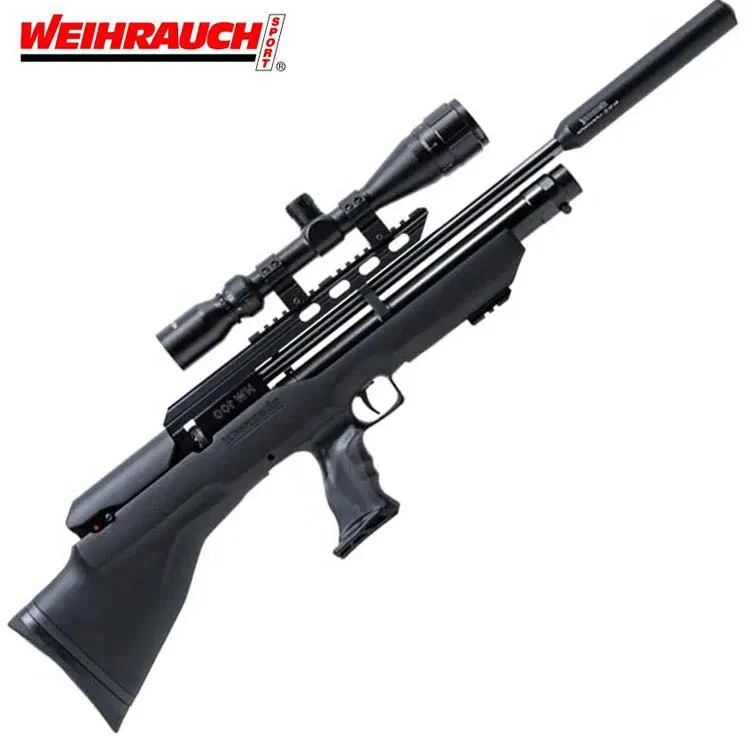
Weihrauch HW100 BP
$1,500.00
The new HW100 Bullpup proves that accuracy and mobility can be on point, while balance is not compromised.
Born from the famous HW100 series, the HW100 Bullpup is based on Weihrauch’s renowned mainframe – providing ultimate performance.
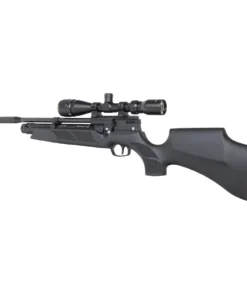
The rifles features a black, ambidextrous soft-touch stock and Weihrauch’s distinguished two –stage match trigger.
With exceptional German technical configuration the balance of the rifle has been fine tuned. An overall length of 83cm and weighing in at 3.7kg you can be assured the bullpup will be steady when pointing.
Extra features include a picatinnay rail, which can be removed, ambidextrous pistol grip and 14 shot magazine.
Quote: “the best scope rail I’ve ever encountered” Terry Doe, Airgun Shooting Magazine.
Key Info

Trigger…2-Stage Match Rekord Trigger

Overall Weight…3.78kg

Overall Length…83.5cm

Loading Mechanism…14 Shot Mag

Ambidextrous…YES

Shot Count per Calibre
110 (.177) 140 (.22)
Weihrauch HW100 BP – German Bullpup PCP Precision, 14-Shot Magazine and Advanced Regulated Performance
The Weihrauch HW100 BP brings the proven engineering principles of the HW100 platform into a compact bullpup configuration designed around precision, balance, smooth operation and repeatable performance. Rather than simply shortening a traditional rifle, Weihrauch positions the action farther rearward so a useful barrel length can be retained while the overall package remains considerably shorter.
For 2026, Weihrauch’s current catalogue identifies the updated production model as the HW 100 X-BP. This latest generation builds upon the original HW100 BP design with a lighter aluminium air cylinder, 250-bar operating pressure, an updated regulator and substantially increased shot capacity. The rifle retains many of the characteristics that established the HW100 family’s reputation, including a 14-shot rotary magazine, fast biathlon-style side lever, two-stage adjustable match trigger, integral pressure monitoring and precision German manufacture.
The current full-length HW 100 X-BP is offered in .177/4.5mm, .20/5.0mm and .22/5.5mm, with different power configurations depending on market and legal requirements. Weihrauch also offers the shorter X-BPK carbine version. The exact output, barrel length and shot capacity therefore depend on the calibre and regulatory configuration being purchased.
Compact Bullpup Engineering
The principal advantage of the bullpup format is packaging efficiency.
By positioning the action behind the trigger area, Weihrauch can retain a useful barrel while shortening the overall rifle.
This gives the platform a compact feel without reducing it to a very short-barrel design.
For shooters who value manageable dimensions at a range, during transport or while working from supported positions, that architecture can be particularly appealing.
Current HW100 X-BP 250-Bar System
The current X-generation bullpup uses an aluminium air cylinder rated to 250 bar.
Compared with the older HW100 platform, Weihrauch states that the new aluminium cylinder reduces weight while increasing firing capacity.
The updated regulator is also intended to improve consistency.
A pressure gauge and quick-fill equipment allow the owner to monitor and replenish the air supply conveniently.
Original HW100 BP 200-Bar System
Earlier HW100 BP models used a 200-bar stainless-steel air cylinder.
That distinction is important when researching used rifles, replacement cylinders or filling equipment.
The older BP and the current X-BP should not automatically be treated as having identical reservoir specifications.
Always confirm the exact generation before buying parts or servicing equipment.
14-Shot Rotary Magazine
One of the most recognizable features of the HW100 family is its 14-shot rotary magazine.
The magazine allows several shots to be prepared in advance while preserving deliberate manual cycling through the side lever.
The system is valued for straightforward loading and repeatable indexing.
For target sessions, the capacity also reduces interruptions between groups.
Biathlon-Style Side Lever
The rifle uses a short side lever positioned to make cycling quick and comfortable.
On the latest X-BP, Weihrauch moved the lever farther forward to improve access within the bullpup layout.
Left-handed versions are also offered.
A smooth lever action is important because it lets the shooter cycle the rifle without significantly disturbing the overall position.
Two-Stage Adjustable Match Trigger
The trigger is a major part of the rifle’s precision-oriented design.
A two-stage match-style mechanism provides a defined first stage followed by a predictable release.
This helps the shooter apply pressure gradually rather than disturbing the sight picture with a sudden pull.
Trigger setup should always prioritize predictable, safe operation.
Precision and Consistency
The HW100 family has long been associated with repeatable PCP performance.
Its regulated air delivery, carefully manufactured barrel system, rigid receiver, match-style trigger and consistent magazine indexing all contribute to that reputation.
However, mechanical quality is only part of practical accuracy.
Pellet compatibility matters.
Scope mounting matters.
Cheek position matters.
Air pressure matters.
Trigger technique matters.
A high-quality rifle performs best when the complete system is kept consistent.
How Good Is the Weihrauch HW100 BP?
The rifle is particularly strong in the areas of build quality, smooth cycling, predictable trigger behavior and compact handling.
The current X-generation also adds greater air capacity and a lighter cylinder.
Its design is not centered on maximum possible output.
Instead, the platform is built around controlled, repeatable shooting characteristics.
That distinction is important for buyers looking for a refined PCP rather than simply choosing a rifle according to velocity figures.
Why Choose a Bullpup PCP?
A bullpup can provide much of the useful barrel length of a conventional rifle in a significantly shorter package.
This can make the rifle easier to handle from a bench or other supported position.
Storage and transport can also become easier.
At the same time, the shooter should make sure the unusual rearward action position and optic height feel comfortable.
How to Get the Best Precision
Begin with one suitable pellet.
Use a consistent starting pressure.
Keep the same magazine.
Confirm scope mounting.
Maintain the same cheek position.
Shoot several groups under similar conditions.
Record the results.
If another pellet or setup is tested, change one variable at a time.
This method produces much more meaningful accuracy information than constantly changing multiple factors.
Where the Rifle Performs Best
The compact dimensions and stable bullpup layout make the rifle particularly useful for controlled recreational target shooting, club-range use and other lawful sporting applications.
Its balance can also make supported shooting comfortable.
Actual suitability depends on the shooter’s preferred position and local regulations.
When Should You Choose the HW100 BP?
This platform makes sense when the buyer wants compact handling without giving up the refined multi-shot operation associated with the HW100 family.
It is especially attractive to shooters who value smooth manual cycling, a high-quality trigger, regulated air delivery and traditional German manufacturing standards.
Important Information Before Buying
Determine whether the rifle is the original BP or the current X-BP.
Confirm calibre.
Confirm legal power configuration.
Check the cylinder generation.
Verify cylinder age on a used rifle.
Confirm magazine condition.
Inspect the filling equipment.
Check that the scope rail suits the intended mounts.
Finally, follow Weihrauch’s pressure-vessel guidance carefully.
Weihrauch HW90
The Weihrauch HW90 belongs to a completely different powerplant category.
It uses gas-ram technology rather than a pre-charged pneumatic system.
A buyer comparing the two should therefore focus on the difference between self-contained break-barrel operation and externally filled PCP operation.
weihrauch
The name weihrauch is closely associated with German sporting airgun manufacture.
The HW100 family represents the company’s PCP engineering, while other models use spring-piston, gas-ram and pistol configurations.
weihrauch
A second search for weihrauch may lead buyers across the company’s wider catalogue.
Therefore, model-specific specifications should always be checked before comparing products.
hw 30
The hw 30 belongs to the company’s lighter spring-powered rifle family.
It is mechanically much simpler and does not use a compressed-air cylinder.
weihrauch hw45
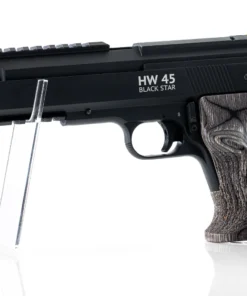
The weihrauch hw45 is an air pistol rather than a PCP bullpup rifle.
Its purpose, handling and powerplant are fundamentally different.
weihrauch hw100
The weihrauch hw100 name describes one of the manufacturer’s best-known PCP families.
The bullpup version takes that established platform and repackages it around shorter overall dimensions.
weihrauch hw 95
The weihrauch hw 95 is a conventional break-barrel spring-piston rifle.
It offers a very different shooting experience from a regulated PCP.
weihrauch hw44
The weihrauch hw44 is a PCP air pistol.
Although it shares compressed-air technology with the HW100 family, its dimensions, ergonomics and intended use are very different.
german air rifle
For buyers searching german air rifle options, the HW100 BP represents Weihrauch’s emphasis on precision machining, regulated air delivery and refined mechanical controls.
air rifles
The term air rifles covers spring, gas-ram, CO2 and PCP systems.
The HW100 BP belongs specifically to the multi-shot PCP category.
weihrauch hw95 hw100 airgun air pistols
The search phrase weihrauch hw95 hw100 airgun air pistols covers several mechanically different products.
The HW95 is a break-barrel rifle, the HW100 is a PCP rifle family, and Weihrauch’s pistol line uses other operating systems.
hw100 airgun
The phrase hw100 airgun commonly refers to Weihrauch’s regulated multi-shot PCP platform.
The BP version adds compact bullpup ergonomics.
air pistols
Air pistols are shorter hand-held airguns and should not be confused with full-size or bullpup rifles.
rifles de aire
The phrase rifles de aire broadly means air rifles and can include spring, gas-ram, CO2 and PCP designs.
The model described here uses pre-charged compressed air.
hw50
The hw50 belongs to the spring-piston rifle range and uses a break-barrel action rather than an air reservoir.
what are air pistols
For buyers asking what are air pistols, they are compact air-powered handguns rather than shoulder-fired rifles.
They can use different power sources including spring, CO2 and PCP systems.
weihrauch hw50
The weihrauch hw50 is a traditional break-barrel sporting rifle and should not be confused with the regulated PCP platform described here.
sk x rifles
The phrase sk x rifles may appear in searches involving different rifle families.
It does not represent a defining technical specification of the HW100 BP.
air shot gun
An air shot gun belongs to a different category of pneumatic or air-powered sporting equipment.
It should not be confused with a rifled PCP designed for pellets.
air rifle makes
Buyers comparing air rifle makes should look beyond brand name alone.
Powerplant, trigger quality, barrel manufacture, air capacity, ergonomics and support availability all influence ownership.
weihrauch hw97k
The weihrauch hw97k is a fixed-barrel underlever spring-piston rifle.
It does not require an external compressed-air filling source.
compressed air rifles
The HW100 BP belongs to the category of compressed air rifles because high-pressure air is stored in the rifle’s cylinder before firing.
hw97
The hw97 belongs to the company’s spring-powered underlever family.
Its firing cycle and maintenance requirements differ from a PCP.
weihrauch hw50s
The weihrauch hw50s is another break-barrel spring rifle.
It is mechanically simpler but offers a very different shooting experience.
weihrauch englisch
The phrase weihrauch englisch is commonly used by buyers seeking English-language information from the German manufacturer.
Official English documentation is useful for confirming model-specific technical specifications.
hw50 s
The hw50 s belongs to the traditional spring-rifle category rather than the PCP bullpup category.
hw35 air rifle
The hw35 air rifle is a classic break-barrel design with a long history.
It should not be confused with the modern compressed-air system of the HW100 family.
hw 97k
The hw 97k is a compact version of the fixed-barrel underlever platform.
Its mechanical operation is completely different from a PCP.
weihrauch hw80
The weihrauch hw80 is a full-size spring-piston break-barrel rifle.
It uses mechanical spring power rather than stored compressed air.
weihrauch hw30
The weihrauch hw30 is a lighter break-barrel model intended for a different type of shooting experience.
hw35e for sale
A buyer searching hw35e for sale is considering a classic break-barrel platform.
The HW100 BP is considerably more complex because it uses regulated compressed-air operation.
hw97k
The hw97k remains one of Weihrauch’s recognizable underlever rifles and provides a useful comparison for shooters deciding between spring-powered and PCP technology.
accurate air rifles
Searches for accurate air rifles should focus on repeatability rather than advertising velocity alone.
Barrel quality, trigger control, consistent air delivery, pellet suitability and shooter technique all affect practical groups.
hw35
The hw35 is a traditional break-barrel design with different handling and maintenance requirements.
weihrauch revolvers
The phrase weihrauch revolvers relates to another product category entirely and does not describe the rifle platform discussed here.
hw 50
The hw 50 is a spring-powered rifle rather than a pre-charged pneumatic design.
hw 100 bullpup
The phrase hw 100 bullpup directly describes the compact configuration covered here.
Its key advantage is the ability to retain a useful barrel while shortening the overall rifle.
hw75
The hw75 is an air pistol and should not be compared directly with a shoulder-fired PCP bullpup.
hw95
The hw95 is a spring-piston rifle with a conventional break-barrel action.
weirauch
The term weirauch is a common misspelling of Weihrauch.
When searching technical information, the correct manufacturer spelling helps produce more reliable specifications.
weihrauch hw30s
The weihrauch hw30s belongs to the lightweight spring-powered range and uses a completely different operating system.
hw50s
The hw50s is another spring-piston rifle rather than a PCP.
Weihrauch HW90 air rifle
The Weihrauch HW90 air rifle is known for its gas-ram powerplant.
This makes it mechanically different from the compressed-air reservoir used in the HW100 BP.
HW90 gas ram air rifle
The HW90 gas ram air rifle uses a gas ram that is compressed during cocking.
The HW100 BP stores compressed air before the shooting session instead.
Weihrauch gas ram rifle
A Weihrauch gas ram rifle provides a self-contained powerplant without the filling equipment required for PCP ownership.
Weihrauch pellet gun
The broad term Weihrauch pellet gun can refer to several pistols and rifles.
The exact model should always be specified when comparing technical data.
Air Arms S510 XS Ultimate Sporter FAC
The Air Arms S510 XS Ultimate Sporter FAC is another premium PCP platform.
However, its conventional rifle layout, action design, stock geometry and air system differ from the Weihrauch bullpup.
air rifle
An air rifle uses compressed gas or mechanical energy rather than conventional firearm ammunition to propel a projectile.
Different designs can still behave very differently.
air gun
The phrase air gun is broader and includes rifles, pistols and other air-powered sporting platforms.
air arms
Air Arms is a separate manufacturer with its own PCP and sporting rifle families.
Its products should not be treated as Weihrauch specifications.
air rifles
Modern air rifles include spring-piston, gas-ram, CO2 and pre-charged pneumatic systems.
The HW100 BP sits within the regulated PCP group.
pellet guns
The phrase pellet guns broadly covers air-powered platforms that fire diabolo-style or other compatible airgun projectiles.
cal .177 pellets
cal .177 pellets are widely used for target shooting because of their relatively small diameter and typically flatter trajectory at suitable power levels.
The correct projectile should still be selected through actual grouping.
break barrel pellet gun
A break barrel pellet gun requires the barrel to be pivoted during cocking.
The HW100 BP does not use this mechanism because it is a pre-charged pneumatic repeater.
airguns
The term airguns includes a broad range of rifles and pistols powered through different systems.
air pisto
The phrase air pisto is commonly a shortened or misspelled search for an air pistol and describes a different format from this bullpup rifle.
177 caliber
177 caliber remains a widely used airgun calibre and is available within the current HW100 X-BP range.
177 pellet vs.22 pellet
When considering 177 pellet vs.22 pellet, the difference goes beyond diameter.
Projectile weight, trajectory, power configuration, shot count and intended lawful target use should all be considered.
The most suitable calibre depends on the exact shooting application and regional regulations.
air arms s510 ultimate sporter .177 sub 12
The air arms s510 ultimate sporter .177 sub 12 represents another premium PCP configuration designed around a specific power category.
It should be compared according to ergonomics, action design, air capacity and intended use rather than by brand name alone.
what is an air rifle
For someone asking what is an air rifle, it is a shoulder-fired platform that uses compressed gas or mechanical stored energy to propel an airgun projectile.
The HW100 BP uses stored high-pressure compressed air.
airgins
The term airgins is a common misspelling of airguns.
Buyers should use exact model names when looking for technical information.
.22 air rifle
A .22 air rifle fires a 5.5mm-class projectile.
The current HW100 X-BP is available in .22 as well as smaller calibres.
air arms s510
The air arms s510 is a separate premium PCP platform with its own side-lever mechanism, reservoir design and stock options.
air riflery
The phrase air riflery broadly describes sporting or recreational rifle shooting with air-powered equipment.
Precision depends heavily on consistent equipment setup and shooter technique.
airgun shooting range near me
A search for airgun shooting range near me can help owners locate an appropriate controlled facility for lawful target practice.
Before attending, confirm the range’s calibre, power and equipment rules because not every range accepts every PCP configuration.
Why the Regulator Matters
A regulated PCP is designed to deliver air at a more controlled pressure from shot to shot.
This can help produce more consistent velocity across the useful portion of the air supply.
The updated regulator in the X-generation is one of the major technical changes Weihrauch introduced.
Why the 14-Shot Magazine Matters
Fourteen rounds provide a useful balance between capacity and compact dimensions.
The shooter can complete several target groups without constantly stopping to reload.
At the same time, the rifle remains manually cycled, allowing the user to maintain deliberate control over each shot.
Why the Trigger Matters
Even an excellent barrel cannot compensate completely for poor trigger control.
A predictable two-stage match trigger allows pressure to be applied progressively.
This makes it easier to release the shot without disturbing the sight picture.
Why the Bullpup Balance Matters
Positioning the action closer to the shoulder shifts much of the rifle’s mass rearward.
This changes the handling characteristics compared with a conventional sporter.
Some shooters appreciate the more centralized feel, particularly from supported positions.
Why Scope Position Is Important
Bullpup ergonomics make scope positioning especially important.
Eye relief must feel natural.
The cheekpiece should support repeatable alignment.
The mount should remain secure.
A poorly positioned optic can make even a mechanically accurate rifle uncomfortable to use.
Why Air-Cylinder Age Matters
Weihrauch places specific service-life requirements on its compressed-air cylinders.
Current manufacturer guidance states that relevant PCP cylinders carry a defined service life and should be checked according to their marked dates.
The cylinder should never be machined, modified or damaged.
This is particularly important when purchasing a used rifle.
How to Inspect a Used HW100 BP
Begin with the cylinder markings.
Check the cylinder’s manufacturing and expiry information.
Inspect the exterior for impact damage.
Confirm pressure retention.
Cycle the lever.
Check both magazines if supplied.
Evaluate the trigger.
Inspect the stock.
Check the pressure gauge.
Inspect the quick-fill equipment.
Verify that the optic rail is secure.
A cosmetically clean rifle should not automatically be assumed to be mechanically perfect.
Why Maximum Velocity Is Not Everything
A high velocity figure may look attractive on paper, but precision depends more heavily on consistency and projectile compatibility.
An excessively fast setup may use more air without producing smaller groups.
Therefore, practical accuracy should be judged from repeated target results rather than velocity alone.
How to Evaluate Precision Properly
Use a stable support.
Begin with a known pressure.
Use the same ammunition.
Use the same magazine.
Maintain the same cheek and shoulder position.
Fire multiple groups.
Measure the groups.
Then repeat the process.
A single exceptional group is less useful than repeated consistent results.
When to Refill
The rifle should generally be refilled before performance becomes noticeably inconsistent.
The exact useful range depends on calibre, power configuration and generation.
Monitoring the pressure gauge and keeping a shooting log can help establish the most useful refill point for an individual rifle.
Where the Current X-BP Improves on the Earlier BP
The current generation introduces significant technical development.
The aluminium cylinder reduces weight.
The operating pressure rises to 250 bar.
Shot capacity increases.
The regulator has been redesigned.
The cocking lever has also been repositioned for bullpup ergonomics.
These changes make the X-BP more than a cosmetic update.
Original BP Versus Current X-BP
Buyers should distinguish carefully between the two generations.
The earlier BP typically uses the established 200-bar HW100 air-cylinder system.
The current X-BP uses the newer 250-bar aluminium cylinder.
Parts and filling specifications should therefore be checked against the exact rifle rather than assumed to interchange.
Final Section 1 Assessment
The Weihrauch HW100 BP represents a compact interpretation of one of Weihrauch’s best-known PCP platforms.
Its bullpup architecture reduces overall length while retaining a useful barrel.
The 14-shot rotary magazine supports convenient multi-shot operation.
The biathlon-style side lever provides smooth manual cycling.
The adjustable two-stage match trigger supports deliberate precision.
The regulated compressed-air system promotes repeatable shot behavior.
Meanwhile, the current HW100 X-BP advances the design with a 250-bar aluminium cylinder, revised regulator and increased shot capacity.
For buyers, the most important step is identifying the exact generation.
An original BP and a current X-BP should not be treated as mechanically identical.
Cylinder pressure, cylinder construction, barrel configuration, total length and shot capacity can differ.
Once the correct model is identified, the platform offers a strong combination of compact dimensions, German manufacturing quality, smooth operation and precision-oriented ergonomics.
A suitable pellet should be selected through real group testing.
The air cylinder should be monitored carefully.
The scope should remain secure.
The trigger should be used consistently.
The magazines should remain clean.
Stock and optic fit should be adjusted to suit the shooter.
Used examples should be checked for cylinder age and overall mechanical condition.
For shooters who want a refined, compact PCP with proven HW100 engineering and a precision-oriented bullpup layout, the HW100 BP remains a highly sophisticated option for lawful recreational target shooting and other permitted sporting used.
Section 2 – Precision Setup, Air Management, Handling, Accuracy and Practical Ownership
Understanding the Rifle as a Complete Precision System
The Weihrauch HW100 BP performs best when every part of the rifle is treated as part of one connected system.
The air cylinder, regulator, side lever, magazine, trigger, barrel, stock, optic, pellet choice, and shooting position all influence the final result.
Because the platform is compact, small differences in cheek position, shoulder contact, and optic height can become noticeable very quickly.
The shooter should therefore focus on repeatability.
The same pellet should be used during comparison testing.
The rifle should begin from a similar pressure.
The same magazine should be used.
The optic should remain secure.
The stock should remain in the same position.
The same support points should be used.
Only one variable should be changed at a time.
This makes the rifle easier to understand and easier to troubleshoot.
Creating a Baseline Setup
Before experimenting with different pellets or adjustments, establish a reliable reference configuration.
Choose one pellet that already produces consistent groups.
Use the same magazine.
Begin from a known cylinder pressure.
Confirm the optic zero.
Keep the same cheek position.
Use the same shoulder placement.
Shoot from the same distance.
Fire several groups.
Record the results.
This creates a reference that can be revisited later.
Why One Change at a Time Matters
Changing several things at once makes diagnosis difficult.
A different pellet may be introduced.
The optic may be adjusted.
The cylinder pressure may be lower.
A different magazine may be used.
The shooter may also change support position.
If accuracy improves or becomes worse, it becomes difficult to know why.
A better method is simple.
Change one thing.
Test again.
Record the result.
Then decide whether another change is necessary.
Pellet Selection
Pellet choice can have a major influence on precision.
Different weights behave differently.
Head size can affect bore fit.
Skirt condition can influence sealing.
Shape can affect magazine feeding.
Manufacturing consistency also matters.
Several suitable pellets should therefore be compared under similar conditions.
Pellet Weight
Heavier pellets generally travel more slowly.
Lighter pellets may produce higher velocity.
However, speed alone does not determine accuracy.
The best pellet is the one that produces repeatable groups and reliable feeding.
Pellet Shape
Projectile geometry can influence both loading and flight.
Some designs may sit more consistently in the magazine.
Others may enter the barrel more smoothly.
Actual target results should guide the final choice.
Inspecting Pellets
Damaged pellets can create misleading results.
Bent skirts may affect sealing.
Visible deformation can influence feeding.
Dirty pellets can introduce inconsistency.
Damaged ammunition should be removed before serious testing.
Pellet Batch Variation
Different production batches can behave differently.
If a new tin suddenly changes group size, the rifle should not immediately be adjusted.
The ammunition itself may be responsible.
Comparing the new batch with a proven batch can help identify the cause.
Understanding the Air Cylinder
The air cylinder stores the compressed air needed for each shot.
The rifle performs best within a useful pressure range.
The shooter should therefore monitor the gauge rather than simply continuing until the cylinder is nearly empty.
Stable pressure usually produces more meaningful accuracy testing.
Consistent Starting Pressure
Comparison testing becomes more reliable when each session begins from a similar pressure.
One test should not begin almost full while another starts much lower if the goal is direct comparison.
A consistent starting point removes one important variable.
Understanding the Useful Pressure Window
The rifle may show changes as pressure falls.
Velocity may change.
The firing sound may change.
Point of impact may move.
Group size may increase.
The shooter should learn where the rifle remains most stable.
Why Remaining Air Is Not the Whole Story
The presence of air in the cylinder does not mean every remaining shot will behave identically.
Once performance begins to change noticeably, refilling may be more useful than continuing.
For precision work, consistency is more important than extracting every possible shot from a fill.
Controlled Filling
Only properly rated high-pressure filling equipment should be used.
The fill connection should remain clean.
The cylinder should be filled gradually.
The pressure limit marked for the exact generation should never be exceeded.
This is especially important because older and newer versions can use different operating pressures.
Why Slow Filling Helps
Compressed air heats during filling.
After cooling, the pressure reading may settle lower.
A slower fill reduces unnecessary heat and makes the final pressure easier to interpret.
Clean and Dry Air
Clean, dry compressed air helps protect the pneumatic system.
Moisture can contribute to corrosion.
Dust can damage seals.
The fill connection should remain protected between uses.
Fill Connection Care
The filling connection should remain clean.
Protective caps should be used where supplied.
Dust and grit can damage sealing surfaces.
The fitting should be inspected periodically.
Hose and Coupler Condition
High-pressure hoses should be checked regularly.
Cuts, cracks, bulges, or damaged fittings should not be ignored.
Couplers should connect securely.
Questionable equipment should be replaced.
Monitoring Pressure Retention
Pressure should remain reasonably stable under stable temperature conditions.
A small change after filling may be normal.
Repeated pressure loss under similar conditions may indicate a leak.
The pattern should be observed before the cause is assumed.
Temperature Effects
Temperature influences compressed air.
A cylinder filled while warm may show lower pressure after cooling.
A cold cylinder may show a higher reading after warming.
This should be considered before assuming that a leak is present.
Understanding the Regulated System
The regulator helps control the pressure delivered for each shot.
A stable regulator supports repeatable velocity.
This is one of the main reasons regulated PCP rifles can produce consistent results across a useful portion of the fill.
However, regulator performance should be judged through actual shooting behavior rather than assumption.
Why Regulator Stability Matters
If the regulator behaves consistently, velocity usually remains more predictable.
This can support smaller group variation.
A sudden change in velocity pattern may therefore justify closer inspection of the air system.
Side-Lever Operation
The side lever should operate smoothly.
It should not be forced.
A complete and controlled cycling motion helps ensure reliable loading.
If resistance changes suddenly, the cause should be investigated.
Why Smooth Cycling Matters
Smooth cycling helps protect pellets from unnecessary damage.
It also allows the shooter to stay close to the firing position.
A consistent loading rhythm can improve concentration during longer sessions.
Consistent Lever Technique
The lever should be cycled completely each time.
Partial movement can create unreliable loading.
The shooter should develop a deliberate and repeatable motion.
Magazine Reliability
The rotary magazine should index smoothly.
Pellets should sit correctly.
The mechanism should not bind.
Any unusual resistance should be investigated.
Loading the Magazine
Pellets should be loaded carefully.
The skirt should not be damaged.
The magazine should not be overfilled.
Any pellet that does not sit correctly should be removed rather than forced.
Magazine Cleanliness
Dust and debris can affect indexing and feeding.
The magazine should remain clean.
Excess lubricant should be avoided because it can attract dirt.
Comparing Multiple Magazines
If several magazines are used, each can be identified individually.
This makes troubleshooting easier.
If one magazine repeatedly causes feeding problems while another works normally, the source becomes easier to isolate.
Barrel Performance
The barrel provides the mechanical foundation for pellet stabilization.
However, barrel quality alone does not guarantee accuracy.
Pellet compatibility, pressure consistency, optic setup, and shooter technique all remain important.
Barrel Cleaning
The barrel should not be cleaned automatically after a fixed number of shots.
If accuracy remains stable, unnecessary cleaning may provide no benefit.
Cleaning should be based on observed performance.
Gentle Cleaning
When cleaning becomes necessary, the process should remain careful.
The bore should be protected.
The muzzle should not be damaged.
Suitable equipment should be used.
Barrel Conditioning
A freshly cleaned barrel may require several shots before normal grouping returns.
The shooter should allow the barrel to stabilize before making unnecessary optic adjustments.
Muzzle Condition
The muzzle should remain clean and protected from impact.
Damage can influence pellet release.
A sudden accuracy change should include a visual inspection.
Trigger Control
The trigger should be pressed smoothly.
The finger should move mainly rearward.
The firing hand should remain relaxed.
A sudden pull can disturb the sight picture.
Trigger Finger Position
Too much finger can introduce sideways pressure.
Too little contact can reduce control.
The ideal position allows a straight and predictable press.
Using the Two-Stage Trigger
The first stage should be taken up smoothly.
The shooter should then pause at the second stage.
Final pressure should be added gradually.
This helps reduce unnecessary movement during release.
Trigger Adjustment
Trigger adjustment should prioritize control and safety.
A very light trigger is not automatically better.
The release should remain predictable and manageable.
Grip Pressure
The firing hand should remain controlled but relaxed.
Excessive grip pressure can create tension.
A moderate and repeatable grip generally supports better precision.
Follow-Through
The shot does not end at trigger release.
The shooter should remain behind the rifle.
The cheek should stay on the stock.
The optic should remain observed.
The trigger movement should finish naturally.
This makes each shot easier to evaluate.
Shot Calling
Shot calling is a useful precision skill.
The shooter watches the sight picture during release.
Any movement is noted.
The likely impact is predicted.
The target is then checked.
This helps separate shooter movement from equipment problems.
Bullpup Stock Fit
The stock should place the rifle naturally into the shoulder.
The cheek position should align the eye with the optic.
The grip should feel comfortable.
The buttpad should provide repeatable contact.
Correct fit reduces unnecessary tension.
Cheek Position
The cheek should contact the stock at the same point for each shot.
If head position changes, the view through the optic can also change.
A repeatable cheek weld improves consistency.
Buttpad Position
The buttpad should contact the shoulder comfortably.
Its position should remain repeatable.
Poor fit can create unnecessary muscular tension.
Shoulder Contact
The rifle should return to the same area of the shoulder.
Changing shoulder pressure can alter alignment.
Consistency improves practical precision.
Support-Hand Placement
The support hand should use a consistent reference point.
Moving it significantly changes balance.
A stable support position helps the rifle settle naturally.
Understanding Bullpup Balance
A bullpup places more of the action closer to the shooter.
This creates a different balance compared with a conventional rifle.
The rifle may feel more centrally weighted.
Some shooters find this helpful because less mass extends far in front of the support hand.
Why Compact Balance Can Help
A shorter overall package can feel easier to manage from supported positions.
It can also reduce unnecessary forward movement during repositioning.
However, the correct support-hand position should still be found through practice.
Bench Shooting
A stable bench is useful for evaluating mechanical accuracy.
The same support points should be used.
The rifle should not be forced into alignment.
Several groups should be compared.
Front Support
The front support should reduce movement without applying unnecessary pressure.
A consistent support point is more important than absolute rigidity.
Rear Support
A rear bag can help stabilize the stock.
Small elevation corrections can then be made without changing the entire body position.
Bipod Use
A compatible bipod can provide stable front support.
However, rear support and shoulder pressure should remain consistent.
The rifle should still be allowed to settle naturally.
Standing Practice
Standing is naturally less stable.
Some movement is normal.
The goal is to manage movement rather than eliminate it completely.
A balanced stance is usually more repeatable.
Kneeling Practice
Kneeling provides additional support.
The shooter should find a position that feels stable without excessive tension.
Seated Practice
A seated position can provide excellent stability.
The shooter should still maintain consistent cheek and shoulder contact.
Prone Practice
Prone can be highly stable.
The optic and cheek position should allow a comfortable head angle.
Neck strain should be avoided.
Natural Point of Aim
The rifle should settle toward the target when the body relaxes.
If the shooter constantly forces alignment, body position should be adjusted.
Breathing Control
Breathing moves the upper body.
A comfortable pause after exhaling is often used for the shot.
The pause should remain natural.
Long forced breath holds can increase tension.
Avoiding Excessive Hold Time
Holding on target too long can increase movement.
Muscles become tired.
Visual focus decreases.
If the shot does not develop naturally, lowering the rifle and restarting is usually better.
Managing Fatigue
Long sessions can reduce performance.
Hands become tired.
Shoulders become tired.
Visual concentration declines.
Short breaks can restore consistency.
Optic Selection
A suitable optic should match the rifle and intended shooting distance.
Clear glass matters.
Reliable adjustment matters.
Eye relief matters.
Field of view matters.
Extreme magnification is not always necessary.
Why Optic Height Matters
Bullpup rifles often position the optic higher relative to the shoulder.
Therefore, cheek alignment becomes especially important.
The eye should meet the optic naturally rather than forcing the head into an awkward position.
Scope Mounting
The optic should be mounted securely.
The reticle should remain level.
Eye relief should feel natural.
The shooter should not need an uncomfortable head position.
Mount Inspection
Scope mounts should be checked periodically.
Loose hardware can cause point-of-impact changes.
Overtightening should also be avoided.
Zeroing
Zero should be established with the pellet chosen for regular use.
Once a stable zero is found, unnecessary adjustment should be avoided.
Constant changes make the rifle harder to evaluate.
Confirming Zero
Zero should be checked periodically.
If groups remain tight but move, the optic and mounts should be inspected before deeper troubleshooting begins.
A shifted group is different from a larger group.
Range Verification
Point of impact changes with distance.
The shooter should confirm actual performance at several useful ranges.
Real target data is more valuable than generic trajectory assumptions.
Creating a Personal Range Reference
A simple record can be created showing actual point of impact at different distances.
This produces practical information specific to the rifle, pellet, optic, and pressure range.
Wind Effects
Wind can influence pellet flight.
Its effect becomes greater as distance increases.
Outdoor groups should always be interpreted in relation to wind conditions.
Temperature Effects
Temperature influences compressed air.
It can also affect ammunition behavior.
Comparisons are more meaningful when conditions are similar.
Lighting Effects
Lighting changes how the target and reticle appear.
Bright glare can reduce clarity.
Low light can make aiming more difficult.
Consistent lighting helps during testing.
Chronograph Testing
A chronograph can provide useful information about velocity consistency.
Several shots should be measured.
Average velocity can be recorded.
Extreme spread can be reviewed.
Standard deviation can provide additional context.
Average Velocity
Average velocity provides a useful reference.
If it changes significantly without an intentional adjustment, pressure, temperature, pellet selection, or regulator behavior may have changed.
Extreme Spread
Extreme spread shows the difference between the fastest and slowest measured shot.
A smaller spread generally suggests more consistent velocity.
However, good numbers do not automatically guarantee tight groups.
Standard Deviation
Standard deviation shows how tightly measured shots cluster around the average.
Lower values can be useful.
However, the target should remain the final measure of practical performance.
Evaluating Group Shape
Group shape can provide useful information.
Vertical patterns may suggest one type of inconsistency.
Horizontal patterns may suggest another.
Irregular groups may result from several combined factors.
Several groups should be compared before conclusions are drawn.
Tight Groups That Shift
If groups remain tight but move to another part of the target, the rifle may still be mechanically consistent.
Possible causes include optic movement, pressure differences, lighting, or changes in hold.
Groups That Become Larger
If groups open up, ammunition should be checked.
The optic should be inspected.
Pressure should be reviewed.
Shooter fatigue should be considered.
Magazine feeding and barrel condition may also deserve attention.
Accuracy Troubleshooting
Troubleshooting should follow a logical order.
Check the pellet.
Check the magazine.
Check the side lever.
Check cylinder pressure.
Check the optic.
Check the mounts.
Check cheek position.
Check shoulder contact.
Check environmental conditions.
Only after these areas are reviewed should deeper mechanical causes be considered.
Exterior Maintenance
The rifle should remain clean and dry.
Dust should be removed.
Moisture should not remain on metal surfaces.
Excess lubricant should be avoided.
Stock Care
The stock should be wiped down after use.
Adjustment hardware should remain secure.
Any unusual looseness should be investigated.
Accessory Rail Inspection
Mounted accessories should remain secure.
Loose equipment can alter balance or introduce movement.
Only useful accessories should be installed.
Cylinder Inspection
The air cylinder should be inspected periodically.
Visible damage should not be ignored.
The connection area should remain clean.
Cylinder age and manufacturer service-life requirements should also be respected.
Why Cylinder Age Matters
Compressed-air cylinders are pressure vessels.
Their marked service life matters.
Used rifles should therefore be checked carefully before purchase.
The cylinder date should be verified.
Any expired or damaged component should be handled according to manufacturer guidance.
Seal Wear
Seals are normal service items.
Their lifespan depends on pressure, temperature, cleanliness, storage, and frequency of use.
Correct replacement parts should be used when servicing becomes necessary.
Detecting Air Loss
A small pressure change after cooling may be normal.
Repeated pressure loss under stable conditions may indicate a leak.
The pattern should be observed before the cause is assumed.
Avoiding Unnecessary Internal Work
A properly functioning rifle does not need constant internal disassembly.
Opening the high-pressure system without a clear reason can create new problems.
Seals can be damaged.
Leaks can be introduced.
Internal settings can be disturbed.
Routine external inspection is usually enough until a genuine issue appears.
Professional Servicing
The internal pneumatic system operates at high pressure.
Deeper regulator, valve, and pressure-system work should be handled by someone with appropriate knowledge and tools.
Storage
The rifle should be stored securely.
Unauthorized access should be prevented.
The environment should remain dry.
Extreme heat should be avoided.
Heat Exposure
High temperatures can affect seals, optics, and pressurized systems.
The rifle should not be left unnecessarily in a hot vehicle or similar environment.
Moisture Control
If the rifle has been exposed to moisture, it should be dried before long-term storage.
This helps protect external components and accessories.
Transport Protection
A suitable case can protect the rifle during transport.
The optic, barrel, stock, magazine area, and air cylinder should be protected from impact.
The rifle should remain unloaded and be transported according to applicable law.
Evaluating a Used Example
A used rifle should be inspected systematically.
Check cylinder age.
Observe pressure retention.
Cycle the side lever.
Inspect the magazines.
Evaluate the trigger.
Check stock condition.
Inspect the optic rail.
Inspect the barrel and muzzle.
Review service history where available.
Pressure Retention in a Used Rifle
Pressure should remain stable under stable temperature conditions.
Persistent loss may indicate a leak.
The cause should be identified before continued use.
Side-Lever Condition in a Used Rifle
The lever should move smoothly.
Unexpected resistance or excessive looseness should be investigated.
Magazine Condition in a Used Rifle
The magazine should index correctly.
It should not bind.
Pellets should feed consistently.
Damaged magazines should be repaired or replaced.
Trigger Condition in a Used Rifle
The trigger should feel consistent.
Unexpected roughness or unpredictable release may indicate that servicing is needed.
Stock Condition in a Used Rifle
The stock should remain structurally sound.
Any adjustable parts should lock securely.
Excessive movement can affect repeatability.
Barrel Condition in a Used Rifle
The muzzle should remain clean and undamaged.
The barrel assembly should remain secure.
Any impact marks should be investigated.
Cosmetic Wear Versus Mechanical Condition
Cosmetic marks do not automatically indicate poor performance.
A used rifle can show normal handling wear and still function very well.
Likewise, a visually clean example may still require servicing.
Mechanical condition matters more than appearance.
Ownership Costs
Long-term ownership includes more than the initial purchase.
The owner should consider filling equipment, pellets, magazines, seals, cylinder replacement, servicing, storage equipment, and optic maintenance.
These costs should be considered before purchase.
Why the Compact Layout Matters
The bullpup design allows useful barrel length to fit inside a shorter overall package.
This makes the rifle easier to store and manage while retaining dedicated rifle ergonomics.
Why the Regulated System Matters
The regulator helps deliver more consistent air pressure from shot to shot.
This supports predictable velocity and more meaningful precision testing.
Why the Side Lever Matters
The side lever provides deliberate manual operation.
It keeps the operating hand close to the firing position.
This creates a smooth shooting rhythm.
Why the Magazine System Matters
The rotary magazine reduces interruptions between shots.
Reliable indexing also helps maintain a consistent loading process.
Why the Trigger Matters
A predictable two-stage trigger helps the shooter release the shot without disturbing aim.
This is especially useful during deliberate precision work.
Why Optic Stability Matters
A secure optic allows meaningful accuracy testing.
A loose scope can make a mechanically consistent rifle appear inaccurate.
Why Pressure Management Matters
The rifle performs best when pressure is monitored carefully.
The shooter should understand the useful operating range rather than relying only on the fact that air remains in the cylinder.
Why Maintenance Discipline Matters
A regulated PCP benefits from careful ownership.
Clean air matters.
Cylinder condition matters.
Magazine cleanliness matters.
Seal condition matters.
Side-lever condition matters.
Optic stability matters.
Storage conditions matter.
These habits improve long-term reliability.
Who Will Appreciate This Platform
The rifle is best suited to shooters who value compact bullpup handling, regulated air delivery, smooth side-lever operation, refined trigger control, and structured precision testing.
It is particularly suitable for owners who want a shorter overall rifle without giving up the smooth operation and precision-oriented engineering associated with the platform.
Final Practical Assessment
The Weihrauch HW100 BP combines compact bullpup architecture, a regulated compressed-air system, smooth side-lever operation, rotary multi-shot feeding, a precision barrel, two-stage trigger, stable stock ergonomics, and flexible optic mounting in one refined platform.
Its strongest qualities are compact handling, mechanical smoothness, precision potential, and consistency.
However, dependable performance depends on disciplined ownership.
A suitable pellet should be selected.
Cylinder pressure should be monitored.
Magazine condition should be maintained.
The side lever should operate smoothly.
The optic should remain secure.
Cheek and shoulder position should remain consistent.
The barrel should be maintained carefully.
The filling connection should remain clean.
Cylinder age should be monitored.
Seals should be checked.
Internal high-pressure work should be handled appropriately.
When these principles are followed, the platform can provide dependable precision, smooth operation, compact handling, and a refined ownership experience for lawful recreational target shooting and other permitted sporting applications.
Be the first to review “Weihrauch HW100 BP”
Related products
WEIHRAUCH
WEIHRAUCH
Uncategorized
WEIHRAUCH
WEIHRAUCH
WEIHRAUCH
Reviews
There are no reviews yet.