
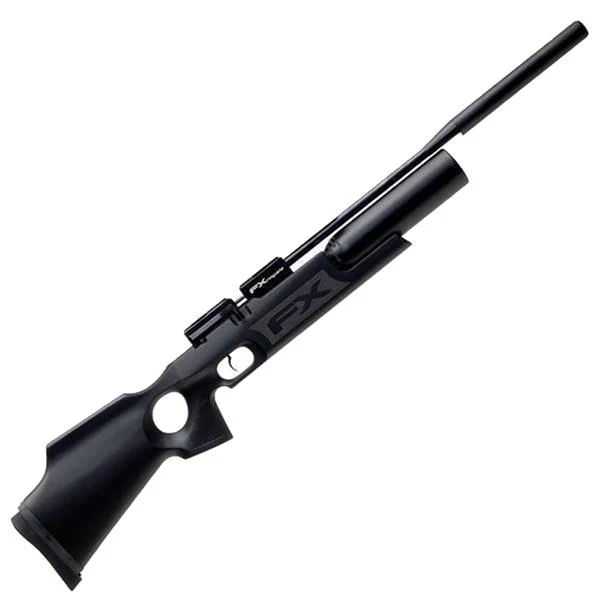
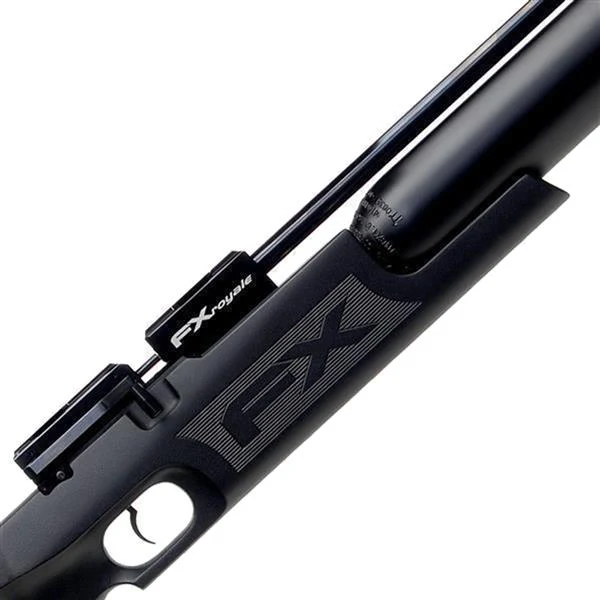
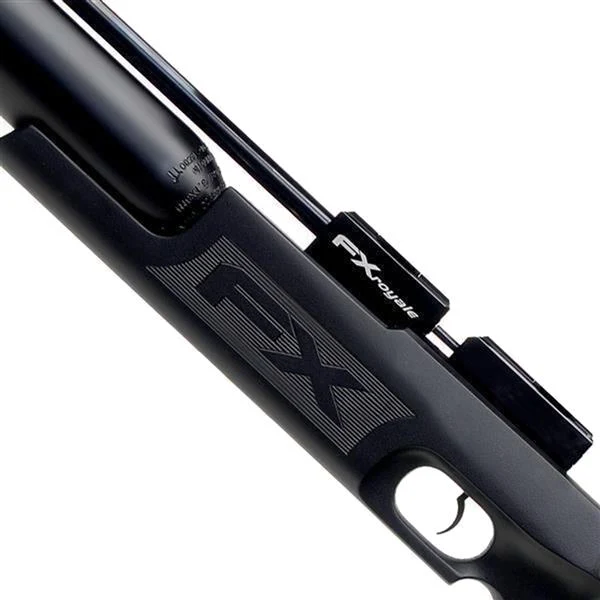
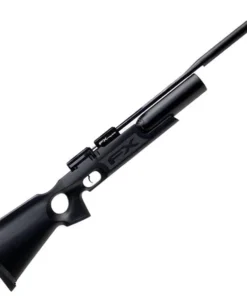
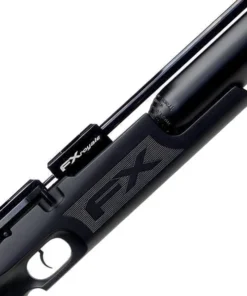
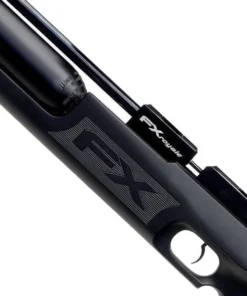
FX Royal 400 Synthetic
$1,450.00
FX Royal 400 Synthetic
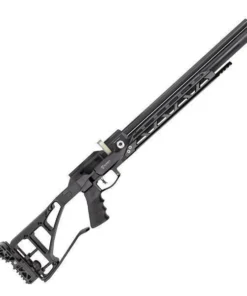
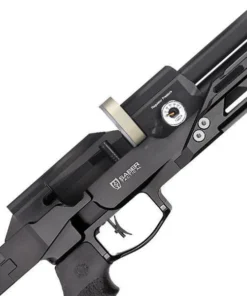
This gun is without a doubt, an FX Flagship! FX spent two years in developing and testing the Royale breech block and valve system before it was put into production. Incorporated into the breech block is a super smooth and effortless side lever, cocking system and spring tensioned magazine.
Adjustable match-grade trigger for crisp, precise release of the shot and a 3-step patented power adjuster, allows for super-fast selection of the required power level. The power adjuster will also repeat itself with absolute precision. The 400 cc air supply provides many super accurate shots from the Smooth Twist barrel. The Royale 400 is a lightweight super gun, quiet in report with the included suppression system. A regulator also comes standard which will give more consistent shots per fill. Completely recoil free.
FX Royal 400 Synthetic – Classic Regulated PCP Accuracy With Lightweight Sporter Handling
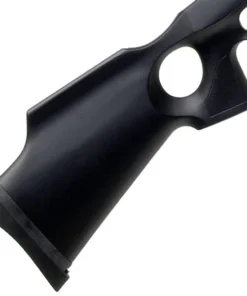
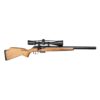
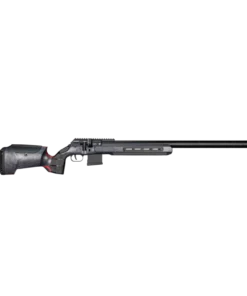
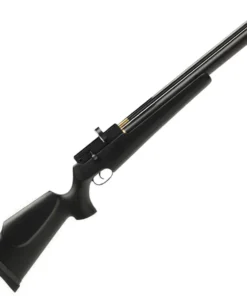
he FX Royal 400 Synthetic, commonly listed as the FX Royale 400 Synthetic, is a classic Swedish PCP sporter built around accuracy, smooth operation, regulated air delivery, and practical field handling. Unlike many current-generation rifles that emphasize chassis systems and extensive external controls, the Royal 400 uses a more traditional sporting layout with a synthetic thumbhole stock, sidelever cocking system, rotary magazine, internal regulator, adjustable two-stage match trigger, and FX Smooth Twist barrel technology. Historical specifications commonly list a barrel length of approximately 19.5 inches, or about 500mm, along with an 11mm dovetail optics rail and a balanced sporter profile.
FX Airguns Sverige and Swedish PCP Engineering
Searches for fx airguns sverige, fx airguns sweden, fx airguns, and fxairguns connect directly with the Swedish engineering heritage behind this rifle.
The Royal series demonstrates an earlier generation of the design philosophy that later became associated with fx air guns, fx pcp, fx air rifle, pcp airguns, and premium air guns generally: controlled air delivery, precision barrel technology, smooth cycling, and refined ergonomics.
For shooters who want a high-quality air rifle or pcp air gun without the highly technical appearance of modern competition platforms, the Royal 400 remains especially attractive.
Smooth Twist Barrel and Precision Potential
The Royal 400 uses FX Smooth Twist barrel technology. Historical descriptions explain that the system leaves much of the barrel relatively smooth before introducing the stabilizing twist nearer the muzzle. The design was intended to reduce unnecessary friction while giving the pellet rotational stability before it exits.
That makes projectile selection especially important.
Even a premium pellet gun can produce different results with different ammunition. Testing several suitable fx pellets can help determine which weight and profile best suits an individual barrel.
For users who want measured data, an fx chronograph or fx pocket chronograph can be used to evaluate actual velocity and shot-to-shot consistency.
Internal Regulator and Consistent Performance
The internal regulator is one of the most important engineering features of the rifle.
Instead of allowing every shot to depend directly on changing reservoir pressure, the regulator supplies the firing system with a controlled working pressure. This helps produce more consistent velocity through the useful portion of the fill.
That consistency supports repeatable trajectory and tighter groups.
The rifle also incorporates a multi-step power adjustment system on historical full-power configurations, allowing output to be reduced for situations where maximum performance is unnecessary.
Sidelever Action and Magazine Capacity
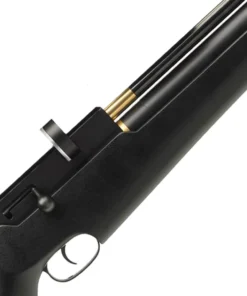
The smooth sidelever action cycles the removable rotary magazine with relatively little effort.
Magazine capacity was commonly listed at 16 shots in .177 and 12 shots in .22.
This provides convenient follow-up shots during target sessions while preserving the familiar ergonomics of a traditional sporter.
The combination of smooth cycling and a refined adjustable trigger is one of the reasons older Royal-series rifles continue to interest shooters looking for proven high end air rifles.
FX Impact M4 and Modern Impact Comparison
Modern searches for fx impact m4, fx m4, impact m4, impact m4 500mm, impact m4 air rifle, impact m4 ballistic coefficient, and fx impact m4 for sale naturally lead to comparisons with older FX rifles.
The difference is substantial.
The newer fx impact, f x impact, and fx impact air rifle platforms emphasize extensive external tuning, compact bullpup architecture, modular components, and advanced projectile optimization.
The Royal 400 follows a simpler philosophy.
It prioritizes familiar sporter handling, regulated consistency, smooth operation, and straightforward adjustment.
FX Impact M3 and Earlier Impact Platforms
The same distinction applies to the fx impact m3, f x impact m3, fx m3, fx m3 airgun, fx impact m3 air rifle, fx impact m3 .22cal air rifle, and fx impact m3 .22cal air rifle. 600mm barrel.
Those rifles offer substantially more tuning capability.
The Royal 400 instead appeals to shooters who want a quality regulated rifle without needing to manage multiple external tuning systems.
FX Panthera MkII and Competition-Focused Rifles
The FX Panthera MkII, fx panthera, and fxpanthera represent a more competition-oriented direction.
Their chassis-based layouts are designed around supported precision shooting, accessory mounting, and extensive adjustment.
The Royal 400 is much more traditional.
Its synthetic thumbhole stock and conventional proportions make it feel immediately familiar to shooters accustomed to sporter rifles.
FX DRS Classic, Tactical and Pro
The newer fx drs, fx drs classic, fx drs tactical, fx drs pro, and fx drs air rifle return to more conventional rifle proportions in a modern design.
This gives them some conceptual similarity to the Royal series.
However, they use newer internal architecture and should not be confused with the older Royal platform.
FX Leopard, Wildcat, Crown, Dreamline and Other Comparisons
The Royal 400 may also be compared with the fx leopard, fx leopard airgun, fx leopard air rifle, fx wildcat, fx wildcat mk3, fx maverick, fx king, fx dreamline, fx dreamline classic, fx dynamic, fx dynamics, fx crown, fx crown mk2, fx crown mkii, and fx crown mkll.
Each model represents a different balance between compactness, adjustability, stock design, reservoir capacity, and intended shooting style.
The Royal remains notable for its straightforward regulated sporter configuration.
Synthetic Thumbhole Stock and Practical Handling
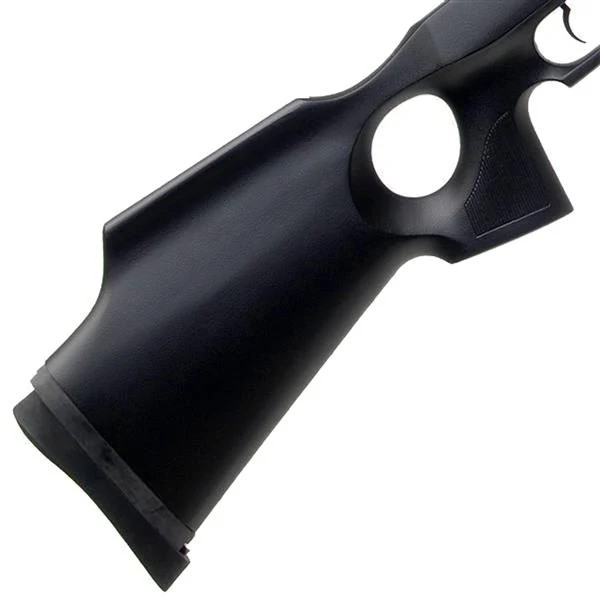
The soft-touch synthetic stock provides weather resistance and secure handling.
Historical listings describe the synthetic version as a right-handed thumbhole design with an adjustable recoil pad and good balance around the breech area.
This makes the rifle practical for shooters who prefer a durable stock that requires less cosmetic care than walnut.
The synthetic configuration also keeps the rifle relatively manageable during extended shooting sessions.
Reservoir Capacity and Fill Configuration
Reservoir specifications require care because different versions were sold over time.
The standard Royal 400 was associated with a roughly 400cc aluminum cylinder, while some dealer-supplied rifles were upgraded to removable 480cc carbon-fiber bottles rated to 250 bar.
Therefore, a used rifle should always be filled according to the rating printed on its actual cylinder rather than a generic online specification.
FX Outdoors, FX USA and International Interest
Searches for fx outdoors, fx usa, and fx airguns usa often come from buyers looking for older FX rifles, accessories, parts, service information, or archived specifications.
European users may also encounter the term luftgevær when researching the same category.
Local ownership, licensing, power, transport, and use regulations should always be checked before purchase.
Reximex Lyra K and Alternative PCP Comparisons
Buyers comparing traditional sporters may also search for Reximex Lyra K, reximex, reximex airguns, reximex throne gen2, reximex throne gen 2, reximex гр, reximex mito, reximex mitos, reximex rра, reximex lieva, and reximex accura pcp air rifle.
Likewise, Reximex Lyra-K PCP air rifle, Reximex Lyra-K airgun, and Reximex Lyra-K review are often used when comparing PCP platforms with more traditional stock designs.
These are different rifles with different internal systems and should not be treated as specification equivalents.
Energy Calculators and Performance Research
Searches such as tps to joules calculator, Tps joule calculator, fps to ft Ibs, and airgun joules calculator usually relate to projectile-energy calculations.
Other terms such as gunseek, roxy max, and mx rex may appear during broader equipment research.
Actual energy should be calculated using verified projectile mass and measured velocity from the specific rifle.
Why Choose the FX Royal 400 Synthetic?
The Royal 400 Synthetic remains attractive because it provides regulated PCP performance without unnecessary complexity.
Its Smooth Twist barrel, internal regulator, smooth sidelever, multi-shot magazine, adjustable match trigger, power control, durable synthetic stock, and traditional balance create a refined shooting platform that still feels straightforward to operate.
Historical reviews also emphasized that pellet selection matters significantly; one test reported a major improvement in group size after switching ammunition, reinforcing the importance of matching the projectile to the individual barrel.
For shooters who value classic sporter ergonomics, proven Swedish engineering, smooth handling, and consistent precision more than extreme external adjustability, the FX Royal 400 Synthetic remains a distinctive and capable older-generation PCP rifle.
Section 2 – Precision Engineering, Practical Accuracy, Handling and Long-Term Performance
A Refined Approach to PCP Performance
One of the strongest qualities of this rifle is its simplicity. Rather than surrounding the shooter with numerous external controls, complicated chassis components, or highly specialized adjustment systems, the platform focuses on the fundamentals that matter most during real-world shooting.
A consistent air supply, a quality barrel, a predictable trigger, comfortable ergonomics, and smooth cycling create the foundation for dependable performance.
This approach makes the rifle particularly appealing to shooters who want high-end pneumatic engineering without turning every shooting session into a tuning project.
The rifle can be set up, tested with suitable ammunition, zeroed carefully, and then used consistently without constant adjustment.
For many owners, that straightforward ownership experience is an important advantage.
Why Regulation Matters
A regulated pneumatic rifle manages compressed air differently from a simple unregulated system.
As shots are fired, pressure inside the main reservoir gradually falls. Without regulation, this changing pressure can influence the amount of air released for each shot.
A regulator creates a more stable working pressure for the firing valve.
This helps reduce unnecessary variation.
The benefit becomes particularly important when the shooter is trying to produce tight groups.
If every shot receives a similar amount of air, velocity is more likely to remain consistent.
That does not guarantee accuracy by itself, but it removes one important variable.
Shot-to-Shot Consistency
Consistency should always be considered more important than one impressive velocity figure.
A rifle that produces one very fast shot followed by several slower ones is less useful for precision work than one that produces a stable series of similar shots.
Stable velocity helps make trajectory more predictable.
At short distances, small velocity differences may not produce an obvious change.
At longer distances, those differences can become much more noticeable.
For this reason, experienced shooters usually pay close attention to consistency across a complete shot string.
Establishing a Reliable Baseline
Before making changes, the shooter should establish a baseline.
A baseline is simply a known configuration that produces repeatable results.
The same projectile should be used.
The same filling procedure should be followed.
The optic should remain unchanged.
The rifle should be fired from the same support position.
Several groups should then be recorded.
This provides useful reference information.
If later adjustments improve performance, the difference becomes clear.
If performance becomes worse, the shooter can return to the original setup.
The Importance of Ammunition Testing
Projectile selection can make a dramatic difference.
Even high-quality ammunition may perform differently from one barrel to another.
Weight is important, but it is only one factor.
Head diameter, skirt shape, manufacturing tolerance, material consistency, and overall geometry can all influence performance.
Testing several suitable projectile types is therefore worthwhile.
Each option should be tested under similar conditions.
The same distance, rest, pressure level, and shooting position should be used whenever possible.
This creates a fair comparison.
Do Not Judge Ammunition From One Group
One unusually tight group can be misleading.
Chance can occasionally produce a result that is better than normal.
A better test involves several groups.
If the same projectile repeatedly produces similar accuracy, the result is more meaningful.
The shooter should look for repeatability.
A projectile that produces one exceptional group and several poor ones may be less useful than one that delivers consistently good groups.
Inspecting Ammunition
Damaged ammunition can undermine otherwise excellent performance.
Bent skirts, distorted heads, contamination, or obvious manufacturing defects can alter flight behavior.
For careful testing, projectiles should be inspected before loading.
Damaged pieces should be removed.
This ensures that ammunition quality does not create false conclusions about the rifle.
Barrel Condition
The barrel plays a central role in accuracy.
However, a barrel does not necessarily need to be cleaned constantly.
Many precision air rifles perform best after a small amount of projectile material has conditioned the bore.
If the rifle continues grouping well, unnecessary cleaning may offer no advantage.
When accuracy begins to deteriorate unexpectedly, barrel condition can become part of the diagnostic process.
Cleaning should then be performed carefully using suitable tools.
After Barrel Cleaning
The first shots after cleaning may not represent normal performance.
The barrel may need several projectiles before its internal surface becomes conditioned again.
Therefore, the shooter should avoid making immediate tuning decisions after cleaning.
A short settling period is often useful.
Once group sizes stabilize, meaningful testing can resume.
Trigger Control and Accuracy
The trigger is one of the most important connections between the shooter and the rifle.
A good trigger should feel predictable.
The shooter should know approximately when the shot will release.
This allows the trigger press to become part of a controlled firing sequence rather than a sudden event.
A heavy or unpredictable trigger can encourage the shooter to pull the rifle off target.
A predictable release reduces this risk.
Trigger Finger Placement
Finger position affects the direction of pressure applied to the trigger.
The finger should generally move rearward rather than pulling sideways.
Too much finger around the trigger can rotate the rifle toward the firing hand.
Too little contact can reduce control.
The shooter should find a position that allows smooth movement.
Consistency is more important than copying another shooter’s exact finger placement.
Grip Pressure
The grip should remain firm enough for control but relaxed enough to avoid unnecessary tension.
A very tight grip can create movement through the wrist and forearm.
That movement may influence the sight picture.
A relaxed hand also allows the trigger finger to move more independently.
This is particularly useful during slow precision shooting.
Shoulder Position
The rifle should contact the shoulder in approximately the same place for every shot.
Different shoulder pressure can alter the way the rifle settles.
Although pneumatic rifles produce relatively little recoil compared with firearms, internal movement still occurs.
Consistent contact helps keep the firing cycle predictable.
The shoulder should support the rifle rather than aggressively pulling it backward.
Cheek Position
A consistent cheek position supports repeatable eye alignment.
The shooter’s eye should naturally settle behind the optic.
If the head needs to move significantly after mounting the rifle, the scope position may need adjustment.
The ideal setup allows the full sight picture to appear almost immediately.
This makes shooting faster and more comfortable.
It also helps reduce parallax-related error.
Scope Height
Scope height affects both comfort and consistency.
If the optic is mounted too high, the shooter may struggle to maintain cheek contact.
If it is too low, the shooter may need to press the head downward.
Neither situation is ideal.
The best mounting height allows a natural head position.
The shooter should be able to shoulder the rifle without stretching the neck.
Eye Relief
Correct eye relief allows the shooter to see the full image through the optic without moving the head forward or backward.
The rifle should first be shouldered naturally.
The scope can then be positioned until the full field of view appears.
Only after this position is established should the rings be tightened fully.
This improves comfort and repeatability.
Scope Mount Security
Loose scope mounts can create extremely confusing accuracy problems.
Groups may shift without an obvious pattern.
The rifle itself may be blamed unnecessarily.
For this reason, the optic mounting system should always be checked during troubleshooting.
Screws should remain secure.
However, excessive tightening should also be avoided because it can damage the scope or mounts.
Understanding Parallax
Parallax is another common source of aiming error.
If the shooter’s eye changes position behind the optic and the reticle appears to move across the target, parallax is present.
Scopes with adjustable parallax allow this effect to be reduced.
The adjustment should be matched to the target distance.
This becomes particularly important when using high magnification.
Magnification Selection
High magnification can help when shooting small targets.
However, it also makes natural movement appear larger.
This can cause the shooter to overcorrect constantly.
Moderate magnification may produce better practical results in many situations.
Higher settings are especially useful from a stable bench.
Lower settings can be more comfortable for general shooting.
The ideal choice depends on range and stability.
Zeroing Correctly
Zeroing should be performed using a stable rest and a safe target area.
The shooter should fire groups rather than adjusting the scope after every shot.
One impact can be misleading.
A group shows the average point of impact more clearly.
Once the group is consistent, the optic can be adjusted.
Additional groups should then confirm the new zero.
Confirming Zero Over Time
A zero should not simply be established once and forgotten forever.
It should be checked periodically.
Transport, optic movement, temperature changes, or maintenance can sometimes shift the point of impact.
A quick confirmation group before an important shooting session can prevent surprises.
Bench Shooting
A bench provides one of the best environments for evaluating mechanical performance.
The rifle can be supported securely at the front and rear.
This reduces shooter movement.
The support should remain consistent.
The rifle should not be clamped excessively.
A natural position generally produces more realistic results.
Front Rest Position
The position of the front support can influence handling.
The same location should be used during accuracy testing.
Moving the support dramatically may change the balance and pressure applied to the stock.
Consistency makes results easier to compare.
Rear Bag Technique
A rear bag can provide very fine elevation control.
The shooter can gently squeeze the bag to move the aiming point.
This should be done consistently.
Large changes in rear pressure can alter the rifle’s position.
With practice, rear support becomes a precise tool.
Natural Point of Aim
Natural point of aim means aligning the body so the rifle naturally settles on target.
The shooter should not have to use constant muscular effort to keep the reticle centered.
If the sights drift when the body relaxes, the position should be adjusted.
This reduces tension.
It also makes the shooting position easier to repeat.
Breathing Technique
Breathing naturally moves the upper body.
Many shooters release the shot during the brief pause after exhaling.
The pause should remain comfortable.
Holding the breath for too long can create tension.
If the shot does not feel ready, the shooter should breathe normally and restart the sequence.
Trigger Timing
The shot should not be rushed simply because the reticle briefly crosses the target.
A controlled trigger press is more important.
The shooter should settle into the position, control breathing, prepare the trigger, and complete the shot when alignment is stable.
This process becomes smoother with practice.
Follow-Through
The firing sequence continues after the trigger breaks.
The shooter should keep the head behind the optic.
Grip pressure should remain unchanged.
Shoulder contact should remain stable.
Moving immediately after the shot can influence consistency.
Follow-through also makes it easier to observe the impact.
Calling the Shot
Experienced shooters often know when they have made an error.
If the reticle moved just as the trigger released, the shooter may predict where the projectile went.
This is known as calling the shot.
It is useful because it helps distinguish shooter error from equipment problems.
Over time, good shot calling improves troubleshooting.
Chronograph Testing
A chronograph can provide useful performance information.
The shooter can measure the velocity of multiple shots.
The average velocity provides a useful reference.
The difference between the fastest and slowest shots also gives information about consistency.
However, chronograph data should always be compared with target results.
Numbers alone do not guarantee accuracy.
Understanding Velocity Spread
A large velocity spread can contribute to vertical dispersion.
A smaller spread generally indicates more consistent air delivery.
However, a rifle can still shoot poorly with excellent velocity consistency if the ammunition does not suit the barrel.
This is why data should be interpreted as part of a larger picture.
Power Adjustment
Different shooting situations may not require the same energy level.
A reduced setting may provide quieter operation, improved efficiency, or additional shots per fill.
A higher setting may be appropriate where lawful and necessary.
The shooter should choose a level that matches the intended use.
Maximum output should never be treated as automatically superior.
Why Maximum Velocity Can Be Counterproductive
Driving a projectile faster does not always improve accuracy.
Some pellets may become less stable when pushed beyond their preferred range.
Higher output can also increase air consumption.
A modest velocity reduction may produce better groups and greater efficiency.
This is why target performance matters more than headline numbers.
Understanding Air Efficiency
Air efficiency describes how effectively the rifle converts stored pressure into useful projectile performance.
An efficient setup provides good velocity without wasting excessive air.
Regulation, valve timing, barrel length, and projectile weight all contribute.
A balanced system generally produces more useful shots from each fill.
Shot Count
The number of useful shots depends on several factors.
Calibre, power setting, reservoir pressure, projectile weight, and configuration all influence consumption.
The most meaningful figure is not simply the total number of shots.
The shooter should identify how many shots remain consistent.
Once performance begins to change, the reservoir should be refilled.
Reservoir Pressure
Pressure should be monitored carefully.
The shooter should understand the specific cylinder fitted to the rifle.
Different versions and replacement reservoirs may have different pressure ratings.
The approved maximum should never be exceeded.
The markings on the actual cylinder should always take priority over generic specifications found online.
Safe Filling
Only high-pressure filling equipment designed for PCP use should be used.
Connections must remain clean.
The rifle should be filled gradually.
Rapid filling generates heat.
After the air cools, the pressure reading may settle slightly lower.
This is normal.
The shooter should never attempt to compensate by exceeding the rated pressure.
Clean Air
Clean, dry air supports long-term reliability.
Moisture, oil, and debris can cause internal problems.
Fill fittings should remain protected when not in use.
Hoses should be kept away from dirty surfaces.
High-pressure equipment should also be inspected regularly.
Sidelever Operation
The sidelever should operate smoothly.
A controlled movement loads the next projectile.
Aggressive cycling is unnecessary.
If unusual resistance appears, the shooter should stop.
Possible causes include magazine alignment, projectile deformation, or debris.
Forcing the action can create additional problems.
Magazine Loading
The rotary magazine should be loaded carefully.
Projectiles should sit correctly.
Damaged ammunition should not be forced into place.
The magazine should rotate freely.
Keeping it clean helps maintain reliable operation.
A spare magazine can also be useful during longer target sessions.
Lightweight Handling
The synthetic stock helps keep the rifle relatively manageable.
Lower weight improves portability.
The rifle can be carried more comfortably between shooting positions.
However, a light rifle may show shooter movement more easily than a heavy bench rifle.
Good technique therefore remains important.
Synthetic Stock Advantages
Synthetic stocks offer practical benefits.
They generally tolerate damp conditions better than unfinished wood.
They require less cosmetic maintenance.
They can also remain more dimensionally stable when exposed to changing weather.
This makes the rifle practical for users who prioritize function over traditional stock materials.
Thumbhole Ergonomics
The thumbhole design supports a relaxed firing-hand position.
The wrist can remain relatively natural.
This improves comfort during longer sessions.
It also helps the trigger finger move independently.
A relaxed wrist can contribute to better trigger control.
Adjustable Rear Pad
An adjustable rear pad allows the rifle to fit the shoulder more comfortably.
Small positional changes can improve head alignment.
The goal is to make the rifle settle naturally.
If the stock fits correctly, the shooter should not need to force the head or shoulder into position.
Field Carry
The rifle’s sporter layout makes it comfortable to carry.
A suitable sling can improve convenience.
The rifle should remain controlled while moving.
The muzzle must always point in a safe direction.
Local transport and use requirements should also be followed.
Supported Field Shooting
Whenever possible, the shooter should use a stable support.
Shooting sticks, bags, or other lawful rests can improve accuracy dramatically.
Supported positions reduce muscle fatigue.
They also make the rifle easier to hold consistently.
Kneeling Position
Kneeling provides a useful compromise between speed and stability.
The shooter can use body structure for support.
The position should feel comfortable rather than forced.
With practice, it can become significantly more stable than standing.
Sitting Position
A seated position can provide excellent stability.
The shooter can support the arms against the knees.
Different leg positions may work for different people.
The goal is to create a stable structure without excessive muscle tension.
Standing Position
Standing is the least stable common position.
The rifle will naturally move.
The shooter should not try to eliminate all movement.
Instead, a balanced stance and relaxed upper body should be used.
The trigger can be released as the sight picture settles naturally.
Wind Effects
Wind becomes increasingly important as distance increases.
A crosswind can move a pellet significantly.
The shooter should observe grass, vegetation, dust, flags, and other indicators.
Conditions can vary between the firing point and target.
This makes wind reading a skill that improves with experience.
Temperature Effects
Air pressure changes with temperature.
A reservoir filled in a warm location may display lower pressure after cooling.
This does not automatically mean the rifle is leaking.
For precise testing, the rifle should be allowed to stabilize in the environment where it will be used.
Long-Range Considerations
At greater distances, small inconsistencies become more visible.
Velocity spread creates more vertical separation.
Wind creates more horizontal movement.
Distance errors become more important.
For this reason, long-range shooting requires reliable data.
The shooter should confirm trajectory at several known distances.
Ballistic Calculations
Trajectory software can provide useful estimates.
Measured velocity, projectile weight, sight height, and zero distance can be entered.
The resulting calculation helps the shooter understand expected drop.
However, software should be verified against actual target impacts.
Real shooting remains the final test.
Range Measurement
Knowing the true distance to the target improves accuracy.
A rangefinder can help.
Known-distance target practice is also valuable.
Once the shooter understands trajectory at several distances, corrections become more predictable.
Reliability Over Time
A reliable rifle should behave consistently from one session to the next.
The trigger should feel the same.
The sidelever should cycle smoothly.
The magazine should feed correctly.
The air system should retain pressure.
The point of impact should remain stable.
Any sudden change should be investigated.
Seal Condition
The air system relies on seals.
Over time, seals can wear.
A gradual pressure loss may indicate an O-ring problem.
Temperature changes should first be ruled out.
If a leak is confirmed, the correct replacement components should be used.
Avoiding Unnecessary Disassembly
A rifle that is performing correctly does not need constant internal attention.
Unnecessary disassembly can create problems.
External inspection, cleaning, pressure monitoring, and correct storage are often sufficient.
Internal high-pressure work should be performed only by someone who understands the system.
Troubleshooting Accuracy Problems
Accuracy problems should be investigated logically.
First, check the optic.
Then confirm the mounts.
Verify the ammunition.
Inspect barrel condition.
Check velocity consistency.
Review shooter technique.
Only after these simple possibilities have been examined should major mechanical changes be considered.
Tight Groups That Shift Position
If groups remain tight but move to another point on the target, the rifle may still be accurate.
The issue could be zero, scope movement, wind, support pressure, or temperature.
This situation is different from the groups becoming larger.
Recognizing the distinction helps identify the cause.
Groups That Become Larger
If group size suddenly increases, the shooter should consider ammunition, barrel condition, optic security, pressure consistency, and technique.
Returning to a known baseline is often helpful.
If the rifle performs normally again, the problem may be related to a recent change.
Storage
The rifle should be stored in a secure, dry location.
Unauthorized people should not have access.
Humidity should be controlled where possible.
The optic should be protected.
The air system should be stored according to appropriate manufacturer guidance.
Transport
A padded or hard case protects the rifle during transport.
The rifle should be unloaded.
Magazines should be removed where appropriate.
Loose equipment should not be allowed to strike the optic.
Local transport requirements should always be followed.
Long-Term Ownership
One of the advantages of a straightforward regulated rifle is that it can remain enjoyable without demanding constant attention.
Once a good ammunition choice and reliable zero have been established, the owner can focus primarily on shooting.
Routine maintenance is relatively simple.
This creates a satisfying ownership experience for shooters who prefer dependable operation over constant adjustment.
Who Will Appreciate This Rifle Most
This platform suits shooters who value traditional ergonomics, predictable operation, smooth cycling, and regulated precision.
It is particularly appealing to users who do not need an extensive competition chassis or a large number of external tuning controls.
The rifle provides enough sophistication to deliver excellent performance while remaining easy to understand.
Why Simplicity Has Value
More adjustment is not always better.
Every additional control creates another variable.
For shooters who want to spend more time shooting and less time tuning, a simpler system can be an advantage.
Once the rifle is performing correctly, it can remain in that configuration.
This improves confidence and consistency.
Final Practical Assessment
The real strength of this rifle lies in how effectively its individual components work together.
The regulated air system promotes consistent pressure delivery.
The barrel provides the mechanical foundation for accuracy.
The adjustable trigger supports precise human input.
The smooth sidelever makes operation easy.
The multi-shot magazine improves convenience.
The synthetic stock keeps the rifle practical and relatively lightweight.
Together, these features create a capable and refined shooting platform.
The rifle does not need excessive complexity to perform well.
Instead, it relies on sound engineering and disciplined use.
A shooter who selects ammunition carefully, mounts the optic correctly, maintains consistent technique, and follows sensible maintenance practices can achieve excellent repeatability.
That is ultimately what matters most.
Precision is not simply about producing one impressive group.
It is about producing dependable results repeatedly.
When the rifle, ammunition, optic, environmental conditions, and shooter technique are properly understood, this platform can provide exactly that kind of confidence.
Its combination of regulated performance, traditional ergonomics, lightweight construction, durability, and straightforward operation gives it lasting appeal for shooters who value proven design and practical accuracy.
Section 3 – Advanced Precision, Reliability, Practical Ownership and Long-Term Use
Precision Is More Than a Small Group
A precision rifle should not be judged only by the smallest group it has ever produced. A single exceptional result can happen under ideal conditions, but long-term accuracy is about repeatability. The rifle should be able to produce similar results over multiple groups, different sessions, and changing conditions when the same setup is used.
This is why experienced shooters normally look beyond one target.
The real question is whether the rifle behaves predictably.
Does the point of impact remain stable?
Does the air system deliver similar performance from shot to shot?
Does the trigger feel the same?
Does the magazine feed consistently?
Does the barrel continue to group well with the chosen projectile?
When these elements remain stable, the shooter can begin to trust the rifle rather than constantly questioning the equipment.
Establishing Mechanical Confidence
Mechanical confidence develops through controlled testing.
A stable bench position provides an excellent starting point because it reduces much of the movement introduced by unsupported shooting.
The rifle can be supported at the front and rear.
The optic should be mounted securely.
One type of ammunition should be used.
Several groups can then be fired at a known distance.
If the results remain similar, the shooter has useful evidence that the basic setup is working properly.
This baseline becomes extremely valuable later.
If accuracy changes, the shooter can compare the new performance against the original results.
Why Repeatability Matters
Repeatability is one of the most important qualities in any regulated pneumatic rifle.
A rifle that produces one perfect shot followed by several inconsistent shots is difficult to trust.
By contrast, a rifle that repeatedly places projectiles in the same area gives the shooter confidence.
That confidence becomes especially important at longer distances.
Small changes that are barely visible at short range can become much more obvious farther away.
For this reason, repeatability should usually be prioritized over maximum velocity.
Understanding Vertical Dispersion
Vertical group spread can appear for several reasons.
Velocity variation is one possibility.
If one projectile leaves the barrel noticeably faster than another, the two may follow slightly different trajectories.
At short distances, the difference may be difficult to see.
At longer range, it can become more obvious.
However, vertical dispersion is not always caused by the rifle.
Different rear support pressure, changing shoulder contact, breathing, or inconsistent head position can also move the impact vertically.
The shooter should therefore investigate carefully rather than making immediate mechanical adjustments.
Understanding Horizontal Dispersion
Horizontal group spread may be influenced by wind, trigger technique, rifle cant, grip pressure, or support position.
A sideways trigger pull can move the rifle.
Strong or changing crosswinds can do the same.
This is why the shooter should consider environmental conditions before deciding that the rifle has developed an accuracy problem.
Patterns should be observed over several groups.
One group alone rarely tells the full story.
Long-Range Shooting Fundamentals
Longer-distance shooting places greater demands on both equipment and technique.
The farther the projectile travels, the more time gravity and wind have to influence it.
Distance estimation also becomes more important.
Small errors in velocity, range, or wind correction can create substantial differences at the target.
This means successful long-range shooting depends on several factors working together.
The rifle must be consistent.
The projectile must remain stable.
The distance should be known.
The optic must be reliable.
The shooter must maintain good technique.
Projectile Stability
Every projectile has a flight behavior influenced by its weight, diameter, shape, and velocity.
Some projectiles remain stable across a wide range of distances.
Others perform very well at short range but become less predictable farther away.
This is why testing should not stop after one distance.
A projectile that performs well at 25 metres should be tested again at greater ranges if the shooter intends to use it farther out.
This process helps identify whether the projectile maintains useful stability.
Aerodynamic Efficiency
A more aerodynamically efficient projectile can retain velocity better.
It may also experience less wind drift than a less efficient design.
However, aerodynamic efficiency is only useful if the projectile also suits the barrel.
A theoretically excellent design can still perform poorly if it does not stabilize correctly.
For this reason, real target performance should always take priority over theoretical numbers.
Confirming Trajectory
Trajectory calculators can help predict projectile drop.
Measured velocity, projectile weight, sight height, and zero distance can be entered into the calculation.
The result provides an estimated flight path.
This information is useful, but it should always be confirmed on actual targets.
Real conditions may differ from theoretical assumptions.
The most reliable trajectory information comes from combining measured data with verified impacts.
Building a Range Reference
Once the shooter has confirmed the point of impact at several known distances, a personal range reference can be created.
This may include elevation adjustments or holdover points.
The reference should be based on the actual rifle and chosen ammunition.
Once recorded, it becomes much easier to make predictable corrections.
This is more useful than relying entirely on generic ballistic information.
Measuring Distance Correctly
Distance becomes increasingly important as range increases.
A small estimation error may not matter much at short range.
Farther away, the same error can cause noticeable vertical movement.
A rangefinder can reduce uncertainty.
Known-distance target practice can also help the shooter understand trajectory without needing to estimate constantly.
Wind Reading
Wind is one of the most difficult external variables to manage.
Its strength can change quickly.
Its direction can also shift.
Conditions near the shooter may not match conditions near the target.
The projectile may pass through several different air movements during one flight.
The shooter can observe grass, dust, leaves, flags, and vegetation.
Over time, these visual clues become easier to interpret.
Crosswind Effects
A direct crosswind usually has a stronger sideways effect than a wind approaching from an angle.
A headwind or tailwind normally creates less horizontal drift.
Understanding this relationship helps the shooter estimate corrections.
However, wind should always be confirmed through actual impact behavior.
Conditions can change between shots.
Temperature and Pressure
Compressed air changes pressure as temperature changes.
A reservoir filled in a warm environment may show a lower pressure after cooling.
Likewise, pressure can rise when the rifle becomes warmer.
This is normal gas behavior.
The shooter should avoid immediately assuming that every pressure change indicates a leak.
For precise testing, it is useful to allow the rifle to stabilize in the environment where it will be used.
Atmospheric Conditions
Air density, temperature, humidity, and altitude can influence projectile flight.
At ordinary ranges, wind is usually the largest environmental factor.
However, detailed shooters may still record atmospheric conditions.
This information can help explain why the point of impact changes slightly between sessions.
Scope Reliability
A mechanically accurate rifle can appear inconsistent when fitted with an unreliable optic.
The scope must hold zero.
The rings should remain secure.
Turret adjustments should move predictably.
The reticle should remain stable.
If point of impact changes without an obvious explanation, the scope should be inspected before the rifle is heavily adjusted.
Scope Mount Inspection
Mounting screws should be checked occasionally.
Loose rings can create unpredictable shifts.
Overtightened rings can also damage the scope.
The best approach is secure, even tightening using suitable tools.
If the mount manufacturer provides torque specifications, those values should be followed.
Turret Tracking
Shooters who adjust elevation regularly should understand how accurately the optic tracks.
When the turret is moved a known amount, the point of impact should move by the corresponding amount.
Returning the turret to zero should also return the rifle to the original point of impact.
A simple tracking test can help determine whether the optic behaves reliably.
Reticle Holdovers
Some shooters prefer using reticle reference marks instead of adjusting the turret.
This can be faster during varied-distance shooting.
However, reticle holds must be verified.
The shooter should know which mark corresponds to each distance.
Magnification settings can also affect the relationship between reticle marks and point of impact depending on the optic design.
Controlling Rifle Cant
Cant means tilting the rifle sideways.
A small amount may have little effect at close range.
At longer distances, it can move the point of impact.
The shooter should therefore try to keep the rifle upright.
A level can help.
However, good body position should also make correct alignment feel natural.
Benchrest Technique
A bench rest can reveal the rifle’s mechanical potential.
The front support should be stable.
The rear support should provide fine control.
The rifle should be allowed to sit naturally.
Clamping it rigidly can create an unrealistic test.
The same support position should be used for each shot.
Consistency is more important than force.
Rear Support
A rear bag can provide precise elevation adjustment.
Gentle pressure raises or lowers the aiming point.
The shooter should apply this pressure consistently.
Changing the amount from shot to shot can alter the rifle’s position.
Practice makes rear support control more natural.
Shoulder Contact
The stock should meet the shoulder in the same general position each time.
Different pressure can change how the rifle settles during the firing cycle.
The shooter should use enough contact to maintain control without pulling excessively.
A relaxed, repeatable position usually produces better results.
Grip Pressure
Grip pressure should also remain consistent.
A very tight grip can create sideways movement.
An extremely loose grip can make the rifle feel unstable.
The firing hand should remain controlled but relaxed.
This helps the trigger finger move independently.
Trigger Technique
The trigger should be pressed smoothly.
The finger should move mainly rearward.
A sudden jerk can disturb the sight picture.
The shooter should build pressure progressively until the trigger releases.
This process becomes more natural through repetition.
Breathing Control
Breathing moves the upper body.
A common technique is to release the shot during the natural pause after exhaling.
The pause should remain comfortable.
The shooter should never hold the breath so long that tension develops.
If the shot does not feel correct, breathing should resume normally.
The sequence can then be restarted.
Follow-Through
Follow-through means maintaining the firing position after the shot.
The eye remains behind the optic.
The cheek stays on the stock.
Shoulder pressure remains stable.
The shooter avoids lifting the head immediately.
This technique helps prevent movement during the final part of the firing cycle.
It also makes it easier to observe the impact.
Calling Shots
An experienced shooter can often recognize when a shot was poorly executed.
If the reticle moved just before the trigger broke, the shooter may predict the direction of the miss.
This is called calling the shot.
Developing this skill helps distinguish technique errors from equipment problems.
It also reduces unnecessary adjustments.
Chronograph Data
Chronograph readings help reveal performance trends.
Several shots should be recorded.
The average velocity provides a useful reference.
The difference between the fastest and slowest shots provides information about consistency.
However, the data should always be compared with actual target results.
Numbers alone do not define precision.
Extreme Spread
Extreme spread measures the difference between the highest and lowest velocity in a shot string.
A large spread may contribute to vertical dispersion.
A smaller spread generally suggests more consistent air delivery.
However, a low spread does not guarantee small groups.
The projectile must still suit the barrel.
Standard Deviation
Standard deviation provides another way to evaluate velocity consistency.
It describes how closely the readings cluster around the average.
A lower value can be beneficial for longer-distance shooting.
However, shooters should avoid focusing only on numerical perfection.
The target remains the final measure of practical performance.
Efficient Power Use
An efficient setup produces the required performance without using excessive air.
Maximum velocity is not always the best goal.
A slightly lower velocity may produce tighter groups and more shots per fill.
This is especially true if the projectile becomes less stable at higher speed.
The shooter should look for a balance between energy, accuracy, and air consumption.
Managing Shot Count
The useful number of shots is more important than the maximum possible number.
The shooter should identify how many shots remain stable before reservoir pressure becomes too low.
Once performance begins to change, the rifle should be refilled.
This keeps trajectory predictable.
A simple shot log can help.
Recognizing Pressure Changes
As the reservoir empties, the regulator eventually reaches a point where it can no longer maintain the same working pressure.
Velocity may then begin to fall.
The sound of the rifle may change.
The point of impact can also move.
The shooter should learn where this transition occurs.
Filling Consistently
A repeatable filling routine improves consistency.
The rifle should be filled slowly.
Connections should remain clean.
The same starting pressure can be used during testing.
After filling, the system may cool slightly.
Allowing it to settle before precise testing can improve repeatability.
Clean Filling Equipment
Fill equipment should remain clean and dry.
Dust can enter the system through contaminated fittings.
Moisture can also create long-term problems.
Hoses and connectors should be inspected regularly.
Damaged components should be replaced.
High-pressure equipment should never be improvised.
Monitoring the Reservoir
The actual cylinder fitted to the rifle should determine the approved fill pressure.
Older rifles may have been fitted with different bottles during their life.
This makes inspection especially important when buying second-hand equipment.
Markings on the cylinder should be read carefully.
A generic specification from another version should never override the rating of the fitted reservoir.
Detecting a Slow Leak
A slow leak may show itself through gradual pressure loss.
Temperature changes should first be considered.
If the pressure continues falling under stable conditions, a seal may require attention.
The source should be identified before parts are replaced randomly.
Correct replacement seals should be used.
Seal Condition
Seals are normal wear items.
Their lifespan depends on pressure, temperature, cleanliness, and use.
A rifle can remain reliable for a long time when the air system is kept clean and correctly maintained.
If a seal eventually requires replacement, the correct material and dimensions are important.
Sidelever Reliability
The sidelever should feel smooth.
A sudden increase in resistance should be investigated.
Possible causes include projectile deformation, magazine alignment, debris, or mechanical wear.
The shooter should never force the lever simply to complete the cycle.
This can create unnecessary damage.
Magazine Reliability
The magazine should rotate freely.
Projectiles need to sit correctly.
Damaged ammunition should not be forced into the chambers.
Dust and debris should be removed.
A clean magazine contributes to reliable feeding.
If the mechanism becomes stiff, the cause should be addressed before further use.
Barrel Cleaning Frequency
Cleaning should be based on performance rather than a fixed schedule.
If the rifle continues grouping well, there may be no reason to clean the barrel.
When accuracy declines unexpectedly, barrel condition becomes a possible factor.
Suitable cleaning equipment should be used.
Aggressive methods should be avoided.
Accuracy After Cleaning
The first few shots after cleaning may not behave exactly like later shots.
The barrel may require a short conditioning period.
This is normal.
The shooter should allow performance to stabilize before making changes to the rifle or optic.
Understanding Point-of-Impact Shifts
A point-of-impact shift does not always mean the rifle has become inaccurate.
If the group remains small but moves, the rifle may still be grouping well.
Possible causes include wind, optic movement, support changes, temperature, or zero adjustment.
This is different from random dispersion.
Understanding Larger Groups
If group size increases significantly, the cause may involve ammunition, barrel condition, optic stability, inconsistent air delivery, or shooter technique.
The shooter should return to a known baseline.
If the original configuration works again, the issue may be linked to a recent change.
Avoiding Unnecessary Tuning
A rifle that is performing well does not need constant adjustment.
This is particularly important with a straightforward regulated platform.
Once a reliable configuration has been found, leaving it alone can improve confidence.
Constant changes can make it difficult to understand what the rifle normally does.
Keeping a Shooting Log
A simple notebook can record useful information.
The shooter may note ammunition type, fill pressure, group size, distance, average velocity, temperature, and wind.
This information becomes valuable over time.
If performance changes, older data provides a reference.
Storage Environment
The rifle should be stored in a dry location.
Excessive humidity can affect metal components and optics.
The synthetic stock itself requires relatively little maintenance, but the rest of the rifle still deserves protection.
A secure cabinet or other suitable storage solution also prevents unauthorized access.
Protecting the Optic
The optic can be damaged by heavy impact.
A padded or rigid case provides protection during transport.
Lens covers help protect the glass.
Loose equipment should not be allowed to move around inside the case.
A damaged scope can create difficult-to-diagnose accuracy problems.
Transport
The rifle should be unloaded before transport.
The magazine should be removed when appropriate.
The rifle should remain secured inside a suitable case.
Local legal requirements should always be followed.
The compact sporter layout makes the rifle relatively convenient to carry compared with some larger precision platforms.
Synthetic Stock Maintenance
The synthetic stock requires relatively little care.
Dust and dirt can usually be removed with a soft cloth.
Harsh chemicals should be avoided.
The stock should still be inspected occasionally for damage around mounting points.
Its weather-resistant nature makes it practical for regular use.
Long-Term Mechanical Care
Long-term reliability is helped by sensible maintenance rather than constant disassembly.
External screws can be checked periodically.
The fill system can be kept clean.
The magazine can be inspected.
The optic can be checked.
Internal work should be performed only when necessary.
Professional Servicing
High-pressure internal components require knowledge and appropriate tools.
If the owner is unsure about regulator service, valve work, or internal repair, professional assistance is sensible.
Incorrect service can create additional problems.
Professional maintenance can also preserve the rifle’s long-term value.
Buying a Used Example
Older premium rifles often appear on the second-hand market.
Condition should be evaluated carefully.
The air system should hold pressure.
The sidelever should operate smoothly.
The magazine should feed correctly.
The trigger should feel consistent.
The barrel and crown should be inspected.
The optic rail should not show damage.
Checking Service History
A known service history can be useful.
Information about regulator work, seal replacement, reservoir changes, or previous repairs helps the buyer understand the rifle.
A replaced bottle may have a different pressure rating from the original reservoir.
Documentation therefore adds value.
Evaluating Cosmetic Condition
Cosmetic wear does not always indicate poor mechanical condition.
A rifle may show minor marks from normal use while performing perfectly.
Likewise, a rifle that looks almost new may still require servicing.
Mechanical inspection is therefore more important than appearance alone.
Why Simplicity Can Improve Reliability
A simpler rifle contains fewer external controls for the owner to disturb accidentally.
This can improve consistency.
Once the rifle is properly set up, the shooter can focus on ammunition, zero, and technique.
There is less temptation to change multiple settings after every disappointing group.
This straightforward approach can be a major advantage.
Suitability for General Target Shooting
The rifle is well suited to general precision target shooting.
Its sporter stock feels familiar.
The magazine provides convenient multi-shot operation.
The regulated action helps support consistency.
The relatively manageable weight makes it comfortable for extended sessions.
These qualities create a versatile shooting platform.
Supported Field Positions
When shooting away from a bench, a suitable support can improve accuracy substantially.
Shooting sticks, bags, or other stable rests reduce movement.
The shooter should choose a position that allows a natural point of aim.
Good support often provides a greater improvement than adding more power.
Kneeling and Sitting
Kneeling and sitting positions can offer excellent stability when practiced correctly.
The shooter should use bone structure rather than excessive muscle tension.
The position should feel balanced.
If the body is strained, small movements become more difficult to control.
Regular practice makes these positions more natural.
Standing
Standing is inherently less stable.
The rifle will move.
The shooter should accept controlled movement rather than fighting it.
A balanced stance, relaxed grip, and good breathing can improve results.
The trigger should be released during the most stable part of the aiming movement.
Be the first to review “FX Royal 400 Synthetic”
Related products

FX Air Gun
FX Air Gun
FX Air Gun
FX Air Gun
FX Air Gun
FX Air Gun
FX Air Gun
FX Air Gun
Reviews
There are no reviews yet.