
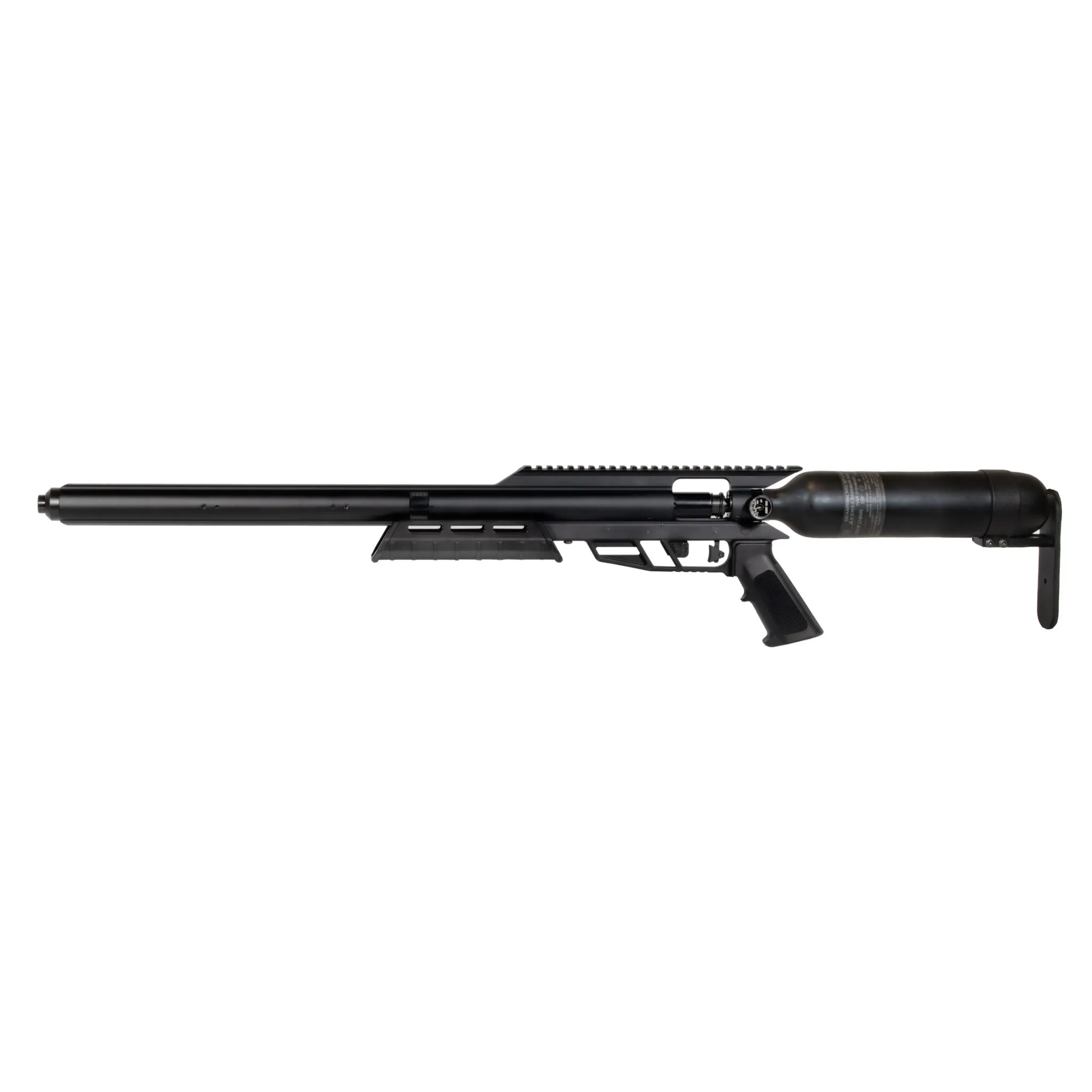
Texan Carbine .308 Caliber
$850.00
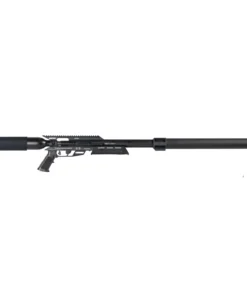
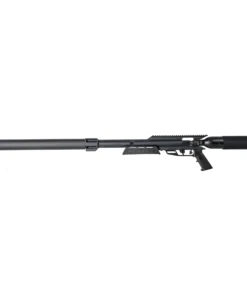
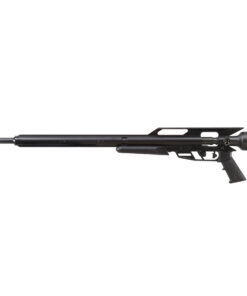
The AirForce Texan® Carbine .308 Big Bore Air Rifle delivers the legendary power of the Texan platform in a shorter, more maneuverable rifle built for hunters who demand performance without unnecessary bulk. Whether you’re working through dense brush, hunting from a blind, or carrying your rifle across long distances, the Texan Carbine offers the perfect balance of power, portability, and precision.
Built around a precision Lothar Walther barrel, the Texan Carbine launches .308 caliber projectiles at velocities exceeding 1,100 FPS, generating over 225 foot-pounds of energy depending on projectile weight and power settings. The proven single-shot design provides exceptional reliability and allows shooters to use a wide range of pellets and cast slugs.
The latest Texan Carbine features a 500cc air cylinder with a 3,000 PSI (206 BAR) fill pressure, providing increased air capacity for consistent performance in the field. A newly added manual safety enhances confidence while carrying and handling the rifle.
Versatility has also been expanded with a full-length Picatinny optics rail for mounting scopes, red dots, or thermal optics, while 11mm dovetail accessory rails offer additional mounting options for accessories. Combined with the adjustable two-stage trigger and adjustable buttpad, the Texan Carbine can be tailored to fit virtually any shooter.
Proudly built in Texas, the Texan Carbine .308 continues the AirForce tradition of delivering innovative, American-made airguns that redefine what big bore PCP performance can be.
Perfect For
From predators and deer-sized game where legal, the Texan Carbine .308 Caliber offers the power, accuracy, and handling serious hunters expect in a compact big bore platform. Its streamlined design makes it equally at home in thick timber, elevated blinds, or open country where quick handling can make all the difference.
AirForce Texan® Carbine .308 Big Bore Air Rifle Specifications
- Action: Single Shot
- Air Tank Volume: 500cc
- Barrel: 24.75 inches
- Energy: up to 225 foot pounds*
- Length: 39 inches
- Max Fill Pressure: 3,000 PSI / 206 Bar (Only use compressed air or dry nitrogen)
- Safety: Manual
- Sights: Open or Optic may be installed
- Trigger: 2 Stage Adjustable for position
- Velocity: Up to 1100 feet per second
- Warranty: Limited Lifetime
- Weight: 7.5 lbs.
Texan Carbine .308 Caliber
Texan Carbine .308 Caliber Overview, Design, Purpose, and Important Information
What Is the Texan Carbine .308 Caliber?
The Texan Carbine .308 Caliber is a large-bore pre-charged pneumatic air rifle presented in a comparatively compact carbine configuration. It belongs to the specialized end of the pneumatic airgun market and should be distinguished from ordinary recreational air rifles designed for low-energy target practice.
The platform uses stored compressed air rather than conventional firearm cartridges. Consequently, its operating principle differs from cartridge-based firearms as well as from spring-powered air rifles.
Because of its large bore and pneumatic architecture, the platform should be regarded as specialized equipment. Appropriate handling, secure storage, lawful use, and adherence to manufacturer specifications are therefore essential considerations for ownership.
AirForce and the Texan Platform
The AirForce name is associated with several pneumatic airgun platforms. Searches involving airforce airguns, airforce texan, airforce texan air rifle, and airforcetexan can lead to information about the wider product family.
Other terms commonly encountered include air force guns, airforce talon p, airforce condor, air force talon, air force texan lss, and airforce texan ss. These names describe different platforms or configurations and should not automatically be treated as specifications for the Texan Carbine .308 Caliber.
Similarly, searches involving Tex-Rex, AirForce Tex-Rex PCP rifle, Tex-Rex Brush Gun air rifle, AirForce Tex-Rex air rifle, and AirForce Tex-Rex hunting rifle concern other products or broader market terminology.
How Does a PCP Air Rifle Work?
A PCP air rifle stores compressed air in a dedicated reservoir. During operation, controlled pneumatic energy is used to propel a compatible projectile.
This is fundamentally different from a conventional pellet gun using a spring-piston mechanism.
Understanding what is an air rifle therefore requires distinguishing the different operating systems found within the category. A pre-charged pneumatic platform depends on previously stored compressed air, whereas other airguns generate or release their propulsion energy differently.
A compatible filling system is consequently part of PCP ownership, although the appropriate equipment and pressure requirements must always be established from the manufacturer’s documentation.
Why the .308-Caliber Configuration Matters
A .308-caliber configuration places the rifle within the larger-bore segment of the airgun market.
It is therefore substantially different in character from common recreational air rifles using smaller projectiles.
The caliber should not, however, be considered an indication of performance by itself. Projectile mass, operating pressure, pneumatic efficiency, barrel characteristics, and other technical factors all influence the overall behavior of an airgun.
Similarly, generalized claims involving extremely high velocities should not automatically be attributed to this model. Technical specifications should always be verified against documentation for the exact configuration.
Compact Carbine Format
The carbine format gives the rifle a comparatively compact physical configuration.
This can influence how the platform feels when carried, stored, or positioned for controlled target shooting.
However, compact dimensions do not make a large-bore airgun equivalent to a low-energy recreational rifle.
The equipment should still be treated as potentially hazardous and handled only in appropriate environments by people who understand the relevant safety requirements.
Why Consider This Type of Platform?
The principal distinguishing characteristic is the combination of a large bore and pneumatic operation within a carbine-oriented configuration.
For an experienced owner, this can provide a specialized alternative to smaller airgun platforms.
The rifle may be encountered in discussions surrounding target shooting and large-bore pneumatic equipment. However, its suitability for any particular activity depends on local regulations, range rules, equipment specifications, and the user’s experience.
Where Should It Be Used?
The appropriate environment depends on the laws and rules applicable to the user’s location.
A controlled shooting range is generally the most appropriate environment for evaluating specialized airgun equipment.
Before visiting a range, the owner should confirm that the facility permits the specific caliber, energy category, and equipment configuration.
Not every airgun range accepts large-bore pneumatic systems.
Private property should not automatically be assumed to be suitable. Local discharge restrictions can apply even when the owner has permission to access the land.
Target Shooting
Target shooting provides a controlled way to evaluate general handling and consistency.
An appropriate target area should have a suitable backstop and controlled surroundings.
The owner should ensure that the area beyond the target is also safe and that unauthorized people cannot enter the shooting zone.
The rifle should be used only where discharge is lawful.
Precision Considerations
Precision is influenced by the complete system rather than caliber alone.
Barrel condition, projectile consistency, air-system condition, sighting equipment, shooting technique, and environmental conditions can all influence results.
Consequently, one isolated result should not be treated as a universal representation of the rifle.
A controlled evaluation using consistent conditions provides a more useful understanding of the platform.
How Good Is the Platform?
A meaningful assessment should focus on whether the rifle’s characteristics match the user’s lawful and legitimate requirements.
The large-bore configuration makes the platform specialized rather than universally suitable.
An experienced user interested in large-bore pneumatic technology may value its distinctive configuration, while someone looking for a simple introductory air rifle may require a fundamentally different type of equipment.
Therefore, suitability is more informative than an arbitrary overall rating.
Important PCP Information
The pneumatic reservoir is an important component of the system.
Compressed air contains stored energy, so the reservoir and associated components must be treated as pressure-bearing equipment.
The owner should follow the manufacturer’s specified pressure limits and filling procedures.
The reservoir should not be modified, drilled, heated, cut, welded, or otherwise altered.
Any suspected pressure-system defect should be evaluated using an appropriate professional service procedure.
Air Supply
PCP ownership requires an appropriate source of compressed air.
The correct filling equipment depends on the specific system and manufacturer requirements.
An air gun pump may be relevant to some pneumatic platforms, while other configurations use different approved equipment.
The important consideration is compatibility rather than simply finding equipment capable of producing high pressure.
Improvised filling arrangements should be avoided.
Maintenance
Routine maintenance helps preserve the condition of the rifle.
The exterior should be kept clean and dry.
The barrel should be maintained according to the manufacturer’s recommendations.
Pressure-related components should be inspected appropriately.
Unusual pressure loss, visible damage, corrosion, or unexpected mechanical behavior should be treated as reasons for further evaluation.
Internal pressure-system repairs should not be attempted casually.
Related Airgun Platforms
The wider market contains numerous pneumatic systems.
Searches may include AirMaks Arms air rifles, AirMaks Arms PCP air rifles, AirMaks Arms PCP rifles, AirMaks Katran, and other specialized platforms.
Additional search terminology can include airmaks katran, airmaks, airmarks, katran airmaks, air marks, katran, air max krait, and airmaks krait.
These products belong to separate product families and should not be represented as interchangeable with the Texan Carbine.
AirMaks Terminology
Terms such as AirMaks Arms for sale, AirMaks Arms shop, and AirMaks Arms USA refer to the wider AirMaks market rather than establishing specifications for the Texan Carbine.
Likewise, unrelated phrases such as hamster with gun, hamster with a gun, and hamster holding gun do not provide meaningful technical information about a large-bore PCP rifle and should not be used as engineering descriptors.
Pest-Control Terminology
Searches involving best pellet gun for pest control, pellet gun for pest control, and air rifle for pest control represent a broader category of intended use.
Whether a particular airgun can legally be used for pest management depends on local wildlife laws, discharge restrictions, land permissions, and other requirements.
A species may also be protected even where it is commonly regarded as a nuisance elsewhere.
Hunting Considerations
Large-bore airguns are sometimes discussed in connection with hunting.
However, hunting laws vary substantially.
Requirements can depend on the species, season, location, caliber, projectile, equipment classification, and method.
Therefore, technical capability should never be confused with legal authorization.
The owner should verify all applicable hunting regulations before considering any field use.
Related Large-Bore Terminology
Terms such as AirForce big bore airgun, AirForce big bore air rifle, AirForce Brush Gun, brush gun PCP air rifle, and AirForce Texan Brush Gun can appear in searches for related large-bore equipment.
They should not automatically be interpreted as alternative names for the exact Texan Carbine .308 Caliber.
Correct model identification is particularly important when researching technical specifications, accessories, replacement components, or servicing.
Responsible Ownership
The rifle should be treated as specialized equipment requiring informed ownership.
The owner should understand:
The applicable laws
Safe storage requirements
Transportation requirements
Approved operating conditions
Compatible components
Manufacturer maintenance recommendations
Range restrictions
Any relevant hunting or wildlife regulations
These considerations are particularly important with large-bore pneumatic systems.
When Should It Be Used?
The rifle should only be used when the location, activity, equipment, and legal circumstances are appropriate.
Before use, the equipment should be inspected for obvious damage or unusual conditions.
The shooting environment should be controlled.
A suitable backstop should be present.
The owner should also know what lies beyond the target.
Who Is It Appropriate For?
The platform is better suited to an experienced adult who understands pneumatic airgun systems and responsible handling.
It is not an ideal choice for someone seeking a simple introductory air rifle without first developing appropriate knowledge and experience.
The owner should understand compressed-air systems, storage responsibilities, applicable regulations, and controlled shooting practices.
Overall Product Character
The Texan Carbine .308 Caliber represents a specialized large-bore PCP configuration.
Its defining characteristics are its pneumatic operating system, substantial bore, and comparatively compact carbine format.
Its precision potential depends upon the complete system and the conditions under which it is evaluated.
Its reliability depends upon appropriate maintenance and responsible equipment management.
Its suitability depends upon the owner’s experience, intended lawful application, and access to an appropriate shooting environment.
For that reason, the most important information surrounding the platform is not simply its caliber. Responsible ownership requires attention to pressure management, maintenance, secure storage, controlled shooting conditions, compatible equipment, and compliance with applicable law.
Used only in appropriate circumstances and maintained according to manufacturer guidance, the platform can be understood as a specialized piece of pneumatic sporting equipment rather than an ordinary recreational air rifle.
Construction, PCP Technology, Handling, Precision, Maintenance, and Responsible Ownership
The Texan Carbine .308 Caliber is a specialized pneumatic platform whose ownership requires an understanding of both its mechanical construction and the responsibilities associated with large-bore airgun equipment. Its compact configuration gives it a distinctive physical character, while its pre-charged pneumatic architecture means that compressed air remains an important consideration throughout the ownership process.
For that reason, the platform should be evaluated as a complete mechanical system rather than by looking at one specification in isolation. The barrel, action, pressure reservoir, valves, seals, trigger assembly, stock, mounting surfaces, and external controls all contribute to the overall equipment condition. Furthermore, the environment in which the rifle is stored and used can influence its longevity.
General Construction
The rifle is built around a pneumatic architecture in which stored compressed air provides the propulsion source. This creates a different ownership experience from conventional spring-powered airguns.
The major components have different functions, but they must work together within the conditions established by the manufacturer.
The pressure system manages stored air.
The barrel provides the projectile’s guided path.
The action provides the mechanical interface for loading and operation.
The trigger provides the user’s primary firing control.
The stock provides the physical interface between the equipment and the shooter.
The sighting system, where fitted, provides the aiming interface.
Because these components interact, maintenance should be approached systematically rather than as a collection of unrelated tasks.
Carbine Configuration
The compact configuration influences the physical handling of the platform.
Compared with substantially longer equipment, a carbine-format rifle can occupy less space during storage and transportation. It can also feel different when positioned for controlled target shooting.
However, the reduced physical size does not reduce the importance of safe handling.
A large-bore pneumatic rifle remains potentially hazardous, and its compact dimensions should never be interpreted as an indication that it can be handled casually.
The user should maintain control of the equipment whenever it is being handled and should ensure that it remains inaccessible to unauthorized individuals.
Ergonomic Considerations
Ergonomics can influence the consistency of the shooting experience.
The relationship between the stock, grip, trigger, action, and sighting system affects how the rifle is positioned.
Different users may experience the same configuration differently because body size, posture, and shooting position vary.
A comfortable and repeatable position can make controlled target shooting easier to evaluate.
However, comfort should never override safe handling.
The user should establish familiarity with the equipment while it is unloaded and in an appropriate environment before beginning authorized shooting activities.
Balance
Balance is another factor that influences handling.
The location of the rifle’s mass can affect how naturally it can be supported.
Additional equipment can also change the balance.
For this reason, a rifle should be considered as a complete configuration rather than judged from photographs or specifications alone.
A prospective owner should consider whether the physical arrangement is appropriate for their experience and intended lawful application.
Stock Condition
The stock should be inspected periodically.
Cracks, unusual movement, loose fittings, or impact damage should not be ignored.
A damaged stock can affect handling and may indicate that the equipment has experienced an impact that could have affected other components.
If significant damage is discovered, professional inspection may be appropriate before the rifle is returned to service.
Barrel Protection
The barrel should be protected from unnecessary impacts.
It should not be used as a carrying handle or placed where it can strike hard surfaces.
During transportation, the equipment should be secured inside a suitable protective case.
The muzzle should also be protected from contamination.
The barrel is an important precision component, so unnecessary physical damage should be avoided.
Barrel Maintenance
Maintenance should follow the manufacturer’s recommendations.
The barrel should not be cleaned using improvised tools or aggressive materials.
Abrasive equipment can cause unnecessary wear.
Unsuitable chemicals can also affect finishes, seals, or other components.
The goal of maintenance should be preservation of the existing condition.
Excessive intervention is not necessarily beneficial.
Pressure Reservoir
The pressure reservoir is one of the most important components of the system.
It stores compressed air and therefore contains stored energy.
The reservoir should be treated as a pressure-bearing component throughout its service life.
It should not be drilled, cut, welded, heated, or otherwise modified.
The owner should follow the manufacturer’s inspection requirements and specified operating limits.
If physical damage or significant corrosion is discovered, the equipment should not simply be returned to service without appropriate evaluation.
Pressure Management
Correct pressure management is fundamental to responsible PCP ownership.
The manufacturer establishes operating parameters for the system, and those parameters should be respected.
Pressure should never be exceeded simply to alter performance.
Likewise, the owner should not assume that specifications from another configuration apply to this rifle.
Different models can have different pressure requirements, component designs, and service procedures.
Filling Equipment
The equipment used to supply compressed air should be appropriate for the rifle.
Hoses, connectors, gauges, and other components should be compatible and maintained properly.
Before use, pressure equipment should be inspected for visible damage.
A damaged hose or connector should not be used.
Improvised filling arrangements can introduce unnecessary risk and should be avoided.
Pressure-System Inspection
Periodic inspection can help identify developing problems.
The owner should look for obvious physical damage and other unusual conditions.
Any unexpected pressure loss should also be taken seriously.
The correct response to a suspected pressure-system problem is to make the equipment safe and follow the manufacturer’s service recommendations.
Pressure-bearing components should not be disassembled simply to investigate a problem.
Air Retention
A change in normal air retention can indicate a mechanical issue.
If pressure begins to decline unexpectedly, repeatedly refilling the system without identifying the cause is not an appropriate solution.
The issue may involve a seal, valve, connection, or another component.
Professional assessment may therefore be necessary.
Seals
Seals play an important role in pneumatic systems.
They help retain and manage compressed air.
Normal use can eventually cause wear, and deterioration may become apparent through changes in pressure retention or other unusual behavior.
The owner should follow the manufacturer’s maintenance recommendations for seals.
Unapproved internal repairs should be avoided.
Valves
The valve system controls the movement of stored compressed air through the operating system.
Because it is part of the pneumatic architecture, it should be maintained according to the manufacturer’s requirements.
The owner should not attempt to modify its operation without explicit manufacturer support.
An unexplained valve problem should be addressed through appropriate servicing rather than experimentation.
Trigger System
The trigger should operate predictably.
The owner should become familiar with its normal characteristics before regular use.
Any sudden change in trigger behavior should be treated as a potential mechanical issue.
The trigger should not be modified simply to change its characteristics.
Unauthorized changes can affect both operation and safety.
Professional service is preferable when the trigger develops an unfamiliar problem.
Action
The action should be operated according to the manufacturer’s instructions.
The owner should understand the safety system and normal loading procedure before use.
This familiarity should be developed in a controlled environment.
If the action develops unusual resistance, movement, or sound, the equipment should be inspected before continued operation.
Loading Awareness
The user should follow the manufacturer’s loading procedure exactly.
Only compatible projectiles should be used.
A projectile that appears physically suitable is not necessarily appropriate.
Compatibility should be established from authoritative information for the specific configuration.
This is particularly important with specialized large-bore equipment.
Projectile Compatibility
Projectile selection can influence both performance and mechanical condition.
Dimensions, weight, shape, construction, and compatibility with the barrel can all matter.
The user should therefore rely on manufacturer-approved or otherwise clearly specified compatible ammunition.
Unknown or unsuitable projectiles should not be used merely because they appear to fit.
Precision
Precision should be evaluated under controlled conditions.
The mechanical condition of the rifle is only one factor.
The projectile, sighting system, shooting position, trigger control, environmental conditions, and air-system condition can all influence results.
Consequently, one unusually good or poor result does not necessarily represent the overall characteristics of the equipment.
Evaluating Consistency
A series of controlled groups can provide more meaningful information than isolated shots.
The same equipment configuration should be maintained during a comparison.
Changes in sighting equipment, projectile type, shooting position, or environmental conditions can make comparisons difficult.
A methodical approach provides a better understanding of how the system behaves.
Shooting Technique
The shooter’s technique can have a substantial effect on precision.
Body position, support, sight alignment, and trigger control can all influence results.
A repeatable technique allows the shooter to distinguish equipment behavior from user variation.
The goal should be controlled evaluation rather than attempting increasingly demanding or unsafe shooting conditions.
Environmental Conditions
Outdoor conditions can influence the shooting experience.
Wind can affect projectile movement.
Temperature can influence materials and equipment behavior.
Humidity can increase the risk of corrosion.
For this reason, differences between shooting sessions should not automatically be attributed to the rifle.
Environmental conditions should be considered before concluding that mechanical performance has changed.
Wind
Wind is particularly relevant during outdoor target shooting.
Its direction and strength can change throughout a session.
The effect can also become more noticeable as distance increases.
Controlled or sheltered environments can reduce some of these variables during equipment evaluation.
Temperature
Extreme temperatures should be avoided when they fall outside the manufacturer’s stated operating conditions.
Cold environments can affect some materials and mechanical components.
High temperatures can create additional storage and transportation concerns.
The equipment should be protected from unnecessary temperature extremes.
Humidity
Humidity can contribute to corrosion over time.
The rifle should therefore be kept dry when not in use.
After exposure to damp conditions, the exterior should be dried appropriately.
The equipment should not be stored wet inside a closed case.
Storage
Secure storage is an essential part of responsible ownership.
The rifle should remain inaccessible to children and unauthorized individuals.
Where local regulations require locked storage or other specific measures, those requirements should be followed.
The storage environment should also protect the equipment from unnecessary moisture and physical damage.
Protective Case
A suitable protective case can reduce the risk of impact during storage and transportation.
The rifle should be positioned securely inside the case.
Heavy equipment should not be placed directly on top of it.
Tools and other hard objects should be separated from the rifle so that they cannot move against sensitive components.
Transportation
Transportation requirements vary between jurisdictions.
The owner should verify applicable laws before moving the rifle.
The equipment should be secured against movement and unauthorized access.
It should not be left unattended in an unsecured vehicle or location.
A suitable case can provide physical protection while also helping maintain controlled access.
Long-Term Storage
When the equipment will not be used for an extended period, the owner should follow the manufacturer’s recommendations for preparation and storage.
The environment should be dry and reasonably stable.
The rifle should be protected from impact and unnecessary pressure.
Before returning the equipment to service, another inspection should be conducted.
Exterior Maintenance
The external surfaces should be kept clean.
A suitable soft cloth can be used where appropriate.
Cleaning materials should be compatible with the finish.
Strong chemicals should not be used unless specifically approved.
Regular light maintenance is generally preferable to allowing contamination to accumulate.
Corrosion Prevention
Metal components should be checked periodically.
Early signs of corrosion should be investigated rather than ignored.
The appropriate treatment should depend on the component and manufacturer’s recommendations.
Aggressive removal methods should not be used on critical components without professional guidance.
Professional Service
Professional service is appropriate when the owner encounters an unfamiliar mechanical or pressure-related problem.
A qualified technician can inspect the equipment using appropriate tools.
This is particularly important for pressure-bearing components.
The owner should not attempt complex internal repairs without the necessary expertise.
Recognizing Abnormal Operation
The owner should become familiar with normal equipment behavior.
Unexpected changes may include unusual sounds, unexplained pressure loss, changes in trigger characteristics, loose components, visible damage, or unusual action behavior.
Any significant change should be investigated.
Continuing to operate equipment that may have developed a serious fault is not a suitable troubleshooting method.
Maintenance Records
A maintenance record can be useful for long-term ownership.
The owner can record inspections, professional service, cleaning, and other relevant observations.
This creates a useful history.
Over time, a record can help reveal gradual changes that might otherwise be overlooked.
Accessory Management
Accessories can alter the balance and dimensions of the rifle.
They should therefore be selected carefully.
Each accessory should have a clear purpose and should not interfere with controls or maintenance.
Additional equipment also increases the number of components that should be inspected before use.
Sighting Equipment
A suitable sight can assist with controlled target shooting.
It should be securely mounted and compatible with the rifle’s mounting arrangement.
The mounting system should be checked periodically.
If the point of impact changes unexpectedly, the sighting equipment should be considered alongside other possible causes.
Backstop
An appropriate backstop is essential for controlled shooting.
The target should be positioned so that the projectile can be contained safely.
The area beyond the target should also be controlled.
A target should never be placed where a projectile could travel toward people, buildings, roads, or other uncontrolled areas.
Range Environment
Before visiting a range, the owner should confirm that the facility permits the equipment.
Large-bore airguns may be subject to restrictions at facilities that permit smaller equipment.
All range procedures should be followed.
The owner should also respect cease-fire procedures and instructions from range personnel.
Personal Protection
Appropriate eye protection should be used in accordance with range requirements and responsible shooting practices.
Other protective equipment may be appropriate depending on the environment.
Protective equipment should fit properly and should not interfere with safe handling.
Household Responsibilities
If the equipment is stored in a home, access should be carefully controlled.
Children should not have access to the rifle.
Visitors should not handle it without appropriate supervision and authorization.
The storage location should remain secure even when the owner is away.
Legal Responsibilities
The classification of large-bore airguns varies significantly between jurisdictions.
Rules may concern ownership, minimum age, purchase, transportation, storage, discharge, importation, hunting, or transfer.
The owner should verify the rules applicable to their exact location.
Information from another country or region should not be assumed to apply locally.
Field Activities
Any activity outside a controlled range should be assessed carefully.
Landowner permission does not automatically establish that projectile discharge is lawful.
Local restrictions may apply.
Wildlife regulations may also apply if animals are involved.
The owner should therefore verify all relevant requirements before considering field use.
Hunting
Where hunting with airguns is lawful, additional restrictions may apply.
These can concern species, seasons, land, equipment, projectile characteristics, and permitted methods.
Technical capability does not establish legal permission.
The owner should confirm the relevant rules before considering any hunting activity.
Pest Management
Pest management is also jurisdiction-specific.
Some species are protected.
Some locations prohibit projectile discharge.
Residential areas may have additional restrictions.
The equipment should therefore only be used for this purpose where the activity is specifically lawful and appropriate.
Appropriate Experience
The platform is better suited to an experienced adult who understands pneumatic airgun systems and responsible handling.
A person unfamiliar with specialized airgun equipment should obtain appropriate instruction before operating it.
Experience should include an understanding of safe storage, pressure-system awareness, controlled shooting environments, and basic equipment maintenance.
Why Maintenance Matters
Maintenance preserves the relationship between the mechanical components.
A clean exterior helps protect the finish.
A properly maintained pressure system supports dependable operation.
A protected barrel helps preserve the precision characteristics of the equipment.
Secure storage reduces environmental and unauthorized-access risks.
Regular inspection can identify problems before they become more serious.
Long-Term Ownership
Long-term ownership is best approached as an ongoing responsibility.
The rifle should not simply be stored and forgotten between shooting sessions.
Its condition should be checked periodically.
The storage environment should be maintained.
Pressure-related equipment should be inspected.
Documentation should be retained.
Professional servicing should be arranged when appropriate.
Overall Assessment
The Texan Carbine .308 Caliber is a specialized pneumatic platform that requires informed and responsible ownership.
Its large-bore configuration makes careful handling particularly important.
Its pressure reservoir requires respect and proper maintenance.
Its precision characteristics should be evaluated under controlled conditions.
Its mechanical condition should be monitored throughout its service life.
Its storage and transportation should comply with applicable requirements.
Most importantly, the owner should follow the manufacturer’s documentation and local law rather than relying on generalized information about airguns.
A disciplined approach to maintenance, secure storage, controlled target environments, appropriate equipment inspection, and professional servicing when necessary provides the foundation for responsible long-term ownership.
Precision, Reliability, Maintenance, Handling, and Long-Term Performance
The Texan Carbine .308 Caliber is a specialized pneumatic platform that should be evaluated as a complete mechanical system. Its performance is influenced by the interaction between the barrel, pressure system, action, trigger, stock, sighting equipment, projectile compatibility, environmental conditions, and the user’s consistency. Therefore, meaningful evaluation requires more than focusing on a single specification.
For an experienced owner, understanding these relationships can make routine maintenance easier and can provide a clearer picture of how the equipment behaves over time. At the same time, responsible ownership requires recognizing that large-bore equipment should only be handled and used within appropriate legal and controlled environments.
Understanding Precision
Precision refers to the consistency with which a properly maintained rifle can place compatible projectiles under controlled conditions.
It should not be confused with a single successful shot.
A useful assessment involves repeated observations under reasonably consistent conditions. The same equipment configuration, compatible ammunition, sighting arrangement, and shooting position should be maintained when comparisons are being made.
This approach makes it easier to distinguish mechanical characteristics from changes caused by the environment or the shooter.
Factors That Influence Results
Several factors can influence the observed performance of a pneumatic rifle.
Barrel condition is one consideration.
Projectile consistency is another.
The condition of the pneumatic system can also affect consistency.
Sighting equipment must remain secure.
The shooter’s position and trigger technique can change results.
Finally, wind, temperature, and other environmental conditions can affect the shooting environment.
Consequently, a change in results does not automatically indicate that the rifle itself has developed a fault.
Mechanical Consistency
A well-maintained mechanical system provides a more reliable foundation for controlled evaluation.
The owner should periodically inspect the rifle for visible damage, unusual wear, corrosion, loose components, or other changes.
If the rifle behaves differently from its established normal condition, the change should be investigated rather than ignored.
This is particularly important when the difference involves the pressure system or other components associated with safe operation.
Barrel Condition and Precision
The barrel should be protected from unnecessary impacts and contamination.
It should not be used as a carrying handle or placed where it can strike hard surfaces.
During transportation, appropriate protection should be provided.
Cleaning should be performed according to the manufacturer’s recommendations. Excessive cleaning or the use of inappropriate tools can create unnecessary wear.
A consistent maintenance routine is preferable to repeated aggressive intervention.
Projectile Consistency
Compatible ammunition plays an important role in evaluating a rifle.
Differences in dimensions, weight, construction, and manufacturing consistency can influence the results obtained on a target.
For that reason, comparisons should be made using compatible ammunition rather than an assortment of unknown products.
The manufacturer’s specifications should be treated as the primary reference for compatibility.
Sighting Equipment
The sighting system can influence the consistency of the aiming process.
A sight should be mounted securely and checked periodically.
If the sight becomes loose, the resulting change in point of impact may be mistaken for a problem with the rifle itself.
Sighting equipment should therefore be inspected alongside the rifle when unexpected changes occur.
Trigger Familiarity
A consistent trigger interface can help the shooter maintain a repeatable technique.
The owner should become familiar with the normal characteristics of the trigger before beginning regular use.
A sudden change in resistance, movement, or general feel should be treated as an indication that inspection may be required.
The trigger should not be modified without appropriate manufacturer support.
Unauthorized changes can affect both mechanical behavior and safety.
Action Condition
The action should remain clean and mechanically sound.
The owner should become familiar with its normal operation while the rifle is unloaded and in a controlled environment.
Unexpected resistance, unusual sounds, or changes in normal movement should not be ignored.
If the action develops a significant abnormality, professional inspection is preferable to continued experimentation.
Pneumatic System Reliability
The pressure system is fundamental to the operation of the rifle.
Because compressed air stores energy, the reservoir and related components must be treated carefully throughout the equipment’s service life.
Operating pressure should remain within the manufacturer’s specified limits.
The pressure system should never be modified in an attempt to obtain different characteristics.
Pressure Retention
Normal pressure retention should be understood by the owner.
An unexpected decline can indicate a problem with seals, valves, connections, or another component.
If unusual pressure loss occurs, repeatedly restoring pressure without investigating the cause is not an appropriate long-term solution.
The equipment should be made safe and assessed using the appropriate service procedure.
Seal Wear
Seals naturally experience wear.
Their condition can influence the ability of the pneumatic system to retain pressure.
Potential changes in pressure retention should therefore be monitored.
Internal seals should be serviced according to the manufacturer’s requirements.
The owner should avoid dismantling pressure-bearing components without appropriate training and equipment.
Valve Condition
Valves are important components within the pneumatic system.
They should be maintained according to manufacturer guidance.
Unusual operation involving the pneumatic system should be investigated rather than corrected through improvised adjustments.
A qualified technician can assess internal components when professional service is necessary.
Reservoir Care
The reservoir should be protected from impact, corrosion, excessive heat, and unauthorized modification.
It should never be drilled, cut, welded, heated, or otherwise altered.
Visible damage to the reservoir should be treated seriously.
If there is uncertainty regarding its condition, professional inspection should be obtained before the equipment is returned to service.
Filling Equipment
Filling equipment should be compatible with the rifle and maintained in suitable condition.
Hoses, connectors, gauges, and related components should be checked for visible damage.
Damaged pressure equipment should not be used.
The manufacturer’s specified filling procedure and pressure limits should always take priority over generalized PCP information.
Environmental Conditions
Outdoor conditions can make performance evaluation more complicated.
Wind can influence projectile movement.
Temperature can affect materials and equipment behavior.
Humidity can increase the risk of corrosion.
Consequently, results obtained under one set of environmental conditions should not automatically be compared with results obtained under completely different conditions.
Wind
Wind can introduce variability into outdoor shooting.
Its strength and direction may change during a session.
This can produce different results even when the rifle and ammunition remain unchanged.
A controlled environment can therefore be useful when the objective is to evaluate equipment consistency.
Temperature
Temperature can affect the general shooting environment and certain mechanical materials.
Extreme conditions should be avoided where they fall outside the manufacturer’s recommendations.
The equipment should be protected from unnecessary exposure to severe heat or cold during storage and transportation.
Humidity
Humidity requires particular attention during long-term ownership.
Moisture can contribute to corrosion on exposed metal surfaces.
After use in damp conditions, the rifle should be dried appropriately.
It should not be sealed inside a case while wet.
A dry storage environment provides better protection against environmental deterioration.
Dust and Contamination
Dust can accumulate around mechanical interfaces and storage areas.
The rifle should therefore be kept reasonably clean.
The protective case should also be maintained because dirt inside the case can transfer onto the equipment.
Routine light cleaning is preferable to allowing contamination to accumulate over long periods.
Maintenance Intervals
Maintenance should be performed according to manufacturer recommendations.
Some checks can be performed routinely by the owner.
More complicated service should be left to qualified personnel.
The owner should not assume that every component requires frequent disassembly.
Preventative care should be proportionate to the equipment’s condition and usage.
Visual Inspection
A visual inspection can identify obvious problems before use.
The owner can look for:
Visible cracks
Corrosion
Loose components
Damage to the stock
Barrel damage
Unusual wear
Pressure-system damage
Changes in external controls
Any significant defect should be investigated before normal operation resumes.
Cleaning
The exterior should be cleaned using suitable materials.
The barrel should be maintained according to the manufacturer’s recommended process.
Harsh chemicals and abrasive tools should be avoided unless specifically approved.
After cleaning, the equipment should be checked to ensure that components remain properly positioned.
Lubrication
Lubrication requirements vary between pneumatic systems.
Only products recommended by the manufacturer should be used.
Incorrect lubrication can damage seals or interfere with normal operation.
The owner should therefore avoid applying products simply because they are marketed for other mechanical equipment.
Professional Servicing
Professional servicing becomes particularly important when the issue involves pressure-bearing components.
A qualified technician can inspect the equipment with suitable tools and procedures.
This can be safer and more reliable than attempting unfamiliar repairs.
Professional service can also help identify problems that may not be obvious during an external inspection.
Recognizing Abnormal Behavior
The owner should pay attention to changes from normal operation.
Potential warning signs include unexplained pressure loss, unusual sounds, changes in trigger behavior, visible damage, unexpected action movement, or other mechanical irregularities.
When such a condition appears, the equipment should be taken out of service until the cause has been established.
Avoiding Unauthorized Modifications
The original configuration should generally be preserved.
Unapproved modifications can change the mechanical characteristics of the equipment.
They can also complicate maintenance and future professional service.
Any manufacturer-supported adjustment should be performed according to the applicable documentation.
Storage
Storage should protect both the equipment and other people.
The rifle should be kept in a secure location inaccessible to children and unauthorized individuals.
Where local requirements specify locked storage, those requirements should be followed.
The storage environment should be reasonably dry and protected from excessive temperature changes.
Protective Cases
A suitable case can reduce physical damage during transportation.
The rifle should be positioned securely.
Heavy objects should not be placed on top of it.
Sharp tools and other equipment should be separated from the rifle.
The interior of the case should also be kept clean and dry.
Transportation
Transportation laws vary by jurisdiction.
The owner should verify the applicable requirements before moving the rifle between locations.
The equipment should be secured against movement and unauthorized access.
It should not be left unattended in circumstances where another person could gain access.
Long-Term Storage
For extended storage, the owner should follow the manufacturer’s recommendations.
The equipment should be inspected before storage and again before returning it to service.
The storage environment should remain dry and reasonably stable.
The rifle should not be placed where it can be struck, crushed, or exposed unnecessarily to moisture.
Maintenance Records
A simple maintenance record can be useful.
The owner can document inspections, professional servicing, cleaning, and unusual observations.
Over time, this record creates a history of the equipment.
Changes that appear minor individually can become easier to recognize when viewed over a longer period.
Evaluating Long-Term Reliability
Long-term reliability depends on several factors.
The quality of the original construction is important, but owner care also matters.
Appropriate storage reduces environmental deterioration.
Correct pressure management reduces unnecessary stress.
Suitable ammunition helps maintain consistent operation.
Routine inspection provides opportunities to identify developing issues.
Professional service addresses problems that should not be handled through informal repairs.
Range Environment
A controlled range provides an appropriate environment for lawful target shooting where permitted.
Before attending, the owner should confirm that the facility accepts the equipment.
Range personnel may impose additional requirements.
These requirements should be followed throughout the session.
Backstop
A suitable backstop is essential.
The target should be positioned so that projectiles can be safely contained.
The area beyond the target should also be considered.
People, buildings, roads, and other uncontrolled areas should not be within the potential projectile path.
Range Discipline
A consistent routine should be maintained throughout a shooting session.
The equipment should remain directed toward the appropriate area.
The user should follow range instructions.
Handling should occur only when permitted.
Cease-fire procedures should always be respected.
Personal Protection
Appropriate eye protection should be used where required.
Protective equipment should fit correctly and should not interfere with normal handling.
Range-specific safety requirements should always take precedence.
Responsible Household Storage
Household access should be controlled.
Children should never be allowed unrestricted access to the rifle.
Visitors should not handle the equipment without appropriate authorization and supervision.
The storage location should remain secure when the owner is not present.
Legal Responsibilities
Large-bore pneumatic equipment can be regulated differently from ordinary recreational airguns.
Requirements may concern ownership, age, purchase, transportation, storage, discharge, importation, transfer, or field activities.
The owner should verify the laws applicable to their specific jurisdiction.
Rules from another country or region should not be assumed to apply locally.
Field Use
Any proposed field use should be assessed against local law.
Permission to access land does not necessarily authorize projectile discharge.
Additional restrictions may apply near homes, roads, public areas, or protected locations.
The owner should confirm all applicable requirements before considering an activity outside an authorized range.
Hunting
Where hunting is lawful, additional rules may apply concerning species, season, location, equipment, and method.
The technical characteristics of the rifle do not automatically establish that a particular hunting activity is permitted.
The relevant regulations should therefore be confirmed beforehand.
Pest Management
The same principle applies to pest management.
Species can have different legal classifications in different jurisdictions.
Discharge may also be restricted in residential or urban areas.
Any such activity should therefore be undertaken only where it is clearly lawful and appropriate.
Appropriate Experience
The platform is better suited to an experienced adult who understands pneumatic equipment and responsible handling.
Someone unfamiliar with specialized large-bore systems should seek appropriate instruction before operating one.
Understanding the pressure system, storage requirements, maintenance procedures, and legal responsibilities is an important part of that preparation.
Practical Evaluation
A practical evaluation should begin with condition rather than performance claims.
The owner should first establish that the equipment is mechanically sound.
Once that has been confirmed, controlled target shooting can provide information about consistency.
Changes should be documented rather than judged from memory.
This approach creates a more objective understanding of the equipment.
Why Consistency Matters
Consistency makes equipment easier to understand.
When the rifle, ammunition, sighting system, shooting position, and environment are reasonably stable, changes in results become easier to interpret.
This is more informative than comparing isolated results obtained under completely different circumstances.
Long-Term Ownership Philosophy
A specialized pneumatic rifle should be treated as a long-term mechanical system.
Its condition depends on routine care.
Its reliability depends on appropriate maintenance.
Its physical appearance depends on protection from impact and corrosion.
Its safe storage depends on controlling access.
Its lawful use depends on understanding local requirements.
Each responsibility contributes to the overall ownership experience.
Final Perspective
The Texan Carbine .308 Caliber requires a higher level of equipment awareness than a basic recreational air rifle.
Its large-bore pneumatic architecture makes responsible handling, pressure-system care, secure storage, and appropriate maintenance particularly important.
Precision should be evaluated under controlled conditions rather than through isolated claims.
Reliability should be monitored throughout the service life of the equipment.
Any unexplained mechanical or pressure-related problem should be addressed before continued use.
Professional servicing should be used whenever an issue extends beyond routine external maintenance.
Ultimately, responsible ownership is built around preparation, inspection, maintenance, secure storage, controlled environments, and compliance with applicable law. These principles provide the foundation for preserving the condition of the rifle while ensuring that its capabilities are treated with the seriousness appropriate to specialized large-bore pneumatic equipment Texan Carbine.308 CaliberTexan Carbine.308 CaliberTexan Carbine.308 CaliberTexan Carbine.308 CaliberTexan Carbine.308 CaliberTexan Carbine.308 CaliberTexan Carbine.308 CaliberTexan Carbine.308 CaliberTexan Carbine.308 CaliberTexan Carbine.308 Caliber Texan Carbine.308 CaliberTexan Carbine.308 Caliber.
Be the first to review “Texan Carbine .308 Caliber”
Related products
AirForce
AirForce
AirForce
AIR GUN RIFLES
AirForce
AirForce
AIR GUN RIFLES
Reviews
There are no reviews yet.