
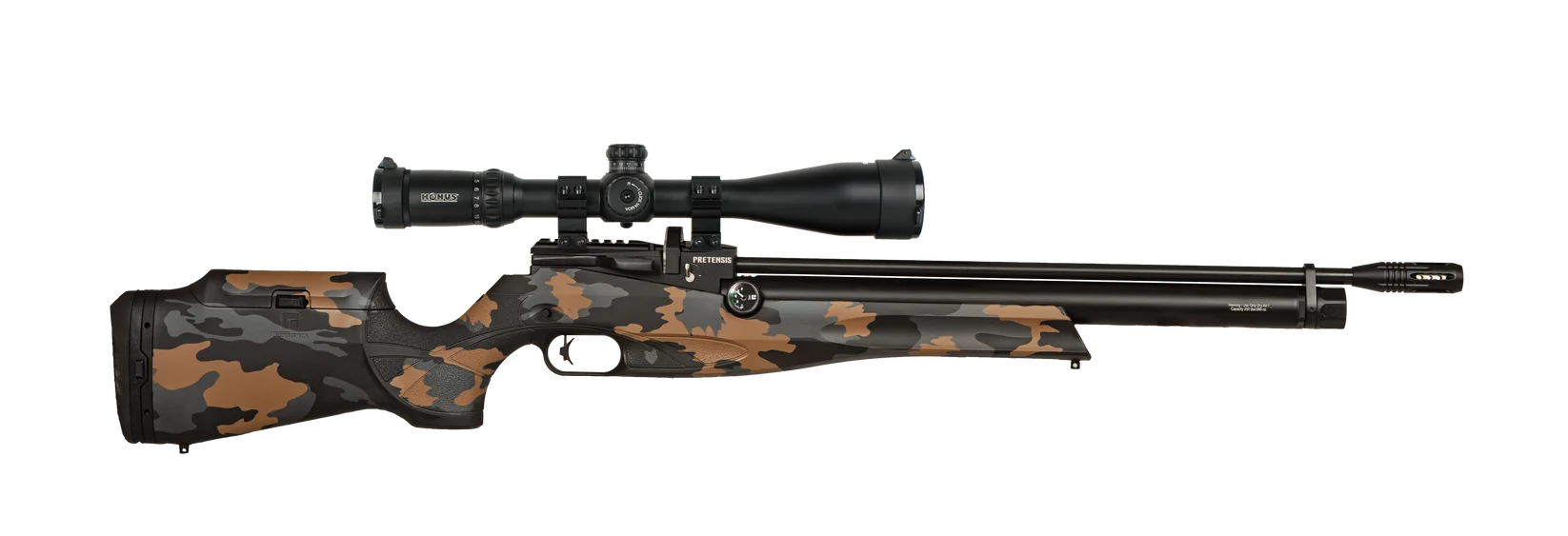
REXIMEX PRETENSIS AMBUSH CERAKOTE

$499.00
The Reximex Pretensis is a full length sporter rifle with a 260cc air cylinder. Due to the 260cc air cylinder the rifle is capable of 210 shots at 200bar. The Pretensis features a soft touch stock with adjustable cheek piece, butt pad & pre-fitted swivel screws.The Pretensis has a cocking lever which is located on the right side of the action. You will find the manual safety to the rear of the stock which can be easily switched between on and off. The rifle also has a fully adjustable 2 stage trigger.
NB. Scope and Mounts not included.
- Calibre: .177/.22
- Capacity: 14/12
- Length: 109cm
- Power: 11.5
- Stock: Ambush
- Thread: 1/2″ UNF
- Tube Size: 260cc
Reximex Pretensis Ambush Cerakote PCP Air Rifle – Cerakote Finish, Adjustable Synthetic Stock and Multi-Shot Performance
Reximex Pretensis Ambush Cerakote Overview, PCP System, Cerakote Finish, Adjustable Stock, Side-Lever Action, Magazine Capacity, Accuracy and Practical Performance
The Reximex Pretensis Ambush Cerakote is a full-length pre-charged pneumatic sporting rifle designed for shooters who want modern styling, practical adjustability, multi-shot convenience and a durable exterior finish. Current UK retail specifications list a 260cc air cylinder, approximately 105 cm overall length, a right-side cocking lever, adjustable cheekpiece, adjustable buttpad, manual safety, fully adjustable two-stage trigger and magazine capacities of 14 shots in .177, 12 in .22 and 10 in .25. The same listing places UK-market output at approximately 11.3 ft-lb, although specifications can differ by jurisdiction.
Reximex Pretensis Ambush Cerakote
The defining character of this model comes from its combination of a full-size sporter layout and distinctive Cerakote-style finish.
Rather than using a traditional walnut stock, this version uses a synthetic soft-touch stock.
That makes it particularly attractive to buyers who prefer modern appearance and lower-maintenance exterior materials.
Cerakote Exterior Finish
The Ambush version uses a decorative protective finish with a camouflage-inspired appearance.
The finish gives the rifle a more tactical visual character than the standard walnut configuration.
At the same time, the coated metal surfaces are intended to offer practical resistance against normal handling wear.
Soft-Touch Synthetic Stock
The stock uses a synthetic construction with a soft-touch surface.
This provides a secure contact feel without the moisture sensitivity associated with natural wood.
It also makes routine cleaning straightforward.
Adjustable Cheekpiece
The cheekpiece can be adjusted vertically.
This helps the shooter align the eye more naturally with the optic.
Consistent head placement supports more repeatable sight alignment.
Adjustable Buttpad
The rear pad can also be adjusted.
A better shoulder fit improves comfort and helps the shooter maintain a more consistent position during longer sessions.
Pre-Fitted Swivel Screws
Current retail listings identify pre-fitted swivel screws on the stock.
These provide convenient mounting points for compatible carrying accessories where appropriate.
Full-Length Sporter Design
The rifle measures approximately 105 cm overall according to current retail specifications.
This gives it a traditional full-size sporting profile rather than a compact bullpup configuration.
260cc Air Cylinder
The rifle uses a 260cc air cylinder.
This provides a useful balance between capacity and overall handling.
The same retailer lists the platform as capable of up to approximately 210 shots at 200 bar in its stated UK configuration, although actual shot count varies with calibre, pressure, output, pellet and environmental conditions.
PCP Power System
Compressed air is stored in the cylinder and released in controlled amounts during firing.
This creates a mild firing cycle compared with spring-powered mechanisms.
The shooter can therefore concentrate heavily on trigger control and sight alignment.
Side-Lever Cocking
The rifle uses a lever located on the right side of the action.
Cycling the lever prepares the next shot and indexes the magazine.
A smooth lever action helps maintain a steady shooting rhythm.
Why the Side Lever Matters
The shooter does not need to break the barrel or operate a heavy spring mechanism.
This reduces movement between shots.
It can also make repeated target sessions more comfortable.
Multi-Shot Magazine System
Magazine capacity changes with calibre.
Current listings specify 14 shots in .177, 12 shots in .22 and 10 shots in .25.
This allows several shots before reloading.
.177 Calibre
The .177 version provides the highest magazine capacity.
It is commonly selected for target shooting because of its relatively flat trajectory.
Pellet choice still plays a major role in consistency.
.22 Calibre
The .22 version uses a heavier projectile.
It provides a different trajectory and firing characteristic.
The best choice depends on legal limits and intended sporting use.
.25 Calibre
The .25 configuration offers the largest projectile diameter of the listed options.
Current UK retailer listings show this calibre as available for the Ambush Cerakote version.
Availability may differ between countries.
Adjustable Two-Stage Trigger
The platform uses a fully adjustable two-stage trigger according to current retailer information.
The first stage prepares the release, while the second stage provides the final break.
A predictable trigger can improve shot consistency.
Manual Safety
A manual safety is positioned toward the rear of the action on the listed configuration.
It should always be treated as an additional safeguard rather than a replacement for correct muzzle discipline.
Threaded Muzzle
Current specifications list a ½-inch UNF thread.
This provides compatibility with suitable muzzle accessories where lawful.
Scope Compatibility
The rifle is intended for optical sight use.
Current retail listings offer it with optional scope packages, although the scope is not necessarily included in the base rifle price.
Accuracy and Precision
The mild firing cycle, adjustable stock, multi-shot system and scope-ready layout provide a strong foundation for practical precision.
However, accuracy still depends on pellet quality, air pressure, optic setup and shooter technique.
Testing several pellet types is usually worthwhile.
Why Choose the Ambush Cerakote Version?
The strongest reasons are its distinctive coated finish, synthetic soft-touch stock, adjustable cheekpiece, adjustable buttpad, side-lever action, multi-shot magazine and 260cc air supply.
It suits buyers who want a modern appearance with practical range features.
How Good Is the Handling?
The full-size stock gives the rifle a conventional shoulder position.
The adjustable cheek support helps improve optic alignment.
Meanwhile, the synthetic construction keeps routine stock maintenance simple.
Where It Performs Best
The rifle is particularly well suited to controlled recreational ranges and other lawful shooting environments with a secure backstop.
Its stock adjustment and mild firing cycle make bench, seated and supported positions especially comfortable.
When This Rifle Makes Sense
Choose this version when you prefer a modern coated finish and synthetic stock over traditional walnut styling.
It is especially suitable when multi-shot convenience and adjustable ergonomics are priorities.
Reximex
The reximex range includes sporting rifles, compact platforms, bullpups and pneumatic pistols.
The Pretensis Ambush occupies the full-size sporter category.
Reximex Airguns
Among current reximex airguns, this version is differentiated primarily by its coated finish and soft-touch synthetic stock.
Its layout remains more traditional than many compact tactical designs.
Reximex Lyra K
The Reximex Lyra K belongs to another product family.
It should not be treated as having the same dimensions, stock design or air system.
Reximex Lyra-K PCP Air Rifle
The phrase Reximex Lyra-K PCP air rifle refers specifically to the Lyra-K platform.
The Ambush Cerakote should instead be evaluated on its own full-size Pretensis architecture.
Reximex Lyra-K Airgun
A Reximex Lyra-K airgun search may lead buyers toward the broader catalogue.
However, the Pretensis uses different stock geometry and overall dimensions.
Reximex Lyra-K Review
A Reximex Lyra-K review does not establish Pretensis performance.
Each model should be assessed independently.
Reximex Lyra-K PCP Rifle
The phrase Reximex Lyra-K PCP rifle describes another compressed-air platform.
Both use pneumatic power, but their physical layouts differ.
Reximex Lyra-K Regulated PCP
Searches for Reximex Lyra-K regulated PCP focus on pressure regulation.
The current Ambush retailer specification cited here does not explicitly list a regulator, so that feature should not be assumed without checking the exact production version.
Reximex Lyra-K Compact PCP Rifle
The phrase Reximex Lyra-K compact PCP rifle emphasizes reduced overall size.
The Pretensis Ambush is instead a full-length sporter.
Reximex Lyra-K Tactical Air Rifle
A Reximex Lyra-K tactical air rifle search reflects interest in modern styling.
The Ambush Cerakote also has a contemporary appearance, but it retains a more conventional full-size stock.
Reximex Lyra-K Hunting Rifle
The phrase Reximex Lyra-K hunting rifle reflects a common use-case search.
Any use involving animals must comply with local wildlife, calibre, discharge and humane-practice regulations.
Buy Reximex Lyra-K Online
Searches such as buy Reximex Lyra-K online reflect buyer intent.
For the Pretensis, purchasers should confirm calibre, legal power output, included accessories and transfer requirements.
Best Price Reximex Lyra-K
The phrase best price Reximex Lyra-K is another transactional search.
Price comparisons should account for finish, magazines, optic bundles and warranty coverage.
Reximex Lyra-K Accuracy Test
A Reximex Lyra-K accuracy test cannot be used to predict the performance of another model directly.
Each rifle requires its own pellet testing.
Reximex Lyra-K Scope Package
The phrase Reximex Lyra-K scope package commonly refers to retailer bundles.
The Ambush is also offered by some retailers with optional optics.
Reximex Lyra-K Pellet Gun
A Reximex Lyra-K pellet gun and the Pretensis both sit within the broader PCP category.
However, dimensions, stock configuration and handling differ.
Reximex Lyra-K for Pest Control
The phrase Reximex Lyra-K for pest control refers to a possible lawful use rather than a technical specification.
Local regulations and safe backstops must always be followed.
Reximex Lyra-K Small Game Hunting
Likewise, Reximex Lyra-K small game hunting is a use-case phrase.
Whether any pneumatic rifle can legally be used for that purpose depends on jurisdiction.
Reximex Throne Gen2
The reximex throne gen2 and reximex throne gen 2 describe another compact bullpup-style product family.
The Pretensis remains a conventional full-length sporter.
Reximex Mito
The reximex mito belongs to a smaller pistol-format product family.
It should not be confused with a shoulder-fired full-size rifle.
Reximex Mitos
Searches for reximex mitos usually refer to the same compact product family or a spelling variation.
Reximex RPA
The phrase reximex rра relates to another compact product line.
It does not describe Pretensis specifications.
Reximex Lieva
The search phrase reximex lieva may refer to another model or spelling variation.
Exact model names should always be confirmed before comparing specifications.
Reximex Accura PCP Air Rifle
The reximex accura pcp air rifle is another full-size sporting platform.
Current Accura Carbon specifications, for example, show a 480cc carbon bottle and regulated system, illustrating how significantly specifications can differ within one manufacturer’s range.
TPS to Joules Calculator
The phrase tps to joules calculator appears to be a variation of velocity-to-energy searches.
Velocity alone cannot determine projectile energy.
Pellet mass is also required.
Tps Joule Calculator
The same applies to Tps joule calculator searches.
Correct projectile weight must be entered for a meaningful result.
Airgun Joules Calculator
An airgun joules calculator uses pellet mass and measured velocity to estimate kinetic energy.
This is useful for checking local power-limit compliance.
FPS to FT LBS
The search fps to ft Ibs also requires pellet weight.
FPS alone cannot produce an accurate ft-lb figure.
Gunseek
The keyword gunseek may be used by buyers looking for listings or comparison information.
Current manufacturer and reputable retailer specifications should remain the main technical references.
Roxy Max
The phrase roxy max does not describe a feature of this rifle.
It should be treated as an unrelated search term.
MX Rex
Likewise, mx rex should not be treated as a technical specification of this platform.
Legends M3 Grease Gun S
The Legends M3 Grease Gun S is an unrelated recreational replica.
It belongs to a very different product category.
Umarex
umarex is another major airgun manufacturer.
Its catalogue includes pneumatic rifles, BB replicas and training-style products.
Umarex USA
Searches for umarex usa and umarexusa generally relate to the company’s American distribution.
These products are separate from the Reximex range.
Umarex Airguns
The phrase umarex airguns covers many different power systems and formats.
The Pretensis should be compared using its own specifications.
Umarex Air Rifles
Searches for umarex air rifles may include competing PCP platforms.
Reservoir size, stock fit, magazine capacity and overall length are useful comparison points.
Umarex Notos
The umarex notos is a compact PCP design.
Its size and handling differ considerably from a full-size sporter.
Umarex Gauntlet
The umarex gauntlet is another PCP platform often considered by buyers.
The Pretensis Ambush differentiates itself through its full-size synthetic stock and distinctive exterior treatment.
Umarex Zelos
The umarex zelos belongs to another modern pneumatic category.
Its specifications should be compared directly rather than assumed to match.
Umarex Hammer
The umarex hammer is a large-calibre platform with a very different intended use.
It is not a direct equivalent.
Umarex T4E
umarex t4e products are primarily training-style or recreational platforms.
They should not be confused with a traditional sporting PCP rifle.
Umarex TR50
The umarex tr50 is a revolver-format product.
Its ergonomics and operating concept differ substantially.
Umarex Smith
The phrase umarex smith often refers to licensed pistol or revolver-style products.
These are separate from the Pretensis category.
Umarex HDR 50
The umarex hdr 50 belongs to the revolver-style training and recreational category.
Umarex T4E Smith
The phrase umarex t4e smith likewise refers to training-style equipment rather than full-size sporting rifles.
Umarex HK Heckler
Searches for umarex hk heckler commonly relate to licensed Heckler & Koch replicas.
They are not direct alternatives to this platform.
Glock BB Gun
A glock bb gun is generally a CO₂-powered replica pistol.
The Pretensis instead uses a high-pressure pneumatic cylinder and pellet magazines.
Glock 19 BB Gun
A glock 19 bb gun is another pistol-format recreational product.
Its dimensions and operating system are entirely different.
Umarex Glock 19
The umarex glock 19 belongs to the licensed replica category.
The Pretensis remains a shoulder-fired sporter.
Umarex Glock 17 Gen 5
The umarex glock 17 gen 5 is likewise a pistol-style recreational replica.
Airsoft Glock
An airsoft glock fires lightweight plastic projectiles.
It belongs to a separate airsoft category.
Metal BB Gun
A metal bb gun generally fires spherical BB ammunition.
The Pretensis uses diabolo-style pellets in its listed calibres.
Air Guns
The broad phrase air guns includes PCP, spring, gas-ram and CO₂ systems.
This model belongs specifically to the pre-charged pneumatic class.
Why the 260cc Cylinder Matters
The 260cc cylinder provides enough capacity for extended recreational sessions while keeping the rifle in a conventional full-size format.
It avoids the bulk of extremely large front bottles.
Why the Adjustable Stock Matters
The adjustable cheekpiece and buttpad allow the shooter to refine head and shoulder placement.
Better fit supports more consistent sight alignment and trigger control.
Why the Cerakote Finish Matters
The coated appearance distinguishes this model visually from traditional walnut and plain synthetic versions.
It also offers a practical exterior suited to users who want a lower-maintenance modern finish.
Why the Magazine Matters
The multi-shot magazine reduces the need to handle individual pellets between every shot.
This makes range sessions smoother and more convenient.
How Good Is the Precision?
Practical precision depends on consistent air delivery, suitable pellets, secure optics, stock fit and smooth trigger use.
The rifle’s mild firing cycle and adjustable ergonomics provide a strong foundation for good results.
Important Current Specifications
Current UK retail information lists the Pretensis Ambush Cerakote with a 260cc air cylinder, approximately 105 cm overall length, synthetic soft-touch stock, adjustable cheekpiece, adjustable buttpad, pre-fitted swivel screws, right-side cocking lever, manual safety, fully adjustable two-stage trigger, ½-inch UNF muzzle thread, and calibre options of .177, .22 and .25. Magazine capacities are listed as 14, 12 and 10 shots respectively.
The same source lists UK-market power at approximately 11.3 ft-lb and states a potential shot count of around 210 shots at 200 bar in that configuration. Exact output, shot count and available specifications can vary by market, so buyers should confirm the individual rifle before purchase.
For buyers seeking a full-length pneumatic sporter with distinctive modern styling, multi-shot convenience, adjustable ergonomics and a durable synthetic stock, the Pretensis Ambush Cerakote offers a practical combination of appearance, comfort and range usability.
Handling, Air Management, Magazine Use, Trigger Control, Accuracy Development, Stock Ergonomics, Maintenance, Storage, and Practical Ownership
This full-size pneumatic sporting rifle is designed for shooters who value smooth operation, adjustable ergonomics, multi-shot convenience, and a low-maintenance synthetic exterior. Its mild firing cycle, adjustable cheek support, side-operated action, and practical stock layout make it well suited to structured recreational shooting. Because the system relies on stored high-pressure air, good ownership habits should focus on clean charging equipment, correct pressure monitoring, careful magazine handling, and dry storage.
Overall Handling
The rifle has a stable and balanced feel.
Its full-size layout provides a conventional shoulder position.
The synthetic stock also helps keep routine handling straightforward in changing weather conditions.
Balance
Weight is distributed through the action, stock, and front air cylinder.
This creates a steady feel during supported shooting.
The support hand should be placed where the rifle settles naturally without excessive muscular effort.
Synthetic Stock Feel
The stock provides a secure and practical contact surface.
It is less sensitive to ordinary moisture than traditional wood.
Even so, the surface should still be cleaned and dried after use.
Shoulder Position
The butt should sit naturally against the shoulder.
Excessive pressure is unnecessary.
A consistent shoulder position helps maintain the same sight picture from shot to shot.
Adjustable Cheekpiece
The cheek support should be set so the eye aligns naturally with the optic.
The shooter should not need to raise or twist the head.
A comfortable head position improves repeatability during longer sessions.
Adjustable Buttpad
The rear pad can be positioned to improve shoulder fit.
Small changes can make the rifle feel noticeably more comfortable.
Once a suitable position is found, the hardware should remain secure.
Grip Position
The firing hand should remain relaxed.
A tight grip can disturb trigger release.
Consistent finger placement is more useful than excessive pressure.
Support-Hand Position
The support hand should stay in approximately the same location.
Moving it can change balance and sight alignment.
Repeatability helps improve practical consistency.
Side-Lever Operation
The side lever should move smoothly and positively.
It should not require excessive force.
Grinding, stiffness, or unusual resistance should be investigated before continued use.
Magazine Loading
Pellets should be inserted carefully.
Damaged ammunition should not be used.
The magazine should rotate freely and remain clean.
Magazine Insertion
The magazine should seat correctly before the action is cycled.
If resistance is felt, forcing it should be avoided.
Incorrect alignment can damage the feeding system.
Multi-Shot Rhythm
The magazine system allows several shots before reloading.
This creates a smoother shooting rhythm.
However, breathing, trigger control, and follow-through should still remain deliberate.
Pressure Monitoring
The onboard gauge should be checked regularly.
The shooter should learn the normal operating range.
Unexpected pressure loss should be investigated.
Safe Filling
Only compatible high-pressure charging equipment should be used.
The filling process should remain clean and controlled.
Overfilling should never be attempted.
Clean Charging Equipment
Dust and moisture should be kept away from the filling connection.
Dirty fittings can introduce debris into the pressure system.
Clean hoses and connectors support long-term reliability.
Controlled Filling
Charging should be performed gradually.
Rapid filling can create unnecessary heat.
A controlled process is easier to monitor.
Air Cylinder Condition
The cylinder should be visually inspected from time to time.
Deep scratches, dents, or corrosion should not be ignored.
Any concern about structural condition should be professionally assessed.
Pressure Gauge Condition
The gauge should remain clear and readable.
A damaged or inconsistent gauge can make pressure management difficult.
Any unusual behavior deserves inspection.
Trigger Control
The trigger should be pressed smoothly.
A clean release helps preserve the sight picture.
Jerking the trigger can enlarge groups.
Finger Placement
The trigger finger should contact the blade in a repeatable position.
Changing placement can alter the direction of pressure.
Consistency improves control.
Trigger Adjustment
Adjustment should remain within the intended range.
Extremely light settings are unnecessary.
Reliable operation is more important than minimum pull weight.
Safety Function
The safety should be checked during every session.
It should operate consistently.
Safe muzzle direction remains essential even when the safety is engaged.
Mild Firing Cycle
The firing cycle is relatively calm.
This makes the rifle easier to hold consistently.
The shooter can concentrate more on sight alignment and trigger control.
Accuracy Potential
The platform is capable of strong practical precision.
However, ammunition quality, pressure consistency, optic setup, stock fit, and technique all contribute.
Accuracy depends on the complete system.
Group Testing
Several groups should be compared.
One unusually tight group may not represent normal performance.
Repeated consistency provides better information.
Bench Shooting
A bench position is useful for confirming zero and testing ammunition.
Stable support reduces shooter movement.
The rifle should still be positioned naturally.
Standing Position
Standing requires more balance and control.
Shorter sessions can reduce fatigue.
The shooter should focus on posture rather than trying to eliminate all movement.
Kneeling Position
Kneeling provides more support than standing.
The body should form a comfortable structure.
Unnecessary muscular tension should be avoided.
Seated Position
A seated position can be very stable.
It is useful for longer practice sessions.
The adjustable stock can improve comfort in this position.
Optic Position
The scope should sit at a comfortable height.
Eye relief should allow a natural head position.
The adjustable cheek support can help refine alignment.
Mount Security
Mounting screws should remain secure.
A sudden change in impact may indicate loose hardware.
Basic checks should be completed before making large optic adjustments.
Zero Retention
Stable zero depends on secure mounts, suitable ammunition, and consistent pressure behavior.
Technique also matters.
Several factors should be checked when performance changes.
Pellet Selection
Different pellet designs may produce different results.
Testing several quality options is worthwhile.
The most consistent choice is usually preferable.
Pellet Weight
Different weights can change trajectory and efficiency.
Testing should be performed under similar conditions.
Repeatability matters more than maximum speed.
Pellet Condition
Damaged pellets should be discarded.
Bent skirts and deformed heads can affect feeding and accuracy.
Ammunition should remain clean.
Pellet Storage
Pellets should be kept dry and protected.
A rigid container helps prevent damage.
Different batches should remain organized.
Magazine Care
The magazine should remain free from dust and fragments.
Heavy lubrication should be avoided.
A clean mechanism usually performs more reliably.
Barrel Condition
The bore should remain free from obstruction.
Frequent aggressive cleaning is rarely necessary.
Cleaning should be based on actual need.
Muzzle Area
The front assembly should remain secure.
Damage around the muzzle can affect consistency.
Any unusual change in sound should be investigated.
Synthetic Stock Care
The stock can be cleaned with a soft cloth.
Harsh solvents should be avoided.
The surface should be dried before storage.
Finish Protection
The coated exterior should be protected from unnecessary abrasion.
Dragging the rifle across rough surfaces can damage the finish.
A padded rest or case is preferable.
Adjustment Hardware
Cheekpiece and rear-pad screws should remain secure.
Loose hardware can affect comfort and consistency.
Overtightening should also be avoided.
External Metalwork
Metal surfaces should be wiped after handling.
Fingerprints can contain moisture and salts.
A light protective film can help reduce corrosion.
Humid Conditions
High humidity requires extra attention.
The rifle should never be stored while damp.
A dry and secure cabinet is preferable.
Condensation
Moving between cool and warm environments can create moisture.
The rifle should be allowed to dry before storage.
This is especially important in humid climates.
Rain Exposure
Direct rain should be avoided when possible.
If the rifle becomes wet, the stock and metalwork should be dried thoroughly.
Charging connections should also be checked.
Heat Exposure
The rifle should not be left in extreme heat.
Closed vehicles can become very hot.
High temperatures are undesirable for pressure systems and surface finishes.
Cold Conditions
Cold can affect pressure behavior.
The rifle should adjust gradually between environments.
Large temperature changes should be monitored carefully.
Transport
A padded case helps protect the stock, optic, cylinder, barrel, and controls.
The rifle should remain unloaded.
Local transport rules should always be followed.
Range Preparation
Before shooting, inspect pressure, safety, magazine, optic, stock, and general condition.
Confirm that the shooting area is secure.
A proper backstop is essential.
Backstop Selection
The backstop should safely contain pellets.
Hard surfaces can cause ricochets.
The area behind the target must also be considered.
Indoor Use
Indoor shooting requires a proper pellet trap and adequate space.
Noise and ventilation should be considered.
Improvised traps should be avoided.
Outdoor Use
Outdoor shooting introduces wind and changing light.
These conditions can affect point of impact.
The location must remain lawful and controlled.
Wind Effects
Wind can move a pellet noticeably over distance.
The shooter should observe changing conditions.
Consistent testing is easier when wind is light.
Long-Term Storage
For extended storage, the rifle should remain clean, dry, and secured.
Pressure storage should follow manufacturer guidance.
Periodic inspection remains useful.
Filling Port Protection
The charging connection should remain clean and protected.
Dust should not be allowed into the port.
A clean connection helps preserve internal components.
Seal Condition
Seals are essential for holding pressure.
A gradual unexplained pressure loss may indicate wear.
Persistent leaks should be professionally inspected.
Leak Detection
A noticeable pressure drop while stored should not be ignored.
Repeatedly refilling without identifying the cause is not ideal.
Professional assessment is preferable.
Internal Servicing
Pressure-system work requires suitable tools and knowledge.
Internal servicing should not be treated as casual maintenance.
A competent technician is the safer choice.
Avoiding Unnecessary Modification
The rifle is designed to operate within an intended pressure and output range.
Changes made only to increase output can affect reliability and legal compliance.
Factory-intended operation is usually better for long-term ownership.
Beginner Use
The mild firing cycle and adjustable stock can make the rifle comfortable to learn with.
However, high-pressure systems require proper supervision.
Safe handling and charging procedures should be understood first.
Experienced Shooters
Experienced users may appreciate the adjustable fit, smooth action, magazine system, and long shot capacity.
These features support longer structured sessions.
They also make ammunition testing more efficient.
Ownership Costs
Routine expenses include ammunition, charging equipment, seals, optics, and occasional professional servicing.
Reliable filling equipment should be considered part of the ownership budget.
Clean and dependable charging equipment is worth prioritizing.
Resale Condition
Future value depends on mechanical and cosmetic condition.
A clean stock, healthy pressure system, smooth action, secure optic, and documented servicing all help.
A clear ownership history can increase buyer confidence.
Overall Practical Ownership
This full-size pneumatic sporting platform offers a strong combination of adjustable ergonomics, multi-shot convenience, mild firing behavior, and straightforward synthetic-stock maintenance. Its smooth side-operated action, adjustable fit, pressure-fed firing system, and practical exterior make it especially suitable for controlled recreational shooting and longer practice sessions.
With clean charging equipment, correct pressure management, suitable pellets, secure optics, careful maintenance, dry storage, and professional servicing when pressure-system problems arise, the rifle can remain reliable, precise, comfortable, and visually distinctive for many years.
Long-Term Durability, Air-System Care, Finish Protection, Magazine Reliability, Trigger Maintenance, Storage, Troubleshooting, and Ownership Value
A full-size pneumatic sporting rifle with a coated synthetic exterior can remain dependable for many years when its pressure system, seals, barrel, magazine, side-operated action, trigger assembly, stock hardware, optic mounts, and external surfaces are maintained correctly. Long-term ownership should focus on clean charging practices, stable storage conditions, sensible pressure management, and early diagnosis of leaks or changes in mechanical behavior.
Overall Mechanical Durability
The firing system relies on stored compressed air rather than a heavy spring.
This produces a mild firing cycle.
Fewer moving parts during discharge can support long service life when the system is kept clean and properly maintained.
Air Cylinder Condition
The air cylinder should be inspected regularly.
Deep scratches, dents, corrosion, or impact damage should not be ignored.
Any concern about structural condition should be assessed by a qualified technician.
Pressure-System Safety
The pressure system should always be treated carefully.
Filling beyond the stated limit should never be attempted.
Only compatible high-pressure charging equipment should be used.
Pressure Gauge
The gauge should remain clear and easy to read.
An inconsistent or damaged gauge can make pressure management difficult.
Any unusual movement or unreliable reading should be investigated.
Filling Port
The charging connection should remain clean.
Dust, oil, and debris should be kept away from the port.
A clean fitting helps protect seals and internal components.
Clean Charging Equipment
Hoses and connectors should remain free from contamination.
Moisture introduced during filling can cause long-term problems.
Clean fittings and dry air support reliable operation.
Controlled Filling
Charging should be performed gradually.
Rapid filling can create unnecessary heat.
A controlled process is easier to monitor.
Seal Condition
Seals are essential for holding pressure.
A gradual pressure drop may indicate wear.
Persistent leakage should not be ignored.
Leak Awareness
Unexpected pressure loss during storage deserves attention.
Repeatedly topping up without identifying the cause is not ideal.
Professional inspection is preferable when leakage continues.
Valve Condition
The valve controls air release during firing.
If consistency changes noticeably, the valve system may require assessment.
Internal valve work should not be treated as routine maintenance.
Side-Lever Condition
The side lever should move smoothly.
Grinding, stiffness, or unusual resistance should not be ignored.
The lever should never be forced.
Linkage Wear
The internal linkage cycles the loading system.
Wear can develop over time around moving contact points.
A change in feel should be investigated.
Magazine Condition
The magazine should rotate freely.
Cracks, distortion, or damaged indexing parts can cause feeding problems.
A damaged magazine should be replaced rather than forced into use.
Magazine Cleanliness
Dust and pellet fragments should not be allowed to build up.
The mechanism should remain mostly dry.
Heavy lubrication can attract dirt.
Pellet Feeding
Pellets should enter the chamber smoothly.
Repeated resistance may indicate a magazine or alignment problem.
Forcing the action can make damage worse.
Barrel Condition
The bore should remain free from obstruction.
Frequent aggressive cleaning is rarely necessary.
Cleaning should be based on actual condition and performance.
Muzzle Area
The front assembly should remain secure.
Damage around the muzzle can affect precision.
The rifle should be protected during transport.
Front-End Condition
Any threaded or attached component at the front should remain secure.
Loose parts can affect balance and consistency.
Any sudden change in sound should be investigated.
Trigger Assembly
The trigger should remain smooth and predictable.
Its feel should not change suddenly.
Any irregular release should be assessed before continued use.
Trigger Blade Position
The trigger blade should remain secure.
A loose setting can affect finger placement.
Adjustment hardware should be checked periodically.
Trigger Adjustment
Adjustment should remain within the intended range.
Extremely light settings are unnecessary.
Reliable operation is more important than minimum pull weight.
Safety Function
The safety should engage and release correctly.
Any irregular behavior should be treated seriously.
The rifle should not be used until the issue is corrected.
Synthetic Stock Condition
The stock should remain structurally sound.
Although synthetic material handles weather well, cracks and impact damage should still be monitored.
Damage around mounting points deserves particular attention.
Coated Exterior
The coated finish should be protected from unnecessary abrasion.
Dragging the rifle across rough surfaces can damage the exterior.
A padded rest or case is preferable.
Grip Area
The grip should remain secure and free from cracks.
Textured surfaces can collect dust and moisture.
A soft cloth or brush is usually sufficient.
Fore-End
The fore-end should remain structurally sound.
Loose action fit can affect consistency.
Any movement between stock and action should be investigated.
Adjustable Cheekpiece
The cheekpiece should remain secure once positioned.
Loose hardware can change head alignment.
Adjustment screws should be checked periodically.
Adjustable Buttpad
The rear pad should remain firmly attached.
Loose hardware can change shoulder placement.
Correct tension should be maintained.
Stock Screws
Action screws should remain snug.
Loose screws can affect accuracy.
Overtightening can also damage threads or mounting points.
Avoiding Excess Torque
More force is not always better.
Excessive tightening can damage hardware.
Correct tension is preferable.
Optic Rail Condition
The mounting rail should remain clean and undamaged.
Dirt or burrs can interfere with proper mount seating.
Unnecessary modification should be avoided.
Mounting Screws
Mount screws should be checked periodically.
A sudden point-of-impact shift may indicate loose hardware.
Basic checks should come before extensive sight adjustment.
Optic Condition
The scope should remain secure and internally sound.
A damaged optic can imitate an accuracy problem.
The sighting system should be checked before assuming an internal fault.
Zero Retention
Stable zero depends on secure mounts, consistent pressure, suitable ammunition, and repeatable technique.
Large corrections should not be made before these factors are checked.
Pellet Quality
Uniform pellets support better consistency.
Bent skirts and damaged heads should be discarded.
Ammunition should remain clean and dry.
Pellet Storage
A rigid container helps prevent damage.
Moisture and dust should be avoided.
Different batches should remain organized.
Long-Term Accuracy
Precision depends on the complete system.
Air delivery, barrel condition, optic security, pellet quality, stock fit, and trigger control all contribute.
One weak component can affect overall performance.
Diagnosing Accuracy Loss
If group size suddenly increases, begin with simple checks.
Inspect the optic, mounts, pellets, pressure level, magazine, and shooting technique.
Internal disassembly should not be the first response.
Pressure-Related Changes
Performance may change as the reservoir pressure falls.
The shooter should learn the normal operating range.
Unusual changes should be recorded and investigated.
Inconsistent Velocity
Noticeable variation may indicate seal wear or valve issues.
The cause should be investigated systematically.
Guesswork is less effective than careful diagnosis.
Humidity Protection
High humidity increases corrosion risk.
Metal surfaces should be wiped after use.
The rifle should never be stored while damp.
Condensation
Moving between cool and warm environments can create moisture.
The rifle should be allowed to dry before storage.
This is especially important in humid climates.
External Metal Protection
A light protective film can help preserve exposed metal.
Only a small amount is needed.
Excess product can attract dust.
Rust Inspection
Small rust spots should be addressed early.
Corrosion is easier to control before it spreads.
Regular visual checks are worthwhile.
Finish Inspection
The coated exterior should be checked for chips or deep scratches.
Minor cosmetic marks may not affect operation.
Exposed metal should still be protected from moisture.
Heat Exposure
Extreme heat should be avoided.
A closed vehicle can become very hot.
High temperatures are undesirable for pressure components and exterior finishes.
Cold Conditions
Cold can influence pressure behavior.
The rifle should adjust gradually between environments.
Sudden temperature changes can also create condensation.
Water Exposure
If the rifle becomes wet, it should be dried thoroughly.
Metalwork, stock surfaces, and charging connections all require attention.
Long-term dampness can create hidden problems.
Dust and Dirt
Dust can collect around the lever, magazine area, trigger, and filling port.
A soft cloth or brush is normally sufficient.
Abrasive cleaning should be avoided.
Transport Case
A padded case protects the stock, cylinder, optic, barrel, and controls.
The rifle should remain unloaded during transport.
Local transport rules should always be followed.
Long-Term Storage
For extended inactivity, the rifle should remain clean, dry, and secured.
Pressure storage should follow manufacturer guidance.
Periodic inspection remains useful.
Storage Position
A stable cabinet or safe is preferable.
The rifle should not be stored where the optic or cylinder can be struck.
Unauthorized access should be prevented.
Post-Use Routine
After a session, wipe exposed metal surfaces.
Inspect the stock, optic, magazine, and charging connection.
Check for unusual pressure loss.
Pre-Use Routine
Before shooting, inspect pressure, safety, magazine, optic, and general condition.
Confirm that the barrel is clear.
A short inspection can prevent avoidable problems.
Internal Lubrication
Internal pressure components should not be lubricated casually.
Incorrect products can damage seals or create unsafe conditions.
Professional servicing is preferable.
External Lubrication
Only small amounts should be used where appropriate.
Excess product should be removed.
Charging connections should remain free from unsuitable oils.
Seal Replacement
Seal replacement requires proper depressurization and suitable knowledge.
Incorrect work can create leaks or unsafe operation.
Qualified servicing is recommended.
Valve Servicing
Valve work involves pressurized components.
This should not be treated as casual maintenance.
A competent technician is the safer choice.
Mechanical Troubleshooting
If the action becomes difficult to cycle, feeding becomes unreliable, or pressure begins dropping unexpectedly, use should stop until the cause is identified.
Continuing to operate a damaged mechanism can increase repair costs.
Avoiding Unnecessary Modification
The rifle is designed to operate within an intended pressure and output range.
Changes made solely to increase output can affect reliability and legal compliance.
Factory-intended operation is usually better for long-term ownership.
Legal Compliance
Power limits, licensing, transport, and storage requirements vary by jurisdiction.
The owner should confirm local rules.
Responsible ownership includes legal compliance.
Safe Storage
The rifle should remain inaccessible to unauthorized users.
Local storage requirements should be followed.
Magazines and pellets should also be secured where required.
Resale Value
Condition has a major influence on future value.
A clean exterior, healthy pressure system, smooth action, secure optic, and documented servicing all help.
Original condition is often attractive to buyers.
Service Records
Maintenance records are useful.
Document seal replacement, valve servicing, gauge replacement, and professional inspection.
A clear history can increase buyer confidence.
Cosmetic Preservation
Avoid unnecessary scratches and impacts.
Use a padded rest or case.
Do not place the rifle directly on rough surfaces.
Ownership Costs
Routine expenses include pellets, charging equipment, seals, magazines, optics, and occasional professional servicing.
Reliable filling equipment should be considered part of long-term ownership.
Good maintenance can reduce avoidable repair costs.
Reliability Over Time
A properly maintained pneumatic system can provide long service life.
Clean air, healthy seals, secure hardware, and sensible pressure management are central to reliability.
Routine inspection is more useful than frequent modification.
When Professional Service Is Needed
Professional help is appropriate for persistent leaks, abnormal gauge behavior, difficult lever movement, trigger irregularity, damaged pressure components, or major accuracy loss.
Early diagnosis can prevent more serious damage.
Preserving Original Performance
The best long-term approach is straightforward.
Use quality ammunition.
Keep charging equipment clean.
Monitor pressure carefully.
Protect the stock and metalwork from moisture.
Overall Long-Term Ownership
This modern pneumatic sporting platform rewards careful pressure management, clean charging practices, sensible finish care, and consistent maintenance. A healthy air cylinder, smooth loading system, reliable magazine, predictable trigger, secure optic, protected stock, and corrosion-free metalwork provide the foundation for dependable performance.
With dry storage, suitable pellets, clean filling equipment, periodic inspection, and professional servicing when pressure-system problems appear, the rifle can preserve its consistency, reliability, distinctive appearance, and long-term value for many years.
Be the first to review “REXIMEX PRETENSIS AMBUSH CERAKOTE”
Related products
Reximex
Reximex
Reximex
Reximex

Reximex
Reximex
Reviews
There are no reviews yet.