
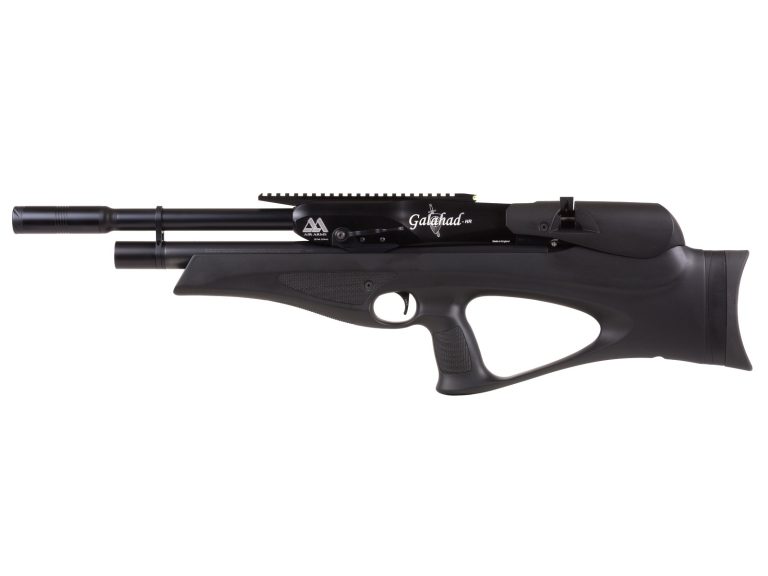
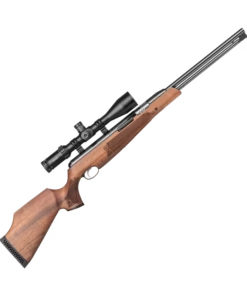
Air Arms Galahad Carbine, REG FAC Black Stock
$1,400.00
The Air Arms Galahad Carbine in Regulated FAC High-Power configuration is a serious PCP for shooters who demand regulated consistency and genuine power. The “HR” designation stands for High Power and Regulated — two things that matter when you want shot-to-shot repeatability at a meaningful energy level. We carry this in the all-black stock configuration, and it ships with a Weaver/Picatinny rail (note: the dovetail shown in some images is not what you’re getting — it’s Weaver/Pic).
This is a purpose-built carbine for the shooter who wants British-engineered quality in a compact, regulated platform.
- High-Power Regulated PCP: “HR” designation confirms a built-in regulator for consistent shot-to-shot velocity.
- Carbine length: Shorter, handier format without sacrificing the Galahad’s premium engineering.
- Weaver/Picatinny rail: Ready for modern optics mounts out of the box.
- Available in .22 caliber with a muzzle velocity of 870 fps.
- Black synthetic stock: Weather-resistant and purpose-focused.
Caliber 0.22″ Brand Air Arms
Air Arms Galahad Carbine REG FAC Black Stock – Premium Regulated Bullpup PCP Air Rifle for Superior Accuracy
Why the Air Arms Galahad Carbine REG FAC Black Stock Is a Premium Choice for Precision Shooters
Introducing the Air Arms Galahad Carbine REG FAC Black Stock
The Air Arms Galahad Carbine REG FAC Black Stock is an advanced air rifle that combines innovative bullpup engineering with the legendary craftsmanship that has made air arms one of the world’s leading manufacturers of premium air rifles. Designed for shooters who demand outstanding consistency, ergonomic handling, and exceptional precision, this modern air gun delivers remarkable performance across a wide variety of shooting applications.
Whether you are an experienced enthusiast looking to expand your collection of professional airguns, or someone beginning their journey into precision shooting, this rifle provides the reliability, balance, and confidence needed to perform at the highest level.
Why Choose This Premium Air Rifle?
Understanding what is an air rifle helps shooters appreciate why premium pneumatic systems continue to dominate recreational and competitive shooting. Unlike many conventional rifles, a regulated PCP platform provides highly consistent compressed air delivery, allowing every shot to leave the barrel with outstanding repeatability.
The Galahad Carbine has been engineered to deliver exceptional precision while maintaining a compact overall length. This makes it suitable for shooters who require excellent maneuverability without sacrificing barrel performance or long-range accuracy.
Its refined engineering allows users to enjoy smooth operation, dependable reliability, and comfortable shooting sessions for years.
Built Upon the Legacy of Air Arms Engineering
For decades, Air Arms air rifle platforms have established a worldwide reputation for superior craftsmanship and dependable engineering. The Galahad benefits from years of technological refinement that also influenced respected models including the Air Arms S510 XS Ultimate Sporter FAC, Air Arms S510 XS Ultimate Sporter FAC Walnut Stock, Air Arms S510 XS Ultimate Sporter, Air Arms S510 FAC, Air Arms S510 XS FAC PCP Air Rifle, air arms s510, air arms s510 ultimate sporter .177 sub 12, air arms s410, air arms tx200, and prosport air arms.
Each generation has contributed valuable innovations that continue shaping today’s premium precision shooting platforms.
Outstanding Accuracy Across Multiple Calibers
Selecting the correct caliber plays an important role in achieving optimal performance. Many enthusiasts prefer the highly accurate 177 caliber, while others compare 177 caliber vs 22 before choosing the configuration that best matches their intended shooting discipline.
Likewise, discussions surrounding 177 pellet vs.22 pellet help shooters understand the advantages of different projectile sizes. Whether selecting a precision-focused 177 air rifle or a harder-hitting .22 air rifle, proper caliber selection contributes significantly to practical shooting performance.
High-quality cal .177 pellets further enhance consistency by providing reliable barrel engagement and stable flight characteristics.
How Modern PCP Systems Work
Many newcomers ask how do air guns work. Instead of relying on spring-powered compression like a traditional break barrel pellet gun, modern PCP systems store compressed air inside a high-pressure reservoir.
Each trigger pull releases a carefully controlled volume of air behind the projectile, producing exceptional shot-to-shot consistency. This regulated firing cycle minimizes recoil while allowing shooters to maintain greater stability throughout every shot.
Those researching what is break barrel air rifle technology often discover that PCP rifles offer smoother operation, faster follow-up shots, and improved long-range precision.
Charging the rifle is simple using an air compressor rifle system or a reliable pcp hand pump, providing flexibility for home or field use.
Perfect for Target Shooting and Recreational Use
Whether searching for an airgun shooting range near me, participating in organized target air rifle shooting, or simply enjoying recreational shooting on approved private property, the Galahad delivers dependable performance across multiple environments.
Its excellent balance, compact dimensions, and refined trigger characteristics allow shooters to maintain confidence during both casual practice sessions and advanced precision training.
Easy Maintenance for Long-Term Reliability
Routine maintenance remains an essential part of preserving peak performance. A quality Air rifle cleaning kit helps remove residue while protecting barrel condition and maintaining consistent accuracy over thousands of shots.
Proper cleaning, careful inspection, and responsible storage significantly extend service life while ensuring dependable mechanical performance throughout years of ownership.
Important Considerations Before Purchase
Modern pneumatic rifles are designed primarily for sporting applications including recreational target shooting, competitive marksmanship, pest management, and hunting where legally permitted. Although discussions sometimes include air guns for home defense, these products should always be used responsibly and in accordance with local laws and regulations.
Understanding different air rifle calibers, selecting appropriate projectiles, and following safe operating procedures allow owners to maximize both performance and enjoyment.
Why the Air Arms Galahad Carbine REG FAC Black Stock Stands Above the Competition
The Air Arms Galahad Carbine REG FAC Black Stock successfully combines premium British engineering, regulated PCP technology, compact bullpup ergonomics, outstanding balance, exceptional trigger control, and precision barrel manufacturing into one highly refined shooting platform. Inspired by decades of innovation across the renowned Air Arms product range, it delivers the consistency, reliability, and long-range accuracy demanded by today’s serious shooters.
Whether you are expanding an existing collection, improving your marksmanship, exploring precision shooting, or seeking dependable field performance where legally permitted, this rifle provides the confidence, engineering excellence, and practical versatility expected from one of the industry’s most respected manufacturers.
Engineering, Handling, Performance and Practical Ownership
Compact Bullpup Design
The Air Arms Galahad Carbine uses a compact bullpup layout that positions the action farther back within the stock. This design reduces the rifle’s overall length without requiring an excessively short barrel. As a result, the shooter receives a compact platform that remains practical for precise shooting.
Its reduced overall length makes the rifle easier to handle in confined shooting positions, inside hides, around benches, and during movement between approved shooting locations. The balanced design can also help reduce front-end fatigue during longer sessions.
Although the layout feels different from a traditional sporting rifle, many shooters quickly appreciate the improved manoeuvrability. The shorter configuration allows the rifle to remain close to the body, which supports controlled movement and a stable shooting position.
Regulated Air Delivery
The regulated system is one of the most important elements of this model. It controls the amount of compressed air released during each shot, helping the rifle produce consistent performance throughout the useful portion of the air charge.
Without proper regulation, velocity may gradually change as reservoir pressure falls. A regulator helps manage this variation by supplying the firing valve with air at a more controlled pressure. Consequently, pellet speed and trajectory can remain more predictable.
This consistency is particularly valuable when shooting at different distances. Even small changes in velocity can affect the pellet’s point of impact, especially during precision target shooting. Therefore, regulated performance can improve confidence and reduce unexplained vertical variation in shot groups.
Side-Lever Loading System
The side-lever action provides a smooth and efficient loading process. The lever is positioned so that the shooter can cycle the action without significantly disturbing the firing position.
A clean loading movement is important because unnecessary body movement may affect consistency. The shooter can maintain a relatively stable cheek position while operating the mechanism, preparing the rifle for the next shot with minimal interruption.
The action should always be operated deliberately. Forcing the lever, double-loading, or attempting to cycle the mechanism while the magazine is incorrectly positioned may cause damage or create an unsafe condition. Regular inspection and correct magazine insertion are therefore essential.
Magazine Operation
The removable magazine provides quick follow-up loading during organised shooting sessions. Pellets are arranged inside the magazine and are indexed as the action is operated.
Before filling the magazine, each pellet should be inspected. Damaged skirts, deformed heads, dirt, or inconsistent manufacturing can influence accuracy. Pellets should be inserted carefully to avoid distortion.
It is also advisable to count the number of shots taken. Relying entirely on the magazine mechanism can sometimes result in dry firing or uncertainty about whether a pellet has been loaded. A disciplined loading routine helps prevent these problems.
Match-Grade Barrel Performance
The barrel is designed to support accurate pellet travel when the rifle is paired with suitable ammunition. Precision depends on the relationship between the barrel, pellet diameter, pellet weight, air pressure, and shooting technique.
Different pellet brands may perform differently even when they are labelled with the same calibre. For this reason, serious shooters often test several pellet types at controlled distances. Groups should be compared under similar weather conditions and from a stable rest.
The best pellet is not necessarily the fastest or heaviest option. The ideal choice is the one that produces consistent grouping, reliable magazine feeding, and a predictable point of impact.
Trigger Control and Adjustment
A refined trigger can help the shooter release the shot without disturbing the rifle. The trigger system is designed to provide a clear and controlled firing process when it is correctly adjusted.
Trigger adjustment should be approached carefully. An excessively light or incorrectly configured trigger may become unsafe. Adjustments must follow the manufacturer’s instructions, and any uncertainty should be referred to a qualified technician.
Good trigger technique is equally important. The shooter should apply steady rearward pressure while maintaining a stable grip. Jerking or snatching the trigger can pull the rifle away from the intended point of aim.
Ergonomic Black Stock
The black stock gives the rifle a modern appearance while also providing a practical, weather-resistant exterior. Its shape is intended to support stable contact between the shooter and the rifle.
A consistent cheek position helps align the eye with the optic. Meanwhile, a secure shoulder position helps the shooter control movement and repeat the same firing posture.
The grip should remain firm but not excessively tight. Too much pressure may introduce muscle tension and cause horizontal movement. A relaxed and repeatable hold generally produces better results.
Scope Selection and Mounting
The rifle requires an appropriately selected optic for most precision applications. Scope magnification should match the intended shooting distance and target size.
A compact optic may preserve the rifle’s balanced handling, while a larger optic may provide increased magnification and additional adjustment features. However, excessive size and weight can reduce the advantages of the compact design.
Correct mounting is essential. The rings must match the scope tube diameter and mounting rail. Eye relief should be adjusted so that the full sight picture is visible from a natural shooting position.
After installation, the scope should be aligned and zeroed at a safe, authorised range. Mounting screws should be tightened evenly according to suitable torque guidance.
Charging and Pressure Management
The air reservoir must be filled using compatible high-pressure charging equipment. The fill connection should be clean and undamaged before use.
Charging should be performed gradually. Introducing air too quickly may generate heat and can place unnecessary stress on seals and internal components. The pressure gauge should be monitored throughout the process.
The stated maximum filling pressure must never be exceeded. Overfilling does not automatically provide more useful shots and may damage the rifle.
After filling, the charging line should be safely depressurised before the connector is removed. This prevents sudden release of high-pressure air and protects the fitting.
Accuracy in Real Shooting Conditions
Bench testing provides useful information, but real-world accuracy is influenced by wind, distance, shooter stability, pellet quality, and target presentation.
Wind can move a pellet significantly, especially over longer distances. Shooters should learn to observe grass, leaves, range flags, and other environmental indicators. However, shots should not be attempted when conditions exceed the shooter’s ability.
Stable body positioning remains fundamental. Whether shooting from a bench, kneeling, sitting, or using a supported position, the rifle should rest naturally on target. Muscular force should not be used to drag the sight picture into alignment.
Noise and Shot Behaviour
The shrouded barrel helps manage the sound produced during firing, although actual noise levels depend on power configuration, pellet selection, surroundings, and local regulations.
Mechanical sound may also come from the action, hammer, and pellet impact. A rifle may appear quieter in an open area than in an enclosed building where sound reflects from walls and hard surfaces.
Hearing protection may still be appropriate, particularly at indoor facilities or when multiple shooters are present.
Cleaning and Routine Inspection
Regular care helps preserve reliable operation. The exterior should be wiped after handling to remove moisture, fingerprints, and dirt.
The barrel should not be cleaned excessively. Cleaning is usually most appropriate when accuracy declines, contamination is suspected, or the rifle has been exposed to poor conditions.
The owner should regularly inspect the magazine, seals, filling connection, mounting screws, stock fasteners, and pressure gauge. Air loss, unusual noises, inconsistent performance, or mechanical resistance should be investigated before further use.
Safe Storage and Transportation
The rifle should be stored unloaded in a secure cabinet or approved locking system. Pellets and charging equipment should be controlled so that unauthorised individuals cannot access them.
During transportation, the rifle should be placed in a protective case. The magazine should be removed, and local transportation requirements must be followed.
A pressure reservoir may remain partially charged according to manufacturer guidance, but the rifle should never be left in extreme heat, direct sunlight, or an unsecured vehicle.
Who This Rifle Is Best Suited For
This model is most suitable for experienced shooters who value compact dimensions, regulated consistency, refined handling, and precision-focused engineering.
It may also appeal to shooters transitioning from a conventional rifle layout who want a shorter platform without losing the stability associated with a full-length barrel system.
Beginners can use the rifle under qualified supervision, although proper instruction is essential because the charging system, magazine, regulator, optic, and safety procedures require careful understanding.
Final Performance Assessment
The Air Arms Galahad Carbine, REG FAC Black Stock offers a strong combination of compact design, controlled air delivery, smooth loading, ergonomic support, and precision potential.
Its performance is best realised through correct pellet testing, responsible pressure management, careful scope setup, disciplined trigger control, and regular maintenance.
For lawful target and sporting use, it provides a refined platform capable of delivering dependable results when operated by a trained and responsible owner.
Shooting Technique, Setup, Maintenance and Long-Term Ownership
Preparing the Rifle Before the First Session
Before using the rifle, the owner should read the manufacturer’s manual and become familiar with the loading system, safety mechanism, pressure gauge, filling connection and magazine operation. This preparation reduces avoidable mistakes and helps establish a safe operating routine from the beginning.
The rifle should be inspected for visible damage before it is charged or loaded. The stock, barrel assembly, pressure cylinder, trigger guard, magazine and mounting rail should all appear secure. Any loose component, damaged seal or unusual movement should be examined by a qualified technician before use.
The barrel must remain pointed in a safe direction during every stage of preparation. The magazine should remain removed until the shooter is positioned at an authorised range and ready to begin.
Establishing a Safe Shooting Position
A stable position contributes significantly to accuracy. The shooter should begin by placing the feet, knees or body support in a comfortable and balanced arrangement. The rifle should then be brought naturally toward the target without forcing the upper body into an uncomfortable angle.
The shoulder contact point should remain consistent. Meanwhile, the cheek should rest in the same position for every shot. Changing head position can alter the sight picture and cause unexplained movement in the point of impact.
The supporting hand should hold the rifle without squeezing excessively. A relaxed grip allows the platform to settle naturally and reduces unwanted movement caused by muscle tension.
Correct Breathing and Trigger Release
Breathing affects movement. Therefore, the shooter should avoid holding the breath for an extended period. A controlled breathing cycle generally provides better stability.
Many shooters inhale normally, exhale partially and release the shot during a brief natural pause. This pause should remain comfortable rather than forced.
Trigger pressure should increase gradually. The finger should contact the trigger consistently and pull straight toward the rear. Sudden movement can shift the rifle at the exact moment the pellet leaves the barrel.
After the shot, the shooter should maintain the firing position briefly. This technique, often called follow-through, helps prevent premature movement and encourages consistent shot execution.
Zeroing the Optic
Zeroing aligns the optic with the pellet’s point of impact at a selected distance. The process should begin at a relatively short range to ensure that the first shots land safely on the target board.
A large paper target with a clear centre point is useful during the initial stage. The shooter should fire a small group rather than adjusting the optic after every individual shot. A group provides more reliable information because a single shot may be affected by shooter error or pellet variation.
Once the centre of the group has been identified, the adjustment controls can be used to move the point of impact. Small, measured corrections are preferable to large random changes.
The process should continue until the group is centred at the chosen distance. The shooter should then confirm performance at additional distances because pellet trajectory changes throughout its flight.
Understanding Pellet Trajectory
A pellet does not travel in a perfectly straight line. Gravity begins affecting it as soon as it leaves the barrel. The sight line and pellet path normally intersect at one or more distances, depending on the optic height and chosen zero.
At closer or longer distances, the shooter may need to aim slightly above or below the intended point of impact. These corrections should be learned through controlled range testing rather than guesswork.
Recording the results can be helpful. A simple shooting log may include distance, pellet type, air pressure, weather conditions, group size and sight adjustment. Over time, this information helps the owner understand how the rifle behaves under different conditions.
Testing Different Pellets
Pellet testing is one of the most effective ways to improve practical accuracy. Small differences in head size, weight, skirt design and manufacturing consistency can influence how well a pellet travels through the barrel.
Testing should be performed under controlled conditions. The same distance, target style, rest position and approximate pressure range should be used for each pellet type.
Several groups should be fired before a decision is made. One excellent group may occur by chance, while repeated results provide stronger evidence.
The selected pellet should feed smoothly through the magazine and should not require excessive force during loading. Reliability is as important as accuracy, particularly during longer sessions.
Managing Reservoir Pressure
The pressure gauge allows the shooter to monitor the remaining air supply. Performance is generally most consistent within the rifle’s intended operating range.
The rifle should not be repeatedly fired after pressure falls below the recommended level. Low pressure may produce unstable velocity and poor accuracy. It may also create difficulty during the next filling cycle, depending on the condition of the valve system.
Filling should take place in a clean area where dust, water and oil cannot enter the connection. The filling equipment should be inspected regularly, and damaged hoses or fittings should be replaced immediately.
The connection must be released carefully after filling. Any residual pressure inside the hose should be removed through the proper bleed system before disconnection.
Protecting the Internal Components
High-pressure pneumatic equipment requires clean, dry air. Moisture may cause corrosion, while oil or unsuitable lubricants can create dangerous conditions within a high-pressure system.
Only products specifically approved for the rifle should be used. General household lubricants, automotive oils and combustible sprays should never be introduced into the reservoir or filling system.
The internal regulator, firing valve and high-pressure seals should not be dismantled by an inexperienced owner. Specialist tools and technical knowledge are often required. Unauthorised work can damage the rifle, affect safety and invalidate warranty protection.
Magazine Care and Loading Discipline
The magazine should be kept clean and protected from impact. Dirt or bent components may interfere with indexing and pellet alignment.
Pellets should be inserted in the correct direction and seated carefully. Damaged pellets should be discarded because they may jam the mechanism or produce unpredictable accuracy.
A shooter should never attempt to insert more than one pellet into the barrel. If there is uncertainty about whether the rifle has been loaded, the safest action is to stop and inspect the system according to the manufacturer’s procedure.
The rifle should not be fired without a pellet unless the manufacturer specifically permits it. Repeated dry firing may place unnecessary stress on internal components.
Weather and Environmental Conditions
Temperature, wind and moisture can influence shooting performance. Strong wind affects pellet movement, while rain may reduce visibility and create slippery handling conditions.
Cold temperatures can change seal behaviour and pressure performance. Therefore, the rifle should be allowed to adjust gradually when moved between very different temperatures.
Condensation may form when a cold rifle is taken into a warm building. The exterior should be dried carefully before storage. The case should also remain open until all moisture has evaporated.
Direct sunlight and excessive heat should be avoided. A pressurised rifle must never be left inside a hot vehicle or beside a heat source.
Cleaning the Barrel
The barrel should be cleaned only when necessary. Excessive cleaning may cause wear or damage if incorrect equipment is used.
A non-abrasive pull-through system is often more suitable than a rigid cleaning rod. Any cleaning material should be compatible with air-powered equipment and should not leave excessive residue inside the barrel.
Before cleaning, the rifle must be unloaded and secured. The magazine should be removed, and the pressure condition should be managed according to the manual.
After cleaning, several settling shots may be required before the rifle returns to its normal accuracy. This occurs because the barrel surface may need a small amount of pellet material to restore consistent performance.
External Care
Metal surfaces should be wiped after handling because fingerprints may contain moisture and salts. A clean, soft cloth is usually sufficient for routine care.
The stock should be cleaned with a product suitable for its material. Harsh solvents can damage finishes, seals and synthetic surfaces.
The optic lenses should be cleaned using a blower, lens brush and suitable lens cloth. Rubbing dust directly across the glass may create scratches.
Mounting screws, stock bolts and external fasteners should be checked periodically. However, overtightening should be avoided because excessive force can damage threads or mounting components.
Safe Storage
The rifle should be stored unloaded and secured against unauthorised access. A locked cabinet or approved storage system provides better protection than an ordinary case.
The storage area should remain dry and stable. Damp rooms, garages and outdoor sheds may encourage corrosion and damage sensitive components.
The magazine should be removed during storage. Pellets, filling equipment and access keys should also be controlled responsibly.
The rifle should never be displayed in a way that allows children, visitors or untrained individuals to handle it.
Transporting the Rifle
Transportation requirements vary by location. The owner must understand the legal rules that apply before travelling.
The rifle should be unloaded and placed inside a secure protective case. The case protects the barrel, stock, optic and pressure system from impact.
The rifle should remain out of public view during transportation airgins. It should not be left unattended in a vehicle, particularly where theft or heat exposure may occur.
Relevant documents, permissions or certificates should be carried when required. Travelling across regional or national borders may involve additional restrictions air riflery.
Diagnosing Accuracy Problems
A sudden loss of accuracy does not always indicate a serious mechanical fault air pisto. The owner should begin with simple checks.
Loose scope mounts, damaged pellets, incorrect pressure, wind, inconsistent shooting technique and barrel contamination are common causes. Each factor should be tested separately pellet guns.
If groups remain inconsistent, the shooter should confirm that the optic is functioning correctly. A different optic may be used temporarily to determine whether the original sight is causing the problem.
Air leakage, unusual sound, rough loading or unstable pressure may indicate a technical issue. In such cases, the rifle should be examined professionally.
Recognising Possible Air Leaks.
A slow pressure drop may occur because of a damaged seal, contaminated valve or loose filling connection. The rifle should be monitored after charging to determine whether pressure is being lost.
Leak detection must be conducted safely Air Arms Galahad Carbine REG FAC Black Stock Air Arms Galahad Carbine REG FAC Black Stock. The owner should not dismantle pressurised components or apply heat to any part of the system.
A qualified technician can identify the source and replace the appropriate seals. Attempting random repairs may worsen the problem or create additional risks.
Building Consistency Through Practice
Precision develops through repeatable technique. Short, focused practice sessions are often more productive than long sessions performed while tired.
The shooter should concentrate on one element at a time, such as breathing, trigger control or follow-through. Progress can then be measured through group size and consistency Air Arms Galahad Carbine REG FAC Black Stock.
Using clearly marked targets helps identify patterns. Shots that repeatedly move in one direction may reveal a technique issue, an optic adjustment problem or an unstable position Air Arms Galahad Carbine REG FAC Black Stock.
A shooting diary can also track improvement. Dates, distances, results and observations provide useful evidence over time.
Be the first to review “Air Arms Galahad Carbine, REG FAC Black Stock”
Related products

Air Arms
Air Arms
Air Arms



Air Arms

Reviews
There are no reviews yet.