KRAL BREAKER MARINE SYNTHETIC
Price range: $500.00 through $565.00
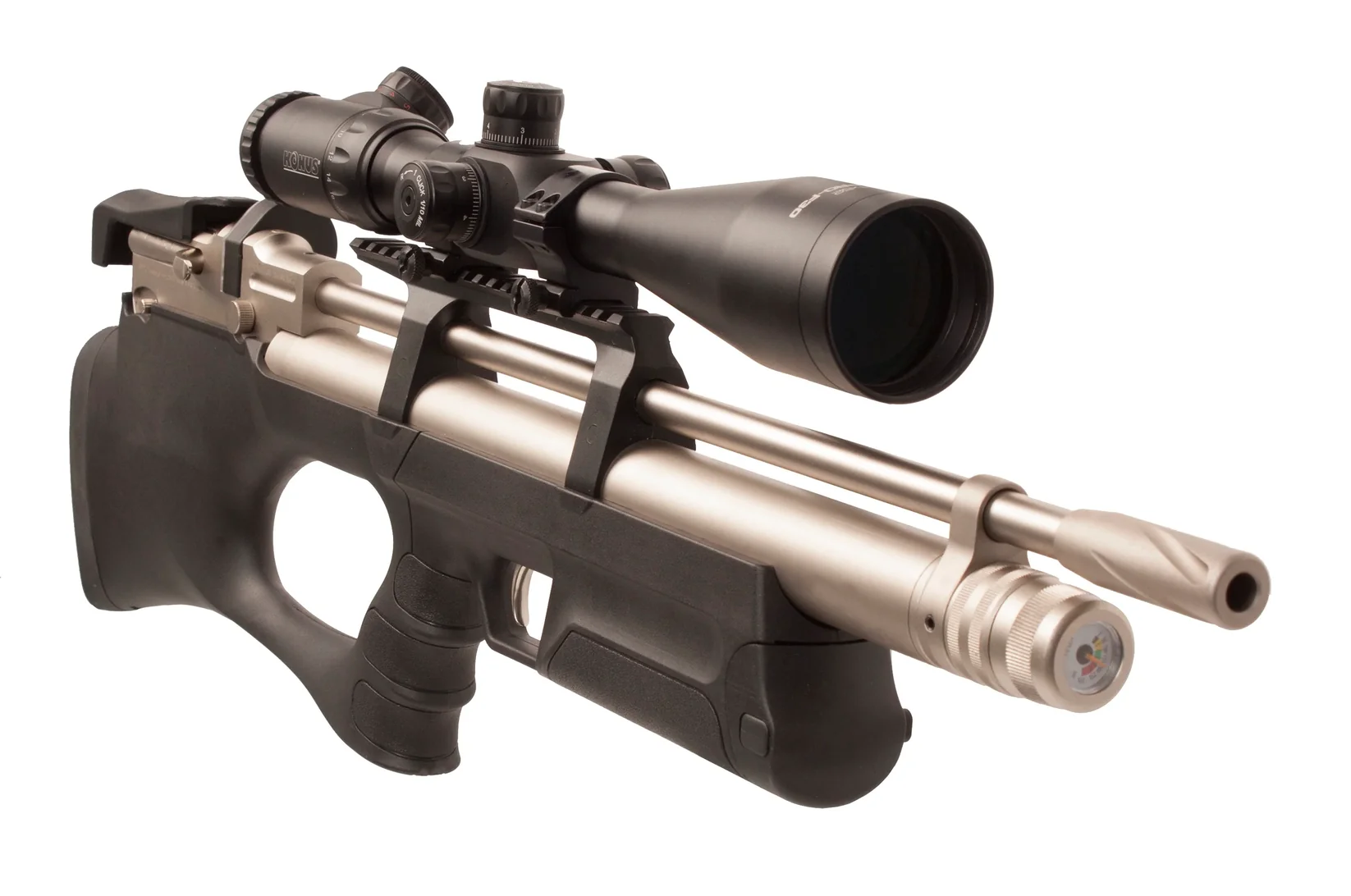
The Breaker PCP rifle from Kral takes the action from the Kral Puncher rifle and incorporates it into a Bullpup stock, which basically means the action is seated at the rear of the stock which reduces overall length of the rifle, whilst still maintaining a full size barrel and cylinder.
The action features a side lever which is very smooth and positive and loads the pellet from the multishot magazine into the cold hammer forged barrel. This barrel has been made to very strict standards which ensures that the accuracy and consistency are excellent, especially for a rifle in this price range.
The camo stock also benefits from a textured foregrip which provides further support in wet conditions.The stock is fitted with a rubber butt pad to the rear for improved shoulder support.
A power adjuster is incorporated onto the Breakers breech so you can fine tune the power output for close or longer ranges, and the two stage adjustable trigger is easily adjusted to your requirements.
- Calibre: .177/.22/.25/FAC
- Capacity: 14/12/10
- Colour: Black
- Length: 730mm
- Material: Synthetic
- Power: 11.5
- Stock: Synthetic
- Thread: 1/2″ unf
- Tube: 280cc
NB. Scope and Mounts not included
KRAL BREAKER MARINE SYNTHETIC
Product Overview, Design, Construction, and Technical Characteristics
What Is the Kral Puncher Breaker Marine Synthetic?
The Kral Puncher Breaker Marine Synthetic is a specialized pre-charged pneumatic platform designed around a compact mechanical architecture and a durable synthetic exterior configuration. It belongs to the broader Kral Puncher family, where PCP technology is used to provide a compressed-air operating system.
The Marine Synthetic configuration is particularly identifiable by its synthetic construction, which is intended to provide a practical exterior platform for users who require equipment that can be maintained in a variety of environments.
Because PCP equipment contains compressed air, the system should be regarded as pressure-bearing machinery. Consequently, appropriate inspection, maintenance, storage, transportation, and compliance with applicable regulations are important parts of responsible ownership.
Kral Arms Engineering and Product Identity.
Kral Arms is associated with a broad range of pneumatic products, including several models within the Puncher family. Search terminology can include Kral, Kral Arms, Kral Puncher, Kral Puncher Breaker, Kral Arms PCP Rifle, Kral Puncher PCP, Kral Air Rifle, Kral Arms Airguns, and Kral Puncher Series.
However, these terms can describe different products and configurations. Therefore, specifications associated with another model should not automatically be applied to the Kral Puncher Breaker Marine Synthetic.
Synthetic Construction
The synthetic configuration provides a practical exterior material that can be easier to maintain than some traditional stock materials.
Synthetic construction can also provide consistent dimensional characteristics under ordinary environmental conditions. Nevertheless, the equipment should still be protected from prolonged exposure to excessive moisture, extreme temperatures, chemicals, and unnecessary physical impact.
The exterior should be inspected periodically for cracks, deformation, loose components, or other changes.
PCP Operating Principle
A pre-charged pneumatic system stores compressed air in a reservoir before operation. A pneumatic mechanism then controls the release of stored energy through the operating system.
This arrangement differs from conventional cartridge-based firearm mechanisms.
The pressure reservoir and associated components should therefore be treated with particular care. Unauthorized modification, drilling, cutting, heating, or other alteration of pressure-bearing components should be avoided.
Precision and Consistency
Precision should be evaluated through repeatability rather than through an isolated result.
Observed performance can be influenced by equipment condition, compatible components, environmental conditions, sighting equipment, and operator consistency.
Consequently, generalized claims found in search results should not automatically be treated as specifications for the Marine Synthetic configuration.
A meaningful technical assessment should rely on manufacturer documentation and consistent evaluation conditions.
Mechanical Architecture
The platform combines several mechanical assemblies that work together as one system.
The pressure reservoir provides stored pneumatic energy.
The valve system manages the release of that energy.
The barrel provides the guided projectile path.
The action provides the mechanical operating interface.
The trigger serves as an important mechanical control.
The synthetic stock provides the external structural interface.
Because these components interact, maintenance should be approached as a complete system rather than as isolated parts.
Why the Synthetic Configuration Matters
A synthetic configuration can be useful where straightforward maintenance and resistance to ordinary environmental exposure are important considerations.
Unlike a traditional natural-material stock, synthetic construction is not dependent on the same type of material behavior associated with wood.
Nevertheless, synthetic does not mean indestructible. Cracks, deformation, impact damage, loose fittings, and chemical exposure can still affect the equipment.
Environmental Considerations
Environmental conditions should be considered during both use and storage.
Humidity can contribute to corrosion on exposed metal surfaces.
Dust can accumulate around mechanical interfaces.
Temperature changes can influence storage conditions.
Rapid movement between cold and warm environments can create condensation.
For long-term preservation, a reasonably dry and stable environment is preferable.
Maintenance
Maintenance should follow the manufacturer’s instructions for the exact configuration.
External surfaces should be kept clean and dry.
Suitable cleaning materials should be used.
Abrasive products and unsuitable chemicals should be avoided because they can damage finishes or other components.
Pressure-related servicing should be treated as specialized maintenance rather than ordinary cleaning.
Inspection
Regular inspection can help establish a useful maintenance baseline.
The owner can check the exterior for unusual corrosion, cracks, deformation, looseness, or evidence of impact.
Mechanical controls should also be observed for unexpected changes.
If the equipment develops unexplained pressure behavior, abnormal mechanical movement, or significant structural damage, professional assessment should be considered.
Storage and Transportation
The Kral Puncher Breaker Marine Synthetic should be stored securely and kept inaccessible to children and unauthorized individuals.
A suitable protective case can provide additional protection during transportation.
The equipment should remain securely positioned to reduce unnecessary movement.
Applicable storage and transportation requirements should be verified for the relevant jurisdiction.
Responsible Ownership
Responsible ownership includes more than maintaining the external appearance.
The pressure system should be preserved in its intended configuration.
Maintenance should follow reliable technical documentation.
Significant damage should be investigated.
Replacement components should be appropriate for the exact configuration.
Storage should remain secure.
Transportation should be carefully managed.
Local legal requirements should also be verified.
Important Product Identification Note
Terms such as Kral Puncher Breaker Synthetic, Kral Puncher Breaker Walnut, Kral Arms Puncher Breaker PCP Air Rifle, Kral Puncher Breaker review, and Kral Puncher Series can appear in searches alongside this product.
They should not, however, be treated as interchangeable product specifications. The Marine Synthetic configuration should be identified using its exact model documentation before technical specifications are published.
Likewise, terms such as Kral NP 02, Kral Puncher Mega, Puncher Auto, Empire X, KP12, KR9, KR-101, ST-500, and other model names represent separate product references unless manufacturer documentation establishes otherwise.
Overall Product Character
The Kral Puncher Breaker Marine Synthetic is best understood as a specialized PCP platform combining a pressure-based operating system with a synthetic external configuration.
Its principal ownership considerations include pressure-system care, mechanical inspection, environmental protection, secure storage, transportation, and appropriate maintenance.
For accurate technical specifications, the exact manufacturer documentation for the Marine Synthetic configuration should remain the primary reference. This is especially important when publishing information concerning caliber, dimensions, reservoir specifications, operating limits, compatible components, or other model-specific characteristics.
Construction, Durability, Maintenance, and Long-Term Care
The Kral Puncher Breaker Marine Synthetic should be considered a precision pneumatic system that requires consistent care throughout its service life. Its condition is influenced not only by the quality of its individual components but also by storage, transportation, environmental exposure, cleaning practices, inspection, and professional servicing.
A good maintenance routine is therefore based on prevention. Rather than waiting for an obvious problem to develop, the equipment should be inspected periodically so that changes can be identified at an earlier stage.
Understanding the Overall Construction
The equipment consists of several interconnected assemblies that perform different functions while operating as one complete system.
The external structure provides support and protection. Internal mechanical components manage the operating cycle. Pneumatic components manage compressed air. The barrel provides the controlled projectile path, while mechanical controls provide the interfaces required for normal operation.
Because these systems interact, a problem affecting one component can sometimes produce symptoms elsewhere.
For example, an unusual change in pressure behavior does not necessarily mean that the pressure reservoir itself is defective. Seals, valves, connections, or other pneumatic components can also contribute to changes in system behavior.
Consequently, diagnosis should be based on appropriate technical procedures rather than assumptions.
Synthetic Material Care
The synthetic exterior is designed to provide a practical material for the stock and surrounding structural areas.
Synthetic materials generally require straightforward cleaning and can be less sensitive to some forms of environmental exposure than natural materials. Nevertheless, they should not be considered immune to damage.
Excessive heat, harsh chemicals, sharp impacts, and inappropriate storage can still affect synthetic components.
Cleaning should therefore be performed using materials that are appropriate for the particular surface.
Strong solvents should not be applied without confirming compatibility.
Likewise, abrasive materials should not be used simply because they remove marks quickly.
Preserving the original surface is generally preferable to aggressive treatment.
Inspecting the Stock
The stock should be inspected periodically.
Attention can be given to cracks, deformation, loose mounting areas, unusual movement, and evidence of significant impact.
A small superficial mark may have little mechanical significance. However, a crack or deformation affecting an important structural area deserves additional attention.
The equipment should not be subjected to unnecessary stress while an important structural condition remains uncertain.
Professional inspection can be appropriate where damage is significant or difficult to assess.
Metal Component Inspection
Although the exterior configuration includes synthetic material, other components can contain metal surfaces that require appropriate care.
Metal surfaces should be kept reasonably clean and dry.
Moisture should not be allowed to remain against exposed metal for extended periods.
After exposure to damp conditions, the equipment should be inspected and dried appropriately before storage.
This is particularly relevant in environments with persistent humidity.
Corrosion Prevention
Corrosion can develop gradually.
The earliest signs may appear as discoloration or surface changes before more substantial deterioration becomes obvious.
Regular inspection therefore provides an opportunity to identify developing corrosion.
The significance of corrosion depends on where it occurs.
A superficial mark on a non-critical exterior surface is different from deterioration affecting an important structural, mechanical, or pressure-bearing component.
When the location or severity of corrosion is uncertain, professional assessment is preferable to aggressive treatment.
Cleaning the Exterior
External cleaning should be simple and controlled.
Loose dust and ordinary surface contamination can generally be removed using suitable materials recommended for the relevant surfaces.
The objective should be preservation rather than excessive cleaning.
Repeated aggressive cleaning can introduce unnecessary wear.
Similarly, chemicals that are suitable for one material may be unsuitable for another.
For this reason, cleaning products should be selected with consideration for the particular surface being treated.
Cleaning the Mechanical Areas
Mechanical areas should not be flooded with cleaning products.
Excessive liquid can migrate into areas where it is not intended to be present.
Contamination should be removed using an appropriate procedure rather than by applying increasingly aggressive products.
Where the manufacturer provides a specific maintenance procedure, that procedure should take priority.
Pressure-System Care
The pressure system requires particular attention because compressed air represents stored energy.
Pressure-bearing components should remain in their intended configuration.
They should not be drilled, cut, welded, heated, reshaped, or otherwise modified through improvised methods.
A component that appears strong enough for a modification may still have been designed around specific material properties and pressure conditions.
Consequently, modifications to pressure-bearing components should not be attempted.
Pressure Reservoir Inspection
The accessible exterior of the pressure reservoir should be inspected periodically for unusual changes.
The inspection can include looking for substantial dents, deformation, corrosion, cracks, or evidence of impact.
If an important physical change is identified, normal handling should be discontinued until the condition has been appropriately evaluated.
A pressure-bearing component should never be judged solely by appearance when significant damage is suspected.
Qualified professional inspection provides a more reliable approach.
Pressure Behavior
Normal pressure behavior should become familiar during responsible ownership.
An unexpected change may indicate a condition involving a seal, valve, connection, or another pneumatic component.
Simply restoring pressure without determining why the behavior changed does not correct the underlying condition.
If manufacturer-approved troubleshooting does not clearly identify the cause, professional service should be obtained.
Seals
Seals are important components within pneumatic systems.
Like many manufactured materials, seals can experience gradual deterioration.
Age, environmental conditions, storage, and normal use can influence their condition.
When a seal-related issue is suspected, replacement should follow an appropriate technical procedure.
Improvised materials should not be assumed to provide suitable compatibility.
Valve Assemblies
Valve assemblies form an important part of the pneumatic system.
Their condition can influence the behavior of the equipment.
Unusual pressure behavior should therefore receive appropriate attention.
Internal valve work should not be approached casually.
Where servicing is required, manufacturer-supported procedures or qualified technical service should be used.
Barrel Protection
The barrel should be treated as a precision component.
It should not be used as a handle or lever.
It should not be subjected to unnecessary impacts.
During transportation, it should be appropriately protected.
The muzzle should remain protected from contamination and foreign material.
If a significant impact occurs, the barrel and surrounding assemblies should be inspected before normal handling resumes.
Protecting Precision Components
Precision components can be affected by impact, contamination, corrosion, and inappropriate maintenance.
For that reason, storage and transportation should minimize unnecessary physical contact.
Heavy objects should not be placed against sensitive components.
Equipment should not be allowed to move freely inside a case where repeated impact could occur.
Appropriate padding and secure positioning can reduce these risks.
Mechanical Controls
Mechanical controls should remain in their intended configuration.
The owner should become familiar with their normal characteristics.
Unexpected resistance, looseness, unusual sounds, or other changes should be investigated.
Mechanical parts should never be forced when they do not behave normally.
Forcing a component can potentially worsen an existing issue.
Trigger Maintenance
The trigger should remain in its intended configuration.
Changes in normal mechanical characteristics should receive appropriate attention.
Unauthorized alterations should be avoided because they can change the mechanical behavior of the equipment and complicate future servicing.
When unusual movement or other concerns develop, professional inspection should be considered.
Impact Damage
Significant impacts deserve additional attention.
A fall or collision may affect structural or internal components even when the exterior appears relatively normal.
The absence of obvious external damage does not always establish that every component remains unaffected.
After a substantial impact, the equipment should be inspected before normal handling resumes.
Where the condition cannot be confidently assessed, professional inspection should be obtained.
Transportation
Transportation can expose equipment to vibration, impacts, temperature changes, moisture, and unauthorized access.
A suitable protective case can reduce some of these risks.
The equipment should remain securely positioned inside the case.
Unnecessary movement should be minimized.
The case should also be maintained so that its protective function remains reliable.
Protective Case Maintenance
The case should be inspected periodically.
Latches should function properly.
Hinges should remain secure.
Padding should remain capable of protecting the equipment.
The interior should be clean and dry.
A damaged case should not be assumed to provide the same protection as an intact case.
Vehicle Storage
Vehicle interiors can experience significant temperature changes.
During hot conditions, an enclosed vehicle can become substantially warmer than the surrounding environment.
Cold conditions can also affect some materials.
Rapid transitions between temperatures may produce condensation.
Consequently, prolonged exposure inside vehicles should be avoided where practical.
Security should also be considered during transportation.
Humidity
Humidity can become particularly relevant in tropical and coastal environments.
Persistent moisture can encourage corrosion on exposed metal surfaces.
The equipment should therefore be stored in a reasonably dry environment.
Where the surrounding environment is consistently humid, suitable storage practices become even more important.
After exposure to moisture, the equipment should be dried appropriately before being placed into long-term storage.
Temperature
Extreme temperatures should be avoided where possible.
The storage environment should be reasonably stable.
Rapid temperature transitions should also be considered because condensation can occur when equipment moves between significantly different environments.
A stable storage environment supports better long-term preservation.
Long-Term Storage
Before extended storage, the equipment should be inspected.
External surfaces should be clean and dry.
The storage area should be secure.
The protective case should be clean and suitable.
Moisture should not be trapped against the equipment.
After a prolonged storage period, another inspection should be completed before normal handling resumes.
Secure Storage
Secure storage is an important part of responsible ownership.
Children and unauthorized individuals should not have access.
The storage location should provide reasonable protection against physical impact, moisture, excessive temperatures, and environmental contamination.
Where applicable regulations establish specific storage requirements, those requirements should be followed.
Household Considerations
Shared living environments require additional attention.
The equipment should not be left in an openly accessible location.
Visitors should not handle specialized equipment without authorization and appropriate supervision.
Security should remain effective even when the owner is away.
Maintenance Records
A maintenance record can provide useful information over the life of the equipment.
Inspection dates can be documented.
Cleaning can be recorded.
Professional servicing can be noted.
Storage periods and unusual environmental exposure can also be recorded.
This creates a chronological history that can help distinguish gradual deterioration from sudden changes.
Why Maintenance Records Matter
Memory becomes less reliable as time passes.
A condition that appears unusual today may be difficult to compare with its condition several months earlier.
Written records provide an objective reference.
They can also provide useful information to a technician if professional servicing becomes necessary.
Replacement Components
Replacement components should correspond to the exact configuration.
A component that physically fits does not necessarily provide appropriate technical compatibility.
This is particularly important for pressure-bearing, sealing, structural, and precision components.
Manufacturer documentation should therefore be consulted before replacement components are selected.
Improvised substitutions should be avoided.
Preserving the Original Configuration
Maintaining the intended configuration can simplify future maintenance.
Unnecessary modifications introduce additional variables.
They can make troubleshooting more complicated.
They can also make it harder to establish whether a later change resulted from normal wear, environmental exposure, maintenance, or modification.
Manufacturer-supported components and procedures should therefore be preferred.
Professional Servicing
Professional servicing is appropriate when a condition extends beyond routine maintenance.
Examples can include unexplained pressure changes, suspected internal pneumatic problems, significant structural damage, severe corrosion, or abnormal mechanical behavior.
A qualified technician can assess the equipment using suitable procedures.
Professional servicing can also help maintain the intended configuration.
Manufacturer Documentation
Manufacturer documentation should remain the principal technical reference.
It may contain model-specific information about maintenance, storage, servicing, inspection, approved components, and operating limitations.
Information associated with another product should not automatically be applied.
Where generalized information conflicts with model-specific documentation, the manufacturer’s instructions should take priority.
Legal Responsibilities
Requirements concerning specialized pneumatic equipment vary between jurisdictions.
Rules can address ownership, age restrictions, storage, transportation, importation, transfer, and discharge.
The applicable requirements should be verified for the exact jurisdiction.
Information from another country or region should not automatically be assumed to apply locally.
Responsible Handling
Responsible handling begins with recognition that compressed air represents stored energy.
The equipment should remain appropriately controlled.
Unauthorized individuals should not handle it.
Mechanical problems should not be investigated through unnecessary experimentation.
When a condition cannot be confidently assessed, qualified professional assistance should be obtained.
Controlled Environments
Where lawful activities involving projectile equipment are permitted, an appropriate controlled environment should be used.
Facility requirements should be confirmed beforehand when there is uncertainty.
Established procedures should be followed throughout the activity.
The surrounding area should also be considered.
Environmental Awareness
Responsible use of specialized equipment includes awareness of the surrounding environment.
The potential projectile path should be appropriately contained.
People, occupied structures, roads, and uncontrolled areas should not be exposed to foreseeable hazards.
Environmental control should therefore extend beyond the immediate area.
Protective Equipment
Appropriate protective equipment should be used according to facility requirements and responsible practice.
Eye protection is particularly relevant in environments involving projectile equipment.
Protective equipment should fit correctly and should not interfere with awareness of the surrounding environment.
Operator Knowledge
The owner should understand the limits of personal technical knowledge.
Specialized pneumatic equipment should not be treated as ordinary household machinery.
Anyone unfamiliar with the system should obtain suitable instruction before handling it.
When a pressure-related, structural, or mechanical condition cannot be confidently evaluated, professional assistance should be obtained.
Preventative Maintenance
Preventative maintenance is generally preferable to waiting for a significant failure.
Regular inspection can reveal developing corrosion.
Appropriate storage can reduce environmental deterioration.
Careful transportation can reduce physical damage.
Maintenance records can reveal gradual changes.
Professional servicing can address conditions beyond routine care.
Long-Term Reliability
Long-term reliability is supported by consistency.
The equipment should be inspected regularly.
It should be kept clean and dry.
It should be protected during transportation.
It should be stored securely.
Manufacturer recommendations should be followed.
Unauthorized modifications should be avoided.
Significant changes should be investigated.
Relevant maintenance records should be retained.
Practical Maintenance Routine
A straightforward routine can be followed throughout the service life.
First, inspect the exterior for unusual changes.
Next, compare its condition with previous maintenance records where available.
Perform routine maintenance according to manufacturer instructions.
After moisture exposure, dry and inspect the equipment appropriately.
Before long-term storage, ensure that the equipment and storage environment are clean and dry.
During transportation, use suitable physical protection.
After significant impact or prolonged storage, complete another inspection.
Whenever a condition exceeds routine maintenance, obtain qualified professional assistance.
Overall Perspective
The Kral Puncher Breaker Marine Synthetic should be maintained as specialized pneumatic equipment throughout its service life.
Its pressure-bearing components require appropriate care.
Its synthetic structural components should be protected against unnecessary damage.
Its precision mechanical assemblies should remain in their intended configuration.
Its storage environment should be secure and reasonably stable.
Its transportation should minimize unnecessary movement and physical impact.
Its maintenance should follow reliable manufacturer guidance.
Its ownership and any lawful activity involving it should comply with applicable requirements.
Final Perspective
Good long-term care is based on prevention rather than reaction.
Regular inspection establishes a useful baseline.
Appropriate maintenance helps preserve important components.
Secure storage reduces environmental deterioration and unauthorized access.
Careful transportation reduces unnecessary physical damage.
Professional servicing provides an appropriate solution when a condition extends beyond routine maintenance.
Most importantly, unexplained pressure behavior, significant corrosion, structural damage, abnormal mechanical movement, or other important changes should not be ignored. When the condition cannot be confidently assessed, normal handling should be discontinued and qualified professional assistance should be obtaine
Section 3: Reliability, Precision, Inspection, and Responsible Ownership
Long-term reliability depends on consistent care, appropriate storage, careful transportation, regular inspection, and timely professional servicing. For specialized pneumatic equipment, these factors are particularly important because the system combines pressure-bearing components with mechanical and precision assemblies.
A responsible ownership routine should therefore be based on prevention. Instead of waiting for a visible failure, the equipment should be periodically examined so that changes can be recognized before they become more significant.
Understanding Reliability
Reliability describes the ability of equipment to remain in its intended condition over time.
It should not be determined from one successful operating session. Likewise, one unusual observation does not necessarily prove that a component has failed.
A better assessment is developed through repeated inspection, consistent maintenance, and comparison with the equipment’s established condition.
The owner should become familiar with the normal appearance of the equipment and document meaningful changes when they occur.
Establishing a Condition Baseline
A baseline provides a useful reference for future inspections.
When the equipment is known to be in appropriate condition, its external surfaces, structural components, mechanical controls, storage case, and general condition can be documented.
Photographs can also provide a useful visual record of external condition.
A maintenance log can record inspection dates, cleaning, professional servicing, storage periods, and significant environmental exposure.
Over time, this information can make gradual changes easier to identify.
Why Consistent Inspection Matters
Some forms of deterioration develop slowly.
Corrosion can begin as a minor surface change.
A structural problem can initially appear insignificant.
A mechanical component can gradually develop unusual movement.
Storage conditions can also change without being immediately obvious.
Regular inspection provides an opportunity to recognize such developments.
It does not guarantee that every problem will be detected, but it creates a more systematic approach to equipment care.
Precision and Repeatability
Precision should be considered separately from general reliability.
A system can remain mechanically functional while observations vary because of environmental conditions, equipment condition, operator consistency, or other external variables.
For that reason, isolated observations should not be treated as complete evidence of precision.
Meaningful technical evaluation requires consistent conditions and appropriate measurement methods.
Manufacturer documentation should remain the primary reference for published specifications.
Environmental Influence
Environmental conditions can affect both equipment condition and observations.
Humidity can contribute to corrosion.
Dust can accumulate around exposed interfaces.
Temperature changes can affect storage conditions.
Rapid changes between cold and warm environments can create condensation.
These factors should therefore be considered whenever changes in equipment condition are evaluated.
Humidity Management
Persistent humidity is an important consideration for long-term storage.
Moisture can contribute to corrosion on exposed metal surfaces.
The equipment should be kept dry whenever possible.
If it becomes wet, appropriate drying should take place before long-term storage.
The equipment should not be sealed inside a closed container while moisture remains present.
A reasonably stable and dry storage environment is preferable.
Corrosion Inspection
Corrosion should be evaluated according to location, severity, and progression.
A superficial mark on an external surface is not equivalent to deterioration affecting a structural or pressure-bearing component.
The owner should avoid assuming that all corrosion has the same significance.
Likewise, aggressive sanding or chemical treatment should not be performed on an important component without understanding the material and purpose of the affected surface.
Where the significance of corrosion is uncertain, professional inspection is appropriate.
Dust and Contamination
Dust can accumulate during storage and transportation.
Fine particles can settle around mechanical interfaces and other exposed areas.
Regular inspection can help prevent contamination from becoming excessive.
The storage case should also be kept clean.
Otherwise, dust inside the case can transfer back onto equipment that has already been cleaned.
Cleaning Philosophy
Cleaning should be purposeful and controlled.
The objective should be preservation of the original condition rather than aggressive removal of every cosmetic mark.
Suitable cleaning materials should be selected according to the manufacturer’s recommendations.
Abrasive products should not be used unnecessarily.
Strong chemicals should not be assumed to be suitable for every surface.
Different materials, coatings, finishes, and seals can respond differently to cleaning products.
External Surface Care
External surfaces should be kept reasonably clean and dry.
A suitable soft cleaning material can be used when compatible with the manufacturer’s guidance.
The equipment should not be soaked with cleaning fluid.
Excessive moisture can migrate into areas where it is not intended to be present.
After cleaning, surfaces should be allowed to dry appropriately before storage.
Lubrication Considerations
Lubrication requirements depend on the design of the equipment.
Only products specifically supported by appropriate manufacturer documentation should be used.
A lubricant suitable for another mechanical system may not be compatible with particular seals, coatings, or internal components.
Excessive lubricant can also attract dust and create additional contamination.
Consequently, lubrication should be performed only where required and according to suitable technical guidance.
Pressure-System Awareness
The pressure system deserves particular attention because compressed air represents stored energy.
Pressure-bearing components should remain within their intended configuration.
They should not be drilled, cut, welded, heated, reshaped, or subjected to improvised modification.
A modification that appears minor can alter the characteristics of a component designed for a particular pressure environment.
For that reason, pressure-related work should follow manufacturer procedures or be performed by qualified personnel.
Pressure Retention
Normal pressure behavior should be understood as part of responsible ownership.
An unexplained change in pressure retention can indicate a condition involving a seal, valve, connection, or another component.
Repeatedly restoring pressure without identifying the cause does not address the underlying problem.
When a significant change develops, manufacturer-approved troubleshooting should be consulted.
If the cause cannot be confidently established, professional servicing should be obtained.
Seals and Aging
Seals can naturally deteriorate over time.
Age, environmental conditions, storage, and ordinary service can influence material condition.
Because seals can contribute to pressure retention, changes associated with them should not be dismissed without consideration.
Internal seal replacement should be performed using appropriate components and procedures.
Improvised replacement materials should not be assumed to provide suitable compatibility.
Valve Condition
Valve assemblies form part of the pneumatic system and can influence its behavior.
Unexpected changes should therefore receive appropriate attention.
Internal valve work should not be treated as casual maintenance.
When servicing is necessary, appropriate technical procedures should be followed.
Where the owner does not have the required expertise or equipment, professional servicing is preferable.
Barrel Protection
The barrel should be treated as a precision component.
It should not be used as a carrying handle, lever, or support point.
During transportation, unnecessary contact with hard surfaces should be avoided.
The muzzle should remain protected from foreign material and contamination.
If a significant impact occurs, the relevant components should be inspected before normal handling resumes.
Structural Inspection
Structural components should be inspected periodically.
The inspection can include looking for cracks, deformation, looseness, impact marks, or other unusual changes.
A substantial fall or collision should receive additional attention.
External appearance alone cannot always establish the condition of internal components.
Where a significant impact has occurred, professional inspection can provide greater confidence.
Mechanical Controls
Mechanical controls should remain in their intended configuration.
The owner should become familiar with their normal movement and resistance.
Unexpected stiffness, looseness, unusual sounds, or other changes should receive attention.
Mechanical parts should never be forced simply because they do not behave as expected.
Forcing a component can potentially increase the severity of an existing problem.
Trigger Condition
The trigger should remain within its intended configuration.
Changes in its normal characteristics should not automatically be treated as harmless.
Unauthorized alteration can introduce additional variables into the mechanical system.
If unexpected movement or resistance develops, appropriate inspection should be performed.
Impact Events
A significant impact can justify additional inspection.
The equipment may appear externally normal while an internal component has been affected.
This is why continued operation should not be used as the primary method of determining whether hidden damage exists.
After a substantial fall, collision, or similar event, professional assessment can be appropriate.
Transportation
Transportation introduces several potential sources of deterioration.
Vibration can cause movement.
Impacts can damage surfaces or structural components.
Moisture can contribute to corrosion.
Temperature changes can create condensation.
Unauthorized access can create security concerns.
A suitable protective case can reduce several of these risks.
Protective Case
The protective case should be maintained as carefully as the equipment itself.
Latches should function correctly.
Hinges should remain secure.
Padding should remain capable of providing suitable protection.
The interior should be clean and dry.
A damaged case should not be assumed to provide the same protection as an intact case.
Transportation Security
During transportation, unauthorized access should be prevented.
The equipment should remain appropriately secured in accordance with applicable requirements.
The owner should verify transportation regulations applicable to the relevant jurisdiction.
Requirements can vary considerably between locations.
Vehicle Conditions
Vehicle interiors can experience substantial temperature changes.
During hot weather, an enclosed vehicle can become considerably warmer than the surrounding environment.
Cold conditions can create the opposite problem.
Rapid movement between very different temperatures can also encourage condensation.
For these reasons, unnecessary prolonged exposure to extreme vehicle temperatures should be avoided.
Long-Term Storage
Before extended storage, the equipment should be inspected.
It should be clean and dry.
The storage area should be secure.
The protective case should also be clean and dry.
Moisture should not be trapped against surfaces.
The equipment should not be positioned where it can easily fall or be struck by other objects.
After prolonged storage, another inspection should be performed before normal handling resumes.
Secure Storage
Secure storage is an essential part of responsible ownership.
Children and unauthorized individuals should not have access.
The storage environment should provide reasonable protection from moisture, excessive temperature, physical impact, and environmental contamination.
Where local requirements specify particular storage arrangements, those requirements should be followed.
Household Security
Shared residences require additional consideration.
The equipment should not be left in an openly accessible location.
Visitors should not handle specialized equipment without appropriate authorization and supervision.
Security should remain effective when the owner is away.
Maintenance Documentation
A maintenance record can provide useful information over the equipment’s service life.
Inspection dates can be recorded.
Cleaning can be documented.
Professional servicing can be noted.
Storage periods can be recorded.
Significant environmental exposure can also be documented.
This creates a chronological history that can help identify gradual changes.
Professional Servicing
Professional servicing is appropriate when a condition extends beyond routine maintenance.
Examples include unexplained pressure changes, suspected internal component problems, severe corrosion, significant structural damage, and abnormal mechanical behavior.
A qualified technician can assess the equipment using suitable procedures.
Professional servicing can also help preserve the intended configuration.
Replacement Components
Replacement components should correspond to the exact configuration.
Physical fit does not automatically establish technical suitability.
This is particularly important for pressure-bearing components, seals, structural elements, and precision mechanical assemblies.
Manufacturer documentation should therefore be consulted before replacement components are selected.
Improvised substitutions should be avoided.
Preserving the Original Configuration
The original configuration provides a useful reference for future inspection.
Unnecessary modifications introduce additional variables.
They can complicate troubleshooting and make it harder to determine whether a later change resulted from wear, environmental exposure, maintenance, or modification.
Manufacturer-supported components and procedures should therefore be preferred.
Recognizing Warning Signs
Potential warning signs include unexplained pressure changes, significant corrosion, structural damage, abnormal mechanical movement, unusual sounds, unexpected looseness, and changes from established normal condition.
These signs should not be ignored.
Repeatedly operating equipment to determine whether a suspected problem becomes worse is not an appropriate diagnostic approach.
Where an important abnormality is identified, normal handling should stop until the condition has been appropriately assessed.
Inspection After Moisture Exposure
After exposure to rain, condensation, or damp conditions, the equipment should be inspected.
Moisture should be removed appropriately.
The equipment should be allowed to dry before long-term storage.
It should not be sealed into a closed case while damp.
If moisture has affected an important mechanical or pressure-related area, professional assessment should be considered.
Inspection After Extended Storage
Equipment removed from long-term storage should receive an inspection before normal handling resumes.
External surfaces should be checked.
Corrosion should be considered.
The protective case should be inspected.
Maintenance records should be reviewed.
Any unexplained change should receive appropriate attention.
Manufacturer Documentation
Manufacturer documentation should remain the primary technical reference.
It can contain information concerning maintenance, storage, servicing, inspection, approved components, and operating limitations.
General information from another product should not automatically be applied.
Where generalized advice conflicts with model-specific documentation, the model-specific information should take priority.
Legal Awareness
Requirements can differ between jurisdictions.
Rules may address ownership, minimum age, storage, transportation, transfer, importation, and discharge.
The owner should verify the requirements applicable to the exact jurisdiction.
Information from another country should not automatically be assumed to apply locally.
Responsible Handling
Responsible handling begins with recognition that compressed air contains stored energy.
The equipment should remain appropriately controlled.
Unauthorized individuals should not handle it.
Mechanical problems should not be investigated through unnecessary experimentation.
When a condition cannot be confidently assessed, qualified professional assistance should be obtained.
Controlled Environments
Where lawful activities involving projectile equipment are permitted, an appropriate controlled environment should be used.
Facility requirements should be confirmed when there is uncertainty.
Established procedures should be followed.
The surrounding environment should also be considered.
Environmental Awareness
Responsible equipment ownership includes awareness of the area surrounding the equipment.
The potential projectile path should be appropriately contained.
People, occupied buildings, roads, and uncontrolled areas should not be exposed to foreseeable hazards.
Environmental control should extend beyond the immediate location.
Protective Equipment
Appropriate protective equipment should be used according to facility requirements and responsible practice.
Eye protection is particularly relevant in environments involving projectile equipment.
Protective equipment should fit correctly and should not interfere with environmental awareness or responsible handling.
Operator Knowledge
The owner should understand the limits of personal technical knowledge.
Specialized pneumatic equipment should not be treated as ordinary household machinery.
Anyone unfamiliar with the system should obtain appropriate instruction before handling it.
When a pressure-related, structural, or mechanical condition cannot be confidently evaluated, qualified assistance should be obtained.
Preventative Maintenance
Preventative maintenance is generally preferable to waiting for a significant failure.
Regular inspection can identify developing corrosion.
Appropriate storage can reduce environmental deterioration.
Careful transportation can reduce physical damage.
Maintenance records can reveal gradual changes.
Professional servicing can address conditions beyond routine care.
Long-Term Reliability
Long-term reliability is supported by consistency.
The equipment should be inspected regularly.
It should be kept clean and dry.
It should be protected during transportation.
It should be stored securely.
Manufacturer recommendations should be followed.
Unauthorized modifications should be avoided.
Significant changes should be investigated.
Relevant maintenance records should be retained.
Practical Ownership Routine
A straightforward routine can be followed throughout the equipment’s service life.
First, inspect the external condition.
Next, compare the current condition with previous records when available.
Perform routine maintenance according to manufacturer instructions.
After moisture exposure, dry and inspect the equipment appropriately.
Before long-term storage, ensure that the equipment and storage environment are clean and dry.
During transportation, provide suitable physical protection.
After significant impact or prolonged storage, complete another inspection.
Whenever a condition exceeds routine maintenance, obtain qualified professional assistance.
Final Perspective
Reliable ownership is based on prevention rather than reaction.
Regular inspection establishes a useful baseline.
Appropriate maintenance helps preserve important components.
Secure storage reduces environmental deterioration and unauthorized access.
Careful transportation reduces unnecessary physical damage.
Professional servicing provides an appropriate solution when a condition extends beyond routine care KRAL BREAKER MARINE SYNTHETICKRAL BREAKER MARINE SYNTHETICKRAL BREAKER MARINE SYNTHETIC KRAL BREAKER MARINE SYNTHETIC KRAL BREAKER MARINE SYNTHETICKRAL BREAKER MARINE SYNTHETICKRAL BREAKER MARINE SYNTHETIC KRAL BREAKER MARINE SYNTHETIC KRAL BREAKER MARINE SYNTHETICKRAL BREAKER MARINE SYNTHETICKRAL BREAKER MARINE SYNTHETIC KRAL BREAKER MARINE SYNTHETICKRAL BREAKER MARINE SYNTHETICKRAL BREAKER MARINE SYNTHETICKRAL BREAKER MARINE SYNTHETICKRAL BREAKER MARINE SYNTHETICKRAL BREAKER MARINE SYNTHETICKRAL BREAKER MARINE SYNTHETIC.
Most importantly, unexplained pressure behavior, significant corrosion, structural damage, abnormal mechanical movement, or other important changes should not be ignored. When the condition cannot be confidently assessed, normal handling should be discontinued and qualified professional assistance should be obtained KRAL BREAKER MARINE SYNTHETICKRAL BREAKER MARINE SYNTHETICKRAL BREAKER MARINE SYNTHETIC KRAL BREAKER MARINE SYNTHETICKRAL BREAKER MARINE SYNTHETICKRAL BREAKER MARINE SYNTHETICKRAL BREAKER MARINE SYNTHETICKRAL BREAKER MARINE SYNTHETICKRAL BREAKER MARINE SYNTHETICKRAL BREAKER MARINE SYNTHETICKRAL BREAKER MARINE SYNTHETICKRAL BREAKER MARINE SYNTHETICKRAL BREAKER MARINE SYNTHETIC.
Be the first to review “KRAL BREAKER MARINE SYNTHETIC”
Related products
Kral Arms

Kral Arms
Kral Arms
Kral Arms
Kral Arms
Kral Arms
Reviews
There are no reviews yet.