






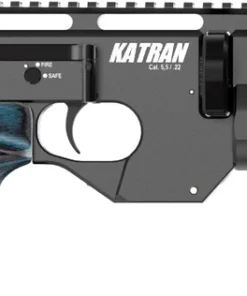
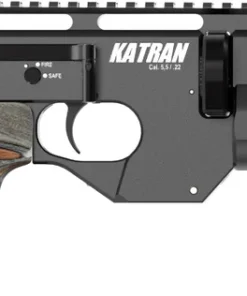
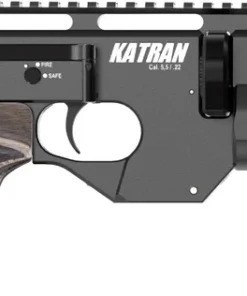
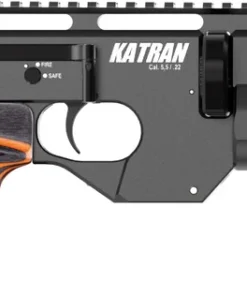
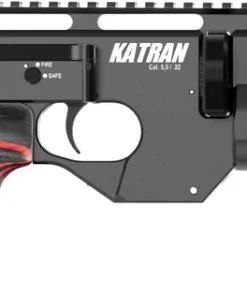
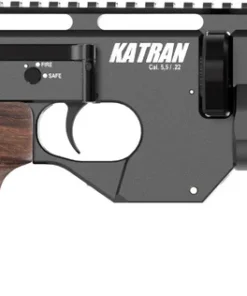
AirMaks Arms Katran-B Compact.

Price range: $1,550.00 through $1,900.00
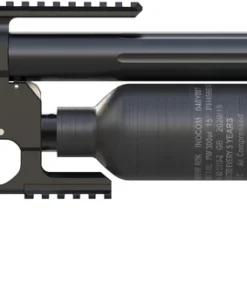
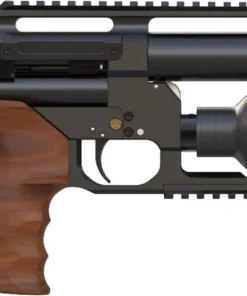
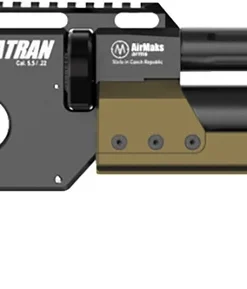
The buddy bottle version of the Katran. Lightweight and comfortable air rifle, the KATRAN has an ergonomic right-hand AR15 grip, a foldable stock with an adjustable butt-pad and cheek-piece. The aluminium handguard has a 9 slot KeyMod for accessory mounting. Easy-cocking side lever comfortably situated near the trigger with a possibility to change right-left side. The trigger has a 2-stage adjustment.
◊ Aluminium, foldable, length-adjustable stock (excl. laminate/walnut models)
◊ Adjustable cheek piece and butt pad
◊ Aluminium handguard with 9 slot Keymod and picatinny rail
◊ AR15 right-hand Grip
◊ Side lever action, right-left changeable
◊ AR15 style safety, right-left changeable
◊ Two-stage trigger with external adjustment
◊ Supplied with Negrini case
◊ Regulator
◊ Magazine Holder (excl. laminate/walnut models)
◊ Anti-double feed system
◊ External velocity regulation screw
◊ 20MOA Picatinny rail
◊ 1/2” UNF thread for moderator (see page 13)
◊ Barrel with 1:17.7 twist
◊ Magazine – 18 shot (.177), 16 shot (.22), 14 shot (.25)
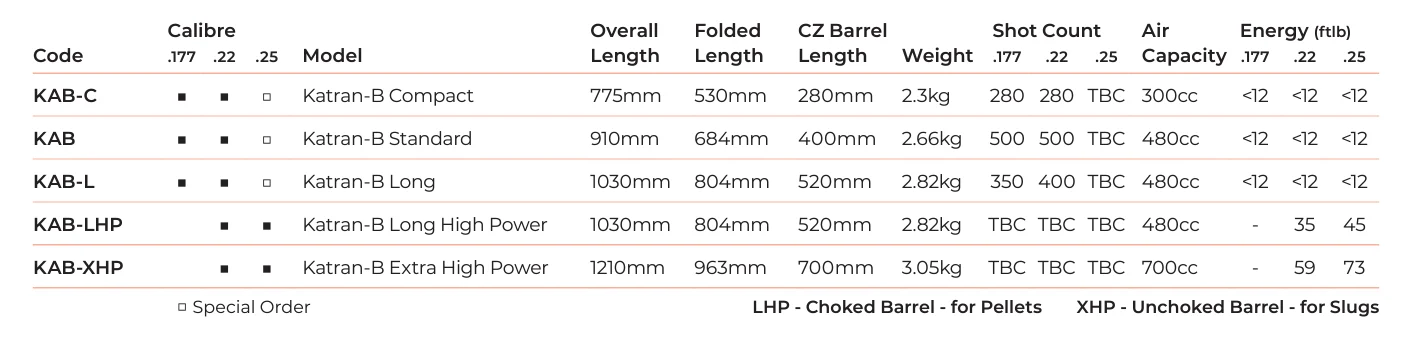
- Shot Count:
KAB-C .177 280
KAB-C .22 280
KAB .177 500
KAB .22 500
KAB-L .177 350
KAB-L .22 400
AirMaks Arms Katran-B Compact PCP Air Rifle – Precision Engineering, Lightweight Design and Advanced Performance
AirMaks Arms Katran-B Compact – Advanced PCP Technology, Precision Performance and Exceptional Versatility
The AirMaks Arms Katran-B Compact combines Czech engineering, refined pneumatic technology, and a lightweight tactical-inspired design. Developed for enthusiasts who appreciate mechanical precision, consistent performance, and comfortable handling, this compact pre-charged pneumatic rifle offers an impressive combination of practical features.
Unlike conventional spring-powered designs, the Katran-B Compact operates through a regulated compressed-air system. Consequently, its smooth firing cycle, precision-manufactured CZ barrel, and adjustable two-stage trigger contribute to a controlled shooting experience.
Furthermore, its 300cc high-pressure air bottle supports extended recreational target sessions, while the folding aluminum stock provides practical storage convenience. The 280mm barrel maintains manageable dimensions without sacrificing the quality of its manufacturing.
AirMaks Katran – Czech Manufacturing, Reliability and Innovative Design.
The airmaks katran family reflects the engineering philosophy of airmaks, a Czech manufacturer known for innovative pneumatic rifles.
Frequently searched under variations such as airmarks, katran airmaks, air marks, ar max, arm max, and max arms, the manufacturer offers several configurations designed around different user preferences.
Although the air max krait and airmaks krait belong to related product discussions, their configurations differ from the katran compact bottle platform.
Likewise, references to uramax should not be confused with the actual manufacturer.
Among contemporary AirMaks Arms air rifles, the compact bottle configuration emphasizes portability, mechanical refinement, and consistent compressed-air delivery.
AirMaks Arms PCP Air Rifles – Understanding Compressed-Air Technology
For customers asking what does pcp air rifle mean, PCP stands for pre-charged pneumatic, meaning compressed air is stored within a refillable reservoir.
The expression komprimiran zrak also refers to compressed air, highlighting the fundamental operating principle behind this technology.
Modern AirMaks Arms PCP air rifles incorporate pressure regulation to improve consistency as reservoir pressure gradually decreases.
Furthermore, the broader selection of AirMaks Arms PCP rifles offers various barrel lengths, storage capacities, and ergonomic arrangements.
The Katran-B Compact features a Huma-Air regulator, reversible side-lever mechanism, and anti-double-feed system.
Precision CZ Barrel and Adjustable Trigger Engineering
A 280mm CZ-manufactured barrel forms an important component of the rifle’s construction.
Its precision-engineered rifling contributes to projectile stabilization, while consistent ammunition quality remains essential for repeatable target results.
Additionally, the adjustable two-stage trigger offers a distinct mechanical feel suited to recreational precision shooting.
The 300cc air reservoir provides additional capacity compared with smaller conventional compact configurations. However, actual shot counts depend on caliber, energy settings, and operating conditions.
Best Pellet Gun for Pest Control – Understanding Responsible Applications
Customers researching the best pellet gun for pest control, pellet gun for pest control, or air rifle for pest control should consider local legislation, safety requirements, and humane wildlife-management standards.
Although precision pneumatic equipment has several recognized applications, any pest-management activity requires appropriate legal authorization and responsible handling.
Meanwhile, internet searches such as hamster with gun, hamster with a gun, and hamster holding gun generally refer to fictional or novelty imagery rather than legitimate technical specifications or responsible animal-control practices.
Javelin Pro Hunt Tac Bipod and Accessory Compatibility
The javelin pro hunt tac bipod is one example of a specialist shooting support accessory that buyers may research.
The Katran-B Compact incorporates a KeyMod aluminum handguard and a 20 MOA Picatinny optics rail, offering established attachment interfaces.
Nevertheless, compatibility with any particular accessory must be verified independently.
Its adjustable cheekpiece, buttpad, and folding stock further contribute to handling comfort and storage flexibility.
AirMaks Arms for Sale – Product Availability and Authorized Distribution
Customers searching for AirMaks Arms for sale, AirMaks Arms shop, or AirMaks Arms USA should confirm the seller’s authorization, local regulations, available caliber, and warranty support.
The AirMaks Katran compact bottle platform is available in different regional configurations, including .177 and .22 versions.
Furthermore, the rifle should be distinguished from larger bottle-fed models, which may feature different reservoir capacities and barrel lengths.
Benjamin Air Rifle and Alternative Pneumatic Platforms
Buyers comparing a benjamin air rifle, benjamin air rifles, or the wider air rifle and air pistol category will encounter several different operating systems.
For example, benjamin marauder pcp, benjamin marauder, benjamin armada, and benjamin prowler represent separate products with their own configurations.
Similarly, the benjamin bulldog, Benjamin Bulldog Magnum Series Bullpup, benjamin marauder air rifle bulldog 357, and benjamin bulldog 457 20 joules relate to different specifications or product searches that should not be confused with this compact platform.
Other terms, including benjamin break, benjamin airbow, air bows pellet rifle, co2 pellet guns, and cal .177 pellets, describe different equipment types, operating technologies, or ammunition categories.
Western Airguns and Specialized PCP Rifle Comparisons
The western airguns product family offers additional options for enthusiasts researching contemporary pneumatic technology.
Models and searches such as western rattler, western airguns rattler, western air guns, western rattler 357, and western rattler bullpup generally concern larger or differently configured systems.
Likewise, mordax, western airguns mordax, mordax air gun, mordax airgun, western mordax venom, and western sidewinder identify other products or related search interests.
The singular search variation western air gun also belongs to this broader comparison category.
However, these alternatives should be assessed individually because dimensions, operating characteristics, and intended applications vary considerably.
AirMaks Arms Katran-B Compact – Highlighted Features and Specifications
- Manufacturer: AirMaks Arms, Czech Republic
- Model: Katran-B Compact / Katran CB configuration
- Operating system: Pre-charged pneumatic
- Available calibers: .177 (4.5mm) and .22 (5.5mm) in common UK listings
- Barrel: 280mm CZ precision-manufactured barrel
- Air reservoir: 300cc bottle
- Maximum fill pressure: 300 bar
- Pressure regulation: Huma-Air regulator
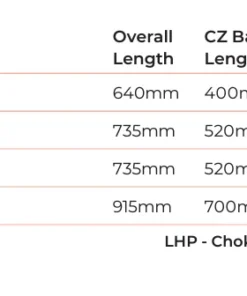
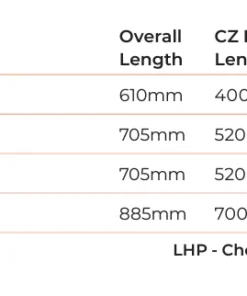
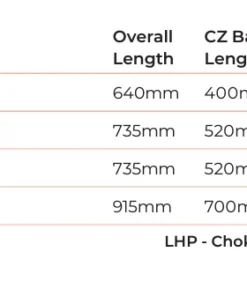
- Overall length: Approximately 775–780mm
- Folded length: Approximately 530–535mm
- Weight: Approximately 2.3kg unloaded
- Magazine capacity: 18 rounds (.177) or 16 rounds (.22)
- Trigger: Externally adjustable two-stage mechanism
- Stock: Foldable aluminum construction with ergonomic adjustments
- Charging mechanism: Reversible side lever
- Accessory interface: KeyMod handguard and Picatinny optics mounting rail
- Safety: Manually operated, reversible configuration
- Additional mechanism: Anti-double-feed system
Why Choose the AirMaks Arms Katran-B Compact?
The Katran-B Compact offers a well-rounded combination of advanced pneumatic engineering, practical ergonomics, and reliable manufacturing features.
Its precision CZ barrel, regulated air system, adjustable furniture, and compact folding design distinguish it from more conventional sporting configurations.
Moreover, the thoughtful combination of lightweight materials and mechanical functionality creates a versatile platform for experienced enthusiasts and responsible recreational target shooters.
For buyers seeking Czech manufacturing quality, refined operating characteristics, and a compact PCP design, this rifle represents an attractive addition to the modern precision airgun category.
Advanced Engineering, Exceptional Build Quality, Ergonomic Comfort, Technical Innovation and Long-Term Ownership Value
2.1 A New Standard in Compact Czech Engineering
The AirMaks Arms Katran-B Compact represents a distinctive combination of innovative design, modern manufacturing principles, and practical sporting equipment functionality. Developed by a Czech manufacturer with experience in advanced pneumatic technology, this model brings together carefully selected materials, sophisticated internal components, and an ergonomic exterior designed to appeal to enthusiasts who appreciate mechanical quality.
Its compact configuration reflects an important principle in contemporary engineering: sophisticated equipment does not necessarily require excessive dimensions. Instead, thoughtful component placement, efficient construction, and balanced proportions can produce a technically capable product without unnecessary bulk.
One of its most recognizable characteristics is the combination of an aluminum chassis, folding rear assembly, and integrated high-pressure reservoir. These elements create an appearance that is modern and functional while maintaining a clear distinction between structural components and operating mechanisms.
Furthermore, the overall construction emphasizes consistency rather than decorative complexity. The exterior design includes purposeful lines, accessible controls, and carefully positioned supporting elements that contribute to a cohesive mechanical arrangement.
This attention to detail makes the platform interesting not only to experienced recreational enthusiasts but also to customers who enjoy studying technical design.
Although the appearance suggests a highly specialized instrument, the underlying engineering remains understandable. Compressed air provides the operating energy, mechanical controls manage the action, and internal components work together within a structured housing.
Consequently, the product offers an opportunity to appreciate how several engineering disciplines intersect, including materials science, fluid mechanics, precision manufacturing, and ergonomics.
Its strongest appeal lies in this combination of mechanical sophistication and practical compactness.
2.2 High-Quality Aluminum Construction and Structural Integrity
Aluminum alloys play a significant role in modern equipment manufacturing because they offer a favorable combination of strength, weight efficiency, corrosion resistance, and machinability.
The main chassis uses metal construction to provide a rigid foundation for the surrounding components. As a result, the equipment maintains a substantial mechanical character without relying on unnecessarily heavy exterior materials.
Furthermore, aluminum allows manufacturers to incorporate precisely formed surfaces, mounting interfaces, and structural details into a relatively compact design.
The use of metal also contributes to a distinctive tactile experience. Compared with some lightweight polymer housings, rigid metal structures often provide a different sensation during handling.
However, material quality should never be judged by weight alone. Manufacturing tolerances, surface treatment, structural geometry, and assembly quality are equally important.
The exterior finish contributes additional protection against routine environmental exposure. Nevertheless, no finish is completely resistant to scratches, abrasion, or accidental damage.
Careful ownership therefore remains essential for preserving the product’s appearance.
Another consideration involves the interaction between different materials. Temperature changes can produce slight dimensional variations, making accurate manufacturing and appropriate component selection important throughout the assembly.
The result is a platform that reflects deliberate material choices rather than unnecessary ornamentation.
For customers evaluating long-term ownership, these construction characteristics provide meaningful insight into the manufacturer’s design priorities.
2.3 Compact Dimensions and Practical Storage Benefits
Size influences how equipment fits into everyday ownership routines. Storage availability, transportation requirements, protective cases, and workspace organization all become easier to evaluate when an instrument has clearly defined proportions.
The compact configuration emphasizes manageable dimensions while incorporating the features expected from a sophisticated pneumatic platform.
Its folding rear assembly represents one of the most recognizable elements of this design. The arrangement reduces overall storage length and creates a practical distinction between the equipment’s extended and folded profiles.
This is particularly useful when considering cabinet dimensions or choosing a suitable protective case.
However, reduced size should not be confused with reduced responsibility. Secure storage remains essential regardless of the equipment’s dimensions.
A locked cabinet or appropriately secured case helps prevent unauthorized access, while separate and compliant ammunition storage may be required under local rules.
Furthermore, the available storage space should accommodate the equipment without placing unnecessary pressure on delicate external components.
The compact format also influences visual balance. A shortened front assembly, centrally positioned housing, and folding rear section produce proportions that differ noticeably from those of traditional full-length sporting designs.
Consequently, the product appeals to customers who appreciate functional industrial design and efficient packaging.
2.4 The Engineering Principles Behind Compressed-Air Operation
Compressed-air technology relies on storing energy in the form of pressurized gas rather than using the conventional mechanical spring arrangement found in some other sporting equipment.
This operating principle introduces several important engineering considerations, including pressure containment, valve behavior, sealing integrity, and regulated air delivery.
The reservoir functions as a pressure vessel specifically designed for its intended operating conditions.
Its construction must account for the substantial forces created by compressed gas, making appropriate materials and manufacturing quality essential.
Furthermore, the surrounding pneumatic system contains components that manage airflow during normal operation.
One defining characteristic of this technology is the absence of the large spring-driven mechanical movement associated with certain traditional designs.
However, compressed-air equipment still contains moving parts and produces a genuine discharge impulse.
It should never be described as completely recoil-free, silent, or mechanically motionless.
The technology’s appeal lies partly in its distinct operating characteristics and partly in the opportunities it creates for compact mechanical design.
Importantly, high-pressure systems require responsible maintenance and strict compliance with manufacturer instructions.
Owners should never exceed the stated pressure limit, introduce unauthorized modifications, or attempt repairs involving pressurized components without appropriate qualifications.
These precautions are fundamental to safe ownership.
2.5 Precision Barrel Manufacturing and Material Quality
The barrel is one of the most technically significant components of the overall assembly.
Its manufacture requires accurate dimensional control, appropriate material selection, and careful surface finishing.
The Czech-produced barrel used in this model reflects the manufacturer’s emphasis on established industrial manufacturing expertise.
Precision machining contributes to consistency in bore geometry and the overall condition of the internal surface.
Meanwhile, the surrounding construction supports the barrel as part of a larger mechanical system.
It is important to recognize that manufacturing quality and practical results are related but not identical concepts.
A well-produced component provides a useful foundation, yet actual performance depends on numerous variables, including the condition of the complete assembly, the suitability of factory-approved ammunition, and environmental circumstances.
Therefore, numerical accuracy claims should come from controlled testing rather than assumptions based exclusively on material origin.
The shorter barrel configuration also represents a deliberate design compromise.
It contributes to compact dimensions while remaining an integral component of the manufacturer’s intended system.
For technically minded enthusiasts, this arrangement offers an interesting example of how dimensional constraints influence engineering decisions.
2.6 Pressure Regulation and Consistent System Characteristics
Regulated pneumatic systems incorporate a mechanism intended to manage the relationship between reservoir pressure and the operating pressure supplied to the action.
This distinguishes them from simpler arrangements in which the available reservoir pressure may influence operating characteristics more directly.
The installed regulator is one of the principal technical features of the compact model.
Its presence reflects an emphasis on controlled pneumatic operation.
However, pressure regulation should not be interpreted as a guarantee of perfectly identical results under every condition.
Temperature, component condition, manufacturing variation, and normal mechanical tolerances can influence system behavior.
Furthermore, the regulator operates as part of a complete pneumatic assembly rather than functioning independently.
The relationship between the reservoir, seals, valves, and associated components determines overall system characteristics.
From an engineering perspective, the inclusion of this technology demonstrates the manufacturer’s intention to provide a sophisticated operating platform.
Owners should treat the regulator as a precision component and avoid unauthorized adjustment or disassembly.
Any concerns about pressure behavior or mechanical malfunction should be assessed by qualified service personnel.
This approach helps protect both user safety and the integrity of the equipment.
2.7 Ergonomic Design and Comfortable Handling
Ergonomics represents one of the most important aspects of modern sporting equipment design. A technically sophisticated product may contain excellent internal components, yet its practical appeal can diminish when the exterior feels uncomfortable or unnecessarily complicated.
This compact model addresses that challenge through an adjustable rear assembly, textured grip, and balanced arrangement of external controls.
The ergonomic right-hand grip offers a familiar shape that accommodates natural hand placement. Meanwhile, the adjustable rear components allow users to account for differences in body dimensions and personal comfort.
Another important advantage comes from the carefully organized control layout. Rather than distributing essential mechanical elements across an unnecessarily large housing, the manufacturer has concentrated the operating components within an accessible arrangement.
Furthermore, the design combines metal structural elements with surfaces intended for comfortable contact.
The folding construction contributes to storage convenience without fundamentally changing the product’s purpose as a precision sporting instrument.
Individual comfort will naturally vary. Hand size, arm length, posture, and personal preferences influence how different people perceive the same equipment.
Consequently, buyers should consider physical fit alongside the published technical specifications.
The result is an ergonomically focused platform that places substantial emphasis on human interaction as well as mechanical performance.
2.8 Adjustable Cheekpiece and Personalized Comfort
The adjustable cheekpiece is an important feature for users who value a comfortable relationship between their head position and the equipment’s external geometry.
People differ considerably in facial structure, neck length, and preferred posture. A fixed rear assembly may therefore feel comfortable to one individual but less suitable for another.
Height adjustment provides a means of accommodating these variations within the manufacturer’s intended design.
Furthermore, a supportive cheek-contact surface can contribute to a more natural feeling during routine supervised sporting activities.
The quality of an adjustable component also depends on its construction. Materials, fastening integrity, adjustment range, and resistance to unwanted movement all influence its practical value.
Another consideration involves long-term maintenance. Components that experience repeated handling should remain clean and free from unnecessary contamination.
The ability to personalize the exterior demonstrates the manufacturer’s understanding that equipment should accommodate different users rather than expecting everyone to have identical physical proportions.
For customers interested in mechanical refinement, this feature adds another dimension to the overall ownership experience.
2.9 Adjustable Buttpad and Practical Exterior Refinement
The adjustable buttpad complements the rear assembly by providing additional flexibility in contact positioning.
Its inclusion reflects a wider engineering approach centered on modularity and user accommodation.
Unlike a permanently fixed component, an adjustable arrangement allows the exterior geometry to accommodate individual comfort requirements.
This becomes relevant when evaluating different sporting products because the quality of the rear interface can substantially influence perceived ergonomics.
Furthermore, the construction demonstrates how relatively small mechanical details can contribute to the overall sophistication of a product.
The supporting materials must provide adequate rigidity while maintaining a suitable contact surface.
Adjustment hardware should also retain its intended condition throughout normal use.
As with other moving components, unauthorized alteration should be avoided, particularly where changes could affect structural integrity.
The manufacturer’s intended configuration provides a useful balance between physical adaptability and straightforward construction.
Ultimately, this design feature strengthens the impression of a thoughtfully developed sporting platform.
2.10 Modern Side-Lever Mechanism and Mechanical Sophistication
The external lever arrangement is another distinguishing characteristic of the overall design.
Its construction reflects the manufacturer’s preference for a modern mechanical layout rather than the appearance of traditional sporting models.
The reversible configuration accommodates different user preferences through a manufacturer-supported arrangement.
Meanwhile, the compact placement of the mechanism contributes to the equipment’s recognizable profile.
The quality of such an assembly depends on several engineering factors, including component alignment, surface finishing, spring characteristics, and manufacturing tolerances.
Smoothness and consistency can influence the owner’s perception of quality during ordinary handling.
However, a pleasant mechanical feel should not automatically be interpreted as proof of superior durability.
Long-term reliability requires appropriate materials, consistent manufacturing, and periodic inspection.
The mechanism should remain free from excessive dirt, moisture, and physical damage.
Furthermore, owners should follow the manufacturer’s operating documentation rather than attempting unauthorized mechanical alterations.
The overall arrangement illustrates how contemporary industrial design can combine compact dimensions with sophisticated external controls.
2.11 Two-Stage Trigger Construction and Mechanical Refinement
A two-stage trigger differs from a basic single-stage arrangement because its mechanical movement incorporates distinct phases.
The design used in this model includes manufacturer-provided adjustment capability, reflecting an emphasis on refined mechanical construction.
From a technical perspective, the trigger assembly contains interacting parts that must operate within carefully defined tolerances.
Surface finish, component quality, and consistent manufacturing all contribute to the system’s intended mechanical behavior.
Furthermore, the presence of a two-stage configuration demonstrates attention to the characteristics expected from specialist sporting equipment.
However, trigger mechanisms are safety-critical components.
Improper alteration can compromise the equipment’s intended operation and introduce serious hazards.
Therefore, any inspection, repair, or adjustment beyond ordinary authorized use should follow the official documentation and, when necessary, involve a qualified professional.
Customers should also recognize that mechanical feel is partly subjective.
One person’s preferred operating characteristics may differ from another’s, even when both are evaluating a correctly functioning product.
The important consideration is that the equipment operates safely, consistently, and within the specifications established by its manufacturer.
2.12 Integrated Protection Against Unintended Double Feeding
Modern repeating pneumatic systems often incorporate mechanical safeguards designed to reduce the possibility of certain handling errors.
This model includes an anti-double-feed mechanism, an important feature within the manufacturer’s overall design.
The purpose of the system is to reduce the risk of more than one projectile entering the relevant section of the action during normal operation.
Such protection demonstrates attention to the mechanical problems that can arise in magazine-fed equipment.
Nevertheless, protective systems should never be treated as replacements for responsible handling.
No mechanical safeguard can eliminate every possible malfunction or compensate for damaged components, inappropriate ammunition, or negligent use.
Furthermore, a malfunction should not prompt an owner to force the mechanism or attempt improvised repairs.
Qualified inspection is the appropriate response when normal operation becomes uncertain.
The presence of this feature adds an extra level of engineering consideration to the overall platform.
It also illustrates why evaluating a sporting product requires examining internal mechanical provisions rather than concentrating exclusively on exterior appearance.
2.13 Magazine Construction and Practical Storage Features
The magazine system forms an important part of the product’s overall mechanical architecture.
Its capacity varies according to the selected factory caliber, reflecting differences in projectile dimensions and internal magazine geometry.
The manufacturer’s design also incorporates storage space for additional magazines in applicable stock configurations.
This arrangement demonstrates attention to organization and accessory management.
Rather than treating every component as an isolated item, the exterior structure accommodates practical storage features within the available space.
However, included accessories may differ between retailers, regional packages, and alternative stock versions.
For that reason, customers should examine the exact contents of the advertised package before purchasing.
Magazine condition is another important ownership consideration.
Physical damage, contamination, and unsuitable replacement components may affect the equipment’s intended operation.
Accordingly, owners should use compatible factory-approved accessories and avoid forcing parts that do not fit correctly.
This attention to compatibility helps preserve mechanical integrity while reducing unnecessary maintenance problems.
2.14 Surface Treatment and Exterior Durability
Exterior finishing contributes both to appearance and long-term preservation.
The matte-black presentation gives the equipment a restrained technical identity, with contrasting contours that emphasize the shape of its supporting structure.
More importantly, surface treatment can provide protection against ordinary handling marks and environmental exposure.
Nevertheless, the effectiveness of any finish depends on the material beneath it, the application process, and the conditions of use.
Repeated contact with abrasive surfaces may eventually create visible wear.
Similarly, exposure to moisture, dirt, and unsuitable cleaning chemicals can affect external components.
Maintaining the original appearance therefore requires appropriate care.
Soft cleaning materials, suitable storage conditions, and periodic inspection can help reduce preventable deterioration.
The manufacturer’s choice of a relatively understated exterior also gives the product a functional appearance rather than relying on excessive decorative elements.
For enthusiasts who appreciate industrial design, the combination of geometric surfaces and durable materials contributes substantially to its visual appeal.
2.15 Environmental Conditions and Temperature Considerations
Environmental factors influence the performance and condition of nearly every mechanical instrument.
Compressed gas responds to changes in temperature, while metallic components may experience small dimensional variations as their surroundings become warmer or colder.
These effects are ordinary consequences of physical laws.
However, they become especially important when equipment contains a high-pressure reservoir and precision-manufactured components.
Owners should avoid exposing the product to excessive heat, including prolonged storage inside vehicles under direct sunlight.
Likewise, unnecessary exposure to moisture and corrosive environments can reduce the service life of exterior materials.
Cold conditions may influence seals and mechanical feel, while dusty surroundings can introduce contamination into exposed areas.
The appropriate response is preventive maintenance and responsible storage.
No fixed environmental operating range should be assumed unless the manufacturer supplies a verified specification.
Consequently, users should follow the official manual whenever conditions fall outside normal recreational expectations.
These considerations are important because long-term reliability depends on both engineering quality and the environment in which equipment is maintained.
2.16 Responsible High-Pressure Reservoir Ownership
The 300cc reservoir represents one of the most technically significant elements of this compact configuration.
As a pressure-containing component, it must meet demanding structural and safety requirements.
High-pressure storage places considerable mechanical stress on the vessel walls, seals, and associated fittings.
For this reason, owners should treat the reservoir as a specialized component rather than an ordinary removable container.
The manufacturer specifies a maximum working pressure of 300 bar.
This figure identifies an upper operating limit, not a recommended value to exceed.
Furthermore, pressurized components should never be exposed to inappropriate heat sources, unauthorized machining, or improvised repair methods.
Any indication of physical damage, unusual leakage, or compromised integrity requires professional evaluation.
Periodic inspection should follow applicable manufacturer guidance and local pressure-vessel requirements.
The reservoir’s substantial capacity contributes to the product’s distinctive configuration, but its safe use remains dependent on correct maintenance and compatible equipment.
A responsible owner should prioritize the integrity of this system throughout the product’s service life.
2.17 Understanding Published Capacity and Runtime Claims
Product descriptions often highlight reservoir size and expected operating duration.
However, capacity alone cannot establish exactly how many usable discharges a particular configuration will provide.
The relationship between stored gas volume and operating duration depends on several interacting variables.
These include the model’s factory energy classification, caliber, mechanical condition, and environmental temperature.
Regional configurations may also differ significantly because national laws impose different restrictions on pneumatic equipment.
Some retailers advertise relatively high shot counts for restricted-energy models.
Nevertheless, such figures should be interpreted as estimates obtained under particular conditions rather than universal guarantees.
A customer purchasing a different regional version should not assume identical operating duration.
Furthermore, the total number of possible discharges should not be confused with the number delivered within a manufacturer’s defined performance range.
For these reasons, reliable product information should distinguish published estimates from verified measurements.
This approach gives customers a more realistic understanding of the equipment without introducing unsupported numerical promises.
2.18 Czech Manufacturing Heritage and Quality Expectations
The Czech Republic has a substantial industrial history involving precision machining, metalworking, and mechanical manufacturing.
This broader engineering environment provides useful context for understanding the development of contemporary sporting equipment.
The manufacturer draws on modern production methods to create products with distinctive mechanical characteristics.
Its design philosophy emphasizes modular construction, sophisticated external components, and efficient use of space.
However, country of origin alone does not establish product quality.
Manufacturing consistency depends on actual production standards, inspection procedures, component selection, and after-sales support.
For buyers seeking reliable information, these considerations are more meaningful than broad claims about national engineering superiority.
The use of established component suppliers and clearly documented technical specifications can strengthen customer confidence.
Furthermore, access to replacement parts and qualified service providers contributes significantly to the ownership experience.
A technically interesting product becomes more valuable when supported by dependable documentation and reasonable service arrangements.
2.19 Maintenance, Cleaning and Preventive Inspection
Routine care is essential for preserving the condition of any precision mechanical product.
Exterior surfaces should remain free from excessive dust, moisture, and corrosive contamination.
A clean, soft cloth can remove ordinary fingerprints and handling marks, while manufacturer-approved products may be appropriate for more persistent contamination.
However, aggressive solvents should never be applied indiscriminately.
Certain chemicals can damage seals, coatings, polymer components, or protective finishes.
Similarly, internal components should not be dismantled without suitable expertise.
The pneumatic system contains pressurized elements that require specialized handling.
Owners should also monitor the general condition of visible fasteners, protective surfaces, and external components.
Signs of unusual wear or mechanical damage warrant professional inspection.
When the equipment will remain unused for an extended period, storage conditions should follow manufacturer recommendations.
Excessive humidity, uncontrolled heat, and unauthorized access should be avoided.
Consistent preventive care helps preserve the original condition of the product and supports responsible long-term ownership.
2.20 Secure Storage and Transportation Responsibilities
Secure storage forms an essential part of responsible sporting equipment ownership.
Although this model uses compressed air rather than conventional firearm cartridges, it remains capable of causing serious injury.
Consequently, it should always receive appropriate safety precautions.
A locked cabinet or approved secure storage system helps restrict unauthorized access.
A padded protective case can also reduce exposure to scratches and ordinary transportation damage.
Local laws may impose additional requirements involving transport, licensing, documentation, or storage arrangements.
Therefore, buyers should review the regulations applicable to their jurisdiction.
It is also important to distinguish between a product’s physical portability and its legal transportability.
A folding design does not create an exemption from relevant restrictions.
Furthermore, storage equipment should accommodate the full dimensions of the product without forcing delicate components against hard surfaces.
These precautions contribute to a safer ownership environment and reduce avoidable damage.
2.21 Product Documentation and Manufacturer Support
Comprehensive documentation adds considerable value to sophisticated mechanical equipment.
The official instruction manual provides essential information regarding safety precautions, component identification, maintenance requirements, and authorized operating procedures.
It also establishes the boundaries within which the product should function.
Owners should retain this documentation for future reference rather than relying exclusively on informal internet discussions.
Furthermore, manufacturer support may become important when replacement seals, mechanical components, or professional inspection services are required.
Access to knowledgeable technical assistance can prevent unnecessary complications and reduce the likelihood of unsuitable repairs.
Retailer support also deserves consideration.
A reputable seller should be able to clarify the exact version offered, applicable warranty provisions, and any regional compliance requirements.
The quality of the ownership experience often depends on these services as much as the initial technical specifications.
Accordingly, customers should view documentation and after-sales support as integral parts of the overall product package.
2.22 Understanding Regional Specifications and Legal Classification
Pneumatic sporting equipment may be supplied in different configurations depending on the intended market.
Energy limitations, licensing requirements, and legal definitions vary considerably between countries.
For example, certain British-market versions are advertised within the sub-12 ft-lb category, while other jurisdictions permit different classifications.
These variations can affect the specifications shown on retailer websites.
Consequently, customers should avoid assuming that every product bearing the same commercial name has identical characteristics.
The correct specification is the one associated with the actual manufacturer-approved variant offered for sale.
Furthermore, importation and possession may involve separate legal requirements.
A product permitted for ownership in one location may require additional authorization elsewhere.
Responsible purchasing therefore involves verifying local legislation and the seller’s compliance procedures.
This is particularly important when ordering internationally.
Clear product identification, accurate documentation, and lawful distribution help prevent misunderstandings and support a more dependable customer experience.
2.23 Why Mechanical Quality Matters Beyond Appearance
Visual design often creates the first impression of a sporting product, but long-term satisfaction depends on less immediately visible characteristics.
Component alignment, material quality, seal integrity, and manufacturing consistency all influence reliability.
A sophisticated exterior cannot compensate for poorly manufactured internal assemblies.
Likewise, impressive advertised specifications should be supported by appropriate engineering standards.
This compact platform illustrates the value of considering construction as a complete system.
Its supporting chassis, pneumatic reservoir, internal mechanisms, and adjustable exterior components must function together.
Furthermore, mechanical quality includes the ability to maintain intended operating characteristics through normal use.
Routine inspection and manufacturer-supported servicing contribute to this objective.
For customers comparing equipment, it is useful to examine published technical documentation, warranty conditions, and independent ownership feedback.
These sources provide a broader perspective than appearance alone.
The most meaningful measure of quality is the relationship between engineering design, consistent operation, maintenance requirements, and customer expectations.
2.24 Long-Term Ownership Value and Practical Considerations
A purchasing decision should consider more than the initial acquisition cost.
Replacement components, professional maintenance, secure storage, and accessory compatibility may all influence total ownership expenses.
The availability of technical support is particularly relevant for products incorporating specialized pneumatic systems.
Furthermore, regional distribution arrangements can affect how easily genuine replacement components can be obtained.
A customer who intends to retain equipment for many years may therefore place substantial value on documentation and dependable service access.
Physical construction also contributes to perceived value.
A rigid chassis, adjustable exterior components, and carefully manufactured mechanical assemblies create an impression of technical sophistication.
However, long-term reliability should be evaluated through documented ownership experience rather than unsupported claims of indestructibility.
Similarly, resale value cannot be guaranteed.
Market demand, product condition, local regulations, and availability of newer models may influence future pricing.
The strongest purchasing rationale is therefore an informed appreciation of the equipment’s actual features and suitability for responsible recreational ownership.
2.25 Final Assessment of Engineering and Overall Quality
The AirMaks Arms Katran-B Compact combines modern Czech manufacturing, specialized pneumatic construction, and compact industrial design within a distinctive sporting platform.
Its carefully organized exterior emphasizes structural rigidity, ergonomic adaptability, and practical storage considerations.
Meanwhile, the internal architecture demonstrates the manufacturer’s commitment to sophisticated mechanical engineering.
The regulated compressed-air system, precision-manufactured barrel, adjustable rear components, and protective mechanical features contribute to an integrated design.
Furthermore, the substantial reservoir and folding construction distinguish this configuration from more traditional sporting equipment.
Nevertheless, responsible ownership remains essential.
Appropriate storage, qualified servicing, correct product identification, and compliance with local legislation all contribute to a safe and dependable experience.
For customers who appreciate precision manufacturing and mechanically advanced sporting products, this model presents an interesting combination of design innovation and technical capability.
Its value lies not in exaggerated performance promises but in the thoughtful integration of materials, components, and practical features.
Ultimately, the equipment offers a compelling example of how contemporary engineering can deliver sophisticated functionality within a compact and recognizable form.
Be the first to review “AirMaks Arms Katran-B Compact.”
Related products
AirMaks Arms
Airmaks
Airmaks
AirMaks Arms
AirMaks Arms
AirMaks Arms
Reviews
There are no reviews yet.