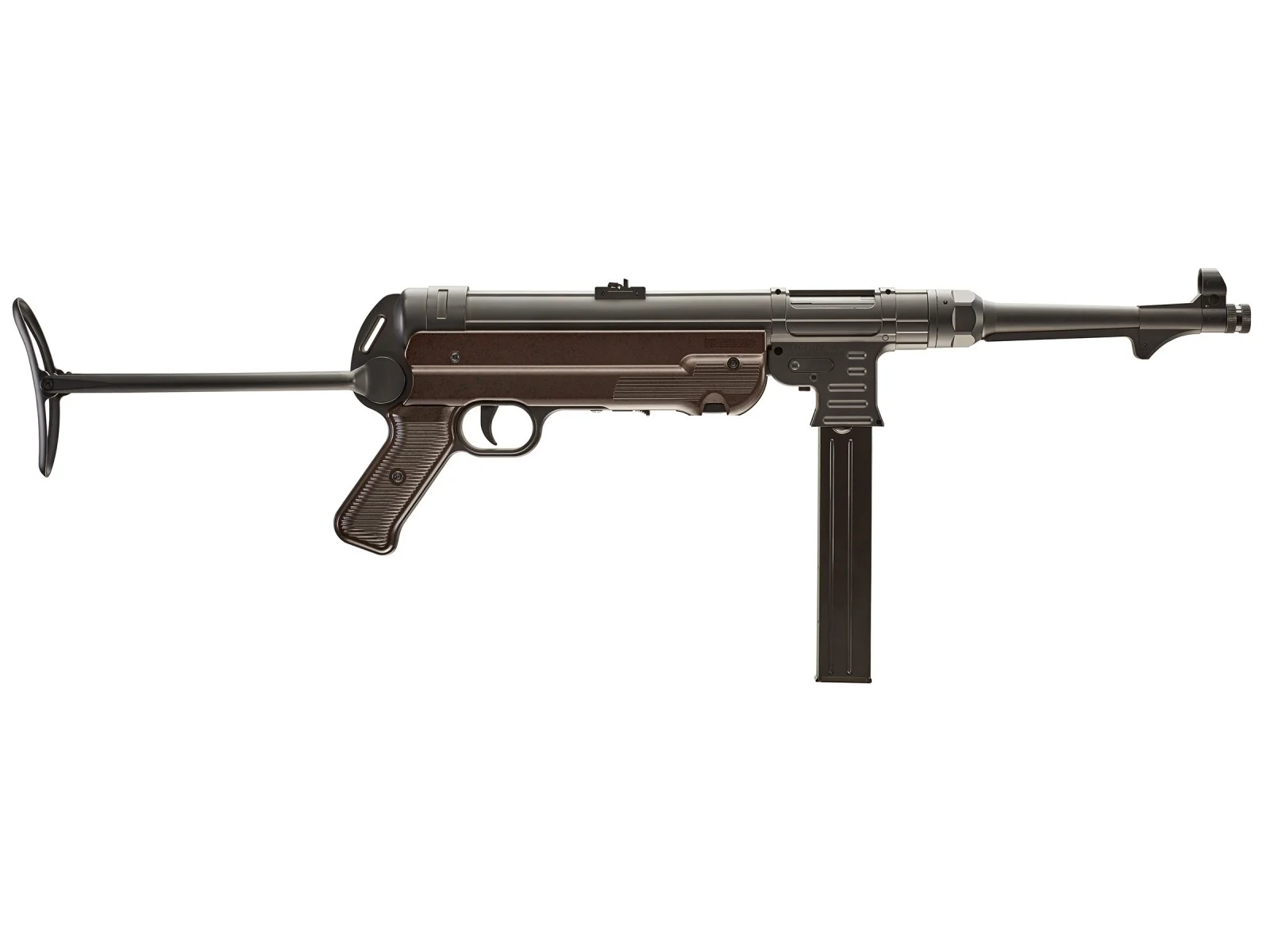
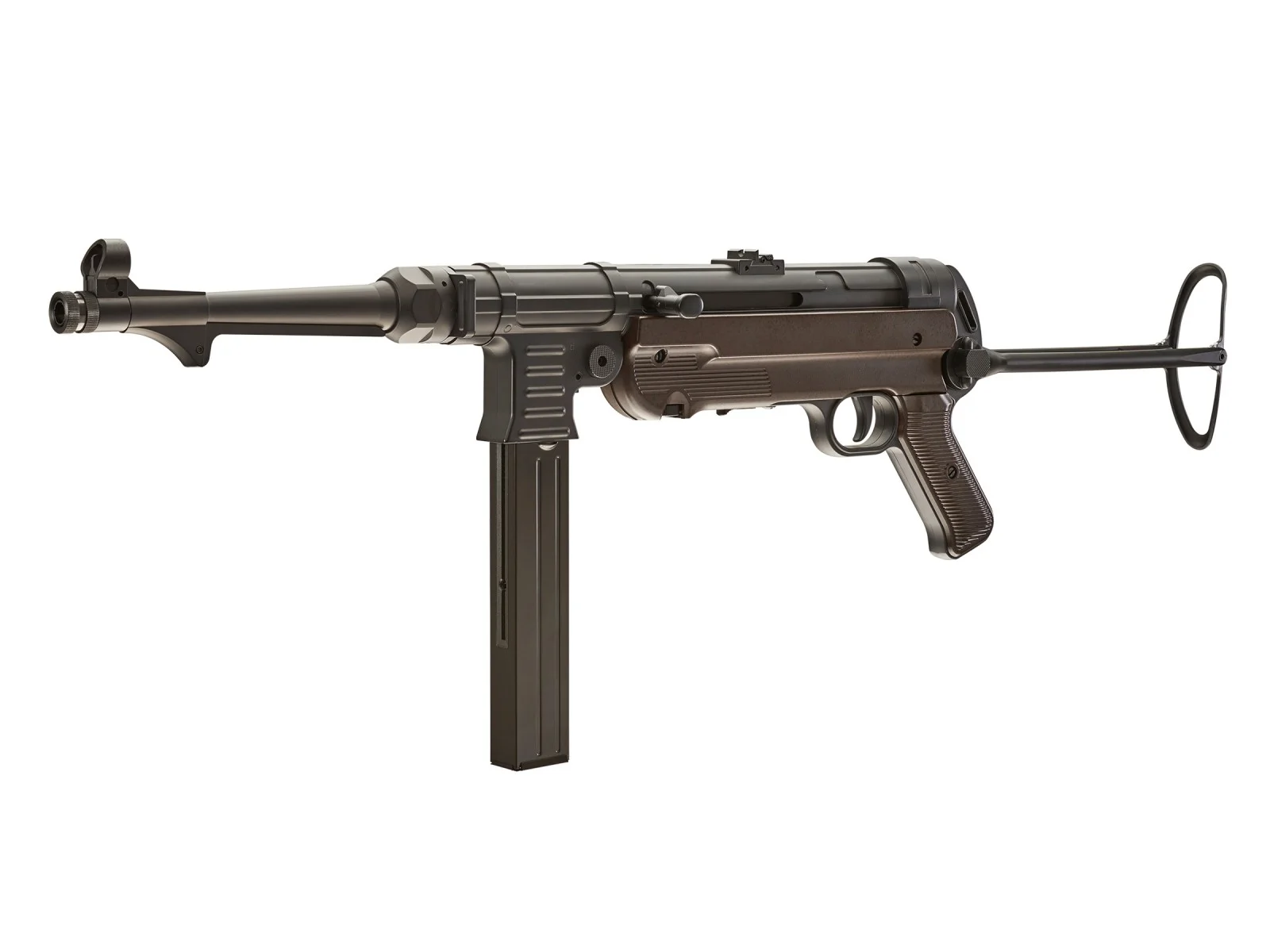
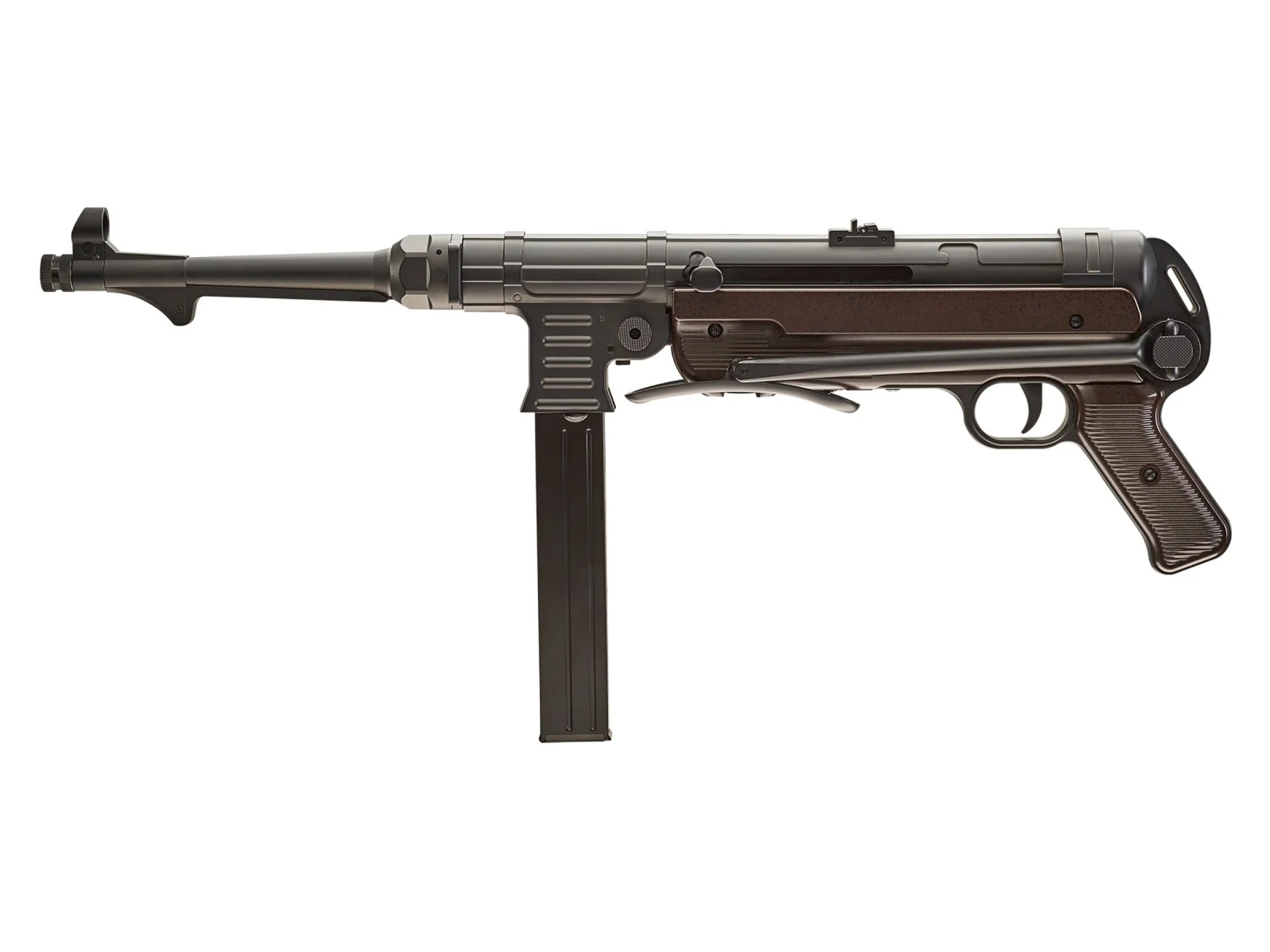
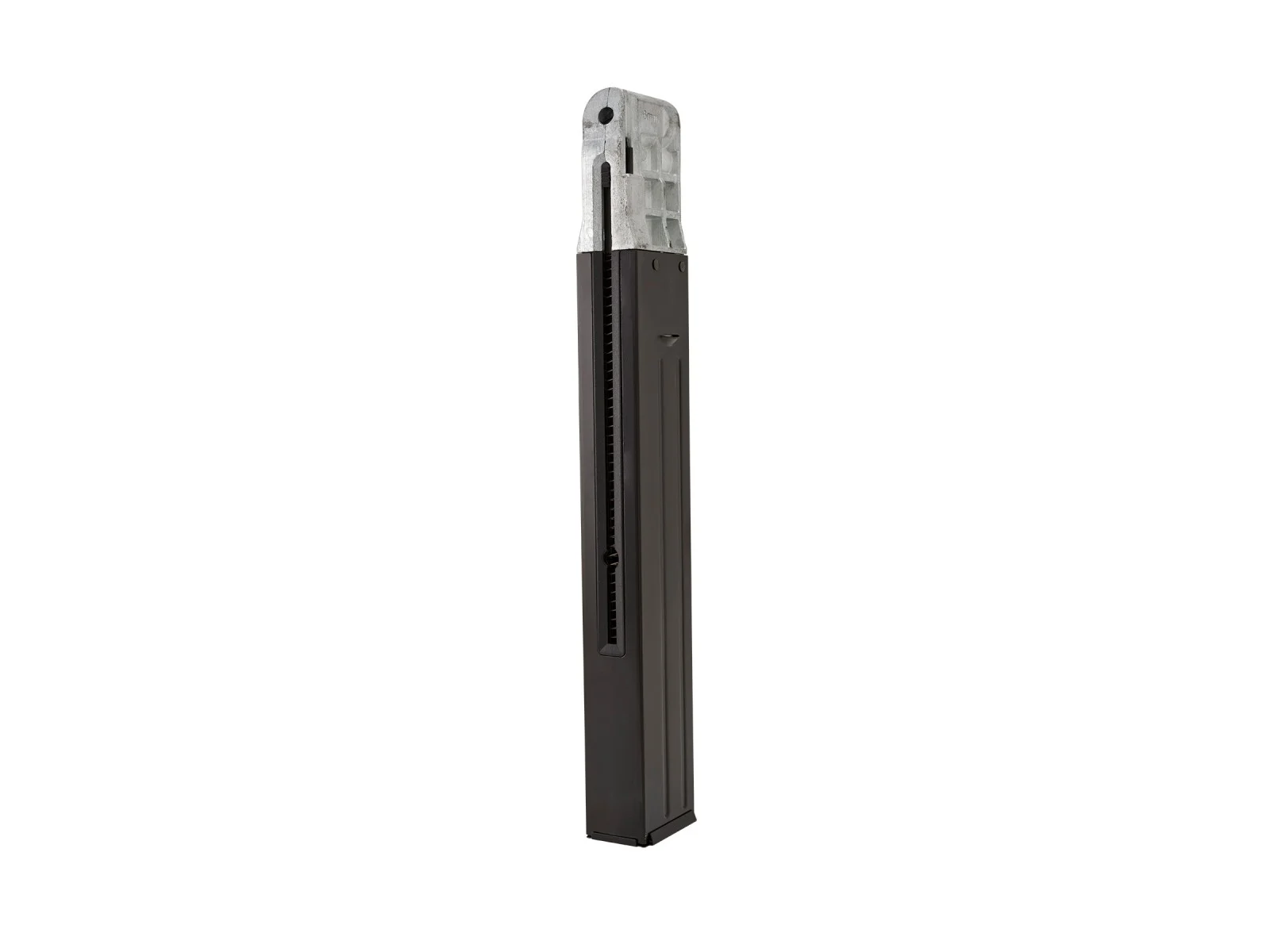
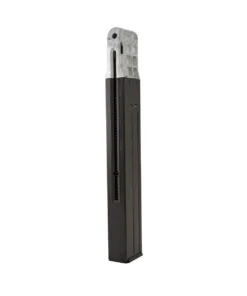
Umarex Legends MP40 CO2 BB Submachine Gun
$200.00
Description
For years the Legends series by Umarex has brought historic firearms to life as airgun replicas for shooting enthusiasts.
Now Umarex has created their very own German MP40 submachine gun replica. This .177 caliber BB rifle promises hours of fun with a 52 round magazine and full auto capability! Powered by two 12 gram CO2 cartridges, simply select full or semi-automatic firing, and mow down tin cans like never before.
The “real steel” MP40 was first developed in 1940 for German paratroopers and later became the standard submachine gun for the Wehrmacht infantry. The Legends MP40 is a faithful replica that will transport you back in time the minute you pick it up. The realism is highlighted by the full metal body and folding shoulder stock. The hooded front sight and adjustable rear sight stay true to the original design and keep your eyes on the prize.
Umarex Legends MP40 Submachine Gun
- Distinctive German replica
- Two firing modes: Full-Auto and Semi-Auto
- Uses (2) 12-gram CO2 cartridges
- Blowback
- 52rd BB magazine (.177 caliber)
- Full metal with polymer grip
- Fixed front sight
- Adjustable rear sight for elevation
- Folding stock
- Manual safety
Specifications
BrandUmarex
Caliber.177 (4.5mm)Max Velocity450 fpsSuggested forPlinking/FunPowerplantCO2Loudness3-MediumNoise Level83.36 dB Weight7.7 lbsFunctionRepeaterActionSemi/Full-autoFixed/adj. powerFixedBlowbackYesScopeableNoFront SightsPostRear SightsAdjustable for elevationSafetyManualBarrelSmooth boreBarrel Length10.0″Overall Length24.5″Capacity52 round(s)Body TypeSubmachine gunStockSyntheticMaterialMetal/ABS plasticButtplateAdjustableAmmunition5.1gr BBColorBlackGrip OrientationAmbidextrousMagazine Included1UpgradesLegends MP40
Umarex Legends MP40 CO2 BB Submachine Gun
Introduction to the Umarex Legends MP40
The Umarex Legends MP40 CO2 BB Submachine Gun is a detailed pneumatic replica inspired by the historically recognized German MP40. Developed for the Legends collection, this model combines distinctive historical styling with modern CO2-powered technology.
Manufactured by Umarex, the replica features a substantial metal exterior, folding shoulder stock and recognizable MP40-inspired proportions. Furthermore, its traditional appearance makes it particularly relevant to collectors interested in historical military equipment and replica manufacturing.
Unlike conventional spring-powered airguns, this model uses compressed carbon dioxide as its power source. Its construction incorporates a blowback mechanism and a magazine designed to accommodate both the ammunition and CO2 cartridges.
1.2 Historical Inspiration and Design Characteristics
The original MP40 became one of the most recognizable submachine-gun designs associated with the Second World War.
Its distinctive exterior proportions, folding stock and metallic construction have influenced numerous historical reproductions.
The Legends interpretation preserves many recognizable visual characteristics while incorporating modern pneumatic technology.
Consequently, the model occupies an interesting position between historical collecting and contemporary replica manufacturing.
Its metal receiver, folding stock and traditional exterior configuration contribute to its recognizable appearance.
1.3 CO2-Powered Pneumatic Architecture
The product uses two 12-gram CO2 cartridges as its designated power source.
This arrangement distinguishes it from traditional spring-operated air rifles and other pneumatic designs.
The manufacturer specifies a .177-calibre (4.5mm) steel BB configuration.
Furthermore, the system incorporates blowback functionality, reproducing an important mechanical characteristic associated with the historical design.
The CO2 system, magazine assembly and exterior components form part of the manufacturer’s integrated design.
CO2 performance can vary with environmental temperature, cartridge condition and product condition. Therefore, advertised velocity should be understood as a factory specification rather than a guaranteed measurement for every individual example.
1.4 Metal Construction and Exterior Appearance
One of the most recognizable characteristics is its substantial metal construction.
The folding stock contributes to the historical appearance while providing a distinctive exterior configuration.
The product also incorporates a polymer grip section, combining different materials within the overall assembly.
Its front sight is fixed, while the rear sight provides elevation adjustment.
Together, these components preserve the recognizable appearance of the historical reference.
1.5 Magazine Capacity and Ammunition Classification
The manufacturer specifies a 52-round magazine capacity.
The ammunition classification is .177 (4.5mm) steel BB.
Importantly, steel BB ammunition should not be confused with conventional diabolo-shaped airgun pellets.
The smoothbore barrel is designed around the manufacturer’s specified ammunition category.
Compatible accessories and replacement magazines should be identified using the correct product references.
1.6 Published Technical Specifications
The principal factory specifications are listed below.
- Manufacturer: Umarex
- Collection: Legends
- Model: MP40
- Manufacturer SKU: 2251813
- Power source: CO2
- CO2 requirement: Two 12-gram cartridges
- Ammunition: .177-calibre steel BBs
- Magazine capacity: 52 BBs
- Operating modes: Semi-automatic and full-automatic
- Barrel construction: Smoothbore
- Barrel length: 9 inches
- Advertised velocity: Up to 465 FPS
- Weight: Approximately 7.7 lbs
- Overall length: Approximately 24.5–33 inches
- Sights: Fixed front and elevation-adjustable rear
- Stock: Folding metal construction
- Safety: Manual
Specifications should be checked against the exact production version and its accompanying manufacturer documentation.
1.7 Understanding Its Position Within the Umarex Legends Collection
The Legends collection includes several historically inspired pneumatic replicas.
Other recognizable products within the wider Umarex catalogue include the Legends M3 Grease Gun, Umarex MP5, Umarex Hammer, Umarex Gauntlet, Umarex Origin and Umarex Notos.
The manufacturer also produces different product families, including Umarex T4E equipment, Glock-branded airguns and CO2-powered recreational products.
These models have different specifications and operating systems. Therefore, their components and technical characteristics should not be treated as interchangeable.
1.8 Safety, Storage and Product Classification
Although this product is a CO2-powered BB replica, it must be treated as potentially dangerous equipment.
Its realistic appearance also means that it should never be displayed or carried in public in a manner that could cause confusion with an actual firearm.
Eye protection, appropriate backstops, secure storage and compliance with applicable regulations are essential.
Customers should also verify local requirements concerning possession, transportation and use before acquiring the product.
The manufacturer documentation should remain the primary reference for product-specific maintenance and safety requirements.
Construction Quality, Material Engineering, Historical Authenticity, Mechanical Design, Durability and Long-Term Ownership
2.1 Understanding the Engineering Behind the Design
The development of historically inspired mechanical replicas requires a careful balance between visual authenticity, manufacturing consistency and modern material requirements.
Manufacturers must consider how different materials contribute to the overall appearance and structural characteristics of the completed product.
Furthermore, historical designs often contain distinctive exterior details that must be represented accurately while accommodating contemporary manufacturing methods.
This creates an interesting engineering challenge.
Traditional visual characteristics must be maintained without compromising the consistency expected from modern production.
Consequently, the manufacturing process involves several considerations, including material selection, surface finishing, dimensional consistency and component integration.
Each contributes to the overall quality of the finished product.
Another important consideration is the relationship between historical appearance and modern safety requirements.
A successful reproduction should communicate its historical inspiration while remaining clearly identifiable as a contemporary sporting replica.
2.2 Historical Design and Manufacturing Authenticity
Historical reproduction requires more than copying the general silhouette of an older design.
Manufacturers must consider the proportions, exterior materials, surface characteristics and recognizable visual details associated with the original reference.
Furthermore, historical manufacturing methods often differed considerably from contemporary industrial processes.
Modern production facilities employ different materials, machinery and quality-control procedures.
Consequently, historical replicas generally represent an interpretation rather than an exact reproduction of the original manufacturing process.
This distinction is important for collectors.
A modern reproduction may preserve recognizable exterior characteristics while incorporating contemporary materials and mechanical components.
The historical appearance therefore provides the visual identity, while modern manufacturing establishes the actual construction.
Understanding this distinction helps establish realistic expectations when evaluating authenticity.
2.3 Material Selection and Industrial Construction
Material selection plays an important role in the quality of manufactured products.
Engineers consider characteristics such as density, structural strength, corrosion resistance and manufacturing compatibility.
Metallic materials are commonly selected for components requiring particular structural characteristics.
Meanwhile, engineered polymers offer flexibility in exterior design and production consistency.
Different materials also respond differently to environmental exposure.
Humidity, temperature changes and prolonged sunlight may influence their long-term condition.
Consequently, material selection must consider the environment in which the finished product will be stored and maintained.
Another important consideration is the relationship between adjoining materials.
Where metallic and polymer components meet, appropriate manufacturing tolerances help preserve their intended compatibility.
Ultimately, the quality of a finished assembly depends on the selection and integration of suitable materials.
2.4 Understanding Metallic Construction
Metal remains an important material in the manufacture of traditional mechanical products.
Its physical properties make it suitable for applications requiring particular combinations of rigidity and structural stability.
However, different metal alloys possess different characteristics.
Some offer greater corrosion resistance, while others provide particular manufacturing or structural advantages.
Furthermore, surface treatments influence appearance and environmental preservation.
The quality of metallic construction should therefore be evaluated through material specifications and manufacturing documentation rather than appearance alone.
Surface condition can provide useful information, but it cannot independently establish the quality of an internal component.
Environmental exposure may also influence metallic surfaces over time.
Moisture and unsuitable storage conditions can contribute to corrosion.
Consequently, appropriate preservation remains important throughout the ownership period.
2.5 Polymer Components and Contemporary Materials
Engineered polymers have transformed many areas of industrial manufacturing.
They allow manufacturers to produce complex exterior shapes with relatively consistent dimensions.
Furthermore, different polymer formulations can provide particular combinations of rigidity, flexibility and environmental resistance.
Nevertheless, not all polymers possess identical properties.
Their characteristics depend on material composition, manufacturing processes and finishing treatments.
Prolonged ultraviolet exposure may contribute to deterioration in certain formulations.
Similarly, unsuitable cleaning substances may affect surface appearance.
Consequently, owners should follow the manufacturer’s preservation recommendations.
Another consideration is the connection between polymer and metallic components.
These interfaces require suitable dimensional compatibility.
Ultimately, contemporary polymer technology provides useful manufacturing opportunities when supported by appropriate quality assurance.
2.6 Surface Finishing and Exterior Presentation
Surface finishing contributes significantly to the visual quality of manufactured products.
Different techniques may be employed depending on the material and intended appearance.
These processes can influence colour consistency, texture and resistance to ordinary environmental exposure.
Furthermore, finishing quality can affect how the completed product is perceived.
However, exterior appearance should not be confused with structural integrity.
A visually attractive finish cannot establish the condition of internal assemblies.
Likewise, minor cosmetic deterioration does not automatically indicate a significant mechanical problem.
Appropriate preservation is therefore important.
Abrasive cleaning substances and unsuitable chemicals may damage certain surfaces.
Owners should consult manufacturer recommendations before using cleaning products.
Where substantial deterioration or suspected structural damage appears, professional evaluation is appropriate.
2.7 Dimensional Accuracy and Manufacturing Consistency
Manufacturing consistency is essential when producing mechanical assemblies.
Components must correspond with established engineering dimensions and production requirements.
Manufacturers use different inspection procedures to maintain acceptable dimensional standards.
These may include specialized measuring instruments and computer-controlled inspection equipment.
Furthermore, material consistency influences the reliability of manufacturing results.
Different production batches may also incorporate technical revisions.
Consequently, two products that appear similar may not necessarily contain identical components.
This is particularly important when identifying replacement parts.
Accurate product documentation helps establish the correct manufacturing configuration.
Ultimately, dimensional accuracy contributes to the consistency and integrity of the finished assembly.
2.8 Quality Assurance and Factory Inspection
Quality assurance involves establishing procedures that help maintain manufacturing standards.
These procedures may include material verification, visual assessment and dimensional inspection.
Furthermore, production documentation helps establish traceability.
Traceability becomes particularly important when manufacturers introduce revisions or identify manufacturing irregularities.
However, no inspection process eliminates every possibility of future deterioration.
Products remain subject to environmental exposure, accidental damage and material aging.
Consequently, appropriate preservation and professional assessment remain important.
Manufacturers may also maintain procedures for responding to legitimate customer concerns.
These procedures help identify potential manufacturing issues and establish appropriate technical support.
Ultimately, consistent manufacturing depends on systematic inspection and documented quality standards.
2.9 Mechanical Components and Product Integration
A completed mechanical product consists of multiple interconnected assemblies.
Each component contributes to the overall construction.
Consequently, material compatibility and manufacturing consistency are important considerations.
Different production generations may incorporate revised components.
Therefore, visually similar replacement parts should not automatically be considered interchangeable.
Accurate identification remains essential.
Authorized technical support can help establish the correct component references.
Furthermore, existing components may experience deterioration through environmental exposure or accidental damage.
Professional assessment is appropriate whenever structural condition becomes uncertain.
Owners should avoid unauthorized modifications that could compromise the original manufacturing arrangement.
Ultimately, component compatibility helps preserve the integrity of the completed assembly.
2.10 Understanding Mechanical Wear and Aging
Mechanical wear is a natural consideration in products containing moving components.
Repeated use, environmental contamination and material aging can influence individual assemblies.
However, different materials experience different forms of deterioration.
Metallic surfaces may develop corrosion, while polymer materials may experience environmental aging.
Protective finishes can also deteriorate through ordinary handling.
Consequently, product condition should be assessed individually rather than assumed from age alone.
Storage history is another important consideration.
A well-preserved older product may have a different condition from a newer example that has experienced unsuitable storage.
Professional inspection can help establish the condition of important components.
Ultimately, understanding material aging helps owners develop realistic expectations regarding long-term preservation.
2.11 Professional Inspection and Maintenance
Professional inspection supports responsible ownership.
Qualified technicians may examine exterior condition, identify visible deterioration and assess whether further technical attention is required.
However, external appearance cannot establish the condition of every internal assembly.
Consequently, suspected mechanical damage should receive appropriate professional evaluation.
Manufacturer documentation should remain the primary reference for maintenance requirements.
Unauthorized disassembly or modification may introduce unnecessary hazards.
Furthermore, specialist products may require service arrangements that are not available through ordinary repair facilities.
Owners should therefore identify suitable technical support before purchasing.
Keeping professional maintenance records can also provide useful information about the product’s history.
Ultimately, qualified servicing contributes to responsible long-term preservation.
2.12 Genuine Replacement Components
Replacement components should correspond with the original manufacturer’s specifications.
This is particularly important when products incorporate specialized mechanical assemblies.
Visually similar components may differ in material composition, dimensions or manufacturing generation.
Consequently, compatibility should not be established through photographs alone.
Accurate identification helps determine suitable replacement references.
Authorized distributors may provide additional technical assistance.
Furthermore, genuine components are intended to preserve the original design relationships between assemblies.
Unauthorized substitutions may introduce compatibility concerns.
Customers should retain original purchase records and product identification information.
These documents can simplify technical inquiries.
Ultimately, genuine replacement components contribute to maintaining manufacturing consistency.
2.13 Product Authenticity and Identification
Authenticity is an important consideration when purchasing historical reproductions.
A genuine product should correspond with the manufacturer’s identification information and official documentation.
However, exterior appearance alone cannot establish authenticity.
Customers should consider retailer credibility, product provenance and accompanying documentation.
Furthermore, different manufacturing generations may contain visible or less obvious variations.
Consequently, the exact production configuration should be established before purchasing replacement components.
Retailers should provide accurate product descriptions and photographs.
Customers should also retain original receipts and warranty information.
These records may become useful when requesting manufacturer assistance.
Ultimately, authenticity depends on reliable identification and credible distribution.
2.14 Packaging and Transportation Protection
Packaging protects manufactured products during storage and transportation.
Appropriate packaging helps reduce exposure to accidental impacts, abrasion and environmental contamination.
Furthermore, protective materials can help preserve exterior finishes.
Transportation requirements may differ according to the product’s legal classification and destination.
Consequently, customers should confirm applicable carrier restrictions before arranging shipment.
International transportation may involve customs documentation and additional regulatory requirements.
Retailers should communicate these conditions clearly.
Another consideration is the retention of original packaging.
Original packaging may provide useful product identification information and protection during lawful transportation.
Ultimately, appropriate packaging contributes to preservation and responsible commercial distribution.
2.15 Storage and Environmental Preservation
Environmental conditions influence the long-term condition of mechanical products.
Humidity, temperature fluctuations and airborne dust introduce different preservation challenges.
Moisture may encourage corrosion on susceptible metallic surfaces.
Similarly, prolonged ultraviolet exposure may affect certain polymer materials.
Consequently, storage recommendations should correspond with the manufacturer’s documentation.
Secure storage is equally important.
Appropriate arrangements help prevent unauthorized access and accidental damage.
Owners should also consider environmental changes during transportation.
Sudden temperature differences may contribute to condensation.
Ultimately, suitable storage and environmental care help preserve material condition and exterior appearance.
2.16 Warranty Protection and Customer Support
Warranty coverage represents an important part of the ownership experience.
Manufacturers and distributors may provide protection against specified manufacturing defects.
However, warranty arrangements differ according to the product and purchasing jurisdiction.
Customers should therefore review the applicable conditions before completing a transaction.
Important considerations include coverage duration, exclusions and authorized servicing requirements.
Furthermore, unauthorized modifications may affect warranty eligibility.
Accidental damage and unsuitable maintenance may also fall outside standard coverage.
Customers should retain original purchase receipts and identification documentation.
These records may simplify legitimate service inquiries.
Another important consideration is the availability of authorized technical support.
A retailer with established service arrangements may provide a more convenient ownership experience.
2.17 Understanding the Importance of Manufacturer Documentation
Manufacturer documentation provides important information about a product’s original construction.
It may include technical specifications, identification details, material information and maintenance requirements.
Furthermore, documentation can help distinguish different production generations.
This becomes particularly important when manufacturers introduce revisions.
Two visually similar products may contain different factory components.
Consequently, documentation should correspond with the exact example being purchased or serviced.
Customers should retain original documents whenever possible.
Digital copies may also provide convenient access.
However, unofficial online descriptions should not automatically replace manufacturer instructions.
Authorized technical assistance remains the preferred source when uncertainty concerns structural condition or compatibility.
Ultimately, accurate documentation supports informed ownership.
2.18 Historical Collecting and Display Considerations
Historical reproductions can hold particular interest for collectors because they represent recognizable designs from earlier periods.
Their appeal may involve historical significance, exterior craftsmanship and the relationship between original designs and contemporary manufacturing.
However, a modern reproduction should be distinguished from an original historical artifact.
Differences in production dates, materials and manufacturing methods are important.
Collectors should therefore examine product documentation carefully.
Provenance can also influence historical interest.
Accurate records help establish the identity and manufacturing background of an individual example.
Display arrangements deserve attention as well.
Realistic replicas should be displayed responsibly and should never be presented in a manner that could create confusion with an actual firearm.
Ultimately, accurate identification and responsible presentation contribute to an informed collecting experience.
2.19 Responsible Ownership and Legal Compliance
Legal classification is an essential consideration when purchasing regulated sporting replicas.
Different jurisdictions establish different requirements concerning possession, transportation, storage and authorized activities.
Consequently, prospective owners should verify applicable legislation before purchasing or importing a product.
Manufacturer descriptions do not replace local legal requirements.
International transportation may also introduce customs or authorization considerations.
Customers should consult competent authorities when requirements are uncertain.
Secure storage is equally important.
Appropriate arrangements help prevent unauthorized access.
Furthermore, regulations may change over time.
Owners should remain informed about applicable requirements throughout the ownership period.
Ultimately, responsible ownership combines legal compliance, secure storage and appropriate product identification.
2.20 Financial Considerations and Long-Term Ownership
The initial purchase price represents only one element of the overall financial commitment.
Additional considerations may include secure storage, professional inspection and authorized servicing.
Furthermore, replacement component availability may influence long-term ownership costs.
Consequently, customers should investigate technical support arrangements before making a purchasing decision.
Warranty coverage deserves similar attention.
Buyers should understand the conditions and exclusions associated with their purchase.
Product authenticity and individual condition may also influence long-term value.
However, future resale values cannot be guaranteed.
Market conditions, product availability and regulatory changes may affect demand.
Ultimately, informed financial planning helps establish realistic ownership expectations.
2.21 Technological Development in Modern Replica Manufacturing
Contemporary replica manufacturing continues to develop through improvements in material science and industrial production.
Computer-controlled machinery can improve dimensional consistency.
Furthermore, modern inspection systems help identify manufacturing irregularities.
Advances in engineered polymers and metallic finishing also provide additional manufacturing possibilities.
However, technological innovation should be evaluated through measurable improvements rather than promotional terminology.
A newly introduced material does not automatically provide superior performance in every application.
Its suitability depends on the intended engineering requirements.
Furthermore, long-term reliability requires appropriate testing and quality assurance.
Manufacturers must consider the relationship between innovation, component compatibility and future serviceability.
Ultimately, successful manufacturing development combines technological improvements with dependable production standards.
2.22 Evaluating Exterior Condition
Exterior condition provides useful information when examining previously owned equipment.
Customers should distinguish ordinary cosmetic marks from signs of potentially significant deterioration.
Surface scratches, finish variation and minor handling marks may be cosmetic.
However, deformation, substantial corrosion or damaged structural components deserve further assessment.
Photographs can help establish general appearance, but they cannot independently verify internal condition.
Consequently, professional inspection may be appropriate when purchasing used examples.
Another important consideration is the product’s maintenance history.
Previous servicing and storage conditions can influence its present condition.
Customers should request accurate descriptions rather than relying exclusively on promotional photographs.
Ultimately, informed evaluation requires both visual assessment and reliable documentation.
2.23 The Importance of Product Traceability
Product traceability helps establish manufacturing identity and commercial history.
Identification information can assist manufacturers and distributors when responding to technical inquiries.
Furthermore, traceability may help distinguish different production generations.
This is particularly useful when identifying documentation or replacement components.
Customers should retain purchase receipts and relevant product records.
Authorized distributors may also provide assistance with product identification.
However, identification information should be handled responsibly.
Customers should avoid publishing private purchasing documentation unnecessarily.
Ultimately, traceability contributes to accurate technical support and responsible product ownership.
2.24 Long-Term Preservation and Responsible Care
Long-term preservation involves following manufacturer recommendations and maintaining appropriate records.
Owners should avoid unsuitable environmental exposure and unauthorized modifications.
Furthermore, professional servicing may be necessary when structural concerns arise.
Secure storage remains an important responsibility.
Customers should also retain original documentation and warranty information.
Another consideration is the availability of genuine replacement components.
Products supported by established distribution networks may offer a more predictable ownership experience.
Legal compliance should be reviewed periodically because applicable regulations may change.
Ultimately, responsible preservation involves appropriate storage, accurate documentation and qualified technical support.
2.25 Final Assessment of Construction Quality and Ownership
The overall quality of a historically inspired mechanical replica reflects the combined contributions of material science, precision manufacturing and design interpretation.
Metallic construction contributes particular structural characteristics, while engineered polymers provide additional manufacturing possibilities.
Furthermore, surface finishing and dimensional consistency contribute to the appearance and integrity of the completed assembly.
However, manufacturing quality alone does not eliminate the responsibilities associated with ownership.
Environmental preservation, secure storage and appropriate maintenance remain important.
Prospective owners should examine authentic documentation and establish whether suitable technical support is available.
They should also distinguish historical appearance from original historical manufacturing Umarex Legends MP40 CO2 BB Submachine GunUmarex Legends MP40 CO2 BB Submachine GunUmarex Legends MP40 CO2 BB Submachine GunUmarex Legends MP40 CO2 BB Submachine GunUmarex Legends MP40 CO2 BB Submachine
GunUmarex Legends MP40 CO2 BB Submachine GunUmarex Legends MP40 CO2 BB Submachine GunUmarex Legends MP40 CO2 BB Submachine GunUmarex Legends MP40 CO2 BB Submachine GunUmarex Legends MP40 CO2 BB Submachine GunUmarex Legends MP40 CO2 BB Submachine Gun.
Ultimately, responsible ownership depends on accurate product identification, reliable documentation, appropriate preservation and continued compliance with applicable regulations Umarex Legends MP40 CO2 BB Submachine GunUmarex Legends MP40 CO2 BB Submachine GunUmarex Legends MP40 CO2 BB Submachine GunUmarex Legends MP40 CO2 BB Submachine GunUmarex Legends MP40 CO2 BB Submachine Gun
Umarex Legends MP40 CO2 BB Submachine GunUmarex Legends MP40 CO2 BB Submachine GunUmarex Legends MP40 CO2 BB Submachine GunUmarex Legends MP40 CO2 BB Submachine GunUmarex Legends MP40 CO2 BB Submachine Gun Umarex Legends MP40 CO2 BB Submachine GunUmarex Legends MP40 CO2 BB Submachine GunUmarex Legends MP40 CO2 BB Submachine GunUmarex Legends MP40 CO2 BB Submachine GunUmarex Legends MP40 CO2 BB Submachine GunUmarex Legends MP40 CO2 BB Submachine GunUmarex Legends MP40 CO2 BB Submachine Gun.
Be the first to review “Umarex Legends MP40 CO2 BB Submachine Gun”
Related products
umarex AirRifle
umarex AirRifle

umarex AirRifle
umarex AirRifle
umarex AirRifle
Reviews
There are no reviews yet.