
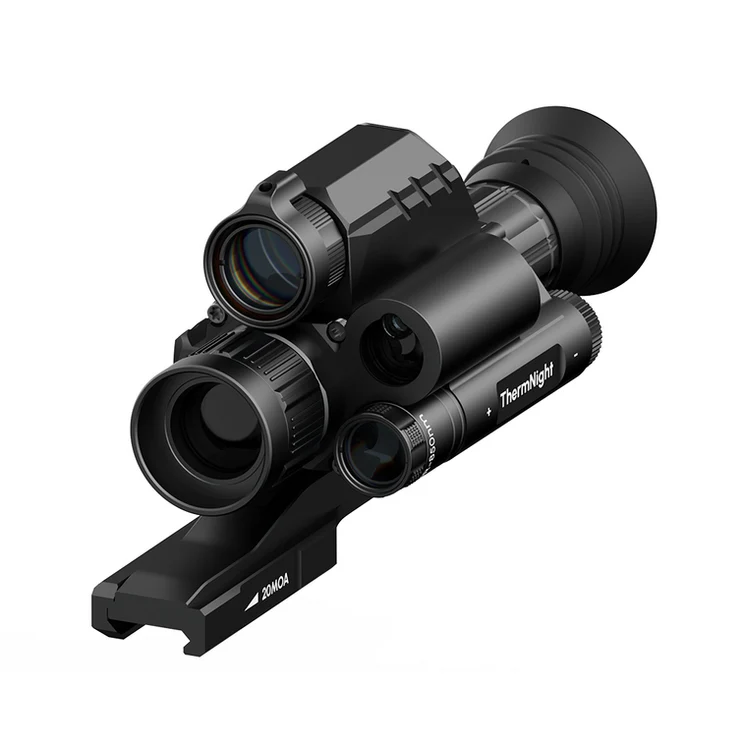
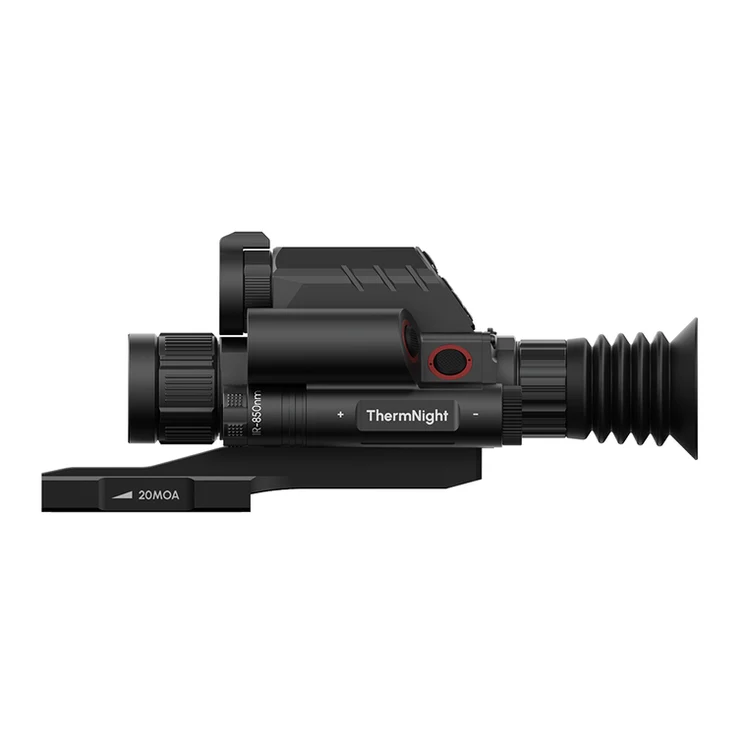
DNT Optics ThermNight Thermal & Night Vision Scope w/ LRF & Balistics

$1,000.00
Discover a New Dimension of Vision with the DNT Thermnight TNC225R
Elevate your shooting experience with the DNT Thermnight TNC225R Thermal & Night Vision Multispectral Scope. This advanced optic is one of the first of its kind, offering an affordable multi-spectral solution for both thermal identification and clear night vision target acquisition. With its integrated laser rangefinder (LRF) and ballistic calculator, accessible through a dedicated companion app, the TNC225R is an essential tool for outdoor enthusiasts, hunters, and professionals alike.
Key Features
SEE IT ALL, ANYTIME, ANYWHERE!
- Multi-Spectral Channel Design: Combines thermal and night vision capabilities for comprehensive target identification in all conditions.
- 256×192 12-Micron Thermal Sensor: Offers high-resolution thermal imaging, capturing fine details in low-light environments.
- Sony Starvis 2 Optical Sensor: Delivers exceptional clarity in visible light and infrared, enhancing target detection at any time of day.
INTEGRATED LASER RANGEFINDER AND BALLISTIC CALCULATOR
- 1000M Laser Rangefinder: Accurately measure distances up to 1000 meters, critical for long-range shooting and precision targeting.
- Inbuilt VCSEL IR Illuminator (850NM): Provides the longest viewing range, ensuring visibility even in complete darkness.
EXCEPTIONAL IMAGE QUALITY AND VERSATILITY
- Digital Zoom: Offers multiple levels (3x, 6x, 9x, 12x) of magnification for both thermal and night vision modes.
- Micro-OLED Display: Features a 1920×1080 resolution, delivering crisp and clear visuals with a smooth 50FPS frame rate.
BUILT TO LAST IN ANY ENVIRONMENT
- Robust and Compact Design: Lightweight yet durable, perfect for rugged outdoor use.
- IP67 Waterproof Rating: Ensures reliable performance in harsh weather conditions.
Enhanced User Experience
- Eye Relief: Comfortable 45mm eye relief with adjustable diopter settings (+5D) for personalized focus.
- Extended Battery Life: Up to 5 hours of operation with a standard 18650 flat-top battery, with additional power options via 5V Type-C USB.
Complete with Essential Accessories
- Internal 32GB Storage: Plenty of space for storing videos and images captured during your excursions.
- WiFi/App Support: Seamlessly connect to the DNT app for enhanced control and functionality.
Technical Specifications
Thermal Sensor:
- Resolution: 256×192 pixels
- Pixel Size: 12x12um
- Base Magnification: 3x
- Image Sensor: Uncooled Infrared Image Sensor
- NETD: ≤25mk@25°C
- Digital Zoom: 3x, 6x, 9x, 12x
- Frame Rate: 50FPS
- Focal Length of Objective Lens: 25mm
Night Vision / Visible Light Sensor:
- Resolution: 1920×1080 pixels
- Base Magnification: 5x
- Image Sensor: Sony Starvis 2
- Digital Zoom: 5x, 7.5x, 10x, 12x, 15x, 17.5x, 20x
- Frame Rate: 60FPS
- Focal Length of Objective Lens: 52mm
- Infrared Power: <5W
Optics:
- Eye Relief: 45mm
- Diopter Adjustment: +5D
- Max LRF Range: 1000m
Display:
- Type: Micro-OLED
- Resolution: 1920×1080 pixels
- Frame Rate: 50FPS
Power:
- Battery Type: 18650 Flat-top
- Operating Time: Up to 5 hours (battery dependent)
- External Power: 5V Type-C USB
Physical:
- Weight: 635g
- Dimensions: 171x79x76mm
- IR Wavelength: 850nm
- Ingress Protection: IP67
- Storage: Internal 32GB
- WiFi/App: Supported by DNT
- Operating Temperature: -20 to 50°C
Includes:
- Standard DNT Picatinny Rail (Alternatives are available )
- Rear Eye Maximizer
- Charging/Data Cable
Note: 18650 (Flat Top) Batteries are NOT INCLUDED.
DNT recommends using reputable manufacturers for optimal performance.
DNT Optics ThermNight Thermal & Night Vision Scope with LRF and Ballistic Calculator – Advanced Multispectral Imaging, Digital Clarity and Smart Optical Technology
DNT Optics ThermNight Thermal & Night Vision Scope with LRF and Ballistic Calculator – Advanced Multispectral Imaging Technology
The DNT Optics ThermNight Thermal & Night Vision Scope with LRF and Ballistic Calculator combines two advanced imaging technologies within a compact electronic optical platform.
Developed for users interested in sophisticated thermal imaging, digital observation, and integrated electronic features, the ThermNight series incorporates infrared sensing, visible-light image processing, and a high-resolution electronic display DNT Optics ThermNight Thermal & Night Vision Scope w/ LRF & Balistics.
Unlike conventional glass-only optics, this multispectral instrument produces images using specialized sensors and digital processing.
Furthermore, the combination of thermal and digital channels provides two distinct ways of viewing the surrounding environment.
Thermal imaging responds to temperature-related differences in emitted infrared radiation. Meanwhile, digital imaging uses an electronic image sensor to produce detailed representations of visible scenes.
Consequently, the instrument offers a combination of modern detection technology and high-definition digital imaging.
The product family also includes an integrated laser rangefinder, onboard ballistic-calculation functionality, image recording, and wireless connectivity.
However, exact specifications vary between the TNC225R, TNC335R, and TNC635R configurations.
Advanced Thermal Imaging and Heat-Signature Detection
The thermal channel incorporates an uncooled infrared detector that converts thermal radiation into electronic image information.
Furthermore, digital processing helps generate recognizable thermal patterns on the display.
This technology has practical applications in lawful wildlife observation, environmental monitoring, and controlled outdoor research.
However, thermal imaging cannot independently establish the identity of every object or reliably reveal details through all obstructions.
Digital Night Vision and High-Definition Image Processing
The digital imaging channel incorporates an electronic sensor designed to reproduce visual details under suitable illumination.
Furthermore, the higher-tier TNC335R and TNC635R models feature Sony STARVIS 2 technology alongside a high-resolution Micro-OLED display.
The electronic imaging system differs fundamentally from conventional optical magnification because it uses sensor data and digital processing.
Integrated Rangefinding and Electronic Features
The product family incorporates a built-in laser rangefinder capable of displaying distance measurements.
Additionally, the manufacturer includes onboard ballistic calculation functionality.
These functions are separate from the thermal and digital imaging channels and require the appropriate model configuration.
The system also supports digital recording and wireless features, allowing compatible media and device functions to be managed electronically.
Optical Retailers, Mounting Standards and Accessory Research
Related search phrases include optics warehouse, optic warehouse, red dot uk, picatinny, picatinny dimensions, 1913 rail, what is a picatinny rail, and scope mount.
Additional terms include difference between weaver and picatinny rail, parker hale scope rings for sale, bipod for rifle, and best rifle bipod for long range shooting.
These expressions concern separate mounting standards, retailers, and equipment categories. They do not establish compatibility with this electronic instrument.
Optical Technology, Illumination and Measurement Terminology
Related technical searches include zero stop scope, what is zero stop on a scope, scope illumination, what is parallax in optics, ballistic solver, and chrony chronograph.
Additional phrases include sniper hider, ir illuminator, and prs spotting scope setups.
These terms represent different optical concepts and technologies, not necessarily features included with every configuration.
Premium Optical Brands and Product Comparisons
Other research expressions include minotaur 10-50×60, swfa ss 10×42, delta stryker, delta optics, element optics, schmidt and bender scopes, and falcon optics.
Further searches include march riflescope adjustments argon filled d42hv56wfml g2 and dnt optics review.
However, conventional glass-based optical systems and electronic multispectral instruments have fundamentally different operating characteristics.
Digital Night Vision and Thermal Imaging Alternatives
Related product searches include hikmicro stellar sx60l thermal scope, best digital night vision scope, and best night vision scope.
When comparing electronic imaging instruments, important considerations include sensor resolution, display quality, thermal sensitivity, recording features, and environmental protection.
BinTac Sporting Equipment and Alternative Research
Separate product searches include bintac t9, bintac, bintac lIc, bintac m50, bintac t9 price, bin tac, bintaclic, bintac t 50, and b&w m50.
Additional expressions include bintac mcar, bintac mcar air rifle, bintac mcar 457, bintac t50, bintac t50 for sale, and bintac m50 for sale.
Further terms include bintac s45 aea and bintac s45 for sale.
These phrases refer to separate sporting equipment rather than technical specifications of the featured multispectral instrument.
AEA Sporting Equipment and Related Product Research
Other searches include aea harpoon, aea harpoon price, AEA Zeus MKII (Bullpup) Standard 18 Big Bore, bintac aea harpoon, aea airguns, aea megalodon, harpoon for sale, and aea harpoon magnum.
These product names have independent specifications and legal classifications.
They should not be confused with the electronic imaging equipment described here.
Technical Specifications and Available Model Configurations
Thermal Imaging Specifications
The product family includes three principal configurations with different detector resolutions.
| Feature | TNC225R | TNC335R | TNC635R |
|---|---|---|---|
| Thermal resolution | 256 × 192 | 384 × 288 | 640 × 512 |
| Thermal sensor type | Uncooled infrared | Uncooled VOx | Uncooled VOx |
| Pixel pitch | 12 μm | 12 μm | 12 μm |
| Thermal refresh rate | 50 Hz | 50 Hz | 50 Hz |
| Thermal sensitivity | ≤25 mK | ≤18 mK | ≤18 mK |
Digital Imaging and Display Technology
The TNC225R incorporates a 1920 × 1080 digital imaging channel alongside a 1024 × 768 Micro-OLED display.
Meanwhile, the TNC335R and TNC635R incorporate Sony STARVIS 2 digital sensing technology and a 1920 × 1080 Micro-OLED display.
Furthermore, the higher-tier models support a 60 Hz digital imaging channel and 50 Hz thermal imaging.
These figures describe sensor and display characteristics rather than guaranteed image detail under every environmental condition.
Electronics, Battery and Construction
The TNC225R includes 32GB of internal storage, an 18650 rechargeable battery, and a manufacturer-stated operating duration of up to five hours.
Additionally, it features an IP67 environmental protection rating and a compact housing weighing approximately 22.8 ounces.
The TNC335R and TNC635R product listings describe 64GB internal storage, rechargeable power, wireless connectivity, and protected exterior construction.
The manufacturer also documents detachable infrared illumination and picture-in-picture imaging functionality across the series, subject to model configuration.
Why Consider This Advanced Multispectral Imaging System?
The ThermNight family offers a distinctive combination of infrared detection, electronic night vision, distance measurement, image recording, and integrated digital technology.
Furthermore, its available detector resolutions give customers different options when comparing imaging performance and budget requirements.
The electronic display, image processing, and wireless features also distinguish the instrument from traditional daylight optics.
For lawful observation, outdoor research, and technology-focused visual applications, the combination of multiple imaging channels can offer practical benefits.
Ultimately, the product family’s appeal lies in its sophisticated electronic architecture, carefully designed sensors, compact construction, and extensive digital features.
Advanced Multispectral Imaging, Digital Sensor Technology, Electronic Engineering, Environmental Durability and Long-Term Ownership
2.1 Advanced Multispectral Imaging and Modern Digital Engineering
Modern electronic imaging technology combines specialized sensors, intelligent processing systems, sophisticated display components, and durable structural materials. Together, these elements create instruments capable of presenting visual information through different forms of electromagnetic radiation.
The featured equipment incorporates separate imaging channels within a coordinated electronic architecture. Each channel performs a distinct function while contributing to the overall viewing experience.
Furthermore, modern processor technology allows complex electronic information to appear on a compact display.
However, sophisticated digital construction cannot guarantee identical image quality under every environmental condition. Temperature differences, atmospheric moisture, lighting, and sensor characteristics influence results.
Consequently, the overall quality of an electronic optical instrument depends on several interacting technologies rather than one isolated specification.
The combination of advanced sensing components and carefully manufactured hardware demonstrates the continuing development of contemporary digital observation equipment.
2.2 Understanding Thermal Radiation and Image Formation
Thermal imaging relies on the detection of infrared radiation emitted by objects and surrounding surfaces. Unlike conventional visible-light observation, this technology interprets differences in thermal energy.
Furthermore, specialized detectors convert incoming radiation into electronic signals that an internal processor can transform into recognizable images.
The resulting picture represents relative thermal information rather than the natural colors of the viewed scene.
However, thermal appearance depends on material properties, environmental temperature, atmospheric conditions, and surface characteristics.
Objects with similar temperatures may appear less distinguishable under certain circumstances.
Consequently, thermal images should not automatically be interpreted as definitive evidence of object identity.
This technology demonstrates how advanced electronic sensing expands the range of information available through modern visual instruments.
2.3 Uncooled Detector Technology and Sensor Construction
Uncooled infrared detectors represent an important development in compact thermal imaging equipment. Their construction allows infrared radiation to be detected without the complex refrigeration systems associated with certain specialized scientific sensors.
Furthermore, modern microbolometer technology converts thermal information into electrical measurements through carefully manufactured sensing elements.
However, detector performance depends on several technical characteristics.
Pixel count, temperature sensitivity, processing algorithms, and environmental conditions contribute to the final image.
Consequently, sensor resolution alone cannot establish overall performance.
The compact construction also requires reliable electronic integration and environmental protection.
The technology illustrates how semiconductor manufacturing and material science contribute to portable observation systems.
Appropriate care helps preserve the original sensor assembly throughout its intended service life.
2.4 Sensor Resolution and Digital Image Definition
Sensor resolution describes the number of individual detection elements available within an electronic imaging array.
A higher pixel count can provide additional spatial information when other relevant factors remain comparable.
Furthermore, carefully designed electronic processing helps translate raw sensor measurements into a visible image.
However, numerical resolution does not automatically guarantee identical clarity in every situation.
Optical quality, thermal contrast, atmospheric conditions, and display characteristics remain important.
Consequently, comparisons between different electronic instruments should consider the complete imaging chain.
A larger sensor array may also place different demands on processing hardware and electronic components.
The relationship between sensing technology and image reproduction demonstrates the complexity of modern digital optical engineering.
2.5 Thermal Sensitivity and Temperature Differentiation
Thermal sensitivity describes an infrared detector’s ability to distinguish small differences in observed thermal radiation.
Manufacturers commonly express this characteristic through noise-equivalent temperature difference measurements.
Furthermore, lower numerical values under comparable test conditions generally indicate an ability to resolve smaller thermal variations.
However, published laboratory figures cannot guarantee identical results in every outdoor environment.
Humidity, atmospheric conditions, surface materials, and internal processing influence the image.
Consequently, thermal sensitivity should be considered alongside detector resolution and overall system quality.
A balanced technical evaluation also examines manufacturing reliability and calibration consistency.
This characteristic demonstrates how sophisticated sensing technology converts subtle physical differences into electronic visual information.
2.6 High-Definition Digital Imaging and Electronic Sensors
The digital imaging channel incorporates a separate electronic sensor designed to produce visual information from available light.
Its operation differs fundamentally from infrared thermal sensing because it depends on the optical characteristics of the visible scene.
Furthermore, advanced semiconductor technology contributes to image capture, signal conversion, and electronic reproduction.
However, image quality remains dependent on available illumination and the limitations of the sensor.
Dark environments, excessive glare, atmospheric moisture, and movement may affect visual detail.
Consequently, digital resolution figures should not be interpreted as guarantees of identical performance under every condition.
The integration of separate imaging channels demonstrates how contemporary manufacturers combine different sensing technologies within a single electronic instrument.
2.7 Modern Semiconductor Technology and Light Sensitivity
Advanced electronic image sensors incorporate microscopic light-sensitive elements arranged across a semiconductor surface.
These components convert incoming light into electrical information that processing hardware can interpret.
Furthermore, contemporary sensor manufacturing supports improved electronic performance through specialized materials and circuit design.
However, sensor quality cannot be evaluated through pixel count alone.
Sensitivity, readout performance, noise characteristics, and processing quality influence the final image.
Consequently, comprehensive technical comparisons should consider multiple specifications.
Environmental conditions also affect the appearance of digitally captured scenes.
The technology represents a sophisticated combination of material science, microelectronics, and optical engineering.
Its continued development has expanded the capabilities of compact observation equipment.
2.8 Image Processing Architecture and Electronic Performance
The internal processor forms a central part of the instrument’s electronic system.
It receives information from imaging sensors and transforms electronic measurements into pictures that can appear on the display.
Furthermore, processing algorithms help manage contrast, brightness, and other visual characteristics.
However, digital processing cannot recreate every detail missing from the original sensor information.
Environmental conditions and hardware limitations remain relevant.
Consequently, exaggerated claims about unlimited electronic image enhancement should be avoided.
Efficient processing also contributes to the relationship between responsiveness, energy consumption, and operating temperature.
The design demonstrates how contemporary observation equipment combines sophisticated software with specialized physical components.
2.9 Display Resolution and Visual Presentation
The internal electronic display represents the final stage of the imaging process.
Its construction converts processed electronic information into a visible picture.
Furthermore, compact high-resolution display technology allows sophisticated visual information to appear within a relatively small housing.
However, display resolution and sensor resolution represent separate characteristics.
A high-resolution screen cannot restore information that the original detector did not capture.
Consequently, customers should evaluate the complete imaging chain.
Brightness, color reproduction, viewing comfort, and electronic processing may also influence perceived image quality.
The integration of advanced display technology demonstrates how modern electronics combine semiconductor engineering with practical visual presentation.
2.10 Micro-OLED Technology and Display Quality
Micro-OLED displays incorporate microscopic organic light-emitting elements within compact electronic assemblies.
Unlike conventional backlit displays, individual pixels generate their own light.
Furthermore, this characteristic can support deep black levels and high contrast under suitable operating conditions.
However, display performance depends on panel quality, driving electronics, brightness management, and environmental factors.
Consequently, the use of advanced display technology does not automatically guarantee identical results across different instruments.
Electronic displays also remain subject to operating-temperature limitations and ordinary component aging.
Appropriate storage and responsible maintenance contribute to preserving their condition.
The technology demonstrates how contemporary semiconductor manufacturing supports sophisticated visual equipment.
2.11 Image Refresh Rate and Display Responsiveness
Refresh rate describes how frequently an imaging system produces or updates visual information.
Higher update frequencies may contribute to smoother-looking motion when the complete system supports the corresponding performance.
Furthermore, sensor readout speed and processing capacity influence responsiveness.
However, refresh rate does not independently determine image quality.
Electronic latency, environmental conditions, detector characteristics, and display performance remain relevant.
Consequently, customers should distinguish between sensor refresh specifications and screen refresh specifications.
The two measurements do not necessarily describe identical functions.
Modern electronic architecture coordinates these components to produce a coherent viewing experience.
The relationship illustrates why multiple technical characteristics must be considered together.
2.12 Understanding Dual-Channel Imaging Architecture
Dual-channel imaging combines information from separate sensing technologies within one electronic platform.
Each channel responds to different physical characteristics of the observed environment.
Furthermore, coordinated software allows the instrument to manage information from these independent sources.
However, the presence of multiple sensors does not guarantee that every scene will produce equally detailed images.
Environmental conditions may favor one imaging method over another.
Consequently, understanding the capabilities and limitations of each channel supports realistic expectations.
The integration also requires careful electrical design, signal processing, and thermal management.
This architecture demonstrates how manufacturers combine several technological disciplines within compact observation equipment.
2.13 Electronic Image Fusion and Visual Information
Some multispectral systems support composite viewing functions that combine information from different imaging channels.
Such features depend on the electronic capabilities and software implementation of the exact product configuration.
Furthermore, combining visual information requires appropriate coordination between sensor data and display processing.
However, electronic image fusion should not be confused with the creation of additional physical detail.
Processing can emphasize available information, but it cannot guarantee accurate identification of every observed object.
Consequently, product descriptions should distinguish manufacturer-supported functions from assumptions about performance.
The technology illustrates how software design contributes to the development of increasingly sophisticated visual instruments.
2.14 Picture-in-Picture Technology and Digital Display Features
Picture-in-picture functionality allows an electronic display to present more than one image region within a coordinated viewing interface.
Its implementation depends on internal processing hardware and the manufacturer’s software configuration.
Furthermore, modern display technology supports multiple information arrangements within a compact screen.
However, advanced interface features may differ between production versions.
Consequently, exact availability should be verified through the relevant technical documentation.
Electronic presentation also depends on display resolution and processing resources.
A complex interface does not necessarily establish superior underlying sensor quality.
The feature demonstrates how contemporary optical equipment integrates software-controlled presentation with specialized imaging hardware.
2.15 Optical Construction and Electronic Image Capture
Even advanced electronic imaging instruments depend on carefully designed optical components.
Specialized lenses direct incoming radiation or visible light toward their corresponding sensors.
Furthermore, the characteristics of these lenses influence image formation before electronic processing begins.
However, optical construction differs between visible-light and thermal imaging channels.
Materials suitable for ordinary glass optics are not necessarily appropriate for long-wave infrared transmission.
Consequently, the complete system requires specialized component selection.
Protective surfaces also demand suitable care.
Contamination, scratches, and accidental impacts may compromise visual quality.
The architecture demonstrates how traditional optical science remains essential within sophisticated electronic sensing equipment.
2.16 Protective Lens Materials and Surface Maintenance
Exposed optical surfaces form important parts of the instrument’s external construction.
Their materials vary according to the imaging technology and wavelength requirements.
Furthermore, protective coatings and carefully manufactured housings help preserve sensitive components.
However, these surfaces remain susceptible to scratches, contamination, and unsuitable cleaning products.
Consequently, owners should follow the manufacturer’s documented maintenance procedures.
Materials designed for conventional glass lenses may not be appropriate for every infrared optical element.
Aggressive solvents and abrasive fabrics should be avoided unless specifically approved.
Protective covers contribute to reducing environmental contamination during storage.
Careful maintenance supports continued image quality while protecting specialized materials that may be expensive to replace.
2.17 Internal Electronics and Circuit Integration
The electronic architecture incorporates multiple functional assemblies, including imaging sensors, processing components, power-management circuitry, and display electronics.
Furthermore, these systems must operate together within a compact protective housing.
Accurate electrical design contributes to component reliability and stable system behavior.
However, sophisticated circuitry remains subject to ordinary limitations.
Moisture intrusion, excessive heat, electrical faults, and accidental damage may compromise operation.
Consequently, unauthorized internal repairs should be avoided.
Qualified servicing provides a safer method of addressing suspected electronic malfunction.
The construction demonstrates how modern observation instruments combine semiconductor technology with mechanical engineering.
Long-term reliability depends on both manufacturing quality and appropriate ownership practices.
2.18 Internal Storage and Digital Media Management
Built-in electronic storage allows compatible instruments to retain supported digital media and system information.
Furthermore, integrated memory reduces reliance on separate recording equipment for certain functions.
However, storage capacity varies between models.
Recorded media also consumes different amounts of memory depending on file format, resolution, and recording duration.
Consequently, users should verify actual capacity before purchase.
Important material should be backed up through supported methods.
Unexpected power loss, software faults, or storage deterioration may affect retained files.
Responsible media management also includes respecting privacy and applicable recording laws.
The feature demonstrates how contemporary optical instruments increasingly incorporate capabilities associated with consumer electronics.
2.19 Video Recording and Digital Documentation
Digital recording offers a way to preserve visual information generated by the electronic imaging system.
Its usefulness depends on sensor quality, processing hardware, storage capacity, and supported recording formats.
Furthermore, recorded material can support lawful environmental observation and documentation.
However, digital footage does not necessarily reproduce every characteristic of the original viewing experience.
Compression, electronic processing, display settings, and environmental conditions may influence recorded detail.
Consequently, footage should be interpreted with appropriate technical awareness.
Recording functions may also be subject to local privacy requirements.
The integration demonstrates how electronic optical instruments combine observation technology with digital media capabilities.
2.20 Wireless Connectivity and Electronic Communication
Wireless features allow compatible equipment to communicate with supported external devices and applications.
Their availability and capabilities depend on the exact model and software version.
Furthermore, wireless communication demonstrates the integration of electronic imaging technology with modern digital ecosystems.
However, connection quality may vary according to distance, interference, device compatibility, and environmental conditions.
Consequently, users should review the manufacturer’s supported connectivity specifications.
Software updates and account permissions may also influence available functions.
Responsible device management includes protecting personal information and avoiding unnecessary network exposure.
The technology illustrates how contemporary optical equipment extends beyond independent visual instruments into connected electronic systems.
2.21 Firmware Architecture and Software Reliability
Firmware provides the internal instructions that coordinate electronic components and supported system functions.
Its design influences interface behavior, hardware communication, media management, and overall stability.
Furthermore, manufacturer-issued updates may address compatibility issues or improve supported features.
However, software changes do not necessarily introduce new hardware capabilities.
Consequently, customers should distinguish between firmware functionality and physical equipment specifications.
Updates should be obtained through official manufacturer channels.
Interruptions, incompatible files, or unauthorized modifications may create operational problems.
Maintaining accurate documentation helps owners understand the installed software version.
The relationship between firmware and hardware demonstrates the importance of long-term software support in modern electronic optical equipment.
2.22 Battery Technology and Portable Power Systems
Rechargeable battery technology provides the electrical energy required by the instrument’s sensors, processor, and display.
Furthermore, efficient power management contributes to portable operation.
However, published battery-life figures depend on specific testing conditions.
Display brightness, ambient temperature, wireless connectivity, and other electronic functions may influence operating duration.
Consequently, advertised runtime should not be interpreted as a guarantee under every circumstance.
Approved charging equipment and suitable replacement batteries remain important.
Damaged, swollen, or overheating batteries require appropriate handling and professional assessment.
The integration of rechargeable power demonstrates how contemporary electronic instruments balance energy requirements with compact physical construction.
2.23 Battery Safety and Electrical Protection
Portable electronic equipment requires careful attention to battery condition and charging practices.
Rechargeable cells contain substantial stored energy and must remain within their approved electrical operating conditions.
Furthermore, appropriate power-management circuitry contributes to system reliability.
However, damaged cells, unsuitable chargers, excessive heat, and unauthorized electrical modifications may create safety risks.
Consequently, owners should follow the manufacturer’s published instructions.
Charging should take place in suitable environments using approved equipment.
Batteries showing visible damage or abnormal behavior should not remain in routine service.
Safe storage also helps prevent accidental electrical contact.
Responsible battery handling contributes to preserving both the instrument and its surrounding environment.
2.24 Thermal Management and Electronic Component Stability
Electronic processors and displays generate heat during normal operation.
The instrument’s structural design must accommodate these thermal characteristics while protecting sensitive components.
Furthermore, appropriate material selection contributes to managing internal operating conditions.
However, excessive environmental heat may influence electronic performance and component longevity.
Consequently, prolonged exposure to extreme temperatures should be avoided.
Storage inside vehicles exposed to intense sunlight may create unfavorable conditions.
Unexpected overheating requires attention according to manufacturer instructions.
Thermal management represents an important engineering consideration within compact electronic equipment.
Its successful integration depends on the coordinated behavior of hardware, software, and protective structural components.
2.25 Environmental Sealing and Moisture Protection
Environmental sealing helps protect electronic components from certain forms of dust and moisture exposure.
Specialized gaskets and carefully manufactured housing interfaces contribute to the intended protection.
Furthermore, documented resistance classifications provide useful information about testing conditions.
However, environmental protection does not guarantee immunity to every form of water damage.
Damaged seals, unauthorized disassembly, and severe impacts may compromise the original construction.
Consequently, owners should respect the manufacturer’s documented environmental limitations.
Suspected internal moisture requires qualified assessment.
Appropriate storage remains important regardless of the published protection rating.
The technology demonstrates how mechanical engineering contributes to protecting sophisticated electronic systems.
2.26 Exterior Housing and Mechanical Durability
The protective housing supports the instrument’s sensors, circuitry, display, and external controls.
Its construction requires accurate dimensional relationships and suitable materials.
Furthermore, a carefully manufactured exterior helps protect sensitive internal assemblies from ordinary handling stresses.
However, structural durability cannot guarantee immunity to accidental damage.
Severe impacts, excessive pressure, and unauthorized modifications may compromise mechanical integrity.
Consequently, periodic exterior inspection remains valuable.
Visible deformation, damaged covers, or unusual gaps may indicate the need for professional assessment.
The exterior also requires suitable cleaning and protective storage.
The construction demonstrates how industrial engineering supports the reliability of advanced electronic optical technology.
2.27 User Interface and Digital Accessibility
The electronic interface provides access to supported functions through the instrument’s available controls.
Its design combines software organization with physical input components and visual feedback.
Furthermore, a clear interface contributes to understanding the equipment’s documented capabilities.
However, interface layouts may differ between production versions and firmware releases.
Consequently, users should consult the correct manufacturer documentation.
Accessibility also depends on individual eyesight, familiarity with digital equipment, and personal preferences.
Complex software features do not automatically guarantee a better experience.
The interface represents an important connection between sophisticated internal electronics and ordinary ownership requirements.
Thoughtful design helps make technical information understandable without changing the underlying hardware characteristics.
2.28 Manufacturer Documentation and Model Identification
Accurate product identification is especially important when a manufacturer offers several configurations within one equipment family.
Individual variants may contain different detectors, displays, storage capacities, or electronic features.
Furthermore, production updates can change specifications while preserving a similar external appearance.
Consequently, buyers should verify the exact model reference.
Original packaging and official technical documents provide useful information.
However, retailer descriptions may occasionally combine details from separate versions.
Customers should avoid assuming identical performance across all configurations.
Accurate documentation also supports future servicing, software compatibility checks, and warranty inquiries.
The importance of model identification demonstrates the complexity of modern electronic product families.
2.29 Responsible Use in Wildlife Observation
Electronic imaging technology can support lawful wildlife observation by providing different forms of visual information.
Thermal patterns and digital imagery may contribute to recognizing environmental changes during permitted observation activities.
Furthermore, recording capabilities can support non-invasive documentation.
However, thermal information alone cannot reliably establish species identity or the circumstances surrounding an animal’s behavior.
Consequently, responsible observers should avoid overinterpreting ambiguous imagery.
Wildlife regulations and protected-area rules may also restrict certain electronic devices.
Respect for animals and natural habitats remains essential.
The technology offers opportunities for observation and education when used within appropriate legal and ethical boundaries.
2.30 Environmental Monitoring and Outdoor Research
Modern imaging instruments can contribute to selected environmental observation activities.
Different sensing technologies may reveal contrasting visual characteristics within natural surroundings.
Furthermore, electronic recording can help preserve observations for later review.
However, such equipment should not automatically be treated as calibrated scientific instrumentation.
Accurate temperature measurement and specialized research may require additional certified devices.
Consequently, users should distinguish between qualitative observation and formal measurement.
Environmental conditions also influence the interpretation of electronic images.
For educational and recreational applications, the technology demonstrates how modern sensing systems can provide useful visual information while retaining important technical limitations.
2.31 Understanding Equipment Limitations and Image Interpretation
Every imaging system operates within physical and electronic limitations.
Sensor resolution, atmospheric transmission, environmental contrast, and processing quality influence the resulting image.
Furthermore, different materials interact with electromagnetic radiation in different ways.
However, enhanced image contrast does not necessarily establish the true identity of an object.
Electronic processing may emphasize certain visual characteristics while reducing others.
Consequently, users should interpret digital images carefully.
Manufacturer specifications describe particular technical properties rather than guaranteeing accurate interpretation under all circumstances.
Understanding these limitations contributes to informed ownership and responsible use.
The technology remains valuable when its capabilities and constraints receive appropriate consideration.
2.32 Protective Cleaning and Routine Maintenance
Routine cleaning helps preserve exposed optical surfaces, electronic controls, and exterior housing components.
Dust, fingerprints, moisture residue, and environmental contamination may accumulate during ordinary use.
Furthermore, unsuitable cleaning products can damage delicate coatings or protective seals.
Consequently, manufacturer-approved materials should guide maintenance.
Electronic equipment should receive appropriate care around charging ports and exposed connectors.
However, aggressive solvents, abrasive fabrics, and excessive moisture may compromise sensitive components.
Protective covers help reduce contamination during storage.
Routine inspection can also identify visible deterioration before further damage develops.
Responsible maintenance contributes to preserving the instrument’s original condition.
2.33 Long-Term Storage and Environmental Stability
Appropriate storage contributes to preserving sophisticated electronic equipment.
Excessive heat, prolonged humidity, direct sunlight, and accidental impacts may influence component condition.
Furthermore, unfavorable environments can contribute to condensation and exterior contamination.
Consequently, a clean, dry, secure location remains preferable.
Protective cases help reduce accidental damage during transportation.
However, equipment should not remain indefinitely inside damp protective materials.
Battery storage requirements should follow manufacturer guidance.
Regular condition checks may help identify visible deterioration.
Suitable environmental management supports the preservation of electronic components, optical surfaces, and structural materials.
Long-term reliability depends on responsible care alongside original manufacturing quality.
2.34 Warranty Coverage and Professional Technical Support
Warranty arrangements represent an important consideration when purchasing sophisticated electronic equipment.
Coverage may depend on distributor, purchase location, model version, and applicable manufacturer terms.
Furthermore, access to qualified technical support can help address suspected sensor, display, or software problems.
However, warranty protection should not automatically be interpreted as covering every form of accidental damage.
Unauthorized modifications may also affect eligibility.
Consequently, customers should review the applicable terms before purchasing.
Retaining purchase records and product documentation supports future service inquiries.
Professional assessment remains appropriate whenever internal malfunction is suspected.
Transparent warranty information helps establish realistic expectations concerning long-term ownership.
2.35 Evaluating Digital Imaging Quality Before Purchase
An informed purchasing decision should consider more than detector resolution alone.
Sensor sensitivity, display characteristics, processing quality, battery performance, environmental protection, and software support all influence overall value.
Furthermore, physical dimensions and maintenance requirements deserve consideration.
However, higher numerical specifications do not automatically establish superior performance under every environmental condition.
Consequently, buyers should compare verified technical information with their individual observation requirements.
Accurate product identification helps prevent confusion between related configurations.
Optional accessories should only be considered included when confirmed by the supplier.
A balanced assessment combines authentic engineering specifications with realistic expectations concerning image quality, durability, and long-term support.
2.36 Final Assessment of Advanced Electronic Imaging Technology
The featured multispectral instrument combines sophisticated infrared sensing, digital image capture, high-resolution electronic display technology, and integrated processing within a compact protective housing.
Furthermore, rechargeable power, digital recording, wireless communication, and specialized electronic functions contribute to its distinctive technical identity.
The design demonstrates how contemporary manufacturers combine semiconductor engineering, optical science, material technology, and software development.
However, responsible ownership remains essential.
Sensitive optical components require appropriate cleaning, electronic systems benefit from approved maintenance, and suspected internal malfunction should receive qualified professional assessment.
For customers interested in modern imaging technology, lawful outdoor observation, and advanced electronic equipment, the product family provides a combination of documented technical capabilities and practical ownership considerations.
Ultimately, its long-term value depends on imaging quality, manufacturing reliability, verified specifications, software support, and appropriate maintenance throughout its intended service life.
Be the first to review “DNT Optics ThermNight Thermal & Night Vision Scope w/ LRF & Balistics”
Related products
Reviews
There are no reviews yet.