
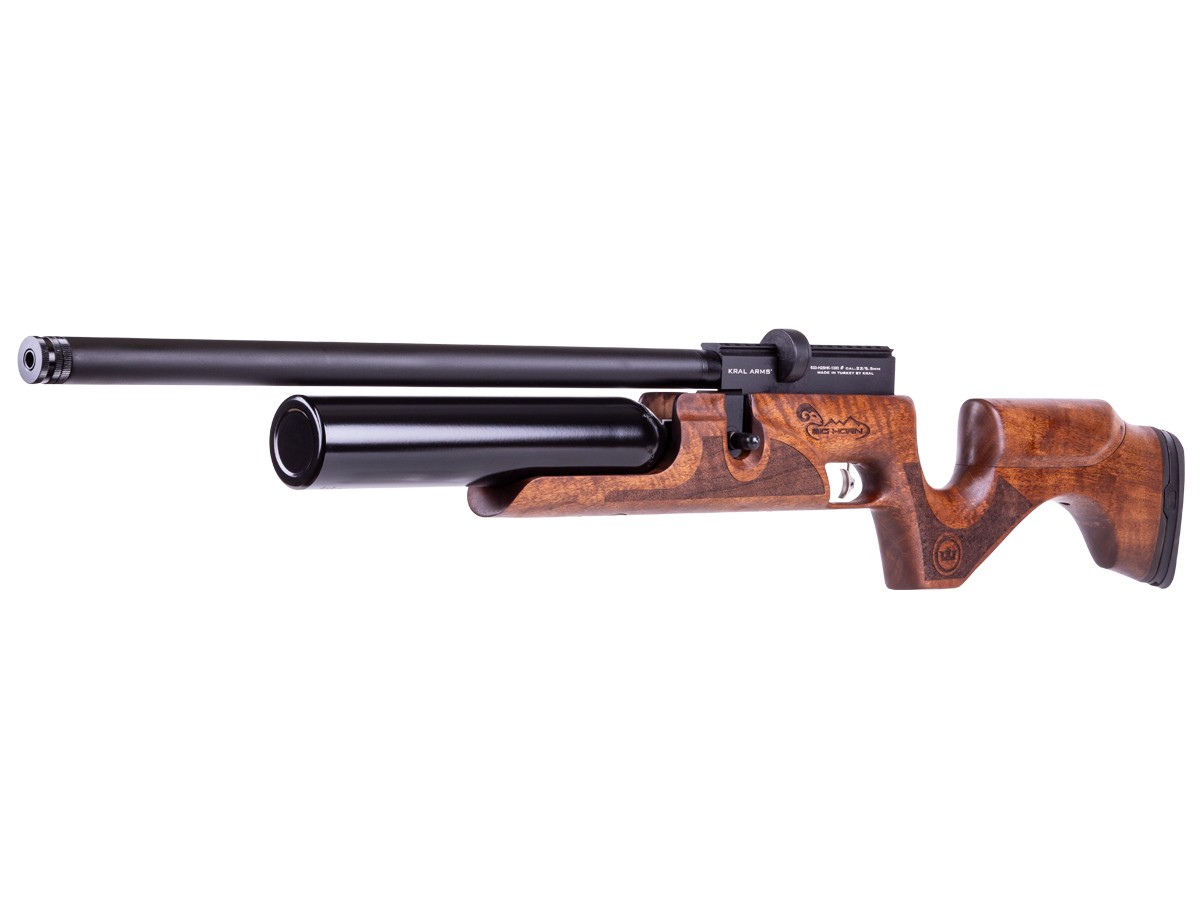
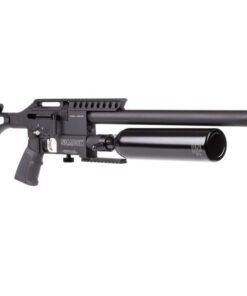
Kral Arms Puncher Bighorn PCP Air Rifle
$700.00
The Kral Arms Puncher Bighorn is a Turkish walnut-stocked PCP with serious caliber range — available from .22 all the way up to .35 caliber, this is a platform that can grow with you from small game into genuine big-game airgun hunting territory. Kral builds solid, well-featured PCPs at competitive prices, and the Bighorn is one of their better efforts.
With .22 cal hitting up to 1,200 fps, .25 cal at 1,100 fps, .30 cal at 900 fps, and .35 cal at 880 fps, there’s a caliber here for nearly every hunting application. The Turkish walnut stock gives it a premium look and feel that belies the price tag.
- Calibers available: .22 cal (1,200 fps), .25 cal (1,100 fps), .30 cal (900 fps), and .35 cal (880 fps)
- Turkish walnut stock — attractive, durable, and naturally grain-matched
- PCP platform for regulated, consistent performance across the shot string
- Wide caliber selection from small pest control up to big-game hunting
Whether you’re chasing squirrels in .22 or stepping up to .35 for something bigger, the Bighorn gives you a quality wood-stocked PCP at a price that makes sense — give us a call and we’ll help you pick the right caliber.
Kral Arms Puncher Breaker PCP Air Rifle – Compact Bullpup PCP Precision and Practical Performance
The Kral Arms Puncher Breaker PCP Air Rifle combines compact bullpup dimensions with multi-shot PCP operation, a sidelever action, an adjustable trigger, and a substantial 280cc compressed-air reservoir.
By moving the action farther toward the rear, the bullpup architecture allows a 53.5 cm barrel to be packaged into an overall rifle length of approximately 73 cm. Consequently, the rifle offers a useful balance between barrel length and compact handling Kral Arms Puncher Bighorn PCP Air Rifle.
Current specifications cover:
- .177 / 4.5 mm
- .22 / 5.5 mm
- .25 / 6.35 mm
Magazine capacity varies accordingly:
- 14 rounds in .177
- 12 rounds in .22
- 10 rounds in .25
A 280cc air reservoir is filled to a maximum working pressure of approximately 200 bar, while the rifle uses a manually operated sidelever and an adjustable two-stage trigger.
Walnut and synthetic-stock configurations have been offered, giving shooters a choice between traditional wood styling and a more utilitarian synthetic format.
Compact Bullpup Architecture
The bullpup design is one of the most important reasons to consider this platform.
Because the action sits behind the trigger area, a useful barrel length can be retained while overall dimensions remain relatively short.
Therefore, the rifle can feel easier to handle from a bench, seated position, or other controlled shooting environment.
280cc PCP Air Reservoir
The 280cc reservoir provides a useful balance between air capacity and overall rifle size.
A maximum fill pressure of approximately 200 bar supports repeated shooting without requiring the exceptionally large bottle systems found on some heavier PCP platforms.
Multi-Shot Magazine System
The detachable rotary magazine reduces interruptions between shots.
The available capacities of 14, 12, and 10 rounds depend on calibre.
This allows a shooter to maintain a more consistent range rhythm while still manually cycling the action.
Sidelever Operation
The sidelever provides straightforward manual loading.
Because the shooter does not need to break the barrel or manipulate a large bolt movement, the rifle can remain relatively stable between shots.
Smooth operation is preferable to forceful cycling.
Adjustable Trigger
An adjustable two-stage trigger allows the shooter to become familiar with a predictable release.
Trigger consistency is important because abrupt movement can disturb the sight picture.
Synthetic and Walnut Options
The platform has been offered in both Synthetic and Turkish Walnut versions.
The synthetic configuration emphasizes durability and practical maintenance.
Meanwhile, the walnut version provides a more traditional appearance while retaining the same underlying bullpup concept.
Why Precision Depends on More Than Velocity
Advertised speed alone does not determine accuracy.
Practical precision depends on:
Pellet quality.
Barrel consistency.
Air pressure.
Optic mounting.
Trigger control.
Stock fit.
Shooter technique.
Environmental conditions.
Therefore, controlled group testing provides far more useful information than simply selecting the lightest or fastest pellet.
kral
kral commonly refers to Kral Arms, a Turkish manufacturer whose product range includes PCP air rifles alongside other sporting platforms.
kral arms
kral arms manufactures multiple PCP families, including the Puncher range.
The Breaker is one of the compact bullpup configurations within that broader lineup.
kral np 02
The kral np 02 belongs to another PCP configuration within the Puncher family.
Its dimensions and stock layout should be evaluated separately from the Breaker.
kral
A second kral reference often appears in searches comparing different models across the manufacturer’s lineup.
Model-specific specifications should always be checked independently.
kral puncher
The kral puncher family includes numerous PCP designs such as compact bullpups, conventional rifles, large-capacity platforms, and tactical configurations.
krale
The term krale may appear in European airgun searches, but it should not be confused with Kral Arms model naming.
a12 shotgun
The a12 shotgun term refers to a firearm category rather than this PCP air rifle.
Its specifications, legal classification, and ammunition system are unrelated to the Puncher Breaker.
kral
Another kral search variation may broadly refer to the manufacturer rather than one specific PCP model.
n_01
The term n_01 may be associated with another Kral model family.
It should not be used to describe the Breaker’s specifications.
puncher mega
The puncher mega is another PCP platform within the wider Puncher series.
It follows a more conventional rifle format than the compact Breaker.
puncher auto
The puncher auto represents a different operating concept from the manually cycled Breaker.
Model-specific action details should not be transferred between them.
rifle 223
The term rifle 223 refers to centerfire firearm terminology and is unrelated to a PCP air rifle.
The Breaker uses compressed air and airgun projectiles rather than firearm cartridges.
kr9
kr9 refers to another Kral product category and should not be confused with the Puncher PCP range.
kral breaker puncher
The kral breaker puncher phrase refers directly to the compact bullpup configuration discussed here.
Its strongest characteristics are compact dimensions, sidelever operation, multi-shot magazines, and PCP power.
kral puncherk
The term kral puncherk appears to be a search variation associated with the Puncher family.
Exact model names should be confirmed before comparing specifications.
empire x
The empire x belongs to another Puncher PCP configuration.
Kral’s product catalogue separates Empire models from the Breaker platform.
a12 gun
The a12 gun term refers to a separate firearm platform and should not be treated as part of the Breaker’s PCP specifications.
xm shotgun
The xm shotgun search term concerns a firearm category rather than a compressed-air rifle.
223 arma
The phrase 223 arma concerns .223-calibre firearm terminology and is not part of the Puncher Breaker airgun platform.
shotgun xm
The shotgun xm term is likewise unrelated to the PCP operating system used here.
223 rifles
The phrase 223 rifles describes centerfire firearms.
The Puncher Breaker operates through stored compressed air and should not be classified with them.
bigmax
The bigmax is another Kral PCP family member and represents a different size and capacity category.
arma 223
The arma 223 phrase again refers to firearm terminology rather than an air-powered PCP platform.
akr gun
The term akr gun should not be used as a substitute for the Breaker’s actual model designation.
kalibre pistol
The phrase kalibre pistol can relate to handgun searches and is not descriptive of this bullpup air rifle.
tabancalar
tabancalar broadly relates to pistols in Turkish-language searches.
It is not a specification of this PCP rifle.
tactical tundra
The tactical tundra term refers to another model or configuration search and should not be confused with the Breaker.
shadow puncher
The shadow puncher belongs to another Kral Puncher platform.
Current Kral information lists the Shadow separately with its own air capacity, dimensions, and stock architecture.
air rifle pop
The phrase air rifle pop may occur in general airgun searches.
For the Breaker, the meaningful technical factors are pressure consistency, barrel quality, magazine function, and shooter control.
kar gun
The term kar gun is not the formal model name of this product and should be treated as a broad search variation.
np500
The np500 is a separate Puncher PCP model.
Kral catalogue material lists it with a larger 500cc air reservoir and different specifications from the Breaker.
kp12
The kp12 belongs to Kral’s firearm product family rather than the Puncher PCP platform.
It should not be presented as an air-rifle specification.
rifle cal 22 semiautomatico
The phrase rifle cal 22 semiautomatico generally refers to a semi-automatic .22 firearm.
The Breaker is a manually cycled PCP and should not be described as such.
kr 101
The kr 101 refers to another product designation and should be treated independently from the Puncher PCP platform.
k12 shotgun
The k12 shotgun is a firearm model and is unrelated to the Breaker’s compressed-air operation.
st-500
The st-500 is another Kral product designation.
Kral lists separate manuals for firearm and airgun product families, so specifications should never be transferred between categories.
rutundra
The rutundra phrase appears to be another model-related search variation rather than a Puncher Breaker specification.
krale airguns
Searches for krale airguns may involve retailers or airgun information rather than Kral Arms manufacturing specifications.
Factory model information should remain the primary reference.
410 shotgun semi auto magazine fed
The phrase 410 shotgun semi auto magazine fed describes a firearm configuration and has no technical relationship to this compressed-air rifle.
pcp air gun
As a pcp air gun, the Breaker stores compressed air before firing.
This provides a smoother firing cycle than a traditional spring-piston system because no large piston accelerates through the action during the shot.
kiral
The term kiral may be a spelling variation appearing in searches for Kral products.
kr-101
The kr-101 is not the Puncher Breaker and should be treated as a separate model designation.
.223 guns
The phrase .223 guns concerns firearm cartridges and should not be used to describe a PCP air rifle.
shadowf
The shadowf refers to the Shadow F configuration within Kral’s Puncher PCP family.
Current specifications place it in .177, .22, and .25 with a substantially different air system from the Breaker.
tundra tactical
The tundra tactical phrase is another unrelated model search and should not be mixed into the Breaker specification.
Kral Puncher Breaker Air Rifle
The Kral Puncher Breaker Air Rifle is a compact bullpup PCP built around a 280cc reservoir, 200-bar pressure system, multi-shot magazines, and sidelever operation.
rifles pcp 5.5
The phrase rifles pcp 5.5 refers to .22-calibre PCP rifles.
The Breaker is available in this calibre alongside .177 and .25.
kr9 rifle
The kr9 rifle term concerns another Kral product designation and should not be confused with the Puncher Breaker.
Kral Puncher Breaker
The Kral Puncher Breaker combines bullpup packaging with a practical mid-sized air reservoir and multi-shot magazine.
This makes it particularly distinctive for shooters who value compactness.
Kral Arms Puncher Breaker PCP Air Rifle
The Kral Arms Puncher Breaker PCP Air Rifle is the full product description for the platform.
Its defining features include bullpup ergonomics, sidelever cycling, multi-shot capability, 200-bar pneumatic operation, and stock choices that include Walnut and Synthetic versions.
Kral Puncher Breaker Synthetic
The Kral Puncher Breaker Synthetic uses a synthetic stock.
The configuration generally offers easier exterior maintenance and a more utilitarian appearance than traditional wood.
Kral Puncher Breaker Walnut
The Kral Puncher Breaker Walnut uses Turkish Walnut and provides a more traditional visual finish while maintaining the same basic bullpup PCP concept.
Kral Arms PCP Rifle
A Kral Arms PCP Rifle can vary significantly in reservoir capacity, stock design, action type, and overall dimensions.
Therefore, individual model specifications should always be checked rather than generalized across the brand.
Kral Puncher PCP
The Kral Puncher PCP range is extensive.
Current Kral listings include Breaker, Mega, Auto, Shadow, NP series, Empire, Bigmax, and several other variants.
Kral Air Rifle
A Kral Air Rifle may use PCP power or another airgun operating system depending on the model.
The Breaker is specifically a pre-charged pneumatic design.
Kral Arms Airguns
Kral Arms Airguns cover multiple stock styles, calibre options, air capacities, and operating layouts.
This variety allows the Breaker to be understood as one compact bullpup option within a much larger range.
Kral Puncher Series
The Kral Puncher Series includes numerous PCP platforms designed around different shooting preferences.
Some emphasize compactness, while others emphasize air capacity, traditional styling, or tactical ergonomics.
Kral Arms Puncher Breaker review
A useful Kral Arms Puncher Breaker review should focus on measurable characteristics rather than appearance alone.
Important evaluation areas include:
Air retention.
Magazine reliability.
Trigger consistency.
Stock comfort.
Balance.
Pellet preference.
Optic stability.
Practical group performance.
Daystate Delta Wolf Performance
Daystate Delta Wolf Performance belongs to a very different premium electronic PCP platform.
It should not be used to describe the Breaker’s mechanical specifications.
daystate blackwolf
The daystate blackwolf represents another premium PCP product family from a different manufacturer.
delta wolf
The delta wolf is a highly sophisticated PCP platform and should be compared independently by technology, regulation, electronics, air capacity, and price.
huntsman daystate
The huntsman daystate family follows another design philosophy focused on traditional PCP rifle ergonomics.
day state
The term day state is a common search variation for Daystate products.
Those rifles belong to a separate manufacturer.
daystate delta wolf
The daystate delta wolf should be evaluated through its own electronic and regulated PCP architecture rather than compared through model names alone.
daystate alpha wolf
The daystate alpha wolf represents another advanced electronically controlled PCP platform.
It is technically distinct from the mechanically operated Breaker.
puddy bottle cover
A puddy bottle cover or protective bottle cover is generally associated with bottle-type PCP accessories.
The Breaker uses an air tube rather than the large external bottle configuration found on some other rifles.
daystate
daystate manufactures premium PCP rifles using different engineering approaches from Kral Arms.
alpha red wolf
The alpha red wolf phrase appears in searches related to premium Daystate PCP platforms and should not be confused with Kral product naming.
air gun pc
The phrase air gun pc may be intended as a variation of PCP airgun terminology.
A PCP system stores pre-compressed air in a reservoir before firing.
air gun suppressor
An air gun suppressor or moderator is regulated differently depending on jurisdiction.
Accessory compatibility and local legality should always be confirmed before use.
what is a delta wolf
The question what is a delta wolf usually refers to Daystate’s electronically controlled Delta Wolf PCP rifle.
It is a separate premium platform from the mechanically operated Breaker.
airgun moderator
An airgun moderator is designed to reduce muzzle report where legally permitted.
Thread compatibility and local regulations should be checked before installation.
black snood
The phrase black snood may relate to an accessory or protective cover rather than the rifle’s core operating system.
It should not be treated as a factory specification.
daystate wolverine sapphire
The daystate wolverine sapphire belongs to another manufacturer’s premium PCP range and should be compared independently.
day wolf
The phrase day wolf may be used informally in searches for Daystate Wolf-family rifles.
It does not describe the Kral Breaker.
Why the Breaker Design Makes Sense
The strongest reason to choose this type of platform is compactness.
A bullpup rifle can retain a useful barrel length while remaining significantly shorter than many conventional rifles.
That can improve storage, transport, and supported range handling.
Meanwhile, the 280cc air tube provides enough capacity for substantial shooting sessions without requiring a large external bottle.
How the PCP System Supports Precision
The pneumatic firing cycle generally produces less internal movement than a spring-piston design.
That can help the shooter maintain:
Sight alignment.
Cheek position.
Trigger control.
Follow-through.
However, consistency still depends heavily on ammunition and technique.
Why the Sidelever Matters
A sidelever provides quick manual cycling while allowing much of the shooting position to remain unchanged.
This can help maintain a consistent cheek weld during repeated groups.
Why Stock Choice Matters
Walnut and Synthetic configurations address different priorities.
Walnut provides traditional appearance and natural material character.
Synthetic construction generally emphasizes practicality, moisture resistance, and straightforward exterior maintenance.
Neither automatically determines accuracy because the internal action and barrel remain the primary mechanical components.
Why Pellet Selection Is Important
Pellet choice can significantly affect performance.
Weight matters.
Head diameter matters.
Skirt condition matters.
Manufacturing consistency matters.
Different barrels may prefer different pellet designs.
Therefore, controlled group testing is more informative than relying solely on advertised velocity.
Where the Rifle Works Best
The platform is particularly well suited to lawful controlled target shooting.
A formal range offers:
Known distances.
Secure backstops.
Clear shooting directions.
Repeatable testing conditions.
Where private target shooting is legally permitted, the shooter should still ensure that the backstop is adequate and that no people, buildings, roads, or animals are beyond the target.
When This Platform Makes Sense
The platform is worth considering when a shooter wants:
A compact bullpup PCP.
A 200-bar air system.
A mid-sized reservoir.
Multi-shot magazines.
Three common calibre options.
A sidelever action.
Adjustable trigger characteristics.
Synthetic or Walnut stock choices.
A relatively short overall rifle.
A practical platform for controlled target shooting.
Why Practical Accuracy Matters More Than Maximum Speed
Velocity figures attract attention, but precision is ultimately measured by repeatable groups.
A consistent rifle with a suitable pellet is more useful for target work than a configuration chosen solely for maximum speed.
Stable air pressure, secure optics, good ammunition, and disciplined trigger control all contribute to the final result.
Filling Equipment and Air Management
Because the rifle operates from pre-charged compressed air, the owner needs access to appropriately rated filling equipment.
This may include a compatible high-pressure hand pump, tank, or purpose-built PCP compressor.
The system should be filled only within the manufacturer’s stated pressure limits.
Important Maintenance Information
Routine care should remain straightforward.
Keep the fill connection clean.
Monitor pressure retention.
Protect the barrel.
Inspect magazines.
Keep optic mounts secure.
Use appropriate maintenance products.
Persistent leaks or internal pneumatic problems should be inspected by someone qualified to service high-pressure PCP equipment.
Safe Storage and Handling
The rifle should be stored unloaded and secured against unauthorized access.
A suitable backstop should always be used during target shooting.
The muzzle should remain under control, while the trigger should only be touched when the shooter intends to fire at a safe target.
Local airgun ownership, transport, power, and accessory regulations should always be followed.
Final Section 1 Assessment
The Kral Arms Puncher Breaker PCP Air Rifle combines a compact bullpup layout with a practical 280cc reservoir, 200-bar fill pressure, 53.5 cm barrel, multi-shot magazine system, sidelever action, and adjustable trigger.
Current documentation lists .177, .22 and .25 calibre options, with magazine capacities of 14, 12 and 10 rounds respectively. Overall length is approximately 73 cm, giving the platform one of its most important practical advantages: a useful barrel length inside a relatively compact rifle.
Both Walnut and Synthetic stock configurations provide different exterior characteristics without changing the fundamental purpose of the platform.
For lawful target shooting, the Breaker’s greatest strengths are compact handling, multi-shot convenience, straightforward sidelever operation, and manageable PCP capacity.
Its best practical precision will come from a properly mounted optic, suitable pellets, consistent air pressure, careful trigger control, regular maintenance, and a repeatable shooting position rather than maximum velocity alone.
Section 2 – Practical Accuracy, Air Management, Bullpup Handling, Optics, Maintenance and Long-Term Ownership
Understanding the Rifle as a Compact Bullpup PCP
The Puncher Breaker is best understood as a compact pre-charged pneumatic rifle designed around practical handling, useful air capacity, multi-shot operation, and a short overall profile.
Its bullpup layout is central to the way the rifle behaves.
Because the action is positioned farther toward the rear, the barrel can remain reasonably long without creating the overall length normally associated with a conventional rifle.
That makes the platform appealing to shooters who want a shorter rifle while retaining enough barrel length for stable target performance.
Why the Bullpup Layout Changes Handling
A bullpup rifle places more of its mass closer to the shooter.
This creates a different balance from a conventional rifle.
Instead of feeling heavily stretched toward the front, the rifle can feel more centered around the shoulder.
That can be useful during seated, kneeling, and supported shooting positions.
However, every shooter has different body dimensions, so the rifle should be shouldered several times before deciding whether the balance feels natural.
Compactness as a Practical Advantage
The shorter overall format can make the rifle easier to:
Transport.
Store.
Handle around a bench.
Move between shooting positions.
Use in confined range spaces.
The shorter profile can also make a suitable case easier to manage.
Why Compact Does Not Mean Lightweight in Every Situation
A compact rifle can still feel substantial depending on the stock material, optic, accessories, and reservoir.
Walnut versions may feel different from synthetic versions.
Likewise, a heavy scope can shift balance upward and rearward.
The best setup is usually one that keeps the rifle balanced rather than simply adding as many accessories as possible.
Understanding the PCP Firing Cycle
The rifle stores compressed air inside its reservoir.
When the trigger is operated, a controlled amount of air is released to propel the pellet.
Because there is no large spring piston moving through the rifle during the shot, the firing cycle tends to feel smoother than a spring-powered rifle.
This reduced mechanical movement can make it easier to maintain sight alignment.
Why a Smooth Firing Cycle Helps
A smoother firing cycle can support:
Consistent shoulder contact.
Steady sight picture.
Cleaner trigger follow-through.
Reduced disturbance at the moment of discharge.
This does not guarantee accuracy by itself, but it makes good technique easier to maintain.
Air Reservoir Management
The air reservoir provides the energy for every shot.
The owner should develop a simple pressure-management routine.
Check the gauge before shooting.
Monitor it during the session.
Refill before pressure falls too far.
This helps maintain more predictable performance.
Why Shot Count Is Only a Guide
Published shot counts are useful, but they are not absolute.
Real-world results can vary with:
Calibre.
Pellet weight.
Temperature.
Valve behavior.
Reservoir condition.
Shooting pace.
Individual rifle condition.
The pressure gauge is therefore more useful than relying only on a fixed number of shots.
Learning the Useful Pressure Range
Every PCP has a practical pressure range where performance tends to remain more consistent.
The shooter should learn how the rifle behaves from a full fill down through the usable portion of the reservoir.
Recording group size and velocity can make this easier.
High-Pressure Filling Equipment
Only equipment intended for PCP use should be connected to the rifle.
Appropriate filling sources may include:
A high-pressure hand pump.
A dive cylinder.
A carbon-fiber fill tank.
A purpose-built PCP compressor.
Connections should be clean, compatible, and properly rated.
Filling Slowly and Carefully
A slower fill is easier to control.
Rapid filling can generate heat and make the final pressure reading less stable.
A controlled fill gives the shooter more time to monitor the gauge.
Avoiding Overfilling
The maximum working pressure should never be exceeded.
Overfilling does not automatically improve performance.
Instead, it can place unnecessary stress on seals and components.
Why Clean Air Matters
Moisture and contamination can affect internal components over time.
Clean, dry air is preferable.
The fill connection should remain protected from dirt and dust.
Temperature and Pressure Changes
Pressure can change as temperature changes.
A reservoir filled in a warm environment may show a different reading after cooling.
This is normal.
The rifle should never be heated deliberately to alter pressure.
Sidelever Operation
The sidelever provides manual cycling between shots.
It should be operated smoothly.
A controlled action helps reduce unnecessary movement and wear.
Why Smooth Cycling Helps Precision
When the lever is operated without excessive force, the shooter can maintain much of the same position.
That means less disruption to:
Cheek weld.
Shoulder position.
Support-hand placement.
Optic alignment.
This is useful during group shooting.
What to Do if the Action Feels Stiff
If the lever becomes unusually difficult to move, stop.
Possible causes can include:
Magazine misalignment.
A damaged pellet.
Debris.
Wear.
A mechanical problem.
The action should not be forced.
Magazine Convenience
The multi-shot magazine is one of the most practical features of the rifle.
It allows several shots before reloading.
This is useful during repeated target strings.
Magazine Inspection
Check the magazine for:
Cracks.
Damage.
Debris.
Uneven rotation.
Poor pellet fit.
Indexing issues.
A worn magazine can cause feeding problems.
Loading Pellets Correctly
Pellets should be loaded without damaging the head or skirt.
Deformed pellets can affect both feeding and accuracy.
For controlled target testing, visibly damaged pellets should be rejected.
Pellet Quality and Accuracy
A quality barrel still depends on quality ammunition.
Differences in:
Weight.
Diameter.
Skirt condition.
Surface finish.
Manufacturing consistency.
can affect group size.
Testing Pellets Properly
Pellet testing should be controlled.
Keep the same:
Distance.
Air-pressure range.
Rest.
Optic setting.
Shooting position.
Target type.
Then compare group sizes.
Why Group Size Matters More Than Velocity
A fast pellet is not automatically an accurate pellet.
A slower pellet that groups consistently can be far more useful.
Precision should be judged by repeatability.
Barrel Performance
The barrel provides the mechanical foundation for accuracy.
It should remain clean, protected, and free from physical damage.
Protecting the Muzzle
The muzzle crown is especially important.
It should not be struck against hard surfaces.
Damage can affect the way the pellet exits the barrel.
Barrel Cleaning
Frequent aggressive cleaning is usually unnecessary.
Cleaning should be conservative and based on need.
Improper rods or abrasive materials can damage the bore.
When Cleaning May Be Appropriate
Cleaning can be considered if:
Accuracy deteriorates suddenly.
Contamination is suspected.
The rifle has been stored for a long period.
A new pellet behaves unusually.
A technician recommends it.
Trigger Familiarity
The trigger is one of the most important shooter interfaces.
The owner should become familiar with:
Take-up.
Break.
Reset.
Pull weight.
Finger position.
A predictable trigger makes deliberate shooting easier.
Why Trigger Position Matters
The trigger finger should meet the trigger naturally.
An awkward position can create sideways pressure.
This can disturb the sight picture.
Smooth Trigger Press
The trigger should be pressed rather than jerked.
A gradual press reduces unnecessary movement.
Safe Trigger Discipline
The finger should remain outside the trigger area until the rifle is pointed safely and the shooter intends to fire.
Mechanical safeties are secondary systems.
Bullpup Stock Ergonomics
Bullpup stocks feel different because the action is placed behind the trigger.
This can change hand position, cheek placement, and shoulder balance.
A shooter should spend time learning the stock rather than expecting it to feel identical to a conventional rifle.
Cheek Position
A repeatable cheek weld is important.
The shooter should place the head in the same position for each shot.
This supports consistent eye alignment behind the optic.
Shoulder Position
The butt should meet the shoulder in the same area every time.
Consistent shoulder placement helps maintain repeatable geometry between shooter, rifle, and optic.
Grip Pressure
The firing hand should remain secure but relaxed.
Excessive grip pressure can create tension.
Support-Hand Position
The support hand should be placed consistently.
A relaxed but stable position is usually better than excessive pressure.
Walnut Versus Synthetic Handling
The two stock materials can feel different in the hands.
Walnut provides a traditional feel and natural material character.
Synthetic construction can feel more utilitarian and easier to maintain in changing weather conditions.
The choice is primarily about handling preference, finish, and maintenance rather than inherent accuracy.
Benchrest Use
A bench is an excellent place to evaluate the rifle.
It reduces some body movement and makes pellet comparisons easier.
Front Rest Position
The front rest should support the rifle without interfering with the air tube, magazine, or controls.
The rifle should still remain under the shooter’s control.
Rear Support
A rear bag can help stabilize elevation.
Small adjustments can then be made more precisely.
Standing Shooting
Standing positions require more balance.
The compact profile can help, but the shooter still needs to control the rifle carefully.
Shorter sessions are useful for preventing fatigue.
Kneeling Position
Kneeling can provide a good balance between stability and mobility.
The shorter overall length may feel convenient in this position.
Seated Position
Seated shooting can be very stable.
It is often useful during informal target practice.
Why Shooter Fatigue Matters
Fatigue changes technique.
Grip pressure can increase.
Shoulder position can shift.
Trigger control can deteriorate.
Taking breaks can improve consistency.
Optic Selection
A suitable scope should match the intended shooting distance.
Useful features include:
Clear glass.
Reliable adjustments.
Correct eye relief.
Appropriate magnification.
Secure mounts.
A practical reticle.
Avoiding Oversized Optics
A very large optic can change the balance of a compact bullpup.
More magnification is not automatically better.
The best scope is one that supports the actual shooting distances.
Scope Mount Quality
Loose mounts can cause shifting point of impact.
Mount screws should be checked periodically.
Scope Height
The scope should be mounted at a height that supports a natural cheek position.
If the optic sits too high or too low, repeatable alignment becomes harder.
Zeroing
Zeroing should be done at a safe range.
Use:
A known distance.
A secure backstop.
Consistent pellets.
A stable position.
Small adjustments.
Once established, record the settings.
Confirming Zero
Zero should be checked after:
Transport.
Impact.
Optic removal.
Mount changes.
Maintenance.
Changing ammunition.
Why Zero Can Shift
Zero may move because of:
Loose mounts.
Optic adjustment.
Impact.
Temperature.
Different pellets.
Shooter inconsistency.
The cause should be investigated systematically.
Chronograph Use
A chronograph can help monitor lawful performance.
It can reveal:
Velocity variation.
Changes through the air charge.
Ammunition inconsistency.
Possible seal problems.
Pressure-related behavior.
Why Consistency Is More Important Than Peak Numbers
For target use, a repeatable rifle is generally more useful than one configured only for maximum velocity.
Predictable performance supports predictable point of impact.
Paper Target Testing
Paper targets are useful because they provide a permanent record.
The shooter can compare groups directly.
Keeping a Shooting Log
A simple notebook can record:
Pellet type.
Distance.
Starting pressure.
Ending pressure.
Group size.
Weather.
Optic setting.
Why Records Improve Evaluation
Written results reduce guesswork.
They make it easier to identify what the rifle prefers.
Range Use
A formal shooting range provides a controlled environment.
Known distances and proper backstops make testing easier.
Private Target Areas
Where legally permitted, private shooting should still be carefully planned.
Consider:
Roads.
Buildings.
Animals.
People.
Property boundaries.
Terrain.
Backstop Quality
The backstop should stop pellets safely.
It should be larger than the target area.
The shooter should always know what lies beyond it.
Eye Protection
Appropriate eye protection is recommended.
Ricochets and fragments can occur even during routine target shooting.
Sound Considerations
Air rifles can still produce noticeable sound.
Accessory rules differ between jurisdictions.
Any sound-moderating equipment should be legal and compatible.
Exterior Cleaning
After shooting, wipe the rifle down.
Remove dust and moisture.
Keep controls and visible moving parts clean.
Walnut Stock Care
A wooden stock should be protected from excessive moisture and harsh chemicals.
A soft cloth is usually sufficient for routine cleaning.
Synthetic Stock Care
Synthetic stocks are generally straightforward to maintain.
Dust and dirt can be wiped away easily.
Strong solvents should still be avoided.
Fill Port Care
The fill connection should remain clean.
Debris can affect seals.
Protective caps should be used when provided.
Seal Condition
Possible signs of seal problems include:
Pressure loss.
Audible leaks.
Reduced shot count.
Inconsistent performance.
Difficulty holding air.
Persistent leaks should be serviced.
Pressure Loss During Storage
A small change can occur because of temperature.
Continuous or substantial loss may indicate a leak.
Avoiding Unnecessary Internal Work
High-pressure pneumatic components should not be opened casually.
Internal repair should follow manufacturer procedures.
Professional service is preferable when the cause of a problem is unclear.
Long-Term Storage
The rifle should be stored:
Dry.
Secure.
Away from children.
Away from excessive heat.
Away from chemicals.
Away from direct sunlight.
Manufacturer guidance should be followed regarding reservoir pressure during extended storage.
Magazine Storage
Magazines should be stored clean and dry.
Damaged pellets should not be left inside.
A protective case can help keep dirt away.
Transport
During transport, the rifle should be unloaded and secured.
The magazine should be removed where appropriate.
The rifle should be protected from impact.
Local transport rules should be followed.
Why a Proper Case Matters
A suitable case protects:
The stock.
The barrel.
The optic.
The reservoir.
The action.
This is particularly useful during repeated travel to a range.
Documentation
Keep:
The owner manual.
Serial number.
Purchase receipt.
Service history.
Warranty records.
Pellet-testing notes.
Chronograph records.
Good documentation makes future maintenance easier.
Buying Used
A used rifle should be inspected carefully.
Check:
Reservoir condition.
Pressure gauge.
Seals.
Barrel.
Stock.
Magazine system.
Trigger.
Safety.
Sidelever.
Fill port.
Optic rail.
Any modifications.
Used Walnut Stock Inspection
On a walnut-stock version, check for:
Cracks.
Deep dents.
Water damage.
Loose action fit.
Repairs.
Surface wear.
Cosmetic marks may be normal, but structural cracks deserve attention.
Used Synthetic Stock Inspection
On a synthetic version, check for:
Cracks.
Warping.
Damaged fasteners.
Loose stock fit.
Heavy impact marks.
Questions to Ask a Seller
Useful questions include:
Does the rifle hold pressure?
Has it been serviced?
Are all magazines included?
Has the reservoir been damaged?
Has the rifle been modified?
What pellets perform well?
Are there known leaks?
How old is the rifle?
Service History
A clear service history can add confidence.
It can show whether seals or other components have been maintained properly.
Unauthorized Modifications
Unverified modifications can affect:
Reliability.
Safety.
Accuracy.
Legal status.
Resale value.
A rifle close to factory condition is generally easier to evaluate.
Ownership Costs
PCP ownership includes more than the rifle itself.
Potential costs include:
Filling equipment.
Pellets.
Scopes.
Mounts.
Magazines.
Replacement seals.
Professional service.
Range fees.
Storage equipment.
Why Filling Access Should Be Planned First
A PCP rifle is only practical when the owner has a reliable way to refill it.
A hand pump may suit occasional shooting.
A tank or compressor may be more practical for regular use.
Hand Pump Considerations
A hand pump is portable and does not require electricity.
However, filling can require physical effort.
The effort becomes more noticeable when the reservoir is low.
Tank Filling
A high-pressure tank can provide convenient refills.
The tank itself must be filled by a suitable source.
PCP Compressor
A dedicated compressor can provide independence from external refill services.
It should be properly rated and maintained.
Ammunition Availability
Calibre choice should consider how easily suitable pellets can be obtained.
A rifle is easier to own long term when quality ammunition is readily available.
Why Pellet Consistency Matters More at Longer Distance
Small differences in pellet quality can become more noticeable as distance increases.
This makes careful ammunition selection increasingly important.
Wind Awareness
Pellets can be affected by wind.
Changing wind direction or speed can alter point of impact.
The shooter should distinguish environmental effects from rifle problems.
Temperature and Shooting Conditions
Temperature can affect reservoir pressure and air density.
Comparing results from very different conditions may therefore be misleading.
Practical Accuracy Expectations
Accuracy should be judged realistically.
A good group depends on:
Rifle condition.
Pellet match.
Optic stability.
Air pressure.
Shooting position.
Wind.
Shooter skill.
A single excellent group should not be treated as the only measure of performance.
Repeatability Is the Real Goal
The more important question is whether the rifle can repeat similar results over multiple groups.
Repeatability is a better measure of practical precision.
Why the Rifle Appeals to Compact-PCP Buyers
The platform combines:
Bullpup handling.
Moderate reservoir size.
Multi-shot operation.
Sidelever cycling.
Three calibre options.
Walnut or synthetic stock choices.
A relatively short overall profile.
That combination gives it a distinctive place among PCP rifles.
Who May Prefer a Conventional Rifle
Some shooters prefer a longer traditional stock because they like the familiar balance and trigger location.
A bullpup is not automatically better for everyone.
Who May Prefer a Larger Reservoir
Shooters who want very long shot strings may prefer a larger bottle-equipped rifle.
The Breaker instead focuses on compactness and balance.
Who May Prefer a Spring Rifle
Someone who wants no external filling equipment may prefer a spring-powered design.
PCP ownership requires additional support equipment.
Range Session Preparation
Before shooting, check:
Air pressure.
Pellet supply.
Magazine condition.
Scope zero.
Backstop.
Filling equipment.
Protective gear.
This reduces unnecessary interruptions.
Why a Routine Helps
A consistent routine makes troubleshooting easier.
Fill correctly.
Use the same pellet.
Check the optic.
Use the same position.
Monitor pressure.
Record results.
Troubleshooting Large Groups
If accuracy suddenly becomes worse, check:
Pellet condition.
Air pressure.
Scope mounts.
Optic zero.
Magazine condition.
Wind.
Shooter fatigue.
Barrel cleanliness.
Change one variable at a time.
Troubleshooting Feeding Problems
If feeding becomes unreliable:
Stop safely.
Remove the magazine.
Inspect the pellets.
Check magazine condition.
Look for debris.
Do not force the sidelever.
Troubleshooting Air Loss
If pressure falls unexpectedly:
Observe the gauge.
Listen for leaks.
Check the fill area.
Inspect accessible seals.
Seek professional service if the cause is not obvious.
Routine Inspection
Regularly inspect:
Reservoir.
Fill port.
Gauge.
Magazine.
Sidelever.
Trigger.
Safety.
Optic mounts.
Visible seals.
Preventive Maintenance
Routine care is usually more useful than frequent disassembly.
Keep the rifle clean.
Use quality pellets.
Protect the reservoir.
Monitor pressure.
Keep mounts secure.
Address leaks promptly.
Safe Storage
The rifle should be stored unloaded and secured against unauthorized access.
Local storage regulations should always be followed.
Legal Configuration
Airgun regulations vary between countries and regions.
Rules may involve:
Muzzle energy.
Velocity.
Calibre.
Licensing.
Transport.
Storage.
Use location.
Accessories.
The rifle should remain within applicable law.
Why Maximum Power Is Not the Only Measure of Quality
Power is only one specification.
A good rifle should also provide:
Consistency.
Reliability.
Comfort.
Repeatable handling.
Magazine function.
Air retention.
Useful accuracy.
These characteristics are often more important during normal ownership.
Practical Long-Term Value
Long-term value depends on how well the rifle fits the owner’s actual needs.
A compact, well-maintained PCP that is easy to fill and comfortable to shoot can be more useful than a larger platform with specifications the owner never needs.
Resale Considerations
Keeping the rifle in good condition can help preserve value.
Keep:
Original documentation.
Magazines.
Fill accessories.
Packaging where practical.
Service records.
Why Original Parts Matter
Original parts and documentation make the rifle easier to assess later.
They can also make servicing simpler.
Final Practical Assessment
The Kral Arms Puncher Breaker is a compact bullpup PCP built around practical handling, multi-shot convenience, moderate air capacity, and a short overall profile.
Its strongest characteristic is the way the bullpup architecture combines useful barrel length with compact dimensions.
The sidelever provides straightforward manual cycling.
The magazine reduces interruptions.
The reservoir offers a practical balance between capacity and overall size.
Walnut and synthetic versions allow the buyer to choose between traditional appearance and more utilitarian maintenance.
The rifle performs best when the owner focuses on consistency rather than maximum figures.
Use quality pellets.
Monitor reservoir pressure.
Keep the optic secure.
Maintain the magazines.
Protect the stock and barrel.
Use properly rated filling equipment.
Address leaks promptly.
Use a secure backstop.
Store the rifle responsibly.
Stay within applicable legal limits.
With those fundamentals in place, the platform can provide a compact, stable and repeatable experience for lawful target shooting, recreational range use, and controlled precision practice.
Section 3 – Real-World Use, Precision Potential, Ownership Value, Buyer Considerations and Long-Term Performance
Why This Platform Works Well for Practical PCP Ownership
A compact bullpup PCP can offer a very different ownership experience from a traditional long rifle.
The shorter overall configuration is easier to store, easier to transport, and often easier to manage from a bench or other supported position.
At the same time, the rifle still retains a useful barrel length and multi-shot operation.
That combination makes it suitable for shooters who want a practical range rifle without moving into an excessively large or heavy platform.
Compact Dimensions Without Giving Up Barrel Length
One of the main advantages of the layout is packaging efficiency.
The action is positioned toward the rear of the rifle.
Because of this, the barrel can remain relatively long while the overall length stays compact.
This creates a useful balance between handling and mechanical stability.
Why the Balance Feels Different
A conventional rifle usually places more of its mass forward of the trigger.
A bullpup carries more of the action closer to the shooter.
As a result, the balance point can feel more centered.
Some shooters find this easier to control from seated or supported positions.
Others may need time to become comfortable with the rearward action.
Learning the Rifle Properly
The best results usually come after the shooter spends time learning the platform.
Important areas to understand include:
Shoulder placement.
Cheek position.
Trigger feel.
Sidelever movement.
Magazine loading.
Useful reservoir pressure.
Preferred pellet type.
Optic setup.
Once these variables become familiar, the rifle becomes easier to operate consistently.
Why Familiarity Improves Precision
A shooter who changes position constantly will usually produce less consistent groups.
A familiar rifle encourages a repeatable routine.
The same grip can be used.
The same cheek position can be used.
The same shoulder contact can be maintained.
That repeatability contributes significantly to practical precision.
Precision Starts with Consistency
Accuracy is not created by one component alone.
A good barrel helps.
A smooth trigger helps.
Stable air pressure helps.
However, the best results come when every part of the shooting process remains consistent.
Why Pellet Choice Matters So Much
Different barrels can prefer different pellets.
Two pellets of the same calibre can behave very differently.
Weight can affect trajectory.
Head diameter can affect barrel fit.
Skirt condition can affect sealing.
Manufacturing consistency can affect group size.
For this reason, pellet testing is one of the most useful steps a new owner can take.
Testing Methodically
A good pellet test should be simple.
Use a stable rest.
Keep the same distance.
Use the same pressure range.
Maintain the same optic settings.
Shoot several groups.
Change only the pellet.
This helps isolate the effect of ammunition.
Why One Group Is Not Enough
A single good group can happen by chance.
Several similar groups are more meaningful.
The shooter should look for repeatability.
That is more useful than one unusually tight group.
Group Size as a Practical Measure
Velocity numbers are interesting, but group size often tells the shooter more about real-world performance.
A rifle that delivers consistent groups can be easier to use effectively than one that simply produces a higher velocity figure.
Understanding the Useful Air Range
The reservoir should not only be viewed as full or empty.
The more useful concept is the stable operating range.
Within that range, velocity and point of impact tend to remain more predictable.
Why Pressure Records Help
Recording starting and ending pressure can be useful.
Over several sessions, the shooter can identify where performance begins to change.
This helps determine a sensible refill point.
Avoiding the Lowest Pressure Levels
Shooting until the reservoir is nearly empty may reduce consistency.
Refilling earlier can help maintain more predictable performance.
Why Air Management Is Part of Accuracy
Air pressure is directly connected to the firing cycle.
If pressure becomes inconsistent, projectile speed may also change.
Therefore, pressure management should be treated as part of precision shooting rather than just maintenance.
Filling Equipment as Part of the Setup
A PCP rifle requires more support equipment than a spring rifle.
That equipment should be considered part of the total system.
A reliable fill source makes ownership much easier.
Hand Pump Use
A hand pump can be practical for shooters who use the rifle occasionally.
It is portable.
It does not require electricity.
However, manual filling requires effort.
High-Pressure Tank Use
A suitable tank can make refilling faster and easier.
It is especially useful for regular range sessions.
However, the tank itself needs access to a suitable refill source.
Compressor Use
A purpose-built compressor can provide more independence.
It should be properly rated and maintained.
Filtration is also important.
Why Filling Cleanliness Matters
The fill port and connection should remain clean.
Dust and moisture can enter the pneumatic system.
Over time, contamination may affect seals or internal components.
Routine Pressure Checks
A quick gauge check before every session is useful.
This confirms whether the rifle retained pressure during storage.
Unexpected loss may indicate a leak.
Recognizing a Possible Leak
Possible signs include:
Falling gauge pressure.
Audible air loss.
Reduced shot count.
Inconsistent performance.
Difficulty holding pressure after filling.
A persistent leak should be inspected.
Why Early Repair Is Better
Small leaks rarely improve on their own.
Repairing a problem early can prevent further wear and reduce unnecessary air loss.
Stock Choice and Ownership Experience
Walnut and synthetic stocks offer different ownership experiences.
Neither is automatically better.
The correct choice depends on priorities.
Walnut Stock Character
Walnut gives the rifle a more traditional appearance.
Natural wood also makes each stock slightly different.
Grain pattern, color, and figuring can vary.
Walnut Stock Care
Wood should be protected from excessive moisture.
It should also be kept away from harsh chemicals.
A soft cloth is usually enough for routine care.
Synthetic Stock Practicality
Synthetic construction is generally easier to maintain.
It can tolerate normal handling and changing weather conditions well.
It is a practical choice for owners who prefer low-maintenance exterior care.
Why Stock Material Does Not Determine Accuracy
The barrel, action, trigger, air system, and ammunition have a much greater influence on group size.
Stock material mainly affects feel, appearance, balance, and maintenance.
Bullpup Trigger Familiarity
The trigger location can feel different compared with a conventional rifle.
The shooter should spend time learning the first stage and break point.
A smooth press is important.
Avoiding Trigger Anticipation
Some shooters begin to anticipate the shot.
This can create unnecessary movement.
The trigger should be pressed progressively while the sight picture remains stable.
Follow-Through
After firing, the shooter should maintain position briefly.
The head should stay in place.
The trigger hand should remain steady.
This encourages better technique.
Why Follow-Through Matters
Good follow-through reduces the tendency to move the rifle too early.
It also makes the entire shot process more deliberate.
Optic Setup
A compact rifle still needs a properly selected optic.
The scope should match the intended target distance.
A very large optic may make the rifle unnecessarily top-heavy.
Choosing Practical Magnification
Higher magnification is not always more useful.
Too much magnification can exaggerate small movements.
It can also reduce field of view.
A moderate optic is often easier to manage.
Eye Relief
Eye relief should feel natural.
The shooter should not need to stretch or pull the head backward.
Comfortable eye position improves repeatability.
Mount Security
Mounts should remain tight.
A shifting optic can create inconsistent point of impact.
This is one of the first things to check if accuracy suddenly changes.
Confirming Zero
Zero should be checked before serious accuracy testing.
This ensures that ammunition comparisons are meaningful.
Why Zero Should Be Rechecked
Transport and impact can affect optics.
Mounting screws can also loosen over time.
A quick confirmation can prevent wasted range time.
Supported Shooting
A benchrest position is ideal for evaluating the rifle.
It reduces some of the movement created by the shooter.
This makes it easier to understand the rifle’s actual performance.
Front Support
The rifle should be supported without interfering with the air tube or controls.
The support should remain consistent between groups.
Rear Support
A rear bag can help control elevation.
It can also reduce unnecessary movement.
Standing Practice
Standing shooting develops balance and control.
Because there is no solid rest, the shooter must manage more movement.
Shorter practice sessions are useful.
Kneeling Practice
Kneeling provides a useful middle ground between standing and bench shooting.
The compact profile can be comfortable in this position.
Seated Shooting
Seated positions can be highly stable.
They are also practical for recreational range use.
Managing Fatigue
Fatigue changes technique.
The shooter may grip harder.
The shoulder position may shift.
Trigger control can become less smooth.
Taking breaks can improve consistency.
Wind and Environmental Conditions
Wind can affect pellet flight.
A rifle that groups well in calm conditions may produce wider groups when wind changes.
This does not automatically indicate a mechanical problem.
Why Weather Notes Are Useful
Recording wind and temperature can help explain changes between shooting sessions.
Temperature and Reservoir Pressure
Air pressure can change with temperature.
This should be considered when comparing gauge readings from different environments.
Paper Targets
Paper targets are useful for evaluating precision.
They provide a permanent record.
The shooter can compare groups from different pellets and pressure ranges.
Marking Targets
It can be useful to write:
Pellet type.
Distance.
Date.
Pressure.
Weather.
Optic setting.
This makes later comparison easier.
Shooting Logs
A simple logbook can become one of the most valuable ownership tools.
It helps the shooter remember which setup produced the best results.
Why Data Helps
Without written records, impressions can be misleading.
Data provides a more objective picture.
Understanding Long-Term Reliability
Reliability depends heavily on maintenance and operating habits.
A well-maintained rifle generally performs more predictably.
Simple Maintenance Works Best
The rifle does not need constant disassembly.
A better approach is:
Keep it clean.
Protect the air system.
Inspect seals.
Maintain magazines.
Keep mounts secure.
Address problems early.
Fill Port Care
The fill port should be protected from dirt.
Contamination can damage seals.
A protective cap should be used when available.
Magazine Care
Magazines should be kept clean and dry.
Do not force damaged pellets into them.
Replace a magazine if it becomes cracked or unreliable.
Barrel Care
The barrel should be protected from impact.
The muzzle is particularly important.
Avoiding Excessive Cleaning
Over-cleaning can cause more harm than good.
Only clean the bore when there is a reason.
Exterior Cleaning
After shooting, wipe down exposed surfaces.
Remove moisture.
Keep the stock and metal parts clean.
Protecting the Rifle During Transport
A proper case is useful.
It protects:
The optic.
The barrel.
The stock.
The air reservoir.
The action.
Why a Case Matters More with an Optic
Scopes can be sensitive to impact.
A padded case reduces the chance of accidental movement or damage.
Storage
The rifle should be stored securely.
It should be protected from unauthorized access.
Local storage rules should be followed.
Moisture Control
A dry storage environment is preferable.
Moisture can affect metal surfaces and stock materials.
Long-Term Storage
If the rifle will not be used for an extended period, follow the manufacturer’s guidance regarding reservoir pressure.
Check the rifle periodically.
Buying Used
A used example can offer good value if condition is verified.
However, PCP rifles should be checked carefully because the air system adds additional components that can wear.
Used Rifle Inspection
Check:
Reservoir condition.
Gauge function.
Pressure retention.
Stock condition.
Trigger operation.
Safety operation.
Magazine function.
Sidelever smoothness.
Barrel condition.
Fill connection.
Checking for Modifications
Ask whether the rifle has been altered.
Unknown modifications can affect:
Reliability.
Accuracy.
Legal status.
Resale value.
Why Original Condition Helps
A rifle close to factory configuration is easier to assess.
It reduces uncertainty.
Pressure Retention Test
A used rifle should ideally hold pressure over time.
A falling gauge can indicate a leak.
Range Testing a Used Rifle
Where possible, a safe range test can reveal:
Magazine reliability.
Trigger feel.
Accuracy.
Air retention.
Action smoothness.
Service History
A clear service history is valuable.
It shows whether the rifle has been maintained responsibly.
Replacement Parts
Before buying used, consider whether magazines, seals, and service parts are available.
Long-term support can influence ownership value.
Ownership Cost
The rifle price is only part of the total cost.
Additional expenses can include:
Filling equipment.
Pellets.
Optics.
Mounts.
Spare magazines.
Service work.
Storage equipment.
Range fees.
Why a Complete Budget Is Better
Understanding the total cost prevents surprises.
A PCP system may require a larger initial setup budget than a spring-powered rifle.
Value for Compact-PCP Buyers
For someone who specifically wants a bullpup format, the platform offers a strong combination of short overall dimensions, multi-shot operation, moderate reservoir size, and common calibre options.
Why Simplicity Can Be Valuable
The rifle does not need an extremely complex adjustment system to be useful.
For many shooters, straightforward operation is an advantage.
Who May Appreciate the Walnut Version
The walnut version may suit someone who values:
Traditional appearance.
Natural wood grain.
Classic styling.
A warmer feel in the hands.
Who May Appreciate the Synthetic Version
The synthetic version may suit someone who values:
Easy exterior maintenance.
Practical handling.
Resistance to normal moisture exposure.
A more utilitarian appearance.
Who May Prefer a Larger Platform
Shooters who prioritize very long shot strings or a heavy benchrest setup may prefer a larger reservoir or bottle-equipped rifle.
Who May Prefer a Conventional Stock
Some shooters simply prefer the feel of a traditional rifle.
Bullpup ergonomics are personal.
Who May Prefer a Spring-Powered Rifle
Someone who wants complete independence from pumps, tanks, or compressors may prefer a self-contained spring rifle.
Safe Range Setup
The target area should be planned carefully.
Use a backstop capable of stopping pellets reliably.
The shooting direction should remain controlled.
Why a Backstop Is Essential
A target does not stop every pellet.
Misses and pass-through shots must also be contained.
Eye Protection
Protective eyewear is recommended.
Ricochets and fragments can occur even during normal target shooting.
Safe Muzzle Direction
The muzzle should remain pointed in a safe direction at all times.
This rule applies whether the rifle is believed to be loaded or unloaded.
Trigger Discipline
Keep the finger away from the trigger until the target is confirmed and the shooter intends to fire.
Range Courtesy
At a shared range, follow commands and ceasefire procedures.
Do not handle the rifle when the range is cold.
Practical Session Preparation
Before shooting, check:
Air pressure.
Magazine condition.
Pellet supply.
Scope zero.
Filling equipment.
Backstop.
Protective gear.
A prepared session is usually more productive.
Troubleshooting Inconsistent Groups
If groups become unexpectedly large, check simple causes first.
Possible causes include:
Loose scope mounts.
Different pellets.
Low pressure.
Wind.
Shooter fatigue.
Magazine damage.
Barrel contamination.
Change One Variable at a Time
Changing several things at once makes troubleshooting harder.
A systematic approach produces clearer answers.
Troubleshooting Feeding Problems
If the rifle fails to feed smoothly, stop.
Inspect the magazine.
Check the pellet.
Look for debris.
Do not force the sidelever.
Troubleshooting Pressure Problems
Unexpected air loss should be investigated.
Check the gauge.
Listen for leaks.
Inspect the fill area.
Seek service if the cause is unclear.
Why Preventive Care Saves Money
Small issues are often cheaper to address early.
A neglected leak or damaged seal can create more inconvenience later.
Long-Term Resale Value
Condition matters.
A clean rifle with documentation and accessories can be easier to resell.
What to Keep
Keep:
Original magazines.
Fill accessories.
Owner manual.
Receipts.
Service records.
Original packaging where practical.
Why Documentation Adds Confidence
Future buyers can verify that the rifle has been maintained properly.
Precision Potential in Real Use
The platform can provide strong practical precision when matched with suitable pellets and a secure optic.
However, no rifle performs consistently if the shooter changes technique constantly.
The Role of Breathing
A controlled breathing rhythm can reduce movement.
The shooter should avoid holding the breath for too long.
The Role of Shoulder Pressure
Shoulder pressure should remain consistent.
Too much pressure can create tension.
Too little can make the rifle unstable.
The Role of Grip
Grip pressure should remain similar from shot to shot.
The Role of Follow-Through
The shooter should keep the sight picture after the shot rather than immediately lifting the head.
Why Technique Matters More at Longer Distance
Small errors become more noticeable as distance increases.
Consistent technique therefore becomes increasingly important.
Understanding Practical Range Limitations
The shooter should not select distance based only on advertised velocity.
Accuracy, pellet behavior, wind, legal use, and backstop safety all matter.
Why Responsible Setup Matters
A well-set-up rifle is easier to use consistently.
There is little value in adding unnecessary complexity.
A Balanced Ownership Approach
The most effective approach is usually simple:
Choose good pellets.
Use a stable optic.
Monitor air pressure.
Keep the rifle clean.
Maintain magazines.
Record results.
Use a safe shooting environment.
Why Constant Changes Can Hurt Performance
Frequently changing optics, pellets, pressure ranges, and shooting positions makes it difficult to understand what the rifle actually prefers.
Consistency produces better information.
Practical Buyer Questions
Before purchasing, consider:
Do I like bullpup ergonomics?
Can I access compressed air?
Do I prefer wood or synthetic?
Can I obtain suitable pellets?
Do I have a safe place to shoot?
Can I store the rifle securely?
Are local regulations clear?
Why These Questions Matter
A rifle can be technically excellent but still be a poor choice if it does not fit the owner’s practical circumstances.
Long-Term Ownership Experience
Over time, the owner will learn the rifle’s individual characteristics.
Every rifle develops a familiar feel.
The preferred pellet becomes clear.
The useful pressure range becomes easier to recognize.
The correct optic setup becomes established.
This familiarity improves confidence and consistency.
Final Section 3 Assessment
The Kral Arms Puncher Breaker is best suited to shooters who value compact dimensions, multi-shot PCP operation, bullpup balance, and straightforward mechanical design.
Its appeal is not based on one specification alone.
The short overall profile helps with storage and handling.
The reservoir provides a practical amount of air.
The sidelever makes repeated operation simple.
The magazine reduces interruptions.
The stock options allow the buyer to choose between traditional wood and low-maintenance synthetic construction.
Most importantly, the rifle rewards consistent technique.
Use quality pellets.
Maintain a stable pressure range.
Keep the optic secure.
Handle the sidelever smoothly.
Protect the barrel.
Keep the air system clean.
Monitor seals.
Use a suitable backstop.
Follow local regulations.
Maintain good records.
With those fundamentals in place, the platform can provide a dependable and practical experience for lawful target shooting and recreational range use.
For a shooter who wants a compact PCP without moving into an extremely heavy or highly complicated platform, the design offers a strong balance of portability, capacity, precision potential, and long-term usability.
Be the first to review “Kral Arms Puncher Bighorn PCP Air Rifle”
Related products
Kral Arms
Kral Arms
Kral Arms
Kral Arms
Kral Arms
Kral Arms
Kral Arms
Reviews
There are no reviews yet.