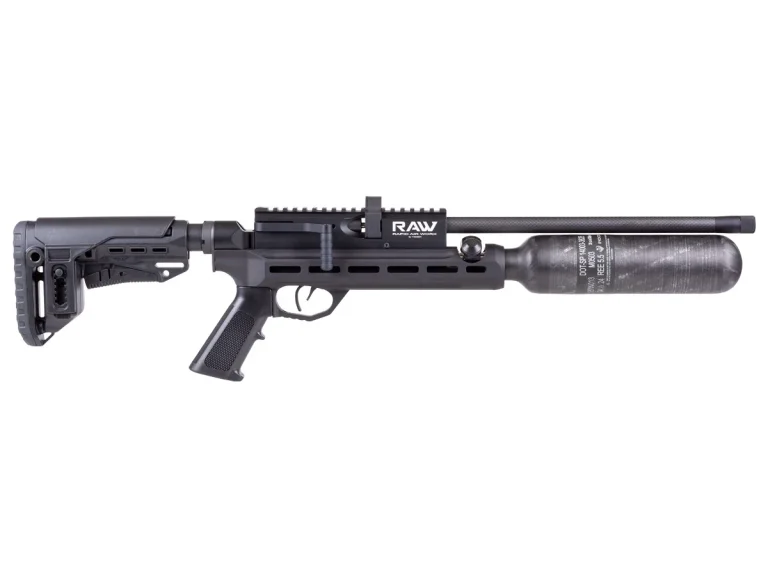
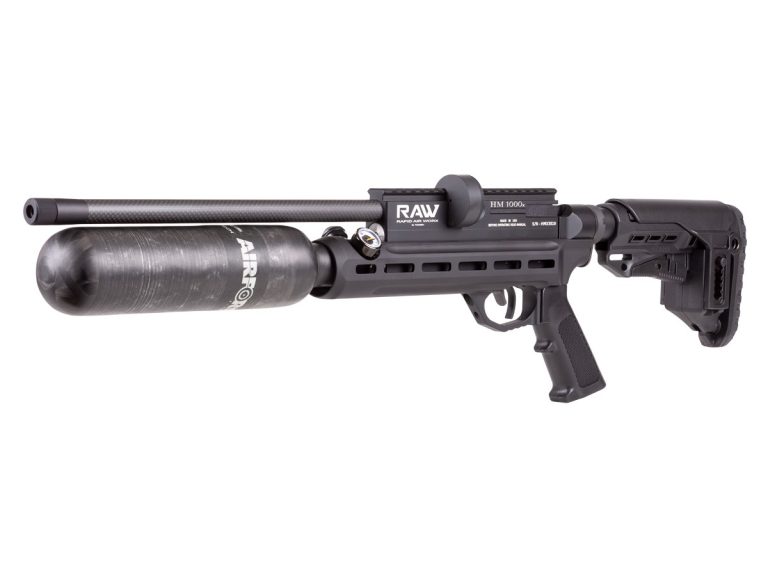
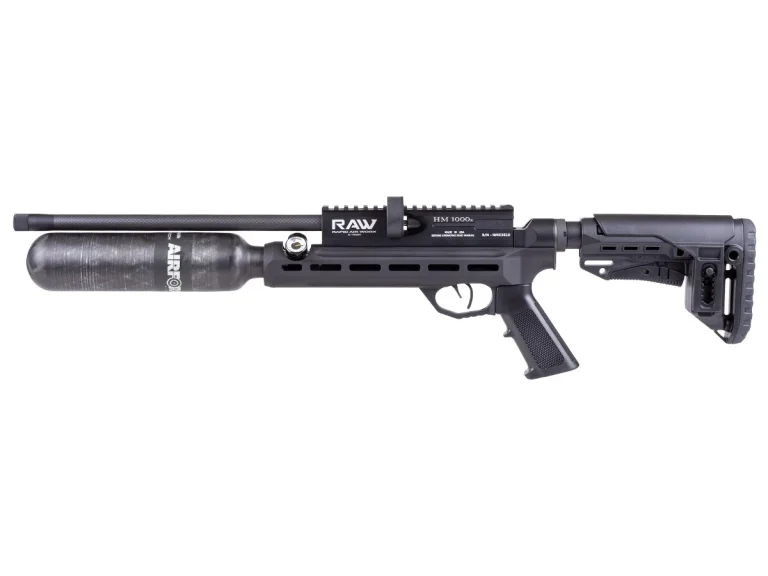
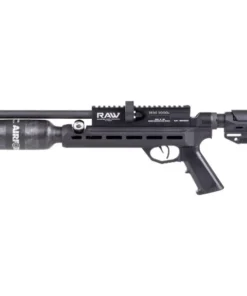
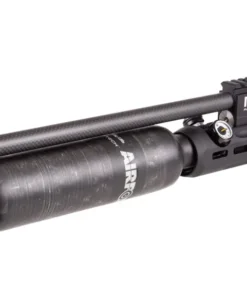
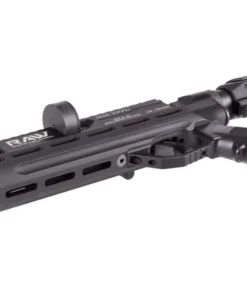
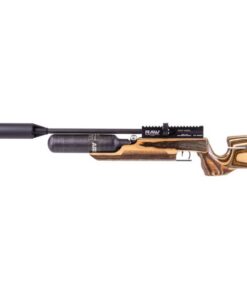
RAW HM1000x Mini Chassis PCP Air Rifle by RAW Rapid Air Worx
$1,800.00
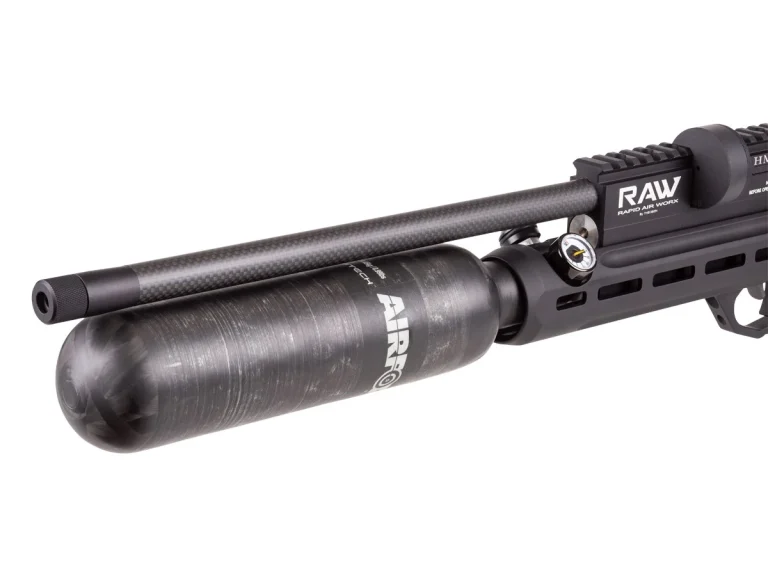
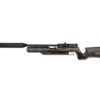
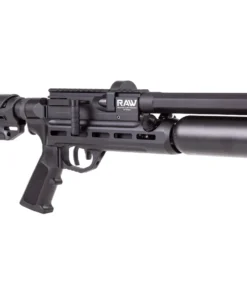
The RAW HM1000X Mini Chassis Rifle features the same incredible accuracy as its larger counterpart, as well as the quality and reliability of a tested, made-in-America platform. Capable of power up to 70 FPE in .30, 50 FPE in .25 and 40 FPE in .22, it provides similar performance to the bigger model but in a form factor that is lighter and more maneuverable because of its efficient design.
This airgun utilizes an updated dual-ported barrel design to deliver excellent power despite its shorter length. The sidelever action is remarkably smooth and notably reliable, and the accuracy of the Lothar Walther rifled barrel is something shooters have come to rely on. In addition, the two-stage adjustable trigger is light from the factory and can be made even lighter, and it provides an incredibly sharp and repeatable break.
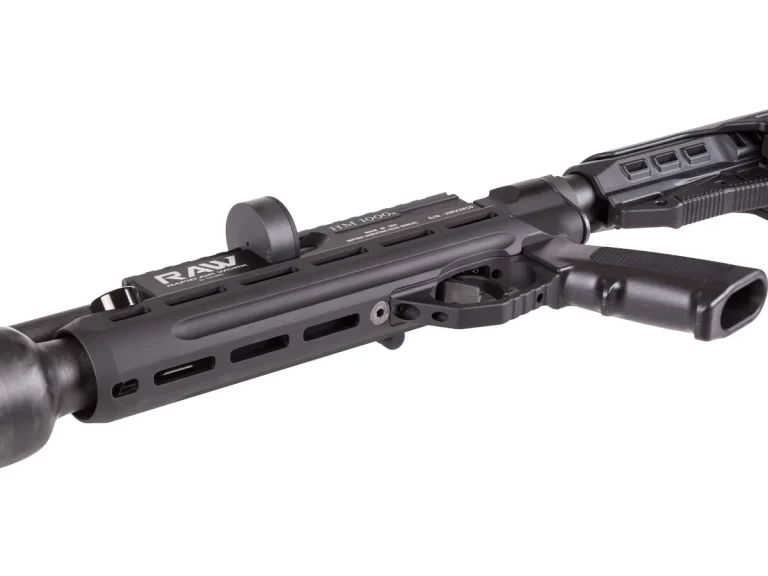
The Rapid Air Worx HM1000X Mini Chassis offers the same action as the larger airguns in the successful HM1000X series and puts it into an aircraft-grade aluminum chassis with tactical features and styling. The stock features an adjustable A-B Arms buttstock with ridged rubber buttpad that yields a variable length of pull, as well as an AR-compatible stock and grip for interchangeable flexibility.
For adding a scope for maximum long-range accuracy, this air rifle offers a Picatinny optics rail, and the chassis features M-LOK accessory rails on all three sides of the forend for attaching items such as bipods, lights, and lasers that improve the stability and increase the functionality of the airgun and shooting experience.
To get a shorter and lighter option in this legendary line of air rifles with the same features and surprising performance for its size, buy the RAW HM1000X Mini Chassis Rifle from Pyramyd AIR today.
RAW HM1000X Mini Chassis PCP Air Rifle
- Improved dual-ported barrel
- Lightweight and rigid aircraft-grade aluminum chassis
- M-LOK rails on three sides for accessories
- AR-compatible A-B Arms grip and buttstock
- A-B Arms buttstock adjusts for length of pull and cheek weld
- Length of pull adjusts from 11.75″ to 16″
- Reversible cheek riser accommodates right or left-handed shooters
- Sidelever can be swapped from Right-Hand to Left-Hand
- Male quick-connect fill fitting
- 490cc carbon fiber air bottle
- Fill pressure: 250 BAR (approx. 3,625 PSI)
- Max. shots per fill: 60 (.22, w/25.39gr pellets), 45 (.25 w/33.95gr pellets), 45 (.30 w/44gr pellets)
- Fully adjustable, match-grade trigger
- Lothar Walther rifled barrel with 1/2-20 threaded end
- Carbon fiber-wrapped barrel w/ two piece shroud
- Fully regulated
- Precision side-lever cocking mechanism
- Max. power: 40 FPE (.22), 50 FPE (.25), 70 FPE (.30)
- 12-shot rotary magazine (.22/.25), 9-shot rotary magazine (.30)
- Easy access hammer spring adjustment
- Max. velocity: 850 FPS (.22), 820 FPS (.25), 840 FPS (.30)
- Barrel length: 15″
- Overall length: 32″-34″
- Includes one magazine
- Made in the USA
RAW HM1000x Mini Chassis PCP Air Rifle by RAW Rapid Air Worx – American Precision Engineering, Compact Design and Advanced Pneumatic Technology
RAW HM1000x Mini Chassis PCP Air Rifle – Advanced American Engineering, Precision Manufacturing and Compact Sporting Design
The RAW HM1000x Mini Chassis PCP Air Rifle by RAW Rapid Air Worx combines American manufacturing, precision engineering, and contemporary sporting design within a compact mechanical platform.
Designed for experienced sporting enthusiasts, this pre-charged pneumatic rifle incorporates a 15-inch Lothar Walther barrel, a regulated operating system, and a precision-machined aluminum chassis.
Furthermore, its adjustable A-B Arms buttstock, ergonomic pistol grip, and reversible side-lever arrangement contribute to its modern construction.
The manufacturer also incorporates a carbon-fiber-wrapped barrel, detachable rotary magazine, and adjustable two-stage match trigger.
Additionally, the M-LOK fore-end and Picatinny optics interface provide standardized mounting provisions.
At approximately 34 inches overall and 7.8 pounds unscoped in the commonly listed configuration, the equipment distinguishes itself from larger traditional sporting designs.
Its compact proportions, carefully manufactured action, and adjustable furniture reflect the manufacturer’s approach to integrating established mechanical technology into contemporary sporting equipment.
Consequently, the platform appeals to enthusiasts who appreciate American craftsmanship, modern materials, precision-oriented construction, and compact dimensions.
RAW HM1000x, Rapid Air Weapons and American Manufacturing
The search terms raw hm1000x, rapid air weapons, rapid air worx, raw air, and american made air rifles reflect interest in the manufacturer’s engineering heritage.
RAW manufactures specialized sporting equipment incorporating precision-machined actions, regulated pneumatic systems, and contemporary exterior components.
Meanwhile, raw air force relates to the company’s association with AirForce Airguns.
The tm1000 designation identifies another established target-oriented model in the manufacturer’s product range.
Although these platforms share engineering heritage, their dimensions and mechanical configurations differ.
RAW Micro Hunter and Compact Sporting Comparisons
The expressions RAW Micro Hunter, microhunter, micro hunter, RAW MicroHunter air rifle, and RAW MicroHunter PCP air rifle concern related compact sporting equipment.
Additional searches include RAW MicroHunter for sale, RAW MicroHunter review, RAW MicroHunter .25, RAW MicroHunter compact air rifle, RAW MicroHunter hunting rifle, and Best compact PCP air rifle.
The phrase DAW MicroHunter 22 appears in related searches, although its spelling differs from the manufacturer’s established designation.
The Mini Chassis model uses a compact aluminum structural arrangement rather than conventional laminated sporting furniture.
Therefore, buyers should compare actual stock types and factory specifications.
Pressure Regulation and Specialized Mechanical Engineering
The expressions pcpregulator, belleville washer stack, and belleville washer stack airgun regulato relate to general pressure-management technology.
However, these terms should not be interpreted as confirmation of particular internal components without manufacturer documentation.
Similarly, grey ops cnc and gray ops onc concern specialist machining or aftermarket equipment research.
Compatibility with external accessories requires separate verification.
Daystate Delta Wolf Performance and Premium Sporting Alternatives
Customers comparing sophisticated sporting equipment may encounter Daystate Delta Wolf Performance, daystate delta wolf, delta wolf, daystate alpha wolf, and daystate redwolf.
Other related searches include daystate, day state, daystate blackwolf, huntsman daystate, alpha red wolf, and daystate wolverine sapphire.
Meanwhile, what is a delta wolf concerns a separate manufacturer’s electronically controlled sporting platform.
The expressions wolf battery and can wolverine go on planes address unrelated technical and transportation questions.
These terms should not be presented as factory features of the American-made model.
Sporting Accessories, Stock Comfort and Compatibility
The terms enhanced rubber butt pad, puddy bottle cover, black snood, and day wolf m-lok to picatinny rail adapter relate to broader sporting accessory searches.
Similarly, magpul moe si and how to put a gun sling on a rifle concern accessory research rather than confirmed included equipment.
The phrase 177 magazine identifies a caliber-specific accessory search, but the commonly documented Mini Chassis versions use .22, .25, or .30 configurations.
Consequently, customers should verify compatibility before ordering additional components.
Specialist Retailers, Product Availability and Customer Support
Searches such as rapid air dealers near me, air guns near me, and air gun dealers near me indicate interest in locating specialist retailers.
Meanwhile, where is pyramyd air located concerns an established American sporting equipment retailer.
The expression raw gear shirts relates to branded apparel rather than the rifle’s mechanical features.
Customers should consider manufacturer documentation, warranty protection, stock availability, and local legal requirements before purchasing.
Moderators, Barrel Shrouds and Exterior Construction
The expressions air gun suppressor and airgun moderator describe muzzle-noise reduction equipment.
The commonly listed Mini Chassis configuration incorporates a carbon-fiber-wrapped barrel and two-piece shroud.
However, the presence of a shroud does not guarantee that additional muzzle accessories are included.
Furthermore, legal restrictions differ between jurisdictions.
Therefore, buyers should confirm the exact factory configuration and applicable regulations.
RAW HM1000x Mini Chassis – Important Technical Specifications
- Manufacturer: RAW Rapid Air Worx
- Country of manufacture: United States
- Model: HM1000x Mini Chassis
- Operating system: Regulated pre-charged pneumatic
- Commonly listed calibers: .22 (5.5mm), .25 (6.35mm), .30 (7.62mm)
- Barrel manufacturer: Lothar Walther
- Barrel length: 15 inches
- Barrel construction: Carbon-fiber-wrapped, rifled barrel
- Barrel shroud: Two-piece assembly on the referenced retailer configuration
- Overall length: Approximately 32–34 inches, depending on stock position
- Unscoped weight: Approximately 7.8 pounds
- Chassis: Precision-machined aircraft-grade aluminum
- Air reservoir: 490cc carbon-fiber bottle on the referenced retailer model
- Maximum filling pressure: 250 bar / approximately 3,625 PSI
- Regulator: Factory-regulated pneumatic system
- Trigger: Adjustable two-stage match-grade
- Action: Reversible side lever
- Magazine: Detachable rotary
- Magazine capacity: 12 rounds in .22/.25; 9 rounds in .30
- Buttstock: Adjustable A-B Arms
- Length of pull: Approximately 11.75–16 inches
- Cheek support: Adjustable, reversible cheek riser
- Pistol grip: AR-compatible
- Optics interface: Weaver/Picatinny
- Fore-end: M-LOK mounting interfaces
- Muzzle: 1/2×20 threaded
- Safety: Manual
- Air connection: Male quick-connect fitting
- Included equipment: One rotary magazine
- Warranty: Subject to manufacturer and retailer conditions
- Legal classification: Depends on caliber, factory configuration, and jurisdiction
Why Choose the RAW HM1000x Mini Chassis?
The Mini Chassis configuration combines American manufacturing heritage, a specialized Lothar Walther barrel, modern pneumatic regulation, and precision-machined aluminum construction.
Furthermore, its adjustable rear furniture, ergonomic grip, detachable magazine, and compact structural arrangement contribute to its distinctive sporting design.
The carbon-fiber reservoir and specialized mechanical components demonstrate the manufacturer’s emphasis on advanced materials and component integration.
For enthusiasts evaluating premium sporting equipment, important considerations include genuine manufacturer support, verified specifications, authorized servicing, and suitability for lawful target activities.
Ultimately, this configuration offers a distinctive combination of compact proportions, contemporary industrial styling, precision manufacturing, and established American engineering craftsmanship.
Advanced American Engineering, Compact Chassis Construction, Precision Manufacturing, Ergonomic Design and Long-Term Ownership Value
2.1 American Engineering Heritage and Manufacturing Excellence
The compact sporting platform reflects a combination of American industrial craftsmanship, specialized mechanical engineering, and contemporary manufacturing technology. Its construction demonstrates the manufacturer’s commitment to precision-machined components, carefully selected materials, and sophisticated pneumatic systems.
Unlike traditional full-length sporting designs, this configuration incorporates its principal assemblies within a relatively compact aluminum structure. The arrangement creates a distinctive appearance while maintaining the mechanical characteristics of an established precision-oriented product family.
Furthermore, modern machining techniques contribute to accurate component dimensions and consistent structural interfaces. Appropriate manufacturing tolerances help maintain the intended relationships between connected mechanical assemblies.
However, manufacturing quality should not be judged solely by exterior appearance. Internal alignment, material integrity, component compatibility, and long-term serviceability remain important considerations.
The American manufacturing heritage contributes to the equipment’s identity, particularly for enthusiasts who appreciate domestic industrial craftsmanship.
Additionally, the combination of traditional mechanical principles and modern materials illustrates how established designs can evolve.
Ultimately, this platform demonstrates the manufacturer’s emphasis on structural refinement, practical dimensions, and carefully integrated engineering.
2.2 Precision-Machined Aluminum Chassis and Structural Strength
The aluminum chassis forms the foundation of the equipment’s compact mechanical architecture. Its construction incorporates carefully shaped surfaces, defined mounting interfaces, and structural components intended to accommodate the principal operating assemblies.
Aluminum alloys remain widely used in industrial manufacturing because they offer a useful combination of strength, relatively low density, and machining versatility.
Furthermore, precision machining allows manufacturers to create complex exterior geometry while maintaining consistent internal dimensions.
However, material identification alone cannot establish complete durability.
Alloy composition, structural geometry, component thickness, manufacturing quality, and protective finishing influence long-term mechanical integrity.
Consequently, customers should consider the entire structural design rather than assuming every aluminum component possesses identical characteristics.
The supporting framework also requires appropriate care.
Severe impacts, accidental damage, and unauthorized structural alterations may compromise its intended condition.
Routine inspection helps identify visible problems requiring qualified attention.
The finished chassis demonstrates how modern manufacturing can produce a compact yet sophisticated supporting structure.
2.3 Compact Mechanical Architecture and Efficient Component Integration
The compact architecture represents an important distinction between this configuration and larger traditional sporting designs.
Rather than incorporating an extended wooden stock, the manufacturer organizes the principal assemblies around a relatively short structural framework.
Furthermore, the reduced exterior dimensions contribute to a recognizable contemporary industrial appearance.
However, compact design involves more than simply reducing the length of the equipment.
Manufacturers must consider component accessibility, mechanical alignment, supporting rigidity, and the relationship between connected assemblies.
These requirements become particularly important when multiple specialized components occupy a concentrated structure.
Consequently, successful compact engineering depends on careful manufacturing and appropriate material selection.
Individual preferences also influence physical suitability.
Some enthusiasts appreciate shorter equipment, while others prefer more substantial exterior proportions.
The design demonstrates how efficient component organization can create a distinctive product without abandoning established mechanical engineering principles.
2.4 Lothar Walther Barrel Manufacturing and Precision Construction
The specialized barrel represents an essential component of the mechanical architecture.
Its manufacturing heritage reflects experience in producing precision-oriented components for sporting applications.
The documented configuration incorporates a 15-inch barrel, distinguishing it from longer alternatives within the manufacturer’s wider collection.
Furthermore, the barrel must integrate accurately with the surrounding mechanical assemblies.
Suitable materials, consistent internal dimensions, and appropriate manufacturing processes contribute to its intended condition.
However, barrel length and manufacturer reputation alone cannot establish a guaranteed accuracy figure.
Actual results depend on approved ammunition, factory specifications, equipment condition, and environmental influences.
Consequently, technical descriptions should distinguish verified construction details from unsupported performance claims.
Precision surfaces also require appropriate maintenance.
Unsuitable cleaning methods or unauthorized modifications may cause damage.
Professional inspection remains advisable whenever unusual wear or suspected defects become apparent.
2.5 Carbon-Fiber Barrel Wrapping and Composite Material Engineering
The carbon-fiber wrapping contributes to the distinctive appearance and modern material construction of the barrel assembly.
Composite materials have become important within industrial engineering because they can offer useful structural characteristics when incorporated into carefully developed components.
Furthermore, the relationship between the composite wrapping and underlying metallic construction requires appropriate manufacturing attention.
Different materials possess different mechanical and thermal properties.
Consequently, the manufacturer must account for these characteristics during product development.
However, composite construction does not make a component immune to accidental damage.
Severe impacts, inappropriate handling, and unauthorized modifications may compromise structural integrity.
Routine visual inspection remains important, particularly when visible damage becomes apparent.
The combination of metallic and composite materials illustrates how modern manufacturing integrates different technologies within specialized sporting equipment.
2.6 Regulated Pneumatic System and Pressure Management
The regulated pneumatic architecture represents an important element of the equipment’s mechanical construction.
Its purpose involves managing the relationship between stored reservoir pressure and the operating conditions established by the manufacturer.
Furthermore, the system incorporates specialized valves, seals, and other precisely manufactured components.
These interacting assemblies must remain within appropriate mechanical tolerances.
However, regulated operation should not be described as guaranteeing identical results under every possible circumstance.
Temperature variation, normal component wear, and manufacturing differences may influence mechanical behavior.
Consequently, professional servicing remains important whenever internal components require attention.
Unauthorized modifications should be avoided because high-pressure systems can present serious hazards.
The regulating mechanism illustrates the importance of fluid dynamics, accurate manufacturing, and responsible engineering within contemporary pneumatic technology.
2.7 Carbon-Fiber Air Reservoir and Pressure Vessel Construction
The carbon-fiber air reservoir forms an essential component of the operating system.
Its construction combines specialized composite materials with pressure-vessel engineering intended for the manufacturer’s approved conditions.
Furthermore, the reservoir connects with carefully manufactured pneumatic assemblies that must maintain appropriate structural integrity.
The referenced configuration incorporates a substantial bottle that contributes to the overall mechanical architecture.
However, reservoir capacity alone cannot establish an exact number of usable discharges.
Actual operating characteristics depend on the factory specification, component condition, and environmental circumstances.
Pressure-containing components require particular care throughout ownership.
Excessive heat exposure, structural damage, unauthorized modifications, and unsuitable repairs may introduce serious hazards.
Consequently, any indication of leakage or compromised integrity requires qualified professional assessment.
The reservoir demonstrates how modern materials contribute to sophisticated sporting equipment while reinforcing the importance of responsible pressure-system maintenance.
2.8 Precision-Machined Action and Mechanical Integrity
The main action incorporates carefully manufactured metallic components designed to maintain appropriate mechanical relationships.
Its construction requires accurate machining, suitable materials, and consistent assembly standards.
Furthermore, the action integrates with the supporting chassis and surrounding pneumatic assemblies.
From an engineering perspective, dimensional accuracy contributes to the intended relationship between moving and stationary components.
However, precision manufacturing does not eliminate ordinary mechanical wear.
Environmental contamination, accidental impacts, and unsuitable maintenance can affect component condition.
Consequently, periodic inspection remains valuable.
Unexpected resistance, visible damage, or abnormal movement should receive qualified technical attention.
The action illustrates how established machining expertise can complement contemporary compressed-air technology within a compact structural arrangement.
2.9 Reversible Side-Lever Mechanism and Contemporary Controls
The reversible side-lever mechanism contributes to the platform’s distinctive mechanical architecture.
Its construction incorporates carefully manufactured moving components intended to maintain the manufacturer’s specified characteristics.
Furthermore, the arrangement reflects the manufacturer’s interest in adaptable exterior controls.
However, no moving assembly remains permanently unaffected by wear or environmental contamination.
Dust, moisture, and unsuitable cleaning products may influence exposed components over time.
Consequently, routine inspection remains important.
Any mechanism displaying unusual resistance should not be forced.
Qualified servicing provides the appropriate response whenever malfunction or physical damage becomes apparent.
The design demonstrates how contemporary sporting equipment can integrate specialized controls within a compact structural framework.
2.10 Adjustable Two-Stage Trigger and Mechanical Refinement
The adjustable two-stage trigger represents an important part of the precision-oriented mechanical construction.
Its internal assembly incorporates carefully manufactured interacting components intended to operate within the manufacturer’s approved specifications.
Furthermore, suitable materials, accurate alignment, and consistent surface finishing contribute to the intended mechanical characteristics.
However, trigger assemblies remain safety-critical components.
Unauthorized alterations may compromise their operating condition and introduce serious hazards.
Individual preferences concerning mechanical feel also vary considerably.
Consequently, subjective impressions should not replace objective considerations such as safe function, correct assembly, and reliable component condition.
Any unusual behavior requires qualified professional assessment.
The mechanism reflects the manufacturer’s emphasis on specialized engineering while reinforcing the importance of responsible ownership and appropriate maintenance.
2.11 Rotary Magazine Construction and Component Compatibility
The detachable rotary magazine forms part of the equipment’s operating architecture.
Its construction requires appropriate dimensional accuracy and consistent manufacturing quality.
Furthermore, the assembly must integrate correctly with the surrounding action.
However, magazines supplied for different factory configurations may not be interchangeable.
Similar exterior appearances do not guarantee identical internal dimensions or attachment requirements.
Consequently, customers should verify compatibility through official documentation.
The magazine also benefits from routine inspection.
Visible damage, contamination, or abnormal movement may indicate the need for professional attention.
Improvised repairs should be avoided whenever they could compromise component integrity.
The assembly demonstrates how relatively small mechanical components can involve sophisticated manufacturing requirements.
2.12 Adjustable A-B Arms Buttstock and Modern Ergonomics
The adjustable rear furniture contributes significantly to the equipment’s contemporary appearance.
Its construction incorporates specialized components designed to provide flexibility for different physical proportions.
Furthermore, the rear assembly integrates with the surrounding aluminum chassis through carefully manufactured interfaces.
However, ergonomic comfort remains subjective.
Individuals differ in height, body proportions, and personal preferences.
Consequently, no single arrangement can guarantee identical suitability for every person.
Adjustment mechanisms also require appropriate care.
Loose hardware, unusual movement, or visible damage may compromise structural integrity.
Routine inspection helps identify concerns requiring professional attention.
The rear furniture illustrates how contemporary manufacturing can integrate adjustable ergonomic components within a compact sporting platform.
2.13 Adjustable Cheek Support and Individual Comfort
The adjustable cheek support represents another element of the equipment’s ergonomic construction.
Its design recognizes that sporting enthusiasts differ in facial structure, physical proportions, and personal comfort requirements.
Furthermore, the component complements the modern rear stock assembly.
However, ergonomic suitability cannot be determined exclusively from published measurements.
Individual preferences vary considerably.
Consequently, customers should evaluate the actual factory configuration when considering physical comfort.
The supporting mechanism also requires appropriate maintenance.
Damaged surfaces, loose fasteners, or abnormal movement may affect its intended condition.
Routine inspection contributes to preserving structural integrity.
The adjustable cheek support demonstrates how human-centered design principles contribute to modern sporting equipment alongside specialized mechanical engineering.
2.14 Ergonomic Pistol Grip and Exterior Design
The pistol grip contributes to the distinctive contemporary appearance of the chassis configuration.
Its shape, material characteristics, and surface texture influence perceived comfort during ordinary handling.
Furthermore, the design complements the angular geometry of the supporting structure.
However, individual preferences remain important.
Hand dimensions, physical proportions, and personal expectations can influence the experience.
Consequently, no single grip design guarantees identical suitability for everyone.
The exterior material also requires appropriate care.
Routine cleaning helps remove ordinary contamination and preserve the original condition.
The integration of a modern grip demonstrates how ergonomic considerations can complement sophisticated mechanical engineering within a compact sporting platform.
2.15 M-LOK Fore-End and Modular Structural Interfaces
The fore-end incorporates standardized mounting interfaces as part of its contemporary industrial design.
These interfaces require carefully controlled dimensions and appropriate supporting materials.
Furthermore, the surrounding structure must maintain suitable mechanical integrity.
However, accessory compatibility cannot be established through visual similarity alone.
Different manufacturers may use specific connection hardware or dimensional requirements.
Consequently, compatibility should be verified through official documentation.
Incorrectly fitted components may damage mounting surfaces and introduce unnecessary mechanical concerns.
The modular arrangement illustrates how contemporary manufacturing can provide standardized exterior interfaces while maintaining a cohesive structural design.
Routine inspection remains important whenever visible wear or damage occurs.
2.16 Precision Optics Interface and Mounting Integrity
The equipment incorporates a dedicated mounting interface designed around established accessory standards.
From an engineering perspective, such arrangements require suitable materials, dimensional consistency, and appropriate structural support.
Furthermore, the interface must integrate securely with the surrounding chassis.
However, visual resemblance does not guarantee universal compatibility.
Different accessories may use particular fastening arrangements or dimensional requirements.
Consequently, customers should verify compatibility before purchasing additional components.
Improperly fitted equipment may damage mounting surfaces.
Routine inspection helps identify loose connections or visible deterioration.
The inclusion of standardized interfaces demonstrates how modern sporting equipment incorporates modular engineering principles within a compact structural framework.
2.17 Compact Dimensions and Physical Weight Distribution
The compact structural arrangement contributes to the equipment’s recognizable identity.
Its dimensions reflect the combination of a relatively short barrel, substantial pneumatic reservoir, precision-machined chassis, and adjustable rear furniture.
However, overall length and weight can vary according to the specific factory configuration.
Consequently, customers should verify the exact version before relying on published measurements.
Weight distribution also influences perceived physical balance.
Total mass alone does not describe every aspect of handling comfort.
Furthermore, optional accessories can change the final dimensions and weight.
Individual preferences vary considerably.
Some enthusiasts prioritize shorter equipment, while others appreciate more substantial proportions.
A realistic evaluation considers the complete configuration rather than concentrating exclusively on one numerical specification.
2.18 Contemporary Industrial Styling and Exterior Appearance
The equipment’s modern appearance reflects its combination of precision-machined metalwork, composite components, and adjustable exterior furniture.
Unlike traditional sporting designs built around decorative wooden stocks, this configuration emphasizes visible mechanical structure.
Furthermore, the angular geometry contributes to a distinctive industrial aesthetic.
However, appearance alone cannot establish mechanical superiority.
Material integrity, manufacturing consistency, and appropriate assembly remain more meaningful technical considerations.
Nevertheless, styling contributes to customer satisfaction.
Some enthusiasts appreciate classic sporting furniture, while others prefer contemporary metallic construction.
The combination of compact proportions and modern materials creates a recognizable appearance.
Appropriate care helps preserve the exterior throughout ownership.
2.19 Protective Finishing and Surface Preservation
Protective finishing contributes to maintaining the appearance of exposed metallic components.
Depending on the treatment applied, coatings may reduce ordinary environmental deterioration.
Furthermore, consistent surface finishing provides a visually unified exterior.
However, no protective treatment offers unlimited resistance to scratches, abrasion, accidental impacts, or unsuitable chemicals.
Consequently, responsible maintenance remains important.
Ordinary fingerprints and light contamination can generally be removed using suitable nonabrasive materials.
Aggressive solvents should be avoided unless the manufacturer specifically approves them.
Humidity may also influence exposed components during extended storage.
For this reason, clean and dry conditions are preferable.
Routine care contributes to preserving the original appearance while reducing unnecessary surface deterioration.
2.20 Environmental Conditions and Material Stability
Environmental conditions can influence the physical behavior of pneumatic, metallic, and composite components.
Compressed gas responds to temperature variation, while exposed metallic surfaces may experience condensation.
Furthermore, airborne dust can accumulate around moving assemblies.
Appropriate storage therefore deserves careful attention.
The equipment should not be exposed to excessive heat, particularly inside enclosed vehicles under direct sunlight.
Similarly, prolonged moisture exposure may affect protective finishes and vulnerable components.
However, suitability for ordinary outdoor sporting activities does not automatically establish waterproof construction.
Specific environmental resistance ratings should not be assumed without manufacturer documentation.
Responsible storage and inspection contribute to preserving mechanical integrity.
2.21 Mechanical Reliability and Preventive Maintenance
Mechanical reliability depends on the condition of several interacting assemblies.
Seals, valves, springs, structural components, and pressure-containing elements must remain within their intended operating conditions.
Furthermore, manufacturing quality provides only part of the foundation for dependable ownership.
Normal wear, environmental exposure, accidental damage, and unsuitable maintenance may influence mechanical behavior.
Consequently, periodic visual inspection remains valuable.
Owners should remain attentive to unusual resistance, visible damage, or unexpected changes in component condition.
However, internal inspection should never involve unauthorized dismantling of pressurized assemblies.
Qualified professional assistance remains appropriate whenever suspected malfunction becomes apparent.
Responsible maintenance contributes to preserving the manufacturer’s intended mechanical characteristics.
2.22 High-Pressure Safety and Professional Servicing
The pressure-containing system represents an important safety consideration.
Its reservoir and connecting assemblies operate under substantial mechanical stress.
Therefore, the manufacturer’s published operating limits must always be respected.
Furthermore, pressure vessels should never be drilled, heated, structurally modified, or repaired using improvised techniques.
Replacement components must satisfy appropriate pressure and compatibility requirements.
A fitting that appears physically similar may not possess the necessary engineering characteristics.
Consequently, genuine manufacturer-approved parts and qualified servicing remain essential.
Any indication of leakage, visible damage, or compromised structural integrity requires professional assessment.
Technical sophistication must always be accompanied by responsible ownership.
High-pressure maintenance should never involve unauthorized modifications.
2.23 Secure Storage and Responsible Transportation
Secure storage forms an essential part of responsible sporting equipment ownership.
The equipment should remain inaccessible to unauthorized individuals when not in use.
A suitable locked cabinet or legally compliant storage arrangement can help meet this requirement.
Furthermore, protective cases may reduce ordinary transportation damage.
However, compact construction does not automatically make transportation legally unrestricted.
Local regulations may establish specific requirements concerning possession, licensing, storage, and movement between locations.
These conditions vary considerably between jurisdictions.
Consequently, customers should confirm applicable legislation before purchasing or transporting the equipment.
Appropriate documentation may also be necessary during lawful transfer or travel.
Responsible ownership combines physical security, legal compliance, and suitable maintenance.
2.24 Manufacturer Documentation and Long-Term Ownership Value
Comprehensive documentation contributes significantly to the long-term value of specialized mechanical equipment.
The official instruction manual provides essential information concerning maintenance responsibilities, safety requirements, and authorized operating procedures.
Furthermore, qualified technical support may become necessary when specialized components require inspection or replacement.
The availability of genuine parts should therefore receive consideration.
Warranty conditions also deserve careful review.
Coverage may vary according to region, distributor, and the nature of the reported concern.
Unauthorized modifications, accidental damage, or unsuitable handling may fall outside applicable protection.
Consequently, owners should retain purchasing documentation and consult official support channels whenever necessary.
Long-term value depends on manufacturing quality, service availability, maintenance requirements, and realistic ownership expectations.
A dependable supplier should clearly identify the configuration and provide accurate information concerning included components.
2.25 Final Assessment of Engineering Quality and Ownership Experience
The compact chassis configuration combines American manufacturing heritage, specialized barrel technology, and contemporary structural design within a sophisticated sporting platform.
Its regulated pneumatic architecture, carbon-fiber reservoir, precision-machined action, and adjustable exterior furniture demonstrate the manufacturer’s emphasis on mechanical refinement.
Furthermore, the compact aluminum framework provides a recognizable alternative to conventional wooden sporting designs.
The integration of composite materials and carefully manufactured metallic components contributes to the equipment’s modern technical identity.
However, responsible ownership remains essential.
High-pressure assemblies require qualified servicing, secure storage should always receive priority, and applicable legislation must be respected.
For enthusiasts who appreciate American craftsmanship, compact industrial styling, and precision-oriented mechanical construction, this configuration offers an interesting combination of engineering characteristics and long-term ownership considerations.
Ultimately, its appeal lies in the integration of structural quality, modern materials, specialized components, and thoughtful manufacturing within one distinctive sporting platform.
Be the first to review “RAW HM1000x Mini Chassis PCP Air Rifle by RAW Rapid Air Worx”
Related products
RAW Air Rifles
RAW Air Rifles

RAW Air Rifles
RAW Air Rifles
RAW Air Rifles
RAW Air Rifles
Reviews
There are no reviews yet.