
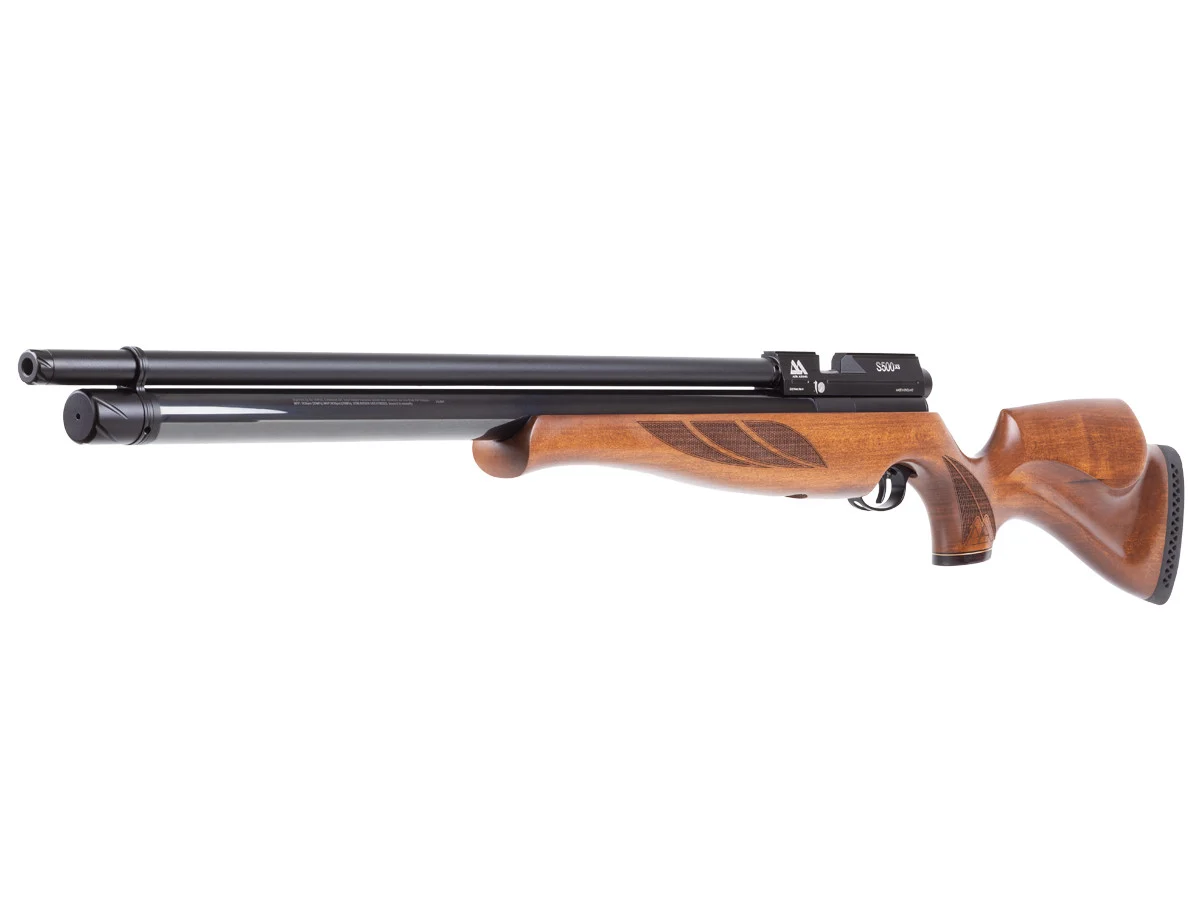
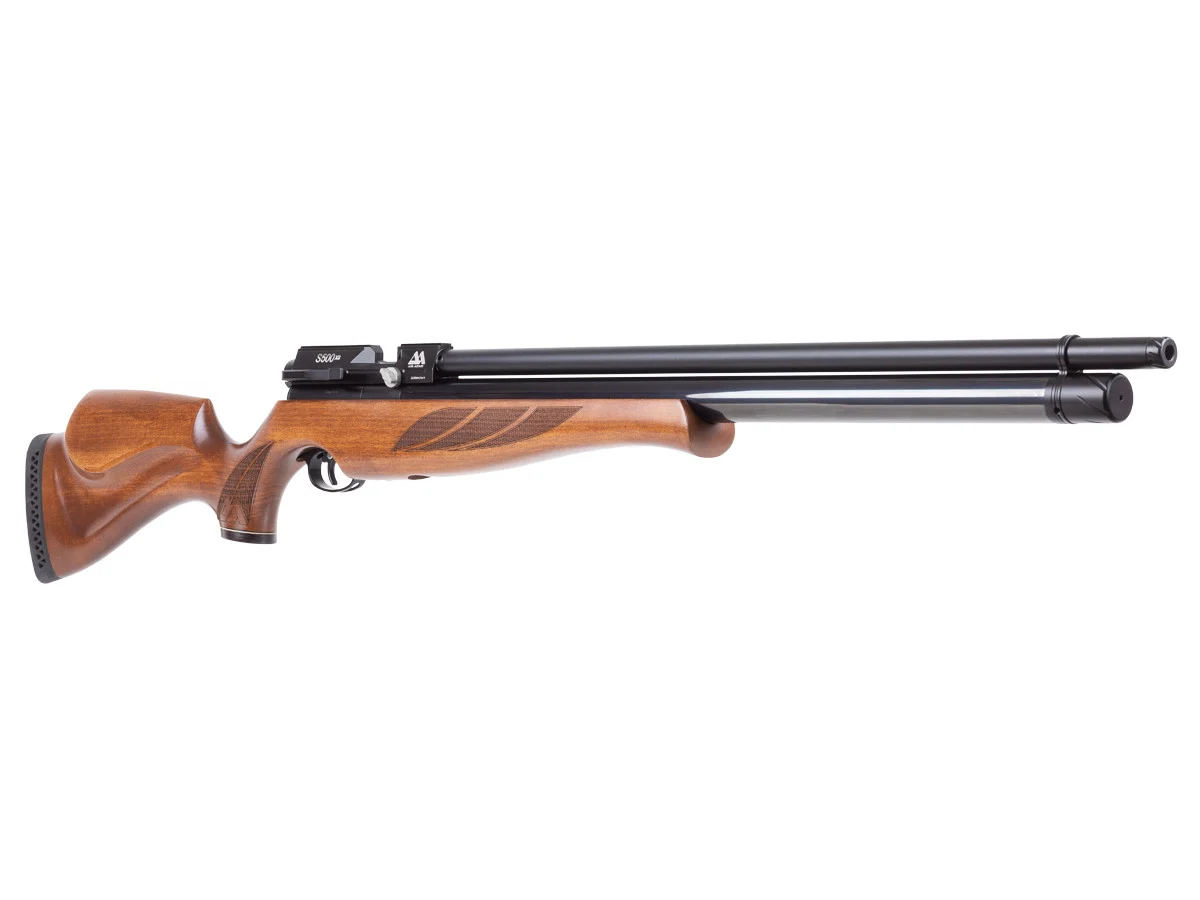
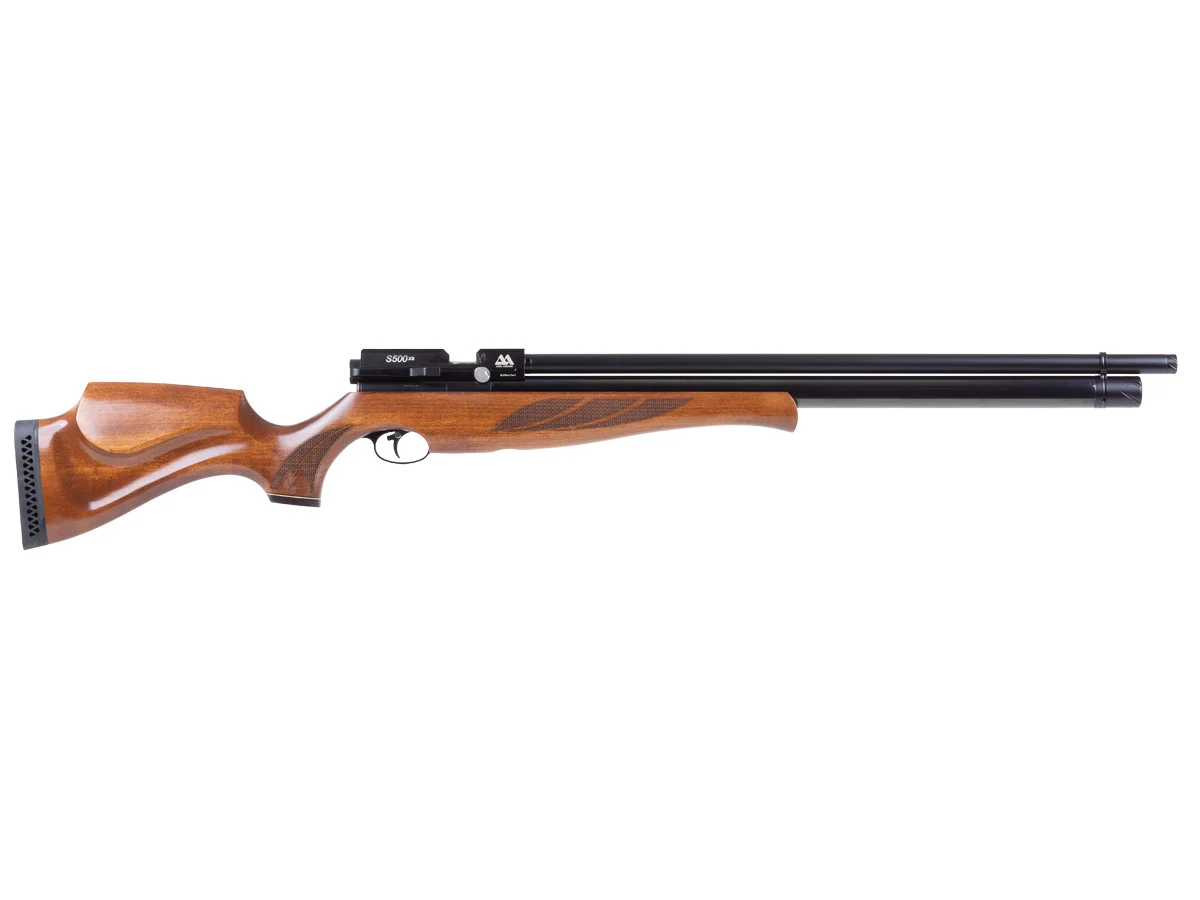
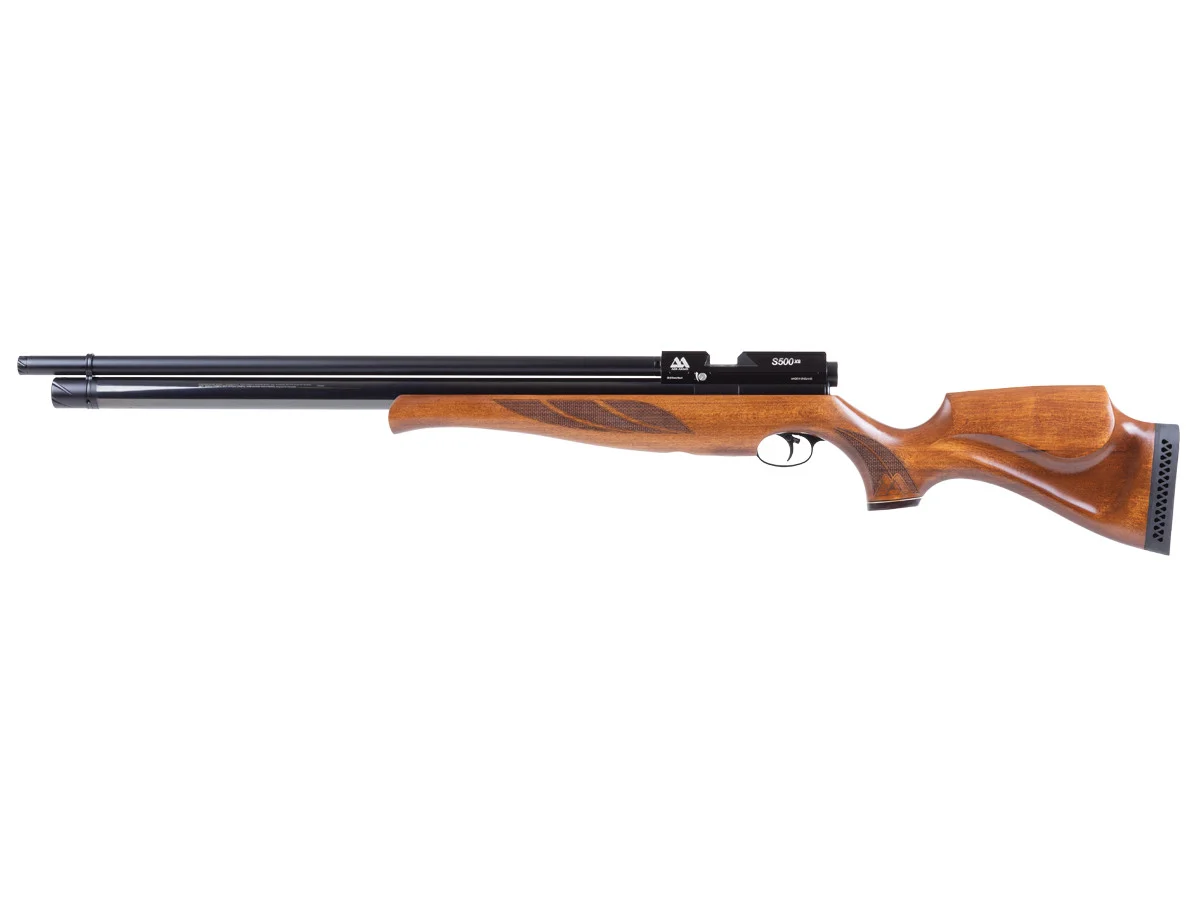
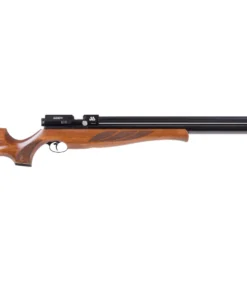
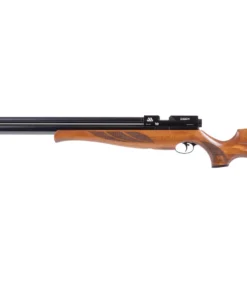
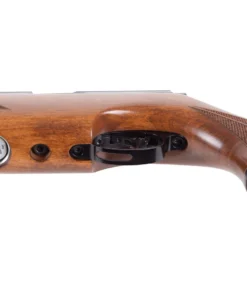
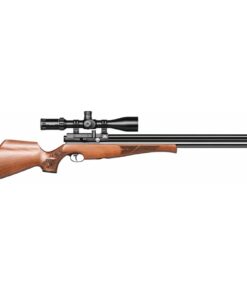
Air Arms S500 XS Xtra FAC Regulated PCP Air Rifle
$1,100.00
Description
Air Arms is known for its beautiful guns. And, the beauty is more than skin deep. As if the beautiful wood stock and deep, rich bluing weren’t enough…there’s the fantastic accuracy built into every gun.
The match grade, Lothar Walther barrel produces groups that would make any shooter proud. The regulator keeps your velocity consistent over the entire shot string, providing up to 60 shots in .177 and 55 in .22. And with the on board, 5 position power adjuster, you can fine tune the performance of the S500XS to your needs.
If you believe that only accurate guns are interesting, then the S500XS must be one of the most interesting guns on the planet! No matter what you’ve shot before or will shoot in the future, the Air Arms S500XS Xtra FAC sidelever will leave an indelible impression!
Helpful resources:
- Learn about hunting with air rifles
- Tips for picking the right airgun for hunting game & pests
- Learn about airgun hunting laws in your state
- Shop related categories: pellet guns, pellet rifles
- Air Arms S500XS Xtra FAC sidelever air rifle
- Precharged pneumatic
- Fully Regulated
- Sidelever cocking
- Single-shot
- 5-position Transfer Port Power Adjuster
- 2-stage adjustable trigger
- Adjustable power
- 11mm scope grooves (no open sights)
- 3625 psi fill pressure (250 bar)
- 288cc tank
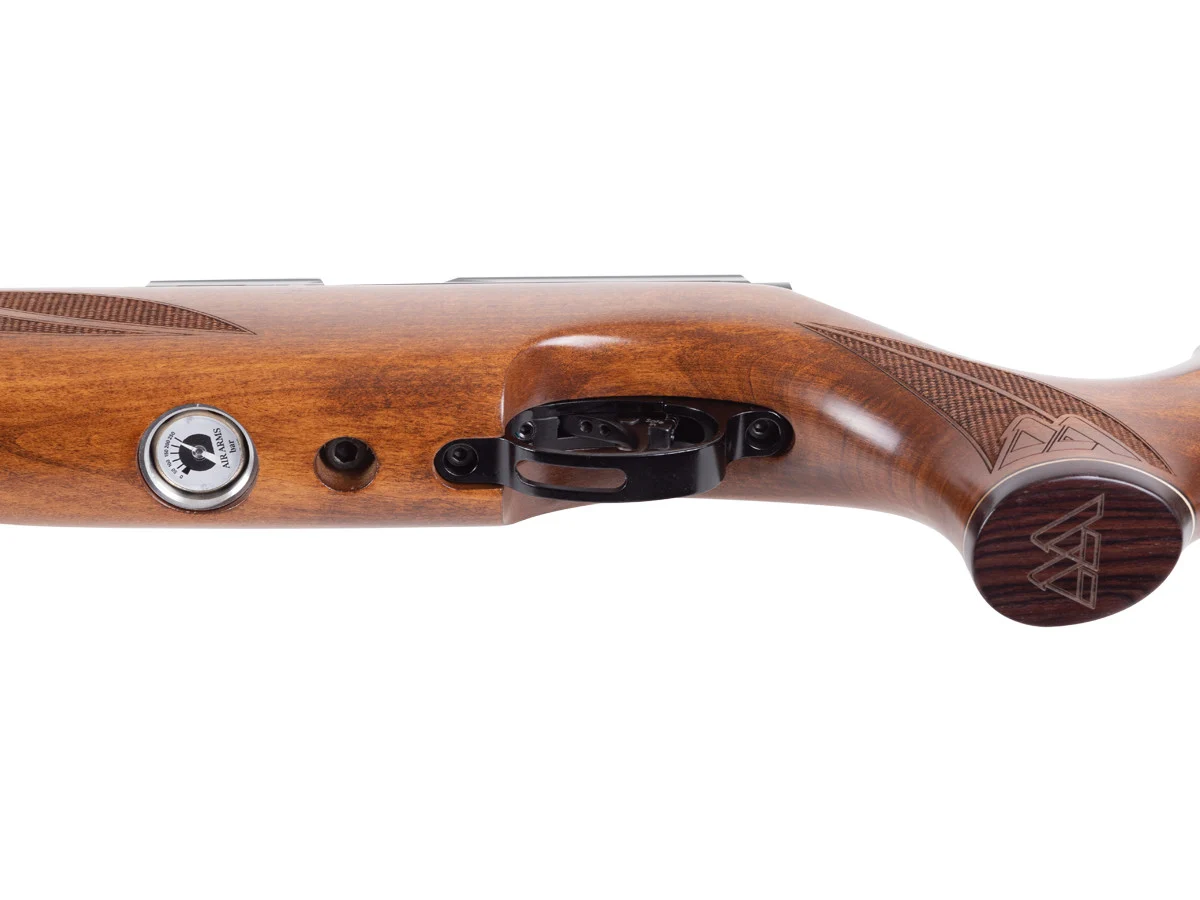
- Built-in manometer (air pressure gauge)
- Lothar Walther barrel
- Shrouded barrel for extra-quiet shooting
- Ambidextrous Monte Carlo poplar stock
- Dual raised cheekpieces
- Checkered pistol grip and forearm
- 60 shots in .177, 55 shots in .22
- Ventilated rubber buttpad
Specifications
BrandAir Arms
Caliber.22 (5.5mm)Max Velocity950 fpsMuzzle Energy32 ft/lbsSuggested forSmall game hunting/plinkingPowerplantPre-charged pneumaticLoudness3-MediumWeight7.1 lbsFunctionSingle-shotMax Shots per Fill55Cylinder Size288 ccActionSideleverFixed/adj. powerMultiple settingsShroudedYesScopeable11mm dovetailFront SightsnoneRear SightsnoneSafetyManualTriggerTwo-stage adjustableBarrelRifledBarrel Length19.75″Overall Length43.5″Capacity1 round(s)Body TypeRifleStockPoplarButtplateVentilated rubberColorBrownOperating Pressure3625 PSI / 250 BARGrip OrientationAmbidextrousRegulatedYesIs Safe To Dry FireYes
Air Arms S500 XS Xtra FAC Regulated PCP Air Rifle – Regulated Single-Shot Precision and High-Pressure PCP Engineering
The Air Arms S500 XS Xtra FAC Regulated PCP Air Rifle is a high-power, single-shot pre-charged pneumatic rifle built around deliberate operation, regulated air delivery and precision-focused engineering.
Unlike the magazine-fed S510, the S500 uses a single-shot breech.
That design encourages a slower and more deliberate shooting process because each pellet is loaded individually.
Air Arms currently identifies the S500 Carbine XS Xtra as a regulated FAC configuration available in .177 and .22. The manufacturer also highlights the platform’s precision Lothar Walther barrel, balanced firing system, side-lever action and single-shot simplicity.
Current Xtra FAC specifications identify a 288 cc air reservoir, 250-bar maximum fill pressure, built-in pressure gauge, adjustable two-stage trigger, 11 mm scope rail, shrouded barrel and multi-position power adjustment system. Depending on stock configuration, the rifle may be supplied in walnut, beech, poplar or lightweight sporting stocks.
The regulator is one of the most important mechanical features.
As the main reservoir pressure falls during use, the regulator helps provide a more consistent working pressure to the firing valve.
That matters because projectile velocity affects trajectory.
If velocity remains more consistent, vertical point-of-impact variation can also be reduced.
Because this is an FAC-rated configuration, legal requirements may apply depending on location.
The rifle should always remain within its approved specification and lawful power category.
Air Arms S510 XS Ultimate Sporter FAC
The Air Arms S510 XS Ultimate Sporter FAC belongs to another regulated Air Arms PCP family.
It differs from the S500 because the S510 uses a magazine-fed multi-shot action.
Why This Difference Matters
The S500 emphasizes deliberate single-shot loading.
The S510 prioritizes repeated magazine-fed operation.
air rifle
An air rifle propels a pellet using compressed gas or mechanically generated air pressure.
The S500 XS Xtra uses pre-compressed air stored inside a high-pressure reservoir.
air gun
An air gun is a broad term covering PCP, spring-piston, gas-ram and CO₂-powered systems.
The S500 belongs specifically to the regulated PCP category.
air arms
Air Arms is the British manufacturer behind the S500, S510, TX200 and other sporting platforms.
The current S500 range includes standard and regulated configurations.
air rifles
Air rifles vary substantially in action type, calibre, power level and intended sporting role.
The S500 XS Xtra combines regulated pneumatic operation with single-shot loading.
pellet guns
The phrase pellet guns broadly refers to air-powered equipment designed to fire shaped pellets.
Pellet calibre must always match the rifle.
cal .177 pellets
cal .177 pellets are approximately 4.5 mm in diameter.
The S500 XS Xtra is available in .177.
Why .177 Is Common
The relatively light projectile can provide a flatter trajectory compared with heavier calibres under similar conditions.
break barrel pellet gun
A break barrel pellet gun uses a hinged barrel as part of the cocking system.
The S500 does not.
Its barrel remains fixed while the side lever operates the breech.
airguns
Airguns include many power systems.
The S500 uses a compressed-air reservoir rather than a mainspring or gas ram.
air pisto
The term air pisto generally refers to an air pistol.
The S500 is instead a shoulder-fired rifle.
177 caliber
177 caliber is one of the current chamberings offered for the S500 XS Xtra.
177 pellet vs.22 pellet
The 177 pellet vs.22 pellet comparison involves pellet mass, trajectory and intended sporting use.
.177
Generally lighter.
Typically flatter trajectory.
.22
Generally heavier.
Different velocity and trajectory characteristics.
air arms s510 ultimate sporter .177 sub 12
The air arms s510 ultimate sporter .177 sub 12 is a lower-power S510 configuration.
It should not be confused with the FAC-rated S500 XS Xtra.
Why
They differ in both action type and power category.
what is an air rifle
For what is an air rifle, it is a shoulder-fired air-powered sporting platform that propels pellets using compressed air or another non-cartridge energy source.
airgins
The term airgins is commonly a misspelling of airguns.
The S500 belongs to the regulated PCP group within that category.
.22 air rifle
A .22 air rifle uses approximately 5.5 mm pellets.
The S500 XS Xtra is currently offered in .22 as well as .177.
air arms s510
The air arms s510 is related to the S500 but uses a multi-shot magazine system.
The S500 remains single-shot.
Why Single-Shot Operation Matters
Each pellet is loaded individually.
This encourages deliberate pellet handling and controlled shooting.
air riflery
air riflery includes structured target practice and other lawful sporting disciplines.
Single-shot PCP rifles can be particularly suitable for shooters who prefer deliberate shot preparation.
airgun shooting range near me
For airgun shooting range near me, the appropriate environment is a recognized range or club with known distances and a suitable backstop.
Why
A controlled range offers:
Safe firing procedures
Reliable pellet containment
Known target distances
Defined shooting positions
air arm
The phrase air arm is sometimes used informally, although Air Arms is the correct manufacturer name.
target air rifle shooting
target air rifle shooting depends heavily on consistency.
Important Fundamentals
Stable position
Scope alignment
Breathing
Trigger release
Follow-through
Why the S500 Design Can Help
Its single-shot operation encourages a deliberate shooting rhythm.
air arms s410
The air arms s410 belongs to an earlier magazine-fed Air Arms PCP generation.
The S500 uses a different single-shot operating format.
air arms tx200
The air arms tx200 is completely different mechanically.
It uses a self-contained spring-powered underlever system instead of stored compressed air.
177 air rifle
A 177 air rifle uses 4.5 mm pellets.
This calibre is widely used for structured target shooting because of its relatively flat trajectory.
how do air guns work
For how do air guns work, different power systems operate differently.
In the S500 XS Xtra
High-pressure air is stored in the reservoir.
The regulator controls working pressure.
The side lever prepares the single-shot breech.
The trigger releases the firing mechanism.
A measured quantity of compressed air passes through the valve.
The expanding air propels the pellet through the barrel.
Air rifle cleaning kit
An Air rifle cleaning kit suitable for the S500 should use gentle equipment appropriate for a precision barrel.
Useful Items
Soft cloth
Suitable pull-through
Cleaning patches
Manufacturer-approved maintenance products
Why Gentle Cleaning Matters
Aggressive cleaning can damage the crown or bore.
177 caliber vs 22
The 177 caliber vs 22 comparison should be made according to the rifle’s actual specification and intended lawful sporting use.
.177
Usually lighter projectile.
Generally flatter trajectory.
.22
Usually heavier projectile.
Different trajectory and air-consumption characteristics.
air guns for home defense
The phrase air guns for home defense does not describe the intended role of the S500 XS Xtra.
It should be treated as sporting equipment and used only for lawful target or other permitted sporting activities.
air compressor rifle
The phrase air compressor rifle is sometimes used informally for PCP equipment.
The rifle itself does not contain a conventional compressor.
Its reservoir is filled from an external high-pressure source.
pcp hand pump
A pcp hand pump may provide a manual filling option if designed for the required pressure.
Why Equipment Rating Matters
The S500 XS Xtra operates at high pressure.
Only properly rated pumps, hoses and connectors should be used.
air rifle calibers
Common air rifle calibers include .177, .22 and .25.
The current S500 XS Xtra is listed by Air Arms in .177 and .22.
prosport air arms
The prosport air arms phrase refers to the Air Arms Pro Sport.
That platform is spring-powered and mechanically different from the S500 PCP.
what is break barrel air rifle
For what is break barrel air rifle, it is a rifle in which the barrel pivots to cock a spring or gas-ram action.
The S500 has a fixed barrel and side-lever PCP action.
Air Arms S510 XS Ultimate Sporter FAC Walnut Stock
The Air Arms S510 XS Ultimate Sporter FAC Walnut Stock belongs to the multi-shot S510 family.
It uses a different stock and loading system from the single-shot S500.
Air Arms S510 XS Ultimate Sporter
The Air Arms S510 XS Ultimate Sporter combines regulated pneumatic operation with a magazine-fed action and extensively adjustable sporting stock.
The S500 instead emphasizes single-shot simplicity.
Air Arms S510 FAC
The Air Arms S510 FAC is a higher-power magazine-fed PCP configuration.
The S500 XS Xtra is also FAC-rated but operates as a single-shot rifle.
Air Arms S510 XS FAC PCP Air Rifle
The Air Arms S510 XS FAC PCP Air Rifle shares regulated PCP principles with the S500 XS.
However, the loading systems are different.
Air Arms air rifle
An Air Arms air rifle can use either pneumatic or spring-powered engineering.
The S500 represents the company’s single-shot PCP platform.
Single-Shot Action
The single-shot breech is one of the defining features of the rifle.
Why Single-Shot Loading Matters
Every pellet can be inspected before loading.
Why This Can Help Precision
Damaged pellets can be rejected before entering the barrel.
Side-Lever Cocking
The side lever prepares the breech for loading and firing.
Why This Helps
The operation is smooth and requires relatively little movement.
Why Smooth Operation Matters
The shooter can maintain a more consistent shoulder and head position between shots.
Fully Regulated Air System
The XS Xtra configuration is fully regulated.
How the Regulator Works
The main reservoir stores air at high pressure.
The regulator reduces that pressure before the firing valve uses it.
Why This Matters
The firing system sees more consistent working pressure.
Why Regulation Supports Precision
More stable working pressure helps support stable velocity.
Why Velocity Stability Matters
Trajectory changes if projectile speed changes.
Practical Effect
Reduced velocity variation can reduce vertical spread.
288 cc Reservoir
Current XS Xtra listings identify a 288 cc air reservoir.
Why Reservoir Size Matters
It determines how much compressed air is stored.
Why Shot Count Still Varies
Air use depends on calibre, output setting and operating conditions.
250-Bar Fill Pressure
The system is listed with a maximum fill pressure of 250 bar, approximately 3,625 psi.
Why This Is Important
The air cylinder stores significant energy.
Important
Never exceed the stated fill pressure.
Built-In Pressure Gauge
The rifle includes an integral pressure gauge.
Why
The shooter can monitor the reservoir before and during use.
Why Starting Pressure Matters
Beginning from a consistent fill level makes shot-count comparison easier.
Adjustable Power System
The XS Xtra uses a multi-position power adjustment system.
Why This Exists
It allows factory-designed adjustment within the intended operating range.
Important
Any adjustment should remain within manufacturer specifications and applicable law.
Why Higher Output Uses More Air
Greater projectile energy normally requires a larger quantity of compressed air.
Practical Result
Shot count decreases as air consumption increases.
Shot Count
Current listings give approximately 60 shots per fill in .177 and 55 in .22 for the XS Xtra configuration.
Why Real Results Can Vary
Temperature
Output setting
Pellet choice
Regulator condition
Valve condition
Lothar Walther Barrel
The S500 uses a precision-engineered Lothar Walther barrel. Air Arms identifies this as one of the core accuracy features of the platform.
Why Barrel Quality Matters
The barrel provides the pellet’s final alignment and guidance.
Why Bore Consistency Matters
Uniform dimensions contribute to repeatable pellet travel.
Shrouded Barrel
The barrel is enclosed by a shroud.
Why
The shroud helps manage discharge characteristics and protects portions of the barrel.
Fixed-Barrel Architecture
The barrel remains stationary during loading and cocking.
Why
There is no hinged barrel joint.
Why This Supports Repeatability
The barrel and optic maintain a fixed mechanical relationship.
Two-Stage Adjustable Trigger
The trigger uses a two-stage design.
Why
The first stage allows preparation.
The second stage defines the final release point.
Why This Helps
A predictable break can reduce unwanted movement.
Why Trigger Adjustment Should Remain Conservative
Extremely light settings are not automatically better.
Why
Reliable engagement and predictable operation are essential.
11 mm Scope Rail
The receiver includes 11 mm scope grooves.
Why
The rifle is intended to be used with a telescopic sight.
Why Scope Security Matters
If the scope moves, the zero changes.
Therefore
Mounts should remain secure and properly installed.
Walnut Stock Option
Air Arms currently lists walnut among the available S500 stock choices.
Why Walnut Appeals
Walnut offers:
Natural grain
Traditional appearance
Rigid structure
Individual visual character
Why Every Walnut Stock Looks Different
Natural wood varies.
No two grain patterns are identical.
Why Walnut Needs Care
The stock should be kept dry and protected from harsh chemicals.
Why
Prolonged moisture can damage the finish.
Low-Recoil PCP Firing Cycle
The S500 has a comparatively calm firing cycle.
Why
There is no large mainspring piston moving through the action.
Why This Helps
The sight picture is easier to maintain through the shot.
Why Low Recoil Does Not Eliminate Technique
The shooter can still disturb the rifle through:
Poor trigger control
Cant
Unstable body position
Inconsistent shoulder pressure
Pellet Inspection
Single-shot loading allows every pellet to be checked.
Look For
Damaged skirts
Deformed heads
Contamination
Why
Pellet condition can influence fit and accuracy.
Pellet Selection
Different barrels may show preferences for different pellet designs.
Why
Pellets vary in:
Weight
Head diameter
Skirt dimensions
Material consistency
Why Controlled Testing Matters
Change one ammunition variable at a time.
Why
Otherwise, results become difficult to interpret.
Pellet Batch Variation
Different batches of the same pellet may perform slightly differently.
Why
Small manufacturing differences exist.
Barrel Cleaning
Cleaning should remain conservative.
Why
Aggressive cleaning can damage the crown or bore.
Clean When
Accuracy changes unexpectedly
Contamination enters the barrel
A major ammunition change is being evaluated
Crown Protection
The muzzle crown should remain undamaged.
Why
The pellet exits at this point.
Zeroing
A reliable zero establishes a trajectory reference.
Why
The pellet follows a curved flight path.
Why Several Groups Are Better Than One Shot
Individual shots can be influenced by wind or shooter movement.
Better Approach
Use repeated groups.
Wind Effects
Wind can move the pellet laterally.
Why
The projectile remains exposed to moving air during flight.
Range Estimation
Distance affects pellet drop.
Why
Velocity decreases throughout flight.
Rifle Cant
Tilting the rifle can alter point of impact.
Why
The barrel and scope rotate relative to gravity.
Breathing Control
Breathing moves the upper body.
Better Approach
Use a natural respiratory pause rather than holding the breath excessively.
Trigger Follow-Through
The shooter should maintain position after release.
Why
It supports a repeatable shooting process.
Standing Position
Standing provides minimal external support.
Why
Balance becomes especially important.
Kneeling Position
Kneeling provides greater skeletal support.
Why
Less muscular effort is required.
Supported Shooting
A stable rest can help evaluate mechanical performance.
Why
Some shooter movement is removed.
Why a Baseline Setup Matters
A known setup makes troubleshooting easier.
Record
Scope position
Zero
Preferred pellet
Fill pressure
Power setting where lawful
Why Constant Adjustment Can Hurt Consistency
Changing several variables together makes the cause of any difference difficult to identify.
Better Method
Change one item.
Test.
Record the result.
Temperature
Compressed air responds to temperature.
Why
Gas pressure changes as temperature changes.
Why Gauge Readings Can Move
A rifle filled in warm conditions may show lower pressure after cooling.
Wet Conditions
Moisture should be removed after use.
Why
Water can affect:
Walnut
Metalwork
Optics
Hardware
Metalwork Care
External surfaces should be wiped after handling.
Why
Fingerprints contain salts and moisture.
Pressure Retention
The rifle should retain air normally.
Possible Warning Signs
Unexpected gauge drop
Audible leakage
Reduced shot count
Seal Condition
PCP systems rely on seals.
Why Seals Wear
Pressure cycling
Temperature
Time
Normal mechanical use
Regulator Maintenance
The regulator is a precision high-pressure component.
Why Professional Service Matters
Incorrect servicing can affect pressure control and safety.
Valve Maintenance
The valve meters the air released during firing.
Why
Its condition influences efficiency and consistency.
Side-Lever Maintenance
The side lever should remain smooth.
Why
Unexpected resistance may indicate contamination or wear.
Why the Action Should Not Be Forced
Forcing resistant components can cause damage.
Storage
Store the rifle unloaded, secure and dry.
Why
Unauthorized access should be prevented.
Transport
Use a protective case.
Why
The stock, optic, barrel and pressure system can all be damaged through rough handling.
Why Zero Should Be Checked After Travel
Scope mounts can move slightly even when no obvious damage is visible.
Safe Backstop
Every shot should be directed toward a suitable pellet-containment backstop.
Why
A target alone may not safely stop the projectile.
Where the Rifle Fits Best
Suitable environments include:
Authorized shooting ranges
Formal target facilities
Other lawful sporting locations with suitable backstops
When the S500 XS Xtra Makes Sense
This configuration suits shooters who value:
Single-shot discipline
Regulated pressure consistency
Smooth side-lever operation
Low recoil
Precision-oriented handling
Why Single-Shot Operation Can Be Valuable
The design encourages deliberate shooting rather than rapid cycling.
Why
Each pellet must be individually handled and loaded.
How Good Is the S500 XS Xtra Platform?
Its technical strength comes from the integration of several systems.
The Regulator
Controls working pressure.
The Barrel
Guides the pellet.
The Trigger
Controls release.
The Side Lever
Operates the action.
The Single-Shot Breech
Encourages deliberate loading.
Why Precision Is a Complete System
Accuracy depends on both equipment and technique.
Mechanical Factors
Air-pressure stability
Barrel condition
Trigger behavior
Scope security
Pellet compatibility
Shooter Factors
Body position
Breathing
Aim
Trigger release
Follow-through
Why Legal Compliance Matters
The XS Xtra FAC is a higher-power configuration.
Why
Higher output can place the rifle within a regulated legal category.
Therefore
Local possession, licensing and power rules should be confirmed.
Why Unauthorized Modification Should Be Avoided
Changes can affect:
Safety
Reliability
Accuracy
Legal status
Professional Maintenance
A qualified technician can inspect:
Regulator
Valve
Seals
Trigger
Pressure gauge
Action
Important Ownership Information
Before use, confirm:
Correct calibre
Safe trigger operation
Appropriate fill pressure
Secure scope mounts
Correct pellet
Legal requirements
Reliable backstop
Final Section 1 Assessment
The Air Arms S500 XS Xtra FAC Regulated PCP Air Rifle occupies a distinctive position within the Air Arms range because it combines regulated high-power pneumatic engineering with deliberate single-shot operation.
Air Arms currently describes the S500 as a precision single-shot platform built around a Lothar Walther barrel and balanced firing system. The manufacturer’s current range identifies the Carbine XS Xtra as regulated and FAC-rated, with .177 and .22 calibre options.
Current XS Xtra specifications also identify a 288 cc air reservoir, 250-bar maximum fill pressure, built-in pressure gauge, adjustable power system, side-lever operation, two-stage trigger and shrouded barrel.
The single-shot action is particularly significant.
Unlike a magazine-fed platform, every pellet is handled individually.
That gives the shooter an opportunity to inspect the ammunition before loading and naturally encourages a slower shooting rhythm.
The regulator provides another important advantage.
As reservoir pressure changes, the regulated system helps supply a more consistent working pressure to the firing valve.
That contributes to more stable velocity and more predictable trajectory.
The barrel then provides the pellet’s final guidance.
The trigger determines the quality of the release.
The scope provides the aiming reference.
Meanwhile, the shooter controls body position, breathing and follow-through.
This means practical precision is the result of the complete system rather than any one component.
High-pressure safety also deserves particular attention.
The reservoir operates at pressures far beyond those produced by ordinary workshop compressors.
Only correctly rated PCP equipment should be used.
Hoses and fittings should be inspected regularly.
The specified pressure limit should never be exceeded.
Internal regulator, valve and seal work should be handled as specialist servicing.
Because the XS Xtra is an FAC-rated configuration, legal compliance is equally important.
The rifle should remain within the approved specification and power category applicable in the owner’s jurisdiction.
For lawful target and sporting use, the S500 XS Xtra provides a refined combination of single-shot discipline, regulated consistency, low recoil, smooth side-lever operation and precision-focused engineering.
Its greatest practical strength is repeatability.
When air pressure, ammunition, optic setup and shooter technique remain consistent, the rifle provides a stable mechanical platform for precise, deliberate shooting.
Handling, Single-Shot Operation, Regulated Performance, Accuracy, Air Management, Maintenance and Long-Term Ownership
Overall Handling Character
The Air Arms S500 XS Xtra FAC Regulated PCP Air Rifle is built around a calm firing cycle, deliberate single-shot operation and stable regulated air delivery.
That combination creates a very different shooting experience from a spring-powered rifle.
There is no heavy mainspring piston moving through the action when the trigger is released. Instead, compressed air is released through the firing valve and used to propel the pellet.
As a result, the firing cycle is comparatively smooth.
The shooter can usually maintain the sight picture more easily, observe target response and evaluate trigger technique with less mechanical disturbance.
However, low recoil does not remove the need for good technique.
Position, breathing, trigger control, eye alignment and follow-through still determine how effectively the rifle’s mechanical consistency is converted into practical accuracy.
Why the Single-Shot Format Matters
The single-shot breech is one of the most important aspects of the platform.
Each pellet is loaded individually.
Why This Changes the Shooting Rhythm
The shooter naturally pauses between shots.
That encourages a more deliberate sequence.
Why Deliberate Shooting Can Be Useful
The shooter has time to:
Inspect the pellet
Check body position
Confirm the sight picture
Control breathing
Prepare the trigger
Why Pellet Inspection Matters
A damaged pellet can influence accuracy.
Look For
Bent skirts
Deformed heads
Visible dirt
Obvious manufacturing defects
Why Single Loading Helps
The shooter can reject a damaged pellet before it enters the breech.
Why This Is Different From Magazine Feeding
With a multi-shot magazine, pellet inspection is usually completed before the magazine is loaded.
With a single-shot breech, inspection can be done immediately before every shot.
Side-Lever Operation
The side lever cycles the action smoothly.
Why This Matters
The shooter does not need to break the barrel or compress a mainspring.
Why Smooth Operation Helps
Less movement is required between shots.
This can make it easier to preserve shoulder and cheek position.
Why the Lever Should Not Be Forced
Unexpected resistance can indicate contamination, mechanical wear or an obstruction.
Forcing the action can damage components.
Better Response
Stop.
Inspect the breech.
Check pellet position.
Have the rifle serviced if the resistance persists.
Balance and Weight Distribution
The overall balance depends on the reservoir, barrel, action, stock and optic.
Why Balance Matters
The support arm must control the rifle during standing or unsupported shooting.
A badly balanced setup can feel more tiring than a heavier rifle whose mass is distributed well.
Why Scope Choice Matters
Large optics can add considerable weight above the action.
Why This Changes Handling
The center of gravity rises.
The rifle may feel different when standing compared with shooting from a rest.
Why Complete Setup Testing Is Important
The rifle should be evaluated with the optic and accessories that will actually be used.
Stock Contact
The stock provides the main physical interface between shooter and rifle.
Important Contact Points
Shoulder
Cheek
Firing hand
Support hand
Why These Should Stay Consistent
A repeatable body-to-rifle relationship helps maintain a repeatable sight picture.
Shoulder Position
The butt should return to the same area of the shoulder.
Why
Changing shoulder contact can alter head position and rifle angle.
Cheek Position
The shooter should place the cheek naturally and consistently.
Why
Eye alignment behind the scope should not require stretching or twisting.
Why High Magnification Makes This More Important
Small changes in eye position become more noticeable.
Grip Pressure
The firing hand should remain controlled but relaxed.
Why
Excess grip pressure can twist the rifle.
Why a Relaxed Hand Helps Trigger Control
The trigger finger can move more independently.
Trigger-Finger Placement
The finger should contact the trigger naturally.
Why
A poor position can create sideways pressure.
Two-Stage Trigger Use
The first stage allows the shooter to prepare.
The second stage provides the final release point.
Why This Helps
Pressure can be applied gradually.
Why Predictability Matters
A predictable break makes it easier to release the shot without disturbing aim.
Why Trigger Adjustment Should Remain Conservative
The trigger is a safety-critical mechanism.
Extremely light settings are not automatically superior.
Reliable engagement and consistent operation matter more.
Regulated Air Delivery
The regulator is central to the rifle’s performance.
Why
The main reservoir pressure changes constantly as air is consumed.
The regulator reduces that changing pressure to a more stable working level.
Why Stable Working Pressure Matters
It can support more consistent pellet velocity.
Why Velocity Consistency Matters
Trajectory depends partly on speed.
A slower pellet spends more time in flight and drops more before reaching the target.
Why Longer Distances Reveal Variation
Small velocity differences may appear insignificant at short range.
At longer distances, they can become easier to see as vertical spread.
Why Regulation Does Not Solve Everything
Other factors still influence performance.
These Include
Pellet variation
Temperature
Valve condition
Barrel condition
Scope movement
Shooter technique
Reservoir Pressure Monitoring
The built-in gauge provides a practical reference for remaining air.
Why Starting Pressure Matters
Beginning each session from a similar pressure makes shot count and consistency easier to compare.
Why Overfilling Is Not Better
Higher pressure does not automatically mean higher useful performance.
Why
The rifle’s valve and regulator are designed around a defined operating range.
Overfilling can create unnecessary stress and may interfere with normal behavior.
Filling Equipment
Only equipment designed for high-pressure PCP use should be connected.
Suitable Options
Purpose-built hand pump
Approved high-pressure cylinder
Suitable PCP compressor
Why Ordinary Compressors Are Inappropriate
Normal workshop equipment is not designed to provide the required pressure or air quality.
Why Dry Air Matters
Moisture inside the pressure system is undesirable.
Why
It can contribute to internal corrosion.
Slow Filling
A controlled fill is preferable.
Why
Compressed air becomes hot as pressure rises.
Why Pressure Can Change After Filling
As the air cools, the indicated pressure may settle slightly lower.
Hose Inspection
High-pressure hoses should be inspected regularly.
Look For
Cuts
Fraying
Bulges
Damaged fittings
Why Damaged Hoses Should Be Replaced
Failure under pressure can be dangerous.
Connector Care
Fill fittings should remain clean.
Why
Dirt can damage seals or prevent proper connection.
Why Improvised Connectors Should Be Avoided
Incorrect fittings may not tolerate the required pressure.
Shot Count Management
Usable shot count depends on several factors.
These Include
Calibre
Output setting
Starting pressure
Temperature
Mechanical condition
Why Recording Shot Count Helps
A sudden change can indicate an efficiency issue.
Why One Session Is Not Enough Evidence
Temperature and conditions can alter results.
Repeated patterns are more useful.
Output Adjustment
Any factory-designed output control should be used conservatively and only within legal and manufacturer limits.
Why
Changes in output affect air consumption and trajectory.
Why Higher Output Uses More Air
Greater projectile energy generally requires more compressed air.
Practical Result
The number of useful shots per fill can decrease.
Why Zero May Change
Velocity changes alter the pellet’s flight path.
Therefore, the optic should be checked after any approved setting change.
Why Internal Modification Is Different
Unapproved internal work can affect:
Safety
Reliability
Accuracy
Legal classification
Barrel Performance
The barrel provides the pellet’s final mechanical guidance.
Why
The pellet must travel through the same bore and leave the muzzle in the same manner for every shot.
Why Barrel Condition Matters
Contamination or damage can reduce consistency.
Crown Condition
The muzzle crown should remain protected.
Why
The pellet exits at this point.
Why Small Damage Can Matter
Uneven gas release can interfere with pellet departure.
Barrel Shroud
The shroud surrounds the barrel assembly.
Why
It helps manage discharge characteristics and provides some protection to the barrel system.
Why the Shroud Should Stay Secure
Movement between components can affect consistency.
Barrel Cleaning
Cleaning should be conservative.
Why
Aggressive cleaning can damage the bore or crown.
When Cleaning May Be Appropriate
Accuracy changes unexpectedly
Contamination enters the bore
A major pellet change produces inconsistent results
A long service interval has passed
Why a Soft Pull-Through Is Useful
It reduces the risk of damaging the crown.
Pellet Selection
Different pellets may group differently.
Why
Pellets vary in:
Head diameter
Weight
Skirt shape
Material consistency
Why Controlled Testing Matters
Only one variable should be changed at a time.
Why
If several factors change together, the cause of any difference becomes unclear.
Group Testing
Repeated groups provide more useful information than individual shots.
Why
One pellet can be affected by wind, aim or trigger technique.
Pellet Batch Variation
Different batches of the same pellet may perform slightly differently.
Why
Small manufacturing tolerances exist.
Pellet Storage
Pellets should remain protected from dirt and deformation.
Why
Soft lead can be damaged easily.
Scope Mounting
The optic should remain secure.
Why
Any movement changes the established zero.
Why Mount Screws Need Checking
Normal use and transport can gradually loosen hardware.
Why Over-Tightening Is Also Wrong
Excessive torque can damage threads or the optic tube.
Eye Relief
The optic should sit at a comfortable distance.
Why
The shooter should see a full image without stretching the neck.
Scope Height
The optic sits above the barrel.
Why
That vertical separation affects both ergonomics and trajectory reference.
Why Natural Head Position Matters
The shooter should not have to lift or lower the head unnaturally.
Parallax
Parallax can create apparent reticle movement when eye position changes.
Why
The target image and reticle may not lie on the same optical plane.
Why Consistent Cheek Position Helps
Repeatable eye placement reduces this variable.
Zeroing
Zero should be established under stable conditions.
Why
It becomes the reference point for other target distances.
Why One Shot Is Not Enough
A reliable zero should be based on group center.
Better Approach
Shoot several groups.
Identify the average center.
Adjust only when a clear pattern appears.
Why Supported Zeroing Helps
A stable rest removes some shooter movement.
Why Normal Position Verification Still Matters
Bench performance does not completely represent standing or kneeling use.
Rifle Cant
Tilting the rifle can change point of impact.
Why
The scope and barrel rotate relative to gravity.
Why Cant Becomes More Important at Distance
Small angular errors produce greater lateral displacement as range increases.
Breathing Control
Breathing naturally moves the upper body.
Why
The chest and shoulders rise and fall.
Better Approach
Use a natural respiratory pause.
Why Long Breath Holding Is Unhelpful
It creates tension.
Trigger Release
The trigger should be pressed smoothly.
Why
A sudden pull can move the rifle.
Follow-Through
The shooter should remain in position after discharge.
Why
It encourages consistency and allows sight movement to be observed.
Standing Position
Standing provides very little external support.
Why
Balance becomes the main challenge.
Why Rifle Fit Matters
A comfortable stock position reduces unnecessary muscular correction.
Kneeling Position
Kneeling provides additional skeletal support.
Why
The rifle can be stabilized with less muscle tension.
Supported Shooting
A suitable rest can help evaluate mechanical accuracy.
Why
It removes some human movement.
Why Hard Clamping Is Unnecessary
A natural support arrangement gives a more realistic picture of how the rifle performs in ordinary target use.
Wind
Wind can move the pellet laterally.
Why
The pellet remains exposed to moving air throughout flight.
Why Mechanical Accuracy Cannot Eliminate Wind
Wind remains an external variable.
Range Estimation
Distance affects trajectory.
Why
The pellet loses speed and drops during flight.
Why Actual Data Is Better Than Generic Charts
Each rifle, pellet and scope combination behaves slightly differently.
Useful Records
Zero distance
Pellet type
Scope height
Normal pressure routine
Approved operating setting
Temperature
Compressed air responds to temperature.
Why
Gas pressure changes when temperature changes.
Practical Effect
A rifle filled indoors may show a different pressure when moved outside.
Why Acclimatization Helps
Allowing the rifle to reach ambient temperature can reduce unexpected changes.
Wet Conditions
Rain can affect:
Grip
Optics
Stock
Metalwork
Why Drying Matters
Moisture should not remain on the rifle.
Stock Care
The stock should be kept clean and dry.
Why
Moisture and harsh chemicals can damage the finish.
Metalwork Care
Exposed surfaces should be wiped after use.
Why
Fingerprints can contain moisture and salts.
Pressure Retention
The rifle should hold air normally.
Possible Warning Signs
Unexpected gauge drop
Audible leakage
Reduced shot count
Why Temperature Must Be Considered
Some pressure movement is normal when temperature changes.
Persistent pressure loss is more significant.
Seals
The pressure system depends on multiple seals.
Why
They prevent air from escaping.
Why Seals Wear
Pressure cycling
Temperature
Time
Mechanical wear
Possible Symptoms
Slow leaks
Reduced efficiency
Inconsistent pressure behavior
Regulator Maintenance
The regulator contains precision components.
Why
Its job is to maintain controlled working pressure.
Signs That May Need Investigation
Unexpected velocity variation
Reduced efficiency
Unusual pressure behavior
Why Simple Causes Should Be Checked First
Pellets, temperature, scope security and fill pressure should be ruled out before assuming regulator failure.
Valve Maintenance
The firing valve meters air release.
Why
Its condition directly affects efficiency and consistency.
Why Internal Valve Work Should Be Professional
Incorrect servicing can affect both pressure safety and legal output.
Side-Lever Maintenance
The lever should remain smooth.
Why
New resistance can indicate contamination or wear.
Why Force Is a Bad Response
Forcing the mechanism may damage internal components.
Breech Inspection
Because the rifle is single-shot, the breech can be inspected directly.
Why
Debris or damaged pellets can interfere with loading.
Why Keeping the Breech Clean Helps
Smooth loading supports repeatability.
Diagnosing Accuracy Changes
Start with the simplest possible causes.
Check First
Pellet condition
Wind
Scope security
Air pressure
Shooter technique
Then Consider
Barrel condition
Regulator behavior
Mechanical service
Why This Order Helps
It reduces unnecessary disassembly.
Vertical Spread
Possible causes can include:
Velocity variation
Range error
Breathing inconsistency
Scope movement
Horizontal Spread
Possible causes can include:
Wind
Cant
Trigger movement
Poor body alignment
Why Patterns Matter
One poor group does not prove a mechanical fault.
Repeated results are far more useful.
Pre-Session Inspection
Before use, check:
Reservoir pressure
Scope mounts
Trigger operation
Breech condition
Stock condition
Why
Small problems are easier to correct before shooting begins.
Post-Session Care
After use:
Wipe the rifle
Dry the stock
Inspect the breech
Check the optic
Store securely
Why
Routine care helps preserve both appearance and function.
Long-Term Mechanical Care
Routine ownership should remain conservative.
Main Priorities
Keep the rifle dry.
Monitor pressure retention.
Protect the barrel.
Inspect filling equipment.
Check scope security.
Why Internal Service Should Be Professional
The rifle contains stored high-pressure air and precision regulator components.
Professional Service May Include
Regulator inspection
Valve inspection
Seal replacement
Gauge inspection
Trigger service
Why Service Records Help
A maintenance history makes future diagnosis easier.
Storage
Store the rifle unloaded, secure and dry.
Why
Unauthorized access should be prevented.
Why Local Rules Matter
Storage requirements differ between jurisdictions.
Transport
Use a protective case.
Why
The scope, barrel, stock and pressure system can all be damaged by impact.
Why the Rifle Should Be Secured Inside the Case
Movement during travel can shift the optic or damage the stock.
After Transport
Check:
Scope position
Reservoir pressure
Trigger function
Breech condition
Why
A short inspection can identify transport-related problems before use.
Air Supply Planning
A PCP rifle depends on a reliable high-pressure air source.
Hand Pump
Advantages:
Portable
Independent
Limitations:
Physically demanding
Slow filling
High-Pressure Cylinder
Advantages:
Fast filling
Convenient
Limitations:
Requires refilling and inspection
Compressor
Advantages:
Independent air supply
Limitations:
Higher cost
Maintenance requirements
Why Air Quality Matters More Than Convenience
Clean, dry air supports long-term internal reliability.
Legal Compliance
This is a higher-output configuration.
Why
Power thresholds and licensing requirements vary between jurisdictions.
Why Local Rules Should Be Confirmed
The exact legal status depends on where the rifle is owned and used.
Why Unauthorized Modification Should Be Avoided
Unapproved changes can affect:
Safety
Consistency
Reliability
Legal classification
Suitable Use Environments
Appropriate settings include:
Authorized ranges
Formal target facilities
Other lawful sporting locations with suitable backstops
Why a Backstop Is Essential
A target alone does not guarantee pellet containment.
Why Hard Surfaces Can Be Dangerous
They may cause ricochets.
Training Value
The calm firing cycle and single-shot operation can support disciplined practice.
Why
The shooter receives clear feedback without heavy recoil masking technique.
Useful Practice Areas
Trigger control
Breathing
Position
Follow-through
Wind observation
Why Structured Practice Helps
It allows one specific weakness to be addressed at a time.
Why Simply Firing More Shots Is Not Enough
Repetition without analysis can reinforce poor technique.
Establishing a Baseline
A known setup is valuable.
Record
Scope position
Zero
Preferred pellet
Normal fill routine
Approved output setting
Why
If something changes later, the shooter has a reference.
Why Constant Adjustment Can Be Counterproductive
Changing several variables at the same time makes performance harder to interpret.
Better Method
Change one variable.
Test it.
Record the result.
Long-Term Precision
The rifle can remain highly consistent if its core systems remain stable.
Important Areas
Barrel
Regulator
Valve
Trigger
Scope
Breech
Why Shooter Technique Often Becomes the Main Variable
Once the rifle is mechanically stable, human inconsistency may exceed mechanical variation.
Why This Is Useful
The rifle becomes a strong platform for disciplined skill development.
Long-Term Ownership Philosophy
The best results usually come from stability rather than constant alteration.
Why
A known configuration provides a reliable reference for evaluating changes.
Final Section 2 Assessment
The Air Arms S500 XS Xtra FAC Regulated PCP Air Rifle is defined by deliberate single-shot operation, regulated pneumatic consistency and a calm firing cycle.
Its regulator helps maintain controlled working pressure as the main reservoir empties.
That supports stable velocity and more predictable trajectory.
The single-shot breech gives the shooter direct control over every pellet.
Each round can be inspected before loading, and the deliberate pace encourages careful shot preparation.
The side lever makes the loading cycle smooth, while the fixed barrel, precision trigger and low-recoil action provide a stable mechanical foundation.
However, the rifle still depends on disciplined ownership.
Filling equipment must be correctly rated.
The reservoir should never be overfilled.
High-pressure hoses and fittings should be inspected.
Clean, dry air is preferable.
Barrel cleaning should remain conservative.
The scope should stay secure.
The breech should remain clean.
Any significant change in pressure retention, regulator behavior, trigger feel or side-lever operation should be investigated rather than ignored.
Accuracy should also be evaluated methodically.
Use consistent pellets.
Track pressure.
Confirm zero.
Observe wind.
Maintain the same body position, breathing routine and trigger technique.
If performance changes, begin with the simplest variables before assuming a mechanical problem.
For long-term ownership, a baseline is extremely useful.
Record the rifle’s preferred pellet, normal fill routine, zero and optic position.
Avoid changing several settings simultaneously.
This makes troubleshooting more precise.
Because the rifle operates in a higher-output category, legal compliance also remains essential.
It should be kept within the approved specification and power category applicable to the owner’s jurisdiction.
For lawful target and sporting use, the S500 XS Xtra provides a technically refined combination of regulated air delivery, low recoil, deliberate single-shot operation and precision-focused handling.
Its strongest practical quality is repeatability.
When air pressure, ammunition, optic setup and shooter technique remain consistent, the rifle provides a stable platform for accurate, controlled shooting.
Be the first to review “Air Arms S500 XS Xtra FAC Regulated PCP Air Rifle”
Related products
Air Arms
Air Arms
Air Arms

Air Arms
Air Arms
Air Arms
Reviews
There are no reviews yet.