
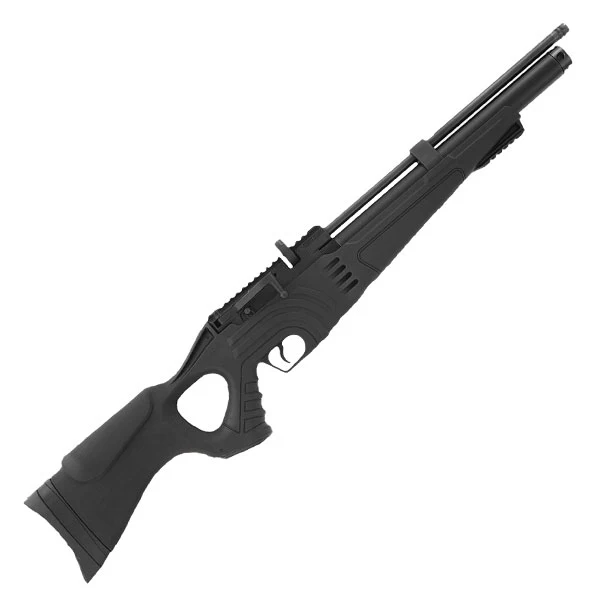
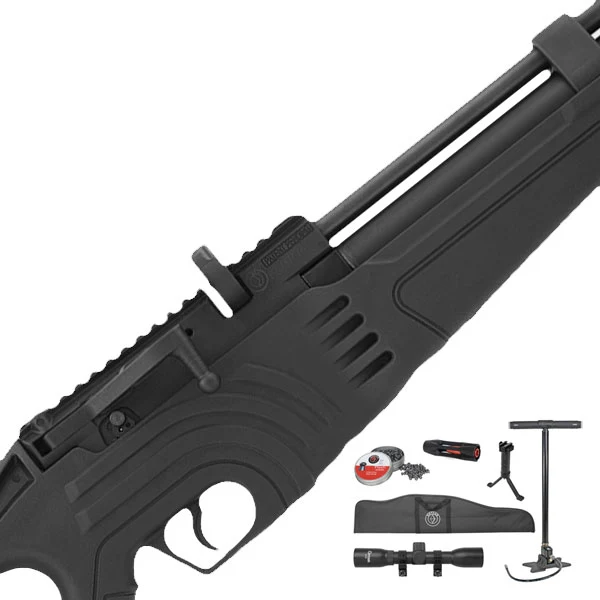
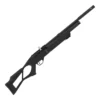
Hatsan Flash 101 Combo PCP Air Rifle

$400.00
PRODUCT DESCRIPTION
Hatsan Flash 101 Combo PCP Air Rifle – Lightweight Multi-Shot PCP Performance with Quattro Trigger and Practical Combo Value
The Hatsan Flash 101 Combo PCP Air Rifle combines a lightweight tactical layout with multi-shot pre-charged pneumatic performance, a precision rifled barrel and practical air capacity. Designed for shooters who want a straightforward PCP platform without the weight and complexity of some larger air rifles, the Flash 101 offers three common calibres, a synthetic thumbhole stock and a side-bolt action.
Current Hatsan technical literature lists the Flash 101 in .177/4.5mm, .22/5.5mm and .25/6.35mm. Published maximum velocities are approximately 1070 fps in .177, 970 fps in .22 and 870 fps in .25, although actual results vary with pellet type, temperature, elevation and configuration. The corresponding manufacturer figures are approximately 22, 31 and 34 ft-lb respectively in unrestricted versions.
The rifle uses a 215cc air cylinder filled to 200 bar, while magazine capacities are 14 shots in .177, 12 in .22 and 10 in .25. Hatsan also lists approximately 55, 50 and 47 shots at optimal velocity respectively.
Lightweight Tactical Construction
At approximately 3 kg / 6.6 lb, with an overall length of about 915 mm / 36 inches and a 450 mm / 17.7-inch barrel, the standard Flash 101 is relatively compact for a full-length PCP rifle.
The tactical-style synthetic stock is suitable for all-weather use and incorporates a thumbhole layout, Monte Carlo cheekpiece and rubber butt pad. These features give the shooter a stable shoulder position while keeping the overall platform practical for extended target sessions.
Multi-Shot Side-Bolt Action
The Flash 101 uses a manually operated side-bolt action.
Its detachable magazine holds:
- 14 pellets in .177
- 12 pellets in .22
- 10 pellets in .25
A single-shot adapter is also associated with the Flash 101 platform, giving shooters the option of slower, more deliberate target shooting.
Quattro Adjustable Trigger
One of the platform’s most important features is Hatsan’s Quattro Trigger system.
A predictable trigger helps reduce unnecessary movement at the moment of release. This is especially important for precision target work where grip, cheek position and trigger control need to remain repeatable.
The trigger should always be adjusted and used within the manufacturer’s recommended limits.
215cc Air Cylinder and 200-Bar Fill
The Flash 101 carries a 215cc cylinder with a 200-bar maximum fill pressure.
This provides enough stored air for extended target sessions while keeping the rifle relatively lightweight.
A pressure gauge allows the remaining cylinder pressure to be monitored, while the quick-fill system supports convenient refilling with suitable PCP equipment.
Scope Mounting and Accessory Rail
The Flash platform uses a receiver designed for both 11mm and 22mm optic mounting, while an additional Picatinny rail is positioned under the forearm.
This gives the rifle useful flexibility for compatible optics and shooting accessories.
Because combo packages vary between sellers, buyers should confirm exactly which scope, mounts, filling equipment or accessories are included with the specific package being purchased.
Hatsan Flash and Flash 101 Comparison
Searches for hatsan flash, hatsan air rifle, hatsanusa, hatsan usa, and general hatsan products frequently lead to the Flash family.
The standard Flash and Flash 101 share many design concepts, but published air-cylinder volumes and package specifications can differ between generations and regional listings. The Flash page, for example, currently lists a 165cc cylinder, while Flash 101 literature lists 215cc.
Therefore, Flash specifications should not automatically be transferred between versions.
CARABINA HATSAN PCP BT65 SB ELITE and BT65 Comparison
The CARABINA HATSAN PCP BT65 SB ELITE belongs to a larger and heavier PCP platform.
Buyers searching hatsan bt65.25 specifications are generally comparing air capacity, size, power class and handling rather than looking at an identical rifle.
The Flash 101 is positioned as the lighter and more compact alternative.
Hatsan Sortie and Semi-Automatic Models
Terms such as hatsan sortie, hatsan sortie tact, hatsan sortie tact semi-auto pcp, and hatsan sortie threaded adapter refer to a different semi-automatic PCP family.
The Flash 101 instead uses a manually operated bolt action.
This simpler system can appeal to shooters who prefer straightforward mechanical operation.
Hatsan Jet and Compact PCP Platforms
Searches for hatsan jet, hatsan jet 2, and hatsan jet i pcp .22 caliber pellet rifle kit generally relate to Hatsan’s compact modular PCP designs.
These products differ considerably from the Flash 101 in dimensions, stock design and intended handling.
Hatsan Bullpup and High-Capacity Comparisons
Other searches may include hatsan bullboss, hatsan flashpup qe, hatsan hercules, hatsan hercules bully, hercules bully air rifle, hatsan invader, hatsan neutron star, hatsan harpoon, hatsan piledriver, and hassan blitz.
These platforms cover bullpups, larger reservoirs and different performance categories.
Their specifications should not be confused with the Flash 101.
Hatsan Spring-Piston Search Context
Terms including hatsan model 95, hatsan mod 95, hatsan 95, model 95, hatsan 135, hatsan airtact air rifle, and hatsan mod 25 refer primarily to other Hatsan airgun platforms, many of which use spring-piston or gas-piston powerplants instead of PCP operation.
The Flash 101 operates from pre-charged compressed air and therefore provides a very different shooting cycle.
Pellet Selection and Target Use
Search terms such as air pellet gun, co2 pellet rifle, and h&n field target trophy often appear during ammunition and rifle research.
The Flash 101 is a PCP rather than a CO2 rifle.
Pellet compatibility should be determined through safe, controlled accuracy testing with ammunition appropriate to the calibre.
Different pellet weights and shapes can affect velocity and grouping.
Snowpeak PP750L PCP Air Pistol and Compact PCP Comparisons
Searches for Snowpeak PP750L PCP Air Pistol, Snowpeak PP750L, snowpeak pp750, pp750, and snow peak pp750 refer to compact PCP pistol/carbine-style platforms rather than a full-length Flash 101 rifle.
Likewise, snowpeak airguns, snowpeak sports, snowpeak ap900, snowpeak max, snowpeak p35x, pr900 gen 3, snowpeak p35, snowpeak m60b, snow peak pp20, p35, p35x, p35x pcp, snowpeak m25, ap900b pcp air rifle, snowpeak m60, snowpeak max 1 price, pcp p 35, m25 rifle, snow peak equipment, hp300, pellet 9mm, snowpeak p35 vs p35x, snowpeak pp20, and m25 weapon belong to different Snowpeak product families.
They can be useful comparison searches, but their reservoir sizes, magazine capacities, dimensions and operating systems should not be applied to the Hatsan.
Why Choose the Flash 101 Combo?
The strongest reason to consider the Flash 101 is its balance of manageable weight, useful air capacity and straightforward multi-shot operation.
Its 215cc reservoir provides practical session length.
The three calibre options give buyers flexibility.
The synthetic stock keeps maintenance simple.
The Quattro trigger supports controlled shooting.
The side-bolt action remains mechanically uncomplicated.
The dual-compatible optic rail expands sighting choices.
Meanwhile, combo packages can offer additional convenience when they include compatible optics and filling equipment.
For recreational target shooting and other lawful sporting use, the Hatsan Flash 101 offers a practical entry into full-size PCP ownership without the bulk of many larger platforms.
Final power level, legal status, calibre availability and combo contents should always be confirmed for the buyer’s market before purchase.
Section 2 – Practical Accuracy, Air Management, Handling, Optics and Everyday Use
Designed for Consistent Sporting Use
The strongest quality of this rifle is the balance between manageable weight, useful air capacity, straightforward operation, and repeatable performance.
A good pre-charged pneumatic rifle should feel predictable.
The firing cycle should remain calm.
The trigger should release consistently.
The sight picture should return naturally.
The air system should provide enough shots for a productive session.
When these elements work together, the rifle becomes easier to understand and more enjoyable to use.
Establishing a Reliable Baseline
Before making adjustments, a reliable baseline should be established.
The same pellet should be used.
The rifle should begin from a similar fill condition.
The same optic setting should be maintained.
The same shooting distance should be used.
Several groups should then be compared.
This creates a useful reference.
If accuracy changes later, the shooter can compare new results with the original baseline instead of guessing.
Change One Variable at a Time
A common mistake is changing several things together.
A different pellet may be loaded.
The scope may be adjusted.
The fill pressure may be different.
The shooting position may also change.
If the result improves or worsens, it becomes difficult to know why.
A more disciplined approach is better.
Change one factor.
Test again.
Record the result.
Then decide whether another change is necessary.
Pellet Selection
Pellet choice has a major influence on practical accuracy.
Different barrels can prefer different pellet designs.
Weight matters.
Head size matters.
Skirt condition matters.
Manufacturing consistency matters.
A pellet that performs well in one rifle may not produce the same results in another.
For that reason, several appropriate options should be tested before one is chosen for regular use.
Repeating Pellet Tests
One excellent group should not decide the final choice.
Chance can produce an unusually small group.
Several groups should be fired with each candidate.
The best pellet is the one that performs well repeatedly.
Consistency matters more than one impressive target.
Inspecting Pellets Before Shooting
Damaged pellets can create misleading results.
A deformed skirt can affect how the projectile engages the barrel.
Dirt or contamination may also influence performance.
For careful target work, obviously damaged pellets should be removed before loading.
This reduces one unnecessary source of variation.
Magazine Convenience
The multi-shot magazine is one of the most practical parts of the rifle.
It reduces the need to reload after every shot.
This allows the shooter to maintain a steadier position.
The cheek weld can remain more consistent.
The support hand can stay in place.
The shooting rhythm also becomes smoother.
Magazine Care
A magazine should rotate freely and load pellets consistently.
It should remain clean.
Pellets should not be forced into place.
Any unusual resistance should be investigated before further use.
A clean magazine improves reliability and reduces feeding interruptions.
Single-Shot Practice
Where a single-shot adapter is available, it can be useful for slow precision practice.
Loading one pellet at a time encourages a more deliberate rhythm.
The shooter can inspect each pellet.
The rifle can be repositioned carefully.
The sight picture can be rebuilt between shots.
This can be particularly useful when evaluating ammunition or refining technique.
Understanding the Air Reservoir
The air cylinder is the energy source for the rifle.
A consistent fill routine helps make each shooting session easier to compare.
The shooter should become familiar with how the rifle behaves as pressure gradually decreases.
This allows the useful operating range to be recognized.
Pressure Management
A PCP rifle does not need to be fired until the reservoir is nearly empty.
The useful range is the pressure range where velocity and point of impact remain stable.
Once performance begins to change, refilling is usually more useful than continuing.
Why Consistent Starting Pressure Matters
If one accuracy test begins from a high fill and another begins much lower, the results may not be directly comparable.
Using similar starting conditions removes one variable.
This helps the shooter understand the rifle more clearly.
Safe Filling
Only suitable high-pressure equipment should be used.
Connections should remain clean.
The filling process should be controlled.
A rapid fill can create heat.
As the cylinder cools, the pressure reading may drop slightly.
This is normal.
The maximum pressure specified for the rifle should not be exceeded.
Clean and Dry Air
Clean, dry compressed air helps protect internal components.
Moisture can create long-term problems.
Dust can damage seals.
Fill fittings should remain protected when not in use.
Hoses and connectors should also be kept clean.
Shot Count
The number of useful shots depends on calibre, pellet weight, temperature, fill condition, and rifle condition.
The important figure is not the absolute maximum number of shots.
The more useful figure is the number of shots that remain consistent.
A shooter should learn where accuracy and velocity begin to change.
Recognizing the End of the Useful Fill
The rifle may show several signs when pressure falls below its most useful range.
The firing sound may change.
The point of impact may shift.
Velocity may drop.
Groups may begin to open.
These patterns should be learned over time.
Handling and Balance
The rifle’s relatively manageable weight is useful during long sessions.
A lighter platform is easier to carry.
It can also be quicker to shoulder.
However, the shooter still needs a stable hold.
Very light pressure on the forearm can allow movement.
Excessive tension can also reduce consistency.
The goal is balance.
Shoulder Position
The butt pad should return to the same position on the shoulder.
Small changes in placement can affect the way the rifle points.
A repeatable shoulder position supports better sight alignment.
Cheek Weld
Cheek position is important.
The head should return to the same place on the stock.
The eye should naturally align with the optic.
If the shooter constantly moves the head to find the sight picture, the optic position may need to be reviewed.
Support-Hand Placement
The support hand should remain in a repeatable location.
Moving the hand farther forward or backward changes balance.
This can influence how the rifle settles on target.
A comfortable position should be found and repeated.
Trigger Control
Trigger technique has a direct effect on accuracy.
Pressure should increase smoothly.
The finger should move primarily rearward.
The rest of the hand should remain relaxed.
A sudden pull can disturb the sight picture.
Trigger Finger Placement
The trigger finger should contact the blade comfortably.
Too much finger can introduce sideways pressure.
Too little contact can reduce control.
The ideal position varies between shooters.
Consistency is the main goal.
Quattro Trigger Use
The adjustable trigger can help create a more predictable release.
However, the lightest setting is not automatically the best setting.
The trigger should remain safe and easy to control.
A clean, predictable break is more important than minimum resistance.
Follow-Through
The shot does not end when the trigger releases.
The shooter should remain behind the rifle.
The cheek should remain on the stock.
The trigger finger should complete the movement.
The sights should remain observed.
This helps reveal whether the shot was executed correctly.
Calling the Shot
Shot calling means predicting where the pellet likely landed based on what the shooter saw during the release.
If the sight moved left at the moment of the shot, the shooter may expect the impact to be left.
This skill helps separate technique errors from equipment issues.
Bench Testing
A stable bench is useful when evaluating mechanical accuracy.
The rifle should be supported consistently.
The support should reduce movement without forcing the rifle into position.
Several groups should be fired.
This helps reveal whether the limiting factor is the rifle, ammunition, optic, or shooter.
Why Bench Testing Helps
A rest reduces human movement.
That makes pellet comparisons more useful.
It also helps confirm whether the optic is holding zero.
Once the mechanical baseline is understood, unsupported shooting can be evaluated more fairly.
Standing Practice
Standing is less stable than supported shooting.
Movement is normal.
The goal is not to eliminate movement completely.
The goal is to manage it.
A relaxed stance is usually more repeatable than excessive muscular tension.
Kneeling Practice
Kneeling can provide more stability than standing.
The shooter should find a comfortable position that can be repeated.
Support points should remain consistent.
The rifle should settle naturally rather than being forced onto target.
Seated Practice
A seated position can provide excellent stability.
It can be useful for deliberate target work.
The shooter should still maintain consistent stock contact and trigger control.
Prone Practice
Prone shooting can be very stable where appropriate.
However, optic height and stock geometry should allow a comfortable head position.
A strained neck position can reduce consistency.
Natural Point of Aim
Natural point of aim refers to where the rifle settles when the body is relaxed.
If the shooter constantly forces the sights toward the target, the body position should be adjusted.
A natural alignment reduces muscular effort.
Reduced effort often improves precision.
Breathing Control
Breathing moves the upper body.
Many shooters complete the shot during the comfortable pause after exhaling.
The pause should not be forced.
If the shot is not ready, normal breathing should resume.
Long breath holds can increase tension.
Optic Selection
A suitable optic should match the rifle’s intended use.
Excessive magnification is not always helpful.
A clear image, useful field of view, reliable adjustments, and appropriate eye relief are usually more important.
The optic should also suit the range where the rifle will normally be used.
Scope Mounting
Mounts should remain secure.
The scope should sit level.
Eye relief should be comfortable.
The shooter should not need to move the head excessively to obtain a full sight picture.
Dual Rail Flexibility
The receiver’s mounting arrangement gives the shooter flexibility when selecting compatible scope mounts.
The most important issue is secure and correct mounting.
The mount system should match the optic and rail.
Zeroing
A stable zero should be established using the pellet intended for regular use.
The same pellet should be used for future verification.
Frequent unnecessary adjustment can make it difficult to understand the rifle’s true performance.
Confirming Zero
Zero should be checked periodically.
If the point of impact changes, the optic and mounts should be inspected before deeper mechanical troubleshooting begins.
A loose mount can imitate a rifle problem.
Different Distances
A pellet does not travel in a perfectly straight line.
The relationship between the barrel and optic means the point of impact changes with distance.
The shooter should therefore verify actual impact at the distances normally used.
Creating a Personal Range Reference
A simple range reference can be useful.
The shooter can record where the pellet impacts at several practical distances.
This is more reliable than relying only on generic ballistic estimates.
Wind
Wind can move pellets.
The effect increases with distance.
Light pellets may be especially sensitive.
Outdoor groups should therefore be interpreted in relation to wind conditions.
Temperature
Temperature can influence air pressure and projectile behavior.
A rifle filled in a warm environment may show a different pressure after cooling.
This does not automatically indicate a leak.
For careful testing, conditions should be noted.
Lighting
Lighting can influence how the optic image appears.
Changing light can affect aiming perception.
For precise comparisons, similar lighting conditions are useful.
Chronograph Testing
A chronograph can provide useful information about velocity consistency.
Several shots should be measured.
The average can be recorded.
Variation between shots can also be observed.
This gives the shooter another way to evaluate performance.
Extreme Spread
Extreme spread is the difference between the fastest and slowest measured shot.
A smaller spread generally suggests more consistent velocity.
However, good velocity consistency does not automatically guarantee excellent groups.
Pellet compatibility still matters.
Standard Deviation
Standard deviation gives another way to evaluate consistency.
Lower values may indicate tighter velocity clustering.
However, the target should remain the final measure.
A small numerical improvement is not important if practical accuracy does not change.
Air Efficiency
Efficiency means obtaining useful performance without unnecessary air consumption.
A good setup should provide predictable shot count and stable accuracy.
There is little value in making changes that consume more air without improving real-world performance.
Avoiding Constant Adjustment
Adjustable features can encourage unnecessary experimentation.
A rifle that already performs well should usually be left stable.
Changes should have a clear purpose.
Constant adjustment can make troubleshooting difficult.
Recording Results
A simple shooting log can be valuable.
The shooter can record pellet type, pressure, group size, distance, temperature, and optic setting.
Patterns become easier to recognize.
If something changes later, previous results provide a reference.
Accuracy Troubleshooting
Accuracy problems should be investigated systematically.
Check the optic.
Check the mounts.
Check the pellets.
Review fill pressure.
Review stock contact.
Review trigger technique.
Review environmental conditions.
Only then should more complex causes be considered.
Tight Groups That Shift
If groups remain tight but move to another part of the target, the rifle may still be mechanically consistent.
Possible causes include optic movement, different pressure conditions, lighting, or hold changes.
A shifted group is different from a larger group.
Groups That Become Larger
If groups suddenly open, ammunition should be checked.
Optic security should be checked.
Pressure should be reviewed.
Barrel condition should also be considered.
Shooter fatigue can contribute as well.
Barrel Care
Barrel cleaning should be based on performance.
If the rifle continues to group well, frequent cleaning may not be necessary.
If accuracy declines unexpectedly, barrel condition can be investigated.
Cleaning should remain gentle.
Conditioning After Cleaning
A freshly cleaned barrel may not immediately produce the same point of impact.
Several shots may be required before performance stabilizes.
The shooter should wait before making unnecessary optic adjustments.
Muzzle Area
The muzzle should remain clean and protected from damage.
Any unusual change in accuracy should include a visual inspection of the muzzle area.
Damage or contamination can affect projectile release.
Exterior Care
The rifle should be kept clean and dry.
Dust should be removed.
Moisture should not remain on metal surfaces.
A soft cloth can handle most routine external cleaning.
Synthetic Stock Care
The synthetic stock requires relatively little maintenance.
It should still be kept clean.
Harsh chemicals should be avoided.
Fasteners should remain secure.
Fill Fitting Care
The fill connection should remain clean.
Protective caps should be used where supplied.
Dust and grit can damage seals.
The fitting should also be checked for wear.
Detecting Air Loss
A small reduction in pressure after cooling may be normal.
Repeated pressure loss under stable conditions may indicate a leak.
The pattern should be observed before the cause is assumed.
Seal Wear
Seals are normal wear items.
Their lifespan depends on cleanliness, pressure, temperature, and use.
Correct replacement components should be used when servicing becomes necessary.
Internal Servicing
The internal air system operates under high pressure.
Regulator, valve, and seal work should be approached carefully.
If the owner does not have suitable knowledge and tools, professional servicing is the appropriate choice.
Avoiding Unnecessary Disassembly
A rifle that performs well does not need constant internal work.
Repeated disassembly can introduce new problems.
Routine external inspection, sensible cleaning, and correct storage are usually sufficient.
Safe Storage
The rifle should be stored securely.
It should be inaccessible to unauthorized users.
The storage location should remain dry.
Applicable local laws should always be followed.
Transport
The rifle should be transported unloaded.
A suitable case can protect the stock, barrel, optic, and air system.
Local transport rules should be followed.
Long-Term Reliability
Reliability is supported by simple habits.
Keep the fill connection clean.
Use suitable compressed air.
Protect the optic.
Use undamaged pellets.
Inspect the magazine.
Avoid unnecessary internal work.
Store the rifle correctly.
These basic steps support long-term performance.
Why the Lightweight Design Matters
A lighter rifle is easier to carry and shoulder.
It can be more comfortable during extended sessions.
It also makes the rifle accessible to shooters who do not want the weight of a larger PCP platform.
Why the Air Capacity Matters
The reservoir provides enough capacity for practical target sessions without making the rifle unnecessarily heavy.
This contributes to the platform’s balance between portability and shot count.
Why the Multi-Shot System Matters
The magazine allows the shooter to maintain rhythm.
Less movement is required between shots.
This can improve convenience and preserve shooting position.
Why the Trigger Matters
A predictable trigger helps reduce disturbance at the moment of release.
This makes it easier to identify other variables such as pellet quality or hold consistency.
Why the Synthetic Stock Matters
The stock is practical for everyday use.
It is easy to maintain.
It is less sensitive to changing environmental conditions than untreated wood.
It also helps keep overall weight reasonable.
Why the Optic Rail Matters
The mounting system gives the shooter flexibility when selecting compatible optics.
A reliable sighting system can greatly improve practical precision.
The key is correct mounting and repeatable eye position.
Who Will Appreciate This Rifle
This platform suits shooters who value manageable weight, straightforward PCP operation, multi-shot convenience, practical air capacity, and adjustable ergonomics.
It is especially useful for structured target shooting and other lawful sporting applications where consistent handling matters.
Final Practical Assessment
The rifle’s strongest quality is balance.
It offers useful air capacity without excessive bulk.
It provides multi-shot convenience without complicated operation.
The adjustable trigger supports controlled shooting.
The synthetic stock keeps maintenance simple.
The optic rail provides flexibility.
The manageable weight makes the rifle comfortable for extended use.
However, the best results still depend on disciplined shooting habits.
A suitable pellet should be identified.
A consistent fill routine should be maintained.
The optic should remain secure.
The shooter should use a repeatable cheek weld and shoulder position.
Trigger technique should remain smooth.
Environmental conditions should be considered.
Maintenance should remain sensible.
When these habits are combined with the rifle’s straightforward PCP design, the platform can provide dependable repeatability, enjoyable handling, practical shot count, and strong long-term usability for recreational target shooting and other lawful sporting use.
Section 3 – Advanced Precision, Consistency, Maintenance and Long-Term Ownership
Precision Comes From Repeatable Conditions
A well-designed PCP rifle becomes more useful as the shooter learns how it behaves under repeatable conditions.
The same pellet should be used.
The same fill routine should be followed.
The same optic setting should be maintained.
The same shoulder position should be repeated.
The same trigger technique should be applied.
When these variables remain stable, the rifle becomes easier to evaluate and easier to trust.
Precision is not created by one feature alone. Instead, it comes from the relationship between the air system, barrel, ammunition, trigger, optic, stock fit, and shooter technique.
Mechanical Accuracy and Practical Accuracy
Mechanical accuracy describes what the rifle can achieve when human movement is minimized.
Practical accuracy describes what the shooter can achieve under normal field or target conditions.
These two results may be different.
A rifle can produce tight groups from a stable rest while producing wider groups from an unsupported position.
That does not automatically indicate a problem.
The difference often comes from movement, breathing, trigger control, or inconsistent stock contact.
Establishing a Long-Term Accuracy Baseline
A reliable baseline should be created early.
Use one trusted pellet.
Start from a similar fill condition.
Shoot at the same distance.
Keep the optic unchanged.
Fire several groups.
Record the results.
Once that baseline is established, future performance can be compared against it.
This is much more useful than relying on memory.
Reading Group Shape
Group shape can provide useful clues.
Vertical spread may suggest one type of inconsistency.
Horizontal spread may suggest another.
Random dispersion may involve several variables.
The important point is to look for repeated patterns rather than one unusual target.
Vertical Dispersion
Vertical spread can be influenced by velocity variation.
It can also come from breathing, inconsistent shoulder pressure, or changing cheek position.
At longer distances, small velocity differences become more noticeable.
A shooter should therefore consider both mechanical and human factors.
Horizontal Dispersion
Horizontal spread may be influenced by trigger movement, stock pressure, or inconsistent eye position.
If the finger pushes sideways during the trigger press, the rifle can move.
Wind can also contribute.
The cause should be investigated systematically.
Random Dispersion
A scattered group may have several causes.
Pellets may be inconsistent.
The optic may have shifted.
The shooter may be changing hold pressure.
The air system may be outside its most consistent pressure range.
Returning to the known baseline is usually the best first step.
Advanced Pellet Evaluation
A serious pellet test should involve several groups rather than one.
Each candidate should be tested under similar conditions.
The rifle should begin from a comparable fill pressure.
The same rest should be used.
The same distance should be maintained.
The shooter should then compare average performance.
Pellet Weight
A heavier pellet is not automatically more accurate.
A lighter pellet is not automatically less stable.
The barrel determines which projectile performs best.
Actual group results should guide the final choice.
Pellet Shape
Different head and skirt designs can behave differently.
Some pellets may seal the barrel more consistently.
Others may feed more smoothly through the magazine.
The best option should perform well repeatedly.
Why Faster Is Not Always Better
Higher velocity does not automatically produce better groups.
A pellet that travels faster may not be the most stable choice for the barrel.
For precision use, consistency usually matters more than maximum speed.
A smooth, predictable trajectory is more valuable than chasing a single high number.
Chronograph Testing
A chronograph can help reveal how consistently the rifle is operating.
Several shots should be measured.
Average velocity can be recorded.
Extreme spread can be calculated.
Standard deviation can also be reviewed.
These numbers provide useful context.
However, they should always be compared with actual target performance.
Average Velocity
Average velocity gives the shooter a reference point.
If it changes significantly between sessions, temperature, pressure, ammunition, or mechanical condition may be involved.
The figure becomes more useful when tracked over time.
Extreme Spread
Extreme spread shows the difference between the fastest and slowest measured shot.
A smaller spread often indicates more consistent performance.
However, an excellent spread does not guarantee a tight group.
Pellet compatibility still matters.
Shooter technique still matters.
Standard Deviation
Standard deviation gives another way to evaluate consistency.
Lower values may indicate a tighter velocity pattern.
However, very small numerical improvements may not create a meaningful difference on target.
The target remains the final measure.
Understanding the Useful Pressure Range
A PCP rifle performs best within a practical operating window.
At the top of the fill, the system may behave one way.
As pressure falls, the rifle may remain stable for many shots.
Eventually, performance can begin to change.
The shooter should learn where that transition occurs.
Pressure Logging
A simple pressure log can be useful.
Record the starting pressure.
Record the number of shots.
Record the ending pressure.
Over time, a clear pattern develops.
This makes it easier to understand practical shot count.
Consistent Refilling
Refilling from a similar point improves testing quality.
If the rifle is always refilled randomly, comparisons become less useful.
A consistent routine creates better data.
Temperature and Pressure
Temperature affects compressed air.
A warm cylinder may show higher pressure.
A cooler cylinder may show lower pressure.
This does not automatically indicate a leak.
The rifle should be allowed to stabilize before conclusions are made.
Sight Reliability
A rifle can only remain accurate if the sighting system remains stable.
The optic should stay secure.
Mounts should remain tight.
The reticle should not shift.
If the point of impact changes unexpectedly, the optic should be checked before deeper mechanical troubleshooting begins.
Mount Inspection
Mounting hardware should be inspected periodically.
Loose screws can create confusing shifts.
Overtightening can also create problems.
The goal is secure, even mounting.
Eye Position
Eye position should remain consistent.
This is especially important with magnified optics.
Changing eye position can affect the sight picture.
A repeatable cheek weld helps solve this.
Scope Height
The optic should sit at a height that allows a natural head position.
If the scope is too high or too low, the shooter may strain to find a clear sight picture.
Comfortable alignment supports repeatability.
Cheek Weld
The cheek should return to the same position.
Small changes can alter eye alignment.
A consistent cheek weld is one of the simplest ways to improve practical accuracy.
Shoulder Pressure
Shoulder pressure should remain similar from shot to shot.
Too much tension can create movement.
Too little contact can make the rifle feel unstable.
A firm but relaxed position usually works best.
Support-Hand Position
The support hand should remain in a consistent place.
Moving it forward or backward changes balance.
That can change how the rifle settles.
A comfortable reference point should be chosen and repeated.
Trigger Control
The trigger should be pressed smoothly.
The rifle should not be jerked or disturbed at the moment of release.
The finger should move mainly rearward.
The rest of the hand should remain relaxed.
Trigger Finger Placement
The amount of finger on the trigger can influence control.
Too much finger may pull the rifle sideways.
Too little contact may reduce consistency.
The ideal position is the one that allows a smooth straight-back press.
Follow-Through
Follow-through remains important after the shot is released.
The shooter should remain behind the rifle.
The cheek should stay on the stock.
The sights should remain observed.
The trigger movement should finish naturally.
Calling the Shot
Shot calling helps the shooter understand technique.
If the sight moved during release, the shooter may be able to predict where the pellet landed.
When that prediction matches the target, technique awareness is improving.
Bench Testing
Bench testing helps separate mechanical accuracy from shooter movement.
The rifle should be supported consistently.
The support should not force the rifle into an unnatural position.
Several groups should be fired.
The results can then be compared with unsupported shooting.
Stable Rest Technique
A rest should reduce movement without changing the rifle’s natural alignment.
The same contact points should be used for every shot.
Changing support position can affect results.
Standing Technique
Standing shooting requires balance.
The goal is not to stop all movement.
The goal is to control movement.
A relaxed stance is usually more effective than excessive muscular tension.
Kneeling Technique
Kneeling can provide a useful compromise between mobility and stability.
The shooter should find a position that can be repeated comfortably.
Natural alignment remains important.
Seated Technique
Seated shooting can provide excellent support.
The shooter should still maintain consistent shoulder pressure and cheek weld.
Prone Technique
Prone shooting can be very stable.
However, the optic and stock should allow a comfortable head position.
Neck strain can reduce consistency.
Natural Point of Aim
Natural point of aim should be checked in every position.
The rifle should settle naturally toward the target.
If the shooter must constantly force alignment, body position should be adjusted.
Breathing Control
Breathing affects stability.
A comfortable pause after exhaling is often used for the shot.
The pause should not be forced.
If the shot is not ready, breathing should resume.
Avoiding Over-Holding
Holding the rifle on target for too long can increase movement.
Muscles begin to fatigue.
Visual focus may decline.
If the shot does not develop naturally, lowering the rifle and restarting is usually better.
Visual Fatigue
Long sessions can tire the eyes.
The sight picture may become less clear.
The shooter may begin to chase the reticle.
Short breaks can restore focus.
Wind Effects
Wind can move pellets significantly.
The effect becomes more noticeable as distance increases.
Lightweight projectiles may be more sensitive.
Outdoor groups should always be interpreted in relation to wind conditions.
Lighting Effects
Changing light can influence how the target and reticle appear.
Bright glare may reduce clarity.
Low light may make the target less distinct.
Consistent lighting is useful for serious testing.
Range Verification
The shooter should verify point of impact at several practical distances.
A single zero distance does not describe the entire trajectory.
Real-world testing is more useful than relying only on generic ballistic predictions.
Creating a Personal Reference
A simple range card can record point of impact at several distances.
This creates a practical reference for future sessions.
The information should come from actual shooting rather than assumption.
Barrel Condition
The barrel should be monitored through accuracy.
If groups remain consistent, aggressive cleaning may not be necessary.
If accuracy changes unexpectedly, barrel condition can be investigated.
Cleaning Frequency
There is no need to clean constantly.
Some barrels perform well for long periods between cleanings.
Performance should guide the schedule.
Conditioning After Cleaning
A freshly cleaned barrel may require several shots before normal performance returns.
The point of impact may change slightly during this period.
The shooter should wait for stability before adjusting the optic.
Muzzle Inspection
The muzzle should remain clean and protected.
Any damage can influence projectile release.
A sudden accuracy change should include a visual check of the muzzle area.
Exterior Metal Care
Metal surfaces should be kept dry.
Fingerprints and moisture should be wiped away.
A suitable protective product may be used where appropriate.
Excess lubricant should be avoided.
Synthetic Stock Maintenance
The synthetic stock is relatively easy to care for.
Dust and dirt can be removed with a soft cloth.
Harsh solvents should be avoided.
The stock should also be inspected for cracks or damaged fasteners.
Fastener Inspection
Stock and accessory fasteners should be checked periodically.
Loose hardware can affect consistency.
However, overtightening should also be avoided.
Magazine Maintenance
The magazine should remain clean.
Pellets should feed smoothly.
Rotation should remain consistent.
If the magazine begins to bind, the cause should be identified rather than forcing it.
Single-Shot Adapter Care
If a single-shot adapter is used, it should also remain clean.
Pellets should load without resistance.
Damage or debris can affect alignment.
Fill Connection Care
The fill fitting should remain protected.
Dust and grit can damage seals.
Protective caps should be used where supplied.
The connector should also be inspected for wear.
Hose and Coupler Condition
Filling equipment should remain in good condition.
Hoses should not show damage.
Couplers should lock securely.
Any questionable high-pressure equipment should be replaced rather than ignored.
Detecting Air Loss
A small pressure change after cooling may be normal.
Repeated loss under stable conditions may indicate a leak.
The pattern should be observed before the cause is assumed.
Seal Wear
Seals naturally wear over time.
Their lifespan depends on pressure, temperature, cleanliness, and use.
Correct replacement parts should be used when service becomes necessary.
Internal Air-System Servicing
The internal air system operates under high pressure.
Valve or internal seal work should be handled carefully.
If the owner does not have suitable knowledge, professional servicing is the better option.
Avoiding Unnecessary Internal Adjustment
A rifle that performs well should usually be left alone internally.
Constant adjustment can introduce new problems.
It can also make future troubleshooting more difficult.
Maintenance Records
A simple maintenance log can be useful.
Cleaning dates can be recorded.
Seal replacement can be noted.
Pressure-loss observations can be tracked.
Optic changes can also be recorded.
Long-Term Storage
The rifle should be stored in a dry and secure location.
Unauthorized users should not have access.
Extreme heat should be avoided.
The air system should be maintained according to appropriate guidance.
Protecting the Optic During Storage
The optic should be protected from impacts.
Lens covers can help keep dust away.
The rifle should not be stored where the scope can be knocked or forced out of alignment.
Transport Protection
A padded or hard case can protect the rifle during transport.
The optic, barrel, stock, and fill system should be shielded from impact.
The rifle should be transported unloaded.
Applicable laws should always be followed.
Long-Term Reliability
Long-term reliability comes from simple habits.
Use clean air.
Use good pellets.
Keep the filling connection clean.
Protect the optic.
Inspect the magazine.
Avoid unnecessary internal work.
Store the rifle correctly.
These habits are straightforward but effective.
Evaluating a Used Example
A used rifle should be inspected carefully.
The reservoir should retain pressure.
The bolt should operate smoothly.
The magazine should index properly.
The trigger should feel predictable.
The stock should be secure.
The optic rail should remain undamaged.
The fill system should also be checked.
Cosmetic Wear Versus Mechanical Condition
Cosmetic marks do not automatically indicate poor performance.
A rifle may show normal handling wear and still operate extremely well.
Likewise, a visually clean rifle may still have mechanical issues.
Function matters more than appearance.
Pressure Retention on a Used Rifle
A used example should be observed for pressure retention.
Temperature should be considered.
A stable pressure under stable conditions is a useful sign.
Repeated loss deserves investigation.
Trigger Condition on a Used Rifle
The trigger should operate consistently.
Roughness or unpredictable movement may indicate that servicing is needed.
A predictable trigger is important for accurate use.
Bolt Operation on a Used Rifle
The bolt should move smoothly.
Unusual resistance should not be ignored.
The action should load pellets consistently.
Magazine Function on a Used Rifle
The magazine should rotate normally.
It should not bind.
Pellets should feed without unnecessary force.
A damaged magazine can create frustrating reliability problems.
Barrel and Muzzle Condition on a Used Rifle
The barrel should be inspected externally.
The muzzle should remain clean and undamaged.
Any evidence of impact should be investigated.
Why Simplicity Matters
The rifle’s straightforward layout can make ownership easier.
There are fewer unnecessary systems to manage.
The shooter can focus on pellets, pressure, optics, and technique.
Why Moderate Weight Matters
A manageable overall weight makes the rifle easier to use for longer periods.
It also makes transport more convenient.
The rifle remains substantial enough to provide stable handling without becoming unnecessarily heavy.
Why Air Capacity Matters
The air cylinder provides a practical balance between shot count and weight.
A larger reservoir would add bulk.
A smaller reservoir would require more frequent refilling.
The existing capacity supports practical recreational use.
Why Multi-Shot Operation Matters
A multi-shot system improves convenience.
The shooter can maintain position.
Less movement is required between shots.
This can help preserve concentration.
Why the Trigger Matters
A predictable trigger improves control.
It helps the shooter release the shot without disturbing alignment.
That makes accuracy testing more meaningful.
Why the Stock Matters
A stable stock helps create repeatable shoulder and cheek contact.
The synthetic material also keeps maintenance straightforward.
Why Optic Flexibility Matters
The mounting system allows the shooter to choose a compatible sighting setup.
This makes the rifle adaptable to different target distances and preferences.
Who Benefits Most From This Platform
This rifle suits users who value straightforward PCP operation, moderate weight, multi-shot convenience, easy stock maintenance, and practical air capacity.
It also suits shooters who enjoy methodical target practice and long-term equipment familiarity.
Final Advanced Assessment
The strongest quality of this rifle is the balance between simplicity, air capacity, manageable weight, and repeatable performance.
The multi-shot action provides convenience.
The adjustable trigger supports controlled release.
The synthetic stock keeps maintenance straightforward.
The air cylinder provides practical session length.
The optic mounting system gives the shooter flexibility.
The overall layout remains easy to understand.
However, the rifle will perform best when the shooter keeps the setup consistent.
A trusted pellet should be selected.
The useful pressure range should be learned.
The optic should remain stable.
Stock contact should remain repeatable.
Trigger movement should stay smooth.
Environmental conditions should be considered.
Maintenance should remain sensible.
When these habits are combined with the rifle’s straightforward pneumatic design, the platform can provide dependable accuracy, predictable handling, practical shot count, and strong long-term ownership value for lawful sporting and target use.
Be the first to review “Hatsan Flash 101 Combo PCP Air Rifle”
Related products
Hatsan
Hatsan
Hatsan
Reviews
There are no reviews yet.