
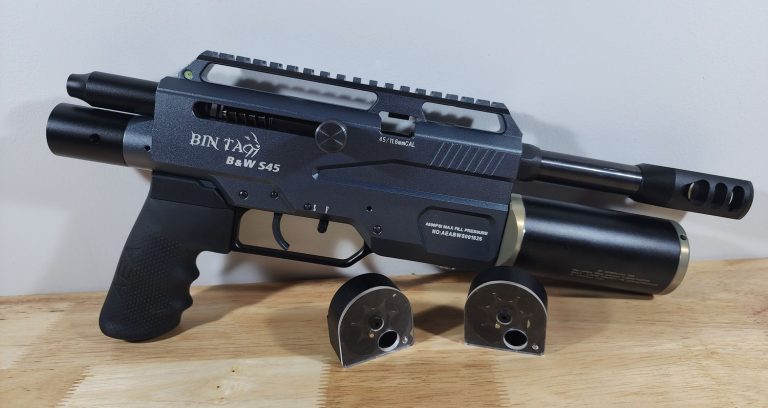
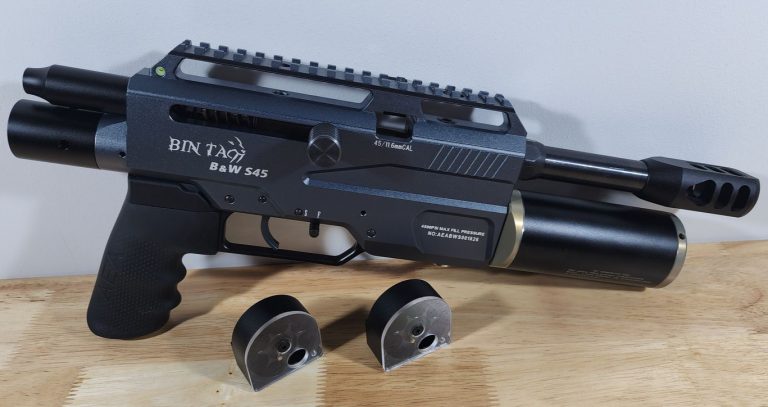
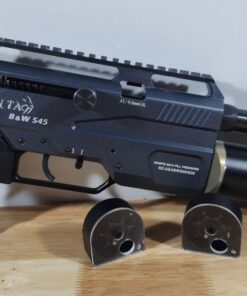
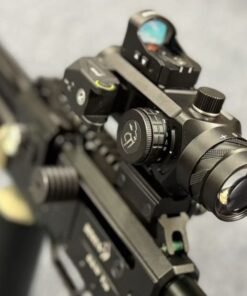
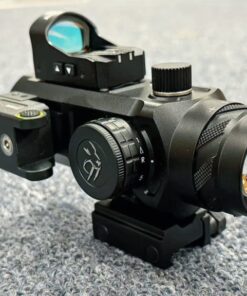
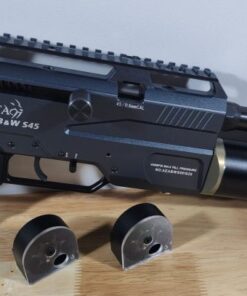
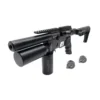
BinTac SP-45 Semi Bigbore Pistol With 3in1 Scope(optional)
$730.00
TopGun-Airguns carries the BinTac SP-45 Semi Bigbore Pistol With 3in1 Scope(optional) as part of our full BinTac inventory. We ship from California, accept all major payment methods, and answer the phone when you have questions — call (714) 907-0067 to talk to a real airgunner.
About the BinTac SP-45 Semi Bigbore Pistol With 3in1 Scope(optional)
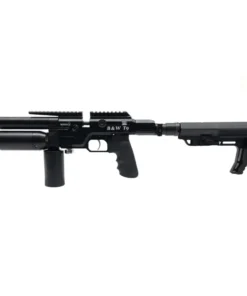
BinTac SP-45 (Short Pistol) 3in1 Scope is optional
Package Includes:
1. SP45 (.45 Cal)
2. Front 200CC
3. Two magazines
4. Muzzle Break
Specs:
Muzzle Energy: Up to 170 Fpe
Magazine Capacity: 6 Rounds
Air Tube Capacity: 200CC Max
Air Filling Pressure: 4500 PSI
Shots Per Fill: 6 Good shots
Barrel Length: 6 Inches
Overall Length: 17.5 Inches
Action: Semi-auto
Optics: Pic Scope Mount
BinTac SP-45 Semi Bigbore Pistol With Optional 3-in-1 Scope – Compact .45 Caliber Semi-Automatic PCP with 6-Round Magazine and 200cc Air System
BinTac SP-45 Semi Bigbore Pistol Overview
The BinTac SP-45 Semi Bigbore Pistol With 3-in-1 Scope (Optional) is a compact .45-caliber pre-charged pneumatic platform designed around portability, semi-automatic operation, a short barrel, magazine-fed convenience, and substantial big-bore performance. BinTac currently specifies a 6-inch barrel, 17.5-inch overall length, 200cc maximum air capacity, 4500 PSI filling pressure, six-round magazine, Picatinny scope mount, semi-automatic action, muzzle brake, and approximately six useful shots per fill. The standard package includes the SP-45, front 200cc reservoir, two magazines, and muzzle brake.
Its compact dimensions make it very different from a conventional long rifle. However, the .45-caliber chambering means it should still be treated as a serious high-energy pneumatic platform and used only in lawful sporting environments with suitable backstops, eye protection, and hearing protection.
Why Choose the SP-45?
The primary reason to choose this configuration is compactness.
At just 17.5 inches overall, the platform is significantly shorter than most full-size big-bore designs. Yet, it still combines a magazine-fed semi-automatic action, high-pressure air reservoir, muzzle brake, and optics mounting capability.
Therefore, experienced users who value a compact pistol format without moving to a conventional low-powered recreational design may find this architecture particularly distinctive.
.45-Caliber Big-Bore Configuration
The SP-45 is chambered in .45 caliber.
Current BinTac specifications list muzzle energy up to approximately 170 ft-lb depending on configuration and ammunition.
Because of that output, it belongs in a completely different class from a basic bee bee gun rifle or recreational plinker.
Suitable ranges, substantial backstops, and careful handling are essential.
6-Inch Barrel
The six-inch barrel keeps the overall package extremely short.
That compact barrel is primarily intended to support portability rather than long-rifle ergonomics.
Consequently, the platform feels very different from larger big-bore rifles with 18-, 22-, or 30-inch barrels.
Semi-Automatic Action
The SP-45 uses a semi-automatic action in its standard configuration.
This means the mechanism cycles between shots without requiring a manual bolt operation each time, provided the system is operating correctly.
For controlled target shooting, the action offers convenient follow-up capability while still requiring deliberate trigger discipline and safe target verification before every shot.
Six-Round Magazine
Magazine capacity is listed at six rounds.
The package includes two magazines, allowing the user to prepare a second magazine before a range session.
Clean magazines, correctly seated projectiles, and consistent ammunition are important for dependable feeding.
200cc Air Reservoir
The platform uses a 200cc front reservoir.
This reservoir works with the 4500 PSI system to support approximately six useful shots per fill according to the current factory specification.
Only filling equipment rated for the required working pressure should be used.
4500 PSI Filling Pressure
The listed maximum fill pressure is 4500 PSI.
Anyone searching air tank for pep airguns is typically looking for what should more accurately be called a properly rated PCP filling cylinder.
The phrase anti air tanks is not the correct terminology for this purpose.
A filling source should always be suitable for the rifle’s specified pressure.
Factory Muzzle Brake
A muzzle brake is included with the package.
Its presence also gives the short front end a more complete appearance.
Because this is a powerful compact pneumatic system, appropriate hearing protection should still be used.
Picatinny Optics Mount
A Picatinny scope mount is built into the platform.
This allows compatible optics to be fitted without modifying the receiver.
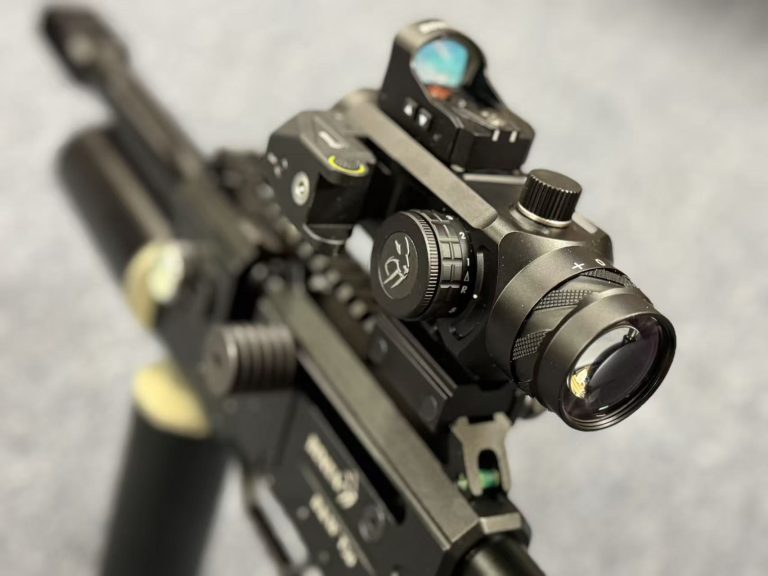
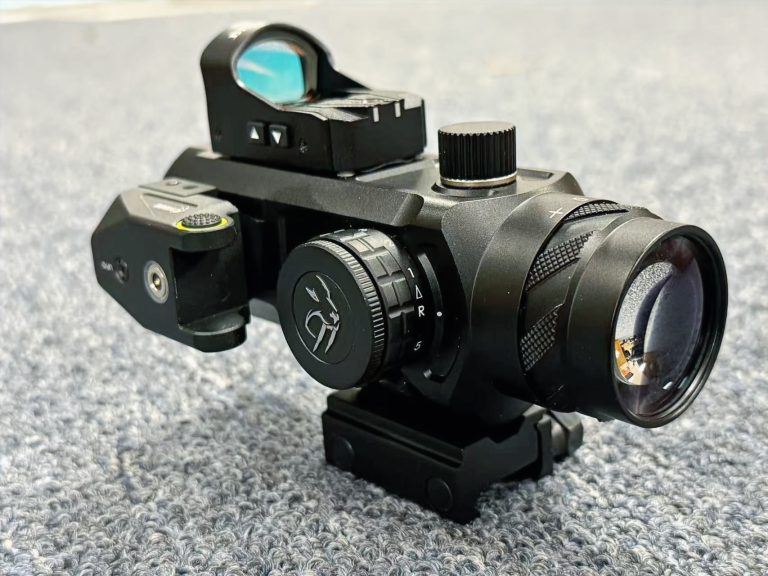
The optional factory-style 3-in-1 optic is especially relevant for users who prefer a complete sighting package.
Optional 3-in-1 Scope
BinTac’s FS1 3-in-1 optic is marketed specifically for its semi-automatic platforms.
The unit combines a red dot, reflex sight, and green laser in one package.
The manufacturer identifies it as compatible with several compact models, making it a natural optional accessory for this platform.
BinTac Brand Overview
Searches for bintac, bin tac, bintac lIc, and bintaclic generally refer to the same BinTac product ecosystem.
The company currently carries compact semi-automatic models, pump-action systems, long-range platforms, large-bore rifles, accessories, magazines, and high-pressure filling equipment.
BinTac T9 Comparison
The bintac t9 is another compact model in the same broader catalog.
Search terms such as bintac t9 price, bintac t9 full auto, and bintac t9 amazon are commonly used by shoppers researching that separate platform.
The SP-45 should not be treated as a T9 variant because its caliber, magazine arrangement, dimensions, and operating characteristics differ.
BinTac M50 Comparison
The bintac m50 is a larger platform.
Current versions of the M50 family include larger-caliber bolt-action configurations, longer barrels, larger reservoirs, and folding-stock options.
Therefore, searches such as bintac m50 for sale, bintac m50 pump action, and b&w m50 relate to another product family rather than this compact pistol-format model.
BinTac T50 Family
The bintac t 50, bintac t50, bintac t50 for sale, bintac t50 extreme, and aea bintac t50 extreme search phrases also refer to separate semi-automatic platforms.
They should not be interpreted as alternative names for the SP-45.
BinTac MCAR Platform
The bintac mcar, bintac mcar air rifle, and bintac mcar 457 terms refer to BinTac’s larger long-range platform.
Current catalog listings position that family as a long-range rifle rather than an ultra-compact big-bore pistol.
BinTac S45 Comparison
Search terms including bintac s45 aea and bintac s45 for sale are particularly easy to confuse with the SP-45 name.
However, the S45 family includes significantly larger configurations and, in current versions, substantially greater air capacity and longer barrels.
The SP-45 is a separate short-format design.
AEA Harpoon Family
The aea harpoon, aea harpoon price, bintac aea harpoon, harpoon for sale, aea harpoon magnum, aea harpoon gun, aea harpoon cartridge, aea .50 harpoon, harpoon air gun, and aea harpoon air gun phrases refer to another compact large-bore family.
BinTac currently lists Harpoon barrel kits and cartridge-related products separately from the SP-45.
AEA Megalodon Comparison
The aea megalodon, aea megalodon 58 cal, aea megalodon 50 cal price, megalodon air rifle, aea megalodon air rifle, and aea megalodon 50 caliber searches relate to a pump-action platform.
BinTac currently lists the Megalodon as a separate pump-action air rifle family.
Accordingly, the phrase aea megalodon 58 cal bintac m50 mixes several distinct product references and should not be treated as an SP-45 specification.
AEA Defender Series
The aea defender, aea defender 2, and aea defender 3 belong to another compact pneumatic family.
These designs are separate from the SP-45 and use different layouts.
AEA Terminator Series
The aea terminator and aea terminator gen 3 also represent different products.
BinTac lists Terminator documentation separately from S45, M50, Megalodon, and other platforms.
AEA Zeus MKII Comparison
The AEA Zeus MKII (Bullpup) Standard 18 Big Bore belongs at the much larger end of the big-bore spectrum.
Searches for zeus 72 cal air rifle price generally relate to .72-caliber Zeus-family products rather than this compact .45-caliber design. BinTac currently lists Zeus products independently in its catalog.
AEA Airguns and BinTac
Searches for aea airguns and aea guns often lead to BinTac because the company sells and supports numerous AEA-associated models and accessories.
However, individual product specifications should always be checked separately.
Airgun Shotgun Comparison
An airgun shotgun generally refers to a pneumatic platform designed around shot-style ammunition or shotgun-like operation.
The SP-45 is instead a magazine-fed .45-caliber big-bore pistol-format PCP.
Practical Precision
Compact dimensions do not eliminate the fundamentals of precision.
Reliable optics, consistent ammunition, clean magazines, stable hand or supported positioning, and repeatable air pressure all contribute to better target consistency.
At the same time, the short configuration places a premium on careful trigger control because small movements can become more visible at the target.
When This Platform Makes Sense
This model is best suited to experienced users who specifically want a short .45-caliber semi-automatic pneumatic platform for lawful range use.
Its compact dimensions make storage easier.
Its magazine system supports convenient target strings.
Its optional multi-function optic provides an integrated sighting solution.
Overall SP-45 Package
The BinTac SP-45 Semi Bigbore Pistol combines a .45-caliber bore, six-inch barrel, 17.5-inch overall length, semi-automatic action, six-round magazine, 200cc air capacity, 4500 PSI filling pressure, Picatinny optics mount, two included magazines, and muzzle brake, with the FS1 red-dot, reflex, and green-laser combination available optionally.
For users comparing compact big-bore pneumatic platforms, it stands apart through its unusually short dimensions, repeating action, substantial caliber, straightforward air system, and optional integrated sighting package.
Compact Performance, Air Efficiency, Handling Balance, Trigger Control, Optic Use, and Real-World Shooting Experience
This compact .45-caliber pneumatic platform is designed around portability, controlled semi-automatic operation, short overall length, and substantial big-bore performance. Because of its compact proportions, the shooting experience is very different from that of a full-length rifle. The platform rewards disciplined technique, stable hand placement, careful air management, and a suitable support system. In practical use, the strongest results come from combining consistent ammunition, secure optics, predictable pressure, and controlled trigger input.
Compact Shooting Character
The short barrel and reduced overall length make the platform easy to handle.
It can be positioned quickly on a shooting bench and stored in much less space than a conventional long rifle.
However, compact dimensions also mean that small hand movements can influence sight alignment more noticeably.
Why Stability Matters
A short platform can feel fast and responsive, but accuracy still depends on stability.
The shooter should avoid excessive hand movement and maintain a repeatable position.
Supported shooting can be especially useful when evaluating mechanical precision.
Two-Handed Control
A secure two-handed grip can improve stability.
The firing hand should remain relaxed around the grip.
The support hand should stabilize the front without applying unnecessary side pressure.
Grip Pressure
Excessive grip pressure can shift the point of aim.
The shooter should hold the platform firmly enough for control without squeezing aggressively.
Consistency matters more than force.
Trigger Finger Placement
The trigger finger should contact the blade in the same place for each shot.
Pressure should move straight toward the rear.
Sideways movement can disturb alignment immediately before firing.
Semi-Automatic Shooting Rhythm
The repeating action allows consecutive shots without manually cycling a bolt.
However, speed should not replace control.
Each shot should be treated as a separate precision event.
Managing Follow-Up Shots
The shooter should allow the sight picture to settle after each shot.
Firing too quickly can introduce grip and alignment errors.
A controlled rhythm usually produces better consistency.
Short-Barrel Balance
The short barrel keeps much of the weight close to the shooter.
This makes the platform feel responsive.
It also reduces front-heavy handling compared with larger big-bore systems.
Air Reservoir Management
The reservoir supports only a limited number of high-output shots.
Therefore, pressure management is important.
The shooter should know the useful operating range instead of waiting until performance changes significantly.
Consistent Starting Pressure
Starting each testing session at a similar pressure improves repeatability.
This makes group comparisons more meaningful.
It also helps identify whether changes come from ammunition or pressure.
Refill Timing
A regular refill point should be established.
Waiting until the system becomes inconsistent makes accuracy testing less reliable.
Pressure should be monitored throughout the session.
Controlled Filling
The reservoir should be filled gradually.
Fast charging can generate unnecessary heat.
The gauge should remain visible during the entire fill.
Clean Air Supply
Only clean, dry compressed air should be used.
Moisture and contamination can affect valves and seals.
A properly maintained filling source is essential.
Magazine Reliability
The magazine should rotate and feed smoothly.
If resistance develops, the mechanism should be inspected.
Forcing a damaged or dirty magazine can create additional problems.
Loading Consistency
Projectiles should be loaded carefully.
They should sit correctly without deformation.
Consistent loading helps reduce feeding issues.
Ammunition Quality
Projectile quality has a strong influence on precision.
Damaged or irregular ammunition should be avoided.
Consistent shape and surface condition support more predictable results.
Ammunition Storage
Projectiles should remain clean and dry.
They should be protected from dirt, crushing, and deformation.
Good storage preserves consistency.
Optic Selection
The compact top rail allows a variety of sighting systems.
A lightweight optic generally complements the platform well.
Large optics may add unnecessary bulk.
Red-Dot Use
A red-dot sight can support fast target acquisition.
It is especially useful when compact handling is a priority.
The brightness should be adjusted so the dot does not obscure the aiming point.
Reflex Sight Use
A reflex sight provides a wide visual field.
This can make target acquisition feel natural.
Proper mounting remains important for consistent zero.
Laser Use
A laser can provide an additional aiming reference where lawful and appropriate.
It should be treated as a secondary sighting aid rather than a substitute for proper technique.
Alignment should be verified periodically.
Optic Height
The sight should sit at a comfortable height.
The shooter should not need to twist the wrist or head excessively.
Natural alignment improves consistency.
Eye Relief
If a magnified optic is used, eye relief should be set carefully.
The shooter should see a full sight picture without moving the head repeatedly.
Zero Verification
Zero should be checked after transport, maintenance, or optic changes.
Loose mounting hardware can shift point of impact.
A stable support makes zero verification easier.
Benchrest Use
A solid bench provides one of the best environments for precision testing.
The platform can be supported without excessive movement.
This allows the shooter to focus on trigger control and ammunition consistency.
Front Support
A padded rest can help stabilize the front.
The support should not interfere with the barrel or reservoir.
The platform should settle naturally.
Rear Hand Support
The firing hand should remain relaxed even when the front is supported.
A tense grip can still influence the shot.
Prone Use
Prone shooting can provide excellent stability.
A suitable support can reduce movement further.
The shooter should remain naturally aligned behind the sights.
Kneeling Use
Kneeling offers a balance between mobility and stability.
The support arm can be braced against the leg.
A relaxed position helps reduce fatigue.
Standing Use
Standing is more demanding.
The compact weight distribution makes it manageable, but unsupported movement is still greater.
Short aiming periods can improve control.
Natural Point of Aim
The platform should settle naturally toward the target.
If constant muscular effort is needed, the shooter should adjust body position.
Natural alignment reduces fatigue.
Breathing Control
Breathing moves the sights.
A short natural pause usually provides the most stable moment for the shot.
Holding the breath too long can create tension.
Trigger Control
The trigger should be pressed smoothly and deliberately.
A sudden pull can move the platform before the projectile exits.
The goal is a clean release without disturbing alignment.
Follow-Through
The shooter should maintain position after the shot.
Immediate movement can reduce consistency.
Good follow-through also helps evaluate technique.
Group Testing
Accuracy should be judged through repeated groups.
One excellent shot provides little information.
Several groups under similar conditions give a more reliable picture.
Establishing a Baseline
Before changing anything, record the original setup.
Note pressure, ammunition, optic position, and group size.
This creates a useful reference.
Avoiding Constant Adjustment
Frequent changes make testing confusing.
Once a dependable setup is found, it should remain stable unless a clear issue develops.
One Change at a Time
When a change is necessary, adjust only one variable.
Then test again.
This makes the result easier to understand.
Velocity Monitoring
A chronograph can help evaluate consistency.
Several readings should be recorded.
A single measurement is not enough.
Interpreting Velocity Spread
A narrow spread generally suggests stable air delivery and consistent ammunition.
A wider spread can come from pressure, temperature, projectile variation, or maintenance condition.
Wind Effects
Wind can influence projectile flight.
Variable wind can make a consistent platform appear inaccurate.
Calmer conditions are better for mechanical testing.
Temperature Effects
Compressed air reacts to temperature changes.
Large shifts can affect pressure behavior.
Allowing the system to acclimate improves repeatability.
Indoor Range Use
Indoor use removes wind from the equation.
This can help with basic accuracy testing.
The range must be suitable for the platform’s energy level.
Outdoor Range Use
Outdoor shooting introduces wind, changing light, and temperature.
These factors should be considered when evaluating performance.
Safe Backstop Selection
A substantial backstop is essential.
The impact area should be rated for heavy projectiles.
Light recreational traps may not be adequate.
Hearing Protection
The platform can produce significant noise.
Hearing protection should be worn.
People nearby should also be protected.
Eye Protection
Eye protection is strongly recommended.
Compressed air systems and projectiles can create hazards if equipment fails.
Long-Session Comfort
Compact size helps reduce bulk, but extended shooting can still create fatigue.
Grip tension and concentration may change over time.
Short breaks help maintain consistency.
Pre-Session Inspection
Before shooting, confirm reservoir pressure, magazine condition, optic security, muzzle device condition, and trigger operation.
Any unusual air loss should be investigated.
Post-Session Review
After shooting, check for pressure loss, loose hardware, feeding changes, or new mechanical resistance.
Early attention can prevent small issues from becoming larger problems.
Overall Real-World Performance
This compact .45-caliber semi-automatic platform offers a distinctive combination of short dimensions, substantial projectile capability, magazine-fed convenience, and flexible optic mounting.
Its small size favors portability.
Its repeating action supports controlled follow-up shots.
Its air system provides strong performance when pressure is managed carefully.
When the shooter combines consistent ammunition, stable grip, reliable optics, proper air management, and deliberate trigger control, the platform can deliver a precise and practical shooting experience across lawful target and sporting environments.
Build Quality, Reservoir Care, Barrel Protection, Seal Condition, Magazine Maintenance, Hardware Inspection, and Long-Term Reliability
The compact .45-caliber platform combines a high-pressure reservoir, short barrel, semi-automatic action, detachable magazine, trigger group, muzzle device, and optics rail in a very small package. Because so many systems are concentrated into a short frame, long-term reliability depends heavily on careful inspection and clean maintenance practices. A rifle or pistol can look excellent externally while still suffering from worn seals, pressure loss, loose mounting screws, damaged magazines, or valve irregularities. Therefore, mechanical condition should always receive more attention than cosmetic appearance.
Overall Structural Condition
The main body should remain rigid and free from cracks, bending, or unusual movement.
Any looseness between the receiver, grip, barrel, reservoir, or optics rail can affect consistency.
Small cosmetic scratches are usually less important than structural movement.
The platform should be inspected periodically even when it appears to function normally.
Compact Frame Inspection
The short frame concentrates several components close together.
For that reason, any unusual gap, movement, or change in alignment should be investigated.
A compact design can hide small amounts of looseness that become more noticeable during repeated use.
Barrel Protection
The six-inch barrel is short, but it still requires careful handling.
The muzzle should not strike hard surfaces during transport or storage.
The barrel should never be used as a carrying handle or support point.
Barrel Alignment
The barrel should appear straight and properly centered.
If the platform is dropped or struck, alignment should be checked.
A sudden accuracy change after impact is a reason to inspect the barrel before making any other adjustment.
Bore Maintenance
The bore does not require aggressive cleaning after every session.
Cleaning should only be performed when necessary.
Suitable tools and materials should be used to avoid scratching the internal surface.
Muzzle Condition
The muzzle should remain free from dents, scratches, or deformation.
Damage at the projectile exit point can affect consistency.
Cleaning tools should be used carefully around this area.
Muzzle Device Inspection
The front-mounted device should remain properly aligned and securely attached.
Any looseness should be corrected before use.
If it appears damaged or misaligned, the platform should not be fired until inspected.
Air Reservoir Condition
The reservoir is one of the most important safety components.
Its exterior should be checked regularly for dents, deep scratches, thread damage, or visible impact marks.
Any structural concern should be taken seriously.
Reservoir Threads
Threaded connections should remain clean and undamaged.
Components should screw together smoothly without excessive resistance.
Cross-threading can damage both the reservoir and receiver connection.
Fill Port Cleanliness
The fill port should remain protected from dust, grit, and moisture.
Contamination introduced during charging can damage seals and internal components.
A protective cap should remain fitted whenever possible.
Using Clean, Dry Air
Only clean, dry compressed air should be used.
Moisture can contribute to corrosion.
Contaminated air can also affect the valve and sealing surfaces.
A suitable filling source is essential.
Controlled Filling
The reservoir should be filled gradually.
Very rapid filling can generate unnecessary heat.
The pressure gauge should be monitored throughout the process.
The approved fill limit should never be exceeded.
Pressure Gauge Condition
The gauge should remain clear and readable.
Fogging, cracked lenses, or unusual readings should be investigated.
If the gauge appears unreliable, filling should stop until the issue is resolved.
Pressure Retention
A healthy pneumatic system should hold pressure consistently.
If pressure drops during storage, the rate of loss should be monitored.
Persistent leakage usually indicates a seal or fitting issue.
Seal Condition
O-rings and internal seals gradually wear.
Temperature changes, age, and contamination can accelerate deterioration.
Replacement seals should match the correct specifications.
Correct Lubrication
Only lubricants approved for high-pressure pneumatic systems should be used where required.
Excessive lubrication can attract dirt.
Incorrect oils can damage sealing materials.
Valve Health
The valve should operate consistently.
Changes in sound, air consumption, or shot behavior can indicate a developing issue.
Complex valve servicing should be handled by qualified technicians.
Semi-Automatic Cycling
The cycling system should operate smoothly.
If the action becomes irregular, sluggish, or unpredictable, use should stop until the cause is found.
Pressure, magazine condition, ammunition, and internal wear can all affect cycling.
Magazine Condition
The detachable magazine should rotate smoothly and feed reliably.
Cracks, dirt, or internal damage can cause feeding problems.
It should be inspected regularly.
Magazine Cleaning
Dust and projectile residue can collect inside the magazine.
Light cleaning helps preserve smooth operation.
Harsh chemicals are generally unnecessary.
Feed Area Inspection
The feed area should remain free from damage.
Bent edges or worn surfaces can affect projectile alignment.
A visibly damaged magazine should be replaced.
Ammunition Inspection
Damaged projectiles should not be loaded.
Deformed skirts, irregular noses, or flattened surfaces can interfere with feeding.
A quick visual inspection can prevent avoidable issues.
Breech Cleanliness
The breech should remain free from dirt and debris.
Fragments can interfere with loading and cycling.
A gentle wipe is usually enough for routine maintenance.
Trigger Mechanism
The trigger should remain predictable.
Any sudden change in feel should be investigated.
Adjustment screws should remain secure once a preferred setting has been established.
Safety Mechanism
The safety should engage and disengage positively.
If it becomes loose, stiff, or unreliable, use should stop until the problem is corrected.
Mechanical safeties never replace proper handling.
Grip Condition
The grip should remain firmly mounted.
Loose hardware can affect hand position and trigger control.
Mounting screws should be checked periodically.
Optics Rail Stability
The top rail should remain securely attached.
Loose mounting hardware can cause point-of-impact shifts.
This should always be checked if accuracy changes unexpectedly.
Optic Mounting Hardware
Red-dot, reflex, laser, or scope mounts should remain secure.
Correct tension is preferable to excessive force.
Overtightening can damage mounting hardware.
Optional Multi-Function Sight Care
If a multi-function optic is fitted, its battery compartment, adjustment controls, mounts, and lenses should be inspected regularly.
Loose battery covers or mounting screws can reduce reliability.
Lens Cleaning
Optic lenses should be cleaned with suitable materials.
Dust should be removed gently.
Abrasive cloths can scratch lens coatings.
Laser Alignment
If a laser is fitted, its alignment should be checked periodically.
Transport or impact can shift its point of aim.
It should be treated as a secondary aiming aid.
Exterior Cleaning
The exterior should be wiped after use.
Sweat, dust, and moisture can collect around screws, rails, and joints.
A soft cloth is usually sufficient.
Moisture Protection
Rain or humidity can remain trapped around small components.
The platform should be fully dried before storage.
Closing a damp pneumatic gun inside a case can encourage corrosion.
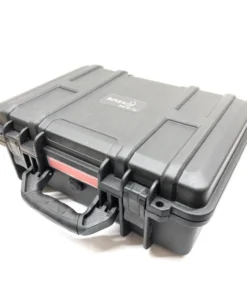
Storage Case Care
A protective case should remain dry and clean.
Foam can retain moisture.
Both the platform and the case should be dry before long-term storage.
Heat Exposure
Extreme heat should be avoided.
A closed vehicle in direct sunlight can become very hot.
Higher temperature can increase pressure inside the reservoir.
Cold Conditions
Cold temperatures can affect pressure and seal flexibility.
Moving rapidly from cold to warm conditions can also create condensation.
Gradual temperature changes are preferable.
Long-Term Storage
For extended storage, the platform should remain clean, dry, secure, and protected from impact.
The storage location should be stable and free from excessive humidity.
Pressure condition should follow manufacturer guidance.
Pre-Session Inspection
Before shooting, inspect the reservoir, pressure gauge, magazine, muzzle device, optics, trigger, and external hardware.
A short routine can identify problems early.
Post-Session Inspection
After shooting, check for pressure loss, loose screws, feeding changes, or new mechanical resistance.
Problems are easier to diagnose while the session is still recent.
Monitoring Air Loss
If pressure drops during storage, record how quickly it happens.
A persistent leak should be repaired.
Repeatedly refilling the reservoir does not correct the underlying issue.
Monitoring Cycling Changes
If semi-automatic operation becomes inconsistent, several causes are possible.
Pressure, magazine condition, ammunition, or internal wear may be involved.
The cause should be identified before continued use.
Monitoring Accuracy Changes
A sudden drop in precision should first prompt simple checks.
Inspect the optic mount, ammunition, barrel condition, and support technique.
Internal adjustment should not be the first response.
Used-Platform Inspection
A second-hand example should be judged primarily by mechanical condition.
Air retention, magazine operation, cycling reliability, barrel condition, trigger behavior, and mounting integrity matter more than cosmetic finish.
Service History
Documented maintenance records can provide useful information.
Previous seal replacement, valve work, or repair history helps establish how well the platform has been maintained.
Cosmetic Wear Versus Mechanical Wear
Small scratches usually affect appearance more than function.
Air leaks, damaged threads, rough cycling, unstable pressure behavior, or loose mounts are much more important.
Professional Servicing
Complex internal repairs should be completed by technicians familiar with high-pressure pneumatic systems.
Incorrect disassembly can create damage or safety risks.
Preserving Long-Term Value
Good maintenance protects both function and resale value.
Use clean air.
Protect the reservoir.
Keep the muzzle safe.
Inspect seals.
Maintain the magazines.
Store the platform dry.
Address faults early.
Overall Long-Term Reliability
A well-maintained compact big-bore pneumatic platform can remain dependable for many years.
Clean air protects internal parts.
Healthy seals preserve pressure.
A protected barrel maintains alignment.
Reliable magazines support smooth feeding.
Secure optics preserve point of aim.
Regular inspection, controlled filling, careful transport, dry storage, and qualified servicing when necessary all help maintain stable pressure behavior, reliable cycling, smooth operation, and long-term mechanical performance.
Be the first to review “BinTac SP-45 Semi Bigbore Pistol With 3in1 Scope(optional)”
Related products
AEA Air Gun
AEA Air Gun
AEA Air Gun
AEA Air Gun
AEA Air Gun
AEA Air Gun
Reviews
There are no reviews yet.