
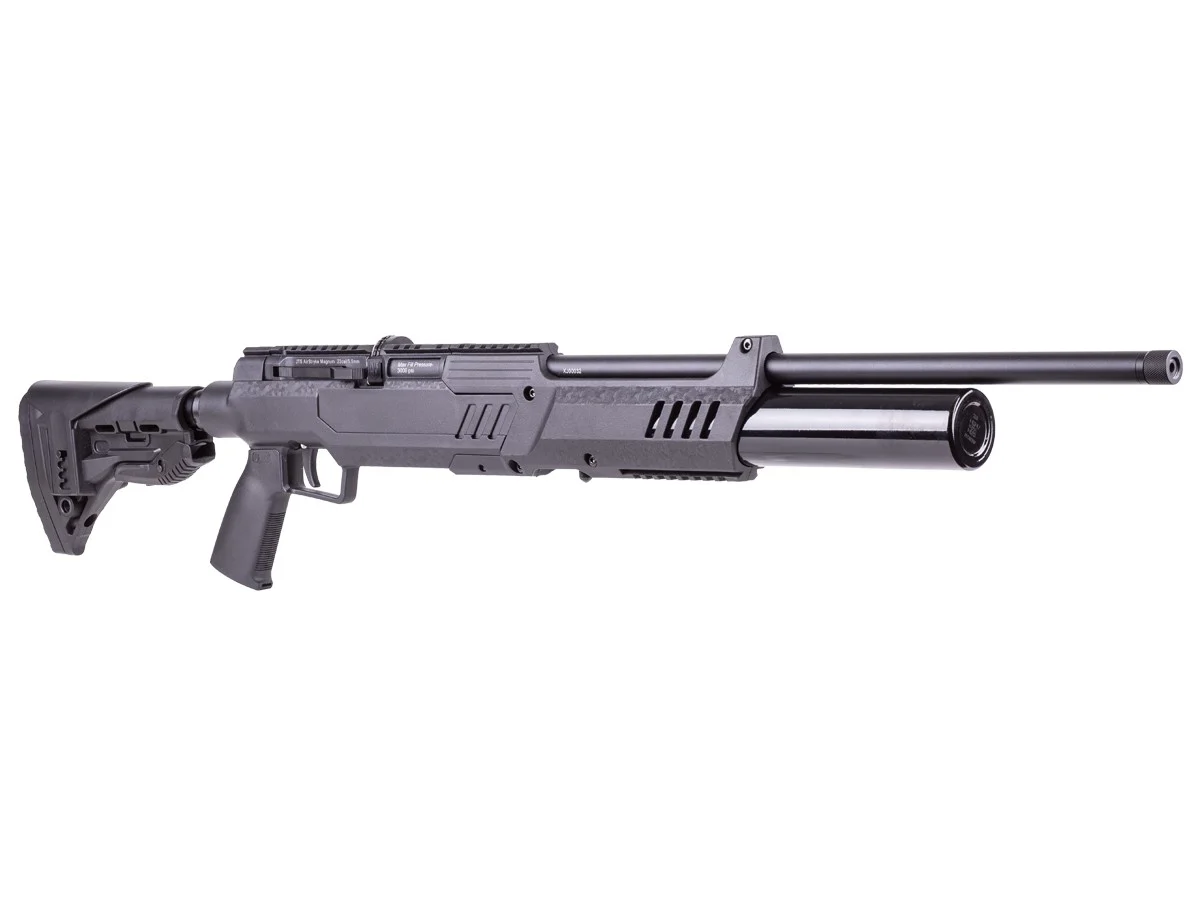
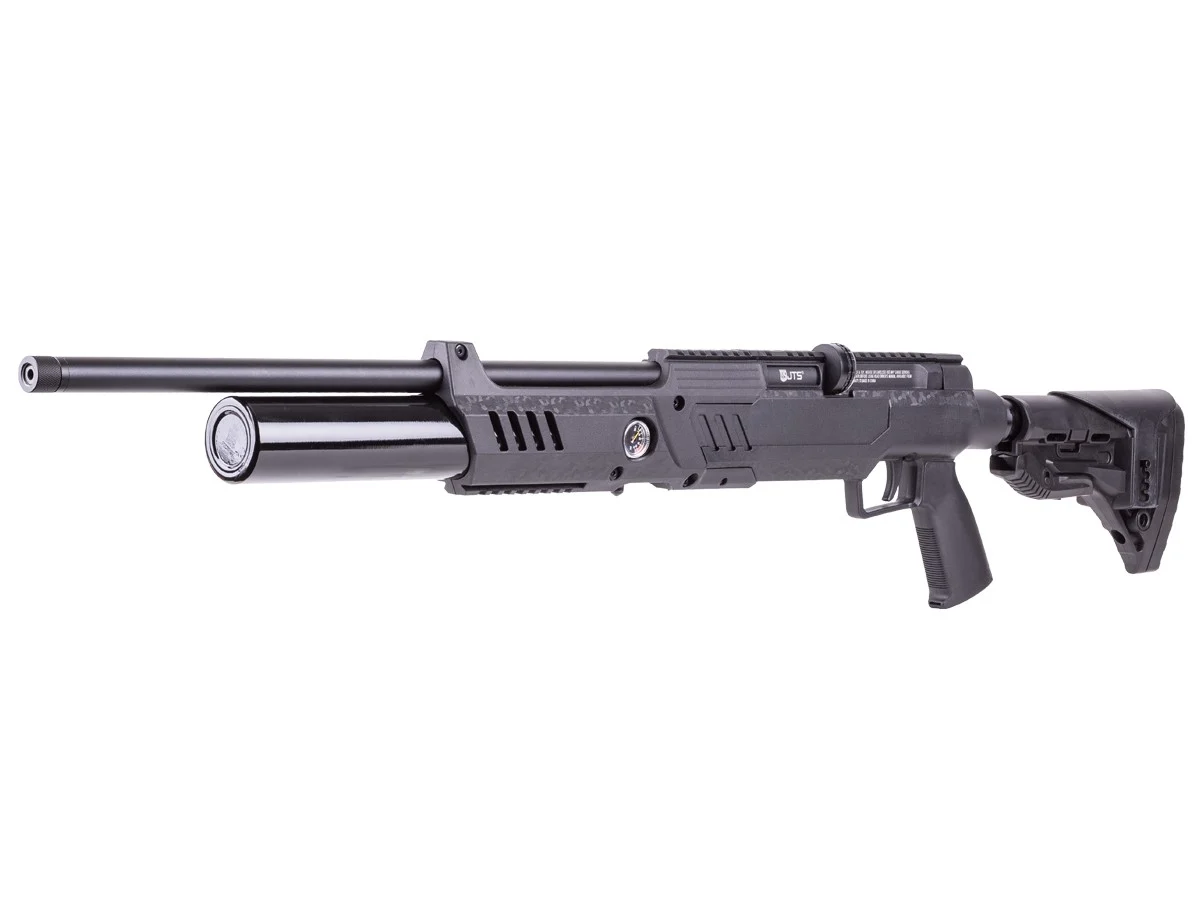
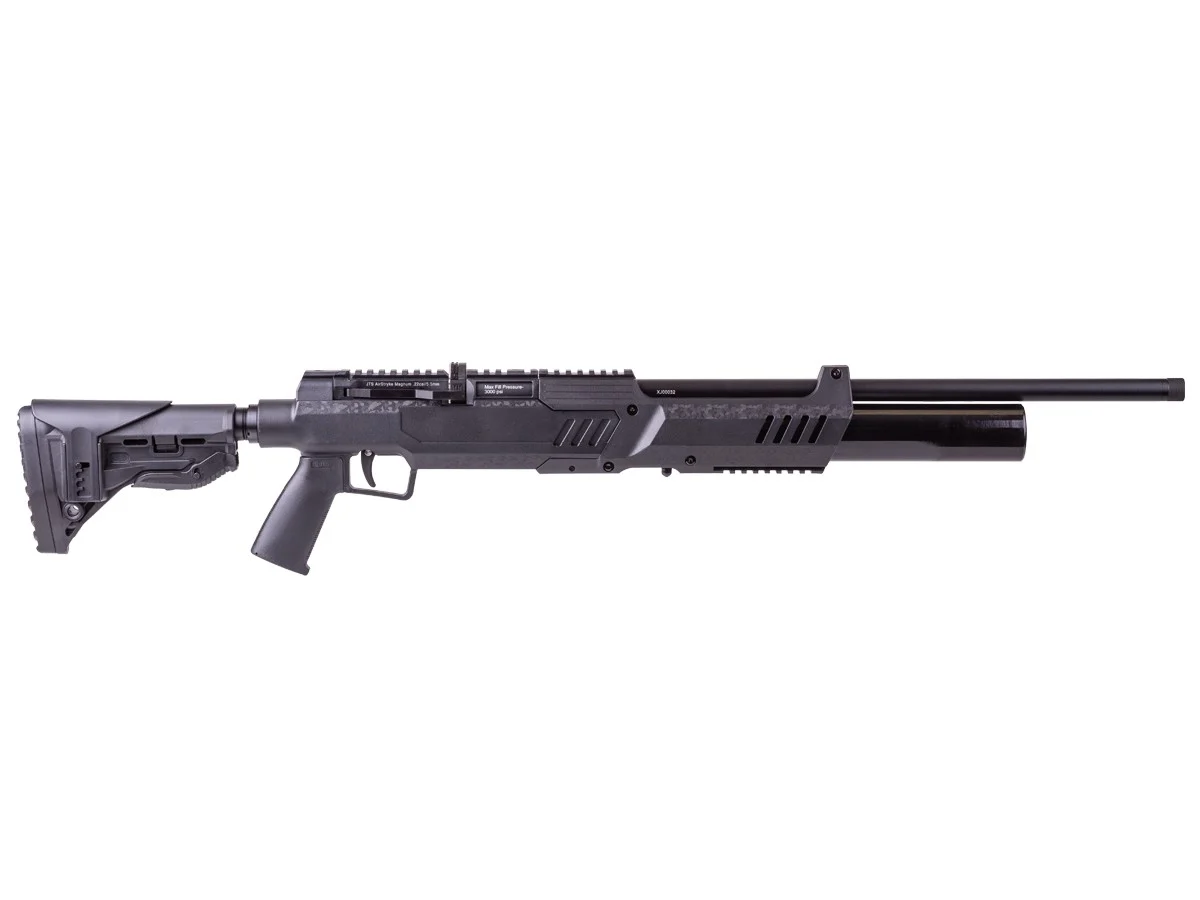
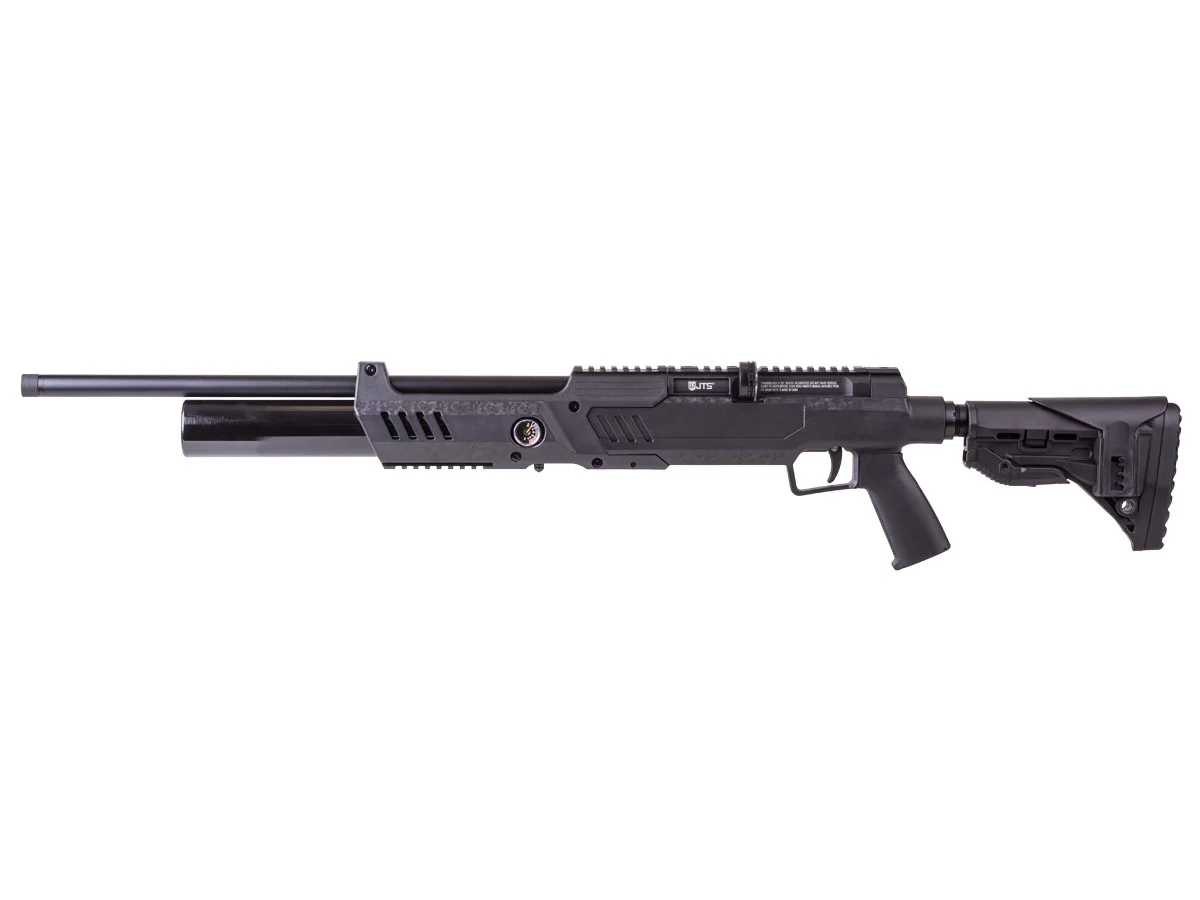
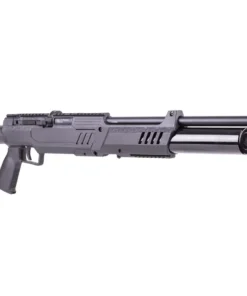
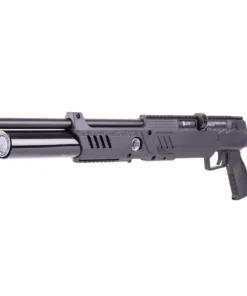
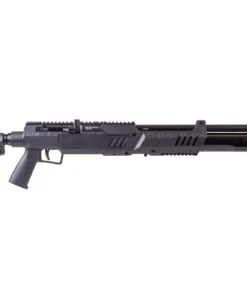
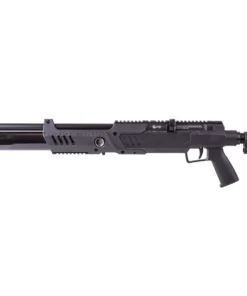
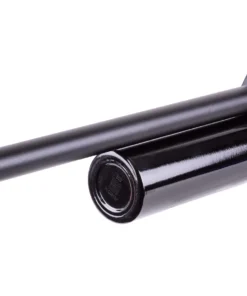



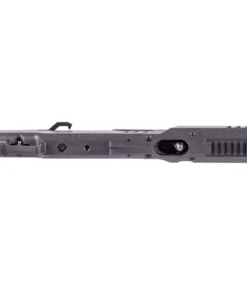
JTS AirStryke Magnum PCP Air Rifle
$230.00
Description.
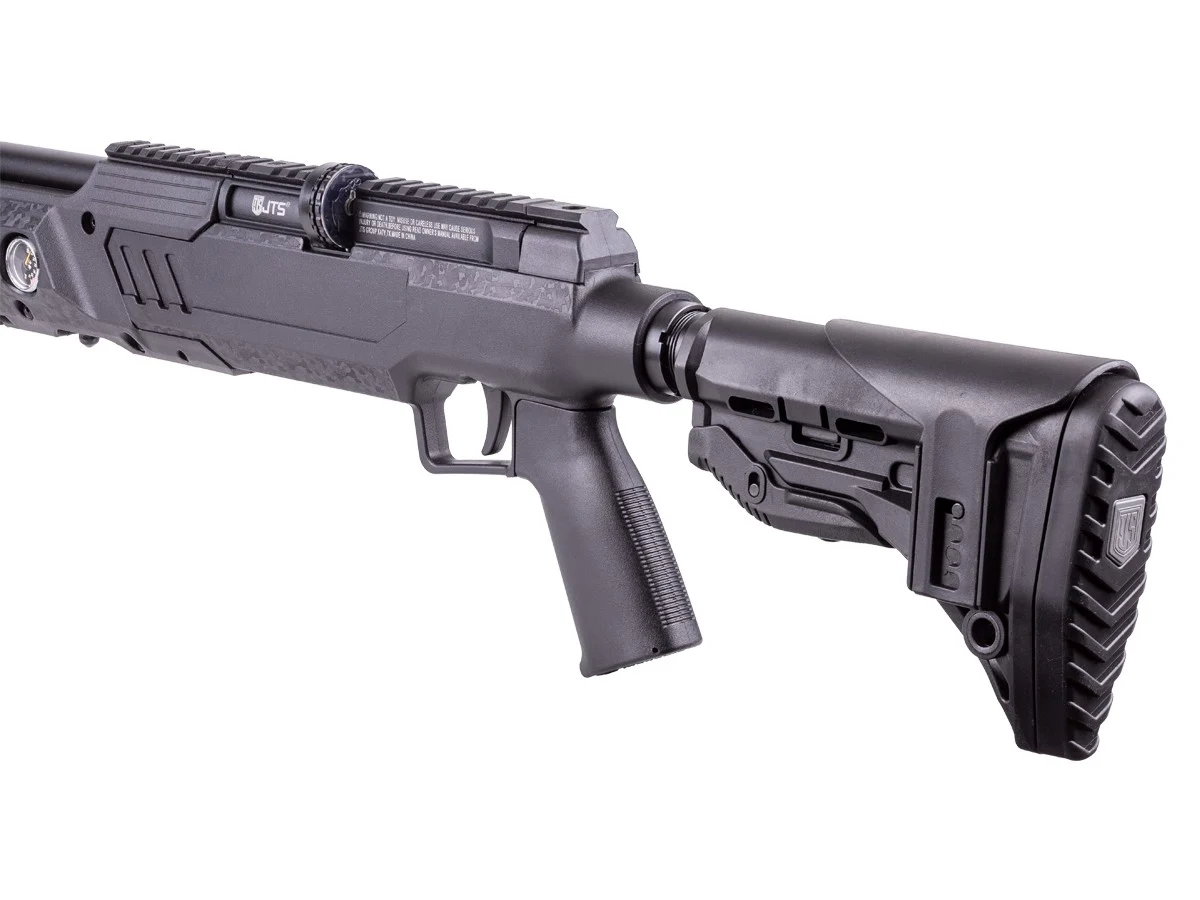
The JTS AirStryke Magnum is a PCP air rifle that takes the successful legacy of the original version and adds power and a .30 caliber option to deliver even more value-focused performance for hunting small game such as squirrels and rabbits in .22, up to game such as coyotes in .30, as well as pest control and target practice. It also adds a patented adjustable polymer tactical stock for superior ergonomics and a custom fit.
Key Takeaways
- The longer barrel results in more velocity and power.
- The regulator offers stable velocities from each shot for dependable performance.
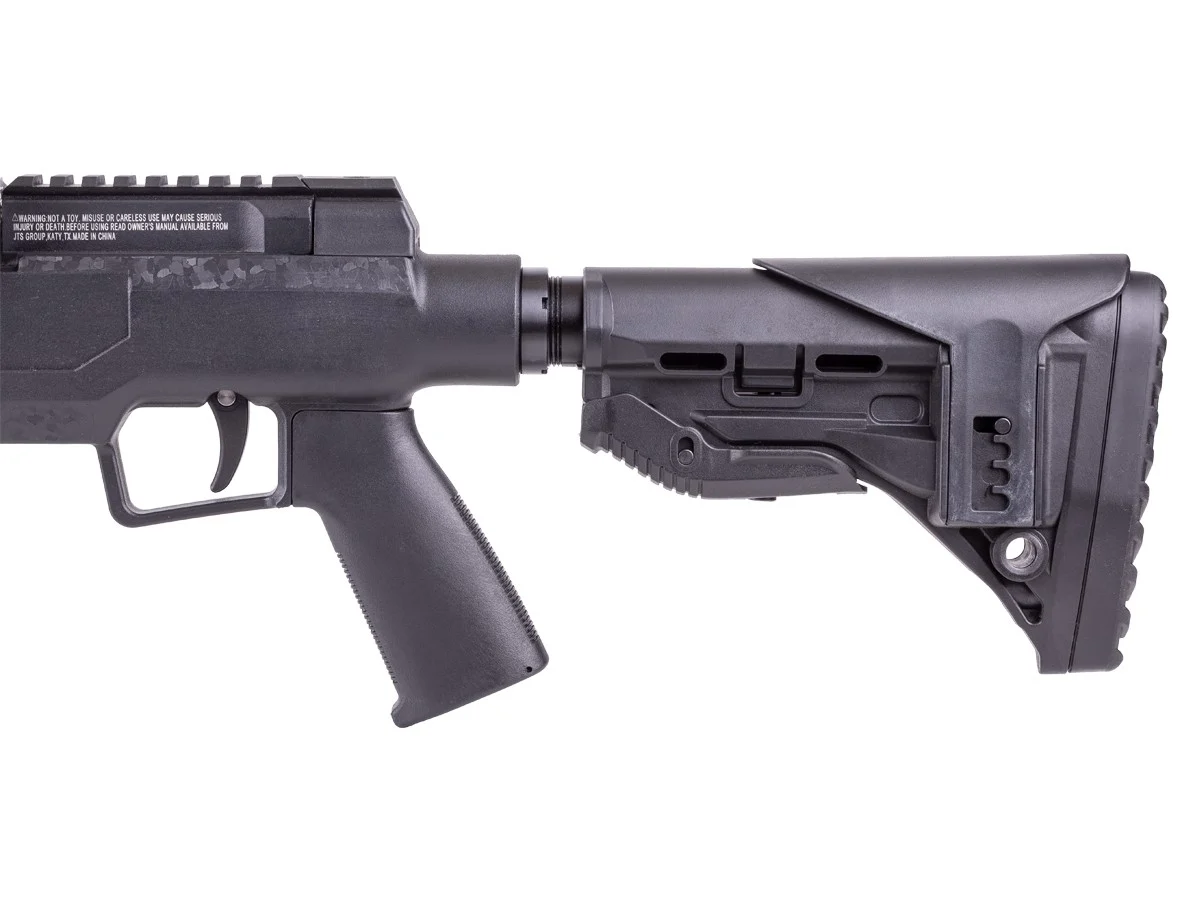
- The adjustable patented synthetic tactical stock enables customization and comfort.
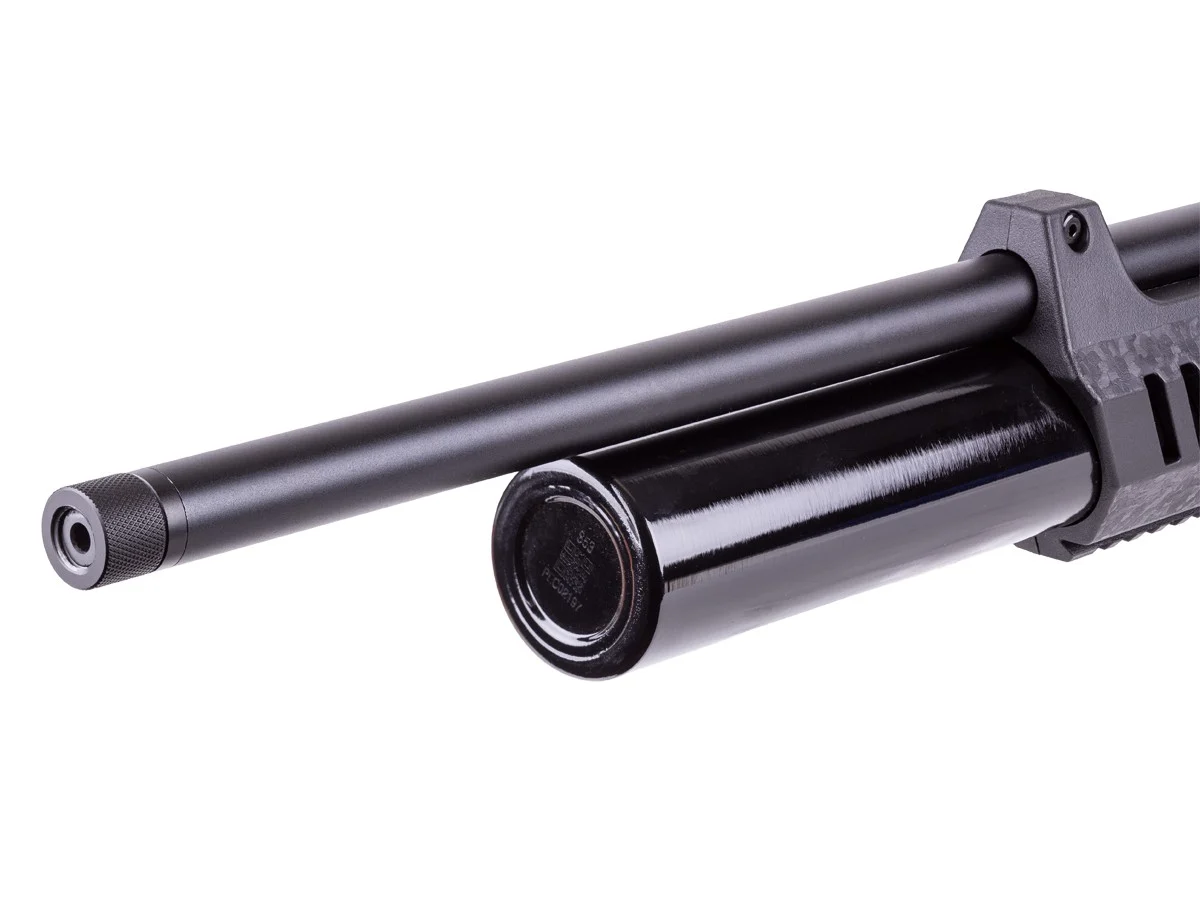
- The increased size of the 350cc air cylinder offers ample shots per fill for an air rifle of this power level.
Added Power for Improved Performance
The JTS AirStryke Magnum PCP Air Rifle has a longer barrel that provides increased velocities and power compared to earlier versions of this platform. This means it can take down larger game and shoot more accurately at longer distances, especially in the .30 caliber option that was not previously available.
Patented Adjustable Buttstock for Customization
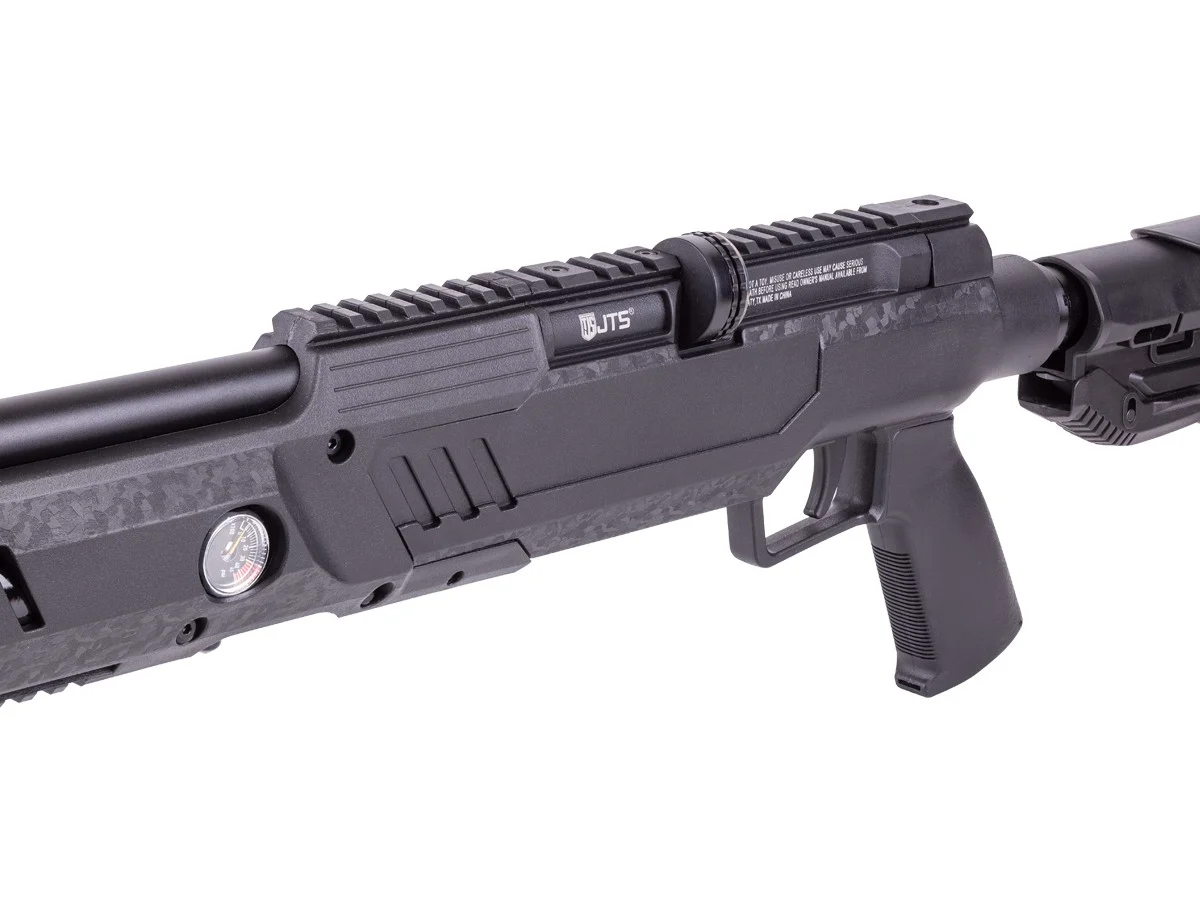
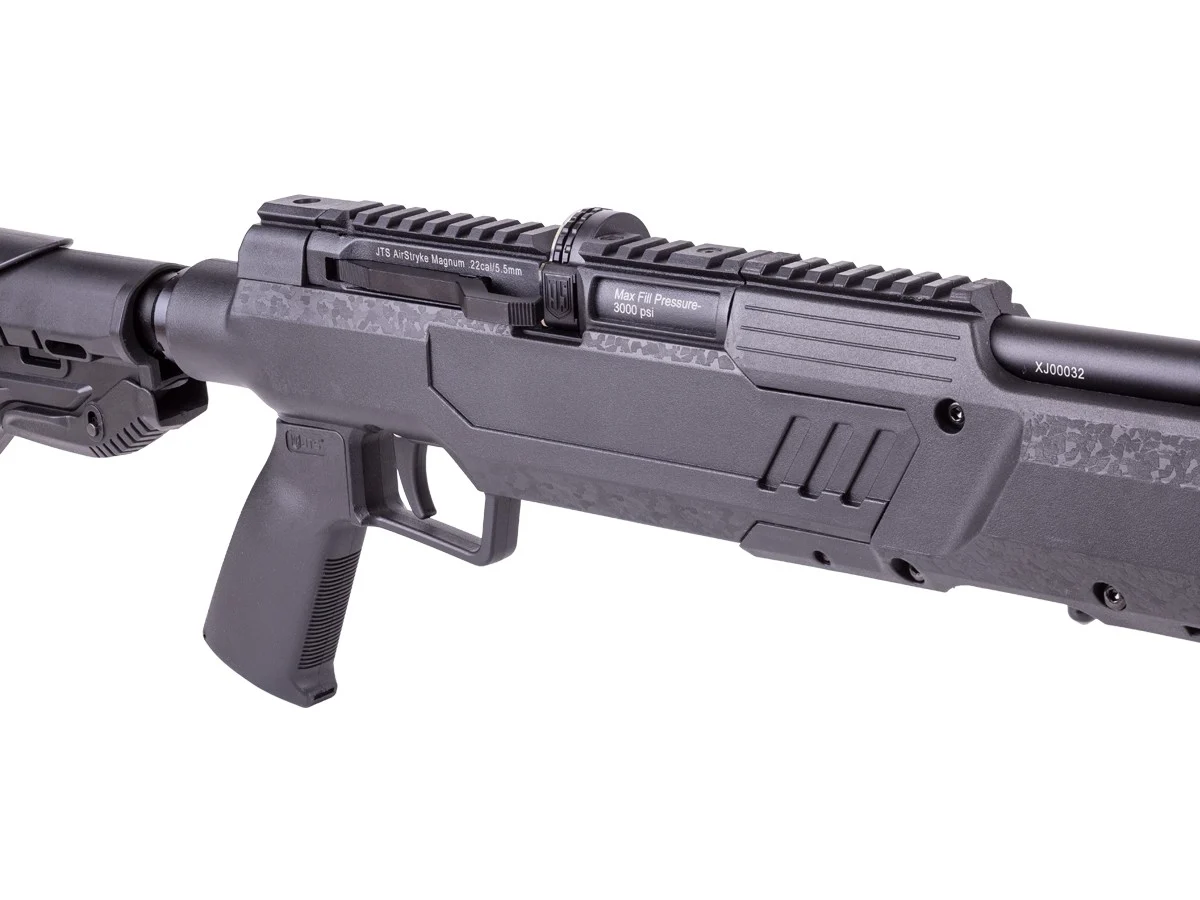
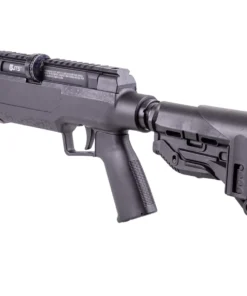
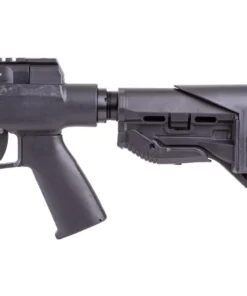
This air rifle has a patented adjustable tactical polymer stock with an adjustable length that offers a customized length of pull that can accommodate the comfort of shooters of different sizes. It also has an elevation-adjustable cheek riser and an AR-style grip that has storage space for a magazine.
Predictable Performance and Accuracy
The JTS Airstryke Magnum PCP Air Rifle has an internal regulator that delivers consistent velocity from the first shot to the last for reliable performance that leads to confidence. In addition, the .177 and .22 has 1/2 UNF muzzle threads with the .30 caliber featuring an M14x1.25 thread protected by a knurled cap to allow the addition of a moderator that makes each shot quieter.
Features for Versatility and Value
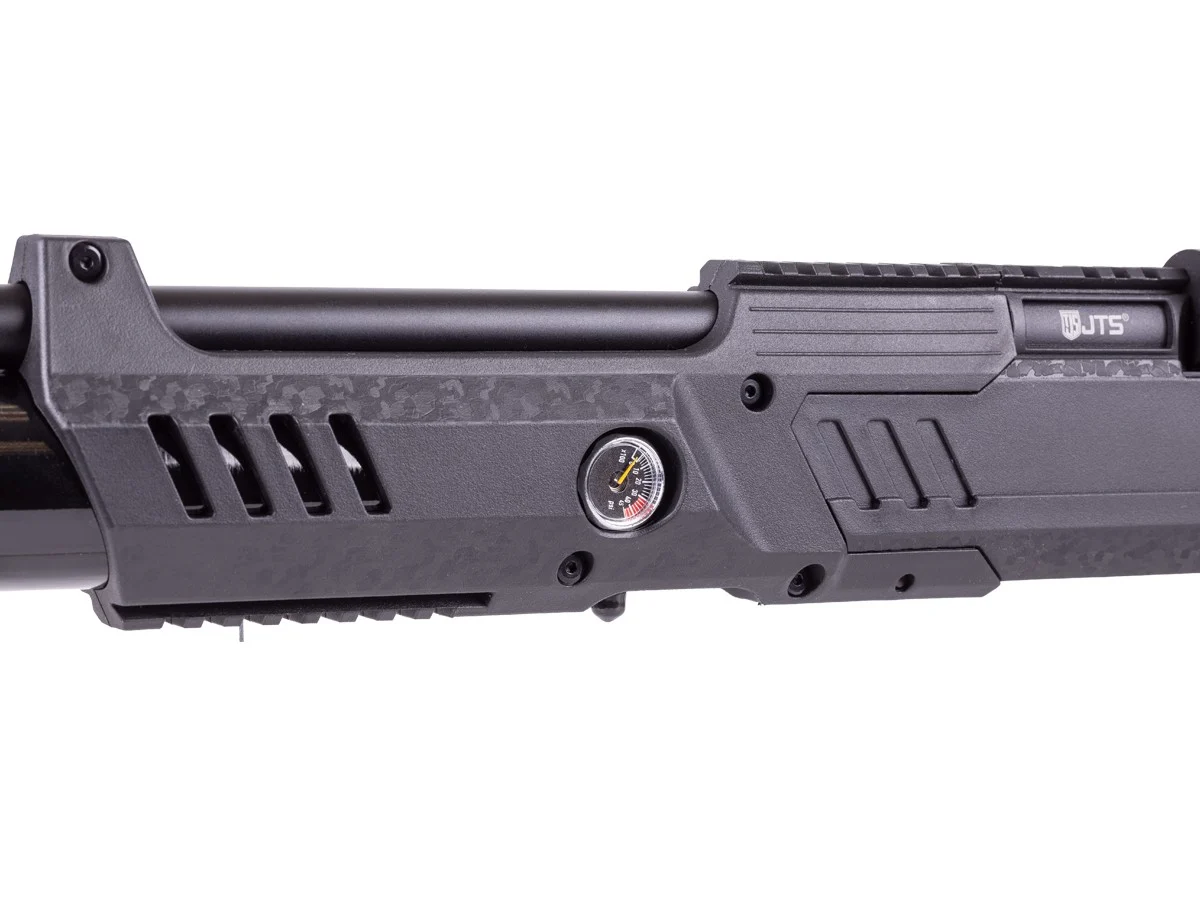
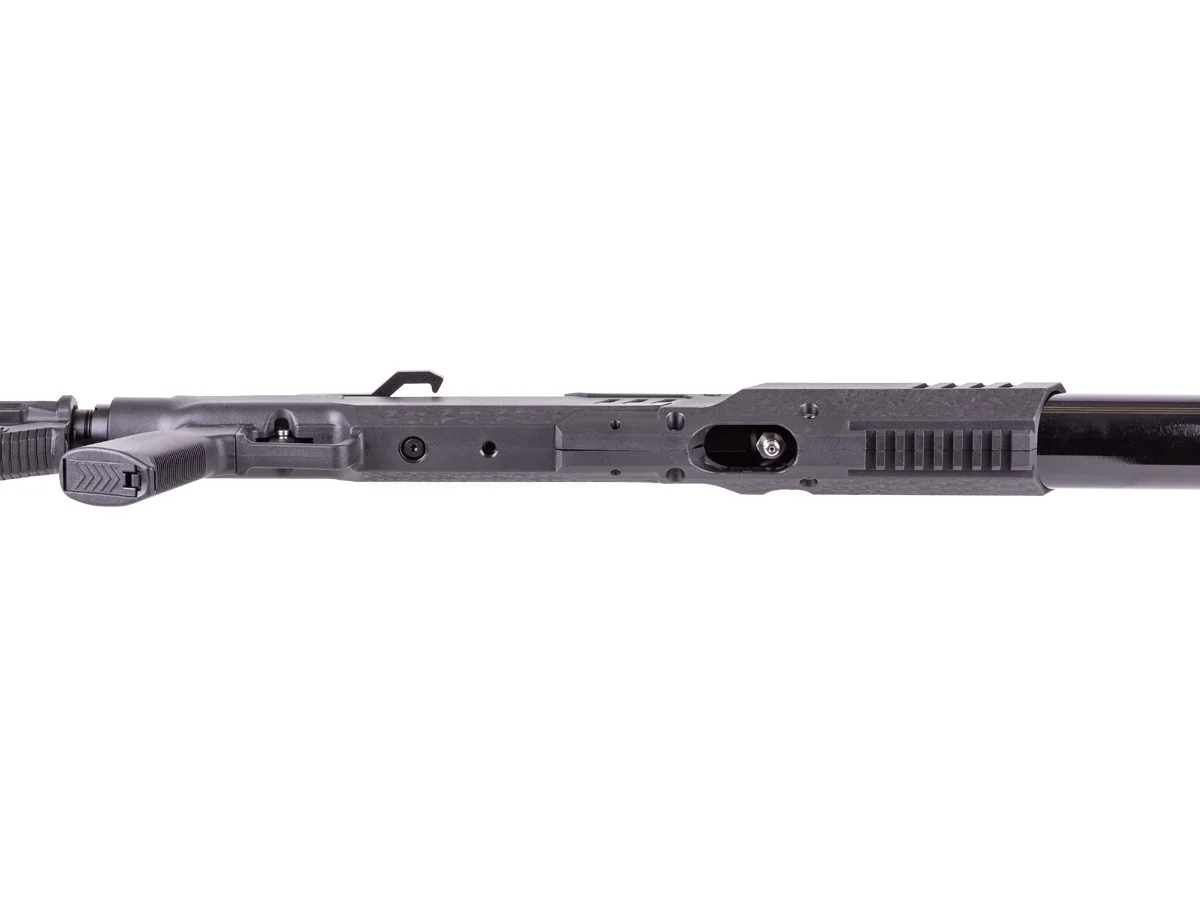
This PCP air rifle still provides excellent value for a regulated airgun of this power level and with its features and adjustability. It has a smooth sidelever, an adjustable trigger, an adjustable buttstock and cheekpiece, and a comfortable grip that has storage for a magazine, as well as a Picatinny forearm accessory rail for adding items such as a bipod, flashlights, and lasers.
Features and Benefits
| Feature | Benefit |
|---|---|
| Patented Adjustable Tactical Buttstock | Provides an adjustable length of pull and four height positions for the cheek riser for a comfortable fit. |
| Larger Barrel | Offers added power and velocity compared to the previous versions, allowing shooters to hunt larger game and increase their distance for target practice. |
| Internal Regulator | Delivers consistent velocity with each shot for predictable performance that leads to improved accuracy. |
| Picatinny Forearm Accessory Rail | Allows shooters to add accessories such as flashlights and bipods to extend the stability and functionality of this air rifle. |
| Sidelever Cocking | Enables convenient and smooth cocking for easier shooting. |
Why Buy JTS Airguns at Pyramyd AIR
JTS Airguns is dedicated to manufacturing high-quality, feature-rich airguns that deliver exceptional performance without breaking the bank. With a commitment to bringing dependable and accessible shooting experiences to enthusiasts, JTS aims to empower every shooter with reliable gear. Shooters can trust JTS to provide robust and accurate air rifles designed for lasting enjoyment and consistent results.
When you shop at Pyramyd AIR, you’re not just buying an airgun. You’re also gaining a partner. We offer fast and free shipping on qualifying orders, a comprehensive loyalty program, and expert pro shop services. Our knowledgeable staff is always ready to assist, and we boast a huge selection of ammo and outdoor accessories. With a legacy since 1996, Pyramyd AIR is your trusted source for all things airgun. Buy the JTS AirStryke Magnum PCP Air Rifle from Pyramyd AIR today.
Additional Resources
JTS AirStryke Magnum PCP Air Rifle
- Precharged pneumatic
- Sidelever action
- Repeater
- Fully regulated
- Rifled barrel
- 1/2 UNF threaded muzzle for .177 & .22 calibers, M14x1.25 for .30 caliber
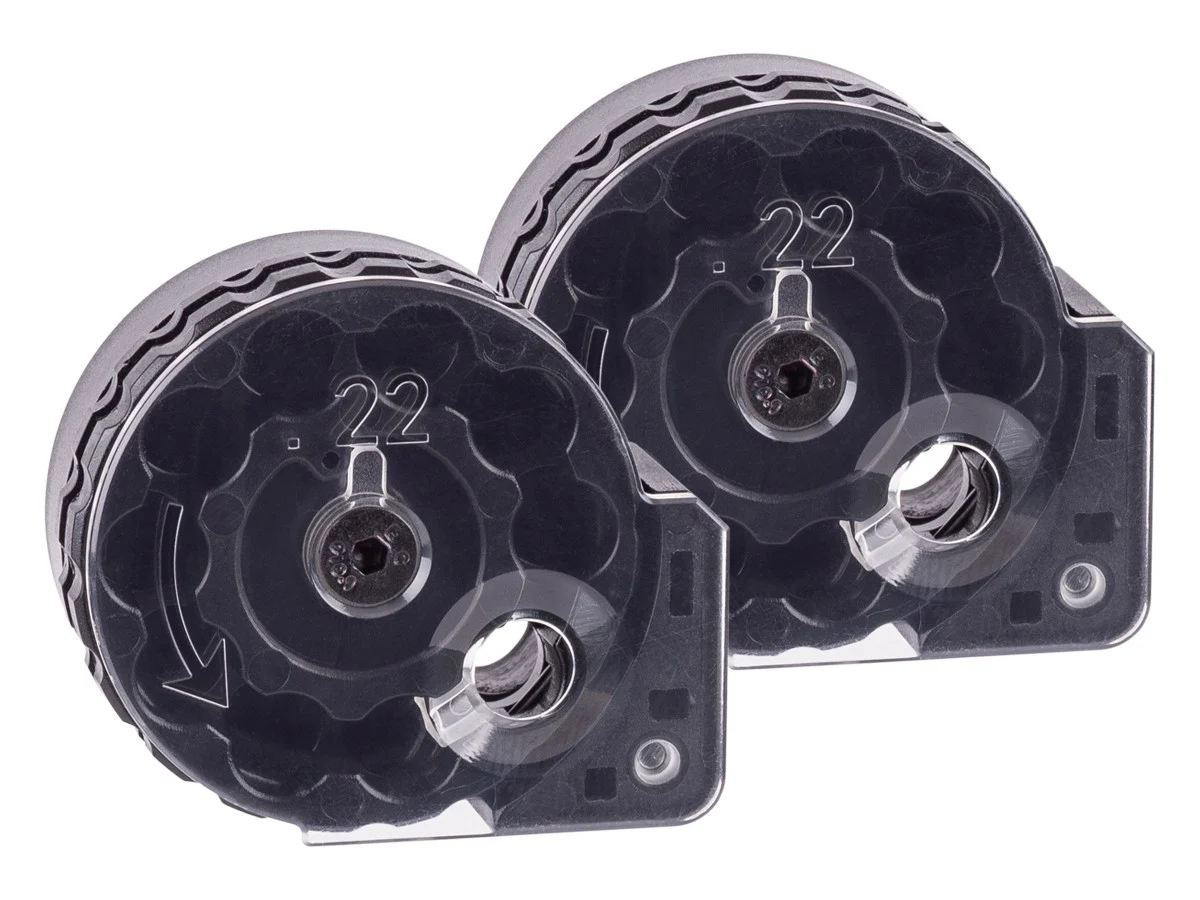
- Magazine capacity: 10rd (.22), 9rd (.25), 7rd (.30)
- Max. shots per fill: 30 (.22, .25, .30)
- Max. velocity: 1200 FPS (.22), w/11.9gr ammo, .1100 FPS (.25) w/16.98gr ammo, 800 FPS (.30) w/45.06gr ammo
- Max. energy: 39.83 FPE (.22), 50.89 FPE (.25), 66.38 FPE (.30)
- Max. fill pressure: 3000 PSI
- 350cc air cylinder
- Adjustable trigger
- Synthetic stock
- Patented adjustable tactical AR buttstock
- Adjustable cheek riser
- Manual safety
- Picatinny optics rail
- Picatinny forearm accessory rail
- Ridged AR-style grip w/magazine storage
- Textured forearm
- Ridged rubber buttpad
- Integrated pressure gauge
- Includes two magazines
- Barrel length: 23″
- Overall length: 40-42″
- Weight: 7 lbs.
Specifications
BrandJTS Airguns
Caliber.30 (7.62mm)Max Velocity800 fps Muzzle Energy66.38 ft/lbsSuggested forSmall game hunting/target practicePowerplantPre-charged pneumaticLoudness3-MediumWeight7.0 lbsFunctionRepeaterMax Shots per Fill30Cylinder Size350 ccActionSideleverShroudedYesScopeableWeaver/PicatinnyFront SightsnoneRear SightsnoneSafetyManualTriggerTwo-stage adjustableBarrelRifledCapacity7 round(s)Body TypeRifleStockSyntheticButtplateRubberColorBlackOperating Pressure3000 PSI / 206 BARBarrel Length23 inGrip OrientationAmbidextrousOverall Length40-42 inRegulatedYesIs Safe To Dry FireYes
JTS AirStryke Magnum PCP Air Rifle – High-Power Regulated Performance for Precision and Field Shooting
JTS AirStryke Magnum PCP Air Rifle Overview
The JTS AirStryke Magnum PCP Air Rifle expands the AirStryke platform with greater power, a larger air reservoir, longer barrel, and a new .30 caliber option. Designed around a fully regulated pneumatic system, it combines a 350 cc air cylinder, 3,000 PSI operating pressure, side-lever action, adjustable trigger, synthetic tactical furniture, and a 23-inch rifled barrel. Current specifications list maximum velocities of approximately 1,200 FPS in .22, 1,100 FPS in .25, and 800 FPS in .30, depending on ammunition.
For shooters researching jts airguns, jts guns, Jts group, jts firearms, or the wider range of JTS pneumatic platforms, the Magnum represents the high-power end of the current AirStryke family.
Why Choose the JTS AirStryke Magnum?
The main reason to choose the Magnum is its combination of regulated consistency and increased energy.
Compared with the standard jts airstryke platform and JTS AirStryke Carbine, the Magnum uses a substantially larger 350 cc air supply while maintaining an advertised 30 shots per fill across its available calibers. Its rated muzzle energies are approximately 39.8 ft-lb in .22, 50.9 ft-lb in .25, and 66.4 ft-lb in .30.
Therefore, anyone comparing a JTS AirStryke Carbine PCP air rifle, AirStryke Carbine airgun, JTS AirStryke Carbine review, JTS AirStryke Carbine price, JTS AirStryke Carbine for sale, or buy JTS AirStryke Carbine online should understand that the Magnum is designed for substantially greater power.
How Good Is the AirStryke Magnum for Precision?
The internal regulator helps provide controlled air delivery between shots, while the rifled barrel supports repeatable projectile stabilization.
In addition, the adjustable two-stage trigger gives the shooter better control over shot release. The adjustable cheek riser and tactical rear stock can also be positioned to support consistent eye alignment behind an optic.
For shooters searching for the best scope for PCP air rifle, the integrated Picatinny optics rail allows a wide variety of compatible scopes to be mounted.
How Does the Magazine System Work?
The Magnum functions as a repeating pneumatic rifle.
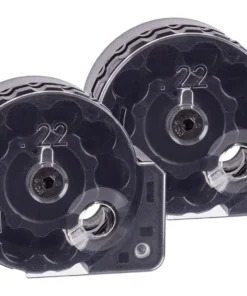
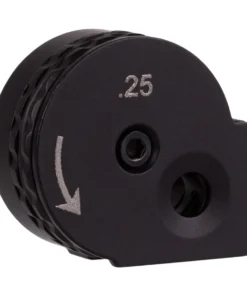
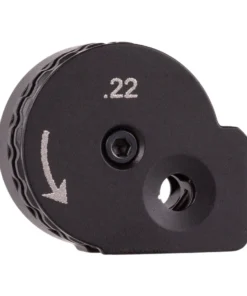
Magazine capacity is listed at 10 rounds for .22, nine rounds for .25, and seven rounds for .30. Two polymer magazines are supplied with the rifle.
Properly matched ammunition remains important. Shooters already familiar with jts pellets should test suitable projectile weights and designs because different combinations may produce noticeably different accuracy.
Where Can the AirStryke Magnum Be Used?
The platform is suited to controlled target shooting, recreational range use, and lawful field applications where its power level is permitted.
A buyer researching a JTS air rifle for hunting should carefully consider caliber, projectile choice, intended quarry, local hunting regulations, and safe backstop requirements.
The increased energy also means legal classification can vary significantly by country. For example, its factory energy levels exceed the 20-joule threshold referenced in current French regulatory discussion.
When Should You Choose the Magnum?
Choose the Magnum when you want more power and onboard air capacity than the smaller AirStryke versions.
The 350 cc reservoir is considerably larger than the 85 cc system used in the Carbine and the 200 cc system found in the standard version.
Because of that capacity, a jts compressor or another suitable clean high-pressure filling source can be especially useful.
The rifle belongs clearly within the compressed air rifle category rather than the conventional spring-powered market.
How Does It Compare With the Airacuda Family?
Buyers may also encounter jts airacuda, jts airacuda max, jts airacuda 25, airacuda, Jts aircuda, airacuda max, and airacuda pcp while comparing JTS models.
The Magnum is different in styling and purpose.
Searches for jts airacuda max 30 and jts airacuda max 30 cal may also indicate interest in larger-caliber performance, although buyers should always verify the exact caliber configuration available for each specific model.
Other JTS-related searches such as jts stealth hawk and jts brawn represent additional options for people exploring the manufacturer’s broader catalog.
Important Caliber Information
Despite broad searches for a 177 cal pellet gun or 177 cartridge, the current AirStryke Magnum specification lists .22, .25, and .30 caliber versions.
Therefore, buyers should not assume that every general airgun search applies directly to this model.
Terms such as lindstradt air gun, tom air gun, and airgins may appear in general search results but do not represent documented AirStryke Magnum specifications.
Similarly, jts shotgun accessories belongs to a different equipment category and should not be confused with accessories intended for this pneumatic rifle.
Practical Equipment and Accessory Setup
The rifle includes both an optics rail and a forearm accessory rail, allowing useful equipment to be positioned without major modification.
Its AR-style grip also includes magazine storage, while the adjustable rear stock incorporates a cheek riser and rubber buttpad.
Shooters familiar with retailers or communities associated with air guns of texas may encounter comparable PCP equipment, filling systems, optics, and ammunition while researching complete setups.
Ultimately, the JTS AirStryke Magnum combines high regulated power, a large air reservoir, adjustable ergonomics, side-lever operation, flexible caliber options, and modern accessory compatibility in one purpose-built platform. For shooters seeking greater performance than the smaller AirStryke configurations while retaining familiar handling and repeatable pneumatic operation, the Magnum provides a compelling step upward in the JTS lineup.
Regulated Performance, Accuracy, Handling, Air Efficiency, and Practical Shooting Experience
The JTS AirStryke Magnum PCP Air Rifle is designed to deliver strong, repeatable performance through a combination of regulated air delivery, a long rifled barrel, adjustable ergonomics, and a large onboard air supply. While power is an important part of the platform, practical accuracy depends on far more than energy alone. Consistency, balance, trigger control, projectile selection, optic setup, and pressure management all contribute to how well the rifle performs during real shooting sessions.
Regulated Air Delivery
The internal regulator helps maintain a more consistent working pressure as the reservoir gradually empties.
Without regulation, changing cylinder pressure can produce larger velocity differences between shots. A regulated system helps reduce this variation by controlling the pressure supplied to the firing valve.
More consistent velocity can improve vertical consistency on the target, particularly at extended distances.
However, the regulator should be viewed as one part of the complete accuracy system rather than a guarantee of precision by itself.
Large Air Reservoir
The larger reservoir provides useful onboard air capacity for a high-output platform.
This reduces the need to refill after only a small number of shots and makes the rifle more convenient during longer range sessions.
The shooter should still monitor the pressure gauge regularly.
Once pressure moves outside the rifle’s most efficient operating range, performance may begin to change.
Learning the useful pressure window makes it easier to plan shooting sessions and refill at the appropriate time.
Barrel Performance
The long rifled barrel is designed to stabilize the projectile before it exits the muzzle.
Its performance depends heavily on the ammunition selected.
Two projectiles of the same nominal caliber may behave differently because of variations in weight, shape, diameter, and construction.
For this reason, accuracy testing should involve several suitable options.
The best combination is the one that repeatedly produces reliable groups rather than simply the highest advertised velocity.
Projectile Selection
Projectile choice can significantly affect practical performance.
Lighter options may produce greater speed, while heavier designs can behave differently in terms of retained energy and stability.
The shooter should evaluate accuracy before focusing on velocity alone.
Testing should be performed under similar conditions whenever possible.
Using the same rest, distance, pressure range, and optic setting makes comparisons more meaningful.
Once a reliable projectile is identified, staying with it simplifies zeroing and trajectory management.
Two-Stage Trigger Control
The adjustable two-stage trigger supports a deliberate firing process.
The first stage allows the shooter to take up initial movement before reaching the final release point.
A predictable break can help reduce unwanted movement during the shot.
The trigger should be set for safe, consistent operation rather than adjusted solely for extreme lightness.
Good technique remains essential.
The finger should press smoothly toward the rear without pulling the rifle sideways.
Side-Lever Operation
The side-lever action allows the next round to be chambered with relatively little movement.
This is useful when the rifle is supported from a bench or bipod because the shooter can maintain a more consistent body position.
The lever should be operated fully and smoothly.
If unusual resistance develops, the action should not be forced.
The magazine, projectile position, and loading path should be inspected before continuing.
Smooth operation helps preserve both reliability and mechanical feel.
Adjustable Stock and Cheek Position
The rear stock allows the rifle to be fitted more closely to the individual shooter.
Correct stock length affects shoulder position, trigger reach, and overall comfort.
The cheek support also helps establish consistent eye alignment with the optic.
A properly configured setup should allow the shooter to shoulder the rifle and see naturally through the sight without repeatedly moving the head.
This repeatability becomes especially valuable during precision shooting.
Optic Setup
The optic should be positioned according to the shooter’s natural head position.
If it sits too high, low, forward, or rearward, the shooter may compensate with poor posture.
That can reduce consistency over longer sessions.
Eye relief should be checked together with stock and cheek adjustments.
Once a comfortable position is established, mount security should be verified regularly.
A loose optic can create apparent accuracy problems that have nothing to do with the rifle itself.
Balance and Weight Distribution
The Magnum’s larger air system and longer barrel contribute to a substantial overall feel.
Balance therefore matters.
A large scope, bipod, or additional accessory can shift the center of gravity noticeably.
Accessories should be added only when they provide a clear practical benefit.
A well-balanced setup is easier to control and more comfortable during extended use.
Poor balance can cause fatigue and make unsupported shooting more difficult.
Supported Shooting
The platform performs particularly well when used from a stable support.
A bipod or front rest can reduce movement and allow the shooter to concentrate on breathing and trigger control.
A rear support may also help with fine elevation adjustments.
Support pressure should remain consistent from shot to shot.
Changing how the rifle contacts the rest can introduce unnecessary variation.
A repeatable setup produces more meaningful group testing.
Breathing and Follow-Through
Good technique still matters with a regulated pneumatic platform.
The shooter should maintain a relaxed breathing rhythm and release the shot during a naturally stable moment.
After the trigger breaks, the head should remain in position and the sight picture should be maintained briefly.
This follow-through helps reduce unnecessary movement.
It also makes it easier to observe the shot and evaluate technique.
Wind and Environmental Conditions
Wind can have a significant effect on projectile flight.
Even when the rifle and ammunition are performing consistently, changing wind can move the impact point.
Temperature and air density can also affect trajectory to a smaller degree.
For this reason, shooting records can be useful.
Noting pressure, distance, ammunition, weather, and group size helps identify patterns over time.
Filling and Pressure Management
The rifle should be filled only with suitable clean, dry compressed air.
The fill connection should be kept free from dust and contamination.
The shooter should also avoid exceeding the recommended pressure.
Proper filling habits protect the pneumatic system and support long-term reliability.
During extended sessions, pressure should be monitored so groups are fired within the rifle’s most consistent operating range.
Real-World Performance
The strongest performance comes from combining mechanical consistency with careful shooting technique.
The regulator helps control pressure.
The barrel supports projectile stability.
The trigger provides a predictable release.
The adjustable stock improves fit.
The side lever supports efficient cycling, while the larger reservoir provides useful shooting capacity.
When those elements are combined with correct projectile selection, secure optics, stable support, and disciplined pressure management, the JTS AirStryke Magnum becomes a predictable and capable platform for demanding target sessions and lawful field use.
Regulated Performance, Accuracy, Handling, Air Efficiency, Ergonomics, and Real-World Shooting Experience
The JTS AirStryke Magnum PCP Air Rifle is designed around a combination of strong power delivery, regulated consistency, practical adjustability, and efficient repeat-shot performance. Although muzzle energy is an important part of the platform, usable accuracy depends on far more than power alone. Barrel quality, regulator behavior, projectile choice, stock fit, optic alignment, trigger control, support position, environmental conditions, and air management all influence the final result. When these factors are handled correctly, the rifle becomes a predictable platform for structured range sessions and lawful field use.
Regulated Air Delivery
The regulated pneumatic system helps maintain a more consistent operating pressure as the main air reservoir gradually empties.
Without a regulator, pressure can decline continuously between shots, which may create larger velocity differences across a full fill. A regulator helps reduce this effect by supplying the firing valve with a more controlled working pressure.
This matters because consistent velocity can reduce vertical variation at distance.
However, regulation should not be viewed as an automatic guarantee of tight groups. Ammunition quality, shooter input, barrel condition, optic stability, and environmental factors still influence accuracy.
Large Air Capacity
The rifle’s larger reservoir provides useful onboard air capacity for a higher-output platform.
A larger supply can reduce the number of interruptions caused by frequent refilling during longer shooting sessions.
That said, shooters should still monitor pressure throughout use.
A rifle may perform most consistently within a particular pressure window.
Once pressure falls outside that range, velocity and point of impact may begin to change.
Learning the rifle’s practical pressure behavior makes range planning easier and helps prevent unnecessary testing outside the most stable operating zone.
Barrel Performance
The rifled barrel provides the final guidance needed to stabilize the projectile before it exits the muzzle.
Even a well-made barrel can behave differently with different ammunition.
Weight, head size, shape, construction, and manufacturing consistency all influence how a projectile interacts with the bore.
For this reason, accuracy testing should be systematic.
A shooter should avoid judging the rifle based on one ammunition type.
Several suitable options should be tested under similar conditions before deciding which performs best.
Ammunition Selection
Projectile selection has a major influence on practical performance.
Lighter options may produce higher velocity, while heavier options may retain energy differently and may behave better in certain wind conditions.
The highest speed does not automatically produce the smallest group.
Accuracy should remain the priority.
Testing should be conducted from a stable position using the same target distance, optic setting, and pressure range.
Once a reliable option has been identified, staying consistent with that choice can simplify zeroing and trajectory management.
Two-Stage Trigger Control
The adjustable two-stage trigger supports a deliberate shot-release process.
The first stage allows the shooter to take up initial movement before reaching the final release point.
A predictable break can reduce sudden disturbance during the shot.
However, an extremely light setting is not always desirable.
Safety, consistency, and clear feedback are more important than minimal pull weight.
The trigger finger should move smoothly to the rear without pulling sideways.
This helps preserve alignment through the firing cycle.
Side-Lever Operation
The side-lever system allows repeated shots to be prepared with relatively little disturbance to the shooting position.
This is useful when the rifle is being used from a rest, bag, or bipod.
The lever should be operated through its full travel in a smooth, deliberate motion.
If unusual resistance develops, forcing the action is not recommended.
The magazine and loading path should be checked first.
Consistent mechanical handling helps preserve reliability and reduces unnecessary wear.
Adjustable Stock Fit
The rear stock helps the rifle accommodate different body dimensions and shooting positions.
Correct length affects trigger reach, shoulder placement, and head position.
If the stock is too long, the shooter may stretch forward.
If it is too short, posture can become cramped.
A properly adjusted setup should feel natural.
The rifle should come into the shoulder without forcing the head or arm into an awkward position.
Comfortable fit supports repeatability.
Cheek Support and Eye Alignment
Consistent cheek position is critical when using an optic.
The eye should align naturally with the sight without excessive lifting or lowering of the head.
If alignment changes between shots, the sight picture may feel inconsistent.
The cheek support should therefore be adjusted together with optic height.
Once the correct position has been found, it should remain unchanged unless another major component is altered.
A repeatable head position helps reduce one more variable during precision work.
Optic Placement
The optic should be positioned according to the shooter’s natural posture.
Incorrect eye relief can create unnecessary tension.
If the optic sits too far forward or rearward, the shooter may compensate by moving the head.
This can affect consistency.
Mounting hardware should also be inspected regularly.
A loose scope or mount can create sudden point-of-impact changes that may be mistaken for a mechanical problem with the rifle.
Checking the optic first can save unnecessary troubleshooting.
Balance and Weight Distribution
The rifle has a substantial layout because of its longer barrel and larger air system.
Balance should therefore be considered when accessories are added.
A heavy optic, bipod, mount, or other front-mounted equipment can shift the center of gravity.
An overly front-heavy setup can become tiring during unsupported shooting.
A rear-heavy configuration can also feel awkward.
Accessories should be selected because they improve function, not simply because space is available.
Benchrest Use
A stable bench setup can reveal the rifle’s practical mechanical consistency.
The front support should remain firm and repeatable.
A rear bag can be used for fine elevation adjustment.
The rifle should settle naturally on the target rather than being forced into position with muscular pressure.
If the shooter repeatedly pushes or pulls the rifle into alignment, support placement may need adjustment.
Natural alignment usually produces more repeatable results.
Bipod Technique
A bipod can provide excellent support when used consistently.
The surface beneath it should be stable.
Forward pressure should remain similar between shots.
Changing bipod loading significantly can alter how the rifle reacts.
The shooter should develop one repeatable method and use it throughout a group.
Consistency in support technique is just as important as consistency in trigger control.
Unsupported Shooting
Although the rifle is especially comfortable in supported positions, unsupported shooting can still be practiced where appropriate.
The supporting hand should be placed where the rifle balances naturally.
The shooter should avoid gripping excessively tightly.
Muscular tension often increases movement.
Shorter strings may be more practical when firing from standing because the rifle’s substantial configuration can become tiring.
A stable stance and relaxed shoulders help improve control.
Breathing Technique
Breathing affects body movement and sight stability.
The shooter should maintain a calm rhythm rather than holding the breath for long periods.
After a normal exhale, there is usually a brief natural pause when movement is reduced.
This can provide a stable moment for shot release.
If the sight picture is not correct during that pause, the shooter can simply restart the breathing cycle.
Rushing often creates more movement than waiting.
Follow-Through
The shooting process should continue after the trigger releases.
The shooter should keep the head in position and remain behind the optic.
The rifle should not be lifted immediately.
This allows the firing cycle to complete without unnecessary disturbance.
Good follow-through also helps the shooter observe how the sight moved during the shot.
Over time, this can provide useful feedback about technique.
Wind Awareness
Wind becomes increasingly important as range increases.
Small projectiles can be influenced noticeably by changing crosswinds.
The shooter should observe flags, vegetation, dust, and other environmental indicators where available.
Conditions near the firing position may not match conditions near the target.
Because of this, longer-range shooting requires observation and patience.
Keeping notes can help the shooter understand how the rifle and chosen ammunition behave in different conditions.
Temperature and Environmental Changes
Temperature can influence both equipment and projectile behavior.
A rifle taken from a hot vehicle into cooler outdoor air may need time to stabilize.
Changes in air density can also influence trajectory slightly at longer distances.
For serious group testing, the equipment should be allowed to settle into the local environment before results are judged.
Consistent conditions make comparisons more meaningful.
Managing Pressure During Long Sessions
Pressure should be monitored throughout extended shooting.
Serious accuracy testing is usually more useful when groups are fired within the most consistent part of the pressure range.
Continuing to shoot well beyond that point may produce changing results that are caused by declining pressure rather than ammunition or technique.
Learning where the rifle performs most consistently makes every session more efficient.
Filling Practices
The rifle should be filled only with suitable clean, dry compressed air.
The fill connection should remain free from dirt.
Contamination introduced during filling can affect internal components.
The recommended pressure should not be exceeded.
Overfilling provides no meaningful benefit and may place unnecessary stress on the system.
Careful filling habits support both performance and long-term reliability.
Recording Results
Simple shooting records can be surprisingly useful.
The shooter can note pressure, distance, ammunition, weather, group size, and optic settings.
These records make it easier to recognize patterns.
If one setup repeatedly performs well, that information can be used confidently in future sessions.
Records also help identify when performance changes after an equipment adjustment.
Real-World Performance
The strongest results come from combining mechanical consistency with disciplined technique.
The regulator supports controlled pressure.
The barrel stabilizes the projectile.
The trigger supports a predictable release.
The adjustable stock improves fit.
The side lever enables efficient cycling.
The large air supply supports extended sessions.
When these systems are combined with suitable ammunition, secure optics, stable support, careful pressure management, and consistent shooter input, the JTS AirStryke Magnum PCP Air Rifle becomes a capable and predictable platform for precision-oriented use.
Build Quality, Air-System Maintenance, Reliability, Cleaning, Storage, and Long-Term Ownership
The JTS AirStryke Magnum PCP Air Rifle is built around a high-pressure pneumatic system, substantial air capacity, a long barrel, adjustable furniture, and a repeating action. Because several mechanical and pressure-bearing components work together, long-term reliability depends on correct maintenance, sensible storage, clean filling practices, and regular inspection. A rifle that is kept clean, dry, properly pressurized, and carefully transported is more likely to maintain consistent performance over time.
Exterior Care
The exterior should be cleaned after regular use.
Dust, fingerprints, moisture, and handling residue can collect on the synthetic furniture, barrel, air cylinder, and exposed metal parts.
A clean, soft cloth is usually sufficient for basic exterior care.
If the rifle has been used in damp conditions, it should be dried before being stored.
Moisture should not be trapped inside a case for long periods because this can encourage corrosion on exposed metal components.
Regular light cleaning is generally better than allowing heavy contamination to build up.
Air Cylinder Inspection
The air reservoir should be checked periodically.
The shooter should look for unusual marks, damage, corrosion, or changes around fittings and connection points.
The pressure gauge can also provide useful information.
If pressure drops noticeably while the rifle is stored without being fired, a leak may be present.
A slow pressure loss should not be ignored.
High-pressure components should not be modified casually because improper servicing can create serious safety risks.
When internal pressure-system work is required, qualified servicing is the appropriate choice.
Clean Filling Practices
Clean, dry compressed air is important for the long-term condition of the pneumatic system.
The fill port should be protected from dust and debris.
Before connecting a filling source, the area around the fitting should be inspected.
Contamination introduced during filling may eventually affect seals, valves, or other internal components.
The rifle should also be filled only within the manufacturer’s recommended pressure range.
Overfilling does not improve performance and can place unnecessary stress on the system.
Protecting O-Rings and Seals
The rifle depends on seals to retain high-pressure air.
Over time, seals may be affected by age, repeated filling cycles, contamination, incorrect lubricants, or extreme temperature changes.
A healthy system should hold pressure consistently.
If leakage develops, the exact source should be identified rather than repeatedly topping up the reservoir and ignoring the problem.
Only materials suitable for high-pressure pneumatic systems should be used.
Petroleum-based products should not be introduced into high-pressure air systems unless specifically approved for that application.
Monitoring Regulator Performance
The regulator is responsible for delivering controlled working pressure to the firing system.
Changes in shot consistency may sometimes indicate that the regulator or related components need attention.
However, inconsistent groups do not automatically mean that the regulator is faulty.
A loose optic, changing ammunition, barrel contamination, shooter technique, weather, or declining reservoir pressure can create similar symptoms.
For this reason, troubleshooting should be systematic.
Simple external causes should be checked before internal mechanical problems are assumed.
Barrel Maintenance
The barrel does not necessarily require aggressive cleaning after every shooting session.
However, accumulated residue may eventually affect performance.
If accuracy declines noticeably after previously being consistent, barrel condition can be one factor to investigate.
Cleaning should be performed carefully using equipment that will not damage the bore.
Harsh abrasives and unnecessary metal contact should be avoided.
The crown at the muzzle should also be protected because damage in that area can affect how the projectile exits.
Muzzle Protection
The muzzle should never be used as a support point.
The front of the rifle should be protected from hard impacts, dirt, and debris.
If accessories are installed near the muzzle, their alignment and tightness should be checked periodically.
A loose or misaligned component can influence accuracy or create unnecessary vibration.
During transport, the front end should remain protected so it does not strike hard surfaces.
Magazine Care
Magazines should be kept clean and inspected regularly.
Dust, damaged projectiles, or small debris can interfere with feeding.
The magazine should enter and rotate smoothly.
If resistance develops, the shooter should stop and determine the cause instead of forcing it.
Projectiles should be loaded carefully and seated correctly.
A magazine-related feeding issue can sometimes be mistaken for a problem with the action itself.
Routine inspection can prevent many of these problems.
Side-Lever Maintenance
The side lever should operate smoothly through its complete range of movement.
It should not require excessive force.
If the action suddenly becomes stiff, the shooter should inspect the magazine, loading path, and projectile position.
Forcing the mechanism can increase the risk of damage.
A smooth and predictable lever action is a good indicator that the loading system is functioning normally.
Any noticeable change should be investigated before continued use.
Trigger Condition
The trigger assembly should remain clean and protected from contamination.
Once a safe and comfortable adjustment has been established, constant changes are unnecessary.
Repeated adjustment can make the firing feel less predictable.
If the trigger suddenly feels different, unusually heavy, unusually light, or inconsistent, the rifle should be inspected.
A predictable trigger contributes directly to both control and safe handling.
Stock and Adjustment Hardware
The adjustable stock and cheek support contain moving and locking parts that should be checked periodically.
Repeated transport and use can allow screws or adjustment points to loosen gradually.
The shooter should confirm that the stock remains secure and that the cheek support does not move unexpectedly.
Fasteners should be tightened appropriately but not excessively.
Overtightening can damage threads, while loose hardware can affect comfort and consistency.
Optic Mount Inspection
Optic mounts deserve routine inspection.
A loose mounting screw can produce significant changes in point of impact.
Before assuming that the barrel, regulator, or ammunition is responsible for an accuracy problem, the scope and mount should be checked.
The optic should remain firmly positioned with no movement under normal handling.
Keeping the sighting system secure simplifies both troubleshooting and zero maintenance.
Moisture and Humidity Control
Humidity can affect equipment even when the rifle is not actively being used.
A damp storage environment can encourage corrosion and may affect optics and hardware.
After wet-weather use, the rifle should be dried fully before storage.
Soft cases can trap moisture, especially in warm climates.
For long-term storage, a dry and stable environment is preferable.
The storage area should also avoid excessive heat and direct sunlight.
Safe Storage
The rifle should be stored securely and in accordance with local laws.
Unauthorized access should be prevented.
The storage position should not place unnecessary pressure on the barrel, optic, air cylinder, or stock.
If the rifle is stored for a longer period, it should be inspected before returning to use.
Pressure, optic security, magazine condition, and general mechanical function should all be confirmed.
Transport Protection
A suitable case can protect the rifle from impact during transport.
The internal layout should prevent the rifle from sliding around.
The optic and pressure system deserve particular protection.
Loose accessories should either be secured or removed.
The rifle should also be transported according to applicable local requirements.
Careful transport protects zero, finish, and adjustment settings.
Recognizing Performance Changes
Owners should become familiar with the normal sound, feel, pressure behavior, and operating rhythm of the rifle.
Unexpected changes can provide early warning that something needs attention.
Examples include unusual air loss, different trigger feel, increased lever resistance, changing accuracy, or unexplained point-of-impact movement.
A single unusual shot may not indicate a fault.
Repeated changes, however, deserve investigation.
Keeping Basic Maintenance Records
Simple records can be useful for long-term ownership.
The shooter can note when the rifle was cleaned, when seals were serviced, when the optic was remounted, or when a significant performance change occurred.
This information helps identify patterns.
It can also make professional servicing easier because the owner can describe when a problem began and what maintenance had already been performed.
Long-Term Reliability
Reliable ownership depends less on constant adjustment and more on consistent, careful habits.
Clean filling practices protect the pressure system.
Dry storage reduces corrosion risk.
Magazine care supports smooth feeding.
Regular fastener checks preserve stability.
Careful barrel treatment protects accuracy.
Secure optics help maintain zero.
The JTS AirStryke Magnum PCP Air Rifle is a complex pressure-driven platform, but routine maintenance does not need to be complicated. By keeping the rifle clean, monitoring air retention, protecting seals, checking mechanical movement, and storing the system responsibly, the owner can help preserve predictable performance over the long term.
The greatest advantage comes from familiarity. Once the shooter understands how the rifle normally feels, cycles, and performs, small changes become easier to recognize. That familiarity makes maintenance more effective and supports a more dependable shooting experience across repeated range sessions and lawful field use.
Field Handling, Shooting Positions, Environmental Performance, Setup Discipline, and Practical Accuracy
The JTS AirStryke Magnum PCP Air Rifle is most effective when its mechanical capability is matched with disciplined setup and consistent shooting technique. Strong power, a regulated action, a long barrel, and a large air supply provide a useful foundation, but practical accuracy still depends on how the rifle is supported, how the shooter manages breathing and trigger control, and how environmental conditions are interpreted. Careful setup turns the platform from a powerful pneumatic rifle into a more predictable precision system.
Preparing the Rifle Before Shooting
A consistent preparation routine helps remove avoidable variables.
Before each session, the shooter should check air pressure, magazine condition, optic security, stock adjustment, cheek position, and the general condition of the rifle.
If the rifle has been transported, mounts and adjustment points deserve particular attention.
A small shift in the optic or stock can change the shooting position enough to affect consistency.
Starting every session from the same configuration makes performance easier to evaluate.
Establishing Natural Alignment
The rifle should point toward the target naturally when the shooter is properly positioned.
If the body must twist or the arms must force the rifle into alignment, unnecessary muscle tension is introduced.
A better approach is to adjust the body, rest, or rear support until the rifle naturally settles near the center of the target.
This reduces fatigue and makes the position easier to repeat.
Natural alignment is especially valuable during longer precision sessions.
Bench Shooting Technique
A stable bench can provide one of the best environments for evaluating mechanical consistency.
The front of the rifle should rest on a stable support, while the rear can be supported to control elevation.
The shooter should avoid pressing down or pulling sideways on the rifle.
Support pressure should remain as consistent as possible from shot to shot.
If the rifle is allowed to settle naturally, the shooter can focus more effectively on trigger control and sight alignment.
Bipod Use
A bipod can provide strong support when the shooting surface is firm.
However, technique should remain consistent.
Applying different amounts of forward pressure can slightly change how the rifle reacts.
For this reason, the shooter should use a repeatable amount of pressure or allow the rifle to rest neutrally.
The surface underneath the bipod also matters.
Hard concrete, soft soil, and a shooting mat can each produce a different feel.
Consistency is more important than using one specific method.
Rear Support
A rear bag or similar support can provide fine control over elevation.
Instead of lifting the rifle with the shoulder, the shooter can make small changes through the rear support.
This helps maintain a relaxed position.
If the rifle repeatedly settles below or above the target, the support height should be changed rather than forcing the rifle into place.
Reducing muscular correction makes the shooting position easier to reproduce.
Standing Position
Unsupported standing places greater demands on balance and strength.
The rifle’s substantial build means the shooter should find a hand position that supports the weight naturally.
The supporting arm should not be locked rigidly.
The shoulders should remain relaxed.
Because fatigue can develop quickly, shorter strings are often more productive than prolonged unsupported shooting.
Once the position begins to deteriorate, accuracy will normally follow.
Kneeling and Sitting Positions
Kneeling and sitting can provide more stability than standing while still allowing practical flexibility.
The shooter should use bone support where possible rather than relying entirely on muscle strength.
The elbow can be positioned against the knee or leg in a way that creates a stable platform.
The rifle should still come naturally into the shoulder.
Good optic height and cheek positioning become especially important because body angles change in these positions.
Breathing Control
Breathing causes natural movement.
Rather than holding the breath for too long, the shooter should maintain a calm rhythm.
After a normal exhale, there is often a short pause when the body becomes relatively still.
That pause can provide a good moment to complete the shot.
If the sight picture is not correct, the shooter should restart the breathing cycle instead of rushing.
Relaxed breathing usually produces better results than extended breath holding.
Trigger Control
The trigger should be pressed smoothly and directly to the rear.
Side pressure can disturb alignment.
The first stage should be taken up consistently, followed by a controlled final release.
The shot should not be forced because the sight picture appears temporarily perfect.
Instead, the shooter should maintain alignment and allow the trigger press to continue smoothly.
This method reduces sudden movement at the moment of firing.
Follow-Through
The shooter should remain in position after the trigger releases.
The head should stay behind the optic.
The rifle should remain supported.
Lifting the head immediately can introduce movement into the end of the firing cycle.
Maintaining follow-through also helps the shooter observe sight movement and impact behavior.
This can provide useful feedback about technique.
Managing Repeated Shots
The repeating action allows quick cycling, but speed should not replace control.
After each shot, the shooter should confirm position and sight picture before preparing the next one.
A deliberate rhythm often produces better groups than rapid firing.
The advantage of a repeating system is convenience, not the need to shoot as quickly as possible.
Consistency should remain the priority.
Wind Awareness
Wind can have a major influence on projectile movement.
A calm firing point does not always mean the entire flight path is calm.
The shooter should observe vegetation, flags, dust, or other indicators between the firing point and target.
Changes in direction or speed can explain horizontal movement that might otherwise be blamed on the rifle.
Keeping notes on wind conditions can help build a more accurate understanding over time.
Temperature Changes
Temperature can affect both the rifle and the air inside the reservoir.
A rifle moved from a hot vehicle into a cooler outdoor environment may need time to stabilize.
Likewise, a cold rifle brought into a warmer environment can experience condensation.
For serious testing, the rifle should be allowed to adjust to ambient conditions before groups are evaluated.
This reduces unnecessary variation.
Heat Management
Extended direct sunlight can warm the air cylinder and other components.
Pressure may respond slightly to temperature changes.
The shooter should avoid leaving the rifle exposed to intense heat unnecessarily.
Shade is preferable during long breaks.
The equipment should also be protected from the extreme temperatures that can develop inside a closed vehicle.
Stable conditions support more predictable performance.
Pressure Management During a Session
The pressure gauge should be checked regularly.
The rifle may perform most consistently within a particular portion of the fill.
Serious group testing is more meaningful when it is conducted within that stable range.
Once pressure falls too far, changes in velocity or point of impact may occur.
Learning how many useful shots are available from a fill makes range planning easier.
Ammunition Testing
Ammunition should be tested methodically.
Several groups should be fired with each suitable option before a conclusion is reached.
One excellent group can happen by chance.
Likewise, one poor group may result from shooter error or changing wind.
Repeated results are more useful.
Only one variable should be changed at a time whenever possible.
This makes it easier to identify what actually improved or reduced performance.
Confirming Zero
Zero should be checked whenever the rifle has been transported extensively, the optic has been adjusted, or new ammunition is introduced.
A small group is normally enough to confirm whether the point of impact remains correct.
If a major shift is discovered, the optic mounts and hardware should be inspected before making large sight corrections.
Mechanical security should always be confirmed first.
Range Discipline
The rifle should only be used where safe shooting is permitted.
A suitable backstop is essential.
The shooter must always know what lies beyond the target.
The muzzle should remain pointed in a safe direction, and the trigger should not be touched until the shooter is prepared to fire.
Protective equipment should be used where appropriate, and local laws should always be followed.
Practical Field Use
Field shooting introduces additional variables JTS AirStryke Magnum PCP Air Rifle.
Uneven ground, changing wind, awkward body positions, and limited support can all reduce precision.
The shooter should choose the most stable safe position available JTS AirStryke Magnum PCP Air Rifle.
A support such as a rest or bipod can be useful when conditions allow.
Shots should not be taken simply because the rifle has sufficient power.
Distance, stability, target identification, surroundings, and legal requirements all need to be considered.
Reducing Shooter Fatigue
Long sessions can create physical and mental fatigue JTS AirStryke Magnum PCP Air Rifle.
Shoulder tension, neck strain, and concentration loss can gradually affect group size.
Short breaks can help reset technique.
The shooter should also pay attention to posture and hydration.
Once the position becomes uncomfortable, continuing to shoot may produce results that reflect fatigue rather than the rifle’s actual capability.
Recording Range Results
Simple notes can improve long-term consistency JTS AirStryke Magnum PCP Air Rifle.
Useful information includes distance, pressure, ammunition, optic settings, weather, group size, and support method.
Over several sessions, these records can reveal patterns that are difficult to remember otherwise.
They can also help identify whether a performance change began after a new projectile, a different optic setting, or a mechanical adjustment JTS AirStryke Magnum PCP Air Rifle.
Optimizing Real-World Performance
The strongest results come from combining mechanical consistency with disciplined shooting habits.
A stable position reduces movement JTS AirStryke Magnum PCP Air Rifle JTS AirStryke Magnum PCP Air Rifle.
Controlled breathing helps create a calm firing window JTS AirStryke Magnum PCP Air Rifle JTS AirStryke Magnum PCP Air Rifle.
Smooth trigger operation protects sight alignment.
Follow-through keeps the firing cycle consistent JTS AirStryke Magnum PCP Air Rifle.
Wind observation helps explain horizontal movement.
Pressure management keeps the rifle inside its useful operating range.
When these practices are repeated carefully, the JTS AirStryke Magnum PCP Air Rifle becomes easier to understand and more predictable in both controlled range sessions and lawful field environments JTS AirStryke Magnum PCP Air Rifle.
TS AirStryke Magnum PCP Air Rifle – High-Power Regulated PCP Performance
The JTS AirStryke Magnum PCP Air Rifle is a powerful and precision-focused pneumatic rifle designed for shooters who want strong performance, dependable shot consistency, and modern tactical handling. Built around a regulated pre-charged pneumatic system, the JTS AirStryke Magnum PCP Air Rifle combines a large-capacity air reservoir, long rifled barrel, adjustable stock, side-lever action, and two-stage trigger into one versatile platform.
A major advantage of the JTS AirStryke Magnum PCP Air Rifle is its regulated air delivery. The regulator helps maintain more consistent pressure throughout the useful portion of the fill, which can support better velocity consistency and more predictable point of impact. For target shooting, range practice JTS AirStryke Magnum PCP Air Rifle, and lawful field use, this type of consistency can make the rifle easier to zero, test, and understand over repeated sessions JTS AirStryke Magnum PCP Air Rifle.
The JTS AirStryke Magnum PCP Air Rifle is also available in multiple calibers, allowing shooters to choose a configuration that matches their intended use. Different caliber options provide different combinations of velocity, projectile weight, energy, and trajectory. Therefore, buyers should select the version that best fits their shooting environment, local regulations, and preferred ammunition.
Comfort and adjustability are also important strengths of the JTS AirStryke Magnum PCP Air Rifle. Its adjustable rear stock and cheek support help the shooter establish a more natural shoulder position and consistent eye alignment behind the optic. This can improve comfort during longer sessions while also supporting repeatable shooting technique. JTS AirStryke Magnum PCP Air Rifle
The side-lever action makes the JTS AirStryke Magnum PCP Air Rifle convenient for repeated shooting. Once the shooter is settled behind the rifle, the action can be cycled efficiently without making large changes to the shooting position. Combined with the multi-shot magazine system, this makes the rifle suitable for structured range practice and extended shooting sessions JTS AirStryke Magnum PCP Air RifleJTS AirStryke Magnum PCP Air Rifle.
Another key feature of the JTS AirStryke Magnum PCP Air Rifle is its long rifled barrel. A quality barrel provides the foundation for projectile stability, but ammunition selection remains essential. Shooters should test several suitable projectile weights and designs to determine which combination delivers the most consistent groups JTS AirStryke Magnum PCP Air Rifle .
The large onboard air supply helps the JTS AirStryke Magnum PCP Air Rifle support practical shot capacity between fills. Clean, dry compressed air should always be used, and the rifle should be filled only within the recommended pressure range. Proper filling habits can contribute to better long-term reliability JTS AirStryke Magnum PCP Air Rifle.
For optics and support equipment, the JTS AirStryke Magnum PCP Air Rifle provides a modern layout that can accommodate suitable scopes and shooting accessories. A properly mounted optic, stable rest or bipod JTS AirStryke Magnum PCP Air Rifle, and consistent trigger technique can help the shooter take advantage of the rifle’s precision-oriented design JTS PCP air rifle.
Overall, the JTS AirStryke Magnum PCP Air Rifle offers a compelling combination of regulated power, adjustable ergonomics, repeating capability, large air capacity JTS AirStryke Magnum PCP Air Rifle, and modern styling. For shooters looking for a strong and versatile pneumatic rifle with an emphasis on consistency and controlled performance, the JTS AirStryke Magnum PCP Air Rifle delivers a capable platform for serious range use and lawful field applications JTS AirStryke Magnum PCP Air Rifle.
Be the first to review “JTS AirStryke Magnum PCP Air Rifle”
Related products
JTS Air Rifles
JTS Air Rifles


JTS Air Rifles
JTS Air Rifles
JTS Air Rifles

JTS Air Rifles
JTS Air Rifles
Reviews
There are no reviews yet.