
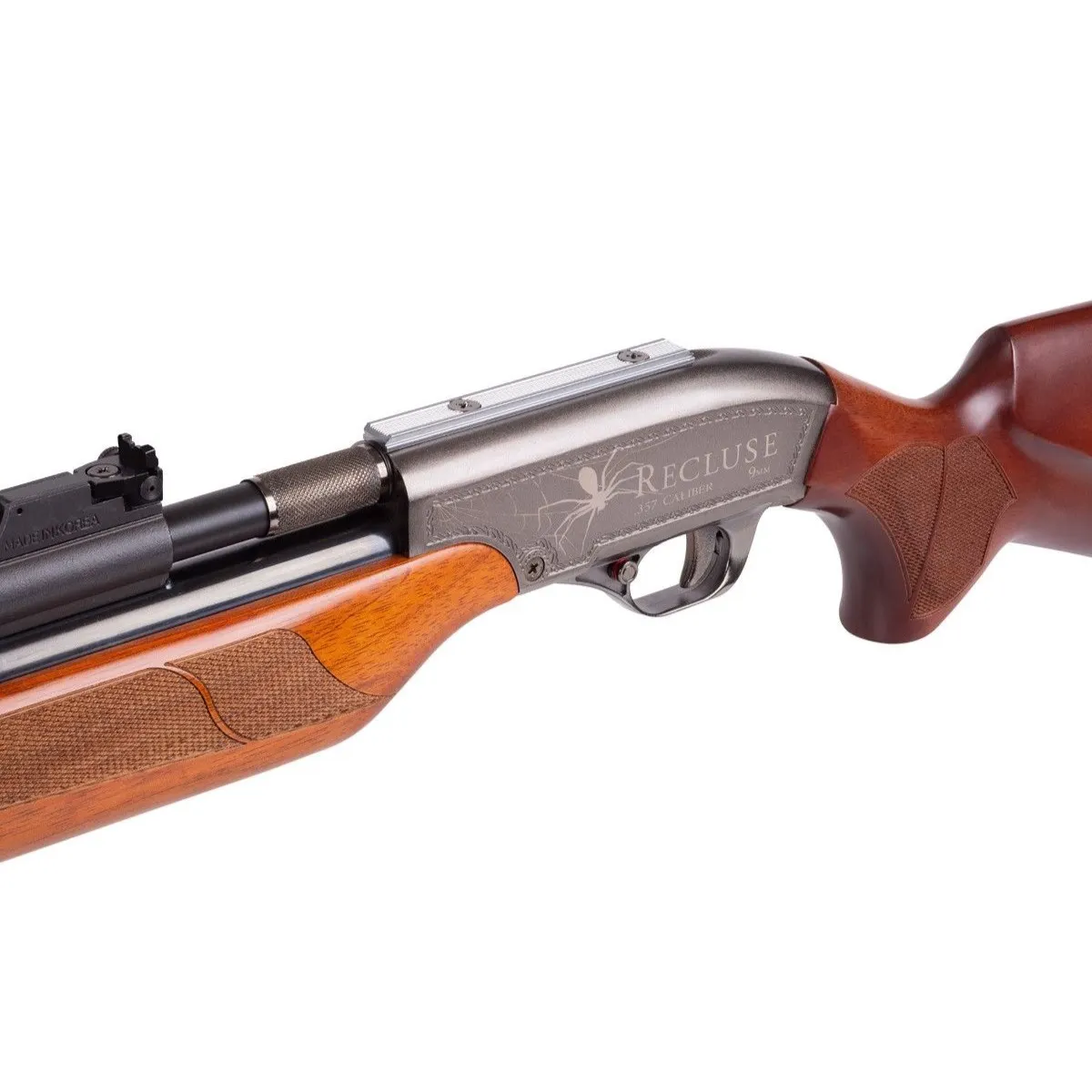
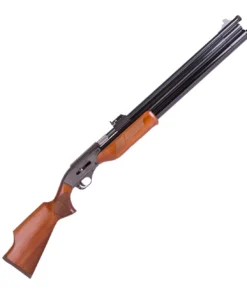
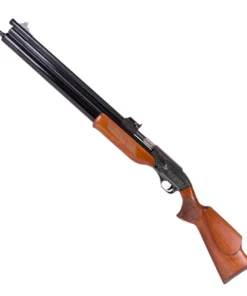
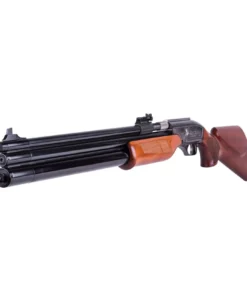
Seneca Recluse II .357 PCP Dual Tank Air Venturi
$500.00
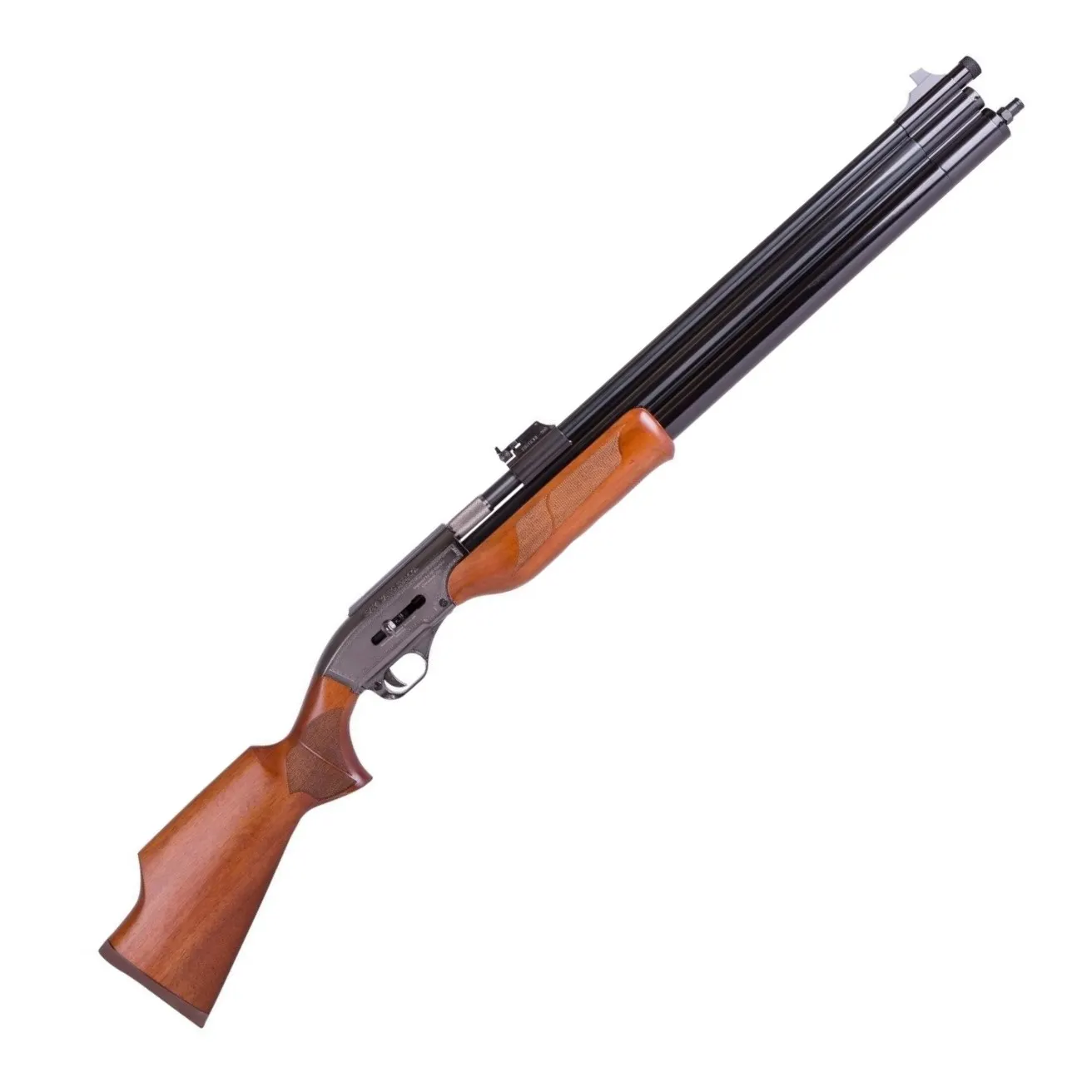
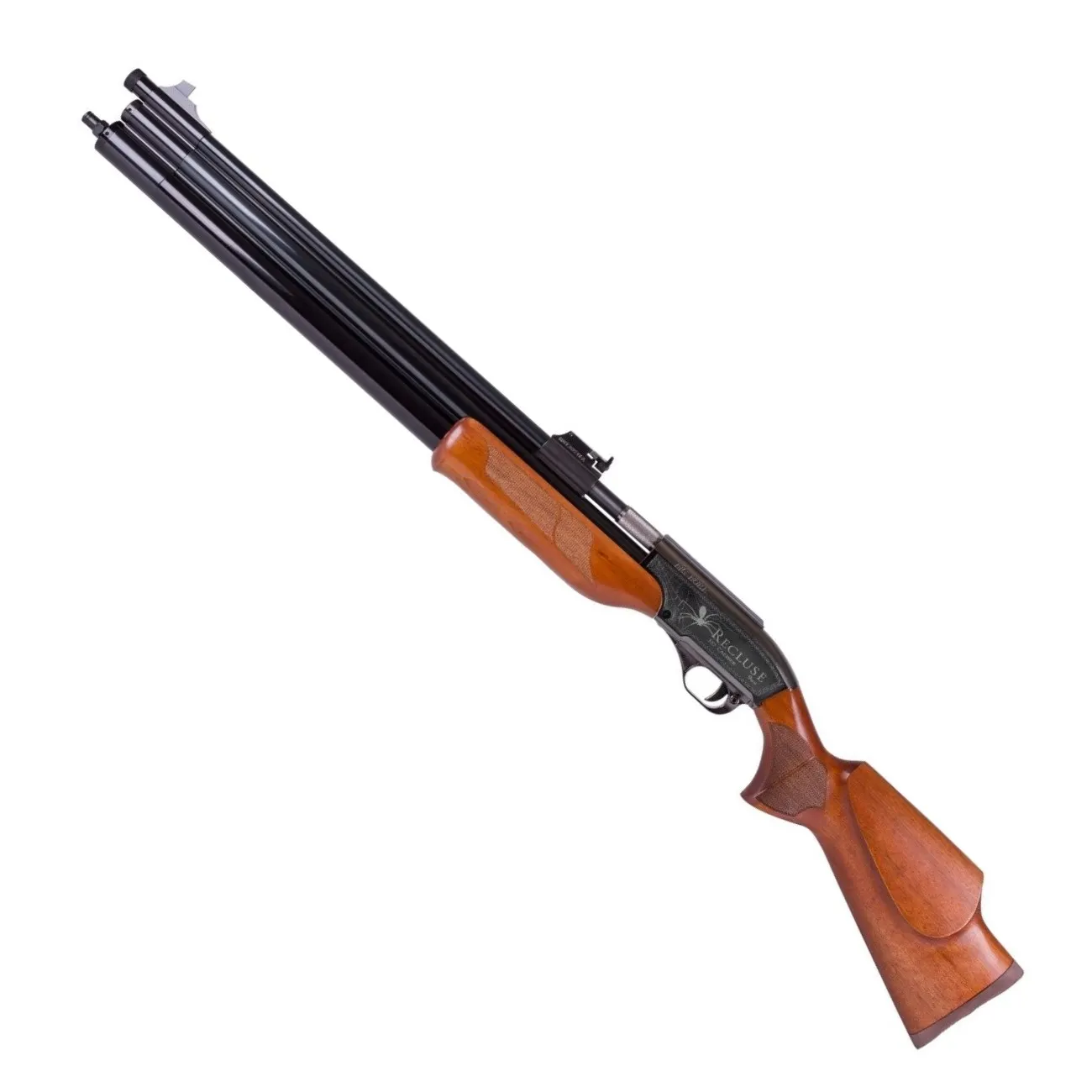
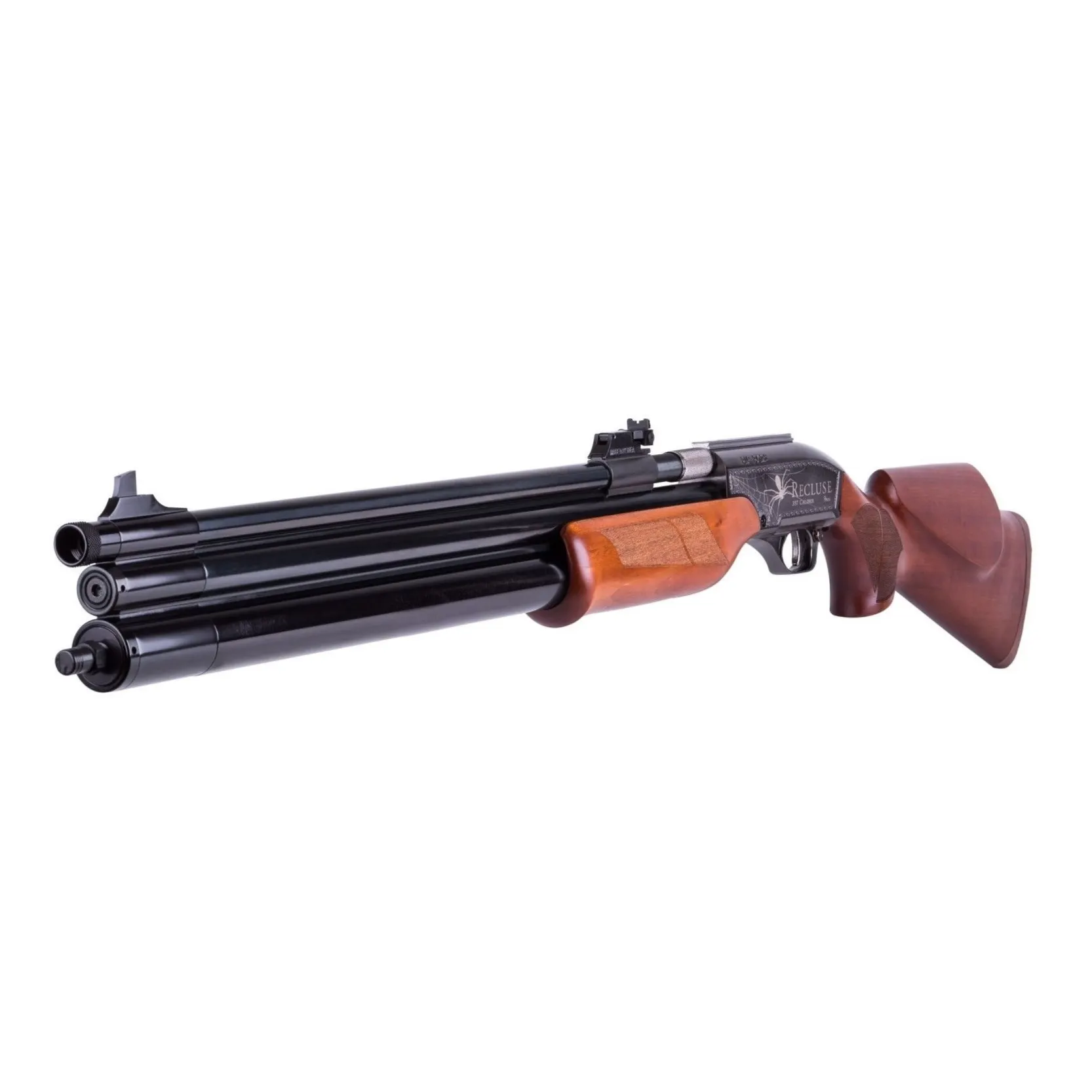
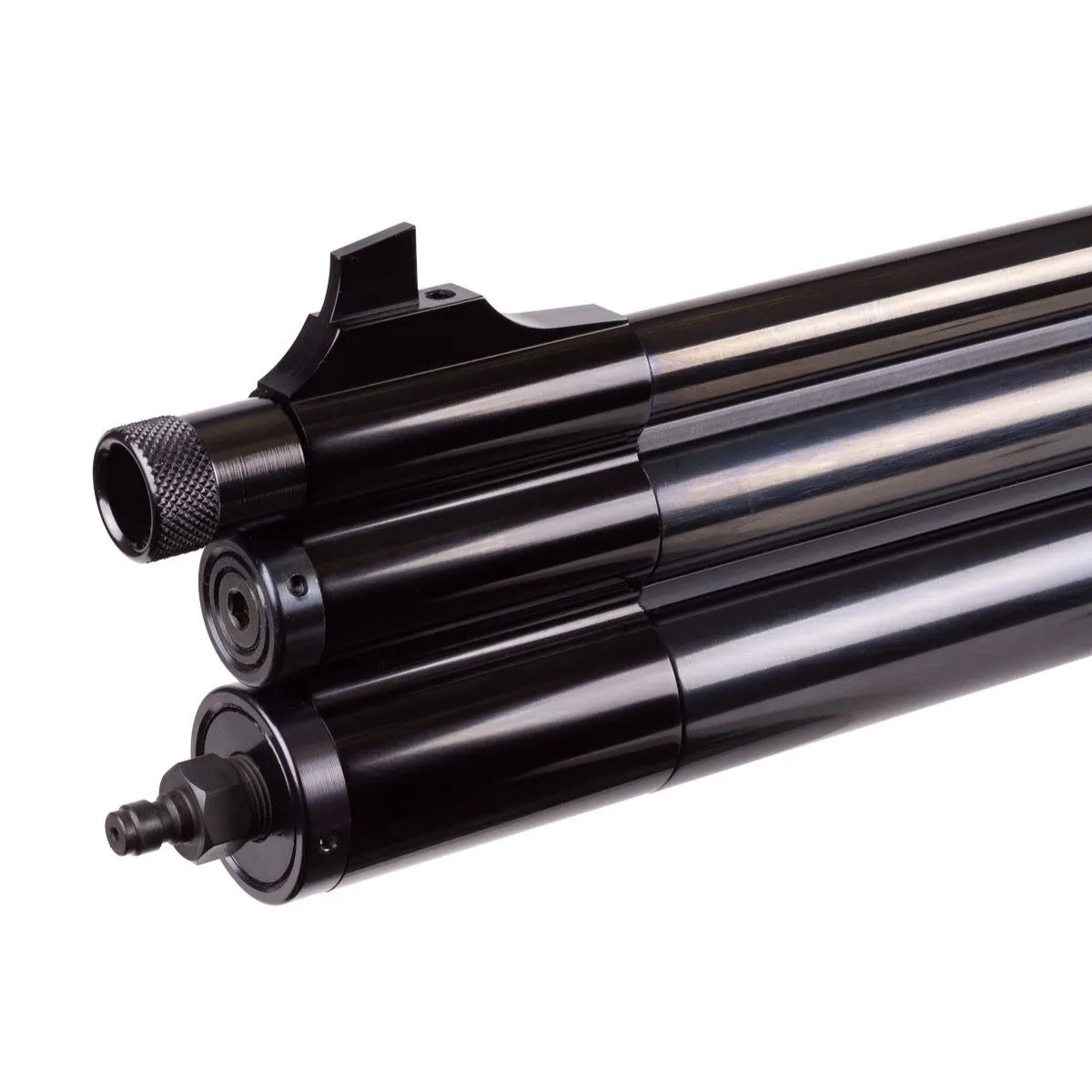
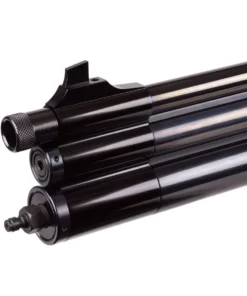
The Air Venturi Seneca Recluse II .357 is an impressive PCP air rifle that distinguishes itself through its dual 500cc air cylinders and heavy .357 caliber. This air rifle is specifically designed for recreational precision shooting at long distances, where the unique adjustable power regulation gives you complete control over every shot.
Our experience with the Seneca Recluse II .357
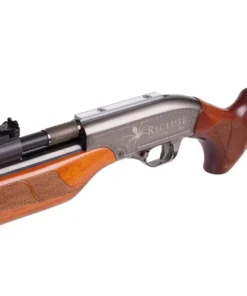
The Shogun team was immediately impressed by this air rifle. The premium wooden Monte Carlo stock with checkering feels luxurious, whilst the weight of 3.4 kilograms ensures a stable shooting experience. The bolt-action system operates particularly smoothly and the adjustable power regulation is a rare but welcome feature in this class.
Technology, performance and variants
This PCP air rifle operates with a maximum fill pressure of 207 bar (3000 PSI). The Seneca Recluse II has a length of 107 cm with a rifled steel barrel of 55 cm. The model is exclusively available in .357 caliber with a maximum power of 300 joules and a muzzle velocity of up to 890 FPS (271 MPS). The dual air cylinders deliver approximately ten full-power shots per fill. Curious about all the technical details? You’ll find them under the ‘More information’ heading on this page.
Use and operation
This air rifle feels solid and well-balanced during use. The bolt-action system offers two positions: pull the bolt halfway for the low power setting (more shots per fill) or fully rearward for maximum power. The safety catch is manual and ergonomically positioned. The 11mm dovetail rail accommodates any rifle scope, whilst the adjustable rear sight and front sight also function excellently for shooters who prefer to shoot without optics.
Who is this air rifle intended for?
The Seneca Recluse II .357 is a specialist air rifle for advanced shooters seeking maximum precision and power. With its high power output and adjustable power regulation, this air rifle is ideal for serious precision shooting at long distances. This is not an entry-level model but a top-class air rifle for the demanding shooter.
Ready to experience the Seneca Recluse II .357 for yourself?
| SKU | SY-R00040 |
|---|---|
| Weight (KG) | 3.40 |
| Color | Brown |
| Product Type | Rifles |
| Caliber | 0.36 |
| Power Source | Pre-charged pneumatic (PCP) |
| Joule (maximum) | 300.00 |
| FPS (Feet per Second) | 890 |
| M/S (Meters per Second) | 270 |
| Firing Mode | Single shot |
| Trigger System | Single Action |
| Material | Wood/Metal |
| Stock Material | Wood |
| Length (cm) | 107.00 |
| Barrel Length (mm) | 550.00 |
| Top rail type | 11mm Dovetail |
| Mounting Rail Type | Dovetail |
| Left or Right Handed | Right-handed |
| Volume (Liters) | 0.50 |
| Maximum fill pressure | 207 bar / 3000 PSI |
| Adjustable | Adjustable front and rear sights |
| Brand | Air Venturi |
Seneca Recluse II .357 PCP Dual-Tank Air Rifle by Air Venturi: Big-Bore Power, Practical Accuracy, and Hunting Capability
Seneca Recluse II .357 PCP Performance, Precision and Buyer Overview
Why Choose the Seneca Recluse II .357 PCP?
The main reason to choose the Recluse II is its combination of substantial projectile energy, controlled single-shot operation, and extended dual-tank capacity. Unlike a lightweight Air Venturi Alpha, Air Venturi Alpha PCP Rifle, or entry-oriented Air Venturi Alpha Air Rifle, the Recluse II belongs to the big-bore hunting category. Therefore, buyers comparing an Air Venturi Alpha Hunting Rifle, Air Venturi Alpha Tactical PCP, or Air Venturi Alpha Precision Air Rifle should understand that the Recluse II serves a more specialized purpose.
Moreover, this rifle is not an Air Venturi Alpha Regulated PCP or Air Venturi Alpha Multi Shot Rifle. The Recluse II is unregulated and single-shot, which means each projectile must be loaded individually and velocity may gradually change as reservoir pressure drops. However, the direct-loading format encourages deliberate shot placement, careful projectile selection, and disciplined hunting practice.
How Does the Dual-Tank PCP System Work?
Compressed air is stored inside two connected reservoirs with a combined capacity of 500cc. The rifle is filled to a maximum operating pressure of 3,000 PSI, or approximately 206 BAR, through a quick-disconnect Foster fitting. A built-in manometer allows reservoir pressure to be monitored, although users should also rely on the accurate gauge fitted to their charging equipment Seneca Recluse II.357 PCP Dual Tank.
Because this is a high-pressure air venturi PCP platform, it should be filled with suitable equipment such as an air venturi compressor, air venturi air compressor, air venturi pcp compressor, compatible air venturi tank, or certified air venturi air tank. Portable equipment such as the air venturi rovair 4500 portable compressor or air venturi rovair may appeal to users who need independent filling capability. Meanwhile, searches for ventur air compressor, air rifle compressor, venturi air, and airventuri commonly reflect the same need: supplying clean, dry, correctly pressurized air to modern pcp airguns and pcp air rifles.
How Good Is the Power and Precision?
The rifled steel barrel measures approximately 21.65 inches, while the rifle includes two selectable power positions. The first bolt stop provides lower power, whereas the second provides maximum power. Consequently, the shooter can conserve air during practice or select greater energy when the intended application and applicable law require it. The manufacturer lists up to 890 FPS and 220 FPE with a 126-grain slug, although actual performance depends on projectile weight, fit, reservoir pressure, temperature, and rifle condition.
Precision is supported by the rifled barrel, stable 8.5-pound platform, checkered hardwood stock, raised right-handed cheekpiece, and 11mm dovetail optics rail. Nevertheless, accuracy must be developed through projectile testing rather than assumed from velocity alone. Different .357 slugs can produce different group sizes, so the rifle should be zeroed with the exact ammunition that will be used.
Where and When Should the Recluse II Be Used?
The Recluse II is intended for lawful outdoor hunting, controlled range practice, and big-bore airgun training. It should be used only where local regulations, safe backstops, noise restrictions, and minimum hunting-energy requirements permit. Because its loudness is manufacturer-rated as high, it is not ideal for small indoor ranges, suburban gardens, or noise-sensitive environments.
Before use, the owner should verify local airgun classifications, hunting seasons, caliber restrictions, projectile requirements, and permitted quarry. Eye protection should always be worn, and the rifle should be treated with the same discipline applied to any powerful projectile-launching platform.
Important Comparison Information for Air Venturi Buyers
Customers researching the Recluse II may also encounter the air venturi avenger, air venturi avenger 25, air venturi avenge, and misspelled searches such as air ventur avenge. Those rifles generally address different buyer priorities and should not be confused with the .357 Recluse II. Similarly, avenger price searches usually concern a different product family.
The compact air venturi microstrike belongs to the air rifle and air pistol market, while the air venturi omnistorm represents another distinct Air Venturi platform. In contrast, the Recluse II is a full-sized Seneca big-bore rifle designed around heavy .357 projectiles.
Likewise, the dragon claw, seneca dragon claw, 50 caliber dragon, and claw air gun terms refer to the larger .50-caliber Seneca Dragon Claw line rather than the .357 Recluse. The Dragon Claw II is rated in a separate caliber and power category, so buyers should compare ammunition availability, intended quarry, recoil characteristics, air consumption, and legal requirements before choosing between these seneca air rifles.
Can the Recluse II Use Air Bolts?
The platform can be used as an air bolt gun with compatible .35-caliber Seneca Air Bolts and the correct manufacturer-approved setup. Published product information lists performance of up to approximately 210 FPE and more than 500 FPS with Seneca Air Bolts. Because air-bolt use introduces specialized loading, trajectory, maintenance, and safety considerations, only compatible projectiles should be used, and the manufacturer’s instructions must be followed carefully.
Why Precision and Proper Filling Are Important
High energy is valuable only when it is supported by repeatable accuracy, correct pressure management, and responsible shot selection. Therefore, owners should track fill pressure, test projectile consistency, inspect seals, clean the barrel appropriately, and confirm the zero before field use. A dependable compressor or certified charging tank is not merely an accessory; it is a central part of maintaining consistent PCP performance.
Ultimately, the Seneca Recluse II gives experienced shooters a powerful, traditional-looking alternative within the Air Venturi and Seneca lineup. Its 500cc dual-reservoir system, two power levels, hardwood stock, .357 rifled barrel, and big-bore energy make it especially compelling for buyers who value controlled precision, substantial power, and authentic PCP engineering.
Engineering Excellence, Practical Performance, and Real-World Shooting Experience
Designed for Serious Big-Bore Performance
Every aspect of this rifle has been engineered to provide dependable performance in demanding shooting conditions. Rather than focusing solely on high velocity, the design emphasizes controlled energy delivery, consistent operation, and dependable shot placement. As a result, experienced shooters can confidently approach a variety of outdoor applications while maintaining precision and reliability.
Furthermore, the rifle balances power with usability. The substantial air capacity allows extended shooting sessions before refilling becomes necessary, while the robust construction inspires confidence during repeated field use. Consequently, users spend more time shooting and less time managing equipment.
Built Around Proven PCP Engineering
Pre-charged pneumatic technology has become one of the most respected power systems in modern airgun design because it delivers clean, smooth, and highly repeatable shooting characteristics. Instead of relying on spring-driven mechanisms, compressed air provides the propulsion needed for every shot.
This operating principle offers several practical advantages. Recoil remains minimal, vibration is significantly reduced, and follow-through becomes much easier to maintain. Therefore, shooters often achieve tighter shot groups after developing familiarity with the rifle.
In addition, the firing cycle feels exceptionally smooth. Since excessive mechanical movement is absent during discharge, the shooter can remain focused on maintaining proper sight alignment and trigger control throughout the entire firing sequence.
Consistency That Builds Confidence
Consistent performance plays a major role in long-range accuracy. Even a powerful rifle cannot produce dependable results if every shot behaves differently. Fortunately, proper filling procedures, quality projectiles, and routine maintenance contribute to repeatable performance over extended shooting sessions.
Likewise, maintaining stable shooting habits improves overall consistency. Proper breathing, controlled trigger movement, and steady follow-through work together to reduce unnecessary shooter input. Consequently, confidence naturally increases as experience grows.
Exceptional Barrel Performance
A precision-rifled barrel represents one of the most important components in any accurate air rifle. Internal rifling stabilizes each projectile as it travels toward the target, helping maintain a predictable flight path throughout its trajectory.
Moreover, barrel quality influences accuracy far more than raw velocity alone. A well-machined barrel combined with correctly matched ammunition frequently produces superior results compared with higher velocities using unsuitable projectiles.
Regular barrel inspection also helps maintain peak performance. Although excessive cleaning is unnecessary, removing accumulated lead residue at appropriate intervals supports consistent accuracy over time.
Smooth Bolt Operation
The bolt mechanism has been designed to provide positive loading while maintaining dependable chamber alignment. Every cycle feels deliberate, allowing the shooter to verify that each projectile has been seated correctly before firing.
Additionally, the loading process encourages careful shooting habits. Since every shot requires individual preparation, users naturally become more attentive to target identification, environmental conditions, and safe firearm handling practices.
Comfortable Handling During Extended Sessions
Comfort becomes increasingly important during long shooting days. An ergonomic stock design allows the rifle to rest naturally against the shoulder while providing excellent cheek support for optical alignment.
Equally important, balanced weight distribution reduces unnecessary fatigue. Instead of feeling excessively front-heavy or rear-heavy, the rifle remains stable throughout different shooting positions. Consequently, offhand shooting becomes more manageable, while supported positions feel exceptionally steady.
Trigger Control and Practical Accuracy
Trigger quality directly affects practical precision. A predictable trigger allows the shooter to release each shot without disturbing the sight picture, ultimately improving shot placement.
Rather than pulling aggressively, experienced marksmen apply slow, continuous pressure until the trigger breaks naturally. This technique minimizes movement while preserving proper alignment between the optic and the intended point of impact.
Practice remains the greatest contributor to accuracy. Even premium equipment performs best when paired with disciplined shooting fundamentals.
Air Management Matters
Efficient air management extends both shooting time and overall system longevity. Filling within recommended operating limits, monitoring reservoir pressure, and avoiding unnecessary overfilling all contribute to dependable operation.
Likewise, allowing equipment to cool after extended filling sessions promotes long-term reliability. Moisture control also remains essential because clean, dry compressed air helps protect internal seals and precision-machined components.
Routine inspections identify minor issues before they become costly repairs. Therefore, preventive maintenance should always remain part of responsible ownership.
Built for Demanding Outdoor Conditions
Outdoor environments constantly introduce variables that challenge accuracy. Wind, temperature, humidity, elevation, and lighting conditions all influence projectile flight.
Fortunately, careful preparation minimizes these effects. Shooters who regularly verify their zero, evaluate wind direction, and understand projectile trajectory typically achieve significantly better field results.
Weather-resistant exterior finishes also help protect the rifle during normal outdoor use. Nevertheless, drying the rifle after exposure to rain or excessive humidity remains good practice.
Why Proper Optic Setup Is Essential
A quality optic allows shooters to fully appreciate the rifle’s accuracy potential. However, proper mounting and zeroing remain equally important.
Mounts should be securely tightened according to manufacturer torque recommendations, while the optic should be positioned to provide comfortable eye relief from natural shooting positions.
Once installed, shooters should confirm zero at realistic engagement distances rather than relying solely on short-range testing.
Real-World Hunting Performance
Field performance depends on far more than advertised specifications. Ethical hunting requires accurate shot placement, appropriate projectile selection, and complete understanding of the intended quarry.
Responsible hunters carefully evaluate distance, shooting angle, wind conditions, and available backstops before taking any shot. If ideal conditions are absent, waiting for a better opportunity remains the responsible decision.
This disciplined approach improves success while supporting humane harvesting practices.
Reliability Through Routine Maintenance
Long-term reliability develops through consistent care rather than occasional repairs. After every shooting session, external metal surfaces should be wiped clean to remove fingerprints and moisture.
Storage should always occur in a cool, dry location where excessive humidity cannot damage metal components or wooden furniture.
Periodic inspection of seals, fasteners, optics, and mounting hardware further ensures dependable performance over many years of ownership.
A Rifle Designed for Long-Term Ownership
High-quality engineering becomes increasingly valuable over years of regular use. Durable materials, dependable mechanical operation, and thoughtful design all contribute to lasting performance that experienced shooters appreciate.
Instead of chasing unnecessary complexity, this rifle focuses on proven functionality, practical field performance, and dependable accuracy. As experience grows, owners often discover that consistency, confidence, and precision matter far more than impressive numbers alone.
Ultimately, this rifle rewards careful technique, proper maintenance, and responsible handling. Whether practicing on the range or preparing for demanding outdoor applications, it provides the stability, power, and precision serious shooters expect from a premium pre-charged pneumatic platform.
Complete Buying Guide, Ownership Benefits, Maintenance, Safety, and Long-Term Value
Understanding the Value of a Premium Big-Bore Air Rifle
Purchasing a premium big-bore air rifle represents more than simply adding another piece of equipment to a collection. Instead, it is an investment in precision engineering, dependable performance, and years of enjoyable shooting experiences. While entry-level models often satisfy casual recreational use, a high-performance platform offers significantly greater consistency, improved durability, and enhanced confidence under demanding conditions.
Moreover, experienced shooters generally appreciate equipment that continues to perform reliably after thousands of shots. High-quality machining, carefully fitted components, and robust construction all contribute to a rifle that remains dependable throughout its service life. Consequently, owners spend less time troubleshooting mechanical issues and more time enjoying productive shooting sessions.
What Makes Big-Bore Air Rifles Different?
Unlike smaller-caliber models that primarily focus on target shooting or pest control, big-bore platforms are designed to deliver substantially greater projectile energy. This additional energy provides increased penetration, greater momentum, and improved terminal performance when used responsibly within legal hunting applications.
However, greater power also requires greater responsibility. Every shot should be carefully planned, every target should be positively identified, and every shooting location should include a safe backstop capable of stopping the projectile completely.
Therefore, responsible ownership begins long before the trigger is ever pressed.
Choosing the Right Ammunition
Projectile selection has a direct influence on overall performance. Different designs, weights, and materials produce different flight characteristics, even when fired from the same rifle.
Heavier projectiles generally retain momentum more effectively, whereas lighter options may produce flatter trajectories over certain distances. Nevertheless, neither option is universally superior because performance depends upon intended use, environmental conditions, and individual barrel preferences.
Testing several quality projectiles often reveals which option produces the smallest groups. Consequently, many experienced shooters maintain detailed shooting records to document velocity, accuracy, and consistency with each ammunition type.
Developing Better Shooting Skills
Even the finest equipment cannot compensate for poor shooting technique. Fortunately, consistent practice allows every shooter to improve over time.
Proper body positioning creates a stable foundation before every shot. Likewise, maintaining a relaxed grip helps prevent unnecessary movement during trigger release. Smooth breathing further improves stability by reducing muscle tension throughout the shooting process.
Additionally, following through after every shot remains equally important. Rather than immediately lifting the head or moving the rifle, experienced shooters maintain their position until the projectile has completely exited the barrel.
Over time, these habits become automatic and contribute significantly to improved accuracy.
Environmental Factors That Affect Accuracy
Outdoor shooting conditions constantly change throughout the day. Wind direction, wind speed, humidity, elevation, temperature, and atmospheric pressure all influence projectile flight.
Crosswinds may gradually push the projectile away from the intended point of impact, while temperature changes can slightly influence air density. Therefore, experienced shooters continuously observe environmental conditions before adjusting their point of aim.
Learning to read natural indicators such as moving grass, drifting leaves, or lightweight vegetation often becomes just as valuable as mastering equipment itself.
Preparing Before Every Shooting Session
Preparation greatly increases both safety and consistency.
Before beginning any shooting session, owners should inspect the rifle for loose screws, damaged seals, visible wear, or foreign debris. The optic should also be checked to confirm that all mounting hardware remains secure.
Likewise, the air reservoir should contain sufficient pressure for the planned shooting session. Starting with inadequate pressure often produces inconsistent results that can easily be avoided through proper preparation.
Finally, confirming the zero before serious use helps eliminate unnecessary uncertainty.
Caring for the Rifle Properly
Routine maintenance protects both performance and longevity.
External metal surfaces should be wiped with a lightly oiled cloth after each shooting session to remove fingerprints and moisture. Wooden components should remain clean and dry while avoiding prolonged exposure to excessive humidity or direct sunlight.
Storage conditions also matter considerably. A cool, dry environment reduces the likelihood of corrosion while preserving seals and internal components for many years.
Furthermore, protective cases help prevent accidental impacts during transportation or long-term storage.
Extending Service Life
Equipment that receives regular maintenance typically lasts much longer than equipment that is neglected.
Periodic inspection allows small issues to be corrected before they become expensive repairs. Replacing worn seals at appropriate intervals, verifying fastener torque, and keeping internal components clean all contribute to dependable long-term operation.
Likewise, using only clean, dry compressed air minimizes moisture buildup inside the air system, helping preserve internal precision components throughout years of ownership.
Safety Should Always Come First
Every powerful air rifle deserves the same respect as any other precision projectile-launching platform.
The muzzle should always remain pointed in a safe direction. Likewise, the trigger should remain untouched until the sights are fully aligned on the intended target.
Eye protection remains essential for every shooter and observer. Hearing protection may also be beneficial depending upon shooting location and environmental conditions.
Additionally, every target should have a suitable backstop capable of safely stopping the projectile. Shooting toward hard surfaces that may cause ricochets should always be avoided.
Safe storage remains equally important. When not in use, the rifle should be unloaded, secured, and stored separately from ammunition where unauthorized access cannot occur.
Building Long-Term Confidence
Confidence develops through experience rather than equipment alone.
Each range session teaches valuable lessons about trajectory, wind compensation, holdover, trigger control, and follow-through. As familiarity increases, shot placement becomes more predictable, while overall consistency steadily improves.
Many experienced shooters maintain detailed shooting logs that record environmental conditions, projectile performance, zero adjustments, and group sizes. These records often become invaluable references for future shooting sessions.
Maximizing Overall Performance
Peak performance results from combining quality equipment with disciplined habits.
Regular practice reinforces proper fundamentals. Consistent maintenance preserves mechanical reliability. Careful ammunition testing identifies the most accurate load. Thorough preparation minimizes preventable errors before every outing.
Together, these practices allow the rifle to perform at its highest potential while providing dependable results under a wide variety of shooting conditions.
An Investment That Continues to Deliver
Quality equipment often proves its value over many years rather than during the first few range visits.
Strong construction, dependable engineering, and thoughtful design contribute to lasting ownership satisfaction. Instead of requiring frequent replacement, a well-maintained rifle continues delivering consistent performance season after season.
For dedicated enthusiasts who value precision, reliability, and responsible shooting practices, long-term ownership frequently becomes one of the most rewarding aspects of investing in premium equipment.
Ultimately, success depends upon preparation, discipline, regular practice, and proper maintenance. When these elements come together, the shooting experience becomes safer, more enjoyable, and consistently rewarding, allowing owners to fully appreciate the engineering and craftsmanship built into every component.
Advanced Performance Insights, Ownership Experience, Long-Term Reliability, and Professional Shooting Techniques
Understanding Real-World Performance Beyond Specifications
Published specifications provide an excellent starting point when evaluating a high-performance air rifle. However, numbers alone never tell the complete story. True performance is measured by consistency, reliability, ease of operation, and the confidence a shooter develops after spending significant time behind the rifle.
As experience increases, shooters begin to appreciate how every component works together. The balance of the stock, the smooth cycling of the action, the predictable trigger release, and the controlled discharge all contribute to an enjoyable shooting experience. Consequently, practical performance often becomes more valuable than impressive figures listed on a specification sheet.
Why Consistency Is More Important Than Maximum Velocity
Many first-time buyers naturally focus on velocity because it appears easy to compare. Nevertheless, experienced shooters recognize that consistency produces better results than occasional high-speed shots.
A rifle capable of delivering repeatable performance allows the shooter to predict projectile behavior more accurately. Therefore, maintaining stable operating pressure, selecting quality ammunition, and following proper shooting techniques generally provide greater benefits than pursuing the highest possible speed.
Furthermore, predictable performance simplifies sight adjustments, improves confidence, and reduces unnecessary guesswork during extended shooting sessions.
Building Confidence Through Practice
Skill develops gradually through repetition and observation. Every session provides an opportunity to refine shooting fundamentals while learning how environmental conditions influence accuracy.
Instead of rushing through a large number of shots, many experienced marksmen concentrate on deliberate, carefully executed shooting sequences. This approach encourages proper breathing, smooth trigger control, stable body positioning, and consistent follow-through.
Over time, these habits become instinctive pcp airguns, allowing the shooter to remain focused even under challenging outdoor conditions.
Understanding Projectile Flight
Every projectile follows a curved path from the moment it leaves the barrel. Gravity immediately begins influencing its trajectory, while wind resistance gradually slows its forward movement.
Because of these natural forces, shooters must understand how trajectory changes at different distances. Practicing at multiple ranges develops familiarity with holdover and point-of-impact adjustments, making future shots significantly more predictable.
Likewise, understanding projectile behavior builds confidence when environmental conditions become less than ideal.
Be the first to review “Seneca Recluse II .357 PCP Dual Tank Air Venturi”
Related products
Seneca Air Rifles
Seneca Air Rifles
Seneca Air Rifles
Reviews
There are no reviews yet.